Fermionic Symmetry Protected Topological Phases and Cobordisms 5
Working assumptions
The effective action can therefore be considered as a homomorphism of the set of SPT phases to R/Z'U(1). The difference of two SPT phases with the same thermal Hall conductivity is an SPT phase with no thermal Hall conductivity.
Fermionic SPT phases without any symmetry
A classification of interacting fermionic SPT phases can be derived from this in the manner just described and is shown in Table 2. We see that there are non-trivial interacting fermionic SPT phases with zero thermal Hall response in D = 0 and 1, but not in D = 2 and 3.
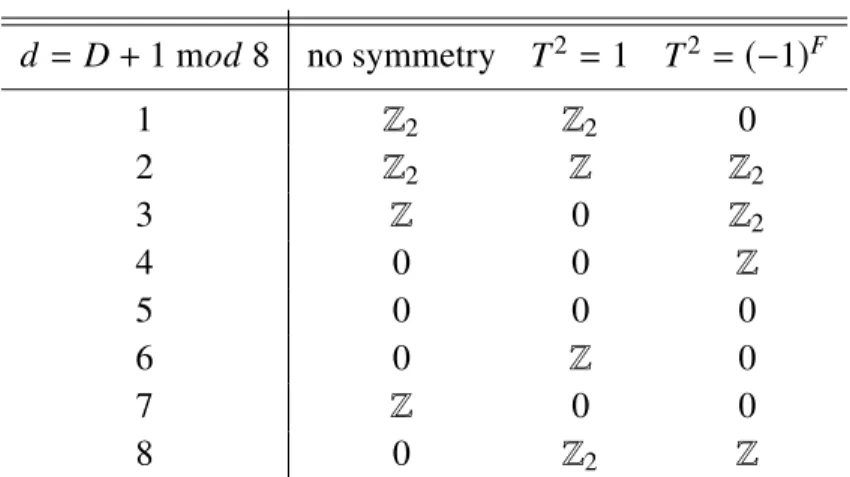
Fermionic SPT phases with time-reversal symmetry
It can be realized by a time-reversal-invariant version of the Majorana chain and is characterized by the presence of a pair of dangling Majorana zero states on the edge. Two layers of the basic phase can be constructed from the d = 2 phase with time-reversal symmetry T2=1, via the map.
Fermionic SPT phases with a unitary Z 2 symmetry
Choosing an element of the Pin−cobordism group gives us a d−1-dimensional fermionic SPT with time-reversal symmetryT2 = 1. This circle bundle is the unit circle bundle of the orientation line plus a trivial line, and is therefore oriented.
Fermionic SPT phases with a general symmetry
This is the same redefinition used in (C. Wang and Senthil, 2014) to show that the classifications T2 = 1 and T2 = (−1)F agree, a result verified here in cobordism. The ring H∗(BO(2),Z2) is generated by the universal Stiefel-Whitney classes rw1andw2, and w2(ξ) is the universalw2.
Decorated Domain Walls
In each decorated image of the domain wall, the degrees of freedom bound to the wall are defined in the broken symmetry regime where the domain wall is infinitely strained. This means that the symmetry properties of G on the domain wall correspond to the fermionic bilinear representation ξ ⊕σ.
Concluding remarks
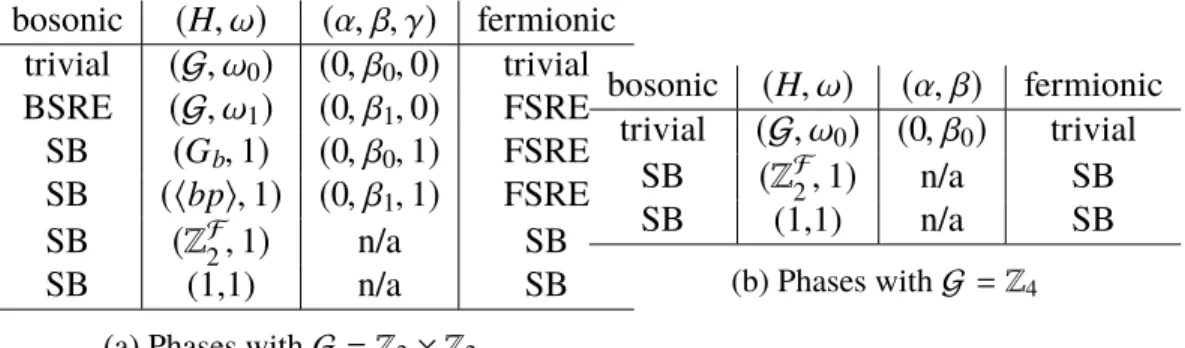
The product of the Koszul signσ0(β) and the spin-dependent factor (−1)s(β) is nothing but the quadratic function σs(β) (Gaiotto and Kapustin, 2016). More generally, elements of the form (α, β,0) correspond to fermionic SRE phases that remain reversible after bosonization, while the bosonic duals of the fermionic SREs(α, β,1) are not SREs (they spontaneously ' n brokenZ2but unbrokenGb).
Equivariant Topological Quantum Field Theory and Symmetry
Oriented equivariant TQFT
When studying oriented D= 2 TQFTs, one usually assumes that the space of local operators (i.e., the vector space attached to S2) is one-dimensional, and thus the algebra of local operators is isomorphic toC. Indeed, it is easy to show that if the TQFT is unitarizable (i.e., the bilinear inner product arises from a Hermitian inner product and an antilinear CPT symmetry), the algebra of local operators is semisimple.
Unoriented equivariant D = 0 TQFT
Unoriented equivariant D = 1 TQFT
We can therefore conclude that the invariant (−1)γ is revealed as the fermion parity (p-charge) of the Rsector state. Using the equivalence of multiplication and (anti-)unity of R(g) with respect to the inner product in Hilbert space, it can be shown that ∗commutes withR(g) for allg ∈ G.

Topological Field Theory, Matrix Product States, and the Stacking
Matrix Product States at RG Fixed Points
Although we will always assume that it is injective, we will not assume that the ground state of the parent Hamiltonian is unique. The statement that X commutes with T in the ground state of the parent Hamiltonian is the statement that X is an endomorphism of the module V .

Topological Quantum Field Theory
We can think of the number ZT(Σ) calculated by the state sum as a matrix element of a linear map. Let us now choose a triangulation of the annulus, so that the cutting boundary is divided into N intervals.
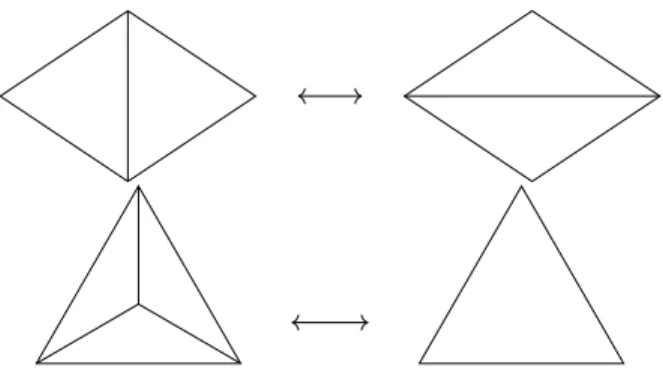
Equivariant TQFT and Equivariant MPS
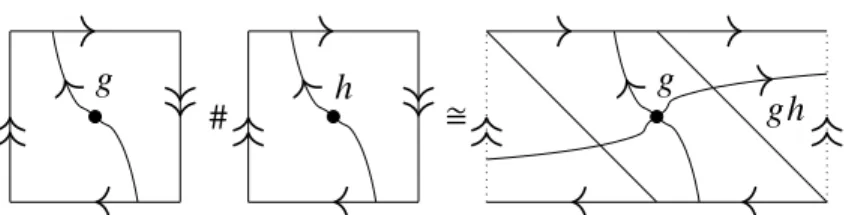
R(g)f)(g0)= f(g0g) (3.35) Pointwise multiplication turns this space of functions into an associative algebra, and it is clear that the G action commutes with the multiplication. It is easy to check that the correct G translations are acting on this space of functions. We also assume that the holonomy of the measurement field between the points labeled 1 on the two boundary circles is trivial.
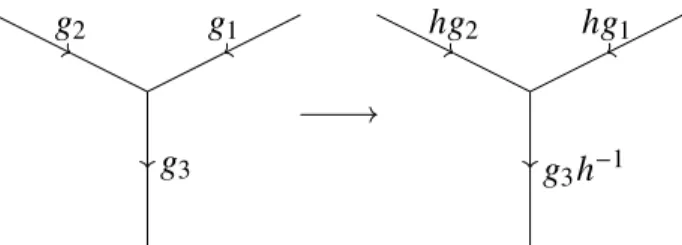
Spin-TQFTs
This identification depends on the choice of a cyclic order of the set of boundary circles of Σ. There is also an identification of the set of spin structures on (Σ, ∂0Σ) and the set of spin structures on Σ∗ (Segal, 2004). The sign is calculated as before as a product of the spin structure dependent sign and the Koszul sign.
Fermionic MPS
The second one corresponds to the equator of the cylinder and comes with the sign σ(β2) := η, which is +1 in the NS sector and −1 in the R sector. A consequence of supercommutativity and (3.72) is that there are no strange ground conditions in the NS sector. One can indeed easily see that a phase that is reversible must correspond to an indecomposable algebra (i.e. the algebra that cannot be decomposed into a sum of algebras).
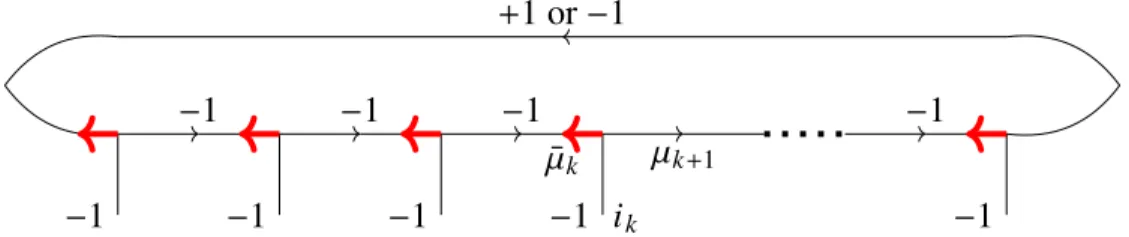
Hamiltonians for fermionic SRE phases
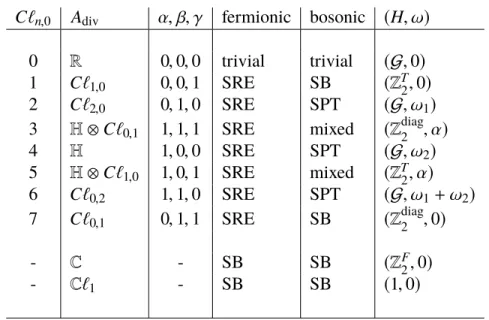
In the next section we will show explicitly that Cl(1) corresponds to the non-trivial Majorana chain. In the NS sector there is a unique ground state which is bosonic, while in the R sector there is a unique ground state which is fermionic (this is most easily seen from continuum field theory). In summary, the ground states of the A = Cl(1) MPS system are a bosonic in the NS sector and a fermionic in the R sector, just like the ground states of the non-trivial Majorana chain.
Equivariant spin-TQFT and equivariant fermionic MPS
It also does not depend on the choice of trivialization of the main bundle; in other words, it is gauge invariant. It is easy to see that the partition function factorizes into a product of the partition function corresponding to End(U) and the partition function corresponding to Cl(1). 3.132) Thus is the partition function of the fermionic SRE with the parameters (α, β,1). 3.133) Tensoring with another copy of Cl(1) multiplies this by another factor Ar f(s), so that the partition function of the fermionic SRE with the parameters (α, β,0) is.
Fermionic MPS
In terms of states, the h-charge of a g-twisted sector is the same as the g-1-charge of an h-twisted sector as long as asg and h commute. We now discuss the meaning of the invariants α, β and γ in the anti-unitary context, following the previous analysis. Finally, γ is the fermion parity of the untwisted Ramond sector, as in the unitary case.

The fermionic stacking law
Note that these data are not gauge invariant, and their equivalence classes under displacement ω from a twisted colimiter do not take a simple form. Kapustin, Turzillo and Ti, 2018), we would have gotten β1∪xin instead of β1∪β1 in the final answer. 30 Note that while β1 ∪β1 is an ordinary colimit and can therefore be ignored for non-time-reversal phases, it is not a twisted colimit and thus cannot be ignored when time-reversal symmetries are present. When G does not divide, γ is not present, and the aggregation law is simple. 31 Again, if we had chosen a different action Gb onC1|1 compatible with actioningb : Γi 7→. 1)βi(gb)Γi in C`(1) factors, the 2-cocycle α would be displaced by a twisted colimit.
Examples
The requirement that the invariant be independent of the discretization imposes structure on the weights. A schematic representation of the supertensor product of superalgebras AandB. The real Clifford algebra A = C`p,qR is generated by anti-commuting elements γ1,. It is clear that any value of the parameter γ ∈ H1(G,Z2) can be realized by free fermionic systems.
Diagrammatic State Sums for 2D Pin-Minus TQFTs
Pin Geometry in Two Dimensions
A pin± structure on a non-oriented manifold is a main pin±(n) bundle with a dual cover of the orthogonal frame bundle. The ABK invariant determines the pinbordism class of the pin surface and thus defines an isomorphismΩpin2 (pt)−→∼ Z/8. Each of the two pin structures on the circle is related to a class of recessed circles in the plane, shown in Figure 4.2.

Ribbon Diagrams and Half Twist Algebras
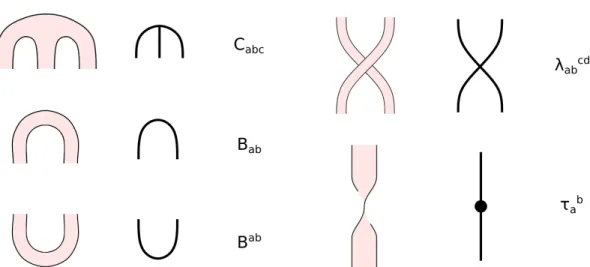
We emphasize that at each value of the parameter the boundaries S0,S1 are attached to the planes R20,R21. In addition to the image of the projection, the helicities of the half-turns (right- or left-handed) are recorded. Regular homotopy has been used to push the legs of the cylindrical band diagrams.
Real Superalgebras and the Arf-Brown-Kervaire TQFT
The choice of has to do with the decomposability of the state sum and is discussed in Section 4.3. In terms of spin structures, there are two different such limits on S1R. The second is related in composition to a cylinder. Let us make a few remarks about the surjectivity of the map from free to interacting SRE phases in the 2d case.

Free and Interacting SRE Phases of Fermions: Beyond the Ten-
Free fermionic systems with a unitary symmetry
Thus, a block of type C can be represented as describing dim q = 12dim r copies of a system of class A. Thus, a block of type H can be considered as describing dim q= 12dim r copies of a system of class C. If ˆG is finite, then the number of allowed irreducible representations is finite and " vector" has a finite length.
Interacting invariants of band Hamiltonians
Let's calculate the change in the ground state charge due to a reflection from the first coordinate axis. 2πi%αlog detrα(g)ˆ (5.29) can be interpreted as the weighted sum of the 1st Stiefel-Whitney classes of the representationsrα (see Appendix D.2 for an explanation of this terminology). Formally, a change of variables β 7 → β + γ ∪γ is indeed an automorphism of the group of fermionic SRE phases in 2d.
Proof of Proposition 1
The classification of surfaces tells us that this is homeomorphic to a disjoint union of cylinders and one of five possibilities: a cap, a pair of trousers, their associated parts and a twice-pierced real projective plane. A G-beam across the trousers, based and downplayed at the critical point, is almost determined by the holonomies k and l around the trouser legs. This situation only occurs when a pair of trousers and an accompanying cap are deformed into a cylinder.
Proof of Proposition 2
We show that the data in figure f define consistent invertible unoriented equivariant TQFTs. We have defined the components of a twisted cocycle where one argument is in G0 and the other is not. It is still necessary to show that a satisfies the cocycle condition for all possible combinations of arguments; in particular we need to show (k,l,mT),(kT,l,m),(k,lT,m), (k,lT,mT),(kT,l,mT), (kT, lT,m ) and (kT,lT,mT) conditions.
Diagrams for the ground states
Necessity of supercommutativity
Appendix: Description of ω in terms of pairs (α, β)
Derivation of the group law for fermionic SRE phases
It is easy to check whether the card preserves both the product and the sort, and the reverse is the case. There is no canonical choice for the projective Gb action on C2 that induces the action (C.11) on Cl(2) 'End(C2).
Relations between bosonic and fermionic invariants
Appendix: Pin groups
Appendix: Characteristic classes of representations of finite groups . 198