Introduction
Scope and Purpose of the Study
The study also reviews, at a less detailed level, ecosystems in Indonesia, Malaysia and Thailand and thus provides a comparison with Singapore. The study distills the success factors that underpin Singapore's ecosystem and provides recommendations for other countries.
Methodology
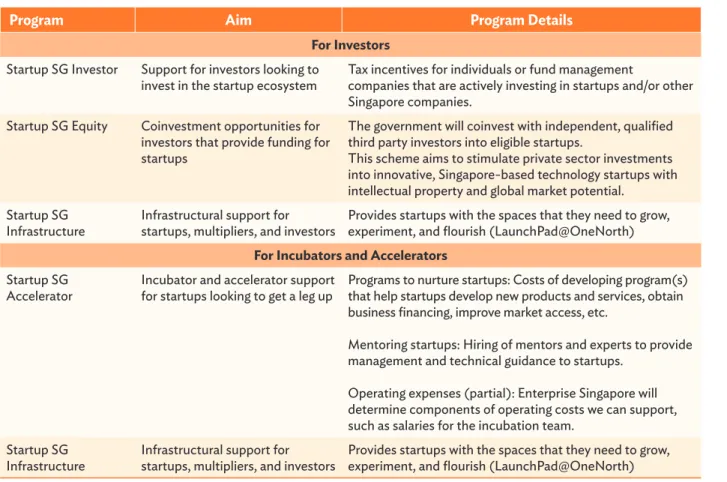
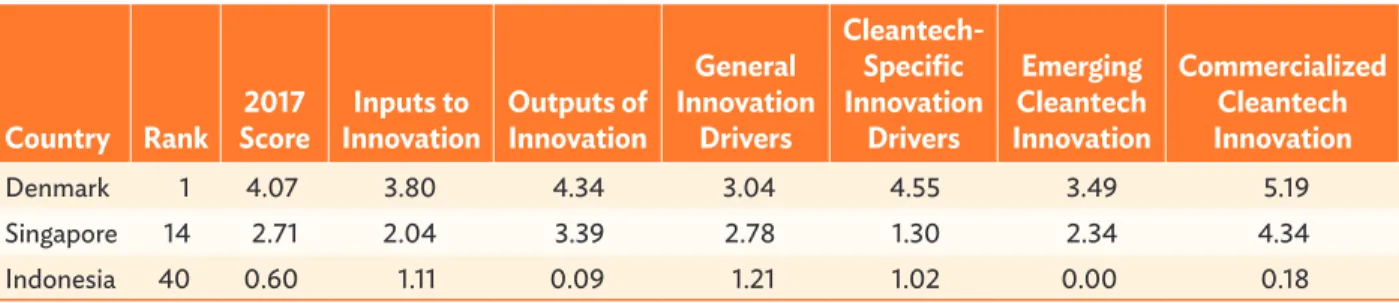
Singapore ranked high in two recent surveys—the 2020 Bloomberg Innovation Index (third) based on factors such as R&D spending, manufacturing capacity and concentration of high-tech companies, and the Global Innovation Index (eighth). In 2020, Crunchbase estimated the presence of 284 startup investors, including venture capitalists (VCs), micro-VCs, private equity firms, accelerators, and family investment offices.2 The government estimates the number of startup investors at 476, along with 143 incubators and accelerators. .3.
Singapore’s Startup Ecosystem
Performance of Singapore’s Startup Ecosystem
In a recent assessment, its ecosystem was ranked 17th in the world and fourth in Asia, behind Beijing, Shanghai and Tokyo. Jakarta was second on a list of emerging ecosystems, but was not in the top 100 ecosystems overall (Startup Genome and GEN 2020).
Factors Contributing to the Performance of Singapore’s Startup Ecosystem
The ICT master plan includes initiatives such as improving infrastructure, increasing connectivity in schools and "edumall 2.0". The latter is an integrated portal of global learning resources and approaches that teachers can access to plan their lessons (GuideMeSingapore n.d.). In 2020, only 11 agritech startups could be counted in Thailand.32 In February 2020, the research arm of Siam Commercial Bank made the following comment: “Obstacles to agritech adoption among small family farmers are lack of capital readiness and small agricultural fields. , making investments unprofitable.
Ecosystem for Selected Sectors
Agritech
As of 2020, Tracxn identified 2,985 companies in the global agritech space, of which 919 were funded.7 One-third of the total funding of $6.3 billion was invested in the previous 24 months, suggesting an acceleration. ESG, under the Ministry of Trade and Industry, is the main agent supporting Singapore's food security strategy by encouraging investment in the sector. Private funds in the agritech space include funding from Big Idea Ventures (with Tyson and Foods and Temasek as investors) and GROW, a Singapore-based accelerator promoted by AgFunder, a global organization, and its co-investors.
In May 2020, GROW launched a 12-week program, the Singapore Food Bowl, to build more resilient and decentralized agri-food systems in the wake of the coronavirus (COVID-19) pandemic (Cordon 2020a). In response to the COVID-19 pandemic, the government announced two initiatives in the sector in 2020. The Asia-Pacific Agri-Food Innovation Summit was held virtually in November 2020 in partnership with Temasek and brought together all the key players.9 To improve information accessibility for startups, AgFunder launched the AFN Asia, which focuses on news and research on agri-food innovation and investment in the Association of Southeast Asian Nations (ASEAN) region (Dean 2019).
Greentech
The Solar Energy Research Institute of Singapore, supported by NRF and EDB and hosted by NUS, started operations in 2008. With over S$250 million in funding, the Energy Research Institute at Nanyang Technological University is one of the largest energy research institutes in Asia and supports projects on energy efficiency and renewable energy integration with a focus on solutions for megacities. As a key organization for climate change and energy efficiency, E2 Singapore offers several incentives to improve the energy efficiency of buildings.
Under the Energy Efficiency Improvement Assistance Scheme, which is funded by the National Environment Agency, grants of up to S$200,000 are awarded to companies for carrying out energy assessments and identifying areas for energy efficiency improvement. In 2019, the Energy Research Institute at Nanyang Technological University launched the EcoLabs Center of Innovation for Energy, which has supported more than 25 startups and aims to serve as a landing pad for startups coming to Singapore. The training grant scheme aims to develop local expertise and capacity in professional energy management, specifically among engineers, managers and consultants who can improve energy efficiency in their own or their clients' organisations. 14.
Edtech
In Singapore and other countries in Southeast Asia, parents place great emphasis on their children's education. The education system is among the best in the world based on student test scores. Approved by the Ministry of Education, the portal uses voice technology to help more than 400,000 students in Singapore speak Malay, Mandarin and Tamil accurately (GuideMeSingapore n.d.).
The government's emphasis on skills development and lifelong learning also increases opportunities for edtech in the corporate and adult markets. The edtech ecosystem has benefited from events such as EduTECH Asia, which is Asia's largest education conference and exhibition, held annually in Singapore. The government also acts as a matchmaker by organizing events that bring together tech startups in Singapore with investors interested in the sector (Enterprise Singapore 2019b).
Healthtech
A financially strong and progressive healthcare system is an important part of the healthtech ecosystem. More than 80 of the world's 100 largest technology companies have operations in Singapore, contributing 6.5% of Singapore's gross domestic product (GDP) by one estimate (EDB Singapore and Galen Growth Asia 2019). In 2019, Indonesia ranked 73rd in the World Bank's Ease of Doing Business index.
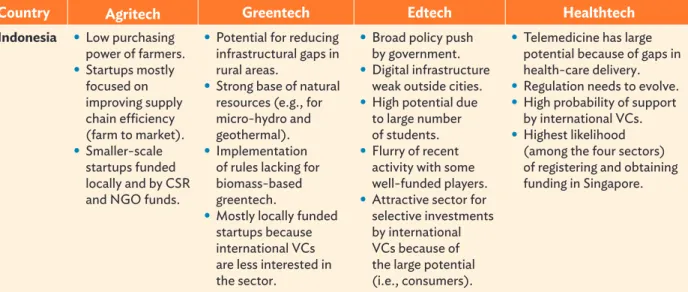
Two of the five largest edtech venture capital rounds in Southeast Asia between 2016 and 2019 were to Indonesian companies. The startup ecosystems for the four sectors have witnessed growth in terms of the number and diversity of players in the four sectors of the three Southeast Asian countries. Locally funded and focused startups that receive significant government support due to their emphasis on agriculture.
Startup Ecosystems in Indonesia, Malaysia, and Thailand
Indonesia
On the other hand, foreign investors usually participate in late-stage deals and accounted for 72% of the deal value (Google and A.T. Kearney 2017). Despite the vibrancy of the VC sector, some founders and VCs noted that funding is difficult for startups with less than $1 million in revenue, causing many startup founders to push them . According to one VC, in the past, funding for agro-technical startups mainly came from non-governmental organizations or corporate social responsibility projects due to long cycles for agro-technical projects.
One entrepreneur said his startup faced challenges in securing biomass – the supply of which would need to be high due to the large agricultural sector – from which the startup would generate energy. Both Grand Rounds for Indonesia involved primary and secondary education, reflecting the attractive nature of this sector due to its large student population (Sahui 2020). Furthermore, a lack of specialized doctors is a major barrier, especially in rural areas where 43% of the population lives (Widjaja 2019).

Malaysia
The government is helping startups through a mix of fully and jointly owned incubators, in partnership with large local companies such as Axiata and Sunway.21 Malaysia's Credit Guarantee Corporation helps entrepreneurs without a track record or experience to obtain medium-term financing of 5 to 7 years. Chong 2016). The model allows the government to tap into the experience and networks of venture capital firms and has some similarities to Singapore's TIS program. This approach differs from previous years when the government funded more than half of all investments in startups (Sukumaran 2019).
An agritech entrepreneur interviewed for the study acknowledged that the government made it easy to start a company and provided a good legal framework including patent protection. Malaysia had 106 edtech startups as of the third quarter of 2019.26 The government has been active in the development of edtech technology, especially since the outbreak of the COVID-19 pandemic. The entrepreneur also opined that the government should be quicker to bring in new regulations to keep up with the changing environment, rather than the private sector coming up with new ideas and presenting them to the government.
Thailand
Thais are avid users of social media—in 2018, there were 51 million active social media users who spent an average of 3 hours and 10 minutes per day on social media.30 Thailand's ecosystem has several accelerators, including two sponsored by agencies government (Digital Economy Promotion Agency [DEPA] and SPARK) (Yongjiranon 2018). Another entrepreneur suggested that potential customers in Thailand place too much importance on reputation, which limits startups, especially those targeting business-to-business sales. In 2019, Thailand's agriculture sector accounted for approximately 8% of GDP and employed 31% of the workforce (Statista n.db, n.dc).
Edtech is important in Thailand because a significant portion of the population lives in rural areas with weak physical infrastructure and inadequate educational resources, affecting access and quality of education. 1 million.34 A Singapore-based accelerator said Thai edtech was not far behind Singapore, although Thai edtech companies tend to focus on the domestic market. Several private hospitals are being recognized for adopting new technologies and strengthening Thailand's high global ranking in healthcare (StartUp in Thailand n.d.).

Summative Assessment
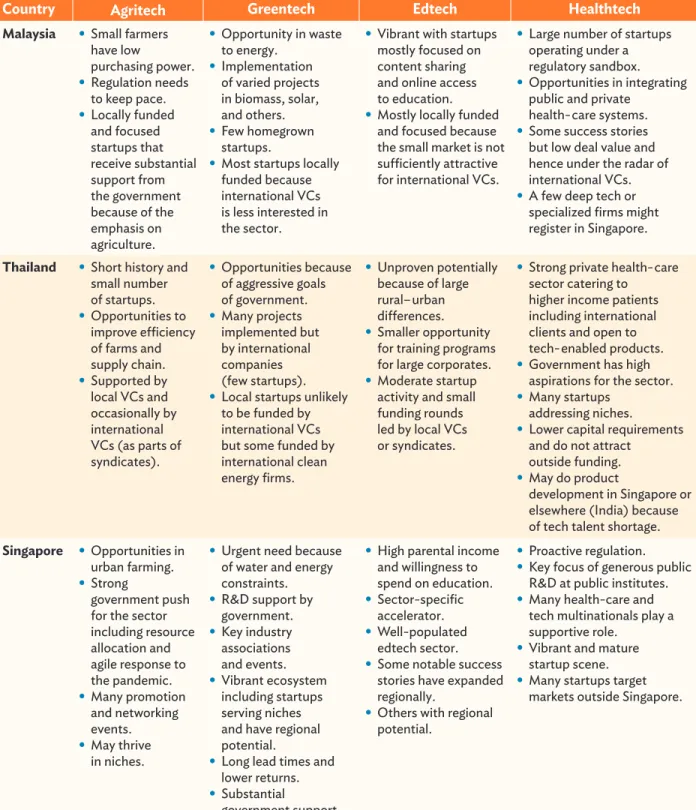
Mostly locally financed and focused because the small market is not attractive enough for international venture capital funds. Some success stories, but low deal value and therefore under the radar of international venture capital funds. Local startups are unlikely to be funded by international venture capital firms, but some are by international clean energy companies.
Southeast Asian Startups Seeking a Base in Singapore
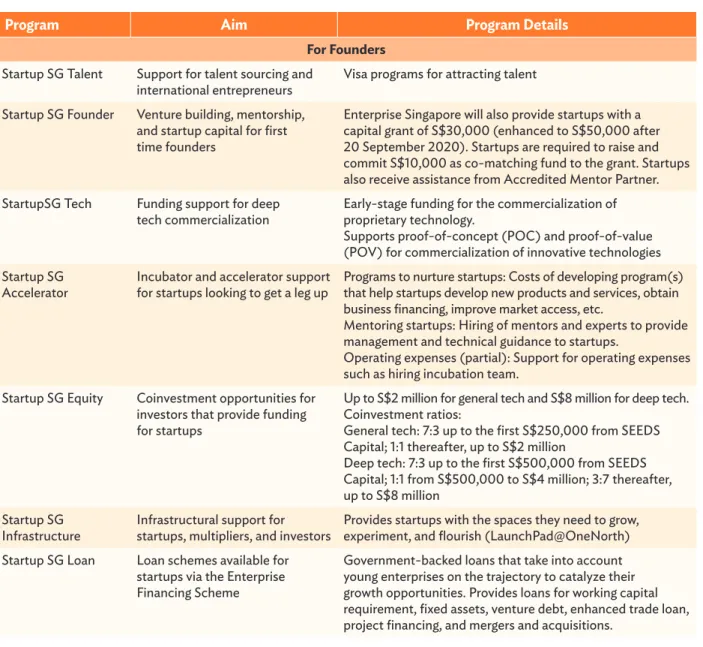
Singapore's co-investment scheme - in which the government puts money into existing private VC funds - was crucial in the early stages of the startup community's development. It helped to attract international VCs who may have been unsure about Singapore's early aspirations to become a startup hub. Singapore's clean government and openness to innovation are important demand-side elements of its startup ecosystem.
Internet connectivity is generally good in Southeast Asia's major cities, but is weaker in rural, remote areas and on islands. Singapore leads Southeast Asia in terms of the quality of its education system and the graduates it produces. Support for startups in this regard could come in the form of streamlined visa procedures for talent that cannot be secured domestically.
Thailand's focus to promote the use of technology in healthcare will have significant impact, global data says. Singapore's openness to the world will never change: Chan Chun Sing reassures foreign businesses over anti-foreigner sentiment.
Recommendations