i
KOTAGAJAH LAMPUNG TENGAH IN ACADEMIC YEAR OF 2018/2019
By:
ALVIAN NUGROHO Student Number : 14120927
TARBIYAH AND TEACHERS TRAINING FACULTY ENGLISH EDUCATION DEPARTMENT
STATE INSTITUTE FOR ISLAMIC STUDIES OF METRO 1440 H / 2019 M
ii
Presented as a Partial Fulfillment of the Requirements for the Degree of Sarjana Pendidikan (S.Pd)
in English Education Department
BY:
ALVIAN NUGROHO STUDENT NUMBER 14120927
Tarbiyah And Teachers Training Faculty English Education Department
Sponsor : Dr. Widhiya Ninsiana, M.Hum Co-Sponsor : Ahmad Subhan Roza, M.Pd
STATE INSTITUTE FOR ISLAMIC STUDIES OF METRO 1440 H / 2019 M
iii
iv
v
vi
vii ABSTRACT
By:
ALVIAN NUGROHO St.N 14120927
The aim of this research was to improve students’ listening skills of tenth grade students at MA Nurul Ulum Kotagajah in the academic year of 2018/2019 using the videos clips.
This research was classified as action research. It was conducted in two cycles with two meetings for each cycle. The main subjects of this research were 33 students of Tenth Grade at MA Nurul Ulum Kotagajah. The data obtained were qualitative and quantitative. The qualitative data were gained from the observations, interviews with both English teacher and the students, and discussions with the collaborator. The data were transformed into observations and field notes. Meanwhile, the quantitative data were gained from the listening tests that were conducted before the implementation and after the implementation in Cycle I and Cycle II.
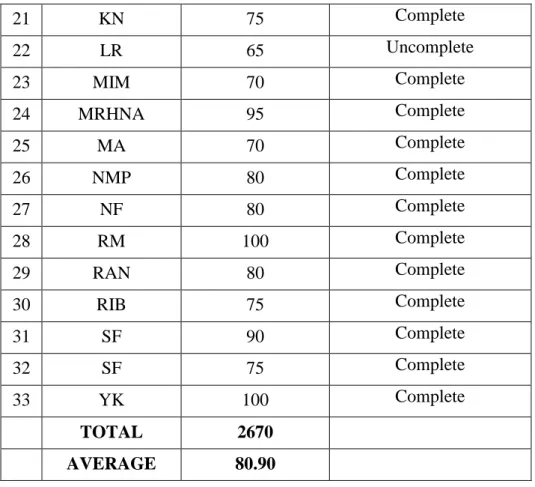
In this research, the test results showed that there was an improve from the pre-test and post-test. In the first cycle the average pre-test score was 53.18 to 64.84 post-test. From the first cycle the target lesson has not been achieved because students who have scored more than 70 are only 10 students from 33 students. This means that the target of the lesson has not been achieved because students who score more than 70 are only 10 students from 33 students. This means that those who get the score according to the criteria are only 30.3% and the target reaches 70%. In the second cycle there was an improve from the results of the post-test I 64.84 to 80.90 in the post-test II. In this cycle the target of learning has been reached 100%, because students get a score of more than 70.
The conclusion of this study is that video clips become one of the media that can help students improve their listening skills in class X MA Nurul Ulum Kotagajah.
viii ABSTRAK
Oleh:
ALVIAN NUGROHO NPM: 14120927
Tujuan dari penelitian ini adalah untuk meningkatkan keterampilan mendengarkan siswa siswi kelas sepuluh di MA Nurul Ulum Kotagajah pada tahun akademik 2018/2019 menggunakan klip video.
Penelitian ini diklasifikasikan sebagai penelitian tindakan. Itu dilakukan dalam dua siklus dengan dua pertemuan untuk setiap siklus. Subjek utama dalam penelitian ini adalah 33 siswa kelas X di MA Nurul Ulum Kotagajah. Data yang diperoleh bersifat kualitatif dan kuantitatif. Data kualitatif diperoleh dari observasi, wawancara dengan guru bahasa Inggris dan siswa, dan diskusi dengan kolaborator. Data diubah menjadi pengamatan dan catatan lapangan. Sementara itu, data kuantitatif diperoleh dari tes listening yang dilakukan sebelum implementasi dan setelah implementasi pada Siklus I dan Siklus II.
Dalam penelitian ini, hasil test menunjukkan bahwa terdapat peningkatan dari pre-test dan post-test. Dalam siklus pertama memperoleh nilai rata-rata pre- test adalah 53.18 menjadi 64.84 post-test. Dari siklus yang pertama target pelajaran belum dicapai karena siswa yang mendapatkan nilai lebih dari 70 hanya 10 siswa dari 33 siswa. Ini berarti bahwa target pelajaran belum tercapai karena siswa yang mendapatkan nilai nilai lebih dari 70 hanya 10 siswa dari 33 siswa. Ini berarti yang berhasil mendapatkan nilai sesuai kriteria hanya 30.3% dan target mencapai 70%. Di siklus yang kedua terdapat peningkatan dari hasil post-test I 64.84 menjadi 80.90 di post-test II. Dalam siklus ini target pelajaran telah dicapai itu 100%, karena peserta didik mendapatkan nilai lebih dari 70.
Kesimpulan penelitian ini adalah video clip menjadi salah satu media yang dapat membantu siswa dalam meningkatkan kemampuan mendengarkan di kelas X MA Nurul Ulum Kotagajah.
ix NPM : 14120927
Jurusan : English Education Fakultas : Tarbiyah
Menyatakan bahwa skripsi ini secara keseluruhan adalah hasil penelitian saya kecuali bagian-bagian tertentu yang dirujuk dari sumbernya dan disebutkan dalam daftar pustaka.
Metro, 21 November 2018
ALVIAN NUGROHO ST.N 14120927
x The under signed:
Name : ALVIAN NUGROHO
Student Number : 14120927
Department : English Education
Faculty : Tarbiyah
States that this undergraduate thesis is original except certain parts of it quoted from the bibliography mentioned.
Metro, 21 November 2018
ALVIAN NUGROHO ST.N 14120927
xi
Meaning: Allah SWT will exalt those who believe among you and those who are given knowledge a few degrees.
(Q.S. AL-MUJADALAH : 11)
xii
1. Almighty Allah SWT, thanks God all about the precious gift inside to me.
2. My beloved Dad Ali and Mom Sugiarti and My Beloved Brother Arief Setiawan and My Beloved Sister Aliyah Nurul Aini, thank you having nursed me with your endless love and taught me about this life. May Allah always bless you, amin ya Robb.
3. My beloved almamater IAIN Metro.
xiii
Allah, the lord of the world whom without his mercy and blessing, none of these would be possible. Let us thank to Allah SWT who always blesses us until now and keeps our healthy so that we can finish this thesis. May peace will not stop to be upon our idol, the one perfect human, Prophet Muhammad SAW, his family and his companions.
This under graduate thesis entitles “Improving The Student Listening Skill Through Video Clip Media At The Tenth Grade Of Ma Nurul Ulum Kotagajah Center Lampung”. In this research the researcher focused to improve the students’
Listening Skill of MA Nurul Ulum Kotagajah. Regarding to the thesis, the reseacher couldn’t work alone, there were many persons who contributed their meaningful hands in accomplishing this thesis. Thanks to Prof. Dr. Enizar, M.Ag as the principal of IAIN Metro, thanks to Mr. Ahmad Subhan Roza, M.Pd as the chief of English Education Study Program and as the co-sponsor and Dr. Widhiya Ninsiana, M.Hum as the sponsor who have guide me to write this thesis. Realize there is no perfect, the good suggestion and critics are waited to make the good change in the future.
The researcher do apologizes for all mistakes in writing this thesis and presentation items. All constructive comments and suggestions are extremely welcomed to lighten up the quality of this undergraduate thesis.
xiv
Metro, 21 December 2018 The writer,
ALVIAN NUGROHO St.N 14120927
xv
APPROVAL PAGE ... iii
NOTA DINAS ... iv
NOTIFICATION LETTER ... v
RATIFICATION PAGE ... vi
ABSTRACT ... vii
ABSTRAK ... viii
STATEMENT OF RESEARCH ORIGINALITY ... ix
MOTTO ... xi
DEDICATION PAGE ... xii
ACKNOWLEDGMENTS ... xiii
TABLE OF CONTENTS ... xv
LIST OF TABLE ... viii
LIST OF APPENDICE ... xix
CHAPTER I INTRODUCTION ... 1
A. Background of Study ... 1
B. Identification of the Problem ... 5
C. Limitation of the Problem ... 6
D. Formulation of the Problem ... 6
E. Objective of The Study ... 6
F. Benefit of The Study ... 6
CHAPTER II REVIEW OF RELATED THEORIES ... 7
A. Theoretical Review ... 7
1. The Concept of Listening ... 7
a. Definition of Listening ... 7
b. Listening Skill ... 8
xvi
a. Definition of Video Clip ... 14
b. Types of Video Clip ... 15
c. The Advantages and Disadvantages of Video Clip Media ... 16
B. Action Hypothesis ... 17
CHAPTER III RESEARCH METHODOLOGY ... 18
A. Type of the Research ... 18
B. Setting of the Research... 18
C. Subject of the Research ... 18
D. Procedures of the Research ... 19
E. The Technique of Data Collection ... 22
F. Technique of Data Analysis ... 25
G. Indicator of Success ... 25
CHAPTER IV RESULT AND DISCUSSION ... 28
A. Description of Data ... 28
B. Description of the Research ... 33
1. Cycle I ... 36
a. Planning ... 36
b. Acting ... 36
c. Observing ... 41
d. Reflecting ... 46
2. Cycle II ... 48
a. Planning ... 48
b. Acting ... 49
c. Observing ... 53
d. Reflecting ... 58
C. Discuccion of The Research... 60
xvii
d. Comparison of Score Pre-Test, Post-Test I and Post-Test II... 62
2. Observation Result of Students’ Activities ... 64
CHAPTER V CONCLUSION AND SUGGESTION ... 53
A. Conclusions ... 53
B. Suggestions ... 54
BIBLIOGRAPHY APPENDICES
CURRICULUM VITAE
xviii
Table 2. Students’ Attendance in Pre-test ... 32
Table 3. Student’s Score at Pre-Test and Post-Test Cycle I ... 37
Table 4. Student’s Learning Activities at First Meeting in Cycle I ... 39
Table 5. Student’s Learning Activities at Second Meeting in Cycle I ... 40
Table 6. Student’s Score at Pre-Test and Post-Test Cycle II ... 45
Table 7. Student’s Learning Activities at First Meeting in Cycle II ... 47
Table 8. Student’s Learning Activities at Second Meeting in Cycle II ... 48
Table 9. The Comparison between Pre-Test and Post-Test Score ... 49
Table 10. Comparison of Score Pre-Test, Post-Test I and Post-Test II ... 50
xix Appendix 3 Lesson plan or cycle 2 Appendix 4 Instrument test for pre-test 1 Appendix 5 Instrument test for post-test 1 Appendix 6 Instrument test for post-test 2
Appendix 7 Students score at pre-test and post-test cycle 1 Appendix 8 Students score at post-test 1 and post-test cycle 2
Appendix 9 Observation sheet of students’ activities cycle 1 and cycle 2 Appendix 10 The example of the students exercise at pre-test 1
Appendix 11 The example of the students exercise at post-test 1 Appendix 12 The example of the students exercise at post-test 2 Appendix 13 Attedance List
Appendix 14 Photo documentation Appendix 15 Field Note
Appendix 16 Names teacher and staff
Appendix 17 School Maps of MA Nurul Ulum Kotagajah Appendix 18 Surat Bimbingan Skripsi
Appendix 19 Surat Tugas Appendix 20 Kartu Bimbingan
1 A. Background of Study
English is one of some international languages which is used by most people around the world. In a global era, people are expected to master English so that they can communicate with other people who live in other countries. As a tool of an international communication, it should be learned by people who live in a country which uses English as a foreign language, including Indonesia. To support Indonesian people in order to be able to communicate with other people around the globe, Indonesian government incorporates English into its educational curriculum as one of its compulsory subjects starting from junior high school. Hence, it is hoped that there will be a great chance for Indonesian learners to improve their English communication competence. This also happened in MA Nurul Ulum Kotagajah Kabupaten Lampung Tengah in carrying out it in learning English.
Learning language covers some aspects. One of the important aspects is linguistic aspect which covers grammar, vocabulary, pronunciation, structure, and so on. Beside those aspects, the learners also need to master the skills of the language such as listening, speaking, reading, and writing. However, it should be kept in mind that those skills cannot be learned discretely. Students who are learning English should master those skills integrated.
Listening is one of the important skill that student should have learned in learning a language such as learning English, but learning to be good in listening is not easy as it seems. This cannot be separated from the influences of listening in constructing students’ vocabulary and enhancing language usage. Listening has the potential to develop students’ pronunciation, words stress, and syntax acquisitions. It also contributes for language expertise and proficiency. Additionally, listening facilities students to obtain 45% of the total language competences.1
In some school setting, the students get some English textbooks which are written in English. These textbooks contain a lot of information related to the subjects the learners learned. In order to access this information, therefore they need sufficient knowledge of English. Especially, they should have the skills of listening because the students were not able to listen the whole of sentences in the recording. The second problem is colloquial language. They were difficult to understand some slang sentences in the recording.
To overcome those problems, it is important for the teacher to find a new strategy in the listening teaching to help the students to be more active in the learning process. There are many kinds of strategies in teaching listening. One of them is using video clip. This video clip is a mix of media songs (audio) and media images (visual). The reason researchers chose the video clip media as a medium of learning to write because video clips can change the mental state of students and support the learning environment. In addition, most students really
1 Ron Iwankovitsch, The Importance of Listening, Language Arts Journal of Michigan, 17, 2001, p.5.
like to watch video clips to create a fun and interesting learning. Thus, students will be more motivated in learning and away from boredom. Video learning media clips can be exploited to help improve listening skills.
The researcher hold the pre-survey on April 10th 2017 in MA Nurul Ulum Kotagajah Kabupaten Lampung Tengah it can be seen that is of the student have difficulties in comprehending the information of the listening text, and they have low motivation in the learning and to know the student in listening subject, below the data of student score is ilustrated in the following table:
Table 1
The data of pre-survey at the tenth grade of MA Nurul Ulum Kotagajah Lampung Tengah
No. Score Category Number of
student Percentage
1 > 75 Pass 10 41%
2 < 75 Fail 20 59%
Total 30 100%
Based on the data above, the researcher found that score of students’ at tenth grade especially class A of MA Nurul Ulum Kotagajah is categorized into low category. It can be seen in from score of the 30 students, only 10 students or 41% will be able to achieve standard competence. Observing the student learning results above, it can be considered that the students can’t understand well and can’t explain again and to apply from what student read. The other problems in English reading, there are, such as 1) The students had lack of vocabularies, so they did not understand what words they had heard from the
teacher, 2) Less motivation in listening. In line with the problem above, it is very important to improve listening ability through video clip media at MA Nurul Ulum Kotagajah Kabupaten Lampung Tengah. One of the ways to improve students’ listening ability by video clip media.
The use of video clip media is expected to generate student motivation and overcome the problems of students in learning to listen. In addition, it can also provide a fun new experience for students. Based on that background, the researcher took the title “Improving The Student Listening Skill Through Video Clip Media At The Tenth Grade of Ma Nurul Ulum Kotagajah Lampung Tengah In Academic Year 2018/2019”
B. Identification of the Problem
This research will be done based on the problems that are identified by the writer. The problems that have been identified are as follows:
1. The students have difficulties in comprehending the English texts.
2. The students do not have sufficient motivation in English text.
3. The students have lack vocabularies.
4. Most of the students get low score in listening comprehending ability.
5. The students have low attention to study English because they think it is hard.
C. Limitation of the Problem
Based on the identification of the problem above, the researcher only focus on the first point above, the students have difficulties in comprehending the English texts.
D. Formulation of the Problem
Based on the background of the problem, identification of the problem, and limitation of the problem, the problem of this research could thus be formulated as follows: “Can the use of video clip media improve the listening skills at tenth grade of MA Nurul Ulum Kotagajah in Academic Year of 2018/2019?”
E. Objective of the Study
The objective of this research is to improve the students’ listening skill learning through video clip media in Tenth Grade students of MA Nurul Ulum Kotagajah, Kabupaten Lampung Tengah.
F. Benefit of The Study
The results of this classroom action research are expected:
1. For the students
By using video clip as a media it is expected that students will be more motivated an enthusiast in English learning especially reading.
2. For the teacher
This study is expected to help the English teacher in finding some interesting medium to overcome their problem in the classroom.
3. For other researchers
To improve the students’ reading skill through video clip as media 4. For the school
This research can be used an information to improve English learning in the future.
7 A. Theoretical Review
1. The Concept of Listening a. Definition of Listening
Listening is one of the subjects studied in the field of language study and in the discipline of conversation analysis. This skill can be improved by practice and there are many rewards to develop your listening skill. It is the active process of receiving and responding to spoken (and sometimes unspoken) messages.
Listening is an active, purposeful process of making sense of what we hear. More often we hear, more we can understand something. Regarding that citation, although listening is receptive, it is very active because listeners can think and understand things at higher levels than what they have heard.2 As they listen, they process not only what they hear but also connect it with other information they have already known. Since listeners combine what they have listened to their existing knowledge and experiences, in a very real sense, they are figuring or creating some kinds of meaning in their own mind.
Listening as a process of receiving what the speaker actually says (receptive orientation); constructing and representing meaning (constructive orientation); negotiating meaning with the speaker and responding
2 M. Helgesen, Listening in Practical Language Teaching. Edited by David Nunan.
(McGraw-Hill. 2003). p.24
(collaborative orientation); and, creating meaning through involvement, imagination and empathy (transformative orientation).3 Listening, then, is a complex, active processes of interpretation in which listeners match what they hear with what they have already known.
Listening is a creative skill. It means we comprehend the sound falling on our ears, and take the raw material of words, arrangements of words, and the rise and fall the voice, and from this material we create significance. So, we can say that listening is like a cooking process, there is the recipe, and then we gather the ingredients, start to process to cook and finally we eat that. The process will be successful if we prepare the right dose, as well as listening, we can get the right words if we listen well and know all of the sentences.
From the definition above, it can be concluded that listening is a complex, active process of interpretation in which listeners match what they have heard with what they have already known. It is a process to start mind.
We must pay attention first with the listening, and then we can easily study the other skills.
b. Listening Skill
Listening is one of the forms of communication that people to daily.
Research had showed that adults spend 45%-55% of their daily life communicaton by listening which is more than any other form of
3 M. Rost, Teaching and Researching Listening. (London, UK: Longman, 2002). p.177
communication such as speaking.4 That research had been provided with evidence that listening has played an important role in life as a human, especially in communication, it is impossible for someone not to do this activity. In general, listening is a process where listener listen to speakers to receive, interpret, and understanding the information. This maybe looks easy and simple, but it is not easy as it look, since listening requires not only ears to receive the information but also requires thinking and prior knowledge in order to interpret and understand the spoken input correctly.
In Rost’s book listening is defined as one of the process of communication which includes four types of orientation, which are receptive, constructive, collaborative, and transformative orientations. The term “receptive orientation” means receiving what the speaker actually says while the terms “constructive orienatation” means constructing and representing meaning. Meanwhile the term “constructive” means negotiating meaning with the speaker and responding while the term “transformative”
orientation means creating meaning through involvment, imagination and empathy.5
c. Types of Listening
According to John A. Kline (1996) listening divided into 5 types:
1) Informative listening is the situation where the listener’s primary concern is to understand the message. Listeners are successful insofar
4 Owen Hargie, Skilled Interpersonal Interaction: Research, Theory, and Practice (London:
Routledge, 2011), p.177.
5 Michael Rost, Teaching and Researching Listening. (London: Pearson Education Limited, 2011), 2nd edition, pp. 2-4
as the meaning they assign to messages is as close as possible to that which the sender intended.
2) Relationship listening is either to help an individual or to improve the relationship between people.
3) Appreciative listening includes listening to music for enjoyment, to speakers because you like their style, to your choices in theatre, television, radio, or film. It is the response of the listener, not the source of the message, which defines appreciative listening. That which provides appreciative listening for one person may provide something else for another.
4) Critical listening is the ability to listen critically. The subject of critical listening deserves much more attention than we can afford.
5) Discriminative listening is the ability to discriminate among the different sounds. It may be the most important type, for it is basic to the other four. By being sensitive to changes in the speaker’s rate, volume, force, pitch, and emphasis, the informative listener can detect even nuances of difference in meaning.
John A. Kline also adds that effective listening, whether informative, relational, appreciative, critical, or discriminative, requires skills. In some cases, the skills are the same for the various types of listening; in some cases, they are quite different.
d. Teaching Listening
Teaching is showing or helping someone to learn how to do something, giving instructions, guiding in the study of something, providing with knowledge, causing to know or understand.6 Listening has also been considered from a further perspective in recent years when it is examined in relation not only to comprehension, but also to language learning. Teaching listening requires a bit more on the part of the teacher than that of the learners. One of the main principle of teaching listening, should be “Language material intended to used for training listening comprehension should never be presented visually first.” Good listening lessons go beyond the main listening task itself with related activities before and after the listening. It means that the teaching of listening should beyond the understanding, then the action.
The importance of listening in language learning and teaching demand the language teachers to help their students become effective listeners for instance, the school establishes one day in a week to use English language, so the students will be familiar with listening process.
There are some principles of teaching listening skill that should be known by the teacher. First, listening should receive primary attention in the early stage of ESL instruction. It means that to learn English language, students should be familiar first with the listening process.
Second, listening should maximize the use of material that is relevant to
6 H. Douglas Brown, Language Assessment Principle and Classroom Practices, (San Fransisco: San Fransisco University, 2000), p. 7.
students’ real life. It can make students know how important the material in the real life. Third, listening should maximize the use of authentic language, because students are difficult to understand if the teacher uses difficult word. Fourth, listening should vary the materials in terms of speakers’ gender, age, dialect, accent, topic, speed, noise, level, and genre. The purpose of that principle is to make the students interested in the material given in every meeting. Fifth, the teacher should always ask the students to listen to the purposes of listening and ask them to show their comprehension in a task. It can drill their listening skill. Sixth, the language material intended to be used for training listening comprehension should never be presented visually first. The students have to be familiar with the audio first.
Furthermore, the teachers have to pay attention to the principles in teaching listening. As mentioned above, one of the principles in teaching listening is that the teacher always asks the students to listen to the purposes of listening. So, he / she can teach listening to the students more effectively if he / she has already known the purposes of listening. One way to do that is to use a simple dialogue in order to show how they might listen differently depending on its goals.
We can conclude that teaching listening means delivering some material by giving the understanding of language system. It also involves how we apply this knowledge of the language system to understand or convey meaning and how we apply particular skills to understand and
convey meaning. It must be practiced continuously so that we will be more familiar with listening and finally we can master it.
2. The Concept of Video Clip Media a. Definition of Video Clip Media
Media is a tool used in teaching and learning process in the form of hardware and software serves to convey and clarify material to achieve goals. Learning media can enhance the learning process of student in teaching which in turn is expected to enhance the achievement of learning achievement.
The use of media has several benefits in the learning process, such benefits include:
1. Teaching will attract students’ attention so they can foster motivation to learn.
2. The teaching materials will be clearer meaning so that they can be better understood by the student, and enable the students to master the better teaching objectives.
3. Teaching methods will be more varied, not merely verbal communication through the words of the teacher so that students are not bored and the teacher does not run out of energy.
4. Students do more learning activities, because not only listen to the teacher’s description, but also other activities.
Media can be grouped into several types, one which is the audio visual media. Audio visual media is a media that consist of component of
images (visual) and sound (audio). The purpose of the use of audio visual here is the use of media that can be heard at once seen or presented and the tool used is a picture and voiced disc as we know the VCD. One type of audio visual media is a video clip.
The video clip comes from two words, a video that means a device that functions as a picture and sound recipient and a clip that means clip, clipping or hooking. Thus, a video clip can be interpreted as a snipped of images and sounds combined into a dish, in this case music or song.
Video clips are short clips of video, usually part of a longer recording. The term is also more loosely used to mean any short video less than the length of a traditional television program. The widespread popularity of video clips, with the aid of new distribution channels, has evolved into ‘clip culture’.
Video clip is a short film or video that accompanies the music, a song, modern video clips. The description of the video clip is a collection of snippets with or without the effects of certain visual intersection composed and tuned according to the rhythm of song, tones, lyrics, instrumental and band performances, musical groups to introduce and auction the product (song) to the public can get to know the next ones buy tapes, CDs, DVDs.7
Video clips are made primarily for displaying and marketing music with the aim of increasing the sales of record albums. Video clips is a
7 Daniel Moller. 2011. Redefining Music Video. CMNS6040-Major Written Assesment.
(Online), (http://danmoller.com/87/). p.34
type of short film with a solid storyline or just consisting of one piece cut.8
b. Types of Video Clip
The meanings presented by the video clip, formed from the mix and interaction of the following elements;
1. Music Videos
Video clips with music a principle. The concept of this video clip is built by adding pictures to music. Images are displayed does not have to be related to a message or a story. Aspects music that binds images, visual effects, and his movements are streamlined with a beat or other musical element, such as rhythm, harmony, melody, and so forth.
2. Lyrics Videos
Video clips with lyrics as a principle. Video clips with concept where lyrics and images interact to build meaning. So the content or the lyrics songs enriched or reinforced meaning with pictures, usually with metaphor language (figurative). If successful lyrics and cooperation the image will enrich the meaning so that the video clip is incarnated into a kind of “visual audio”. But in metaphor, the farther the distance between the meaning of the word and the picture, the more weight it is the audience interprets it. Conversely, if the lyrics and images too related,
8 Brian Dyzak.. What I Really Want To Do On Set in Hollywood: A Guide To Real Jobs in the Film Industry. (LA: Random House LLC, 2010). p.11
then on the visual display does not happen enrichment of meaning, so the visual appearance is just a decoration.
3. Images Videos
Video clips with image as a principle. Video with the concept of where the visual display more in priority role to reveal stories, messages, and meanings. Because of the visual appearance has spoken, and then music is only present behind as a supporter impressions and stories depicted.
c. The Advantages and Disadvantages of Video Clip Media 1. The Advantages of Video Clip Media
a) Overcoming distance and time
b) Be able to describe past events realistically in a short time
c) Can bring students adventures from one country to another, and from another one to another
d) Can be repeated when necessary to and clarity e) The message he delivered was quick and memorable f) Developing students’ thoughts and opinions
g) Developing imagination
h) Clarify the abstract and give the explanation more realistic
i) Able to play the main media for documenting social reality that will be dissected in the classroom
j) Able to act as a storyteller that can provoke creativity learners in expressing their ideas
2. Disadvantage of Video Clip Media
1. As with other audio-visual media, videos too emphasizing the importance of matter rather than process development of the material
2. As with other audio-visual media, the video also overuse of this media also impressed cost no cheap. Emphasizing the importance of the material rather than the process of developing the material and the broadcast also related to other equipment such as video player, screen for the big class and LCD, and others.
B. Action Hypothesis
Based on the literature review above, the following hypotheses are formulated:
“The use of video clip media can improve the students listening skill at the tenth grade of MA Nurul Ulum Kotagajah Kabupaten Lampung Tengah”.
18 A. Type of the Research
The type of the research is Classroom Action Research (CAR). Class action research is an action research conducted by teachers in the classroom.
Classroom action research is a research aimed to improve the quality of learning practice, that focus on the process of teaching and learning in the class. Besides that, classroom action research is one of strategies for solving problem which use real action and developing capabilties to detected and solve the problem.9
B. Setting of the Research
This research uses classroom action research. Then, it will conduct at the tenth grade of MA Nurul Ulum Kotagajah in Academic Year 2018/2019. It is located at Bangun Rejo village, subdistrict of Kotagajah, regency of Central Lampung and Province of Lampung. This school is choosen by the writer because the school has good accreditation and the school is where I practice teaching for the first time. So it will be easy for writer to do the research where it is able to be applied.
C. Subject of the Research
In this research, the writer selects MA Nurul Ulum Kotagajah in Academic Year 2018/2019 as the subject of the study. MA Nurul Ulum Kotagajah has three grades of classes, namely first grade, second grade, and
9 M. Djunaidi Ghory, Penelitian Tindakan Kelas, (Malang: UIN Malang Press, 2008), p. 8.
third grade. First grade is class X, second grade is class XI, and third grade is class XII. Class X is divided into two classes, class XI is divided into two classes, which is named with XI IPS 1 and XI IPS 2 and class XII is divided into 2 classes. The parties involved in this research are as follows:
1. Tenth Grade teacher of MA Nurul Ulum Kotagajah.
2. Tenth Grade students of MA Nurul Ulum Kotagajah are 33 students, consisting of 12 male’s students and 21 female’s students in the academic year 2018/2019.
D. Procedures of the Research
This research design of the study is classroom action research. This classroom action research conducts with teaching writing by using two kinds of tests, those are pre-test and post-test. Action research is compatible for educators as a practical process since it commonly does not gain elaborate statisticaal analysis. Action research is more concerned with improvement in the context of study.10 Norton describes that the purpose of action research is to investigate systematically the teaching or learning facilitation practice with the dual aim modifying practice and contributing to theoretical knowledge.11
10 Jean Mcniff & Jack Whitehead, All You Need to Know about: Action Research. An Introduction, (London: Sage Publications, 2006), p. 7.
11 Lin S. Norton, Action Research in Teaching & Learning, (New York: Routledge, 2009) p. 4.
1. Cycle I a) Planning
The first step in every activity is planning. Planning is the first step of this teaching context and must be prepared by the researcher before doing action. Planning is a step to make arrangement for action project which explains about what, why, when, who, and how the action will be done.12 The planning stage consists of the activities below:
1) The researcher identified the problems and found the problem solving.
2) The researcher made a lesson plan to teach listening.
3) The researcher prepared the material, technique, and media of teaching listening.
4) The researcher prepared observation and evaluation sheet.
b) Action
The second step from classroom action research is action. This step is the realization from the planning that has made by researcher. The planning is just imagination without action. The writer will do the steps in some action:
1) The teacher is practicing the lesson plan.
2) The teacher makes plan the benefit of using video clip as media.
3) The teacher tells the strategies of learning listening.
4) The teacher guided and helped the students in the learning process.
12 Jack C. Richards, Reflective Teaching in Second Language Classroom, (New York, Cambridge University Press, 2007), p.28
c) Observing
The third step is observing. In observing the teacher must be able to analyze the learning process, the student’s activities, the teacher performance, the material and the result of simulation.
Observations controlling the result or effect from the action which done for the students. The observation is done teaching learning process.
The necessary things in teaching learning process are noted by observer.
d) Reflecting
The last activity is reflecting. Suharsimi Arikunto states that in this step, researcher tries to learn, to see, and to consider the results or effect of the action from some criteria. Reflection is the activities that have purposes to analyze, understand, get conclusion based on observation of part that need correction or perfection part have filled the target.
The researcher will know the strength and weakness from action by reflecting. The researcher applies the date for evaluation of making improvement the next cycle. It means that classroom action research is actually helped from process of learning in the class that utilized a systematic planning.
2. Cycle II A. Planning
This planning, the researcher and the teacher gives the material namely:
1) The researcher identifies the problem and finds the problem from the first cycle.
2) The researcher is preparing the lesson plan.
3) The researcher prepares the material, method and strategy of teaching.
4) The researcher prepares the sources of learning.
5) The researcher prepares format to observe.
B. Acting
This step designed on the result of planning of cycle 2.
C. Observing
In this stage the researcher is observing format and note to submit the data on cycle 2.
D. Reflecting
The researcher reflected the acting which had been conducted and identified the results of observation in the learning process.
E. The Technique of Data Collection
Technique of collecting data in this study consists of four techniques that will be conducted by the researcher to collect data. They completely explain as follows;
1. Test
According to Brown, test means, in simple terms, “a method of measuring a person’s ability, knowledge, or performance in a given domain”.13
a) Pre-Test
The researcher gives the learners the pre-test. The test have the purposes to know how far comparison the student’s listening skill of video clip media before given treatment.
b) Post-Test
Post-test is examined to the students after implementing the video clip media in teaching listening skill as a treatment in order to know the improvement of student’s achievements before and after giving the treatment. The writer analyzed the differences between mean of pre-test and two evaluations of test scores.
2. Observation
Observation is, cited Brown, planned procedure for real-time, almost secretly recording of student verbal and nonverbal behavior. One of the objectives of such observation is to measure the students without their consciousness of the observation in order to naturalness of their linguistic performance is maximized.
In this case, the researcher will use observation to get the data about students’ activity and teacher performance during teaching learning process which is observed by observer.
13H. Douglas Brown, Language Assessment Principle and Classroom Practices, (New York: Longman, 2004), p. 3.
In addition, the researcher uses observation as data collecting approach to know how teaching listening through video clip media works in the classroom, how the students respond to the media and they are be able to improve their reading skill, and how the media is able to help the students in learning English reading.14
3. Documentation
Documentation is a readily easy to use source of data in action research as many already exist in the institutional system. Documents collected during the course of an enquiry can illuminate numerous aspects of practice. It includes portofolios of written work, student records and profiles, lesson plans, classroom materials, letters, class memos and newsletter, and previous test or examination papers.15 The writer will use documentation to acquire the data about the school profile such as history of the school, the number of teacher and staff officer and students at MA Nurul Ulum Kotagajah and also the documentation is used to describe the classroom activity in the form of photograph.
4. Field Notes
The most ordinary method of recording the data collected during observation is field notes. Then, notes may improve information from other sources, belonging to documents and interviews, or main research data.
14 Michael J. Wallace, Action Research For Language Teacher, Cambridge University Press, 2002, p. 208
15 Anne Burns, Collaborative Action Research for English Language Teachers, (United Kingdom: Cambridge University Press, 1999), p. 140.
Otherwise, it may include photographs, audio and video recordings.16 In this research, the observer uses field note to record the students activity during the learning process in report form.
F. Technique of Data Analysis
Analyzing the data will be organized step of the pre-test and post-test.
This step is to know comparison between pre-test and post-test by conducting the test.
The formula to get the average of pre-test and post-test as follow:
𝑀 =
𝑋𝑁Note:
M = Mean or Average Score
∑x = Total Product of Score N = Number of Score17
The formula to figure out the percentage of the students who pass the Minimum Mastery Criteria (MMC) in each cycle as follow:
P =
𝐹𝑁
x 100
P = Percentage F = Frequency
N = Total Number of Students
16 Donald Ary et.al, Introduction to Research in Education. Eighth Edition, (USA: Nelson Education, 2010), p. 435.
17 Kumar Yogesh Singh, Fundamental of Research Methodology and Statistic. (New Delhi, New Age International, 2006), p. 286
G. Indicator of Success
To know the gain of data, the researcher will analize the result of test by taking the avarage score of pre-test and post-test. Furthemore, the result must reach the minimum standard of listening ability in this class at least 75. If the mean of post-test has fulfilled at least 75, and 70% of the students has been passed, the researcher will not continue to the next cycle. There will be two minimum cycles in this classroom action research.
27 A. Description of Data
1. Profil of MA Nurul Ulum Kotagajah
Name : MA Nurul Ulum Kotagajah
Address : Jl. Jendral Sudirman, Kotagajah Lampung Tengah
Postal Code : 34153
Phone Number/Fax : +62 857 6901 8558
NPSN/NSS : 10802315 / 312180204173
Wide : 5.030 M
Status : Accreditation B
2. Short Story about The Estabilshment of MA Nurul Ulum Kotagajah.
MA Nurul Ulum Kotagajah stands on the idea of the board of teachers of MTs Nurul Ulum Kotagajah and community leaders to improve education levels, especially for the community. It is necessary for the teacher council to look at accelerating the establishment of the Aliyah School because only Diniyah and Tsanawiyah are available. And because Kotagajah only has two Aliyah Schools that are not sufficient to accommodate all graduates of the Tasnawiyah School.
MA Nurul Ulum was opened for the first time in the 1988/1989 academic year and there were 178 students, both from the Kotagajah region and from outside Kotagajah.
In the first school year he still stayed at the Diniyah Nurul Ulum School for three years. And after a very long process, in 1991 we were able to build three study rooms and one for offices, finally in 1995 they were able to add more space to become:
7 Study Rooms
1 Building Unit for Office
1 Place of Worship
2 Toilet Rooms
1 Warehouse Room
During that year the first year of establishment of MA Nurul Ulum until now has undergone a change of head of Madrasah once, namely first opened in 1988 to 1991 led by Mr. Encco Sunaryo BA and because he got a new assignment then the head of MA Nurul Ulum Kotagajah was Drs. H.
Ngaliman Marzuqi, continued Mr. Wasim, S.Pd.I and in 2017 the head of MA Nurul Ulum Kotagajah was Mr. Hermanto, S.Pd.I and in 2018 the head of MA Nurul Ulum Kotagajah was Bapak Mujiono, S.Pd.I until now.
3. The Condition of Teachers and Official Employers in MA Nurul Ulum Kotagajah.
The numbers of teachers and official employers in MA Nurul Ulum in academic year 2018/2019 are 24 teacher and employers that can be identified as follows:
Table 6
The Condition of Teachers and Official Employers in MA Nurul Ulum Kotagajah
No Name Sex Occupation
1 Mujiono, S.Pd.I. Male Headmaster
2 Wasim, S.Pd.I. Male Vice of Curriculum
3 Siti Nurlia, S.Pd.I. Female Counselor
4 Dra. Sri Hartuti, M.Pd.I. Female Islamic
5 Suwito, S.Pd. Male Mathematics
6 Subakir, S.Ag. Male Arabic
7 Hermanto, S.Pd.I. Male Art
8 Munadji Male Art
9 Bibit, S.Pd. Female History
10 Subandi, S.E Male Economics
11 Drs. Suwandi Male Sport
12 Mahfud Effendi, S.Pd.I. Male Arabic
13 Luluk Luthfiana, S.Pd. Female English
14 Sri Hartati, S.Pd. Female Indonesian
15 Bejan, S.Pd.I. Male History
16 Santi Destaria, S.Pd. Female Mathematics
17 Mega Mustika Sari, S.Pd. Female Geographist
18 Warsin, S.Pd.I. Male Socials
19 Rina Wulandari, S.Pd. Female Nationality
20 Winarni, S.Pd.I. Female Mulok
21 Tri Ariyani, S.Pd. Female Economics
22 Marsum, S.Pd. Male Mathematics
23 Sulhan Fatoni Al Hafidz Male Tahfidz
24 Siti Aisyah, S.Pd.I. Female Arabic
25 Siti Mualimah, S.Pd. Female Indonesians
26 A. Hasan Suhendrik, S.Kom. Male Operator
27 Fahmi Eka Ariyanto Male Head of Administration
28 Ella Tamala Female Administration
29 Ana Mukti Wulandari Female Librarian
30 Ririn Ayu Saputri Female Head of Flag Hoisting Troop
4. The Quantity of MA Nurul Ulum Kotagajah Students
The Quantity of MA Nurul Ulum Kotagajah students in the academic year of 2018/2019 are 107 which can be identifying as follow:
Table 7
The quantity of MA Nurul Ulum Kotagajah, Center Lampung in Academic Year 2018/2019
No Class Sex
Total
Male Female
I
X A 7 9 16
X B 5 12 17
Total 12 21 33
II
XI A 5 18 23
XI B 4 16 20
Total 9 34 43
III
XII A 5 11 16
XII B 4 11 15
Total 9 22 31
Total 107
5. The Building of MA Nurul Ulum Kotagajah
The condition of facilities and buildings in MA Nurul Ulum Kotagajah was good. The description of building in MA Nurul Ulum is as follows:
Table 8
The Building of MA Nurul Ulum Kotagajah, Center Lampung
No Names of Building Total
1 Classroom 6
2 Library 1
3 Headmaster Room 1
4 Vise Principal Curriculum 1
5 Teacher Room 1
6 Staff Room 1
7 Counselor Room 1
8 IPA Laboratory -
9 Computer Laboratory 1
10 Toilet Teacher 1
11 Toilet Student 2
12 UKS Room 1
13 OSIS Room 1
14 Storage Room 1
15 Mosque 1
16 Kitchen 1
17 Canteen 2
18 Parking Area 2
6. The List of Students Named Class X A & B
No Name Sex
1 Achmad Rizki Agung R L 2 A. Herdi Dollyo Changi L
3 Adelia Sepriani P
4 Afifatur Rohmah P
5 Ahmad Nurudin L
6 Ahwi Suci Kurnia P
7 Ajeng Alna Puspita P
8 Andri Romadhon L
9 Anis Marzuqoh P
10 Anisatul Mukaromah P
11 David Noviko L
12 Dewi Syifa Utaskia P
13 Durotun Nafisah P
14 Erik Sanjaya L
15 Eva Aulia P
16 Fajar Sidik L
17 Fitri Luklu'a Alia P 18 Fitri Setianingsih P 19 Futhon Faqih Ghoni A L
20 Irvan Fikriansyah L
21 Khoirun Nisa P
22 Laila Rahmadewi P
23 M. Ilham Mustofa L
24 M. Rizky Hamdan. N. A. L
25 Mita Asriyani P
26 Nuki Mona Puspita P 27 Nurul Fitrianingsih P
28 Rahmat Muhlisin L
29 Ratna Aufa Nissa P
30 Rizka Inayatul Barokah P
31 Sindi Fatikasari P
32 Soimatul Fadilah P
33 Yoga Kurniawan L
B. The Description of Research Result
This chapter presents the process of the research conducted in the Cycle I and Cycle II as well as the result of the research. There are three sections in this chapter. The first presents the identification of field problems. The second reports the discussion of the Research. Each cycle consisted of four steps that were planning, acting, observing, and reflecting which accomplished in two meeting. The students listening skills through video clip media during the teaching and learning process was gained through test which consisted of pretest and post test that was given to the students in the beginning research and in the end of each cycle, while the students’ activity were gained from the observation of students’ learning activities.
1. Action and Learning at Pre-Test a. Pre-test activity
Pre-test was presented to student which was aimed to find out students’ ability before the treatment was implemented. It was conducted on Wednesday, November 14th, 2018 at 10.35 P.M until 11.55 P.M. In this meeting the researcher was being an observer and the collaborator was being a teacher.
Firstly, the collaborator opened the class by greeting, praying, checked the attendance list, and asking the students’ condition. Then, the collaborator gave the explanation to the students about listening skill for 40 minutes by using explanatory media. Afterwards, to measure their ability before giving the treatment, the researcher gave them pre-test. The
researcher used objective test in the form of essay which consisted of two themes which had to be completed for 40 minutes.
b. The students’ pre-test result
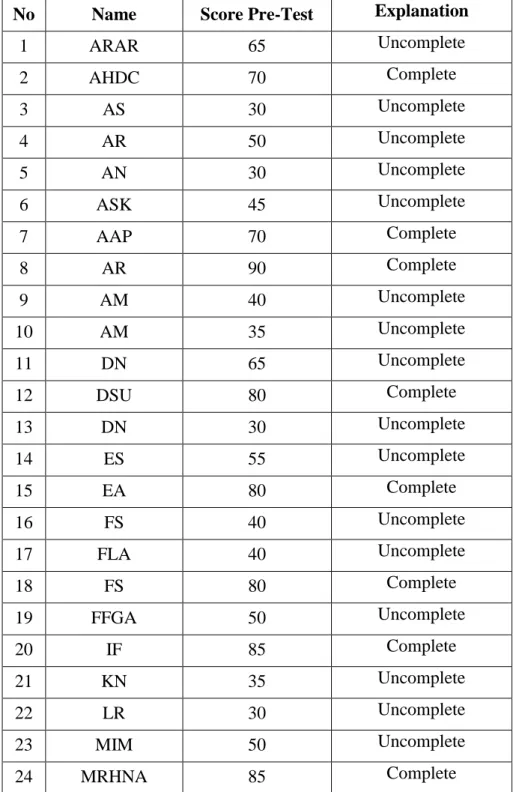
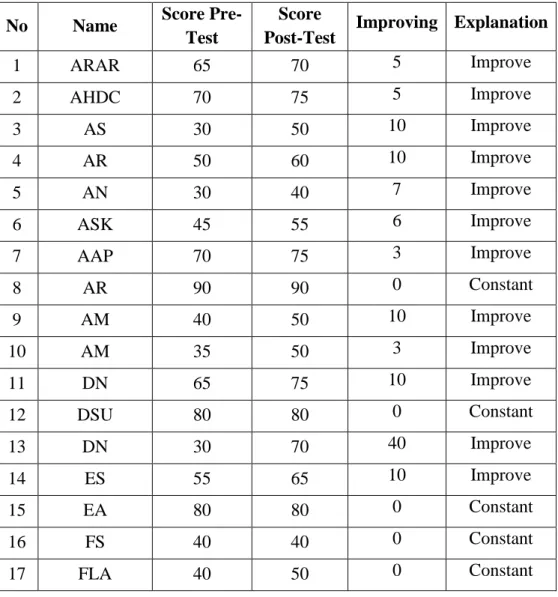
Table 3 : Student’s Score at Pre-Test Cycle I No Name Score Pre-Test Explanation
1 ARAR 65 Uncomplete
2 AHDC 70 Complete
3 AS 30 Uncomplete
4 AR 50 Uncomplete
5 AN 30 Uncomplete
6 ASK 45 Uncomplete
7 AAP 70 Complete
8 AR 90 Complete
9 AM 40 Uncomplete
10 AM 35 Uncomplete
11 DN 65 Uncomplete
12 DSU 80 Complete
13 DN 30 Uncomplete
14 ES 55 Uncomplete
15 EA 80 Complete
16 FS 40 Uncomplete
17 FLA 40 Uncomplete
18 FS 80 Complete
19 FFGA 50 Uncomplete
20 IF 85 Complete
21 KN 35 Uncomplete
22 LR 30 Uncomplete
23 MIM 50 Uncomplete
24 MRHNA 85 Complete
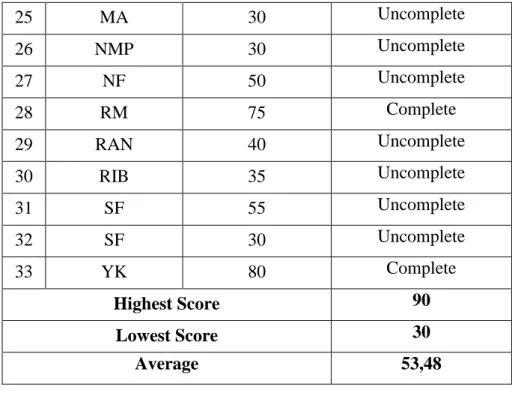
25 MA 30 Uncomplete
26 NMP 30 Uncomplete
27 NF 50 Uncomplete
28 RM 75 Complete
29 RAN 40 Uncomplete
30 RIB 35 Uncomplete
31 SF 55 Uncomplete
32 SF 30 Uncomplete
33 YK 80 Complete
Highest Score 90
Lowest Score 30
Average 53,48
Table 10: Frequency of students’ score in Pre-test Grade Category Frequency Percentage
1. ≥70 Completed 10 33%
2. <70 Uncompleted 23 67%
Total 33 100%
33%
67%
0%
10%
20%
30%
40%
50%
60%
70%
80%
>70 <70
Pre-Test I
Pre-Test I
The highest in pre-test result is 90 and lowest is 3. The average score is 53.48 and just 10 students (30.3%) who success gets score more than 70. It shows that the result of students’ listening skill in the pre test cycle I is unsatisfactory. Because the criteria of students are succesful in mastering material is students who get minimum score of 70 and the class can be said success in achieving the material if 67% of the students in the class get score at least 70.
2. Cycle I a. Planning
In the planning stage, the researcher and the collaborator prepared several things related to the teaching and learning process such as:
prepared the lesson plan, made the instrument that would be examined as post test in the cycle I, prepared the material, made the observation sheet of the students’ activity, identified the problem and found the causes of problem at the beginning and the end of learning activities. The researcher also planned to give evaluation to measure the students’
mastery on the given materials.
Based on the results of the discussion with the collaborator in a democratic atmosphere on November 15th 2018. Some efforts were planned to solve the problems identified above. The efforts focused on improving the students’ listening skills through media video clip.
b. Acting
The action of Cycle I consisted of two meetings. The first meeting was the explanation of video clips media. The researcher explained and thought the students about the purpose, generic structure, and language features of the lyric songs and how to comprehend the spoken text by using video clips. The second meeting, the researcher asked students to answer the questions and practice using video clips individually, then revise their work. The detail of the actions in each meeting was discussed as follows.
1) First Meeting
The first meeting was held on Wednesday, November 14th 2018 at 10.35 a.m. until 11.55 a.m. The researcher started the class by greeting the students. Initially, the students were not really enthusiastic. There were some of the students felt sleepy and talked with their friends. However the students were interested when the researcher performed media to show the lyric text which was video clips media. The video clips media supported with the high quality of video and interesting topic was able to attract the students to pay attention to the teacher explanation.
Before the researcher explained about the lyrics, brainstorming was given to check the knowledge of students about some videos in the form of pictures on the projector by asking the students‟
experience when they watched those videos. By giving illustrations
about the topic being discussed and introduce the video clips used, an example of video clips entitled “Linkin Park – Shadow of the Day”
were given to the students.
The researcher performed the use of video clips in listening teaching and learning process. Explanation of the steps of viewing technique of video clips, how to use them, and the benefit of the techniques were clearly given to the students. After all students understood how to use the viewing technique of video clips, the students were asked to listen and watch some video clips. Then, the researcher asked the students to identify the generic structure of the lyric text and answer the questions there based on the video clips by practicing the techniques and guiding by the researcher. After they had finished the assignment, the researcher asked some of the students to answer the question before the researcher and the students discussed the answers together. All of the students were active to answer the questions.
2) Second Meeting
The second meeting was held on Friday, November 16th, 2018 at 10.15 a.m until 11.00 am. The students looked happy when the researcher came to the class. The researcher started the teaching learning process by greeting and checking the attendance. After all students were ready to start the lesson, the researcher asked the students to flash back first to the last material that they had learned in
the last meeting and review it. It aimed at reminding their memory and be confidence in joining the English listening class.
Then, the researcher asked the students to sit based on their group work. There were 9 groups. The new video clips were played by the researcher and the students had to identify some information by answering the questions on the students‟ worksheets. The students worked in their group. The researcher monitored the students‟
activities. He also helped the groups to enrich students’ vocabularies by offering some synonyms and write the meanings on the whiteboard.
After they had finished doing the assignment, they discussed their work with their groups; many students asked some help to the researcher when they got difficulties. However, some of them still made noise and talked with their friend during the listening teaching and learning process held.
Although some of the students still did not pay attention to the teachers explanation, overall listening teaching and learning process ran well. The researcher asked the students to pay attention to their discussion. The researcher always moved around and paid attention to all students in the class.
In the second meeting the students began active and intrested in teaching learning process. In the pre-test and post-test of cycle I only 10 students of 33 students who got 70.
Table 3 : Student’s Score at Post-Test Cycle I No Name Score Post-Test I Explanation
1 ARAR 70 Completed
2 AHDC 75 Completed
3 AS 50 Uncompleted
4 AR 60 Uncompleted
5 AN 40 Uncompleted
6 ASK 55 Uncompleted
7 AAP 75 Completed
8 AR 90 Completed
9 AM 50 Uncompleted
10 AM 50 Uncompleted
11 DN 75 Completed
12 DSU 80 Completed
13 DN 70 Completed
14 ES 65 Uncompleted
15 EA 80 Completed
16 FS 40 Uncompleted
17 FLA 50 Uncompleted
18 FS 80 Completed
19 FFGA 65 Uncompleted
20 IF 85 Completed
21 KN 70 Completed
22 LR 40 Uncompleted
23 MIM 65 Uncompleted
24 MRHNA 85 Completed
25 MA 50 Uncompleted
26 NMP 50 Uncompleted
27 NF 60 Uncompleted
28 RM 85 Completed
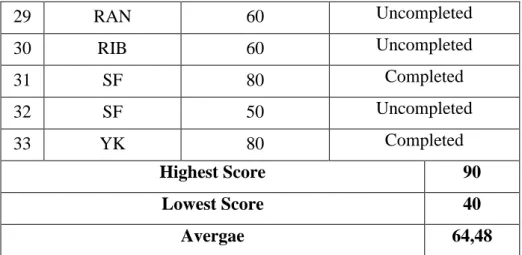
29 RAN 60 Uncompleted
30 RIB 60 Uncompleted
31 SF 80 Completed
32 SF 50 Uncompleted
33 YK 80 Completed
Highest Score 90
Lowest Score 40
Avergae 64,48
Table 10: Frequency of students’ score in Post-Test I Grade Category Frequency Percentage
1. ≥70 Completed 15 45%
2. <70 Uncompleted 18 55%
Total 33 100%
The highest in post-test cycle I is 90 and lowest is 40. The average score is 60.45 and just 15 students (45%) who success gets score more than 70. It shows that the result of students’ listening skill in the post test
45%
55%
0%
10%
20%
30%
40%
50%
60%
>70 <70
Post-Test I
Post-Test I
cycle I is unsatisfactory. Because the criteria of students are succesful in mastering material if a great deal of students who get score of 70 and the class can be said success in achieving the material if 60% of the students in the class get score at least 70.
c. Observing
In observation of the observer’s action, the action the researcher presented two meetings in cycle I of learning to know and understand the meaning of song lyrics in video clips to improve listening skills. The researchers had explained know characteristic, and what to be used to do the exercise but the students still confused and get difficulty to know the meaning of song lyrics in the video clip.
In the second meeting, the researcher explained listening skill at video clip media before giving assignments. In this meeting, the students began active. They also began to be interested in teaching and learning process. In the post test 1, there were 10 of 33 students got good score.
Although only 10 students who passed the minimum score, but the result of the students’ test was better that the students’ pre-test before giving treatment.
The indicators of student activities as follows:
1) Paying attention by explanation and asking question.
2) Listening to music through the media video clip.
3) Make conclusions by rewriting the contents of the song in the video clip.
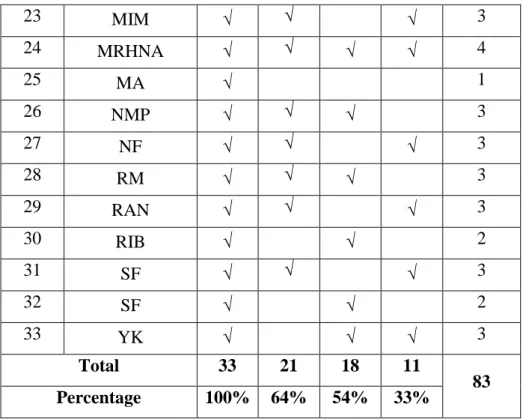
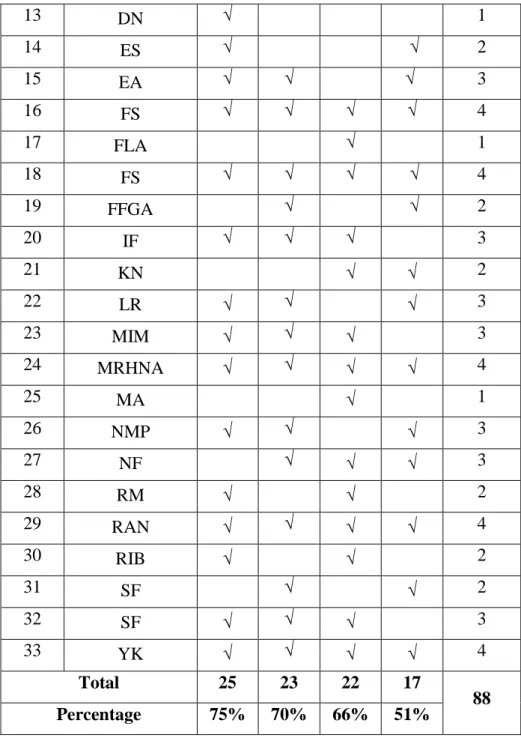
4) Doing task to the related material.
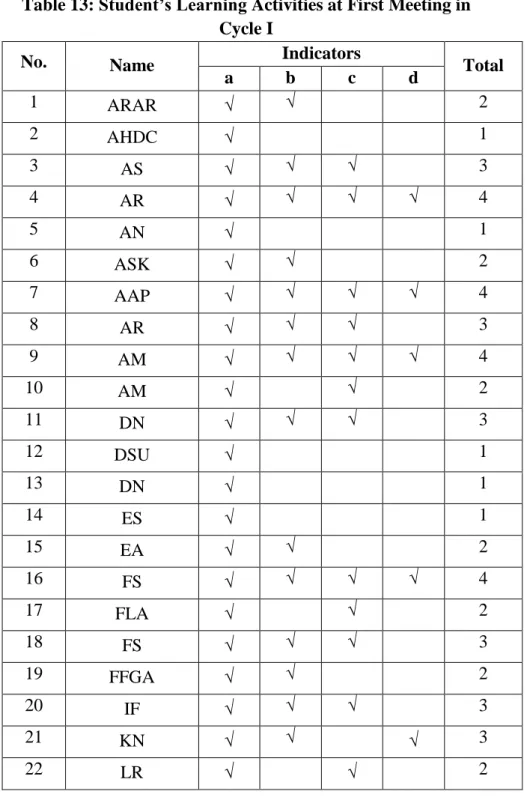
The observation result of students’ learning activities on first meeting and second meeting of the first cycle could be seen on the table below:
Table 13: Student’s Learning Activities at First Meeting in Cycle I
No. Name Indicators
Total
a b c d
1 ARAR √ √ 2
2 AHDC √ 1
3 AS √ √ √ 3
4 AR √ √ √ √ 4
5 AN √ 1
6 ASK √ √ 2
7 AAP √ √ √ √ 4
8 AR √ √ √ 3
9 AM √ √ √ √ 4
10 AM √ √ 2
11 DN √ √ √ 3
12 DSU √ 1
13 DN √ 1
14 ES √ 1
15 EA √ √ 2
16 FS √ √ √ √ 4
17 FLA √ √ 2
18 FS √ √ √ 3
19 FFGA √ √ 2
20 IF √ √ √ 3
21 KN √ √ √ 3
22 LR √ √ 2