The reasons for suggesting that this piece may be of Olmec origin are: (1) The bold simplicity of the style;. 2) the type of jade, which resembles some of those from La Venta;. At the base of the image, a transverse saw line appears to indicate the bottom of a dress or skirt. It is clear that it was drilled before the side points at the base of the head were cut.
CERRO DE LAS MESAS OFFERING DRUCKER 37
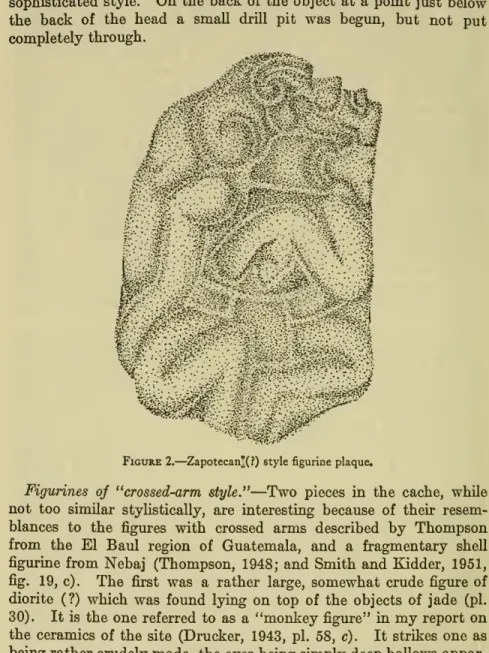
It appears to have a fairly elaborate headdress, although one side of the head is broken off. The corners of the mouth are marked with arches made using a hollow drill at an oblique angle. The surface of the stone next to and below the nose is cut away almost to.
44 BUREAU OF AMERICAN ETHNOLOGY [B0LL. 157
In outline it is almost elliptical with small notches on the sides of the head and the base of the wings. A transverse biconical perforation pierces the object from side to side at eye level. A small pebble of light-green jade was very easily modified into a form vaguely suggesting the head of a forest water (pi. 49, h).
PLAQUES
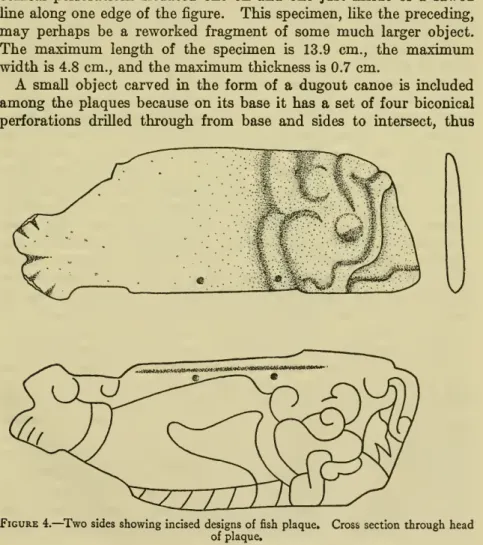
It can also be noted that several indentations along the edges of the panel appear to be remnants of perforations that were originally drilled to hang or secure an object. This pattern faces exactly the opposite direction to the more heavily carved pattern on the other side, meaning that the belly of this fish is on the same edge of the panel as the back of the other. A biconical perforation at one end outside the edge of the excavated area and another in the middle of one side just inside the excavated area were apparently intended for hanging.
The back of the object has two old, partially worn cuts, transverse to the main axis of the piece. The back of the object curves abruptly at the edges and flattens into two longitudinal planes formed by two original saw cuts that are not quite centered on each other. There are two more perforations on the concave side of the object, formed by pairs of intersecting conical pits drilled from the edge and back.
At the right end almost at the junction of the first and second lobes is a biconical hole that passes from one side to the other. The maximum object length is 6.8 cm., the maximum width (through the hinge) is 6.5 cm., and the maximum thickness is 1.1 cm. Near the middle of the round shaft it is slightly pinched, with a shallow saw cut at each end.
Two incomplete circles, made in the same way, are found half way through the blade of the piece.
EARSPOOLS
At the blade end of the object is a borehole remnant, indicating that the present specimen was sawn off from a larger specimen or piece of jade. Most of these same examples are polished only on the front of the flare, while the back and neck are only smoothed, or at most very lightly polished. The smaller piece looks like it is. the stem was cut just below the level of the perforations.
Another of these objects has two pairs of diametrically opposed incisions in the rim of the flare. A number of the other large undecorated discs of this type are quite obviously large overflow flames with the stems cut off. Three other pieces of the same general type appear to have been cut from Type B ear-coils of the variety in which the flare is rectangular in plan with rounded corners (pi.
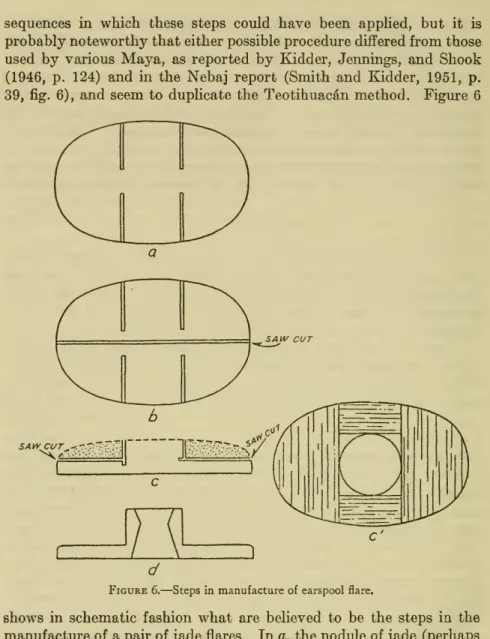
The largest of the disks, although not completely regular in shape, has an average diameter of 7 cm. This may have been the neck disc originally found in one of the few ear coils found with neck discs in place. The next step was to drill out the neck using two tapered drill holes, the larger and deeper each case, where the indications are still from the face.
The final step or steps consisted of whitening the throat, thinning and polishing the flared lips, etc.
CEREMONIAL PERFORATORS (?)
CELTS
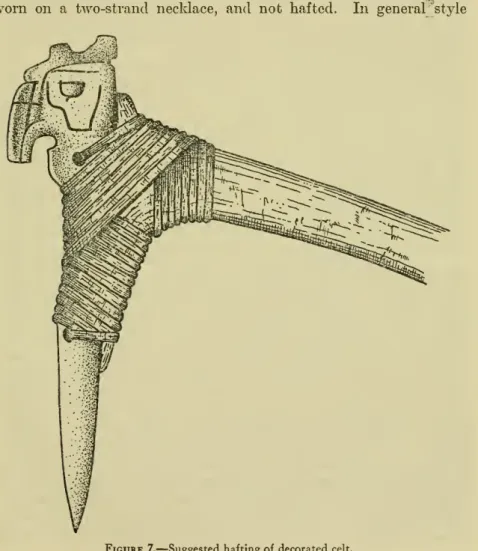
Hisfigm-e 281, although neither the line cut nor the text makes clear whether or not the throat is biconically drilled, shows the use of hollow drill in the carving of the neck, and the same four horizontal saw cuts as indicated in the Cerro de las Mesas- samples to. The poll is worked into a bird-like head with a heavy downward beak reminiscent of that of the Olmec. The area just below the decorated head or between post and heel has a very marked cavity which may have served to tighten the lashing.
Two cylindrical perforations run transversely across the longitudinal axis of the celt in the same plane as the chisel, one just above, the other just below the concave surface (Fig. 7). Presumably these two also serve lashing purposes, although it is possible that the sash was made to be worn on a two-strand necklace and not on a stem.
BEADS
NoT4T^'^^^' CERRO DE LAS MESAS OFFERING DRUCKER 61 pattern of the whole type, if it can be considered as such, is very consistent, for 110 of the 126 pieces are drilled biconically, so that the holes intersect closely middle of the stone; in eight cases. They ranged in size from one whose largest diameter (at right angles to the bore axis) was 4.1 cm. Only three conical perforations; there they were all drilled on both sides (biconically), and in all these cases the two drill holes met approximately in the center of the piece.
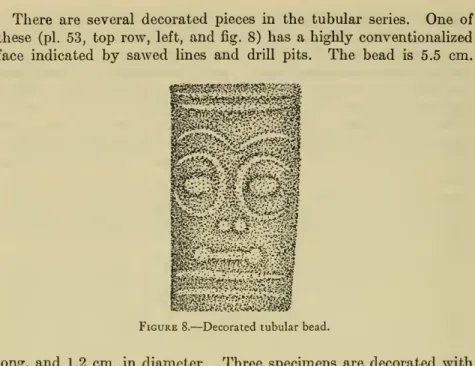
There are four beads with four grooves, one with five, one with seven and one with three (these are spaces, although four were planned). Several of the long, well-made pieces that would normally be classified as "tubular" show a very slight taper towards both ends; a few of the "barrel-shaped" specimens, however, have a slight taper and seem, partly due to the rather wide openings of the perforations, to have square ends. There are 33 definitely tubular specimens, 9 intermediate and 52 that conform to the definition of the barrel-shaped type.
In addition, there are 14 stubby short pieces with square cut ends, which look more like modifications of one or the other of the above. types than the subspherical shape. An approximation of the flared-end tubular bead type occurs in the collection (p. 53, bottom row, left). The largest diameter at ignition is only 0.6 to 0.7 mm, larger than the maximum.
One of the short tubular beads (this particular piece has rounder sides than most, but is proportionally longer and much flatter at the ends than the subspherical forms) has two pairs of small, shallow drilling pits set close together -the other around its circumference and a light.
MISCELLANEOUS OBJECTS
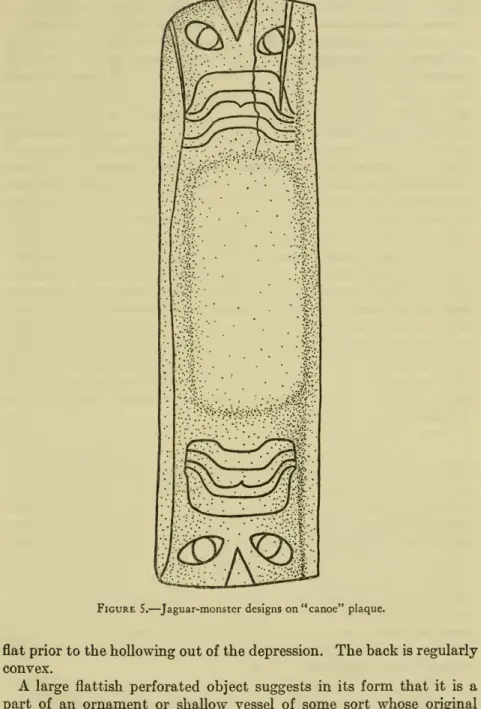
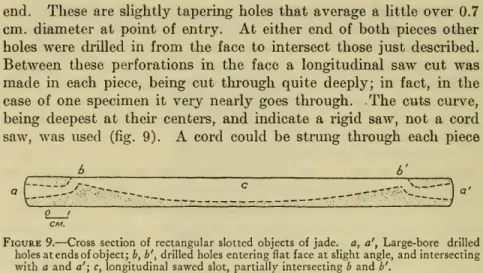
The second bead has a single large perforation drilled vertically to intersect the longitudinal perforation, just to one side of the longitudinal midpoint. At each end of both pieces, other holes were drilled in from the front to cut the ones just described. One face of the object is quite flat; the other is asymmetrically convex and is thickest near the curved edge.
In the center of the curved edge is the remains of a conically bored well that did not penetrate all the way through the stone. A rod-shaped object made of the same material has three sets of three surrounding grooves, two wide with a narrow one in between. The back of the object is somewhat irregular and the grooves do not flow clearly.
Six shallow saw cuts tapering from the edge towards the center of the stone give a shape that suggests a very conventional bird. Sawn grooves surround the ends, one a short distance from one end, the other right at the point of the break. The cross-section of the piece is elliptical, and on one side traces of two longitudinal holes have been preserved, which barely intersected.
These were made prior to cutting and detailing the current copy.
DISCUSSION
In fact, there are considerably fewer pieces of definite Olmec style on offer than might be expected among the neighbors of these skillful lapidaries. Shell-shaped slabs suggest another parallel, although it should be noted that at Cerro de las Mesas we found evidence of a cult associated with shells and other marine forms. It also seems that most of these works must be attributed to the La Venta (Middle Tres Zapotes) phase of this culture, since, as far as we now know, this period for quite a long time represented the flowering of a pure type of Olmec art.
However, cross-checks of ceramics and figurines between Cerro de las Mesas and Tres Zapotes indicate that the horizon labeled Lower I at the former. Therefore, the pieces had to be kept as heirlooms for a long time before they were placed in the offering pit under the mound's staircase. If the assumption is correct that the highland pieces used for comparison are typical, we have further corroboration from the ceramic evidence showing that highland influence (Teotihuacto and later Mixteca) was dominant in the history of this site.
Nrfff CERRO DE LAS MESAS OFFER DRINKS 67 amount or was duplicated in the coastal area and strongly influenced the local ceramic pattern, could be taken as a hint that there was an ancient, well-established route of communication and diffusion from the highlands to the coast. Still, many of the small, flat figurine-shaped pendants (both head sand and full figures) vaguely remind one of small anthropomorphic pendants from the Maya area, especially those where the nose is formed by a continuation of the lines marking the tops of the eyes, or the eyebrows. If one compares them with, for example, the small flat heads in the Rossbach collection (Lothrop, 1936, especially figs. 58 and 59), or with some of the Nebaj specimens (Smith and Kidder, 1951, fig.
If these objects in the Cerro de las Mesas offering are merely commercial objects, and none were locally made in imitation of exotic pieces, they show little actual Maya influence, and it must have been very slight, except in the most indirect way.
LITERATURE CITED
Mayan and Mayoid ones. - Apart from the almost obliterated engraving, which seems to have a distinct Mayan flavor, there are no pieces on the small plaque that could be singled out without hesitation as representatives of Mayan art.