SMITHSONIAN INSTITUTION
Contributions from the United States National Herbarium Volume 44: 1-104
Smithsonian Plant Collections, Guyana:
1989- 1991, Lynn J.Gillespie
by Tom Hollowell Lynn J. Gillespie
V.A. Funk and Carol L. Kelloff
-^THSO/V^-
MAR 1 9 2003
Department of Systematic Biology - Botany, National Museum of Natural History
Washington, DC
2003
Hollowell, Tom, Lynn J. Gillespie, V.A. Funk, and Carol L. Kelloff. Smithsonian Plant Collections, Guyana: 1989 - 1991, Lynn J. Gillespie. Contributions from the United States National Herbarium,
volume 44; 104 pages (including 8 plates).- Part 1 provides the collector's notes on trips in chronological order. Part II lists collection localities, with collection number ranges, habitat descriptions, geographic coordinates, and assisting collectors.
Part 111 consists of maps of Guyana showing collecting loealites. Part IV lists collections in numerical order with identifications and authors. Part V lists collections ordered by determined name. The appendix is a personal account by the collector describing some of her experiences while collecting plants in Guyana.
KEY WORDS: Guyana, botanical Collecting, Nomenclature
DATE OF PUBLICATION: January 2003
Cover Design and Illustrations by Alice Tangerini. Front; Tragia tabulaemontana L.J. Gillespie (Euphorbiaceae), from Gillespie, L.J. 1994. Novon 4: 330-338; back: Plukenclia supraglandulosa LJ.
Gillespie (Euphoribiaceae), from Gillespie, L.J. 1993. Systematic Botany 18: 575-5<J2. Both illustrations also appeared in Gillespie, L.J. <£ W.S. Armbruster. 1997. Smithsonian Contributions to Botany: 86.
All photographs Copyright, Lynn J. Gillespie, except as noted.
Contributions from the United States National Herbarium (ISSN 0097-1618) Department of Systematic Biology - Botany MRC 166, National Museum of Natural History, Smithsonian Institution, Washington, DC, 20013-7012, USA.
POSTMASTER: Send address changes to Contributions U.S. National Herbarium, Department of Systematic Biology - Botany MRC 166, National Museum of Natural History, Smithsonian institution, Washington, DC, 20013-7012, USA.
The paper used in this publication meets the minimum requirements of the American National Standard for Permanence of Paper for Printed Library Materials Z39.48--I984.
Contributions from the U.S. National Herbarium was first published in 1890 by The United States Department of Agriculture. From July 1, 1902 forward it was published as a Bulletin of the United States National Museum. The series was discontinued after volume 38, 1974, and has been revived with volume 39, as a venue for publishing longer taxonomic papers, checklists, floras, and monographs, produced by staff and associates at the U.S. National Herbarium. It is externally peer reviewed, and published at irregular intervals. Subscriptions and other correspondence should be addressed to CUSNH, Department of Systematic Biology - Botany MRC 166, National Museum of Natural History, Smithsonian Institution, Washington, DC, 20013-7012, USA e-mail [email protected]. The present issue is available for free while supplies last.
CONTENTS
INTRODUCTION 5 The Biological Diversity of the Guianas program 6 Lynn J. Gillespie 6 Format of Collection Information 6 References 7 Acknowledgments 7 Contributing Specialists 7 Collections of Special Interest 9 I: NOTES ON TRIPS 15 II: COLLECTION LOCALITIES 21 III: COLLECTION LOCALITY MAPS 34 IV: COLLECTIONS BY NUMBER 39 V: COLLECTIONS BY DETERMINED TAXA 80 APPENDIX: BOTANICAL COLLECTING IN GUYANA 99 PLATES 103
Smithsonian Plant Collections, Guyana:
1989-1991, Lynn J. Gillespie
Tom Hollowell', Lynn J. Gillespie2, V.A. Funk', and Carol L. Kelloff'
INTRODUCTION
The Biological Diversity of the Guianas Program
The "Biological Diversity of the Guianas"
(BDG) is a field-oriented program of the Smithsonian Institution's (SI) National Museum of Natural History. The goal of the BDG is to study, document and preserve the biological diversity of the Guianas (Guyana, Surinam, and French Guiana). The program has been operating since 1983. It was originally confined to botany within Guyana, which was at that time the least known of the three Guianas. It has since been expanded to include faunal studies, but field work in countries other than Guyana has been minimal to date. In Guyana the BDG operates under the auspices of the University of Guyana (UG) with whom it has a Memorandum of Understanding.
The Guianas are a biologically diverse area, and unlike many other tropical countries, approximately 70% of the natural habitat of the Guianas remains pristine. Most of the land is owned by national governments, most of the people live along the coast, and until recently the destructive development of the interior was kept to a minimum. As a result there is a real possibility that large tracts of extremely interesting forest and their accompanying biota can be conserved. These natural areas are now seriously threatened by resource extraction activities such as practiced by Asian logging companies and Brazilian gold miners. It is important that we gain an understanding of the
flora and fauna so that decisions can be made concerning critical areas that have high priority for conservation and so that data can be collected from areas that will ultimately be degraded. In addition, because this region has been long neglected by biologists, it is often an area of
"insufficient information" for many biological studies. For many years most collectors bypassed Guyana in particular. The program was designed to provide specimens and data to address biodiversity questions about many groups of organisms for research and conservation projects. This new information is now being used to produce checklists, vegetation maps, and floristic and faunistic studies. In addition, the BDG program is exploring uses of these data that will lead to a synthesis of information addressing broader biodiversity issues and understanding (Funk and Richardson, 2002).
Prior to the BDG's work, Guyana was little known biologically, with sparse documentation of its biota. In 15 years of collecting the BDG Program has produced works important to the understanding of Guyana's biological diversity and in assisting Guyana with conservation efforts. The BDG Program has published a vegetation map of Guyana (Huber et al., 1995), as well as plant checklists for the Guianas (Boggan et al., 1997), the Guiana Shield (Hollowell et al,, 2001), the Iwokrama area (Clarke et al., 2001), and Kaieteur National Park (Kelloff and Funk, 1998). It has also published a Checklist of the Birds of Guyana (Braun et al., 2000). Data from the BDG program have been used in many publications; a complete list of
1: Biological Diversity of the Guianas Program, MRC 166, National Museum of Natural History, Smithsonian Institution, Washington DC 20013-7012, USA. 2: Research Division, Canadian Museum of Nature, P.O. Box 3443, Station D, Ottawa, Ontario KIP 6P4, Canada.
Guyana Plant Collections: L.J. Gillespie
these can be found on the program's website at http://www.mnh.si.edu/biodiversity/bdg/bdgpub.htmL In addition to these lists, checklists of the herpetofauna and mammals of Guyana can be found on the BDG website, and they will be published by the contributors in the near future.
The BDG fulfills the goals of the Smithsonian Institution by gathering new information and distributing it to encourage production of floras and faunas of poorly known areas; participating in training students and professionals from the host country, supplying data for the identification and preservation of biologically diverse areas; and providing specimens for systematic studies both within the Institution and throughout the world. Although the program operates out of the Smithsonian, wc depend on extensive collaborations throughout the world to accomplish our goals. Currently we have over 100 scientists with whom we interact (see our website for a full list of collaborators and other information about the BDG).
From 1986 until 1998 the BDG maintained a resident plant collector in Guyana. More recently the program has had resident butterfly and bird collectors, and there are plans underway to base an ant collector in Guyana. Botanical specimens collected through the program have been distributed to a network of experts for identification and a set of specimens is deposited at UG, the US National Herbarium in Washington DC, and many other botanical institutions. At the time of this publication the BDG program has collected approximately 44,200 numbers, representing over 225,000 individual specimens.
Lynn J. Gillespie
Lynn Gillespie was the third Resident Plant Collector to participate in the BDG Program.
Over a nearly 19 month period, she spent 12 months in Guyana and approximately 135 days in the field. She collected 2510 numbers, which were processed by the U.S. National Herbarium at the Smithsonian Institution. This processing included distribution to specialists for determination and to other botanical institutions as part of specimen exchange programs.
Currently just over 85% of these plants have
been identified to species. These determinations show that Lynn Gillespie collected over 1200 taxa in 610 genera. Copies of her field notebooks and mounted vouchers for her collections are now in the herbarium housed at the "Centre for the Study of Biological Diversity" at the University of Guyana.
Figure 1. Lynn J. Gillespie cooling off while travelling on the Canje River. Photo C. Kelloff.
Several Guyanese accompanied Gillespie on her collecting trips. Those who assisted with collecting, as recorded on the specimen labels, include; D. Gopaul, L. Kelly with the University of Guyana Forestry Class, H. Lall (Figure 2;
name changed to H. Persaud, March 1989), and S. Tiwari. The Guyanese who assisted in Georgetown include M. Ameer and G. Bacchus.
Other participants in collecting trips include V.
Funk, M.E. Gillespie, RJ. Gillespie, C. Kelloff, T. McDowell, P. Peterson, and D.R. Smart.
The assistance of Dr. George Walcott, Vice- Chanceilor of UG, Dr. Indarjit Ramdass, head of the UG Biology department, and the staff at the U.S. Embassy in Georgetown, Guyana was invaluable. Dr. Walcott made the entire operation possible by proving to be the crucial person in developing the project. Dr. Ramdass helped considerably in facilitating Field trips and providing logistical support, and the U.S.
Embassy helped with handling and shipping of supplies and specimens collected by Gillespie.
Without all of their help, the program would not have succeeded.
Dr. Gillespie is an expert in the plant family Euphorbiaccae and is currently a Research Scientist at the Canadian Museum of Nature in Ottawa. Her publications include work on the Euphorbiaccae of Guyana (Gillespie, 1993a;
1993b; 1994; Gillespie and Armbruster, 1997).
She continues to collaborate with the BDG program by providing determinations of collections in that family.
updated, parts.
This publication is divided into four
^*
W-
Figure 2. Harry Persaud (Lall) at Kaieteur with Gillespie and Pcrsaud 922, Utricularia
humboldtii R.H. Schomb.
Format of Collection Information
These data summarize identification of plants collected by Lynn Gillespie and identified by hundreds of taxonomic specialists. One purpose of this publication is to make the results of this field work widely available to the botanical and conservation community now that over 85% of these collections have been identified and distributed. This publication will also serve as a resource for many herbaria that received sheets of these collections. As is always the case with such endeavors, specialists may revise their determinations of specimens, and data errors are corrected over time. In addition to this publication, the BDG website (see below) with these data will be periodically
Part I presents notes by the collector on the localities, habitats, and events of the collecting trips. The Canje River (Trip 12) section was contributed by Carol Kclloff.
Part II is a detailed account of the localities at which Gillespie made her collections for the BDG program, organized chronologically by trip. The range of numbers for each trip is indicated, as are the dates of the trip. Within each trip, specific localities, as provided by the collector, are listed with their dates for those collections, latitude and longitude coordinates, elevation ranges in meters, habitat descriptions, collection number ranges, and co-cottectors.
Latitude and longitude are given in degree (°), minute ('), and second (") format. These collections were made before affordable Global Positioning Systems (GPS) were available;
coordinates were usually recorded only to the nearest minute and, accuracy varies as locality determinations were made in the field using maps of varying quality.
Part III is a set of maps indicating the localities for each of Gillespie's collecting trips outside of Georgetown. As stated above, the accuracy of these positions is subject to the tools that were available to collectors at the time.
Part IV is a listing of the collections in numerical order. Each number is followed by the determined plant family, plant name including any infraspecific names that are available, and authors of the name. The BDG generally maintains plant name information as submitted by specialists, and these may be checked against the synonymy provided in the Checklist of the Plants of the Guianas, T Edition (Boggan et al., 1997), or in the Preliminary Checklist of the Plants of the Guiana Shield. Volume 1: Acanthaceae - Lythraceae (Holfowell et al., 2001), both of which are available in hard copy from BDG or online at http://www.mnh.si.edu/biodiversity/bdg.
In many eases commonly accepted names are listed following the recorded name. The authors of plant names follow standardized abbreviations (Brummitt and Powell, 1992).
Guyana Plant Collections: L.J. Gillespie
Part V is a listing of collections by determined name, sorted by division, family, genus and specific epithets followed by the collection numbers for each name. Specimens not determined to genus are the first listed for each family, and specimens not determined to species are the first listed for each genus. This section is provided to facilitate the location of specimens of interest to specialists.
The Appendix, "Botanical Collecting in Guyana," is a personal account by Lynn Gillespie of the plant collecting experience in Guyana, written to provide the lay reader with a feel for the challenges and satisfactions of field work in Guyana. It also serves as an introduction to the purpose and procedures of collecting botanical specimens and adding them to herbaria.
In general, the first sheet of determined specimens have been distributed to the Centre for the Study of Biological Diversity at the University of Guyana (ERG) with a second sheet deposited at Smithsonian's U.S. National Herbarium (US). Anyone requiring additional information about the distribution of duplicate specimens to other herbaria or about the specialists who participated in the determination of specimens can contact the BDG Program at the US National Herbarium, MRC 166, Smithsonian institution, Washington DC, 20013- 7012 USA.
This is the second publication by the BDG detailing the collections of the program's plant collectors. The first publication covered the collections of John J. Pipoly from 1987 to 1988 (Hollowell et a!., 2000). As identification of collections by other BDG field botanists becomes at least 80% complete, additional publications will be issued in this series. This is publication number 63 in the Smithsonian's Biological Diversity of the Guianas Program publication series.
References
Boggan, J., V. Funk, C. Kelloff, M. Hoff, G.
Cremers, & C. Feuillet. 1997. Checklist of the Plants of the Guianas, 2nd Edition.
Biological Diversity of the Guianas Program, Smithsonian Institution, Washington, DC.
Braun, M.J, D.W. Finch, M.B. Robbins, and O.K. Schmidt. 2000. A Field Checklist of the Birds of Guyana. Biological Diversity of the Guianas Program, Smithsonian Institution, Washington DC.
Brummitt, R.K., and C.E. Powell, eds. 1992.
Authors of Plant Names. Royal Botanic Gardens, Kew.
Clarke, H.D., V. Funk and T. Hollowell. 2001.
Using checklists and collections data to investigate plant diversity. 1: A comparative checklist of the plant diversity of the Iwokrama Forest, Guyana. Sida Botanical Miscellany 21, 86pp.
Funk, V.A. and K. Richardson. 2002. Systematic data in biodiversity studies: Use it or lose it.
Systematic Biology 51 (2): 303-316.
Gillespie, L.J. 1993a. Euphorbiaceae of the Guianas: annotated species checklist and key to the genera. Brittonia 45(1): 56-94.
Gillespie, L.J. 1993b. A synopsis of Neotropical Plukenetia (Euphorbiaceae) including two new species. Syst. Bot. 18(4):
575-592.
Gillespie, L.J. 1994. A new section and two new species of Tragia from Venezuelan Guayana and French Guiana. Novon 4(4):
330-338.
Gillespie, L.J. and W.S. Armbruster. 1997. A contribution to the Guianan flora:
Dalechampia, Haematostemon, Omphalea, Pera, Plukenetia, and Tragia (Euphorbiaceae) with notes on subfamily Acalyphoideae. Smithsonian Contributions to Botany number 86. Smithsonian Institution Press, Washington, DC.
Hollowell, T„ V.A. Funk, C.L. Kelloff and G.
Gharbarran. 2000. Smithsonian Plant Collections, Guyana: 1986 - 1987, John J.
Pipoly UI. Biological Diversity of the Guianas Program, Smithsonian Institution Washington, DC.
Hollowcll, T., P. Berry, V. Funk, and C. Kelloff.
2001. Preliminary Checklist of the Plants of the Guiana Shield (Venezuela: Amazonas, Bolivar, Delta Amacuro; Guyana; Surinam;
French Guiana). Volume I: Acanthaceae - Lythraceae. Biological Diversity of the Guianas Program, Smithsonian Institution, Washington, DC.
Huber, 0., G. Gharbarran, & V.A. Funk. 1995.
Preliminary Vegetation Map of Guyana.
Biological Diversity of the Guianas Program, Smithsonian Institution, Washington, DC.
Kelloff, C.L. and V.A. Funk. 1998. Preliminary Checklist of the Plants of Kaieteur National Park, Guyana. Biological Diversity of the Guianas Program, Smithsonian Institution, Washington, DC.
Acknowledgments
The compilation of this collection summary would not have been possible without the work of many people who have assisted the BDG Program over the years, both at the Smithsonian and in Guyana. Among these people are John Boggan, Larry Skog, H. David Clarke, Susan Grose, Marilyn Hansel, Karen Redden, Harry Lall (Persaud), Dyantie Naraine, Naseem Nasir, and George Walcott. We also thank Paul Berry of the University of Wisconsin for his especially constructive suggestions on the manuscript. The multitude of specialists, both past and present, that have helped in the determination of Lynn Gillespie's specimens from Guyana, are listed below.
Contributing Specialists Bryophytes
Bartramiaceae: A.E. Newton Bryaceae: A.E. Newton Dicranaeeae: A.E. Newton Fissidcntaccae: R.G. Purs el!
Helicophyllaccae; A.E. Newton Leucobryaceae: A.E. Newton Orfhotrichaccae: B. Allen Pottiaccac: R. Zander Pterobryaceac: A.E. Newton Sematophyllaceae: A.E. Newton
Lycophytes
Lycopodiaceac: D.B. Lellinger, L.J. Gillespie Sclaginellaceae: D.B. Lellinger, G. McKee
Pteridophytcs
Adiantaceae: D.B. Lellinger, J. Prado Asplcniaccae: D.B. Lellinger
Blechnaceac: D.B. Lellinger
Cyatheaceae: D.B. Lellinger, M.J.Jansen-Jacobs Dennstaedtiaccae: D.B. Lellinger
Dryoptcridaceae: D.B. Lellinger Glcicheniaccac: D.B. Lellinger Gramniitidaccae: D.B. Lellinger Hymcnophyllaceae: D.B. Lellinger Lomariopsidaceae: D.B. Lellinger Lygodiaceae: D.B. Lellinger, C.L. Kelloff, Marattiaceae: D.B. Lellinger, M.J.
Jansen-Jacobs
Mctaxyaceac: D.B. Lellinger Olcandraceae: D.B. Lellinger
Polypodiaceae: D.B. Lellinger, C.L. Kelloff Schizaeaceae: D.B. Lellinger, C.L, Kelloff Tectariaccae: D.B, Lellinger
Thclyptcridaceae: D.B. Lellinger
Gymnosperms
Gnctaccae: L.J. Gillespie, T. Hollowcll
Anthophytes
Acanthaceae: D. Wasshauscn Alismataccac: L. Holm-Nielsen Amaranthaceae: J.K. Boggan
Anacardiaceae; J.D. Mitchell, L.J. Gillespie, S.F. Smith
Annonaccac: P.J.M. Maas, M.J. Jansen-Jacobs, D.M. Johnson, J.M.S. Miralha, L.J.
Gillespie, H. Rainer, W. Morawetz
Apocynaccac: L, Allorge, J.F. Morales, G.
Morillo, A.J.M. Leeuwenberg, M.M. Plumel, L.J. Gillespie, A. Goldberg, M. Nee, A.H.
Gentry
Aquifoliaceac: D. Clarke
Araccac: D.H. Nicolson, T.B. Croat, L.J.
Gillespie
Arecaceae: A. Henderson Aristolochiaccac: C. Feuillet
Asclcpiadaccae: G. Morillo, T. Hollowcll Asteraceac: V.A. Funk, J. Pruski, H. Robinson Balanophoraccac: B. Hansen
Bataceae: L.J. Gillespie
Begoniaceae: D. Wasshauscn, S.F. Smith
10
Guyana Plant Collections: L.J, Gillespie
Bignoniaceac: A. Gentry, L.J. Gillespie, J.
Kallunki
Bixaceae: L.J. Gillespie, L.J. Dorr Bombacaccae: L.J. Dorr, L.J. Gillespie Banuetiaceac: A. Weitzman
Boraginaceae: C. Feuillel
Bromeliaceae: B.K. Hoist, E.J. Gouda, M.A.
Spencer
Burmanniaccac: C.L. Kclloff, L.J. Gillespie, P.J.M. Maas
Burseraceac: D. Daly Cabombaceae: C.L. Kelloff
Caetaccae: B.E. Lcuenbcrgcr, L.J. Gillespie Campanulaceae: J.L. Luteyn
Capparaceae: J.C. Lindcman Caryocaraceae: G.T. Prance Caryopliyllaceac: J.K. Boggan Cecropiaccae: C.C. Berg
Celastraceae: A.M.W. Mennega, R.L. Liesner Chrysobalaiiaceac: G.T. Prance, L.J. Gillespie Clu.siaccac: JJ. Pipoly, A.R.A. Gorts-van Rijn, L.J. Gillespie
Combrctaceae: C.A. Stace, L.J. Gillespie, T.
Hollowcll
Commelinaceae: R.B. Faden Connaraceae: R.L. Liesner
Convolvulaceae: T. Hollowcll, L.J. Gillespie Costaceac: P.J.M. Maas, L.J. Gillespie
Cucurbitaceae: C. Jeffrey, M. Nee, J. Pruski, L.J. Gillespie
Cyclanthaceae: J.K. Boggan
Cyperaceae: M.T. Strong, K. Camelbeke Cyrillaceac: J.K. Boggan
Dichapctalaceac: G.T. Prance, L.J. Gillespie Dilleniaccae: C.L. Kclloff, L.J. Gillespie, G.
Aymard
Droseraccae: C.L. Kelloff Ebcnaccae: P. Berry, C. Sothers
Ericaceae: J.L. Luteyn, S. Clemants, L.J.
Gillespie
Eriocaulaceac: M. Hakki
Erythroxylaccac: P. Berry, M.I.B. Loiola, L.J.
Gillespie
Euphorbiaceae: L.J. Gillespie, W.S.
Armbruster, H.-J. Esscr, G.L. Webster, W. Punt, M.J.M. Christenhusz, K.J. Wurdack
Euphroniaceae: S.F, Smith
Fabaccac-Caesal.: R.C. Barneby, J. Grimes, B.
Stergios, L.J. Gillespie
Fabaceae-IVlinios.: R.C. Barneby, J. Grimes, O.
Poncy, L.J. Gillespie, J.E. Ebingcr
Fabaceae-Papil.: R.C. Barneby, J. Grimes, A.M.
dc Carvalho, V.E. Rudd, R. Fortunato, PR.
Fantz, M. Sousa, R.T. Pcnnington, L.J. Gillespie, L. Torres, D. Ncill, C. Stirton
Flacourtiaccae: J.C. Lindcman
Gentianaceae: P.J.M. Maas, L. Struwe, L. Cobb, M.T. Strong, L.J. Gillespie, U.P.D.
Raghoenandan
Gesneriaceac: L.E. Skog, C. Feuillet Ilacmodoraceac: J.K. Boggan
Heliconiaceae: P.J.M. Maas, W.J. Kress, L.J.
Gillespie
Hernandiaccac: L.J. Gillespie
Hippocrateaceae: A.R.A. Gorts-van Rijn, J.A.
Lombard!, L.J. Gillespie
Humiriaceae: J. Cuatrecasas, R.L. Liesner Icacinaceae: A.C. de Roon
Iridaccae: J.K. Boggan Ixonanthaceac: R.L. Liesner Lamiaceae: R.M. Harley
Lauraceae: H. van der Werff, J. Rohwer, L.J.
Gillespie, A. Cbanderbali
Lecythidaccae: S. Mori, G.T. Prance, L.J.
Gillespie
Lcntibulariaccac: P. Taylor, L.J. Gillespie Liliaccae: J.K. Boggan, C.L. Kelloff
Loganiaceac: W.L. Wagner, J. Pruski, R.K.
Shannon
Lorantliaceac: J.W. Kuijt, L.J. Gillespie Lythraceae: M.J. Jansen-Jacobs
Malpigliiaceae: W.R. Anderson, C. Anderson, B. Gates, L.J. Gillespie
Malvaceae: L.J. Dorr, P. Fryxcll, L.J. Gillespie, M.J. Jansen-Jacobs
Marantaceae: H. Kennedy, L.J. Gillespie Marcgraviaceae: A.C. de Roon, J.K. Boggan, L.J. Gillespie
Melastomataccae: J.J. Wurdack, A.
Frcire-Fierro, S.F. Smith, L.J. Gillespie, D.
Penneys, F. Almeda Meliaceae: L.J. Gillespie Mendonciaeeae: D, Wasshausen
Menispcrmaceac: P. Hiepko, R.C. Barneby Monimiaceae: S.S. Renner, M. Pignal, S.F.
Smith, R.K. Shannon
Moraceae: C.C. Berg, L.J. Gillespie Myrsinaceae: J.J. Pipoly, J. Rickctson
Myrtaceae: B.K. Hoist, L.R. Landrum, M.L.
Kawasaki
Nyctaginaceae: R. DeFilipps, L.J. Gillespie Nymphaeaceae: J.H. Wiersema
Ochnaceae: C. Sastre, A. Goldberg Olaeaccae: L.J. Gillespie
Onagraceae: E. Zardini, R.K. Shannon
Orchidaceae: E.A. Christenson, G.A. Romero, L.J. Gillespie, L.M. McCook, M.C.M.
Werkhoven, M.W. Chase, C.L. Kelloff Passifloraccae: C. Feuillet, L.J. Gillespie Phytolaccaceae: C.L. Kelloff
Piperaceae: A.R.A. Gfirts-van Rijn, R. Callejas, M. Christenhusz
Poaceae: L.J. Judziewicz, C.L. Kelloff
Polygalaceae: J.J. Wurdack, A. Jacobs-Brouwer, L.J. Gillespie
Polygonaceae: J. Brandbyge, L.J. Gillespie Proteaeeae: K.S. Edwards
Rapateaceae: P. Berry, L.J. Gillespie, C.L.
Kelloff
Rhamnaceae: G. Nesom
Rhizophoraceae: R.L. Liesner, T. Hollowcll Rubiaceae: CM. Taylor, T. McDowell, B.
Boom, C. Gustafsson, C.L. Kelloff, K.J.
Wurdack, L.J. Gillespie Kutaceae: J. Kallunki
Sapindaceae: P. Acevedo, T.D. Pennington, G.V. Somner, L.J. Gillespie
Sapotaccae: T.D. Pennington, W.A. Rodrigues Scrophulariaceae: N.H. Holmgren, S. Bidgood, L.J. Gillespie, M.J. Jansen-Jacobs
Simaroubaceac: W. Thomas, L.J. Gillespie, R.K. Shannon
Solanaceae: M. Nee, W.G. D'Arcy, L.J, Gillespie
Sterculiaceae: L.J. Dorr, A. Goldberg, M.J.
Jansen-Jacobs
Strelitziaceae: L.J. Gillespie Symplocaceae: J.C. Lindeman Theophrastaccae: J.C. Lindeman
Tiliaceae: L.J. Dorr, A. Goldberg, M.J.
Jansen-Jacobs
Trigoniaceac: C.L. Kelloff
Ulmaceae: C.C. Berg, L.J. Gillespie
Verbenaceae: M.J. Jansen-Jacobs, L.J.
Gillespie, R. Marley
Violaccac: W.H.A. Hekking, A. Goldberg, L.J.
Gillespie, N.H. Holmgren Viseaccae: J.W. Kuijt
Vitaceae: M. Nee, L.J. Gillespie Vochysiaceae: L.J. Gillespie
Xyridaccac: R. Krai, M. Hakki, M.T. Strong, L.J. Gillespie
Zingibcraceae: P.J.M. Maas, L.J. Gillespie
12
Guyana Plant Collections: L.J. Gillespie
Collections of Special Interest
831 Passifloraccae 873 Passifloraceac 880 Passifloraccae 1101 Rubiaceae 1143 Combretaceae 1317 Fabaccae 1435 Myrtaccac 1474 Flacourtiaceae 1508 Gcsneriaceae 1518 Adiantaccae 1555 Apocynaccac 1566 Myrtaceae 1569 Gesneriaccae 1601 Bignoniaceae 1632 Rhamnaceae 1662 Fabaccae-Papil.
1688 Fabaccae-Mimos 1707 Polygalaccae 1712 Polygalaccae 1738 Cyperaccac 1777 Euphorbiaceae 1782a Asclepiadaceac
1786a Asclepiadaceae
Passiflora ascidia Feuillct Passiflora sp. no v.;
Del. C. Feuillct
Passiflora ascidia Feuillct Morinda peduncularis Kunth;
det. C.M.Taylor, 1993
Combretum ? llewelynii J.F, Macbr.;
det. C.A. Stacc, 1994
Hymenolobium nitidum Benth.;
det. J. Grimes, 1991
Myrciaria dubia (Kunth) McVaugh;
dct. B.K. Hoist, 1991
Casearia cf. Fasciculata (Ruiz & Pav.) Sleumer; det. J.C. Lindeman, 1996 Besleria patrisii DC; det. L.E, Skog, 1998 Adiantum cajennense Willd. ex Klotzsch;
Det. J. Prado, 1997
Forsteronia paraensis Harisen;
Det. L. Allorge, 1995 Myrcia nigrescens DC;
Det. B.K. Hoist, 1996
Codonanthopsis dissiimrfata (H.E. Moore) Wiehler; det. L.E. Skog, 1999
Meinora tanaeciicarpa A.H. Gentry;
Det. A. Gentry, 1991
Gouania colurnifolia Rcissek;
Det. M.T. Strong, 1990
Dalbergia fmtescens (Veil.) Britton var.
fmtescens; det. A.M. de Carvalho, 1996 Pipiadenia leucoxyion Barneby & J.W.
Grimes; det. R, Barneby, 1991 Polygala leptocaulis Torr. & A. Gray;
Det. J.J. Wurdack, 1991 Polygala savatuwnim Chodat;
Det. J.J. Wurdack, 1991
Rhynchospora cajennensis Boeck.;
Det. M.T. Strong, 1989
Phyllanthus miimtulus Mull. Arg.;
Det. G.L. Webster, 1993 Marsdenia gillespieae Morillo;
Det. G.Mori Ho, 1991
Ditassa gillespieae Morillo;
Det. G. Morillo, 1991
Holotype To be described Paratype
First collection in the Guianas
First collection in the Guianas?
First collection in the Guianas
First collection in the Guianas
First Collection in Guyana
First Collection in Guyana
First Collection in Guyana?
First collection in the Guianas
First collection in the Guianas
First Collection in Guyana
First Collection in Guyana
First collection in the Guianas
First collection in the Guianas
First collection in the Guianas
First Collection in Guyana
First collection in the Guianas
Rare, possibly a new record for Guyana First collection in the Guianas
Type Collection. Named in honor of Lynn Gillespie. A.C. Smith collected a paratype in Guyana, 1938
Type Collection. Named in honor of Lynn Gillespie
1807a Poly pod iaceae
1807b Adiantaceae 1832 Euphorbiaceae 1861 Rubiaceae 1902 Asteraceae 1915 Piperaceao 1929 Marantaceae 1947 Euphorbiaceae 2102 Myrtaccae 2178 Clusiaceae 2236 Apoeynaccae 2321 Rubiaceae
2333 Caesalpiniaceae 2500 Polygalaceae 2575 Rubiaceae 2691 Viscaceae 2695 Chrysobalanaceao 2735 Lomariopsidaceae 2856 Humiriaceae 2906 Araceae 2924 Rutaceae 2925 Gnetaceae 4285 Apocynaceae
Polypodium polypodioides (L.) Watt var.
polypodioides; del D.B. Lellinger, 1991 Adiantum asperum (Poir.) Desv.;
det. D.B. Lellinger, 1991 Dalechampia cissifolia Poepp.;
det. W.S. Armbruster, 1994
Psychotria cardiomorpha CM. Taylor &
Pool; det. CM. Taylor, 1996
Riencourtia pedunculosa (Rich.) Pruski;
det. V.A. Funk, 1999 Piper fuligineum Kunth;
det. A.R.A. Gorts-van Rijn, 1997 Calathea polytricha Baker;
det. H. Kennedy, 1992
Gymnanthes guyanensis Mull. Arg.;
det. H.-J. Esser, 1996 Myrcia gracilifiora Sagot;
det. B.K. Hoist & M.L. Kawasaki, 1993 Tovomita aff. Gracilipes Planch. & Triana;
det. J. Pipoly, 1995
Prestonia quinquangidaris (Jacq.) Sprang.;
det. G. Morillo, 1992
Rosenbergiodendron iongiflorum Fagerl.;
Cited C. Gustafsson, 1998, Brittonia 50(4):
462
Crudia tomentosa (Aubl.) J.F. Macbr.;
det. R. Barneby, 1991
Polygala violacea Aubl. emend. Marques;
det. J.J. Wurdack, 1991 Richardia scabra L.;
det. CM. Taylor, 2001
Phoradendron semivenoswn Rizzini;
det. J.W. Kuijt, 1997
Licania imbaimadaiensis Prance;
det. G.T. Prance, 1992
Elaphoglossum macrophyllum (Mett. ex Kuhn) H. Christ; det. D.B. Lellinger, 1994 Schistostemon retusum (Ducke) Cuatrec.;
det. J. Cuatrecasas, 1996
Xanthosoma conspurcatum Scholt;
det. T.B. Croat, 1997 Hortia regia Sandwith;
det. J. Kaliunki, 1992
Gnetum camporum (Markgr.) D.W. Stev. &
T. Zanoni; det. T. Hollowell, 2002
Prestonia ? lindleyana Woodson ex Gleason
& A.C. Sm.; det. A.J.M. Leeuwcnberg, 1992
First Collection in Guyana, possibly the Guianas
First Collection in Guyana
First collection in the Guianas
First collection in the Guianas
First Collection in Guyana
First Collection in Guyana
First collection in the Guianas
Rare Guyana endemic (=Sebastiana guyanensis) First Collection in Guyana
First collection in the Guianas?
Second collection in Guyana
First Collection in Guyana
First Collection in Guyana
First Collection in Guyana
First Collection in Guyana
First collection in the Guianas
Type Collection First Collection in Guyana
First collection in the Guianas
First Collection in Guyana
First collection in the Guianas
First collection in the Guianas
First collection in the Guianas?
^ Guyana Plant Collections: LJ. Gillespie
PART I: NOTES ON TRIPS
Trips 1-3: Georgetown Vicinity, 19 February to 2 March 1989
These were day trips from Georgetown. The first trip was to the Mahaica area, along the coast east of Georgetown, where collections were made on a beach and in a highly disturbed scrubby area bordering a water conservancy canal. The second two trips were to white sand savanna and evergreen sclerophyllous forest south of Georgetown along the Linden Highway.
Trip 4: Kato - Kaicteur. 17 March to 1 April 1989
The Kato section of the trip was organized and led by BDG collector William J. Hahn. The team included Gillespie, Harry Persaud from the UG Herbarium, Mike Tamcssar, the zoologist from the UG Museum, SI mammalogist Don Wilson, and SI hcrpetologist Bob Reynolds. All arrived in Kato by helicopter on March 10 and were comfortably housed in a temporary medical camp run jointly by the Guyana Defense Force, Ministry of Health and the U.S. Army.
Collections were made in the vicinity of Kato and Paramakatoi, both Patamona Amerindian villages, and along the trail connecting the two villages. Following the return from Paramakatoi by helicopter (accompanied by a live Bushmaster in a carry-on bag) and the departure of the medical camp, the team had ample time to explore Kato and its surroundings during the nine-day wait for an expected plane. The rolling, mid-elevation countryside around the village is primarily savanna with scattered small trees (e.g.
Plumeria), shrubs (e.g. Bysonima), and palm stands {Mauritia flexuosa). The lower slopes are mostly covered in a low to medium height semi-evergreen forest. The picturesque Chiung River, in a valley just west of Kato, was the favorite bathing spot, and in addition it had a botanically interesting riparian zone with colourful Norantea (plate 1) and Marcgravia vines. One interesting plant collected here was Passiflora quelchii (plate 2), unusual in this genus as a shrub and the first collection record for the Guianas. Plant collections from the Kato-Paramakatoi section of the trip (March 10-28) were made under Harm's collection number series (5556-5808), with the exception
of those made by Gillespie March 17-19 (such as in figure 3) during Hahn's absence on an organizational trip to Georgetown.
Figure 3. The type specimen of Passiflora ascidia Feuillet, collected near Kato Village.
Gillespie & Persaud 831.
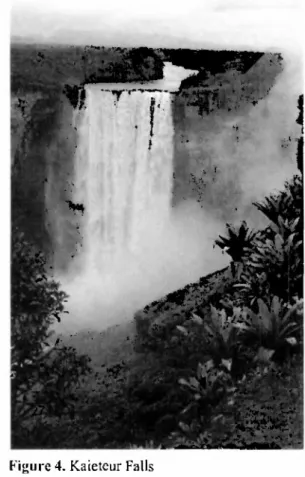
The team departed Kato by small plane on March 29, sharing the flight with two female traders returning with their hoard of Brazilian toilet paper, soap, and spades. Hahn returned to Georgetown, while the rest of the team was dropped off in Kaicteur National Park. Gillespie took over as leader for the Kaieteur section of the trip (March 29-April 1). The team settled in for a three-night stay at the Resthouse overlooking spectacular Kaieteur Falls (figure 4). The surroundings were a botanist's paradise, with giant mauve bladderworts (Utricularia humboldtii, plate 4) emerging from huge terrestrial bromeliads (Brocchinia micraniha),
16
Guyana Plant Collections: L.J. Gillespie
numerous orchids and Rapateaceac (plate 3), to mention just a tiny part of the Park's incredible diversity of plants.
Figure 4. Kaieteur Falls
Trios 5 and 7: Georgetown Vicinity. 14 April and 30 April 1989
These were day trips from Georgetown to the mouth of the Essequibo River, in the region called West Coast Demcrara. Collections were made in disturbed forest and scrub near the coast.
Trio 6: Mainstay - Pomeroon River. 20 to 26 April 1989
Gillespie and Harry Persaud departed Georgetown on April 19 for a wecklong trip to Mainstay and the Pomeroon River. They traveled by ferry across the Essequibo Delta to Adventure, and then by taxi north along the coast to Anna Rcgina, the Administrative Centre of Region 2 (Pomeroon-Supenaam). After obtaining all the necessary permits, they continued on to Mainstay, an Arawak Amerindian village, which was their base for the
next three days. Collections were made in the surrounding white sand forest and by boat in and along the shores of a series of lakes: Mainstay, Capoey and Tapakuma. They returned to Anna Regina where they were based for the next couple of days. One long, enjoyable day was spent collecting from a small speedboat along the margins of a riparian swamp forest on the Pomeroon River, running from Charity 14 miles uprivcr to the Arapiako River.
Trip 8: Kaieteur, 5 to 8 May 1989
After almost missing a chartered plane, the team departed Georgetown on May 4 for a scenic flight to Kaieteur under clear skies. The team included S. Tiwari (Herbarium, University of Guyana), Ron and Madge Gillespie (the collector's parents from Canada). Soon after arriving, Lynn Gillespie collapsed in the Resthouse with the flu, leaving Tiwari and Ron Gillespie to tackle the plant collecting for the first few days. The numerous bags of plants they hauled in kept Madge and Lynn Gillespie busy pressing and numbering on the Resthouse veranda, with one of the best views in the world.
Once recovered, Lynn Gillespie and Tiwari joined the Guesthouse caretakers for a boat trip on the Potaro River and some excellent collecting in the riparian forest. Paddling within sight of the top of Kaieteur Falls, much loo close for the collectors' comfort, the water was amazingly calm and peaceful, with the roar of the waterfall and the rising mist not far away.
One of the most common riparian shrubs was
"whitcy" {Inga seriulifera, Fabaceae, Mimosoideae), a favorite local edible. The shrubs were laden with plump yellow pods, which have a tasty white flesh around the seeds.
On May 9, the day of departure, the team waited hours beside the tarmac runway surrounded by endemic savanna plants. The plane finally arrived at the far end of the runway, unloaded a huge pile of beer, and almost took off without the team but with a full load of other passengers, until the pilot realized who had actually chartered the plane. After the plane was unloaded for a second time the team piled in for a stormy, rough ride back to the city.
Trip 9: Omai - Essequibo River, 27 May to 6 June 1989
This 10-day trip (May 26 to June 5) to Omai was organized courtesy of Placer Dome, a gold mining company. Gillespie and Harry Persaud joined geologist Randy Singh for the 4-hour drive south on roads of exponentially decreasing quality. A very narrow, waterlogged track through dense forest finally led to Yaya Landing on the Essequibo River. After waiting out a downpour, the team traveled by boat upstream and across the river to Omai Camp. At the time of the visit Omai was a small mining exploration and survey camp sitting on a rich gold deposit (the gold apparently found in quartz veins of a diorite intrusion). The rolling terrain was explored using the numerous rough tracks and paths that criss-crossed the 36 km2 area.
Although mostly covered in forest on red lateritic soils, there had been many disturbances by previous small mining activities and selective logging.
Figure 5, The Essequibo River at Omai
There was excellent collecting by boat along the mostly densely forested banks of the Essequibo River. The water level was high, inundating much of the shoreline vegetation.
Although few trees or shrubs were flowering, fruits were abundant. The team explored a tributary creek through the inundated forest, where most shrubs and trees grew in over a meter of water and each appeared to harbour a major ant nest. The team members had never seen such a high density of ants on vegetation!
Cut branches had to be dunked in the creek to get rid of hundreds of ants, while all had to brush hundreds off of themselves. The seemingly perpetual newspaper shortage once again curtailed collecting for the last couple of days.
By the time of departure, Yaya Landing was
underwater. The pickup truck backed into the river, the boat pulled alongside and all jumped aboard for the bumpy ride back to town.
Trip 10: Kanuku Mountains - Rupununi Savanna, 17 June to 7 July 1989
The team included D. Gopaul (Herbarium, University of Guyana), Paul Peterson (Botanist, Poaceae specialist, SI) and Laurccn Pierre (Amerindian Research Unit, University of Guyana). After a two-day delay the team finally departed on June 16 in an Islander airplane for a three-week trip in the Rupununi savannas. The destination was Dadanawa, a cattle ranch in the southern Rupununi savannas, but reports of rain and a wet, muddy landing strip forced the plane to land instead at Lethcm, administrative centre of Region 9 and the major town of Southern Guyana. Thinking that they would have to stay in Lethem for several days, they were very pleasantly surprised at the unexpected arrival of Sandy deFreitas, co-owner of Dadanawa, who had come to town to shop and meet the team.
All squished into the small pickup truck for the 5-hour ride to Dadanawa on a dirt track, crossing numerous creeks on rickety log bridges and through many deep puddles. This was the rainy season in the Rupununi Savannas, the one area of Guyana with very distinct wet and dry seasons.
Comfortably settled into the Dadanawa guesthouse and well fed on beef three times a day, the team explored the surrounding savanna and the riparian zone along the adjacent Rupununi River. Collections were also made in a "bush island", an area of forest on drier, somewhat elevated land, surrounded by savanna.
To reach the next destination, Sand Creek Village, Gillespie traveled with the supplies by boat down the Rupununi River, while the others hiked and botanized. The team was based in a small house kindly provided by the village, from where they explored the adjacent, partly flooded savannas. Two schoolboys led the team up Baboon Hill, a granitic rock outcrop with a completely different flora, including cacti, gesneriads {Sinningia, plate 5), bromeliads and Gentianaceae. That night, the eve of June 24, the team joined the entire village in their St. John the Baptist celebrations, which involved a large bonfire, running over the bed of glowing coals at the stroke of midnight, all followed by a party
Guyana Plant Collections: L.J. Gillespie
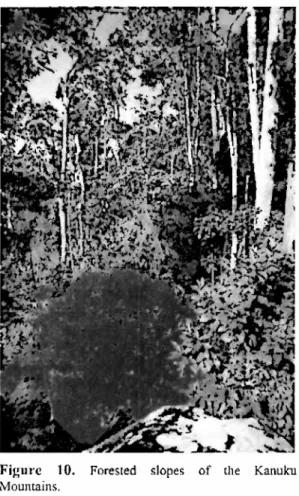
with Brazilian music and salsa dancing. The next day the team set off on a 4-day trip into the southeastern part of the Kanuku Mountains with guides Alcidio, Stanislaus, Christy and Cashmire. They hiked over partly flooded, very muddy savanna, through forest with scattered bush farms, and up densely forested slopes, finally emerging onto an extensive upland savanna. Base camp was established on this dry rolling savanna near a creek bordered by a low gallery forest. One long day was spent exploring nearby Mt. Ishtaban, climbing through mesic forest on the lower slopes to granitic cliffs and an almost impenetrable thicket near the summit.
t.wt*
sTr^
Figure 6. Plant collecting on the Rupununi Savanna.
On the day of return to Sand Creek, the guides rose very early to return to a patch of Ischnosiphon (Marantaceae) seen previously, returning at breakfast time with two new backpack frames (warishis) with which to carry the heavy loads of pressed and preserved plants.
For the last part of the trip Gillespie returned to Dadanawa and collected on the surrounding, botanically rich savanna, bush islands and rocky outcrops, while Peterson and Gopaul ventured further south in search of new grasses. Note that grasses collected on this trip arc included in Peterson's number series (7495-7646).
Trip 11: Aurora - Cuyuni River. 3 to 20 October 1989
The seventeen day trip to Aurora was organized courtesy of the mining company, Dennison Mines. Departing October 3, at the start of an early rainy season, Gillespie and Tiwari traveled by the large GDF helicopter over the Essequibo River and up the winding, milky brown Cuvuni River for about 110 miles, They
landed at Aurora, an abandoned gold mine that had operated during the 1940's. Dennison had recently established an exploration camp here, the base camp consisting of six large wood frames covered with tarps in a small clearing on the banks of the Cuyuni River. Comfortably settled in, the team explored the surrounding area, a patchwork of mature and disturbed, non- flooded rainforest and seasonally flooded riparian forest (including Brownea, plate 8).
Each day they ventured further afield on several recently cleared tracks and new survey lines through the forest, usually making it back to camp before the frequent afternoon thunderstorms and heavy downpours. Canopy trees swayed and groaned in the strong winds, with several falling quite close to the team, providing excellent canopy collecting. The team collected extensively by boat in the riparian forests (Mora, Inga, and Triplaris) along the banks of the Cuyuni River and its maze of islands, channels and tributaries.
Departure was delayed several days since the helicopter was not available. Instead, Dennison made arrangements with a local boat captain for the trip back to Georgetown. Early in the morning under cool, gray skies, several Dennison staff members and team departed in a large, open wooden boat for the long trip downriver. Passing numerous gold dredges while sheltering from torrential downpours under tarps, the first part of the trip went smoothly.
Then after passing over a series of small rapids, the boat arrived at Kamaria Falls, a long set of rapids. With three large outboard engines at full speed, the laden boat flew off each wave crest, crashing into the next wave, with the spray drenching all aboard. The boat and crew arrived safely in Bartica in the early evening and continued on to Georgetown the following morning.
Trip 12: Canie River. 27 to 31 October 1989 Lynn Gillespie and George Bacchus organized the trip up the Canje River. The team included Gillespie, Carol Kelloff (BDG Program Coordinator), Bacchus (retired surveyor and experienced boatman) and S. Tiwari.
Arrangements were made in New Amsterdam for the rental of a boat and engine. After leaving the New Amsterdam vicinity with its sawmills and houses, the team began collecting plants along
the river's edge in what Bacchus called the "new forest area". In order to make the Ikawaru
"stelling bon," or boat house, by dark, collecting had to be cut short for the day and the team just watched the river flow by. The next morning they continued up the Canje River. Talking was almost impossible over the roar of the motor, so Bacchus was signaled by hand when the team wanted to stop to collect. Collecting continued along the river until reaching the Digitima Savanna, also locally called the "cow savanna,"
several miles south of Mora.
Figure 7. Palicourea rigida Kunth, on the Canje savannas. Gillespie, Kclloff & Tiwari 2516.
The white sands of this area support a grass/sedge flora with bush islands of scrub and small trees. According to Bacchus, feral cows roamed the savanna. No cows were apparent, but the "cow flop" indicated that they had passed through recently. Although on first inspection the flora of the savanna looked homogeneous, this was not the case. There were actually many micro-habitats and one did not have to travel far to sec a new assemblage of herbs. The savanna was extensive, and in the distance the vegetation's color varied. In some instances this indicated a damp depression supporting huge populations of Bulbostylis and other sedges. The bush islands also varied. Some were stands of Mauritia palms surrounded by a dense growth of ferns, while others were dominated by Fabaceae trees with little undcrstory. One morning a stinkhorn fungus was found growing in cow dung. Its cap had long, thin, pale arms radiating out like those of a brittle starfish; its center was brown and viscous and was visited by many flies. By late morning the heat of the day had withered this stinkhorn to nothing.
Armadillos ran through the grasses of the savanna. The black flics were merciless, constantly flying into every orifice of the face.
Their bites did not sting, but by the end of the day any exposed skin was covered with red welts. October is generally a dry month, but the team experienced several light rains. These brought out another group of biting flics called
"kabaras". From dusk until dawn these tiny flies bit with such ferocity that all were driven into their mosquito nets. Ant hills, formed of soil piled a foot high and two to three feet wide, dotted the savannas. The "crater" in the center led to a 3 inch hole where ants moved in and out of the nest. Soldiers stood at various points on the nest, moving only at signs of danger. Both termite and ant nests were common on trees and below ground.
On the trip back to New Amsterdam, the team stopped on the other side of the Canje River at another expanse of savanna known as Long Savanna. Here they collected the carnivorous plants Drosera and several species of Utricitlaria as well as two species of Polygala different from those of Digitima Savanna. More riparian trees were collected while moving down the river. The team spent another night at the Ikawaru stelling bon. Gas for the boat's motor was in short supply, so collecting along the river was discontinued on the last segment of the trip.
Trips 13.14.15: Georgetown Vicinity, 25 November, 1 December and 8 December 1989
Trip 13 was a local collecting trip in Georgetown. Trips 14 and 15 were day trips from Georgetown. The first was to mangrove swamps and disturbed shorelines in the East Coast Demcrara area east of Georgetown. The second trip was to dry evergreen forest on white sand along the Socsdyke-Lindcn Highway south of Georgetown.
Trip 16: Imbaimadai-Karowrieng River. 14 to 29 December 1989
Team members Gillespie, D. Smart (University of California) and camp manager George Bacchus traveled by small plane to Imbaimadai, for an 18 day trip in the northwest Pakaraima Mountains. Imbaimadai, a local gold dredging and panning centre, is located on the upper Mazaruni River in a broad upland valley
20
Guyana Plant Collections: L.J. Gillespie
surrounded by sandstone mountains. The team first explored the white sand savannas and low evergreen forest surrounding the village. They then traveled by boat up the Karowrieng River to Maipuri Falls (plate 6), where they established a base camp in a clearing below the Falls.
From their base camp, a simple wood frame covered with a tarp, the team explored and collected. The surrounding lower montane forest was wet, lush, and medium-height due to shallow soils, with aroids and Cyclanthaceae common in the understory. South of camp was a shrub savanna on sandstone outcrops. Having explored the area accessible from camp, Gillespie and Smart hiked back to Imbaimadai, collecting along the way, to make arrangements for guides. With two Amerindian guides, the team climbed the steep sandstone escarpment south of camp. Collections were made in an interesting shrub savanna community on top of a large, flat topped, isolated pinnacle on the very dissected escarpment edge. Located on a rock face at the base of the escarpment were the ancient Timehri rock paintings. Following obscure trails through dense wet forest, they explored the mountainous area north and west of camp. Moving quietly through the forest, the team was able to closely approach a Cock-of-the-rock, a spectacular bird endemic to the Guiana region. On their return to Imbaimadai, the team collected along the way in the diverse mosaic of savanna and forest between the Karowrieng and Partang Rivers. From Imbaimadai, the team made a long one-day trip by boat up the Mazaruni River, collecting in the bordering gallery forest.
Trip 17: Ituni Savannas, 16 to 19 January 1990 This was a four day trip to the Ituni Savannas, a southern extension of the
"Intermediate Savannas" located southeast of Ituni about 150 km south of Georgetown. The team was comprised of Gillespie, Tiwari, Vicki
Funk and Tim McDowell (the new BDG plant collector). Collections were made in white sand savanna and open forest.
Trips 18 &. 19: Kuru-Kuru Creek - Lamaha Canal; KaJeteur, 10 to 11 November and 16 to 19 November 1991
Though her full year of work for the Smithsonian ended in January 1990, Gillespie returned to Guyana in November 1991. She made two day trips from Georgetown, the first south to evergreen forest and shrub on white sand, the second east to the Lamaha Canal near Mahaica. A five day trip was made to Kaieteur National Park. Collections were made of the riparian vegetation and aquatic plants along the Potaro River, mostly above the Falls, upstream 15 km to the first set of rapids. She also explored the shrub savannas on sandstone bedrock west of the airstrip, where a euphorb tree {Peru bicotor, figure 8) was discovered in full bloom, completely covered in small fragrant yellow blossoms (actually pscudanthia made up of tiny staminate flowers enclosed in globose bracts).
Figure 8. Gillespie 4300, Pera bicolor (Klotzsch) Miill. Arg. (Euphorbiaceae).
II: COLLECTION LOCALITIES
Trip Number 1 : Flagstaff-Mahaica Collections: 700-707. 19 February 1989 East coast Demerara, Cane Grove Conservancy, Flagstaff. 19 February 1989.
06°38*N 057°56'W, Elevation 0 m.
Disturbed vegetation. Shrubs and small trees along canal.
Collections: 700 - 706. Collected with S. Tiwari.
Hope Beach, 8 km NW of Mahaica. 19 February 1989.
06°45'N 057°57'W, Elevation 0 m.
Sand beach.
Collections: 707 - 707. Collected with S. Tiwari.
Trip Number 3 : Loo Creek Collections: 764-827. 2 March 1989 3-4 km S of Loo Creek along Linden Highway,
±32 km S of Timehri. 2 March 1989.
06°12'N 058°15'W, Elevation 5 m.
Sclerophyllous forest on white sand.
Collections: 764 - 790. Collected with S. Tiwari.
1 -2 km S of Loo Creek on Linden Highway;
along forest trail 0-1 km from highway. 2 March 1989.
06°13'N 058°15'W, Elevation 10 to 20 m.
Sclerophyllous forest on white sand.
Collections: 791 - 803. Collected with S. Tiwari.
Trip Number 2 : Linden Highway Collections: 708-763. 24 February 1989 Linden Highway near Kuru Kum Creek, ±9 km S of Timehri. 24 February 1989.
06°25"N 058°15'W, Elevation 10 to 20 m.
White sand savanna with scattered shrubs and trees.
Collections: 708 - 712. Collected with S. Tiwari;
H. Lall.
Linden Highway, between Kuru Kuru Creek and Loo Creek. 24 February 1989.
06°26'N 058°15'W, Elevation 10 m.
Sclerophyllous forest on white sand and road edge.
Collections: 713-716. Collected with S. Tiwari;
H. Lall.
Linden Highway, near turnoff to St. Cuthbert's Mission. 24 February 1989.
06°28'N 058°16'W, Elevation 5 to 20 m.
Savanna and scrub on white sand.
Collections: 717 - 753. Collected with S. Tiwari;
H. Lall.
Near Timehri airport. 24 February 1989.
06°30'N 058°) 5'W, Elevation 0 to 20 m.
Forest.
Collections: 754 - 763. Collected with S. Tiwari;
H. Lall.
About 8 kmN of Loo Creek along Linden Highway. 2 March 1989.
06o18'N058°14'W, Elevation 10 to 20 m.
Sclerophyllous forest on white sand.
Collections: 804 - 808. Collected with S. Tiwari.
Near Timehri airport. 2 March 1989.
06*30'N 058°15'W, Elevation 5 to 20 m.
Edge of swamp forest.
Collections: 809 - 827. Collected with S. Tiwari.
Trip Number 4 : Kato - Kaieteur Collections: 828-992. 17 March 1989 to 1 April 1989
2-3 kmN of Kato Village store-airstrip; off Kato-Kurukabaru road. 17 March 1989.
04o41'N 059°48'W, Elevation 690 to 750 m.
Along small forest trail. Low-medium height semi-evergreen forest.
Collections: 828 - 849. Collected with H.
Persaud.
1-2 km N of Kato Village store-airstrip; along trail off Kato-Kurukabaru road. 18 March 1989.
04°39'N 059°49'W, Elevation 690 m.
Low-medium height semi-evergreen forest.
Collections: 850 - 868. Collected with II.
Persaud.
1-3 km NNE of Kato along trail to Paramakatoi.
19 March 1989.
22
Guyana Plant Collections: L.J. Gillespie
04°39'N 059°49'W, Elevation 675 m.
Secondary forest and scrub on steep NE facing hillside.
Collections: 869 - 879. Collected with H.
Persaud.
2-2.5 km W of Kato, along Chiung River just
•downstream of large waterfall. 25 March 1989.
04D40'N 059°50'30"W, Elevation 650 to 675 m.
Riparian forest on steep slope above river.
Collections: 880 - 891. Collected with H.
Persaud.
Kaieteur National Park, between airstrip and escarpment. ENE of airstrip. 29 March 1989.
05°1 IN 059°29'W, Elevation 450 m.
Savanna.
Collections: 892 - 920. Collected with H.
Persaud.
Kaieteur National Park, between airstrip and escarpment. ENE of airstrip. 30 March 1989.
05°1 l'N 059°29'W, Elevation 450 m.
Savanna.
Collections: 921 - 957. Collected with H.
Persaud.
Kaieteur National Park, 1st 2 km of Tukeit trail, 0-2 km from Guest House. 31 March 1989.
05°1 l'N 059°29'W, Elevation 450 m.
Low-medium evergreen forest.
Collections: 958 - 988. Collected with H.
Persaud.
Kaieteur National Park in the vicinity of the airstrip. 1 April 1989.
05° 1 l'N 059"29'W, Elevation 450 m.
Collections: 989 - 992. Collected with H.
Persaud.
Trip Number 5 : Naamryck Canal Collections: 993-1042. 14 April 1989
Trip Number 6 : Mainstay - Pomeroon R.
Collections: 1043-1217. 20 April 1989 to 26 April 1989
Mainstay Village. 20 April 1989.
07°15'N 058°32'W, Elevation 0 to 20 m.
Low semi-evergreen forest on white sand. Forest floor dry.
Collections: 1043 - 1066. Collected with H.
Persaud.
Mainstay Lake, along shore opposite Mainstay Village. 21 April 1989.
07°15'N 058°32'W, Elevation 0 to 10 m.
Open scrub-forest on white sand.
Collections: 1067 - 1078. Collected with H.
Persaud.
Mainstay Village. 21 April 1989.
07°15'N 058°32'W, Elevation 0 to 10 m.
Collections: 1079 - 1086 ; 1099-1105. Collected with H. Persaud.
Mainstay Lake. 21 April 1989.
07°15'N 058°32'W, Elevation 0 to 10 m.
Marsh.
Collections: 1087 - 1098. Collected with H.
Persaud.
Mainstay Lake; shore opposite Mainstay Village.
21 April 1989.
07°15'N 058°32'\V1 Elevation 0 to 10 m.
Forest on white sand.
Collections: 1106-1111. Collected with H.
Persaud.
Red Lock ± 5 km WSW of Anna Regina. 22 April 1989.
07°14'N 058°31'W, Elevation 0 to 10 m.
Disturbed scrub along canal bank.
Collections: 1112-1112. Collected with H.
Persaud.
Naamryck Canal; ±3.5 km SW of Parika. 14 April 1989.
06=50'N 058=27'W, Elevation 0 m.
Disturbed forest and scrub along track by canal.
Collections: 993 - 1042. Collected with D.
Gopaul.
Capoey Lake, near dam at E end, ±5 km W of Queenstown. 22 April 1989.
07°12'N 058°32'W, Elevation 0 to 10 m.
Collections: 1113-1114. Collected with H.
Persaud.
Capoey Mission, west shore of Capoey Lake, ±5 km W of Queenstown. 22 April 1989.
07°12'N 058°32'W, Elevation 0 to 10 m.
Beach, on dry white sand.
Collections: 1115-1139. Collected with H.
Persaud.
07°01'N 058°29'W, Elevation 0 m.
Collections: 1170 - 1170. Collected with H.
Persaud.
Capoey Lake, dam at eastern end, ±5 km W of Queenstown. 22 April 1989.
07"12'N 058°32'W, Elevation 0 to 10 m.
Collections: 1140 - 1141. Collected with H.
Persaud.
Main canal, between Capoey Lake and Red Lock. 22 April 1989.
07°13'N 058U31'W, Elevation 0 to 10 m.
Forest edge along canal.
Collections: 1142 - 1144. Collected with H.
Persaud.
Mainstay Village. 23 April 1989.
07°15'N 058°32'W, Elevation 0 to 10 m.
Collections: 1145 - 1146. Collected with H.
Persaud.
Aruka, SW shore of Tapakuma Lake. 23 April 1989.
07°15'N 05834'W, Elevation 0 to 10 m.
Low moist forest.
Collections: 1147 - 1154. Collected with H.
Persaud.
Tapakuma Lake. 23 April 1989.
07°15'N 058°34'W, Elevation 0 to 10 m.
Marsh at southern end.
Collections: 1155 - 1160. Collected with H.
Persaud.
Wyaka, SE shore of Tapakuma Lake. 23 April 1989.
07°I5'N 058°33'W, Elevation 0 to 10 m.
Low-medium evergreen forest. Soil-brown sand with some clay.
Collections: 1161 - 1168. Collected with H.
Persaud.
Along road between Wyaka and Mainstay. 23 April 1989.
07°15'N 058°32'W, Elevation 0 to 10 m.
Low-medium evergreen forest. Soil-brown sand with some clay.
Collections: 1169 - 1169. Collected with H.
Persaud.
Anna region, along canal by rice mill. 23 April 1989.
Pomeroon River between Charity and Araplako River. 24 April 1989.
07°23'N 058°36'W, Elevation 0 m.
Swamp forest bordered by Rhizophora &
Montrichardia.
Collections: 1171 - 1205. Collected with H.
Persaud.
Araplako River, near confluence with Pomeroon River. 24 April 1989.
07°15'N 058°38'W, Elevation 0 m.
Collections: 1206 - 1208. Collected with H.
Persaud.
Vicinity of Charity, trail along Pomeroon R, just N of Charity. 25 April 1989.
07°23TST 058°36'W, Elevation 0 m.
Narrow strip of swamp forest. Between river and cultivated land.
Collections: 1209 - 1212. Collected with H.
Persaud.
Adventure. 26 April 1989.
07°05'N 058°29'W, Elevation 0 m.
Roadside scrub.
Collections: 1213 - 1217. Collected with H.
Persaud.
Trip Number 7 : West Coast Demerara Collections: 1218-1228.30 April 1989 Between Uirvlugr and Tuschen. 30 April 1989.
06°52'N 058°18'W, Elevation 0 m.
Disturbed forest along old road by coast.
Collections: 1218- 1221. Collected with M.E.
Gillespie; R.J. Gillespie.
Naamryck Canal, 3.5 km SW of Parika. 30 April 1989.
06°50'N 058°27'W, Elevation 0 m.
Disturbed forest & scrub along coast at canal entrance.
Collections: 1222 - 1228. Collected with M.E.
Gillespie; R.J. Gillespie.
Trip Number 8 : Kaieteur
Collections: 1229-1402. 5 May 1989 to 8 May 1989
24
Guyana Plant Collections: L.J. Gillespie
Kaietcur National Park, S of guest house. 5 May 1989.
05°10'30"N 059o29'W, Elevation 420 to 450 in.
Low evergreen forest.
Collections: 1229 - 1279. Collected with S.
Tiwari; M.E. Gillespie; R.J. Gillespie.
Kaieteur National Park. Trail between guest house and Johnson's View. 6 May 1989.
05°10'30"N 059°29'W, Elevation 420 to 450 m.
Collections: 1280- 1296. Collected with S.
Tiwari; M.E. Gillespie; R.J. Gillespie.
Kaieteur National Park. 6 May 1989.
05°10'30"N 059°29'W, Elevation 420 to 450 m.
Wet, low evergreen forest on white sand.
Collections: 1297 - 1320. Collected with S.
Tiwari; M.E. Gillespie; R.J. Gillespie.
Kaieteur National Park. 7 May 1989.
05°10,30'*N 059Q29'W, Elevation 420 to 450 m.
Plants growing in crack in rock cliff by falls.
Collections: 1321 - 1352. Collected with S.
Tiwari; M.E. Gillespie; R.J. Gillespie.
Kaietcur National Park, along Potaro R., 0.5-2 km upstream of Kaieteur Falls. 8 May 1989.
05°I0'30"N 059°29'W, Elevation 420 m.
Riparian forest along black water river.
Collections: 1353 - 1389. Collected with S.
Tiwari; M.E. Gillespie; R.J. Gillespie.
Kaietcur National Park. 8 May 1989.
05° 1 OWN 059°29'W, Elevation 420 m.
Forest trail through disturbed evergreen forest.
Collections: 1390 - 1395. Collected with S.
Tiwari; M.E. Gillespie; R.J. Gillespie.
Kaieteur National Park, S of guest house. 8 May 1989.
05° I OWN 059°29'W, Elevation 420 to 450 m.
Evergreen forest.
Collections: 1396 - 1402. Collected with S.
Tiwari; M.E. Gillespie; R.J. Gillespie.
Trip Number 9 : Omai - Esscquibo River Collections: 1403-1602. 27 May 1989 to 6 June 1989
Essequibo R., between Omai and Dennison Mine Camp (near Kumaka River). 27 May 1989.
05°21'N 058°45'W, Elevation 10 to 15 m.
Partly inundated riparian forest. Dominated by tall evergreens.
Collections: 1403 - 1436. Collected with H.
Persaud.
Essequibo River near Dennison Mine camp. 27 May 1989.
05°21'N 058°48'W, Elevation 10 to 15 m.
Tall evergreen forest.
Collections: 1437 - 1439. Collected with H.
Persaud.
Essequibo River between Omai and Dennison Mine Camp, near Kumaka Falls. 28 May 1989.
05°21'N 058°45'W, Elevation 10 to 15 m.
Partly inundated riparian forest, tall evergreen.
Collections: 1440 - 1466. Collected with H.
Persaud.
Omai, along Main Access Road between Esscquibo R. and first clearing, 29 May 1989.
05°26'N 058°46'W, Elevation 30 to 60 m.
Tall evergreen forest on red lateritc.
Collections: 1467 - 1492. Collected with H.
Persaud.
Omai, SW clearing. 30 May 1989.
05°26'N 058°46'W, Elevation 30 m.
Edge of disturbed evergreen forest on red Iaterite.
Collections: 1493 - 1498. Collected with H.
Persaud.
Omai, track between SW clearing and Omai River. 30 May 1989.
05°26'N 058°46'W, Elevation 30 m.
Forest on red Iaterite.
Collections: 1499 - 1501. Collected with H.
Persaud.
Omai, First Clearing. 30 May 1989.
05°26'N 058°46'W, Elevation 45 to 55 m.
Secondary vegetation of shrubs and small trees.
Red Iaterite.
Collections: 1502 - 1504. Collected with H.
Persaud.
Omai, "Ridge Road" between Main Access Road and Gilt Creek. 30 May 1989.
05°26'N 058°46'W, Elevation 45 to 60 m.
Tall evergreen forest on red Iaterite.
Collections: 1505 - 1507. Collected with H.
Persaud.
Omai, off "Ridge Road", near Gilt Creek. 30 May 1989.
05°26'N 058°46'W, Elevation 45 to 60 m.
Tall evergreen forest on red laterite.
Collections: 1508 - 1525. Collected with II.
Persaud.
Omai, Red Hill Clearing. 31 May 1989.
05°26'N 058°46'W, Elevation 45 to 59 m.
Secondary vegetation of shrubs and scattered trees. Red laterite.
Collections: 1526 - 1529. Collected with II.
Persaud.
Omai, track between Red Hill Clearing and Omai River. 31 May 1989.
05°26'N 058-46'W, Elevation 30 to 60 m.
Tall evergreen forest. Moist shady bank. Red laterite.
Collections: 1530 - 1545. Collected with H.
Persaud.
Essequibo River, 6-8 km downstream of Omai. 1 June 1989.
05°26*N 058°42'W, Elevation 10 to 15 m.
Inundated forest along small tributary creek.
Collections: 1546 - 1583. Collected with H.
Persaud.
Omai, along track on ridge between Main Access Road and Dunclair Pond. 2 June 1989.
05°26'N 058°46'W, Elevation 50 to 100 m.
Tall evergreen forest on red laterite.
Collections: 1584- 1592. Collected with H.
Persaud.
Omai, along track on ridge between Main Access Road and Dunclair Pond. 3 June 1989.
05°26*N 058"46'W, Elevation 50 to 100 m.
Tall evergreen forest on red laterite.
Collections: 1593 - 1594. Collected with H.
Persaud.
Omai, along Main Access Road, between Essequibo River and first clearing, 3 June 1989.
05°26'N 058°46'W, Elevation 30 to 60 m.
Forest on red laterite.
Collections: 1595 - 1601. Collected with H.
Persaud.
Omai, along track on ridge between Main Access Rd. and Dunclair Pond. 4 June 1989.
05°26'N 058°46'W, Elevation 50 to 100 m.
Forest on red laterite.
Collections: 1602 - 1602. Collected with H.
Persaud.
Trip Number 10 : Kanuku Mountains - Rupununi Savanna
Collections: 1603-2041. 17 June 1989 to 7 July 1989
South Rupununi savanna, Dadanawa. 17 June 1989.
02°50'N 059°31'W, Elevation 100 to 120 m.
Riparian woodland and scrub along Rupununi River. Sandy soil.
Collections: 1603-1651. Collected with D.
Gopaul; P. Peterson.
Rupununi savanna, Natun Bush Island, ±2 km SSW of Dadanawa. 18 June 1989.
02°49'N 059°28,W, Elevation 120 to 150 m.
Small creek near "bush island".
Collections: 1652 - 1699. Collected with D.
Gopaul; P. Peterson.
Sand Creek Village, 3 km E of junction of Rupununi & Katawau Rivers. 1 km S of village.
21 June 1989.
03"00'N 059°31 'W, Elevation 100 m.
Partially inundated savanna. White sand-clay soil.
Collections: 1700 - 1715. Collected with D.
Gopaul; P. Peterson.
Baboon Hill, ±1.5 km S of Sand Creek Village.
21 June 1989.
03°00'N 059o31'W, Elevation 120 to 150 m.
East slope. Forest-savanna edge, with large scattered rock outcrops.
Collections: 1716 - 1741. Collected with D, Gopaul; P. Peterson.
Sand Creek Village. Between village and Katiwau River. 22 June 1989.
03°00'N 059-3l'W, Elevation 120 to 150 m.
Savanna.
Collections: 1742 - 1752 ; 1772a, 1772b.
Collected with D. Gopaul; P. Peterson.
Sand Creek Village. Along Katiwau River. 22 June 1989.
03°00'N 059*31'W, Elevation 120 to 150 m.
Gallery forest.
26
Guyana Plant Collections: L.J. Gillespie
Collections: