The initial study was supported by the Grants Office of Charles University in Prague (GAUK) with the project “Measuring Social Capital – The Czech Case” (No. 126507). A very well-known example of the problems in forming and applying theories is the lively discussion about the phenomenon of social capital.
How to Construct a Theory?
Because social capital is an entity of social relations, it is a relatively stable phenomenon and allows the construction of a theory. Sociology textbooks have been published in the past; recently, the first "Handbooks of social capital" were published (Castiglione et al. 2008; Svendsen, Svendsen 2009) showing its importance.
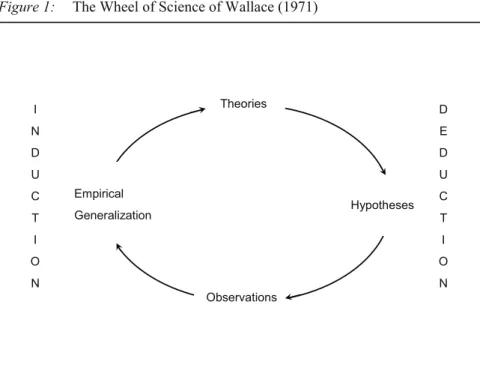
Outline of the Monograph
Chapters 9 to 12 are organized according to the improved model of social capital revealed in the first part of the monograph. It measures diversity according to sociodemographic characteristics in the respondent's circle of friends (Chapter 11).
Social Capital Concepts
Bourdieu’s Concept of Social Capital
- General
- Economic Capital
- Cultural Capital
- Social Capital
Accordingly, incorporated cultural capital reveals one weakness: it is tied to the biological limits of the person who possesses it. The profitability of labor from the accumulation of social capital increases proportionally to the amount of social capital (Bourdieu.
Coleman’s Concept of Social Capital
- General
- Kinds of Social Capital
Each type of social capital depends on the stability of the social structure or relationships. Actor B in this case has social capital in the form of control rights (Coleman 1995: 404).
Discussion of the Concepts
Organizations that produce a private good are a type of social capital whose profits flow directly to the investor. The vague definition of social capital means that the term can be used in various situations (Portes 1998: 5; Schuller et al. 2000: 7).
Conclusions – The Basics of Social Capital Theory
Concepts are presented and discussed according to their ability to serve as a theory of social capital. We use the results of the discussion to refine our requirements for a theory of social capital.
The Theoretical Concept of Social Capital
- General
- Elements of Social Capital
- Characteristics of Social Capital
- Bridging vs. Bonding Social Capital
- Critiques to Putnam's Concept
Putnam discusses the impact of social capital at the macro level of countries and regions (Krätke 2001: 162). He is concerned with the impact of social capital on politics and on society as a whole.
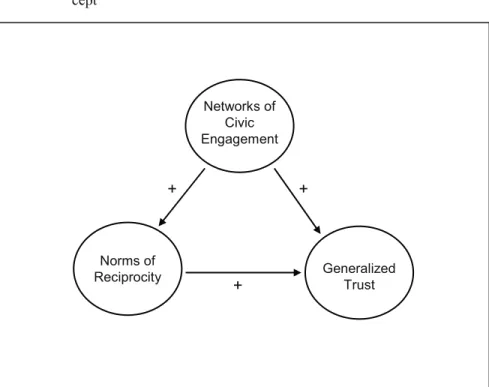
Empirics of Social Capital in Putnam’s Tradition
- Putnam’s Study
- Does Social Capital Positively Influence Political Stability
- Does Putnam's Social Capital Concept Hold up to
- Why Are the Results Confusing?
- How to Revise Putnam’s Concept?
Paxton (2002) analyzed the mutual influence of social capital and democracy using data from the WVS which measures social capital using the aggregated average number of memberships in voluntary associations and unpaid volunteer work and the percentage of individuals in each country who believe that others be confident. (generalized trust). However, the studies presented often use only one item measure of social capital (except Uhlendorff (2004)). For example, Beugelsdijk and Smulders (2003) analyzed the effects of bridging and connecting social capital in 54 regions using data from the European Values Study (EVS) 1999 on bridging social capital (membership in bridging groups42), connecting of social capital and connecting social capital.

Conclusion – How Does Putnam's Social Capital Concept
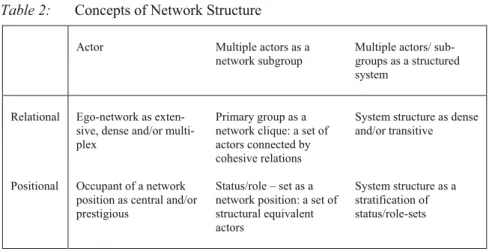
The first was to conceptualize social capital as a multidimensional construct with a structural as well as a cultural dimension. Social capital is a structural asset of networks with the character of a private and public good. Finally, we will conclude how Burt's concept contributes to a general theory of social capital.
General
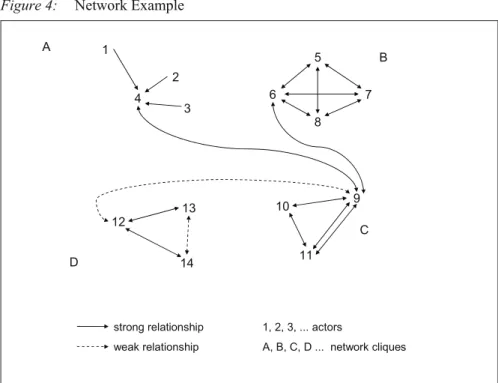
The ego network of actor 12 consists, for example, of the relationships with actors 9, 13 and 14 and the relationships between these actors. In figure 4, the density of the relationships is indicated by the thickness of the line. In figure 4, actor 4 is central in network clique A, because he/she is the target of the strong relationships of actors 1, 2 and 3.
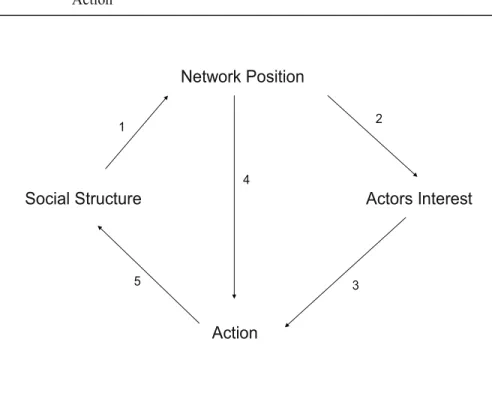
Structural Holes
If no structural holes remain, an actor has the option of creating one to gather information and control benefits. The more ties that span the structural holes, the lower the use of an additional bridge (Burt 2001a: 230). The level of structural autonomy increases with the lack of structural holes around the given actor and decreases with the lack of structural holes around the actor's contacts (Burt 1992: 72).
Critiques to Burt's Concept
However, the results regarding both types of social capital on political and economic performance are ambiguous (see Chapter 3). Fourth, because of his preference for open structures, Burt does not refer to negative effects of social capital. However, his studies deal with the unequal distribution of social capital as we will also focus on in the next section.
Empirical Results of Social Capital Research in Burt's Tradition
- Burt's Studies
- Does Burt's Concept Hold up to Empirical Testing?
- Critiques – Why Do We Find these Different Results?
- Excursus: Closure and Its Advantages in Coleman’s
- Closure or Structural Holes. Which Network Characteristic
The amount of structural holes in different areas of specialization was measured using Burt's restriction index. The structural holes involved provide advantages for innovation (Frankort 2008), but also reduce the output of innovation (Ahuja 2000). During the study, sociometric data were collected to measure a manager's status and the amount of structural holes he/she spans.
Conclusion – How Does Burt's Concept of Social Capital
Moreover, network size and reach/diversity seem important to comprehensively describe an actor's social capital. Like Burt (see Chapter 4 in this monograph), he also conceptualizes social capital as a structural entity. After introducing Lin's concept of social capital and its critical points, we will empirically challenge the concept.
General Theory of Capital
In contrast to the other authors, he developed his concept in accordance with the general idea of capital and he considers other current social capital concepts. Accordingly, we will begin by introducing his general theory of capital and then outline critical points of the previously presented social capital concepts (Chapters 2-4). As we have done in the previous chapters, we will also use his concept to refine our requirements for a general theory of social capital.
Lin's Critical Discussion of Bourdieu, Coleman and Putnam's
119 Lin (2001a: 6) emphasizes that these neo-capital theories include the "potential investment and capture of surplus value by the laborers or masses". Furthermore, the functionality of social capital proposed by Coleman and Putnam (cf. Chapters 2 and 3 of the present monograph) leads to its inseparability from its outcomes. We must avoid these problems in order to generate an operationalizable and testable theory of social capital (Lin 2001a: 8-12).
Lin's Concept of Social Capital
- The Axioms
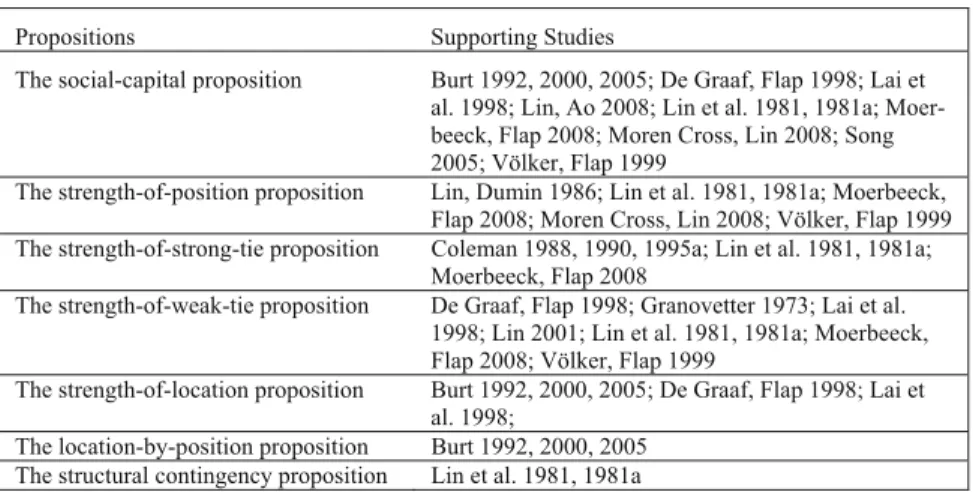
- The Theorems
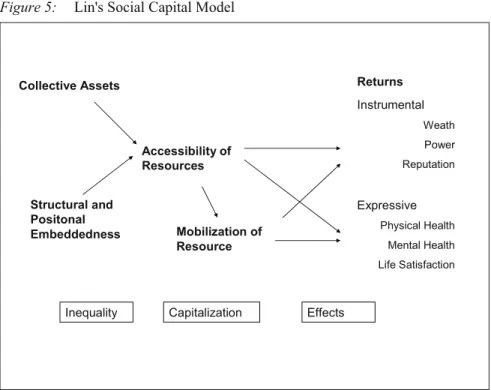
The definition: These structurally embedded resources are social capital for the actors of the network” (Lin 2001: 75). This definition includes three aspects of social capital: resources are embedded in a social structure (embeddedness); they are accessed by individuals (accessibility); and individuals use or mobilize them in purposeful actions (use) (Lin a: . 12). Among other network characteristics, civic participation can increase the capacity of social capital (Lin, Ao 2008: 114).
Discussion
He further formulates a clear condition regarding the scope: The concept of social capital only applies in a hierarchically structured society. Fifth, Lin also does not discuss the potential of using social capital to reduce inequality. The next part will also be devoted to the empirical aspects of inequality in social capital.
Empirics of Lin's Social Capital Concept
- The Position Generator
- Inequality in Access to Social Capital
- Excursus: The Relationship of Social Resources and Civic
- Capitalization and Effects of Social Capital
- Problems of the Position Generator and Their Solution
Access to social capital was mainly provided by association membership and the respondent's human capital. Critics further call for a conceptualization of the contribution of social capital to increasing equality. Most instruments for measuring social capital have only been used in the context of face-to-face surveys.
The Quality of Social Capital Measures in the
The Quality of a Sample
Adequate in this case means that the study correctly depicts all significant details of the analyzed population. The accuracy of a sample is achieved if the parameter estimate is close to the true parameter. The most important thing for the realization of a good sample is the achievement of impartiality and high precision.
The Quality of Measures
- Objectivity
- Reliability
- Validity
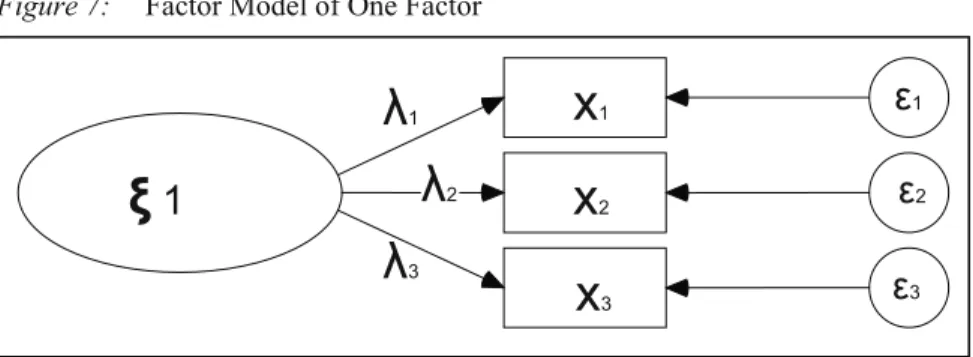
We assume that the expected value of the random error variable is zero (for discussion see Traub 1994: 31). In addition, we must assume that the covariance of the true-score and error-score random variables VTE2 is also zero (see Traub 1994: 32). V is the variance of the observed-score random variable for the i-th part of the test.
Other Methods for Assessing the Quality of Measures
The overall model should have a good model fit if we are to talk about a good explanatory power of the model factors (Hair et al. A better method is to compare the percentages extracted from the variance for the two constructs examined with squared correlation estimates Thus, “Wbis a function of the geometric mean of the number of unrelated X pairs and the number of unrelated Y pairs” (Gibbons 1993: 15).
Influences on the Quality of Measurements
Second, a telephone survey contains less interviewer influence compared to face-to-face interviews. Although we might expect a telephone survey participant to answer relatively long questionnaires (up to 90 minutes) (Schnell et al. 1999), they should be simple and the interviewer's absence constitutes a very different interview situation than the interview situation. face-to-face interview. Accordingly, items that are appropriate for a face-to-face survey may be inappropriate for a telephone survey.
Summary
Although the results are quite contingent, they emphasize the importance of the individual characteristics of the respondents for the quality of the measures. Respondents are not provided with information about the interviewer's age or appearance that would otherwise influence their behavior (Häder, Klein 2002; Porst 2000). This chapter introduces our main strategy and the studies we analyze to evaluate the quality of the different social capital measures.
The Approach of the Quality Study
One aim of this monograph is to assess the quality of social capital measures in the Czech Republic. As we showed in Part 1, many of the currently developed social capital measurement tools that our model assesses have not previously been used in the Czech Republic. To see whether the measures behave as theoretical considerations suggest, we correlate the measurement items with the respondent's sociodemographic data and theoretically linked criteria.
Social Relationships among Czech Citizens 2007/2008
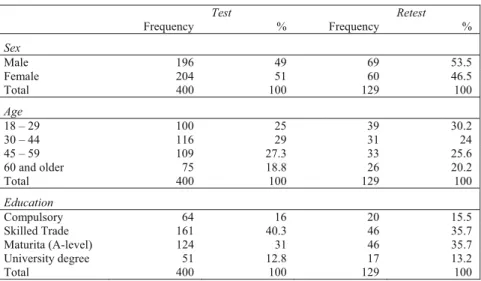
For this purpose, in addition to the test-retest study, we will analyze another study – the face-to-face study 'Our Society'. The frequencies of gender, age and education of the test and retest are shown in Table 4. The analysis shows that the distributions in the test and retest are similar (the tests show insignificant ² values).
The Survey “Our Society” (CVVM 2007-04) for
Summary
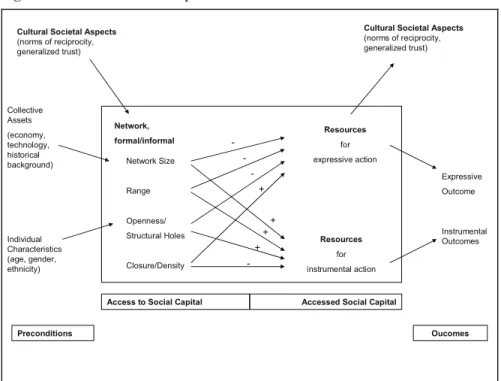
Before analyzing the quality of measures regarding access to and access to social capital (see chapters 10 to 12), the purpose of this chapter is to define the conditions of access to social capital. As concluded in part 1 of the present monograph, access to social capital via networks is determined by cultural social aspects, by collective assets such as historical, technological and economic background, as well as by individual characteristics such as gender, age and education. Finally, we examine the international placement of the Czech Republic in relation to the development of formal and informal networks.
Individual Characteristics
The latter varies depending on the respondent's sociodemographics; the first two are valid for all respondents in a studied population. In this chapter, we start with individual characteristics and continue with important historical developments as well as technological advances that greatly influence the composition of formal and informal networks. Furthermore, we discuss the current development of formal networks and generalized trust as a cultural aspect of society in the context of civil society.
Historical Background
Civic movements and associations as parts of formal networks played an important role in the Czech Republic from the 13th century onwards, especially during the national revival in the 19th century and the establishment of the Czechoslovak Republic in 1918 (Vajdová 2005: 22; Dohnalová et al.. During the transformation, public policy had a great influence on the development of non-profit organizations (Kuti 1999: 52), on the other hand, civil society plays an important role in active regions.
Technology
The Cultural Societal Aspect Generalized Trust
International Comparison
Several post-communist countries such as Estonia, Armenia, Latvia and Lithuania developed it until 1998, while others did not (Azerbaijan, Belarus and Georgia) (Green 2002: 460). The outlined discussions and comparisons show that the Czech Republic is similar to other post-communist countries. The construction of networks in post-communist societies is mediated by three main factors: "the.
Summary
10 Access to social capital I – The quality of network size and density Measures of informal and formal networks. The discussion revealed two crucial aspects of social capital: access to and accessible social capital. This chapter analyzes the reliability and validity of the items assessing network size and density.
Operationalization of Informal Networks
- Network Size
- Network Density
The size and density of the network and the extent and openness or bridging character of the contacts in the network are important. In this respect, the reliable statements of the respondent are highly questionable (see Chapter 4 for an in-depth discussion). Similar contact frequencies are found in the case of friends; more than half of the respondents contact their friends at least three times a month.
Operationalization of Formal Network Measures
- Network Size
- Network Density
This is caused by a large number of non-believers in the Czech Republic (67.9% of the population is non-denominational, see Czech Statistical Office (2003)). We measured the network density of the formal networks with the frequency of participation in the above 5 different types of associations ranging from three or more times in the last month; once or twice; I did not participate at all (for exact question wording see appendix 15.1, items 8.1a-e). In the next part, we will evaluate whether this alternative item is a reliable form of the item battery used in the test.

Test-Retest Reliability of Network Size and Density Measures
- Test-Retest Reliability of the Informal Network
- Alternate Form Reliability of the Formal Network
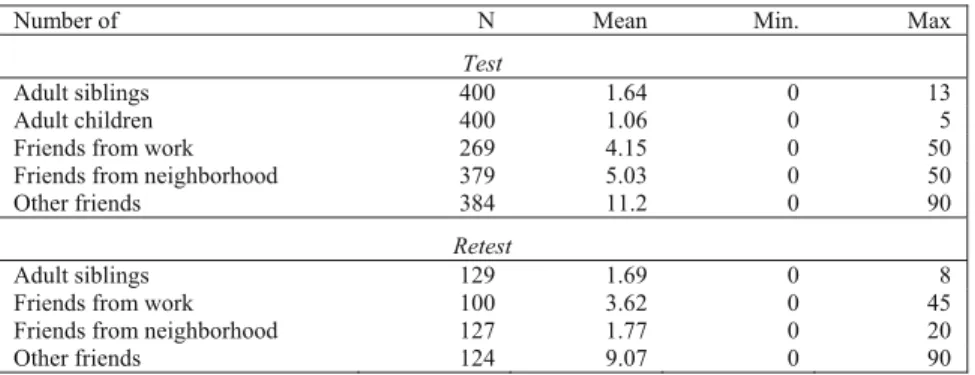
As the reader can see in table 9, the test-retest reliability is very high in the case of the number of siblings (r = 0.747). The items regarding the number of friends from the neighborhood were not reliably answered by any of the analyzed categories. Although the correlations (see table 9) indicate an influence of the sociodemographic characteristics and changes in the reliability of the number of other friends, the binary logistic regressions do not confirm this.

Criterion Validity
Summary
Operationalization
Test-Retest Reliability
- Sex, Age and Education Differences in the Reliability and
Internal Consistency and Test-Retest Reliabilities of the
Why Do We Find Such Bad Reliabilities?
Criterion Validity
Conclusion
Operationalization
- Resources for Expressive Actions
- Resources for Instrumental Actions
Test-Retest Reliability by Item
Internal Consistency and Test-Retest Reliabilities of the
Construct Validity
- CFA Using the Survey “Social Relationships”
- CFA Using the Survey “Our Society”
Criterion Validity of the Resource Generator
Summary
The Questionnaires of the Test and Retest Study “Social
- Czech Version of the Questionnaire / Dotazník
- English Version of the Questionnaire
The Bridging Social Capital Item Battery Used in the Survey
- Czech Version
- English Version
Confidence Intervals and Errors Revealed by Bootstrapping for
Standard Errors and Confidence Intervals of the CFA of the
Estimates of the Constructs Personal Support Social Capital in
CFA Estimates Assessing the Internal Consistency Reliability
Estimates of Construct Personal Support Social Capital for
Comparison of Surveys “Social Relationships among Czech
The Resource Generator Used in the Survey “Our Society”
- Czech Version
- English Version