
After a career in the entertainment industry, she recently completed an MBA at Kingston Business School. Professor Mair teaches strategy and social entrepreneurship in the MBA program, executive programs and PhD program at IESE.
What is social entrepreneurship?
Why produce this book?
Most of the work published to date has been based on anecdotal evidence or was aimed at promoting specific initiatives. At the same time, we are convinced that the academic study of SE will have a profound influence on many of the established management theories.
Antecedents and development of the field
To be able to produce this volume just over a year after this initial meeting of the minds fills us with a sense of accomplishment. Obviously, a handbook like this would have come to nothing without the contribution of the many scholars who participated in the meeting and subsequently contributed to this handbook.
The contents of this volume
Our scan of the previous work in this area revealed a handful of scholarly articles that used the term “social entrepreneurship” and were published in peer-reviewed journals between 1990 and 2004. He maintains a deliberately broad definition of the phenomenon, but also points out that a deconstruction of the term 'social' is essential to understanding what we mean by the term 'social entrepreneurship'.
Directions for the future of SE research
Organizational development – What role do systems and processes play in ensuring the sustainability of the social enterprise. Governance – What role do governance mechanisms play in ensuring the sustainability of the social entrepreneurial venture over time.
Perspectives and Agenda for Research
Interestingly, one of the aspects highlighted by all three authors of the articles in Part I is the need to resist premature final closure of important SE concepts. By deliberately providing broad definitions of the phenomenon, they try to avoid possible exclusion errors.
Austin
The three articles of Part I provide a broad view of the current state of the field and implicitly or explicitly identify some of the most intriguing questions that the emergence of SE as a field of research has raised. History is full of initiatives that, under the banner of the common good, have had more perverse consequences.
Perrini and Vurro
The research imperative
While there are many possible definitions put forward in the early literature, I believe the foregoing has the fundamental merit of creating a broad umbrella for the SE research agenda. In fact, part of our collective research agenda should be to examine and refine our definition as our explorations reveal critical dimensions that deserve salient emphasis.
Three research perspectives
One of the interesting research questions that emerges from the preceding approaches as a target of investigation is the phenomenon of stages. Demonstrating quantitative outcomes of social interventions is a particularly complicated task due to the nature of social change.
Moving forward
Existing research suggests that the magnitude of value depends significantly on the type of resources used (Kanter, 1999; Austin, 2000) and the depth and breadth of alignment of partners' missions, values, and strategies. Doing good while doing good: Dilemmas of performance measurement in nonprofit organizations and the need for a multiple constituency approach.
Introduction
Defining social entrepreneurship: tautology, monologue and politics
Many definitions of SE therefore seem inadequate to deal with the central theoretical and normative questions that arise from the concept's juxtaposition of 'social' objectives and the instruments of private enterprise. Initially, SE differs from its private cousin on the basis of its pursuit of "social" goals.
Breaking the tautology: exploring the ‘social’ in social entrepreneurship
This part of the paper explores theoretical perspectives on the 'social' and demonstrates that the conflicts inherent to social existence make SE an inherently political enterprise. In the first instance, it establishes the 'social' as a domain purposefully separate from the world of private ownership.
Monologue, entrepreneurship and the colonization of the lifeworld
SE's subtle revision of the structure of society's relationship with the state and the market raises important questions about the functional roles of these institutions. Yet taken to the extreme, system integration destroys public discourse and collapses the 'social' realm into a discursively inert shell.
Integration and conclusions
These alternative expressions have been introduced in an attempt to give equal weight to the different components of SE. Fourth, we conclude with brief reflections on the correspondence between theory and practice in order to obtain a preliminary descriptive framework of the SE process.
Where does SE come from?
Most existing academic contributions to this field agree to recognize two main macrodynamics as decisive for the emergence of SEVs: the crisis of the traditional welfare state (Johnson, 2000; Cook, Dodds and Mitchell, 2001; Borzaga and Defourny, 2004) and increase in competitive pressure within the non-profit sector (Dees, 1998b; Reis, 1999). Finally, Borzaga and Defourny identify the existence of a strong relationship between the emergence of SEVs and the characteristics of the legal system.
Reframing the literature: a theoretical basis for SE
This leads us to the next step of the SE process: the launch and operation of the organization. The third major step of the SE process concerns the collection and utilization of financial resources.
Shifting from theory to practice
Mission represents the first step in the process of developing discovered entrepreneurial opportunities into concrete social outcomes and social change (Dees, Emerson and Economy, 2001). This statement confirms what has been said about the change in the accountability streams of SEVs: 'In traditional non-profit organizations, it was the funding organizations that had to be satisfied first, then the executive director (usually the channel for funding sources) , then employees and volunteers, and, only finally, the people whose satisfaction was directly related to the organization's mission in the first place' (McLeod, 1997: 4).
Discussion and conclusion
Schramm http://www.collegesummit.org/ Education and training 11 Creative Capital USA 1999 Peter Thomas Gow http://www.creative-capital.org/ Arts and culture. 17 International Network UK 1994 The Big Issue http://www.street-papers.org/ Media services from Street Papers (INSP).

Opportunities and Intentions
Mair and Noboa further argue that social entrepreneurial opportunities, as well as the ways to pursue these (social) opportunities, are distinct. While previous research on SE has mainly focused on the (social) entrepreneur or the outcome (social enterprise or enterprise), the papers in this chapter address the social entrepreneurial process.
Robinson – How social entrepreneurs identify and evaluate opportunities
Finally, whether or not social entrepreneurs discover an opportunity depends on their personal and work experience and on the characteristics of the market/. In addition to a refreshing view of entrepreneurial opportunities, the paper offers a new perspective on how entrepreneurs navigate social and institutional barriers to markets.
Mair and Noboa – How intentions to create a social venture are formed
Much of the media attention related to SE focuses on the exceptional nature of individual social entrepreneurs. The point here is that we need more than journalistic accounts of the phenomenon of SE.
Theoretical background
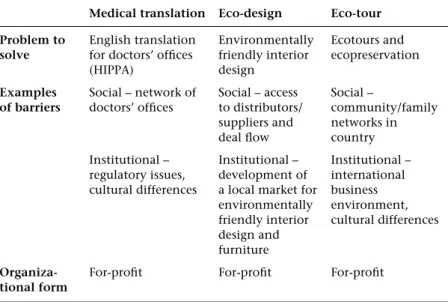
Social entry barriers such as the lack of networks of resources and access to an appropriate workforce are related to the social structure of the market. Entrepreneurs must use the right strategies at the right times (navigation) to overcome the social and institutional entry barriers to their markets/communities.

Data and methods
Findings
Each of the founders described social and institutional factors that challenged them when they entered the market. In this study, five of the six social enterprises were for-profit companies with social missions.
Discussion
Theme #2: Successful social entrepreneurs will consider social and institutional factors when evaluating opportunities to create social ventures. These factors corresponded to the social and institutional barriers I presented in the first half of this chapter.
Conclusion
We believe that the essence of entrepreneurship - in Schumpeter's words, 'the carrying out of new combinations' - is context-free, that is, it is the same regardless of where it takes place (Schumpeter, 1934). In the first part of this chapter, we review the existing literature to explain key constructs.
Mapping social entrepreneurship
We elaborate on the characteristics of social entrepreneurs and identify key antecedents of the SE intention formation process. Furthermore, social entrepreneurs who share the same characteristics can vary widely in terms of the social impact of their initiatives.
A model of socially entrepreneurial intentions
In summary, we contend that empathy represents an important attitudinal element in the SE process that influences the perceived desirability of social entrepreneurship. In the context of this paper, perceived feasibility refers to whether an individual believes that he/she is able to create a social enterprise.

Future research
We recognize that entrepreneurship encompasses unconscious and unintentional behaviour: however, in this paper we focus on the behavior directed towards the creation of a social venture and assume that the creation of a social venture indicates purposeful and planned behaviour. Third, the paper combines knowledge from existing intention-based models with insights into SE and presents a conceptual account of just one particular part—the intention-formation part—of the SE process.
Strategy, Structure and Outcome
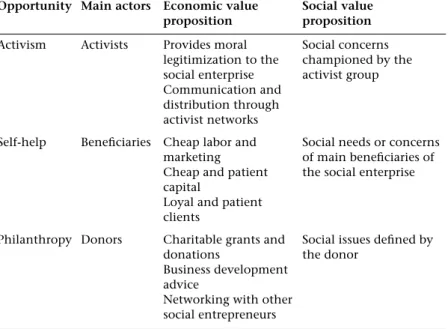
Business ventures with a social purpose - the last variant of social enterprise refers to for-profit enterprises (as in the case of many fair trade enterprises) whose main purpose of existence is to create (external) social benefits (Campbell, 1998; Larson, 2000). ; Foryt, 2002; Schaltegger, 2002; Volery, 2002; Hockerts, 2003; Mair and Noboa, 2003a). In this paper, I will outline a conceptual framework for the sources of entrepreneurial opportunities for social business ventures.
Sources of social entrepreneurial opportunity
In analyzing social enterprises, I focus this article on the sources of entrepreneurial opportunities for business ventures with social purposes. Activism offers social enterprises a range of social entrepreneurship opportunities, mainly by leveraging the key assets of activist groups.
Conclusions
Despite the recognition that technology is not a panacea for social ills (UNDP, 2001), some of the largest and most active philanthropic organizations in the United States (e.g. The Bill and Melinda Gates Foundation, The Open Society Institute and The MacArthur Foundation) is committed to technology-based solutions to social problems. We base our investigation on the following premises: a) social enterprises increasingly develop and use technology to solve critical social problems; b) technological innovation frameworks developed for “for-profit” firms may not be immediately applicable in the SE context and (c) management research may benefit from studying innovation in the SE domain (Drucker, 1989; Kanter , 1999).
Background literature
The purpose of this study is to better understand technological social ventures (TSV), an area that is at the intersection of two fields: SE and technological innovation. Social enterprises can take a complex range of forms (profit, non-profit and in-between hybrids) (Mair and Martí, 2004) and because they operate at the nexus of public, economic and social authorities, they serve multiple masters (Leadbeater, 1997). ; Mair and Noboa, 2003a; Shaw and Carter, 2004).1.
Approach and methods
The evolution of a technology social venture
New stakeholders: Expanding the Bookshare.org platform. The success of Bookshare.org provided a platform for Benetech to start working on 168 Social Entrepreneurship. The uncertainty in the product development process for a social enterprise then lies in interaction with the sociopolitical dynamic – the activist, philanthropic and volunteer communities.

Outcomes of the entrepreneurial process
At the organizational level, social outcomes arise from the establishment of the company's cultural identity, the opportunities for social interaction generated by the new venture, the creation of new organizational networks and the formation of inter-organizational trust. Indirect economic results include increased skill levels of the local population and increased circulation of money locally.
The rural economy and social enterprise