Based on changes in consumer behavior since the pandemic, this paper is dedicated to investigating the effects of product delivery innovation, cashless payments and social media engagement on marketing performance. In addition to that, product delivery innovation and cashless payments through the role of social media engagement have an impact on marketing performance.
Introduction
2020) argued that social media involvement correlates with marketing performance in the case of large companies. Specifically, the element under investigation is social media engagement as a reinforcement of the relationship between PDI and cashless payments on marketing performance.
Literature review 1. Marketing performance
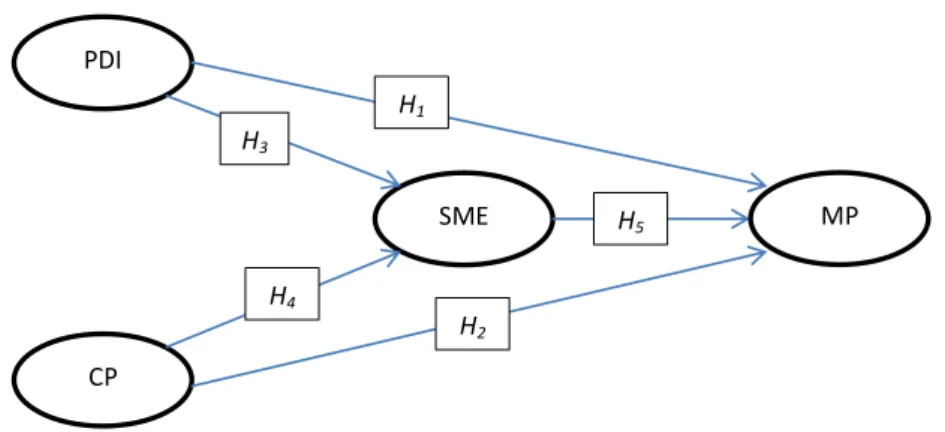
H₄: Cashless payments have a significant effect on marketing performance through social media engagement as an intervening variable. H3: Product delivery innovation has a significant effect on marketing performance through social media engagement as an intervening variable.
Conceptual framework
Cafes and restaurants are developing social media as the main communication standard channeling to potential customers. The new version of product delivery and cash payment procedures, integrated into an intensive social media communication package, can consistently boost the marketing performance of cafes and restaurants.
Methodology
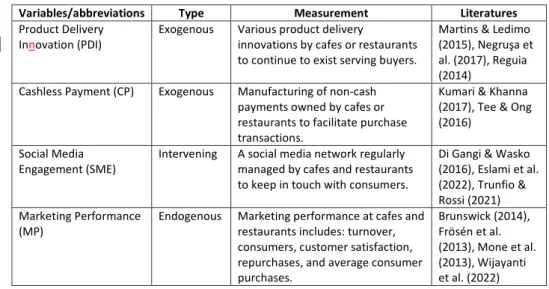
Then, the next objective is to assess the two relationships through social media engagement, which acts as an intervening variable. 2013) and Shaw (2018) articulate endogenous variables as components that are influenced by exogenous variables. Intervention A social media network regularly managed by cafes and restaurants to keep in touch with customers.
Results
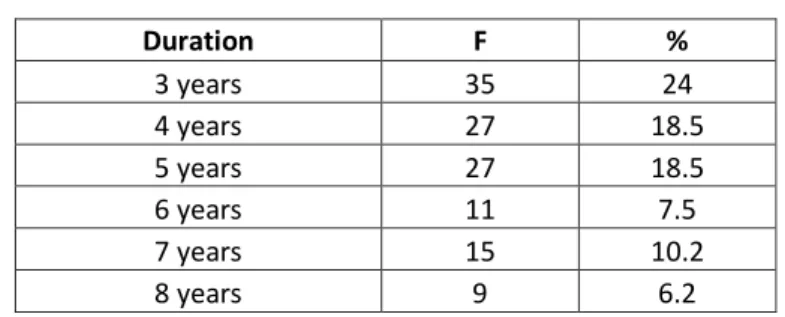
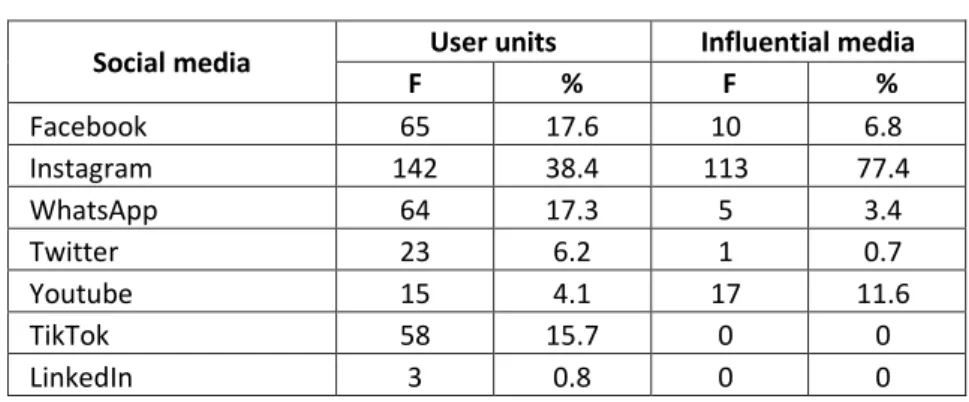
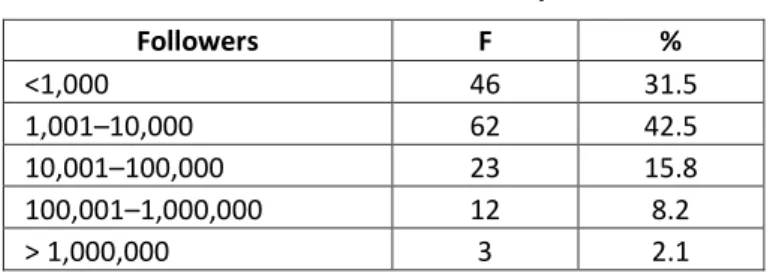
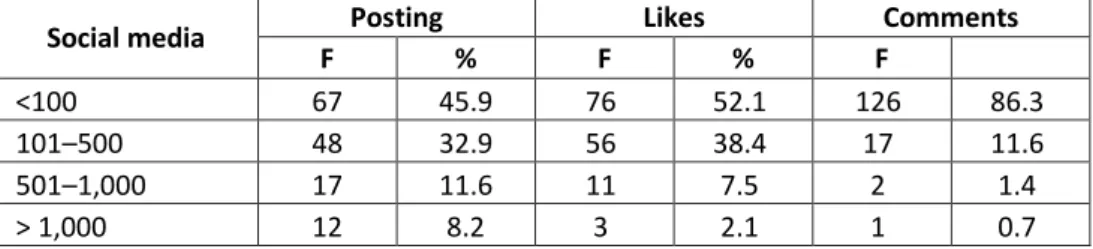
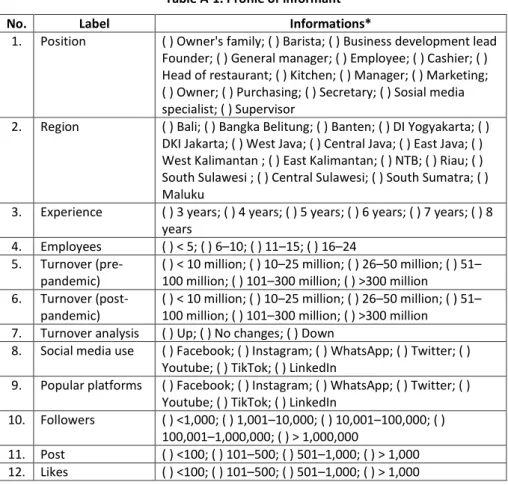
This indicates that the business experience is still young and still growing. From Table 8, it is clear that the social media that receives the most response from consumers is Instagram (77.4%). Many followers do not guarantee that the uploaded content will get a lot of likes, because most of the respondents, 52.1% answered that the content they uploaded has less than 100 likes.
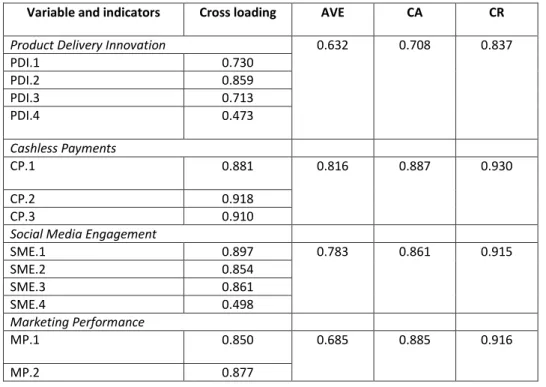
For the first phase, the feasibility of the model based on convergent validity proves that the majority of the indicators on the variable have a loading factor value greater than 70% (> 0.7), thus indicating validity to measure the variable. Narratively, with a coefficient of determination (R2) score of 0.120 it is confirmed that the first structure in a direct relationship was concluded to be weak. Also, the coefficient of determination of 0.363 indicates that the model contained in the indirect relationship between PDI and CP to MP through KMO is moderate.
Discussions
This is evidenced in the fourth hypothesis, which concludes that product delivery innovation mediated by social media engagement has a significant effect on marketing performance. Product delivery innovation developed by cafes and restaurants can improve cafes and restaurants' marketing performance through social media engagement. In reality, the innovation of cafés and restaurants is offset by orientation towards customers or potential customers on social media.
In fact, contrary to product offering innovation, cashless payments will not work optimally in marketing performance unless supported by social media engagement. Therefore, social media as a communication channel is an option for cafes and restaurants to communicate products, promotions and various facilities offered for the convenience of consumers. By maximizing social media as a channel to create closeness with consumers, this is consistent with hypothesis 5 which shows that social media engagement has a positive effect on marketing performance.
Conclusion, limitation, and sugestion
In comparison, some Indonesian SMEs that enable big data in digital creations are moving closer to marketing access (Wibowo et al. are optimistic that the resilience of Bangladeshi SMEs will be determined by the actors that exploit digital marketing and e-commerce.
Acknowledgments
The impact of e-commerce and digital marketing adoption on financial and sustainability performance of MSMEs during the COVID-19 pandemic: An empirical study. The role of digital marketing in mediating the effect of the COVID-19 pandemic and the intensity of competition on business performance. The impact of online food delivery on the nutritional status of home workers during the COVID-19 pandemic.
Continued usage intention towards e-payment during the COVID-19 pandemic from an economic sustainable development perspective using perceived usefulness and electronic word of mouth as mediators. Service quality and satisfaction in the context of varying levels of restaurant image and customer orientation during the COVID-19 pandemic. The role of online food delivery services in the competitiveness of Yogyakarta's culinary industry during the Covid-19 pandemic.
Introduction
The emergence of Covid-19 in Indonesia shows that social media trends can develop a harmonious relationship between producers and customers. As concrete evidence in the case of a pandemic, Herlina et al. 2022) actually found that the involvement of business people in social media did not constructively affect marketing performance. This argument is also relevant to the text prepared by da Silva Wegner et al. 2023), where social media platforms managed by some companies do not connect the target properly.
For example, in Pakistan, engagement with social media platforms, including Facebook and Instagram, is only a small part of attracting customers to develop brand intentions, resulting in a shift towards marketing sustainability (Jamil et al., 2022). Referring to the dynamics of Covid-19, which consists of pitfalls, concerns and contact with entrepreneurship, few publications have discussed the relationship between PDI, cashless payments and social media involvement in marketing performance. For this reason, given the gap in uneven research, this article took the initiative to evaluate the contribution of PDI, cashless payments, and social media engagement.
Literature review 1. Marketing performance
Specifically, the element we investigate is social media engagement as a potentiator of the relationship between PDI and cashless payments on marketing performance. 2014) explained customer engagement as a connected component between companies and customers in marketing. Social media is also a marketing control tool, which is increasingly important after the pandemic (Mason et al., 2021). According to Yusoff and Azmel (2022), social media is an integral part that can be adopted.
Social media engagement is one of the company's movement efforts to gain customer sympathy through content uploaded by the creative team on social media. Generally, effective social media engagement can be seen in the likes, comments and shares of its followers. Academic texts that discuss the impact of social media engagement on marketing performance are cited by Bilgin (2018), Cao et al.
Conceptual framework
Dramatically, PDI's emphasis on OFD applications that have a competitive advantage can expand product segments, one example being marketing performance capabilities. In fact, cafes and restaurants are also helped by payment methods through m-banking and e-wallets. The anxiety during the pandemic, which slowed the economy, also slowed people's mobility, which is now mostly done at home, instead of integrating them into social media networks that encourage cafe and restaurant businesses to be active on social media through the latest launch. products.
In fact, among business people, they are also creating new scenarios in product offerings, which make it possible to target food and beverages only purposefully on social media. The new version of product delivery and cashless payment procedures incorporated into an intense social media communication package can consistently stimulate the marketing performance of cafes and restaurants. The chronology above forms the basis of the conceptual framework for this research, which is detailed in Figure 2.
Methodology
Systematically, the questionnaires were selected from the questionnaire material distributed to the sampling units. The sampling mechanism in the data description uses a statistical tool, for at least 3 years, which means that restaurants and cafes have survived since the Covid-19 attack in early 2020. In principle, the simple random sampling method is focused on sampling completed. criteria and find informants willing to fill in the questionnaire.
Cashless payment (CP) Exogenous Production of non-cash payments owned by cafes or restaurants to facilitate purchase transactions. In the first part, the questions are in the form of an open question, then the second question is in the form of multiple choice, and the third is a perception question using a semantic differential scale of 1 (very irrelevant to what is being done) to 10 (very relevant to what is being done). In the SEM-PLS landscape, the proportion of variables uses indicators derived from theoretical experience and researchers' observations.
Results
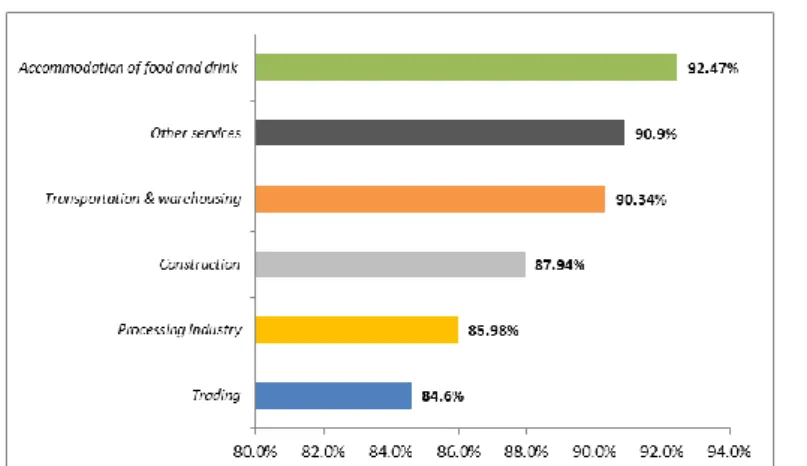
Interestingly, the average number of employees in the cafe and restaurant business is no more than 5 employees (60%). Many followers do not guarantee that the uploaded content will get many likes, because most of the respondents, 52.1% answered that the content they uploaded was liked less than 100 times. Narratively, with a coefficient of determination (R2) score of 0.120, it is confirmed that the first structure in a direct relationship concluded is weakly inclined.
The Q2 score was found to reach 0.069, which articulately indicates that the direct link between PDI, CP and KMO to MP has a competent model. The contribution coefficient of PDI = 0.144 and KP = 0.104 indicates that the more SME increases in each PDI and KP, the more MP increases in over a positive long period. Understanding the achievement of these two parameters confirms that the blindfold procedure has good observations.
Discussions
Product delivery innovations developed by cafes and restaurants can improve their cafe and restaurant marketing performance through social media engagement. In reality, the innovation of cafés and restaurants is offset by an orientation towards customers or potential customers on social media. Unlike product delivery innovation, cash payments will not function optimally for marketing performance if they are not supported by social media engagement.
In Macau, two government-promoted schemes through social media are considered a practical way to address the virus outbreak (Pang et al., 2022). In China, the culture of public engagement through social media has grown exponentially since Covid-19. According to empirical reports, 100% of coffee shops and restaurants studied used social media as a communication channel to establish proximity with consumers.
Conclusion, limitation, and sugestion
Although the risk of the Covid-19 pandemic has decreased, it is still massive and cannot be separated from the influence of the marketing performance of cafes and restaurants. Impact of Covid-19 Pandemic on the Digital Marketing Strategies of United States Businesses: A Case of Selected Multinational Enterprises. The moderating role of information technology governance in the relationship between board characteristics and continuity management during the Covid-19 pandemic in an emerging economy.
Understanding Digital Payment Use During the COVID-19 Pandemic: A Study of the UTAUT Extension Model in Indonesia. Marketing performance and use of big data during the COVID-19 pandemic: A case study of SMEs in Indonesia. Product Delivery Service Provider Selection and Customer Satisfaction in the Internet of Things Era: A Chinese E-Retailer Perspective. 2022). Brand Awareness: The Impact of Social Media During the Covid-19 Pandemic.