The South East Asian Journal of Management The South East Asian Journal of Management
Volume 6
Number 1 April (2012) Article 1
4-30-2012
Impact of Strategy Implementation on Performance of Generic Impact of Strategy Implementation on Performance of Generic Strategy: Evidence from Thailand
Strategy: Evidence from Thailand
Mayookapan Chaimankong
Graduate School of Management, Faculty of Business Administration, Thonburi University Dissatat Prasertsakul
Department of Marketing, Faculty of Business Administration, Mahidol University International College, [email protected]
Follow this and additional works at: https://scholarhub.ui.ac.id/seam
Part of the Management Information Systems Commons, and the Management Sciences and Quantitative Methods Commons
Recommended Citation Recommended Citation
Chaimankong, Mayookapan and Prasertsakul, Dissatat (2012) "Impact of Strategy Implementation on Performance of Generic Strategy: Evidence from Thailand," The South East Asian Journal of Management:
Vol. 6: No. 1, Article 1.
DOI: 10.21002/seam.v6i1.1042
Available at: https://scholarhub.ui.ac.id/seam/vol6/iss1/1
This Article is brought to you for free and open access by the Faculty of Economics & Business at UI Scholars Hub.
It has been accepted for inclusion in The South East Asian Journal of Management by an authorized editor of UI Scholars Hub.
April 2012 • Vol.6 • No.1
Impact of Strategy Implementation on Performance of Generic Strategy: Evidence from Thailand
Mayookapan Chaimankong and Dissatat Prasertsakul
Knowledge Creation in Strategic Alliance - A Case of ‘Child Business’ Learning Process From ‘Parent Partner’
Zuraina Dato Mansor and Wan Mohamed Tarmizi Wan Abdullah
The Effect of Image Compatibility and Escalation of Commitment on Decision Performance
Harris K. Turino and Budi W. Soetjipto
Exploring CEO’s Leadership Frames and E-Commerce Adoption among Bruneian SMEs
Afzaal H. Seyal, Awg. Yussof, Awg. Mohammad and Mohd Noah A. Rahman
The Effect of Human Resources on Capital of Worker Cooperative Suyanto
SEAM Vol. 6 Issue 1 Pages1 - 64 April 2012Depok 1978-1989ISSN
THE SOUTH EAST ASIAN JOURNAL
MANAGEMENT
OF M
Editor in Chief
Sari Wahyuni, Universitas Indonesia Vice Editor
Rofikoh Rokhim, Universitas Indonesia and Bisnis Indonesia Intelligence Unit Managing Editor
Imam Salehudin
Layout and Typesetting Shafruddin Nusantara Administration Angtyasti Jiwasiddi REVIEWER
The South East Asian Journal of Management (ISSN 1978-1989) aims to present the latest thinking andt and research that test, extends, or builds management theory and contributes to management practice. All empirical methods -s -- including, but not limited to, qualitative, quantitative, field, laboratory, and combination methods -- are welcome.
Published twice a year (April and October) by:
Department of Management, Faculty of Economics, Universitas Indonesia, Depok 16424 Indonesia.
Phone: +62-21 7272425 ext 503 Fax : +62-21 7863556
The views expressed in SEAM are not necessarily those of the editorial staff nor the publisher. All articles in this journal, unless otherwise noted, have undergone a blind review process.
Copyright © 2012 Management Research Center, Faculty of Economics, Universitas Indonesia. All rights reserved.
Preet S. Auklah, York University Adith Cheosangkul, Chulalongkorn University Luchien Karsten, University of Groningen Felix Mavondo, Monash University Cornelius B. Pratt, Temple University Vivien T. Supangco, University of Philippines Ma. Gloria V. Talavera, University of Philippines Albert Wijaya,
University of Indonesia
Gunawan Alif, University of Indonesia Anees Janee Ali Hamid, Universiti Sains Malaysia Yanki Hartijasti, University of Indonesia Aryana Satrya, University of Indonesia Hanny Nasution, Monash University Lily Sudhartio, University of Indonesia Djamaludin Ancok, Gajah Mada University Kazuhiro Asakawa, Keio Business School
Arnoudud de Meyer, Univerersity of Cambridge G.M.. Duijsters,
Techhnische Universiteit Eindhoven Rianni Rachmawati,
Univversity of Indonesia Buddi W. Soetjipto, Univversity of Indonesia Hanini Handoko, Gajahh Mada University Arrann Caza,
Griffith h University Pervez GGhauri, King’s Collllege London Andrew Liemems, Greenwich Univiversity
Impact of Strategy Implementation on Performance of Generic Strategy: Evidence from Thailand
Mayookapan Chaimankong and Dissatat Prasertsakul _____________________________
Knowledge Creation in Strategic Alliance - A Case of ‘Child Business’ Learning Process From ‘Parent Partner’
Zuraina Dato Mansor and Wan Mohamed Tarmizi Wan Abdullah _____________________
The Effect of Image Compatibility and Escalation of Commitment on Decision Performance
Harris K. Turino and Budi W. Soetjipto _________________________________________
Exploring CEO’s Leadership Frames and E-Commerce Adoption among Bruneian SMEs
Afzaal H. Seyal, Awg. Yussof, Awg. Mohammad and Mohd Noah A. Rahman ____________
The Effect of Human Resources on Capital of Worker Cooperative
Suyanto __________________________________________________________________
1
15
23
33
53
Contents
April 2012 • VOL.6 • NO.1
THE SOUTH EAST ASIAN JOURNAL
MANAGEMENT
OF
Impact of Strategy Implementation on Performance of Generic Strategy:
Evidence from Thailand
Mayookapan Chaimankong
Graduate School of Management, Faculty of Business Administration, Thonburi University
Dissatat Prasertsakul*
Department of Marketing, Faculty of Business Administration, Mahidol University International College
The purpose of this paper is to examine the strategic orientation in terms of Miles and Snow ty- pologies of the firms in emerging country and investigate their implications on performance. Unlike previous research, this paper focuses the importance of strategy implementation to the performance implications of Miles and Snow typology. Data was collected from 111 key informants from firms in Thailand’s chemical industry using probability sampling. The one-way Analysis of Variance (ANOVA) results showed that prospectors performed better than the other three strategic types, whereas reac- tors exhibited the lowest performance scores. While the success in strategy implementation is found to be a significant predictor of firm performance, the two-way Analysis of Variance (ANOVA) results revealed that the success in strategy implementation did not alter the relationship between Miles and Snow strategic type and a firm’s performance. This finding suggests that the relationship between Miles and Snow strategic type and a firm’s performance may be universal, regardless of the location where the study is conducted. However, additional studies in other contexts are required before the conclusion can be made whether the strategic type – performance relationship will be contingent on strategy implementation.
Keywords: Generic strategies, typologies, Miles and Snow, firm performance, strategy implementa- tion.
Introduction
Strategic management is regarded as an important process for businesses (Bowman and Asch, 1987; Kumar, 2010; Thomson and Strickland, 2003; Viljoan and Dann, 2003). It has been argued that the process of strategic management affects a firm’s ultimate success or failure more than any other factors (Porth, 2003). Strategic management process is im- portant for a firm’s success because it enables
a firm to develop a future direction, provides the ways to achieve its mission, and ultimately leads to value creation (Porth, 2003). A review of literature by Powell (1992) also indicates that firms whom adopt strategic management gener- ally improve their performance. The process of strategic management can be divided into two major tasks: strategy formulation and strategy implementation (David, 1995; Hitt, Ireland, and Hoskisson, 2005; Kazmi, 2008). The for- mer involves the crafting of a strategy, whereas
* Corresponding Author. Email: [email protected]
THE SOUTH EAST ASIAN JOURNAL
MANAGEMENT
OF
the latter is the managerial exercise of putting a chosen strategy in place (Thomson and Strick- land, 2003).
One of the most important tasks for manage- ment is to search constantly for the best strat- egy to boost performance. Researchers have attempted to classify business strategies into ty- pologies as an aid to effectively investigate the relationship between strategy and other vari- ables (Namiki, 1989). A number of studies in- cluding Covin (1991), Miles and Snow (1978), and Porter (1980) have sought to identify be- haviours in the ways organizations compete and to group these behaviours or strategies into typologies or generic strategies. Of the generic strategies proposed in the literature, the Miles and Snow typology is among the most cited in the literature (Galbreath, 2010; Ketchen, 2003).
The relationship between Miles and Snow’s ge- neric strategy and a firm’s performance has been investigated by a number of studies (Conant, Mokwa, and Varadarajan, 1990; Garringos- Simon, Marques, and Narangajavana, 2005;
Hambrick, 1983; Jennings, Rajaratnam, and Lawrences, 2003; Parnell and Wright, 1993;
Shirokova, 2010; Smith, Guthrie, and Chen, 1989; Snow and Hrebiniak, 1980; Zajec and Shortell, 1989). However, their results were not consistent.
Although both strategy formulation and strategy implementation have been highlighted as significant in the literature, strategy imple- mentation has been regarded by some authors as more important than the strategy itself (Har- rison and Pelletier, 2000; Hrebiniak, 2006;
Robbins and Coulter, 1996; Schneier, Shaw, and Beatty, 1991). Nonetheless, a number of studies indicate that strategy implementation has received less attention from both academ- ics and practitioners compared to strategy for- mulation. Previous research has empirically tested the relationship between Miles and Snow generic strategy and a firm’s performance but there has been little analysis of the role of strat- egy implementation.
The emergence of the so-called ‘Tiger econ- omies’ in Asia and the rapid growth in newly emerging countries such as China and Vietnam, have prompted a great interest in Asian coun-
tries (Deshpande, Farley, and Bowman, 2004).
Nevertheless, a review of literature indicated that the research on the link between generic strategy, implementation, and performance is only concentrated in Western countries. Cur- rently, there is little knowledge on the relation- ship between generic strategy, implementation, and performance in an Eastern context. The im- provement in the industry will, in turn, contrib- ute to the economic performance of the country.
the chemical industries in ‘Tiger economies’ of Southeast Asia, that have been reported to have good prospects in the past decade, are now be- ing challenged by China (Wood, 2005). Firms in the chemical industry in those countries in- cluding Thailand have to prepare themselves for this challenge; therefore, it calls for a re- search study that explains performance diver- sity among these firms.
Given the importance of the role of strate- gic management in business, and the existing gaps in the literature, this study conducts an investigation of issues in strategic management with an emphasis on strategy implementation.
Specifically, the relationships between generic strategy, implementation and performance are explored and tested. This study sets out a re- search project to explore and fulfill two major purposes: first, it aims to investigate the rela- tionship between Miles and Snow generic strat- egy and a firm’s performance; and second, it investigates the role of strategy implementation in contributing to performance.
Literature Review
Different views on strategy
Minzberg (2000) makes an analogy of strat- egy as a man who touches an elephant with his eyes covered and is asked to describe what the elephant looks like. One who touches its trunk tells one thing; the others who touch other parts say other things. This indicates vari- ous meanings of strategy According to Mint- zberg (2000), strategy can be viewed as plan, ploy, pattern, position and perspective. Each of those elements represents different aspects of the word ‘strategy’. Another point of confu-
THE SOUTH EAST ASIAN JOURNAL OF MANAGEMENT © April 2012 • VOL.6 • NO.1
2
sion about strategy has been raised by Porter (1996). He argued that for a company to cope with a change in paradigm of competition, it requires the understanding of strategy, and dis- tinguishing strategy from operational effective- ness. Porter indicates that many have misused the word ‘strategy’ to represent what is merely called operational effectiveness or efficiency.
With regards to Porter (1996), the essence of strategy is about long-term positioning of the firm and deciding what activities are required to create value, not benchmarking, outsourcing, partnering, or reengineering. For the purposes of this study, the essences of those mentioned earlier are combined. Following the definition proposed by Hubbard (2000), strategy is de- fined as “those decisions which have long-term impact on the activities of the organization, in- cluding the implementation of those decisions, to create value to key stakeholders and to out- perform competitors” impact on the activities of the organization, including the implementa- tion of those decisions, to create value to key stakeholders and to outperform competitors”.
Different views
on strategic management theory
There are two opposite poles of strategy per- spective – deliberate strategic process (strate- gic planning) and emergent process (strategic incrementalism). The basis of the deliberate strategic process (strategic planning perspec- tive) is developed from the early works in 1965 by Learned, Christiansen, Andrews and Guth at Harvard University (for a discussion see Andrew, 1971; Forester and Browne, 1996).
The focus is on trying to find the fit between environment and the firm using the famous SWOT (Strengths, Weaknesses, Opportunities, and Threats) analysis. According to Andrews (1971), the process starts from assessing the ex- ternal environment, as well as internal strengths and weaknesses, and then strategies are formu- lated and chosen by the firm and, finally, those chosen strategies are implemented.
On the other hand, the emergence process (strategic incrementalism) viewed strategy not as being formulated in a deliberate fashion, but
emerge as the result of implementation follow- ing in the process (McKiernan, 1996). The pro- ponents of this view argue that, in reality, the deliberate or intended strategies may not be re- alized; rather, many strategies may have emerged without necessarily planning in ad- vance (Hurst, et al., 1989; Mckelvey and Al- drich, 1983; Mintzberg and Water, 1985; Quinn, 1980).
For the sake of simplicity in methodology design, this study follows the deliberate stra- tegic process views. The strategic formulation is viewed as a separate process from strategic implementation. Specifically, a strategic deci- sion is assumed to exist before implementation has occurred. Given the different views on stra- tegic management process, the term ‘strategic management’ also brings controversy among academics. Each perspective has different views on the process of strategic management;
hence, this leads to different definitions. As this study employs the deliberate strategic process approach, ‘strategic management’ is defined as the managerial process of shaping a strate- gic vision, establishing objectives, developing a strategy, implementing, and evaluating and control over time). In line with Thomson and Strickland (2003), Hussey (1998) indicates that strategic management process can be broadly categorized into formulation and implementa- tion. The former involves planning, while the latter deals with how to carry out the plan.
The level of strategies in an organization As generally agreed in the literature, strat- egies in organizations can be classified into three levels: corporate, business and functional (Hubbard, 2000; Johnson and Scholes, 2002;
Viljoan and Dann, 2003; Wheelen and Hunger, 1995). Corporate strategies focus on all busi- nesses in an organization as a whole. Corporate strategies embody three general orientations:
growth, stability and retrenchment. At the busi- ness level, the strategy aims to achieve com- petitive advantage in a particular market. And, finally, the functional or operational strategies are concerned with how each part of the organi- zation delivers value to the business and corpo-
Chaimankong and Prasertsakul
rate level. Business-level strategies are central interest of this study.
Types of business strategies
There are two arenas in which a firm in- teracts with its environment: first, a firm must match and adapt to the environment; second, it must find its way to compete with other firms that also attempt to adapt (Rumelt, 1980). The interactions have resulted in two different as- pects of strategic choices: generic strategy and competitive strategy. The generic strategy deals with the basic mission or the scope of business and the strategy is expressed by the product- market definition, whereas the competitive strategy concerns itself with the special com- petitive advantage or creation of an edge over other rivals (Rumelt, 1980). As this study con- cerns firm strategy in general, the focus will be on the generic strategy.
The field of business strategy has dem-
onstrated a shift from a perspective that each firm is unique toward a view which recognises the similarities among groups of firms (Covin, 1991; Dess and Davis, 1984; Miles and Snow, 1978; Porter, 1980). Currently, this perspective is still relevant and prevalent in the literature as evidenced by a number of recent studies that group firms based on their strategic behaviour (see, for example, Aragon-Sanchez and San- chez-Martin, 2005; Galbreath, 2010; Garrin- gos-Simon et al., 2005; Torgovicky, Goldberg, Shvarts, and Dayan, 2005). O’ Farrell, Hitch- ens, and Moffat (1992) argue that the strategic groups offer a frame of reference when refer- ring to firms in the industry. The classification also helps researchers to effectively investigate the relationships between strategy and other variables (Namiki, 1989). The pioneers in stra- tegic groups include the work of Covin (1991), Miles and Snow (1978), and Porter (1980). Por- ter (1980), for instance, proposed that any firm must choose one of three generic strategies to create and maintain sustainable competitive ad- vantage including cost leadership, differentia- tion and focus strategies.
Although there are many classifications of strategic groups, Miles and Snow (1978) and
Porter (1980) are the two prevailing business strategy frameworks in the strategic manage- ment literature (Slater and Olsen, 2000). The Miles and Snow (1978) typology is based on in-depth investigation of four different indus- tries. On the other hand, other strategy typolo- gies, including Porter’s (1980) typology, lack an extensive, detailed, theoretical orientation and are more focused and less generalizable (Smith et al., 1989). Therefore, the Miles and Snow generic strategy is an appropriate choice of structure for analyzing the chemical industry within Thailand.
Miles and Snow typology
Miles and Snow (1978) developed a com- prehensive framework of organizational adap- tation to environmental change and uncertainty.
The complex dynamic of the adaptation pro- cess can be broken down into three choices or problems which management must continually choose or solve. The three choices, or prob- lems, include how an organization define and approach their organization domains (the en- trepreneurial problem), how an organization creates a system or appropriate technology (the engineering problem) and how an organization reduces uncertainty within an organization (the administrative problem) to accomplish success in their domains. On this basis, four types of strategic choices have emerged, namely Pros- pectors, Analyzers, Defenders and Reactors (Miles and Snow, 1978). The former three rep- resent a ‘stable’ form of organization which can be conceptualized on a continuum. Prospectors and Defenders are the two opposite ends on the continuum with Analyzers fall somewhere be- tween those two ends. Prospectors represent a stable form of organization, while Defenders represents an ‘unstable’ form of organization.
Conversely, Reactors can not be placed on the continuum.
Prospectors
According to Miles and Snow (1978), Pros- pectors engage in more dynamic environments than other types of firms in their respective
THE SOUTH EAST ASIAN JOURNAL OF MANAGEMENT © April 2012 • VOL.6 • NO.1
4
industries. The competitive advantage of the Prospectors comes from their innovations in products or market developments. Therefore the central question is how to develop and exploit new products and opportunities in the market.
Defenders
Defenders, on the other hand, deliberately try to enact and maintain an environment for which a stable form of organization is appro- priate (Miles and Snow, 1978). For this reason, they deal with the entrepreneurial problem by attempting to secure a portion of the market to create a stable domain. In other words, they strive to prevent competitors from entering their domain. For this reason, they are likely to focus on a narrow product-market domain.
Analyzers
According to Miles and Snow (1978), Ana- lyzers are the result of the combination of the strengths of Prospectors and Defenders. Even though they share some common characteris- tics, Analyzers tend to demonstrate more risk aversion than Prospectors. A promising oppor- tunity must be evidenced before they engage in a new product and market.
Reactors
Reactors exhibit inconsistent and unstable patterns of adjustment to their environment.
They do not possess mechanisms to respond to environmental change in a consistent fashion (Miles and Snow, 1978). As a result, this type of strategy exists in a state of almost perpetual
instability and firms do not exhibit a clear pat- tern of strategy.
Hypothesis Development
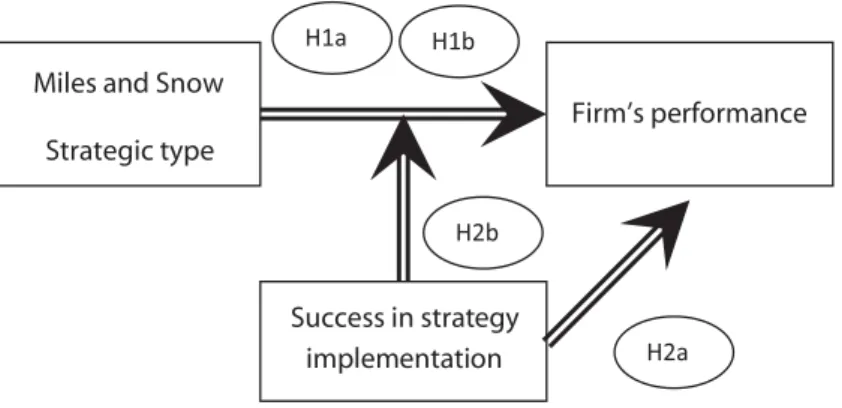
As shown in Figure 1, this study proposes a comprehensive framework to examine the per- formance impact of Miles and Snow’s generic strategy. Furthermore, it investigates the role of the strategy implementation to the generic strat- egy – performance relationship.
Miles and Snow Typology and Performance The studies on performance generally at- tempt to test two propositions. The first prop- osition is that the Prospectors, Analyzers and Defenders perform equally. The first hypothesis is based on the principle of eqifinality which states that “the same final state can be reached from different initial conditions and in differ- ent ways” (Von Bertalanfy, 1960 p. 84). Even though this principle provides an important ba- sis in explaining the first proposition, it is based on the context of a biological system.
In the strategic management context, the no- tion of ‘strategic fit’ can be used to explain why some firms perform well, while the others do not. The strategic fit principle asserts that orga- nizational effectiveness is the outcome of fitting certain organizational characteristics to contin- gencies that govern the situation of the firm (Burns and Stalker, 1961; Galbreath, 1973), and a match between them (a.k.a. fit) would result in a positive organizational performance (Venkatraman and Prescott, 1990). The Miles and Snow typology embraces these concepts.
For example, Miles and Snow (1978) argue that
Chaimankong and Prasertsakul
Figure 1. Conceptual Framework
an organization may be an effective performer if it exhibits a clear, stable strategy. Prospec- tors, Defenders and Analyzers are identified as
“stable” forms of organizations in which they possess a clear, stable strategy for competing in their domains and each has a specific configu- ration of structure, technology and process that is consistent with its strategy (Miles and Snow, 1978). Prospectors, Defenders and Analyzers adjust themselves to the environments that they are in, and, at the same time, have appropriate internal organizational adaptation to handle environmental change and uncertainty. Hence, Miles and Snow (1978) suggest that the three strategic types (Prospectors, Defenders, and Analyzers) are neither superior nor inferior, the following hypothesis is postulated:
H1a : Prospectors, Defenders and Analyzers will perform equally
Another proposition examined in the lit- erature is that Reactors tend to perform more poorly compared to Prospectors, Analyzers and Defenders. If the management does not pursue one of these ‘pure’ strategies (e.g. Prospector, Analyser, or Defender), Miles and Snow argue that they tend to be slow to respond to opportu- nities and are likely to be ineffective performers in the industry. This type of organization lacks consistent and stable adjustment to change and, hence, it can not achieve the ‘fit’. As a result, Reactors tend to underperform the other three.
The research tends to support this proposition (Conant et al., 1990; Jennings et al., 2003; Par- nell and Wright, 1993; Smith et al., 1989). This leads to the following hypothesis:
H1b : Reactors will under-perform Prospec- tors, Defenders and Analyzers
Zahra and Pearce II (1990) suggest that the relationship between Miles and Snow typology and performance may not be straightforward.
Some variables such as company size (Smith et al., 1989), environmental attributes (Ham- brick, 1983) and the fit between strategy and organization (Thomas and Ramaswamy, 1996) can also alter the performance. Consequently,
the influence of strategy implementation on the relationship between strategy type and perfor- mance is worth to examine.
Importance of strategy implementation
Strategy implementation (a.k.a. strategy ex- ecution) is defined as the managerial exercise of putting a freshly chosen strategy in place. It involves the managerial exercise of supervis- ing the ongoing pursuit of strategy, making it work, improving the competence with which it is executed, and showing measurable progress in achieving the targeted results (Thomson and Strickland, 2003). In a nutshell, Strategy imple- mentation refers to how firms take plans into action (Kazmi, 2008).
As the business strategies pursued by firms become more alike, the competitive advantages of firms are increasingly determined by how well they execute the planned strategy (Schneier et al., 1991). Studies on strategic management point out that the success in formulating strate- gy alone may not lead to the success of strategy.
For example, Harrison and Pelletier (2000) in- dicate that the value of strategic decisions will be realized only after effective implementation of a decision. Moreover, firms can not succeed if they do not implement strategies properly and effectively (Getz, Jones, and Loewe, 2009;
Robbins and Coulter, 1996). In line with this, Kruger (1996) indicates that change processes do not achieve the desired result or even fail if implementation is undermined by people in an organization. Additionally, Hrebiniak (2006) stresses the importance of strategy implemen- tation by indicating that a firm’s poor perfor- mance generally stems from the execution of the plan, rather than the plan itself.
Although some authors remark on the im- portance of implementation, Miller (2002) in- dicates that more than 70 percent of strategic initiatives by organizations fail at the imple- mentation stage. Various barriers such as poor communication, poor leadership, and poor sys- tems have been identified as the obstacles to successful implementation (Beer and Eisenstat, 2000; Heide et al., 2002; Raps, 2004). Thus, implementation is an enigma and creates frus-
THE SOUTH EAST ASIAN JOURNAL OF MANAGEMENT © April 2012 • VOL.6 • NO.1
6
tration in many organizations (Noble, 1999).
All of these barriers bring the spotlight to this part of the strategic process.
Currently, practitioners and academics agree that implementation is the most important part of strategic process that has been overlooked for a long period of time (Kaplan and Norton, 2001; Kazmi, 2008; Kruger, 1996). For exam- ple, Thompson and Strickland (1990) suggest that the implementation phase is the most com- plicated and time-consuming part of strategic management. Grundy (1998) advocates that the emphasis of strategic implementation should move from 10 percent to more than 50 per- cent of the overall process. A survey reported by Kaplan and Norton (2001) indicates that the implementation phase is much more important than the quality of the strategy itself.
Even though the previous literature high- lights the role of strategy implementation, few of them have empirically tested the relationship.
Given the importance of implementation, it is important to investigate the role of implemen- tation in contributing to a firm’s performance.
Thus, it is hypothesized that:
H2a : Success in strategy implementation is a significant predictor of a firm’s performance
Furthermore, Miles and Snow (1978) im- plicitly assume that organizational structure and processes are in line with the strategy. Thus, the fit between pursued strategy and organization structure and process suggests that strategy im- plementation is likely to be successful. Howev- er, the real world experience indicates that strat- egy implementation is not always simple and straightforward (Miller, 2002; Noble, 1999). In addition, firms generally ignore or give less at- tention to implementation (Grundy, 1998; Ka- plan and Norton, 2001; Miller, 2002; Thomp- son and Strickland, 1990). Thus, the predicted results may not eventuate if implementation is not successful. The following hypothesis is de- rived:
H2b : The influence of the strategic type on a firm’s performance depends on the success in strategy implementation.
Research Method
The unit of analysis in this research is at the firm level. This is because the primary objec- tive of this study is to empirically test the ef- fects of strategic types proposed by Miles and Snow (1978) and strategy implementation on a firm’s performance. Structured questionnaires were collected from key informants from firms in chemical industry in Thailand. They were mostly senior executives who possess crucial information about organizational situations.
The chemical industry plays an important role in Thailand’s economic system. This industry is considered to be a fundamental industry for both manufacturing and the service sector. The production of chemicals leads to a continuous process in other downstream industries as many raw materials used in many industries are the products from the chemicals industry (Office of Industrial Economics, 2003). A study on a single industry provides ‘natural controls’ for a wide range of variables (Peteraf and Shanley, 1997). It was decided to focus on one particular industry in Thailand, the chemical industry, in- stead of surveying across a range of industries.
This study employs systematic sampling method; that is, every 2nd name on the list was automatically selected from the sampling frame, Z directory, after the initial starting point had been randomly determined. Data col- lection yield 114 questionnaires returned from 309 questionnaires sent out, thus achieving a response rate of 36 percent. According to pre- vious research in this area, a sample size rang- ing from 110 to 400 is common (Conant et al., 1990; Jennings et al., 2003; Parnell and Wright, 1993; Taslak, 2004).
Measurement Model
The questionnaire consisted of two sections.
The first section asked about the company and key informants information, whilst the second part asked about the key constructs. Informa- tion regarding key constructs and their cor- responding scales was obtained by searching the relevant literature; therefore, all constructs were measured using existing scales drawn
Chaimankong and Prasertsakul
from literature with some adjustments. Three constructs employed in this study were mea- sured as follows:
Miles and Snow Typology
The extensive studies on Miles and Snow ty- pologies lead to a number of approaches to op- erationalize the four types of strategies (Conant et al., 1990). Two widely employed approaches are discussed in this section: paragraph and multi-items approaches. In the paragraph ap- proach, four typed paragraphs are presented to the respondents and then the respondents are asked to choose one paragraph that seems to best describe their firm’s characteristics. Alter- natively, many researchers attempted to opera- tionalize Miles and Snow typologies by using a multi-item approach (Conant et al., 1990; Se- gev, 1987; Smith et al., 1989). This approach was developed to overcome the weaknesses of the single-item paragraph approach.
With the limitations of the paragraph ap- proach, this study adopted eleven-item scale from Conant et al., (1990). In each question, four descriptions that represent the characteris- tics of each strategic type were presented to the respondents, and the respondents were asked to choose one of those four that best matched with their firm’s characteristics. This self-reporting has been regarded as a suitable method to utilize when conducting research into strategy (Huber and Power, 1985; Snow and Hrebiniak, 1980).
Firms were then classified into each Miles and Snow generic strategy based on the score that they received.
Success in Implementation
There are numerous approaches to defin- ing success in strategy implementation. Many authors have equated implementation success with the accomplishment of certain results (Al- exander, 1985; Harrison and Pellestier, 2000;
Miller, 1997; Peters and Waterman, 1982).
For instance, Alexander (1985, p. 94) defined the implementation success as “the extent to which the actual implementation: 1) achieved the expected goals of the strategic decision; 2)
achieved the financial results that were expect- ed; and 3) was carried out within the various resources initially budgeted for it”. This study follows the definition by Alexander (1985) which has been adopted in several subsequent studies (Al-Ghamadi, 1998; Kargar and Blu- menthal, 1994; Taslak, 2004).
This measure seeks to assess the overall suc- cess of strategic implementation. The respon- dents were asked to evaluate the success in strategy implementation based on three criteria discussed earlier in this section, using the five- point Likert type scale which is ranging from 1 = highly unsuccessful to 5 = highly success- ful. The criterion to distinguish the higher and lower success of firms is based on the median score of these three objectives. Kargar and Blu- menthal (1994) suggest that the firms that had a median score of 4 or 5 are classified as hav- ing higher success in implementation, whereas those who received 1 or 2 or 3 are considered as having lower success in implementation.
Firm performance
This measure aims to determine the firm per- formance in relation to others in the industry.
Dess and Robinson (1984) argue that strategic management researchers regularly experience problems in obtaining objective data on the per- formance of firms. This leads to the popularity of subjective self-reporting. Most of the studies in this area prefer to operationalize the firm’s performance by using subjective self-report (Conant et al., 1990; Dess and Robinson, 1984;
Jennings et al., 2003; Smith et al., 1989) over objective data (Parnell and Wright, 1993). Dess and Robinson (1984) found that managers pos- sess the ability to judge their firm’s performance in relation to other competitors in the industry.
In addition, Smith et al. (1989) found that the subjective evaluation correlates with the corre- sponding objective data. It was decided to em- ploy subjective self-report and adopt four firm’s performance criteria employed by Smith et al.
(1989). The respondents were asked to rate their firm’s performances relative to others in the industry on the five point interval scales (5
= top 20 percent, 4 = the upper 20-40 percent,
THE SOUTH EAST ASIAN JOURNAL OF MANAGEMENT © April 2012 • VOL.6 • NO.1
8
and so on). This instrument measures four as- pects of firm performance which include: sales growth; profits; return on total assets; and over- all performance.
This study ensures the content validity by taking all measures directly from previous re- search which has been tested and used in some previous studies. Thus, this questionnaire was constructed with an acceptable content validity.
The reliability measured by Cronbach’s alpha for success in strategy implementation and a firm’s performance constructs are shown in Ta- ble 1 below. Both constructs reported the Cron- bach’s alpha of higher than 0.7 which complies with Nunnally’s (1978) guideline.
Result and Discussion
Each of the items was first checked for skew- ness and kurtosis, and the presence of normality and outliers. In order to obtain a holistic pic- ture of each of the variable, histograms and box plots were deemed appropriate. The histograms and box plots were visually examined. The data was thus normally distributed. In addition, the Durbin-Watson test was used to assess the as- sumption of independent errors of the data. A test value close to 2 indicates that the residuals are uncorrelated. Of 111 responses, 40 firms (36 percent) are classified as Defenders; 36 firms (32.4 percent) are Analyzers; 19 firms (17.1 percent) are Prospectors; and 16 firms (14.4 percent) are Reactors.
Hypothesis Testing Results
H1a : Prospectors, Defenders and Analyzers will perform equally
Table 2 presented mean score, standard de- viation, and ANOVA test between Miles and Snow generic strategy and a firm’s perfor- mance. Four performance measures including sales growth, profit, return on asset (ROA), and overall performance were employed in this study. The ANOVA test reveals whether each strategic type has the same level of firm per- formance or not. Specifically, ANOVA com- pares the mean scores of a firm’s performance for each strategic type to determine if there are any differences in a firm’s performance due to strategies.
Prospectors exhibited the highest mean scores in all performance measures, especially when sales growth was used as a performance measure. In contrast, Reactors exhibited the lowest mean scores in all performance mea- sures. Defenders and Analyzers tended to have more or less the same performance scores. To test whether these four strategic types have the same or different levels of performance, the ANOVA test (F-statistic) was calculated.
The ANOVA test (F-statistic) indicated the significant results for all performance measures (p < 0.05). The significant F-statistic suggested that at least one of the strategic types exhibited a different level of firm performance. In other
Chaimankong and Prasertsakul
Table 1. Reliability statistics
Constructs Cronbach's alpha Number of items
Success in strategy implementation .768 3
Firm performance .902 4
Table 2. ANOVA results: subjective performance mean scores (Standard Deviations) between strategy and performance
Performance Dimensions Prospector Defender Analyser Reactor F p-value
Sales growth 3.84
(.688)
3.15 (.700)
3.36 (.931)
2.31
(.704) 11.699** .000
Profits 3.42
(.838)
3.38 (.667)
3.31 (.822)
2.38
(.619) 8.056** .000
ROA 3.47
(.722)
3.40 (.744)
3.22 (.681)
2.56
(.512) 6.396** .001
Overall performance 3.68 (.671)
3.38 (.740)
3.28 (.659)
2.56
(.512) 8.581** .000
Note**The results are highly significant at the 0.001 level
words, the different strategic types that firms pursued lead to different levels of a firm’s per- formance. As ANOVA tests were significant for all four performance measures, to gain further information the post-hoc test was employed to produce multiple comparisons between each pair of strategic groups to reveal the orders.
The Scheffe post-hoc test indicated the in- significant differences in performance level of three strategic types: Prospectors, Analyzers and Defenders. When using sales growth as a performance measure, the Scheffe post-hoc test indicated that only Prospectors and Analyzers performed significantly higher than Defenders and Reactors. The insignificant level of perfor- mance difference was found for Prospectors and Analyzers. Even though the sales growths of Defenders were significantly lower than Prospectors and Analyzers, they exhibited sig- nificantly higher sales growth than Reactors.
H 1b : Reactors will under-perform Prospec- tors, Defenders and Analyzers
The hypothesis 1b was strongly supported.
The Scheffe post-hoc test revealed the sig- nificant lower level of performance for Reac- tors compared to Prospectors, Defenders, and Analyzers, in all performance measures at the 5 percent level of confidence. It was concluded that Reactors under-performed Prospectors, Defenders and Analyzers.
H2a : Success in strategy implementation is a significant predictor of a firm’s performance
To test the predictive utility of success in strategy implementation with respect to a firm’s performance, the univariate linear regression was conducted. The bivariate regression results from table 3 revealed that success in implemen-
tation was a significant predictor of firms’ per- formance (b = .513, t = 6.234, p<.05), and it explained 25.6 % (R2 = .256) of the variation in firms’ performance. It was concluded that suc- cess in strategy implementation is a significant predictor of firm performance.
H2b : The influence of the strategic type on a firm’s performance depends on the success in strategy implementation
The H2b hypothesis further investigated the relationship between strategic type and a firm’s performance, previously tested in a prior sec- tion by adding success in strategy implemen- tation as a contingent variable. The hypothesis stated that the influence of strategic type on a firm’s performance depends on the success in implementation. In other words, the relation- ship between Miles and Snow strategic type and a firm’s performance in research question one is altered by whether a firm reports success in strategy implementation.
Two-way ANOVA was employed to test these hypotheses. The tests were performed four times, corresponding to four performance measures. The median scores of success in strategy implementation were used to classify firms into two groups: firms that succeed in strategy implementation (median = 4 or more) and firms that do not succeed in strategy im- plementation (median = 3 or less). From Table III, the F-statistics of the interaction effect are relatively low for all performance measures.
The non-significant effects were found regard- less of which performance measures were used.
Hence, the hypothesis H2b was rejected and it is concluded that the success in strategy imple- mentation did not alter the relationship between
THE SOUTH EAST ASIAN JOURNAL OF MANAGEMENT © April 2012 • VOL.6 • NO.1
10
Table 3. Results of Bivariate Regression Analysis
Independent Variable Dependent Variable Beta t-Value Sig T R2
Success in Implementation Firm’s Performance .513** 6.234 .000 .256
Note**The results are highly significant at the 0.001 level.
Table 4. Two-way ANOVA test results
Source F-test Sales growth F-test Profit F-test ROA F-test Overall performance
Main effect:
Strategic type
6.368* (p=.004)
2.728* (p=.048)
2.826* (p=.042)
4.264* (p=.003) Main effect:
Success in implementation
8.684**
(p=.001)
13.155**
(p=.000)
9.010**
(p=.000)
12.654**
(p=.001) Interaction effect: Strategic type *
Success in implementation
.535 (p=.695)
1.952 (p=.126)
1.591 (p=.196)
1.525 (p=.212) Note *The results are significant at the 0.05 level.
**The results are highly significant at the 0.001 level.
Miles and Snow strategic type and a firm’s per- formance.
Conclusion
Two hypotheses regarding the relationship between Miles and Snow strategic type and firm performance were strongly supported. Overall, the results lend support to a number of prior studies (Garrigos-Simon et al., 2005; Jennings et al., 2003; Parnell and Wright, 1993; Smith et al., 1989; Thomas and Ramaswamy, 1996). In addition, the result of the first hypothesis was in line with the principle of equifinality and the concept of strategic fit. Unlike previous stud- ies which were conducted in various Western countries, this study was conducted in the East- ern context of Thailand. This finding suggests that the relationship between Miles and Snow strategic type and a firm’s performance may be universal, regardless of the location where the study is conducted. However, to confirm such a claim, more studies in some other countries are required.
There are two interesting points in the find- ings that should be further discussed. First, Prospectors did exhibit significantly better per- formance compared to Defenders when sales growth was used as a performance criteria.
However, this is not a surprising result since Prospectors tend to engage with more entre- preneurial activities (Miles and Snow, 1978).
Second, the findings contradict the conven- tional wisdom proposed by Porter (1980). Por- ter (1980) argues that firms must pursue a pure strategy to remain competitive in their respec- tive markets. If firms pursue two distinct ge- neric strategies at the same time, firms will find themselves ‘struck in the middle’, which result, in losing their competitive advantages. In this study, Analyzers, which is a hybrid strategy be- tween Prospectors and Defenders, can achieve the same level of performance as Prospectors and Defenders. The finding from this empirical test confirms the importance of strategy imple- mentation as suggested by the previous litera- ture. Thus, firms can improve a great deal of their performance by placing more emphasis on strategy implementation.
When the success in strategy implementa- tion was used as a contingent variable to test the relationship between strategic type and firm performance, the hypothesis was not supported.
It indicated that the influence of strategic type
on firm performance does not depend on the
success in strategy implementation. This sug- gests that the relationship may not exist. Addi- tional studies in other contexts are required be- fore the conclusion can be made or confirmed.
The influence of strategic type on the perfor- mance is weaker than the influence of success in strategy implementation. The finding is in line with Hatten et al. (2004) which found that the performance is more associated with strategy implementation than the Miles and Snow stra- tegic type. The finding indicated that not only success in strategy implementation a significant predictor of a firm’s performance, but also it has greater impact on a firm’s performance than the Miles and Snow strategic type that a firm pursues. This finding reinforces the importance of strategy implementation in contributing to a firm’s performance.
This study provides a number of business and research implications. In terms of the re- search implications, this research contributes to the relationship between Miles and Snow strategic type, implementation, and firm per- formance in the chemical industry in an East- ern context where the knowledge is lacking. In terms of implications for business, the findings reveal the desirable and undesirable strategies for the management of firms in the chemical in- dustry in Thailand. The results also point out and confirm the role of implementation in help- ing firms to improve their bottom line
Future Research
More studies in other industries and other countries are required to reveal a clearer picture of the relationship. In addition, like most stud- ies in this field, this study focuses on one partic- ular industry. The relationship may be moder- ated by industry, specifically the industry cycle.
For instance, Defender may be an appropriate strategy in sunset industries, while Prospector and Analyser may fit well with high growth,
Chaimankong and Prasertsakul
dynamic industries. The future research may take this into account. The future research may consider using more specific barriers to imple- mentations. It will enhance the usefulness of
the results in terms of business implication. The management can pinpoint the source of prob- lem more correctly.
THE SOUTH EAST ASIAN JOURNAL OF MANAGEMENT © April 2012 • VOL.6 • NO.1
12
References
Alexander, L. (1985), Successfully Implementing Strategic Decisions, Long Range Planning, 18(3), 91-97.
Al-Ghamadi, S.M. (1998), Obstacles to Successful Implementation of Strategic Decision: The British Experience, European Business Review, 98(6), 322-327.
Andrews, K. (1971), The concept of strategic strategy, Down Jones-Irwin, Homewood.
Aragon-Sanchez, A., & Sanchez-Martin, G. (2005), Strategic Orientation, Management Characteris- tics, and Performance: A Study of Spanish SMEs, Journal of Small Business Management, 43(3), 287-308.
Beer, M., & Eisenstat, R.A. (2000), The Silent Killers of Strategy Implementation and Learning, Sloan Management Review, 42(4), 29-40.
Bowman, C., & Asch, D. (1987), Strategic Management, Macmillan, London.
Burns, T., & Stalker, G.M. (1961), The Management of Innovation, Tavistock Publications, London.
Conant, J.S., Mokwa, M.P., & Varadarajan, P.R. (1990), Strategic types, distinctive marketing compe- tencies and organizational performance: a multiple measures-based study, Strategic Management Journal, 11(5), 365-383.
Courtright, J.A., Fairhurst, G.T., & Rogers, L.E. (1989), Interaction Patterns in Organic and Mecha- nistic Systems, Academy of Management Journal, 32(4), 773-202.
Covin, J. G. (1991), Entrepreneurial Versus Conservative Firms: A Comparison of Strategies and Performance, Journal of Management Studies, 28(5), 439-462.
David, F.R. (1995), Concepts of Strategic Management, Prentice Hall, Englewood Cliffs.
Deshpande, R., Farley, J.U., & Bowman, D. (2004), Tigers, Dragons, and others: profiling high per- formance in Asian firms, Journal of International Marketing, 12(3), 5-29.
Dess, G. G., & Robinson, R. B. (1984), Measuring organizational performance in the absence of ob- jective measure, Strategic Management Journal, 5(3), 286-274.
Forester, J., & Browne, M. (1996), Principles of strategic management, Macmillan, South Melbourne.
Galbreath, J. R. (1973), Designing complex organization, Addison-Wesley, Reading.
Galbreath, J. R. (2010), The impact of strategic orientation on corporate social responsibility, Organi- zational Analysis, 18(1), 23-40.
Garringos-Simon, F. J., Marques, D. P., & Narangajavana, Y. (2005), Competitive Strategies and Per- formance in Spanish Hospitality Firms, International Journal of Hospitality Management, 17(1), 22-38.
Grundy, T. (1998), Strategy Implementation and Project Management, International Journal of Pro- ject Management, 16(1), 43-50.
Getz, G., Jones, C., & Loewe, P. (2009), Migration Management: An Approach for Improving Strat- egy Implementation, Strategy and Leadership, 37(6), 18-24.
Hambrick, D.C. (1983), Some Tests of the Effectiveness and Functional Attributes of Miles and Snow’s Strategic Types, Academy of Management Journal, 26(1), 5- 26.
Harrison, E.F., & Pellestier, M.A. (2000), Levels of Strategic Decision Success, Management Deci- sion, 38(2), 107-117.
Hatten, K. J., James, W. L., & Meyer, D. G. (2004), The Longevity of the Performance Effects of the Miles and Snow Strategic Archetypes: A Ten-Year Perspective in US Banking, International Journal of Management & Decision making, 5(2/3), 196
Chaimankong and Prasertsakul
Heide, M., Grohang, K., & Johannessen, S. (2002), Exploring Barriers to the Successful Implementa- tion of A Formulated Strategy, Scandinavian Journal of Management, 18, 217-231.
Hitt, M.A., Ireland, R.D., & Hoskisson, R.E. (2005), Strategic Management: Competitiveness And Globalization Concepts, Thomson South-Western, Mason.
Hrebinaik, L.G. (2006), Obstacles to Effective Strategy Implementation, Organizational Dynamics, 35(1), 12-31.
Hubbard, G. (2000), Strategic Management: Thinking, Analysis and Action, Prentice Hall, Frenchs forest N.S.W.
Huber, G.P., & Power, D.J. (1985), Retrospective Reports of Strategic-Level Managers: Guidelines for Increasing Their Accuracy, Strategic Management Journal, 6(2), 171-180.
Hussey, D. (1998), Strategic Management, Butterworth Heinemann, Melbourne.
Jennings, D.F., Rajaratnam, D., & Lawrence, F.B. (2003), Strategy-Performance Relationships in Service Firms: A Test For Equifinality, Journal of Managerial Issues, 15(2), 208-220.
Johnson, G., & Scholes (2002), Exploring Corporate Strategy, Financial Times- Prentice Hall, Har- low.
Kaplan, R. S., & Norton, D. P. (2001), The Strategy-Focused Organization: How Balanced Score- Card Companies Thrive In The New Business Environment, Harvard Business School Press, Bos- ton.
Kargar, J., & Blumenthal, R. (1994), Successful Implementation of Strategy Decisions in Small Com- munity Banks, Journal of small business management, 32(2), 10-22.
Kazmi, A. (2008), A Proposed Framework for Strategy Implementation in the Indian Context, Man- agement Decision, 46(10), 1564-1581.
Ketchen, D.J. (2003), Introduction: Raymond E. Miles and Charles C. Snow’s Organizational Strat- egy, Structure, and Process, Academy of Management Executive, 17(4), 95-96.
Kruger, W. (1996), Implementation: The Core Task of Change Management, CEMS Business Review, 1(1), 77-96.
Kumar, K. (2010), Similarities and Differences in the Strategic Orientation, Innovation Patterns and Performance of SMEs and Large Companies, The Business Review, 16(2).
Mckelvey, B., & Aldrich, H. (1983), Populations, Natural Selection, And Applied Organizational Sci- ence, Administrative Science Quarter, 28(1), 101-128.
McKiernan, P. (1996), Historical Evolution of Strategic Management, Dartmounth Publishing, Al- dershot.
Miles, R.E., & Snow, C.C. (1978), Organizational Strategy, Structure and Process, McGraw-Hill, New York.
Miller, S. (1997), Implementing Strategic Decisions: Four Key Success Factors, Organization Stud- ies, 18(4), 577-602.
Miller, S. (2002), Successful Change Leaders: What Makes Them? What Do They Do That Is Differ- ent?, Journal of Change Management, 2(4), 359-368.
Mintzberg, H. (2000), The rise and Fall Of Strategic Planning, Financial Times-Prentice Hall, Lon- don.
Mintzberg, H., & Water, J.A. (1985), Of Strategies, Deliberate and Emergent, Strategic Management Journal, 6(3), 257-272.
Namiki, N. (1989), Miles and Snow’s Typology of Strategy, Perceived Environmental Uncertainty, and Organizational Performance, Akron Business and Economic Review, 20(2), 72-88.
Noble, C. (1999), Building Strategy Implementation Networks, Business Horizons, 62(16), 19-28.
Nunnally, J. (1978), Psychometric theory, McGraw Hill, New York.
Office of Industrial Economics (2003), A Summary Of Industrial Economic Conditions 2003, OIC, Bangkok
THE SOUTH EAST ASIAN JOURNAL OF MANAGEMENT © April 2012 • VOL.6 • NO.1
14
O’ Farrell, P., Hitchens, D., & Moffat, L (1992), Does Strategy Matter? An Analysis Of Generic Strat- egies And Performance In Business Unit Firms, Business Strategy Review, 3(1), 71-86.
Parnell, J.A., & Wright, P. (1993), Generic Strategy and Performance: an Empirical Test of the Miles and Snow Typology, British Journal of Management, 4(1), 29-36.
Peteraf, M., & Shanley, M. (1997), Getting To Know You: A Theory Of Strategic Group Identity, Strategic Management Journal, 18(Summer Special Issue), 165 86.
Porter, M.E. (1996), What is Strategy? , Harvard Business Review, 74(6), 61-78.
Porter, M.E. (1980), Competitive Strategy, Basic Books, New York.
Porth, S.J. (2003), Strategic Management: A Cross-Functional Approach, Prentice Hall, Upper Sad- dle River.
Powell, T.C. (1992), Strategic Planning as Competitive Advantage, Strategic Management Journal, 13(7), 551-558.
Pucko, D., & Cater, T. (2008), A Holistic Strategy Implementation Model Based On The Experiences Of Slovenian, Economic and Business Review for Central and South - Eastern Europe, 10(4), 307-322.
Quinn, J. B. (1980), Strategies for Change: Logical Incrementalism, Irwin, New York.
Raps, A. (2004), Implementing Strategy, Strategic Finance, 85(12), 48-53.
Robbins, S.P. & Coulter, M. (1996), Management, Prentice-Hall, Englewood Cliffs.
Rumelt, R.R. (1980), The Evaluation Business Strategy, McGraw-Hill, New York.
Sagev, E. (1987), Strategy, Strategy Making, and Performance in Business Game, Strategic Manage- ment Journal, 8(6), 565-577.
Schneier, C.E., Shaw, D.G., & Beatty, R.W. (1991), Performance Measurement and Management, Human Resources Management, 30(3), 279-300.
Shirokova, G. (2010), Factors of New Venture Performance in Russia, Management Research Re- view, 33(5), 484-498.
Smith, K., Guthrie, J., & Chen, M. (1989), Strategy, Size and Performance, Organization Studies, 10(1), 63-81.
Snow, C.C., & Hrebiniak, L.G. (1980), Strategy, Distinctive Competence, and Organizational Perfor- mance, Administrative Science Quarterly, 25(2), 317-336.
Taslak, S. (2004), Factors Restricting Success of Strategic Decisions: Evidence from the Turkish Textile Industry, European Business Review, 16(2), 152 -164.
Thomas, A., & Ramaswamy, K. (1996), Matching Managers to Strategy: Further Tests of the Miles and Snow Typology, British Journal of Management, 7(3), 247-261.
Thompson, A.A., & Strickland A.J. (1990), Strategic Management: Concepts and Cases, BPI/IR- WIN, Boston.
Thomson, A.A., & Strickland, A.J. (2003), Strategic Management: Concepts and Cases, McGraw- Hill/Irwin, Boston.
Torgovicky, R., Goldberg, A., Shvarts, S., & Dayan, Y. (2005), Application of Porter’s Generic Strat- egies in Ambulatory Health Care: A Comparison of Managerial Perceptions in Two Israeli Sick Funds, Health Care Management Review, 30(1), 17-24.
Venkatraman, N., & Prescott, J.E. (1990), Environment-Strategy Co-alignment: An Empirical Test Of Its Performance Implications, Strategic Management Journal, 11(1), 1–23.
Viljoan, J., & Dann, S. (2003), Strategic Management, Prentice Hall, Sydney.
Von Bertalanfy, L. (1960), General Systems Theory, Gorge Braziller, New York.
Wheelen, T., & Hunger, D. (1995), Strategic Management and Business Policy, Addison-Wesley Publishing, New York.
Wood, A. (2005), The Tiger vs. the Dragon, Chemical Week, 167 (8), 5.
Zajec, E.J., & Shortell, S.M. (1989), Changing Generic Strategies: Likelihood, Direction, and Perfor- mance Implications, Strategic Management Journal, 10(5), 413-430.
Instructions to Contributors
Aim and Scope
The South East Asian Journal of Management (SEAM) aims to present the latest thinking and research that tests, extends, or builds management theory and contributes to management practice. Contents of the Journal will be of interest to management teachers, students and researchers as well as to practicing managers. Journal materials should be analytical rather than descriptive.
Whilst a major focus of the journal is on management issues related to South East Asia, increasingly global concerns and conceptual topics will be covered also. The journal does not take a narrow view of business and management. Manuscripts from other disciplines might be published if considered to offer significant contributions to solve existing managerial problems.
In order to be published in SEAM, a manuscript must make strong empirical and theoretical contributions to the field of management. Thus, preference is given to submissions that test, extend, or build strong theoretical frameworks while empirically examining issues with high importance for management theory and practice.
Manuscripts
Manuscripts must be double-spaced on 8 1/2 x 11” paper. Body text should be in Times New Roman, font size 12. Manuscript length should be reasonable for the contribution offered. Soft copy of the article should be sent to:
Sari Wahyuni, Ph.D Editor in Chief
The South East Asian Journal of Management Departement of Management
Faculty of Economics Universitas Indonesia Departement of Management Building, Kampus Baru UI,
West Java, Indonesia
Phone : +62-21-7272425 ext 503 Fax : +62-21-7863556
Email: seam@ ui.ac.id
Manuscripts are reviewed by the editor, members of the SEAM Editorial Review Board, and occasional reviewers. The author’s name and affiliation are removed before reviewing in order to ensure objectivity. Please do not identify the author(s) in the body of the paper either directly or by citation. Manuscripts with poor English will be directed to an appointed Language Editing partners before further review process can be done.
With the submission of a manuscript, the following three items should be included in a separate page:
1. Cover page showing title, each author’s name, affiliation, complete address, telephone and fax number, and the category of the article.
Select one category from the following:
Finance, Marketing, Human Resource, Innovation, Knowledge Management, Strategic, and Organization.
2. Abstract of up to 150 words.
3. Keywords, approximately five to seven words.
THE SOUTH EAST ASIAN JOURNAL
MANAGEMENT
OF
Heading
Manuscript should be divided into five heading, i.e. Introduction, Literature Review, Research Method, Result and Discussion and Conclusion. Each heading should be in Times New Roman, bold, font size 14. Sub-heading should be in Times New Roman, bold-italic, font size 12.
Mathematical Notation
Notations should be clearly explained within the text. Equations should be centered on the page. If equations are numbered, type the number in parentheses flush with the right margin. Unusual symbols and Greek letters should be identifed. For equations that may be too wide to fit in a single column, indicate appropriate breaks.
Table and Figures
Indicate table placements within text.
Camera-ready tables should be typed flush with the left-hand margin and have proper labeling of sources, column headings, and other notations. Once the manuscript has been accepted for publication, complex tables and figures (diagrams, charts, graphs, etc.) should be prepared professionally for camera-ready reproduction.
References
Reference citations within the text should consist of the author’s last name and date of publication, without punctuation, enclosed within parentheses, and should be inserted before punctuation and/or at a logical break in the sentence. If several citations are needed, separate them with semicolons, and list alphabetically. If two or more works by an
author have the same year, distinguish them by placing a, b, etc. after the year.
References should be double-spaced and attached on a separate page. Works by single author, list chronologically; two authors, alphabetically and then chronologically;
three authors, the same; four or more, list chronologically. References should be in the following:
Books:
Bagozzy, R.P. (1980), Causal Models in Marketing, New York: Wiley.
Journals:
Singh, J. (1991), Understanding the Structure of Consumers’ Satisfaction Evaluations of Service Delivery, Journal of the Academy of Marketing Science, 19 (Summer), 223-244.
Three or More Authors:
Zeithaml, V.A., Berry, L.L., & Parasuraman, A. (1993), The Nature and Determinants of Customers Experiences of Service, Journal of the Academy of Marketing Science, 21 (Winter), 1-12.
Article in a Book Edited by another Author:
Levitt, T. (1988), The Globalization of Markets, in Multinational Marketing Management, Robert, D.B., & Quelch, J.A. (Eds.), Reading, MA, Addison Weley, 186-205.
Unpublished Dissertations:
Paterson, K.S. (1985), The Effects of Bilingual Labels in Buyer Behaviour, Dissertation, University of California at Irvine.
A copy of the SEAM Journal style sheet is available from the editor on request. For further information, please visit our website http://
seam.pascafe.ui.ac.id or http://journal.ui.ac.
id/tseajm