Spectral shifts can be analyzed to give a clearer picture of the structure of DMSO in DMSO/water mixtures and also in solutions with other hydrogen bond donors that cannot form such extensive hydrogen bonded networks. It has previously been established that the reason for the unique properties of such solutions lies in the formation of strong hydrogen bonds between water and DMSO. The non-covalent interaction that will be most important for this research is the hydrogen bond.
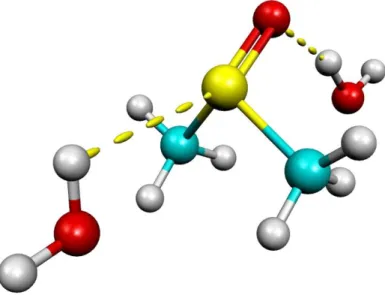
The top methanol donates an OH···N hydrogen bond to a nitrogen atom in pyrimidine, but also accepts an OH···O hydrogen bond from a second methanol molecule below. This type of hydrogen bond is called weak because carbon and hydrogen have similar electronegativities and therefore the interaction with the adjacent oxygen atom is weaker than in the case of OH···O hydrogen bonds. In DMSO/water interactions, DMSO can accept OH···O and OH···S hydrogen bonds from water and donate CH···O hydrogen bonds to water.
The hydrogen of one water molecule forms a hydrogen bond with another through the attraction of the valence electrons of oxygen. Water molecules can also form hydrogen bonds with other molecules, especially with those that have a hydroxyl group, which are also soluble in water. Hydrogen bonds are weaker than covalent bonds because there is no direct sharing of electrons between atoms.
The strongest hydrogen bonds have the donor, the hydrogen atom and the acceptor in a bond angle closest to 180°.
FUNDAMENTALS OF SPECTROSCOPY
There are numerous transition possibilities between energy levels in molecules such as vibrational, rotational, and electronic. Transitions can also occur in the electronic states of molecules which can produce spectra in the visible and ultraviolet regions. There are other types of transitions, as well as types of spectroscopy to study them.
When light, an excitation source, strikes a sample of matter, the light can take several paths.
RAMAN SPECTROSCOPY
In Raman spectroscopy when the molecule is hit with radiation, the photons are absorbed at one frequency which is followed by the emission of photons with a change in frequency. The three types of Raman scattering; Rayleigh, Stokes and Anti-Stokes are depicted in the figure below. Rayleigh scattering, also known as elastic scattering, is the most common and indicates that the scattered radiation has the same frequency as the source radiation.
The change in energy between the scattered and the incident beam indicates a vibrational transition in the molecule.
EXPERIMENTAL METHODS
A photomultiplier tube detector is used to amplify the signal produced by Raman scattering, because Raman Stokes scattering only occurs in about 1 in a million photons. Although a photomultiplier tube, PMT, can amplify these signals, it requires a maintained cool temperature to do so.
COMPUTATIONAL METHODS
DIMETHYL SULFOXIDE (DMSO) 10
- HISTORY AND APPLICATIONS OF DMSO
- PREVIOUS STUDIES
- INTRODUCTION
- EXPERIMENTAL AND COMPUTATIONAL PROCEDURES
- RESULTS
- DISCUSSION
- CONCLUSIONS
The reorientation time of water was found to be related to the reorientation time of DMSO.10 DFT calculations using M06-2X theory were also performed to reveal that DMSO and water form stable structures due to hydrogen bonding between the two molecules. Polarizability was also found to increase with cluster size.11 Raman spectroscopy studies were performed with 1:1 DMSO/water mixtures and found that decreasing temperatures increased hydrogen bonding between DMSO and water.12 Configurations of DMSO/water mixtures were also previously studied with some success. In a previous study involving infrared spectroscopy, NMR spectroscopy, and ab initio calculations, two configurations of DMSO/water clusters were identified.
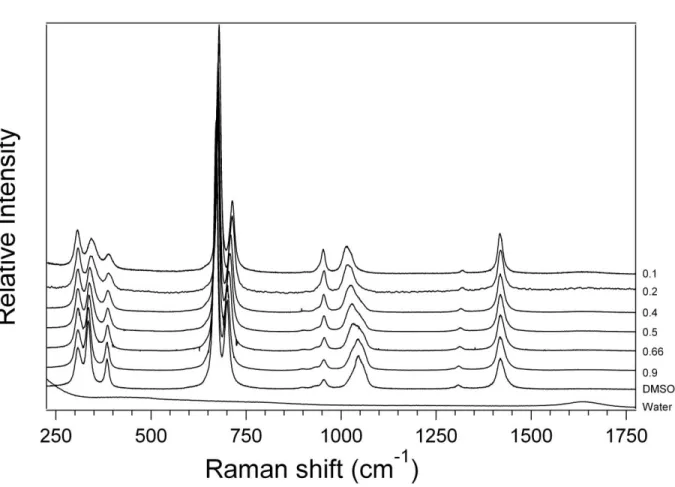
While in the other half of the water monomers only one OH group formed a hydrogen bond with DMSO.13. The DMSO/water cryoprotectant has a depressed freezing point of 203 K. 14 There are also strong deviations from ideality due to the increase in viscosity at mole fractions of 0.3 to 0.4 DMSO in the DMSO/water mixture. 15 Recent Raman scattering experiments and DFT calculations are were used to analyze the structural features of DMSO-water mixts., focusing on the S=O stretching region at ∼1045 cm-1. Due to the stretching of the S=O dimeric mode at 0.1 mole fraction of DMSO, it was found that even at low DMSO concentrations it still exists as a dimer.
The anomalous properties of DMSO/water mixtures have been the subject of a large number of studies. Despite numerous studies, there is still no clear picture of the structure of DMSO in the water mixture. When a DMSO/water mixture is formed, there is a large increase in the temperature of the solution.
As can be seen in Figure 5.6, DMSO is an acceptor of both water molecules in the formation of hydrogen bonds. Figures 5.7 and 5.8 show the theoretical Raman spectra of DMSO/water mixtures for the optimized geometries considered here. The poor agreement in this case is likely due to neglecting the effects of DMSO dimer interactions.
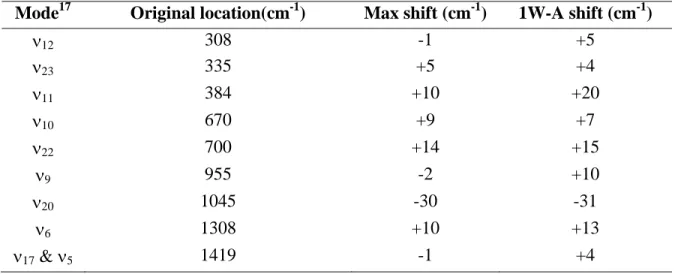
This elongation is believed to be due to an electron density transfer due to the hydrogen bonding of the water molecule to DMSO. The large +14 cm-1 shift in 22 is probably due to the fact that this mode in the 1W-A complex is strongly coupled to a water wagging motion of the hydrogen-bonded proton. In both cases, a theoretical structure of DMSO and one hydrogen-bonded water molecule reproduces experimental results to within 1 cm-1.
In the case of the large redshift, the reorganization of the electron density extends the S=O bond, leading to the redshift. In the case of 22, a strong coupling of a large amplitude motion of the water molecule to the mode leads to the large blue shift. Shikata, T.; Sugimoto, N., Reconsideration of the anomalous dielectric behavior of dimethyl sulfoxide in the pure liquid state.
Raman scattering and DFT calculations used to analyze the structural characteristics of DMSO in water and methanol.