Leif's company contracts with the Department of Athletics at Ohio State University to provide counseling and performance consulting to its 36 sports and nearly 1,000 athletes. He regularly consults with the athletic departments at The Ohio State University and Ohio University, both serving as an adjunct faculty member.
Introduction
You are a coach and want to use sports psychology to help your athletes achieve their goals. You are the parent of an athlete and want to support your child's athletic career in all the right ways.
Getting the Winning Edge
Your Mental Toolkit for Success
Staying Competitive
Improving Team Performance with Sports Psychologywith Sports Psychology
Sports Psychology for Coaches and Parentsfor Coaches and Parents
The Part of Tens
If you're looking for ways to improve your team's performance, Part IV is for you. Finally, if you're short on time, Part VI is full of helpful tips you can use today.
If you want to work with a sports psychologist
And if you're a parent or coach who wants to use sports psychology to help the athletes in your life, go to Part V. We also hope you'll share your success stories and accomplishments with us and what you've found helpful in this Order.
Getting the Winning Edge
Sports Psychology Fundamentals
Even athletes who have had great success often don't believe they ever reached their true potential. How can you tap into your internal sources of motivation to achieve more in your sport?
Introducing Sports Psychology
Introducing Sports Psychology
In Chapter 9, we introduce you to the principles of task management to help you stay on track so you can achieve the goals you set for yourself. If you're a coach, you'll find plenty of advice in this book to help your athletes become the best they can be.
The Gladiator Mind: Strengthening What’s Under the Helmet
The Gladiator Mind: Strengthening What’s Under the Helmet
You can develop your mental toughness if you are aware of what it is and how to work on it.
These are just a small example of the ways you need to fight through adversity and maintain mental toughness while exercising. During two decades in the NFL, he has faced a variety of challenges, and he has met them with intense mental toughness every step of the way.
Improving your confidence through mental toughness
- Answer the questions in the “Asking the right questions” section, earlier in this chapter, as honestly as possible
- Ask other people to answer those same questions and take their feedback seriously
- For each question, journal about or discuss at least three situations where you displayed that aspect of mental toughness in sports
- For each question, journal about or discuss at least three situations where you did not display that aspect of mental toughness in sports
- For each question, journal about or discuss at least three situations where you displayed that aspect of mental toughness in non-sport
- For each question, journal about or discuss at least three situations where you did not display that aspect of mental toughness in non-sport
For each question, journal about or discuss at least three situations where you demonstrated that aspect of mental toughness in sports. For each question, journal about or discuss at least three situations where you did not demonstrate that aspect of mental toughness in sports.
Mental toughness: It’s all around
When they do - and they will - you'll be ready because you've already thought through what to do. Tell them what you want to improve so they can evaluate you effectively.
How fitness affects toughness
Setting Goals: Aiming High and Hitting
Goal setting and motivation: Two peas in a pod
Setting Goals: Aiming High and Hitting the Bull’s-Eye
Long-term goals: One to three years ✓ Medium-term goals: Six months to one year ✓ Short-term goals: One to six months ✓ Immediate goals: One day to one week. You need to start by setting your long-term goal - this is the goal that will guide and inspire you to greater heights as an athlete.
The difference between goals and priorities
Immediate goals are the actions you will take to increase the chances of achieving your short-term goals. If you don't set deadlines, you're likely to let other things get in the way.
Enlisting a support network
That way, when someone asks you if you've met your goal for the season (or better yet, when you ask yourself if you've met your goal), you'll be able to answer yes or no and have the data to back it up. If you don't measure your goals, you are wandering down a road with no course or direction in your journey.
Sidestepping common goal-setting mistakes
Sometimes you will set a goal and then go out and achieve it faster than you expected, or you may encounter obstacles (such as injuries or bad weather) that force you to adjust your goals. Although having to adjust your goals can be frustrating, it is a natural part of success in athletics and life.
Stoking the Fire in Your Belly
How to Fan the Flames of Motivation
Stoking the Fire in Your Belly: How to Fan the Flames of Motivation
If you focus on the tasks to get better – on the things you can control – your motivation will grow. You will feel more motivated if you focus on aspects of the competition that you can control.
Swagger: The Art and Science of Building Real Confidence
Swagger: The Art and Science of Building Real Confidence
When you do, you can move forward and learn to build real, lasting confidence. No matter what happens in your athletic career or life, you can always improve your confidence.
The difference between confidence and cockiness
The key is to develop habits that help you perform consistently and get better. Your risks will be rewarded as your skills increase, which boosts your confidence and makes you think, “I can do this.”
Giving yourself permission to swagger
You think positively, take the risks you need to achieve your goal, experience success and then think even more positively.
The Confidence Cycle
Eventually you will see that you are doing something right every day and your self-confidence will increase. If you let outcomes determine your confidence, you are at the mercy of circumstances beyond your control.
Tracking your confidence over time
When you do this, you'll feel in control and, ultimately, more confident. If you focus on your lack of playing time (an outcome over which you have no control), you are allowing your belief to be dictated by another person's opinion.
Your Mental Toolkit for
Success
In this part we tell you how to use and apply some of the most important mental skills for success in your sport. In this part, we explain how to start, develop and evaluate your own personal image plan.
Mastering the Art of Focus
Mastering the Art of Focus
Anatomy 101
Relevant focus points are those that actually have a direct connection to and impact on your performance. Focus points are relevant because you have control over them and because they affect your performance.
Broad or narrow, external or internal
Types of focus that matter
Zeroing in on the present
Make sure you focus on how you're going to perform athletic tasks – and put everything else aside. You have to train yourself to focus on the process – the specific skills you are performing.
Seeing Is Believing: What You Need to Know about Imagery
Seeing Is Believing: What You Need to Know about Imagery
It's not enough for someone to explain it to you - you have to do it. If you are a physical learner, try to include feeling and muscle movement in your imagery.
Seeing Is Believing: What You Need to Know about Imagery Skill development and execution
When you're just starting out, it's important to practice images at the same time and in the same place, if possible. If you are in one of those pauses, quickly imagine that you succeed in the next exercise.
A sample imagery script
You are calm, yet very intense and focused on the plate, like a cat staring intently at a mouse. You are too good, too prepared and too focused - the pitcher has no chance of getting the ball past you.
Self-Talk: Making Sure You’re Not Yelling in Your Own Ear
Self-Talk: Making Sure You’re Not Yelling in Your Own Ear
A story of your self-talk
Most of the time, you're probably not aware of your self-talk because it happens so quickly. Reducing or stopping negative self-talk is a good first step, but it's not enough.

Journaling for performance
After exercise (while showering, getting dressed, driving home, etc.) ✓ Before bed (for those few moments when you mentally unwind . from your day). The better and more often you practice this skill, the better and more often you will be able to use it during competition.
Getting a Hold of Your Schedule
Getting a Hold of Your Schedule
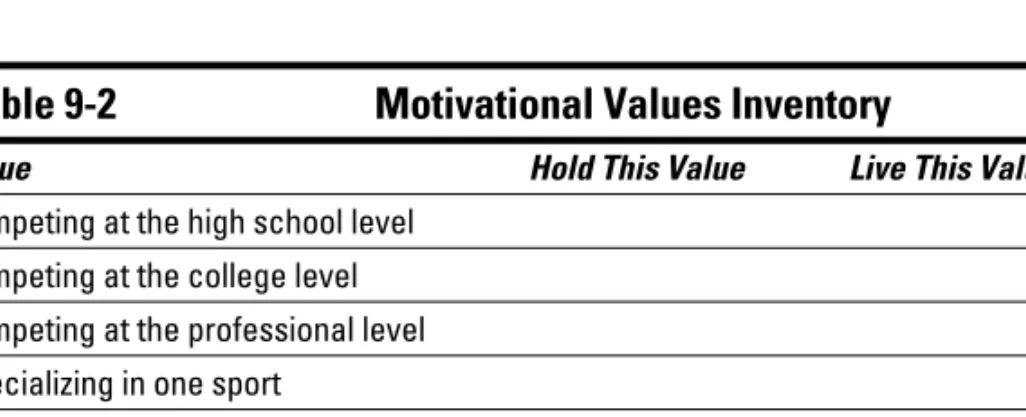
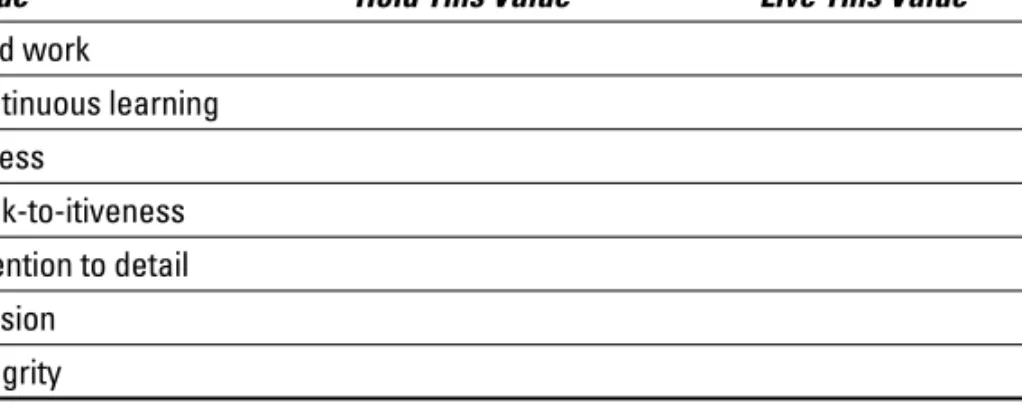
Task management is based on the notion that time management is inefficient and arbitrary in how time is allocated. In order for your task management plan to be effective, you must begin by clarifying your values.
Time management at work
Or let's say you're a sprinter and have a great target speed but need to improve your starts. The number you are left with is the number of hours you cannot count.
Eliminating time wasters
Tell them you're trying a new way of planning and explain your new approach to the task. Determine which tasks you will do each day that week and review them to make sure the tasks you have assigned yourself reflect your priorities.
Staying on task: Why effectiveness is more important than efficiency
This is a dedicated person who also tries to do the same as you with your task management. Instead of "training hard," you can make your task something like "run on the treadmill four times a week at an eight-minute pace."
Staying Competitive
Sports Psychology in Action
When you develop better habits in your sport, you'll develop a reputation as an athlete who gets the job done no matter the circumstances. Finally, this section addresses one of the biggest problems you face as an athlete: adversity.
Winning Habits: How Routines Improve Performance
In this chapter, we help you establish effective routines because they help you consistently perform at higher levels. Then we help you create your own effective routines, both for practice and competition.
Champion habits
Winning Habits: How Routines Improve Performance in Competition
You must remain focused throughout this time and your focus must become sharper and sharper as game time approaches. All of these routines help you stay focused before the game.
Water, water everywhere, but not a drop to drink
You can develop certain habits to ensure that you are mentally ready when play resumes. If you feel comfortable and want to compete, your routines are good for you.
Handling Pressure: Playing in the Fire without Getting Burned
Handling Pressure: Playing in the Fire without Getting Burned
If you allow the symptoms to continue, you will need more time to get them under control. And at some point it may be too late - you made a mistake because of the pressure you felt.
It’s a grown-up’s world
Handling Pressure: Playing in the Fire without Getting Burned Table 11-1 Distinguishing Low, Ideal, and High Arousal
If you are too excited, you feel too much pressure and can't get it done. An athlete in this position typically feels fearful, doubtful, worried, or distracted, and her muscles become tight and tense, increasing the chance of poor performance.
The arousal level that’s right for you
When you're about to play a match, it's easy to get caught up in the emotions of the moment. The more you can trust your body to perform as needed during competition, the more confident you will be during competition.
It’s not all in your head
Remembering this will help you deal with setbacks, successes and failures and improve your ability to relax and enjoy each moment. A gold medal is a wonderful thing, but if you're not enough without it, you'll never be enough with it."
Failure is unavoidable
When you focus on the things you can control, you will be balanced and relaxed. You just have to remember that you'll have the best chance of winning if you focus instead on the things you can control.
Hook me up!
Pay attention to successful pitchers before they throw - you'll see them take a deep breath. When you stretch your muscles, you automatically help them relax by using nervous physical energy.
Staying Strong: The Importance of Managing Energy Levels
Staying Strong: The Importance of Managing Energy Levels
You need to make sure that you store your energy so that it is available when you need it. Be sure to track your energy levels throughout the week so you are in tune with your body.