Challenges with Endogenously Moving Labor Inputs in Traditional Sorting Frameworks:
Evidence from a Computational O-Ring Model
Zachary Kessler
⇤ ∗⇤Alan Turing Institute [email protected]
Abstract
This paper adds endogenous choice to workers’ behavior in a modified O-Ring framework, explicitly modeling the individual sorting dynamics as workers move between firms/countries at the micro-level. This approach reveals in a world with heterogeneous technology, equilibrium wages used in the current array of sorting models are not sufficient to induce the so- cially efficient and predicted sorting patterns if firms do not form with pre-selected labor inputs. This result is then shown to be robust in the face of the model’s parameters. Finally, even if the explicit equilibrium skills required for the firm are present in the labor market, efficient sort- ing can only be achieved if productivity scaling falls below a certain low threshold due to the implied smaller range of skill. The only way the efficient prediction can be recovered in broader settings is with the use of some type of credit mechanism which allows firms to pay above marginal wages.
JEL Codes: C63, D24, J24, J60, O15
Keywords: O-Ring, development, skill matching, labor sorting, technology
1 Introduction
The role of skill matching among workers in generating widespread disparities is com- monly acknowledged. The labor sorting literature models the various methods through which workers and firms align with one another (Eeckhout 2018). One such theory meant to illuminate the importance of skill matching of this process is the O-Ring Theory of Development. In this piece, it is argued that due to new technological innovations there now exist increasing returns for workers who match with those of similar skill levels and this alteration to the production function explains the vast skill disparities observed in the data (Kremer 1993). Further, others have taken this alter- ation and used it to examine the rise of super-firms in industrial organization (Autor et al. 2020) or skill matching and inequality in labor markets (Dalmazzo, Pekkarinen, and Scaramozzino 2007) (Jones 2013). In summary, the broader sorting literature represents a critical contribution to our understanding of labor movements and pro- ductivity with specific attention to development outcomes, though the applications extend far beyond that area.
This piece endogonizes sorting by explicitly modeling the movements of workers through time in a sorting model resembling an O-Ring. In doing so, it reveals that unless technology is homogeneous or firms enter the market with their ideal workforce, the equilibrium wage structures traditionally utilized will not induce sorting in the predicted capacity except under very select, unlikely circumstances. Further, this failure is robust to changes in both productivity and skill density. Given in the real world, firms do not enter the market with their fully realized, or ideal, workers, this contribution augments our understanding of sorting in the labor market, revealing that the process must be driven by something not currently accounted for in present models or some type of social inefficiency exists due to the decentralized market process.
The project uses a computational, agent-based approach to calculate the equilib- rium as doing so analytically with such endogenous choice and explicit movements would be too challenging for more than a few agents. Through this procedure, it can be shown agents consistently converge to a secondary outcome which lies below the socially efficient one. This poorly sorted outcome is stable and cannot be endoge- nously resolved without either certain critical conditions that are unlikely to occur in the real world being met or an additional mechanism not presently provided in the current family of models. This result is driven by the fact that the wages outlined in the current sorting literature cannot endogenously induce the predicted outcome. In these models, the wage o↵ered to an agent is derived from their marginal contribution in an already sorted population of workers. If that population is initially unsorted, in other words a firm enters the market with anything other than its predetermined
not previously uncovered in other models.
The piece proceeds as follows. I begin with a brief review of the original model and its applications as well as some of the broader sorting computational modeling liter- ature. I then outline the simulation and explain the translation of this mathematical model into a computational one, with specific attention on the adjustments necessary to maintain the core of the original model. This section also defines the equilibrium conditions. I then review the results in both homogeneous and heterogeneous technol- ogy environments, outlining the new equilibrium and explaining its emergence as well as stability to parameter changes as well as the presence of equilibrium populations.
Finally, I implement a simple subsidy function acting as a costless form of credit. This incorporation recovers the original prediction and demonstrates the necessity of some second mechanism in generating efficient sorting outcomes.
2 Literature Review
2.1 The O-Ring Model
To begin, let us outline the unique production function. It alters the traditional Cobb-Douglas function in one important way, labor substitutability. Normally, one high skill laborer can be substituted for multiple low skill workers. Such a possibility creates trade o↵s for a firm choosing between the two in production. Instead, the O-Ring production function is structured such that di↵ering labor skill level no longer provides a substitute (Kremer 1993). This complementary nature means substituting a low skill worker into a production process lowers the value of the entire output.
Mathematically, each worker possesses some skill levelq, representing the proba- bility of successfully completing a task such that a product retains full value or the fraction of value the product retains after the worker completes the task. Further, to produce some good, there are somen number of tasks to be completed. This num- ber is determined in the simple version of the model by the technology present in the industry and can functionally be treated as exogenous. A firm cannot produce without each task filled. Once again, the role, or lack thereof, for substitutability in the production function now changes. As the skill level of workers increases, a lowq worker imposes more costs on the higher skilled workers as well as the firm’s output.
Therefore, the firm possesses an interest in spreading highqworkers throughout the production process. These assumptions generate the following production function wherekis capital,Qn
i=1qiis the product of worker skills,nis the number tasks, and Bis output per worker with a single unit of capital if production were done flawlessly
0< qi1
Workers have a skill levelq and face no choice between labor and leisure. The main di↵erence between the traditional and O-Ring production function are the implied returns. While capital remains constant or diminishing as with Cobb-Douglas, labor now possesses increasing returns with respect to skill (Kremer 1993). For the cost function, each firm faces a labor schedule and pays some wagewwhich increases with q. Capital remains paid its rental rate r. These generate the profit function below (Kremer 1993). The agent selects an amount of capital to employ based upon the skill level of workers present in the firm.
k,max{qi}k↵( Yn
i=1
qi) Xn
i=1
w(qi) rk (2)
Wages in this model adjust dependent upon the skill level, once sorted revealing the following first order condition.
dw
dq =qn 1nBk↵ (3)
With this first order condition, a given capital function then converges to an equilib- rium value dependent upon the density of workers at a given skill level. Upon reaching this level of capital, a wage schedule emerges that the firm pays.
k⇤= Z 1
0
(↵qnnB r )11↵1
nd (q) (4)
w(q) = (1 ↵)qnBk↵+c (5)
Through this formulation, agents converge towards an efficiently matched outcome.
Relaxing some of the assumptions such as a fixed level ofn, exogenously determined worker skill q, and perfect information, results in imperfect matching. Functionally, the di↵erence is twofold. First, general geographic, political, and national specialization in skill occurs, meaning there will exists pockets of high and lowqfirms and countries (Kremer 1993). Second, workers are incentivized to invest in their human capital (Kremer 1993). These realizations align with a collection of stylized facts pertaining to development which validate the theory outlined in the paper.
The main component under consideration here is the central matching mechanism.
Functionally, workers are assumed ex ante to have sorted into positions sufficient for a firm to collectively hire them in a single decision. E↵ectively, firms enter the market fully formed. The goal of this project is to determine if the strength of the skill matching is sufficient to act as an incentive for inducing this sorting via an endogenous
such that workers move towards the prediction over time. It should be noted this is distinct from search. The act of search pertains to a firm finding a worker. Instead, here the model examines if a found worker wishes to join the firm at all.
2.2 O-Ring Applications
The applications of the O-Ring theory and in particular the production function re- main broad as time has passed. Some authors have utilized the skill matching phe- nomenon to explain “brain drain” with workers of higher skill departing lowqcountries (Docquier and Rapoport 2012). Another set of scholars build from the O-Ring style technology framework and incorporate efficiency wages in an e↵ort to analyze wage inequality (Dalmazzo 2002). Others describe upgrade mechanisms that derive in part from O-Ring production (Verhoogen 2008) as well as analyze skill stratification in an economy (Garicano and Rossi-Hansberg 2006). Trade is also a common topic of skill complementarity addressed to examine productivity and skill dispersion (Bombardini, Gallipolli, and Pupato 2012). Others apply the theory to examine wage di↵erentials for individuals with the same basic skill set, in this case programming, in two locations to empirically show skill clustering (Clemens 2013). The role of entrepreneurship stands as another concept to which the basic O-Ring theory has been applied (Fabel 2004).
Lastly, the O-Ring theory contributes to studies of technological complexity (Dittmar 2011) and its ability to change wages (Dalmazzo 2002). However, while these studies utilize the O-Ring concept to promote their theory, others express skepticism citing simpler network theories as the reason the stylized facts above emerge (Hausmann and Hidalgo 2011).
In summary, the O-Ring model has been a critical contribution to our understand- ing of numerous areas including productivity growth and wage inequality. While some potential issues have been noted (Garicano and Rossi-Hansberg 2006), the model is generally taken as an accurate assessment of worker dynamics in a world of increasing returns to skill driven by new technology.
2.3 Broader Labor Sorting Models
The O-Ring model represents one particular form of what is broadly called labor sorting models. However, most of these models function similarly in terms of their assumptions and dynamics. A review of the general approach these models demon- strates their similarities to worker sorting and firm hiring decisions (Eeckhout 2018).
There are often additions in terms of frictions and multi-dimensional firms or workers (Lindenlaub and Postel-Vinay 2023). However, the core result generally remains the
choice is fine when firms enter into production only after hiring the ideal labor inputs, but becomes problematic when that assumption is relaxed.
Most of the work above broadly operates within the theoretical space. However, recent work demonstrates the faults in present estimates of sorting (Bonhomme et al. 2023) (Lopes de Melo 2018). However even given these recently documented chal- lenges, evidence in a variety of contexts that sorting does exist across the broader economy (Haanwinckel 2023) (Lise and Robin 2017) (Hagedorn, Law, and Manovskii 2017) doing well to validate the role of sorting in the economy. In particular, spe- cific attention on the impact of sorting in team contents with complementarities finds the strength of these complementarities shifts skill variance. (Brookins, Lightle, and Ryvkin 2015). Additionally, payment based upon performance can further assist in generating highly sorted labor outcomes (Eriksson and Villeval 2008). Sorting models are also found to be useful in explaining emergent strategies in repeated play games (Bernard, Fanning, and Yuksel 2018).
2.4 Computational Approaches to Economics
Computational models have been employed to study the labor market as well as other phenomenon for many years. Of particular relevance here are models which endoge- nously recreate certain observed facts. For example, recent attempts to recreate several stylized facts about the European economy have found success (Deissenberg, van der Hoog, and Dawid 2008) (Petrovic et al. 2017) (Raberto et al. 2019). Additionally, work examining the traditional stock-flow models of the labor markets and their streams of payments have also proven fruitful (Goudet, Kant, and Ballot 2017). At the most cutting-edge, some agent-based computational models can now successfully compete with traditional macroeconomic methods in accuracy (Poledna et al. 2023) while al- lowing a micro-level environment for policy experimentation (Mellacher and Scheuer 2021). Others explore banking and credit markets using this type of agent-based approach (Ashraf, Gershman, and Howitt 2017). Further e↵orts examine a variety of areas including innovation (Dosi et al. 2023), wealth inequality driven by social mobility (Yang and Zhou 2022), financial fragility across labor markets (Guilmi and Fujiwara 2022), and technology spillovers (Terranova and Turco 2022). However, the authors are unaware of any attempts to examine labor sorting explicitly with agent- based methods. The comparative advantage of this methodology stems from its ability to relax an array of assumptions while maintaining core interactions between agents.
3 A Computational Sorting Model
3.1 Model Description
This model possesses two main objects: agents and firms, although firms function- ally stand equivalent to countries producing measured aggregates. Within a period, workers and firms endogenously make their respective application and hiring decisions each period. These micro-level choices are akin to other approaches (Schelling 1978) (Guerrero and Axtell 2011).
The agents are heterogeneous along the skill margin. The range begins at .01, implying a product retains one percent of its original value, and ends at 1 such that a product retains its whole value. The global population of agents’ respective skill levels will be distributed in several ways. The first test utilizes a normal distribution and robustness checks for other densities are included later in the piece.
An agent’s primary goal during the model is to find the highest wage possible, conditional on a firm choosing to employ them. As in the O-Ring model, there is no labor/leisure choice and employees only spend their time working. For now, agents will know exactly the wage they will receive from joining a specific firm, eliminating them from contention if it o↵ers a wage less than their present payment. This is done to provide the model the best chance of properly sorting. Every period, every worker evaluates their potential wage at every firm, noting all those options providing an increase.
Firms in the model each possess a production and profit function equivalent to the O-Ring model. Their goal is to maximize profit by hiring a matched set of workers.
However, some slight di↵erences are required. First, capital selections occur at the start of each period based upon the average skill level of the firm. In the original piece, such a selection occurs after the matching among workers has transpired but here as the process occurs endogenously, it is calculated for all periods, converging to the optimal as workers match. The amount of capital selected is determined by the following equation. The rental rate is exogenous, an adjustment allowed in the original model as well.
k= (↵qnnB
r )11↵ (6)
Firms will generally attempt to pay workers according to the equilibrium wage schedule outlined in equation 5, withnchanging dependent upon the specific firm a worker has joined. It is presumed, as in the original model the constant of integration is 0. As in the sorting literature (Eeckhout 2018) and the original model, firms seek a certain type of worker and only hire them. Using the equilibrium wage schedule reflects the most common arrangement from the literature. Tests with explicitly marginal
In a given period, firms can only hire a single worker. This reflects the fact firms/countries’ entire labor forces do not turnover in a single period. Multiple hires can be allowed but generate very similar results at a much higher computational cost.
Finally, this framework assumes a firm can only enter a bid on a worker from the pool of expected output that will exist upon hiring them. It cannot o↵er a wage that would require it to go into debt. Just as in the original model and in most sorting models broadly speaking, no credit mechanism will exist. Intuitively, if sorting is endogenous, then firms of highernwill be progressively able to outbid lowernfirms for the high skill workers as each sequential hire raises the potential output of hiring another high skill worker.
Now, because the sorting process is endogenous, paying a worker their full the equilibrium wage will not always be possible due to poor matching. Therefore a mechanism is needed to ensure the firm is solvent while matching occurs. The initial paper circumvents this problem by ruling out such worker allocations ex ante since the market clears in a single move. In this version, such allocations are possible while moving towards equilibrium, but generate a wage adjustment term that shifts a wage.
3.2 Non-equilibrium Wage Adjustment Mechanism
At the outset, workers are randomly distributed among firms meaning that low skill individuals restrict firms’ output and therefore the resources required to pay workers their full wage will not be met. To overcome this issue, firms construct a second-best wage schedule by multiplying every worker’s equilibrium wage by the ratio of achieved output,y, to required output,Y, necessary for paying all workers their full wage and capital its full rental rate. Arranging things in this way creates the budget constraint for allocating wages in mismatched firms.
y rk Xn
i=1
(y
Y)w(qi) (7)
This wage adjustment term does not alter the core dynamics of the original model in any way. Instead, it allows for explicit statements on whether the model has reached a stable equilibrium at the micro-level.
Define some individual worker i of skill q as qi. Now say a firm employs qi as well as a collection of other workers with their own skillqj, qj+1, qj+2, ..., qn. Then it is simple to show that in equilibrium, when workers are perfectly sorted, the ratio of qj and qi must equal 1. Further, the sum of these ratios for all workers must equal the firm’s number of tasks minus the reference workern 1. Call this sumE and in
⇤
E⇤=n 1
With this term defined, it is simple to show that in equilibrium, the wage adjustment term drops out the model entirely, returning to the original equation.
E!limn 1
y Y = 1 y⇤ rk⇤ n⇤w(q)
This means a worker’s wage is simply a combination of the wage adjustment term ratio and equation 5, with the valuendetermined by the firm.
Given the above, the wage adjustment term is a basic way for firms to remain solvent while still ensuring in equilibrium workers receive the highest wage from those firms willing to hire them. This specification means the model moves towards a stable outcome and approaches equilibrium at the micro-level as wage adjustment for firms converge to 1. This additionally allows us to separate aggregate output from model equilibrium and make statements on the social efficiency of di↵erent allocations of labor.
3.3 Firm Optimization
When determining if a workerishould be hired, the firm removes a present workerj, the current lowest skill worker, and compares the new output and wage bill against their respective initial values with worker j. If the output increase is greater than that of the associated increase in the wage bill with workers indexed byz, the firm considers the agent a viable option for employment. Such calculations are made for all agents who apply to the firm with the agent who maximizes this di↵erence being the one who is hired.
max(yi,¬j y¬i,j)s.t.
Xn
z=1
wz,i,¬j wz,¬i,j (8)
A number of factors are determined exogenous to the firm in this model. First, the share to capital ↵ is exogenous and homogeneous for all firms. Second, n will be determined at the outset as well. Both homogeneous and heterogeneous specifications for firm tasks will be tested. When a firm replaces a worker, the newly unemployed worker will move to firm which just lost a worker to the hiring firm. This is done for computational simplicity, but later in the piece a true unemployed population of agents will be allowed though this does not change the results. If a firm has less workers than its task number, it simply evaluates the worker’s addition to output versus its wage
3.4 Information in the Model
The initial model developed begins with perfect information, over time relaxing such assumptions. At first, firms will know all workers’ respective skill levels with exact accuracy. However, to examine robustness, errors will be introduced in subsequent tests. In these versions, a firm will observe the skill level of an applying worker but can make an error in either the positive or negative direction. This error"is uniformly distributed over the range of -.5 to .5, or one half of the total possible skill level.
These errors can be increased in size or distributed in an alternative capacity, but for now these adjustments to the information present in the system will be sufficient.
The reason for choosing such a significant error is it allows for more powerful inferences regarding the robustness of the model dynamics to converge towards an equilibrium.
3.5 Dynamics and Equilibrium
The model simulates each worker’s movements individually. At the outset, agents and firms are generated. The agents each possess a skill level in the range described in the prior sections. Initially, firms all possess the same parameters forB,n, r,k, and ↵.
This specification means the heterogeneity lies only on the employee skill level margin and the number of tasks. After their generation, agents are randomly distributed among the firms.
From this point, the model follows a simple sequence. All firms produce their output and pay their inputs. After this procedure, agents examine all firms in the economy, calculate their alternative wages, and apply to any with wages higher than their current. Next, firms will evaluate all agents who applied according to equation 7.
The worker who o↵ers the maximum possible gain relative to their wage bill is hired and the rest are removed from the applicant pool.
The model moves towards equilibrium as the wage adjustment terms converge towards 1 for all firms. Given the definition of this term, this would mean firms are endogenously matching their labor inputs.
3.6 A Simple Example
To illustrate the value of the model, let us walk through a simple iteration with only a few workers. Suppose there are four workers{i, j, a, b}. Each of these workers possess a skill level withqi equal toqj andqa equalingqb. Further, letqi> qa and therefore by extensionqj> qb. Finally, let there be two firms with the same number of tasks.
Given the dynamics of the model, an agentiearns the highest possible wagew⇤i only when matched in the same firm with workerj. Callwithe wage earned if workeriis
matched with anyone else. Use the same definitions for workerj.
wi⇤> wi^wj⇤> wj
It should be obvious these matches will endogenously emerge as workers choose to match with one another by observing wages on o↵er when applying to the firm. Sup- pose for instance workers are initially mismatched as in the broader simulation. If this was the case, the allocation of workers are not in an equilibrium as the wage adjustment terms for all workers will be less than 1. The critical fact is when worker amatches with workeri,wa > wa⇤. In other words, worker aprefers to be matched with workerias the out of equilibrium wage exceeds the equilibrium.
wa⇤< wa^w⇤b< wb
This fact may seem to present a challenge for the model but because of the mismatch, worker i seeks out alternative opportunities and the firm employing worker j will always preferqi > qb, leading to the match being created endogenously. With the move, the model reaches equilibrium.
In the full simulation we will have significantly more workers and firms that make these discrete calculations more challenging in each moment. However, the core dy- namics remain the same and the example above shows the model can theoretically recover the matching equilibrium.
4 Testing the Model
4.1 Model Parameters
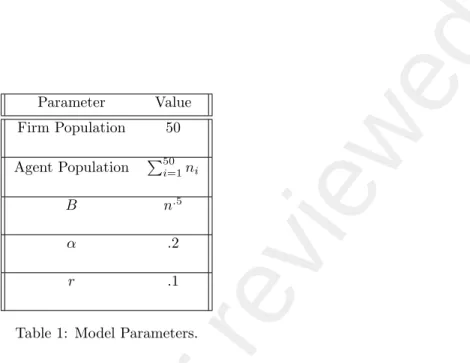
The parameters for the model are provided in the table below. To test the simulation, I employ a Monte Carlo method. For a given framework and set of agents, the simulation will be run 100 times. The only change between model runs is the random order firms activate in each period, determining the order in which they are allowed to hire workers.
This specification allows us to determine if the dynamics of the model are sensitive to particular firm orderings or if they dominate the population regardless of such matters.
To determine if the model is in equilibrium, the wage adjustment mechanism is measured each period. As the model moves through time and workers choose which firms to try and join, the average observed value of the adjustment term will converge to 1. This naive average and a second weighted average will be recorded. In the latter, the adjustment term is weighted by the fraction of aggregate output the firm is currently
Parameter Value Firm Population 50 Agent Population P50
i=1ni
B n.5
↵ .2
r .1
Table 1: Model Parameters.
weighted adjustment term near 1 means the model creates stable, high skill firms. As this simulation uses discrete values for worker skill, it is unlikely that a matched firm will have workers with completely equal skill. This means the micro-level equilibrium will generally be somewhat below 1 but this is due to computational facts not issues with the model itself.
4.2 Homogeneous Task Count
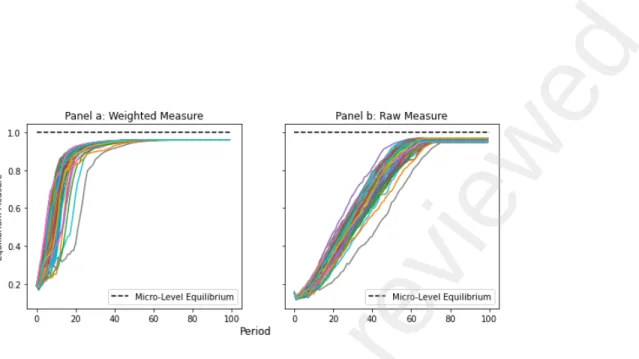
The first framework tests when the number of tasks in the production process,n, is equal for all firms in the economy. The parameter will be set to a value of 20. This formulation o↵ers a chance to test if the endogenous sorting model can replicate the core matching of the mathematical framework in a more simplified setting. Worker skill level is normally distributed around an average of .5 with a standard deviation of .15. Other distributions are tested later in the piece. The results are provided in Figures 1 and 2 where each line represents the path of an individual simulation. In Figure 1 panel a, the weighted average wage adjustment term for all firms is provided with panel b showing the raw version, with the dashed line representing the micro-level wage adjustment term in a perfect equilibrium. In Figure 2, the aggregate output of the economy is shown with the the dashed line represents the predicted output if the type of matching described in the mathematical formulation occurred.
Figure 1: Homogeneous Task Simulation Equilibrium Measure
Figure 2: Homogeneous Task Simulation Aggregate Output
Observed here, at both the micro and macro levels, the equilibrium can be endoge- nously reached. The wage adjustment term converges towards one both in weighted and raw forms with an average score of .96. Similarly, the model converges to the pre- dicted aggregate output given the set of workers. This finding itself mostly serves to demonstrate the computational model recovers the core dynamics of the initial O-Ring model at both the macro-level in terms of output and micro-level in terms of worker sorting. Errors do not alter these results.
4.3 Heterogeneous Task Count
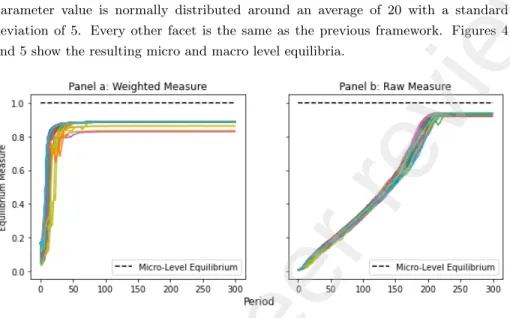
The second framework allows for a heterogeneous number of tasks among firms. The parameter value is normally distributed around an average of 20 with a standard deviation of 5. Every other facet is the same as the previous framework. Figures 4 and 5 show the resulting micro and macro level equilibria.
Figure 3: Heterogeneous Task Simulation Equilibrium Measure
Figure 4: Heterogeneous Task Simulation Aggregate Output
Here the model clearly converges to a second equilibrium in the macro-sense while
b of figure 3. Figure 4 shows the clearly distinct macro-level outcome. Transitioning to a heterogeneous number of tasks between firms, matching indeed occurs. However, it is in the exact opposite capacity predicted in the original formulation. Figure 5 provides insight into this by showing the distribution of each firm’s average skill in the final period for all simulations.
Figure 5: Firm N Versus Average Skill
Whereas in the original framework, the highest skill individuals arrived at the highest task firms or countries, the output of this model shows a di↵erent outcome.
Again, errors do not alter these dynamics. Workers clearly sort in the reverse of the initial prediction.
4.4 An Alternative Outcome in Endogenous Sorting
The reason for the above result is rather simple. Because of the complementarity present in the production function, as the number of tasks in a process increases to- wards some infinity, the impact of a worker’s own firm selection on their wage converges to zero. In a homogeneous world, this is rather irrelevant as the only margin the agent and firm can optimize on is skill. Explicit coordination between workers is basically
have a higher average skill.
In the heterogeneous world, a worker’s wage varies with both the number of tasks and coworkers’ skill level. Therefore, the highn firm is only viable to join if it has hired a number of sufficiently high skill coworkers such that it can properly a↵ord to pay some new worker a wage greater than the more stable, safer wage o↵ered by the lown firm. Unless this is true, then the system will not endogenously generate the necessary coordination amongst workers because the wages a mismatched, highnfirm can a↵ord to o↵er prospective hires will always be less than a matched low n firm.
In other words, the population of workers will be consistently under-sorted relative to the prediction.
This outcome stands distinct from other kinds of positive assortative matching (PAM) or negative assortative matching (NAM) found in the labor sorting literature (Eeckhout 2018),(Hagedorn, Law, and Manovskii 2017). Instead, this model reveals that when agents must endogenously sort themselves as the process unfolds rather than in an ex ante capacity, the probability a particular firm is an ideal place at a given time step for some worker decreases with the number of tasks in the production process.
Therefore, as production becomes more technically complex, high skill individuals choose to isolate themselves in relatively lowernfirms. This selection e↵ectively works to balance the impact of other agents’ selections with the benefit of the complexity.
As the breadth of complexity expands and skill is more diverse, the worse the sorting becomes.
These tests demonstrate the presence of this previously unknown outcome. Now it becomes critical to understand the sensitivity of this outcome and determine what internal factors within the model might induce the original predicted form of sorting.
5 Recovering the Prediction
The framework above proves the existence of a second type of sorting outcome if technology is heterogeneous. The question becomes if the original prediction can be recovered through the adjustment of parameters in the mathematical formulation or with explicit quantities of workers.
5.1 The Impact of Productivity
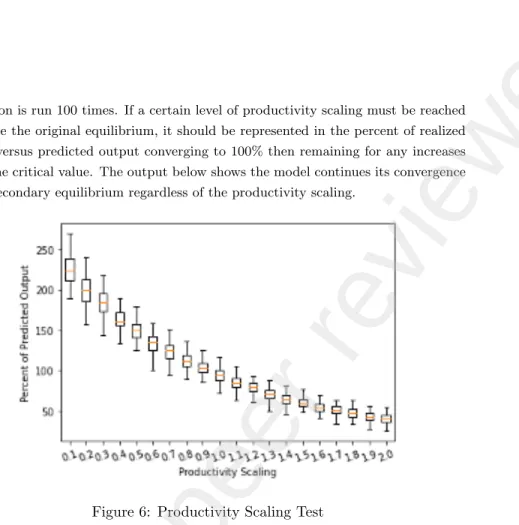
First, in the original production function, B, e↵ectively a total factor productivity sub- stitute, can be increased and potentially move agents out from this alternative steady state. To test this possibility, another Monte Carlo simulation is run in which the rate of increase of output per worker for each additional task rises. Beginning within
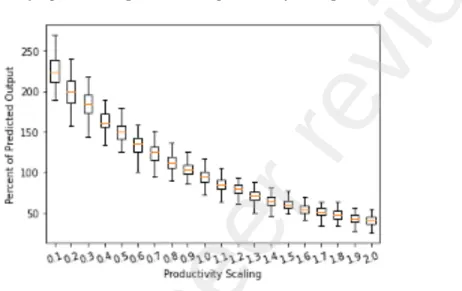
simulation is run 100 times. If a certain level of productivity scaling must be reached to induce the original equilibrium, it should be represented in the percent of realized output versus predicted output converging to 100% then remaining for any increases above the critical value. The output below shows the model continues its convergence to the secondary equilibrium regardless of the productivity scaling.
Figure 6: Productivity Scaling Test
Figure 6 graphs the percent of realized output over predicted output against the associated rate of productivity growth. As productivity growth increases with each additional task, the ratio continuously decays. No change is observed in agents be- havior, as they sort into the same steady state. In other words, the new equilibrium is stable and immune to exogenous changes in productivity. Notably, this analysis means the social inefficiency of the alternative equilibrium stems from the strength of productivity growth born out of technological enhancement. As higher degrees of technological complexity become possible, in other words more steps are necessary for successful production, the marginal product of the additional task must be increasing as well. If technology increases output in this way, the sorting pattern uncovered is socially inefficient.
5.2 The Impact of Skill Density
The next test necessary to determine the robustness of this equilibrium is to examine the impact of skill level density. To this end, worker skill is now drawn from a uniform
Figure 7: Uniform Skill Simulation Equilibrium Measure
Figure 8: Uniform Skill Simulation Aggregate Output
Here the same type of pattern described in the heterogeneous test emerges. In this case, the uniform distribution generates the equilibrium terms in Figure 7 with a weighted score of .998 and a raw score of .82. Figure 8 shows the model’s macro-level output is closer to the predicted output but the reverse sorting remains. Figure 9 shows a similar decline in skill with task count as in the initial heterogeneous test.
Figure 9: Uniform Skill Test Firm N versus Average Skill
Three key insights spring from these tests. First, in a world of heterogeneous pro- duction complexity, the second equilibrium presented here is stable and immune to all internal factors in the mathematical formulation. Adjustments to these parameters cannot return the system to the predicted equilibrium. Second, the social efficiency or inefficiency of the alternative sorting is determined by the rate of return to additional tasks in production. Finally, a market price mechanism based upon the marginal prod- uct of a sorted population in the labor market acting in isolation cannot endogenously induce the necessary coordination to generate the specific predicted outcome presented by sorting models when technology is heterogeneous.
5.3 Utilizing Only Equilibrium Skill Workers
Up to this point, the choice of technology for firms has been considered exogenous.
However, given the sensitivity of production, firms likely only choose technologies which the labor market can support. To accommodate this fact, now for every firmn workers of the necessaryqwill be present. This requisite skill is defined by the equation below and derived in the original O-Ring piece (Kremer 1993) but rearranged to solve
for skill. B0(n)
With this in mind, the critical skill level for firms of specificn given by the equation above can be created. E↵ectively, the equilibrium skill for a firm is dependent upon the speed at which technology scales worker productivity.
It should be noted this calculation by its very construction restricts the range of potential skill for workers. For example, given the smallest viable skill possible for an nof 2, if the same function forBis utilized as in the initial test, the minimum possible skill for workers is .78, essentially allowing only a fifth of the possible range. As the speed with which productivity increases withnrises from .1, this range will increase.
All of this should improve the model’s chances of sorting properly. Additionally, unemployment will be formally allowed in this test. Fired workers enter a pool of unemployed workers who evaluate firms in the same capacity as employed workers.
If at the end of a period, numerous openings exist, workers from the unemployed pool will be allocated to the understa↵ed firms at random. This represents the fact that all firms prefer positive to zero production and workers prefer positive to zero wages. In other words, the swapping mechanism initially used in the homogeneous and heterogeneous tests is dropped.
The only assumption that will be made about the aggregate distribution of skill in this model is that higher skill must be rarer than lower skill. Given that highnfirms by their nature require more workers of higher skill, there will be a higher number of lown firms to ensure the assumption is met. If high skill individuals are more populous relative to lower skill levels, then sorting is a trivial matter. Firms will have values ofnranging from 2 to 9. To ensure a constant rate of decline in the number of workers, there will exist half as many firms at each value starting at 200 for firms ofn equaling 2, 100 for n of 3, and so on until a single firm ofn equaling 9 exists, a total of 397 firms and 1,172 agents. This arrangement ensures a linear decline in workers at each skill level. The test will begin with a technology scaling parameter of .1 increasing by intervals of .1 until reaching a value of 1. Using a Monte Carlo test, each framework is run 100 times with the average percent of predicted output recovered by the simulation being provided in Figure 10. The appendix displays the distribution of skill in firms for each size, showing that sorting moves towards the second outcome found earlier as the skill disparity increases.
Figure 10: Percent of Realized Prediction with Equilibrium Workers As should be evident, even in this highly idealized state where only the desired workers are present, inefficiencies still exist. For values of productivity scaling greater than .3, aggregate output increasingly falls below prediction. Beginning from .4, real- ized output achieves only 97% of the prediction, increasing to a minimum of 79% for scaling of .9. The loss of output from poor sorting grows as technology more e↵ec- tively feeds into ideal worker productivity. In other words, even under highly idealized conditions, where only the equilibrium workers are present, the model still reverts to the second outcome discovered in this piece so long as technology scaling exceeds .3.
It should be noted, the implied equilibrium skill range in the test utilized for produc- tivity scaling of .3 is only .1, a tenth of the theoretical skill range initially outlined.
For values below this, the range is even smaller.
5.4 A Simple Subsidy Function
In an e↵ort to recover the initial predicted sorting, this project will consider a simple subsidy function. Each firm receives some subsidy,S, in each period specified by the following equation. This subsidy increases by some rate , set to two in this case, with each additional task.
S=n (10)
This subsidy is freely given and does not impact the wage bill of the firm. It can be thought of as costless credit given to the firm as function of their maximum capability
will expect the following wage.
E(wi) =wi+ 1
nS (11)
All workers receive an equal fraction of the subsidy. The key accomplishment of this mechanism is that firms now pay based upon their potential, not their present ability.
The result reveals the predicted matching strategy reemerges. Once again using the same Monte Carlo method with identical parameters to the heterogeneous task initial test, the following output is created. Most critically, this model draws skill from a normal distribution rather than the uniform.
Figure 11: Subsidy Test Equilibrium Measure
Figure 12: Subsidy Test Aggregate Output
Figure 10 shows the equilibrium measures for all simulations, reaching a value of .94 signaling matching is indeed occurring and stable. Figure 11 shows the macro-level converge also occurs. The weighted measure is not relevant here.
Figure 12 shows the recovered pattern of skill increasing with the number of tasks in a production function.
The key result demonstrated here is with additional funds incorporated, the pre-
Figure 13: Subsidy Test Firm N versus Average Skill
importantly, it implies that unless workers are sorted initially with firms entering the market fully formed, some type of secondary funding mechanism will be required to induce the predicted result.
6 Implications and Concluding Remarks
This endogenous sorting model demonstrates that unless the predicted worker sorting transpires in a single period, meaning all firms select all their workers before initi- ating any production, it will only emerge from an endogenous process in a world of heterogeneous technology either when the returns to productivity from technological sophistication are low (less than .3) or a second mechanism exists. The risk to an agent in wage terms from waiting for improved coworkers creates an incentive to move towards relatively smaller task firms generating the inefficient outcome.
Given these findings, there are a number of implications for the sorting literature.
First, the sorting process in these models is not robust to relaxing the assumption of full initial formation. Only with certain critical conditions being met such as low returns to productivity and very limited populations of workers, can sorting be endogenously
sorted, leading to less than efficient output and lower than expected wages. Finally, these poorly sorted outcomes are socially stable and cannot be endogenously resolved unless funding to pay wages above marginal cost are available in the periods prior to equilibrium. At present, either workers are sub-optimally sorted or the present sorting literature understates the critical role of credit or some other mechanism in generating the equilibrium.
The existence of this result actually assists in generating some patterns observed in the data. With the rise of micro-level data on individual firms, productivity di↵er- entials between small and large firms have been observed to follow the type of pattern generated here (Decker et al. 2016). Just as in the superstar firm hypothesis (Autor et al. 2020), those firms which are the most productive possess lower shares of labor and are responsible for the majority of output in the simulated “industry.” Future work may focus on applying this concept to production networks as well (Demir et al. 2021).
This piece has demonstrated that in an endogenous sorting procedure with het- erogeneous technology, agents do not match in the traditionally predicted capacity.
Instead, there exists increasing levels of inefficiency as the returns to technological complexity increase. Further, this equilibrium is then demonstrated to be immune to adjustment along all other parameter spaces present in the model. Only under highly specific and unlikely conditions can endogenous sorting be recovered. Without these conditions being met, the only way to recover the initial prediction in this setting is for a credit or subsidy mechanism that allows the firm to finance wage o↵erings as if the workers were already sorted without such sorting yet being present. Additional work exploring the presence of this sorting pattern in other environments should be done to examine the nature of skill matching and diversity.
References
Ashraf, Quamrul, Boris Gershman, and Peter Howitt. 2017. “Banks, market organization, and macroeconomic performance: An agent-based computa- tional analysis.”Journal of Economic Behavior and Organization 135:143–
180. https://doi.org/https://doi.org/10.1016/j.jebo.2016.12.023.
Autor, David, David Dorn, Lawrence F. Katz, Chirstina Patterson, and John Van Reenan. 2020. “The Fall of the Labor Share and the Rise of Superstar Firms.” Quarterly Journal of Economics 135 (2): 695–709. https : / / doi . org/https://doi.org/10.1093/qje/qjaa004.
Bernard, Mark, Jack Fanning, and Sevgi Yuksel. 2018. “Finding cooperators:
Sorting through repeated interaction.” Journal of Economic Behavior &
Organization 147:76–94. issn: 0167-2681. https : / / doi . org / https : / / doi . org/10.1016/j.jebo.2017.11.016. https://www.sciencedirect.com/science/
article/pii/S0167268117303207.
Bombardini, Matilde, Giovanni Gallipolli, and Germ´an Pupato. 2012. “Skill Dispersion and Trade Flows.”American Economic Review 102 (5): 2327–
2348. https://doi.org/10.1257/aer.102.5.2327.
Bonhomme, St´ephane, Kerstin Holzheu, Thibaut Lamadon, Elena Manresa, Magne Mogstad, and Bradley Setzler. 2023. “How Much Should We Trust Estimates of Firm E↵ects and Worker Sorting?” Journal of Labor Eco- nomics 41 (2): 291–322. https://doi.org/10.1086/720009.
Brookins, Philip, John P. Lightle, and Dmitry Ryvkin. 2015. “Optimal sorting in group contests with complementarities.”Journal of Economic Behavior
& Organization112:311–323.issn: 0167-2681. https://doi.org/https://doi.
org/10.1016/j.jebo.2015.02.006. https://www.sciencedirect.com/science/
article/pii/S0167268115000414.
Clemens, Michael A. 2013. “Why Do Programmers Earn More in Houston Than Hyderabad? Evidence from Randomized Processing of US Visas.”American Economic Review103 (3): 198–202. https://doi.org/10.1257/aer.103.3.198.
Dalmazzo, Alberto. 2002. “Technological Complexity, Wage Di↵erentials and Unemployment.” Scandinavian Journal of Economics 104:515–530. https:
Dalmazzo, Alberto, Tuomas Pekkarinen, and Pasquale Scaramozzino. 2007. “O- ring Wage Inequality.”Economica 74 (295): 515–536. https://doi.org/10.
1111/j.1468-0335.2006.00553.x.
Decker, Ryan A., John Haltiwanger, Ron S. Jarmin, and Javier Miranda. 2016.
“Where has all the skewness gone? The decline in high-growth (young) firms in the U.S.”European Economic Review 86:4–23. https://doi.org/10.
1016/j.euroecorev.2015.12.013.
Deissenberg, Christophe, Sander van der Hoog, and Herbert Dawid. 2008. “EU- RACE: A massively parallel agent-based model of the European economy.”
Special Issue on New Approaches in Dynamic Optimization to Assessment of Economic and Environmental Systems,Applied Mathematics and Com- putation 204 (2): 541–552. https://doi.org/https://doi.org/10.1016/j.amc.
2008.05.116.
Demir, Banu, Ana Cec´ılia Fieler, Daniel Xu, and Kelly Kaili Yang. 2021. O- Ring Production Networks. Working Paper, Working Paper Series 28433.
National Bureau of Economic Research. https://doi.org/10.3386/w28433.
Dittmar, Jeremiah E. 2011. “ Information Technology and Economic Change:
The Impact of The Printing Press *.”The Quarterly Journal of Economics 126 (3): 1133–1172. https://doi.org/10.1093/qje/qjr035.
Docquier, Fr´ed´eric, and Hillel Rapoport. 2012. “Globalization, Brain Drain, and Development.”Journal of Economic Literature 50 (3): 681–730. https://
doi.org/10.1257/jel.50.3.681.
Dosi, Giovanni, Elisa Palagi, Andrea Roventini, and Emanuele Russo. 2023.
“Do patents really foster innovation in the pharmaceutical sector? Results from an evolutionary, agent-based model.”Journal of Economic Behavior
& Organization212:564–589.issn: 0167-2681. https://doi.org/https://doi.
org/10.1016/j.jebo.2023.05.039. https://www.sciencedirect.com/science/
article/pii/S0167268123001920.
Eeckhout, Jan. 2018. “Sorting in the Labor Market.” Annual Review of Eco- nomics 10 (1): 1–29. https://doi.org/10.1146/annurev-economics-080217- 053526.
Eriksson, Tor, and Marie Claire Villeval. 2008. “Performance-pay, sorting and social motivation.”Journal of Economic Behavior & Organization 68 (2):
412–421. issn: 0167-2681. https : / / doi . org / https : / / doi . org / 10 . 1016 / j . jebo . 2007 . 10 . 003. https : / / www . sciencedirect . com / science / article / pii / S0167268108001273.
Fabel, Oliver. 2004. “Spino↵s of Entrepreneurial Firms: An O-Ring Approach.”
Journal of Institutional and Theoretical Economics 160 (3): 416–438.
Garicano, Luis, and Esteban Rossi-Hansberg. 2006. “Organization and Inequal- ity in a Knowledge Economy.” The Quarterly Journal of Economics 121 (4): 1383–1435. https://doi.org/10.1093/qje/121.4.1383.
Goudet, Olivier, Jean-Daniel Kant, and G´erard Ballot. 2017. “WorkSim: A Cal- ibrated Agent-Based Model of the Labor Market Accounting for Workers’
Stocks and Gross Flows.”Computational Economics 50 (1): 21–68. https:
//doi.org/10.1007/s10614-016-9577-0.
Guerrero, Omar A., and Robert L. Axtell. 2011. “Using Agentization for Ex- ploring Firm and Labor Dynamics.” InEmergent Results of Artificial Eco- nomics,edited by Sjoukje Osinga, Gert Jan Hofstede, and Tim Verwaart, 139–150. Berlin, Heidelberg: Springer Berlin Heidelberg. https://doi.org/
10.1007/978-3-642-21108-9 12.
Guilmi, Corrado Di, and Yoshi Fujiwara. 2022. “Dual labor market, financial fragility, and deflation in an agent-based model of the Japanese macroecon- omy.” Journal of Economic Behavior & Organization 196:346–371. issn:
0167-2681. https://doi.org/https://doi.org/10.1016/j.jebo.2022.02.003.
https://www.sciencedirect.com/science/article/pii/S016726812200049X.
Haanwinckel, Daniel. 2023. Supply, Demand, Institutions, and Firms: A The- ory of Labor Market Sorting and the Wage Distribution.Working Paper, Working Paper Series 31318. National Bureau of Economic Research, June.
https://doi.org/10.3386/w31318.
Hagedorn, Marcus, Tzuo Hann Law, and Iourii Manovskii. 2017. “Identifying Equilibrium Models of Labor Market Sorting.”Econometrica85 (1): 29–65.
https://doi.org/https://doi.org/10.3982/ECTA11301.
Hausmann, Ricardo, and C´esar Hidalgo. 2011. “The network structure of eco- nomic output.”Journal of Economic Growth 16:309–342. https://doi.org/
10.1007/s10887-011-9071-4.
Jones, Garett. 2013. “The O-ring sector and the Foolproof sector: An explana- tion for skill externalities.”Journal of Economic Behavior and Organization 85:1–10. https://doi.org/10.1016/j.jebo.2012.10.014.
Kremer, Michael. 1993. “The O-Ring Theory of Economic Development.”The Quarterly Journal of Economics 108 (3): 551–575. https : / / doi . org / 10 . 2307/2118400.
Lindenlaub, Ilse, and Fabien Postel-Vinay. 2023. “Multi-Dimensional Sorting under Random Search.”Journal of Political Economy,https://doi.org/10.
1086/725362.
Lise, Jeremy, and Jean-Marc Robin. 2017. “The Macrodynamics of Sorting be- tween Workers and Firms.”American Economic Review 107, no. 4 (April):
1104–35. https://doi.org/10.1257/aer.20131118.
Lopes de Melo, Rafael. 2018. “Firm Wage Di↵erentials and Labor Market Sort- ing: Reconciling Theory and Evidence.”Journal of Political Economy 126 (1): 313–346. https://doi.org/10.1086/695505.
Mellacher, Patrick, and Timon Scheuer. 2021. “Wage Inequality, Labor Mar- ket Polarization and Skill-Biased Technological Change: An Evolutionary (Agent-Based) Approach.”Computational Economics 58 (2): 233–278. htt ps://doi.org/10.1007/s10614-020-10026-0.
Petrovic, Marko, Bulent Ozel, Andrea Teglio, Marco Raberto, and Silvano Cin- cotti. 2017. Eurace Open: An agent-based multi-country model. Working Papers 2017/09. Economics Department, Universitat Jaume I, Castell´on (Spain).
Poledna, Sebastian, Michael Gregor Miess, Cars Hommes, and Katrin Rabitsch.
2023. “Economic forecasting with an agent-based model.”European Eco- nomic Review 151:104306.issn: 0014-2921. https://doi.org/https://doi.
org/10.1016/j.euroecorev.2022.104306.
Raberto, Marco, Bulent Ozel, Linda Ponta, Andrea Teglio, and Silvano Cincotti.
2019. “From financial instability to green finance: the role of banking and credit market regulation in the Eurace model.” Journal of Evolutionary Economics29 (1): 429–465. https://doi.org/10.1007/s00191-018-0568-2.
Schelling, Thomas C. 1978.Micromotives and Macrobehavior.W. W. Norton &
Company.
Terranova, Roberta, and Enrico M. Turco. 2022. “Concentration, stagnation and inequality: An agent-based approach.”Journal of Economic Behavior
& Organization193:569–595.issn: 0167-2681. https://doi.org/https://doi.
org/10.1016/j.jebo.2021.11.002. https://www.sciencedirect.com/science/
article/pii/S0167268121004686.
Verhoogen, Eric A. 2008. “Trade, Quality Upgrading, and Wage Inequality in the Mexican Manufacturing Sector*.”The Quarterly Journal of Economics 123 (2): 489–530. https://doi.org/10.1162/qjec.2008.123.2.489.
Yang, Xiaoliang, and Peng Zhou. 2022. “Wealth inequality and social mobility:
A simulation-based modelling approach.”Journal of Economic Behavior &
Organization 196:307–329. issn: 0167-2681. https://doi.org/https://doi.
org/10.1016/j.jebo.2022.02.012. https://www.sciencedirect.com/science/
article/pii/S0167268122000580.