COLIN BARROW
Starting a Business from Home
Your guide to planning your home star-up, reaching a market and creating a profit
3RD EDITION
Publisher’s note
Every possible effort has been made to ensure that the information contained in this book is accurate at the time of going to press, and the publishers and authors cannot accept responsibility for any errors or omissions, however caused. No responsibility for loss or damage occasioned to any person acting, or refraining from action, as a result of the material in this publication can be accepted by the editor, the publisher or the author.
First published in Great Britain and the United States in 2008 by Kogan Page Limited Second edition 2011
Third edition 2017
Apart from any fair dealing for the purposes of research or private study, or criticism or review, as permitted under the Copyright, Designs and Patents Act 1988, this publication may only be reproduced, stored or transmitted, in any form or by any means, with the prior permission in writing of the publishers, or in the case of reprographic reproduction in accordance with the terms and licences issued by the CLA. Enquiries concerning
reproduction outside these terms should be sent to the publishers at the undermentioned addresses:
2nd Floor, 45 Gee Street London EC1V 3RS
United Kingdom www.koganpage.com
c/o Martin P Hill Consulting 122 W 27th St, 10th Floor New York, NY 10001
USA
4737/23 Ansari Road Daryaganj
New Delhi 110002 India
© Colin Barrow, 2008, 2011, 2017
The right of Colin Barrow to be identified as the author of this work has been asserted by him in accordance with the Copyright, Designs and Patents Act 1988.
ISBN 978 0 7494 8080 4 E-ISBN 978 0 7494 8085 1 Typeset by Integra
Print production managed by Jellyfish
Printed and bound by CPI Group (UK) Ltd, Croydon CR0 4YY
CONTENTS
Cover Title Page Copyright Contents
List of Figures List of Tables
Introduction
01 Finding the right business opportunity Product or service
Classic ways into business
Employing other people’s ideas Buying a business
02 Picking the right business for you Do you have what it takes?
Is the business right for you?
03 Researching the market
Understanding customers Segmenting markets
Analysing competitors Carrying out DIY research 04 Business ownership and title issues
Deciding on ownership Naming your venture
Intellectual property matters
05 Operating from home
Sizing up your space needs Checking out the rules Equipping for work Finding suppliers Insuring essentials
Planning your daily life
06 Keeping the communication lines open Telephone systems
Mailroom matters
Computers: the vital tool
Security and back-up systems
07 Bringing your product and service to market
Deciding on your product or service range Promotion and advertising
Pricing
Distribution and selling
People, Physical Evidence and Process Marketing legals
08 Building and using your website Website basics
Getting seen
Using a submissions service Paying for placement
Tracking traffic Going mobile
Designing your website
09 Doing the numbers
Keeping the books
The business accounting reports Understanding the numbers Computing taxes
10 Raising the money
Estimating financing needs Using your own resources Borrowing money
Getting an investor Free money
11 Preparing a business plan
Why you need a business plan Contents of the plan
Tips on communicating the plan
12 Taking on employees
Recruitment and selection Managing employees
Legal issues in employing people
Employment law in other jurisdictions 13 Growing profitably
Optimizing resources
Improving profit margins Bumping up sales
14 Starting up overseas
Choosing a business-friendly country Researching international markets Money matters
Appendix 1: Home business help and advice
Appendix 2: Directory of proven home businesses Appendix 3: Home business information resource Index
Backcover
List of Figures
FIGURE 1.1 A simple system of business records FIGURE 3.1 Graph showing break-even point
List of Tables
TABLE 2.1 Home business starter attribute check TABLE 2.2 Rating your business idea
TABLE 3.1 Example showing product features, benefits and proofs
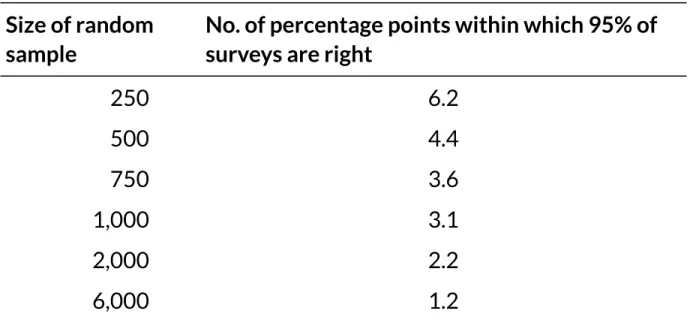
TABLE 3.2 How accuracy increases with the size of the sample TABLE 5.1 Calculating your space needs
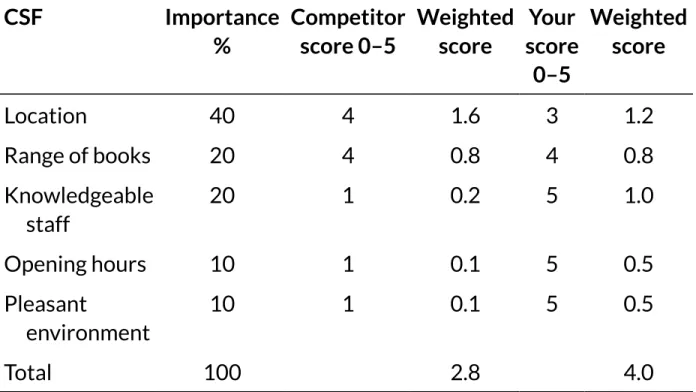
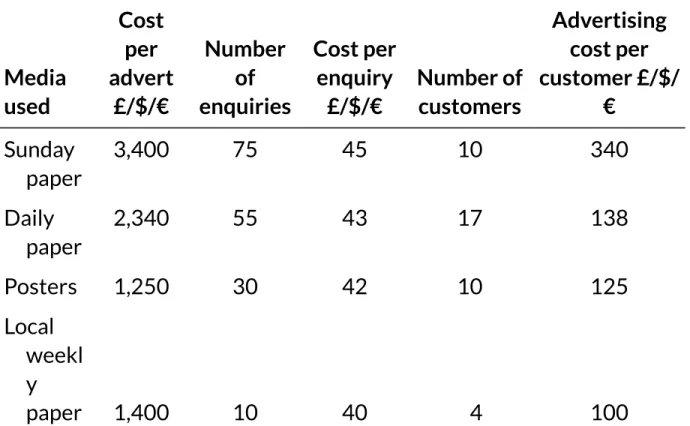
TABLE 7.1 Assessing competitive advantage for a bookshop TABLE 7.2 Measuring advertising effectiveness
TABLE 7.3 UK advertising spend
TABLE 7.4 Pricing – how do you compare with the competition?
TABLE 9.1 A simple cash-book system
TABLE 9.2 Example of an analysed cash book TABLE 9.3 An example of a double-entry ledger
TABLE 9.4 High Note six-month cash flow forecast (£/$/?) TABLE 9.5 Profit and loss account for High Note for the six
months April-September
TABLE 9.6 High Note extended profit and loss account TABLE 9.7 High Note balance sheet at 30 September
TABLE 9.8 The changes to High Note’s balance sheet to account for depreciation
TABLE 13.1 High Note’s profit and loss account and balance sheet
Introduction
The years since the first edition of this book in 2008 have witnessed a near collapse in world financial markets, by many standards the worst since the Wall Street crash of 1929; the first successful coalition government in the United Kingdom since the one led by Winston Churchill in 1940 to steer the country through the war years; the British decision to leave the European Union in 2016; and the election of Donald Trump, the first American President never to have held any prior political appointment since Eisenhower, a five star general Supreme Commander of the Allied Forces in Europe in WW2.
However, these macro gyrations have not daunted would-be business starters. There were approximately 5.5 million active businesses in the UK during 2016, up from 3.5 million in 2010 (www.fsb.org.uk/media-centre/small-business-statistics). The figures from around the world are similarly impressive. There are over 175 million people running their own business in the developed world. That is double the number of just two decades or so ago. GEM (www.gemconsortium.org), through their Global Entrepreneurship Monitor research programme headed up by Babson College in the United States, collect statistics across 60 economies around the world on business starters and equally importantly would-be starters.
Running your own business may seem a daunting task when you first start to gather ideas together and make tentative plans.
Many would-be entrepreneurs after putting a toe in the water quickly pull back, reckoning that they don’t have the skills, that their business concept is not all that compelling or that raising
the money is going to be challenging, expensive and altogether too risky a proposition.
Certainly most of the people you talk to will be only too ready to pour cold water in liberal doses all over your proposed product or service. Your friends and loved ones through a sense of responsibility and perhaps even self-interest will naturally urge caution, preferring a safe regular salary to the apparent lottery of enterprise. After all, everyone knows that most new businesses fail, often causing misery and penury to founders, family, partners and anyone foolhardy enough to supply or in any way get involved.
The first useful fact to know is that the rumour of calamities awaiting most new ventures is just that – an unfounded and incorrect piece of oft-repeated misinformation. An exhaustive study of the eight-year destinations of all 814,000 US firms founded in a particular year revealed that just 18 per cent actually failed, meaning that the entrepreneurs were put out of business by their financial backers, lack of demand or competitive pressures (Bruce A Kirchhoff, 1994, Entrepreneurship and Dynamic Capitalism, Praeger Publishers, Westport, CT). True, some 28 per cent of businesses closed their doors voluntarily, their founders having decided for a variety of reasons that working either for themselves or for this particular type of business was just not for them.
But the majority of the businesses studied in Kirchhoff’s mam-moth and representative study survived and in many cases prospered. With a degree of preparation, a fair amount of perspiration and a modicum of luck you can get started and may even, as in the case examples in this book, become a millionaire to boot.
Working for yourself from home can seem a lonely business.
Indeed loneliness is one of the most frequently quoted concerns
cited to alarm prospective entrepreneurs. Paradoxically there are probably more people running their own business than there are members of almost any other profession or trade.
There are certainly more entrepreneurs than there are doctors, surveyors, airline pilots or engineers. So whilst you may feel alone and maybe even that you are held in low esteem the reality is rather different.
You might be surprised at the number of people and organizations that appear keen to help you get your business up and running. In Appendix 1 there is a directory of such organizations, prominent amongst which is the government.
None of these would-be helpers is particularly altruistic. The government needs you, as new businesses create most of the new jobs in any economy, a fact uncovered by David Birch, a researcher at Massachusetts Institute of Technology (MIT) back in 1979 (The Job Generation Process, MIT, Cambridge, MA) and corroborated by dozens of other studies since then. Also of course you will pay tax on your profits and become an unpaid tax collector for VAT or sales tax on behalf of government agencies.
New businesses are also the main source of innovations, with around 60 per cent of all commercially viable inventions born in new businesses. So venture capital firms looking for superior returns need a steady flow of new businesses to back. Even conservative lending banks see those creating new businesses as being a target worthy of aiming for. Whilst home banking is still largely free, banks rely on business clients to make their money from.
Starting from home: Advantages and
disadvantages
Starting a business from home gives you a number of distinctive advantages over other business start-ups. True, there are a couple of disadvantages as well, but these are more than offset by the benefits.
The advantages
Those starting a business from home have a number of distinct advantages over those plumping for premises straight away. A study by the US Small Business Administration tracking the
survival rates on new businesses
(www.sba.gov/advo/research/business.html > Redefining Business Success) concluded that starting from home significantly improved a founder’s chances of succeeding. Other studies coming from organizations less impartial suggest that home-based businesses are two-thirds more likely to survive the crucial first four years of trading and so establish a firm footing.
The advantages a home-based business has over its peers that give it an edge are as follows.
Lower costs
Walk around town, any town, and you will see offices being refurbished, with new furniture being delivered, shops being fitted out and billboards being erected and painted. Telephone companies will be queuing up to install new lines; internet service providers will be licking their lips as they sign up new clients. Then of course there is the rent and other charges to pay out on business premises. You get the picture.
Starting from home saves most of the £35,000 start-up costs that the average business incurs even before it takes its first order. The chances are you have nearly everything you need to
start up your business already somewhere around your home.
The kitchen table worked fine for Blooming Marvellous to make their plans, pack up their first orders and do their accounts from. A garage, loft, spare bedroom or garden shed can be pressed into service for a whole host of business-related tasks from holding stock to being a dedicated office space away from the normal hustle of home life. Your computer, however old, will almost definitely work just fine, unless you are starting a business at the cutting edge of design or the internet.
Better costs
It’s a curious phenomenon but for many people half the fun of starting a business is spending a fortune at the outset on new gizmos. At last there is an excuse for getting that new colour photocopier, cabtruck that can double for deliveries or a new suite of office furniture without feeling guilty. After all it’s an investment in a new business, not an extravagant spending splurge. The beauty of starting from home is that you don’t really have the excuse for new expenditure that starting in dedicated premises provides, and the chances are you don’t have the space either.
But a valuable additional benefit from not having to spend too much money at the outset of your business is that you get to spend it more wisely later on when you see how your business shapes up. Countless business starters have ‘invested’
thousands in impressive offices only to find that no one has any reason to visit them. The suppliers and clients they hoped to impress only ever see their stationery or website. In fact, researching the local hotels to find those with discreet lobbies or coffee lounges would meet their rare need for a comfortable venue. Just as babies change shape very quickly, so do young
businesses. Best to make do with what you have at first and see how the business shapes up.
More time
There are lots of things that money can buy but time isn’t one of them. However close your business premises are, you could spend at least four hours a day travelling to and from them. I’m sure if your shop, restaurant or office is only a couple of miles away you won’t believe that proposition. How on earth could it be possible to take an hour to travel just one mile? Well, there is an immutable law that says the closer your home is to your business premises the more often you travel between the two.
Ergo, if you are 20 miles away you go once a day, covering 40 miles, and if you are only 5 miles away you come home for lunch and return once or twice more each week to collect things you have forgotten. Whatever the distance, the average weekly travel time is about the same.
Working from home also helps with all the other factors that encroach on your time. If a family member is ill and needs your attention you can work and look after the ill person too: no need to run back and forth or get into work late, as you are on the spot anyway. The same applies to having to put in extra hours to meet a work deadline. You can take an hour out to have dinner with your family and then get back to work afterwards.
Less stress
Commuting to work on a daily basis is stressful. In any vibrant and successful economic area roadworks, accidents, delays and traffic jams are pretty much the norm. Few of us are fortunate enough to live in a car-free area or where parking is never a problem. Even if you could find such a paradise the chances are
it would be useless as a business proposition. Depopulated areas are equally devoid of customers, suppliers and people to employ. Even if you are the boss you have to get into your premises before anyone else and leave after them to lock up.
Often this is a bonus, as with a bit of careful planning you can miss the worst of the traffic. But whatever the benefits this can make for a very long day.
Juggling the factors that make for a satisfactory home–work balance is another source of stress that homeworkers are less prone to suffer. After all, you have everything in one place and can deal with problems as they occur. The opportunity to shift between business-related tasks and working on housework, cooking or maintenance provides exactly the sort of variety that minimizes the chances of getting bored. Also you can work at what you feel best able to do when the conditions are right.
Gardening will be more fun on a sunny morning than at dusk in the rain after a fraught drive home. And if the internet crashes you might be glad of the opportunity.
Improved productivity
Less stress + More time = Improved productivity. This is an equation that works for any business, but works best for a home-based one. It follows that if you can find a couple of extra hours a day and spend them working at something you really feel good about doing you will get more done each day. The more valuable work you do the more productive you are and hence the more income you can generate.
It’s not rocket science. If you can make £20 an hour in your business then every extra hour you work is to your advantage.
Spend the four hours you might have spent travelling at productive work and you have an extra £80 a day. Do that five days a week for 48 weeks and you have an extra £19,200 of
productive output. That makes a home-based business around a fifth more productive than the average business is in its early years.
Unique competitive proposition (UCP)
Many small businesses see their primary initial competitive advantage as being able to sell at a lower price than bigger established competitors. In fact, as most owner-managers have little or no idea what their true costs will be or how much they will sell (see Chapter 9 where I cover break-even analysis, which shows you how to work this out), that proposition is almost always fallacious. They sell cheap and lose money more often than not. Then they struggle hard to get their prices up, losing dozens of expensively won customers on the way.
But most home-based businesses have a winning formula:
Improved Productivity + Lower costs = The potential to sell cheaper and still make good money. This argument is a powerful one and it goes like this. The home-based business hasn’t had to spend large sums of money on premises and rent at the outset, so those costs don’t have to be recovered from every sale. Also, being more productive the home-based business gets more done and so has more to sell. Thus with more output to sell and less costs to recover, anyone running a business from home can undercut any premises-based business and still make more profit.
The usual suspects
Working your business from home also gives you all the advantages that anyone running a business anywhere will enjoy. These include:
the personal satisfaction that comes from following your own vision of how things should be done;
being able to make your own decisions and not always having to rely on others;
having the potential to make as much money as you need rather than having to work set hours;
not having to get involved in office politics or waste time in tedious bonding exercises;
creating employment for family members, if you want, including spouse and children;
having a business to pass on to future generations;
creating a business that is valuable rather than just having a wage whilst making someone else’s business valuable.
The disadvantages
Starting a business whether from home or elsewhere is not a one-way bet. There are disadvantages too. For a start, being your own boss means the buck stops with you. Ultimately you have to take responsibility for everything. As an employee you could reasonably lay the blame for a late delivery or faulty product on the relevant department, but as a business owner everyone blames you and looks to you to create a solution. If that means jumping in the car and doing a delivery yourself overnight, so be it. Owner-managers have the term ‘overtime’
deleted from their memory bank!
You are also responsible for paying back any money borrowed, keeping within the law, filing accounts, paying taxes, maintaining employment records – the list of responsibilities
and obligations is onerous. Also, if you work from home you have a couple of specific disadvantages to keep in mind:
No place to hide
Whilst travelling to work every day can be stressful and is almost invariably a waste of time, it does at least give you some personal space. Also once you are at your business premises you can, for a while at least, leave your home concerns behind.
Peeling paintwork, uncut grass, an empty refrigerator and a faulty bathroom tap are all problems that can be parked out of sight at the back of your mind until your return.
Working from home means that these and any other domestic crises are all too evident all day every day.
Disrupting influences
Business premises are usually cleaned before people turn up for work. Even if you are the person doing the cleaning, as you may well be in the early months and years, you won’t be trying to work whilst it’s being done. At home, unless you live alone, the chances are that you will have to work throughout whilst domestic chores are being carried out. Cleaning, cooking, feeding, ironing and all the other paraphernalia of home life will be going on whilst you are struggling to take a vital phone call on a less-than-perfect line from a client on another continent. The day you have set aside for laying your paperwork out as a prelude to filing will see you in competition for the same floor space.
Also, being on hand makes it difficult to park problems and issues until later in the day. It takes superhuman self-discipline not to answer the door if friends or relatives drop by unexpectedly or if your spouse makes ‘As you are here would you mind?’ type requests.
CASE STUDY Northern Dough
The Northern Dough Company started out making pizzas at their kitchen table in 2011. By 2016 the latest accounts filed at Companies House revealed that they were doubling in size every year. The
company’s debtors, the money owed by customers grew from £27,064 to £47,475 in the past year alone. (Look forward to chapter 9 if your accounting is a little rusty.) Those debtors, customers that owe money for supplies, now include 250 Waitrose stores as well as Booths
Supermarkets, Ocado, Whole Foods and 130 individual farm shops, a healthy customer base by any standards.
The Lancashire-based company is the brainchild of husband and wife team Chris and Amy Cheadle. The idea for the business came after they hosted ‘make your own pizza’ dinner parties. ‘We started the business as an alternative to dining out,’ says Chris. ‘Our friends were invited into the kitchen to create their own favourite recipes.
They enjoyed it so much they often went home with a bagful of dough.’
Chris had something of a head start as he came from three generations of family of bakers in Lancashire. But the business idea wasn’t born in an oven. It was only when he looked for an alternative at the
supermarket that he saw a gap in the market for a convenient and authentic tasting product and the business was born. The idea was tested at a local food market where they sold out everything they had brought in 90 minutes.
www.northerndoughco.com
01 Finding the right business
opportunity
THIS CHAPTER COVERS
deciding on a product or service;
looking for a gap in the market;
buying into an established idea;
going into franchising;
using network marketing;
sourcing business ideas.
Dependent on the type of person you are, the world is either full of business opportunities or everything worth doing is already being done very well by someone else. You may remember the story of the two salespeople sent to a seriously underdeveloped country to sell shoes. On arriving and noticing that none of the locals was wearing shoes, one salesperson e- mailed head office saying ‘No market here, on next flight home.’
The other’s e-mail read rather differently – ‘Enormous potential, no competition, send all warehouse stock out on next flight.’
The truth often lies somewhere between these polarized views of the market. But both salespeople did something right – they got out and saw for themselves. In this chapter you will see the generic ways into business and read case examples of others like yourself who have been, seen and done.
Product or service
One area of continuing confusion for would-be business starters is whether they should look for a product or a service to sell. Products often seem an easier choice, as customers can see immediately what they are getting for their money, and in any event tangible objects are easier to describe. As against this apparent advantage is a feeling that product orientation is old- fashioned, giving off an air of metal-bashing workshops under railway arches in cities that have seen better days.
Defining a product
A product is something physical that generally conveys to a buyer what it does and why it is worth paying good money for it. It could be something as dull as a garden spade, devoid of either technological content or any element of aesthetic design.
Alternatively, a Porsche 911, an Apple iPhone and a Dyson vacuum cleaner are all every bit as much products as the humble spade, but clearly a lot more value has been pumped into them.
Sometimes a product needs a bit of embellishing to make sure end users understand what a privilege they are getting when they shell out their hard cash. Computer software and DVDs are a good example here. These products almost invariably come in a box large enough to pack in half a dozen more similarly sized
items. After you have peeled the onion-like layers of wrapping, the physical product itself may be millimetres thick and a few centimetres in circumference. But that fact alone won’t be enough to deter a supplier such as Microsoft from charging
£400.
Explaining a service
A service on the other hand is something of value that has no residual physical presence. Baby sitting, dog walking and management consultancy advice, for example, are valuable activities that people are prepared to pay for that leave nothing material behind after being ‘delivered’. True management consultants usually leave a report after they have carried out their task, but clients pay for insights and knowledge rather than a few sheets of typing and a chart or two.
Settling on a product/service mix
In truth all product-based businesses are a mixture of both the physical attributes and a specified level of service-based support. Indeed for many products the key differentiators may be the service support that underpins their offer. For example, KIA cars perform much as any other car in their category. You will get to your destination as certainly and quickly in a KIA as in say a Chevrolet, Hyundai or Skoda. But KIA guarantee all their cars for seven years or 100,000 miles, whichever comes first; with a Volvo or Volkswagen you would be on your own after three years or 60,000 miles.
The choice you have to consider in deciding what sort of business to go into is more about what level of service or warranty you want to offer rather than whether you will just sell a product or deliver a service. A mail order business could
make itself better and different from competitors by offering a range of delivery speeds, order tracking so customers are not kept hanging on, and follow-up to ensure the product performs as specified. But if dealing with customers and offering a high level of service are not your bag, choose a business sector where that is not so important.
Classic ways into business
There are very few types of business that can’t be run from home, at least from the outset. Whilst running a paint manufacturing business with toxic fumes pouring out of your chimney, 44-ton artics in the drive and a garage full of tins may cause sufficient problems with the neighbours to render it an impossibility, the key elements of such a business can be run from your front room with little or no difficulty. Manufacture, warehousing, delivery and even invoicing and cash collection can all be outsourced. All you need to be sure of is that enough people want your paint at the price you have to sell to make a decent profit.
So the starting point for every business is a proposition. For Blooming Marvellous the business idea stemmed from the simple fact that once the founders became pregnant they could no longer be fashionably dressed. All the retailers they used before made nothing for pregnant women, and none of the outlets that specialized in maternity wear made anything that could be remotely considered as fashionable. That left the business founders with a classic route to market – an unfulfilled need.
Filling a gap in the market
The most fundamental way to spot a winning business idea is to find a gap in the market. Gaps are usually ‘spaces’ left behind by bigger, more established businesses that either consider meeting the needs of a particular group of customers uneconomic or have just become lazy as they got bigger. For example, Anita Roddick, founder of The Body Shop, found that she could only buy the beauty products she wanted in huge quantities. By breaking down the quantities and sizes of those products from her dining-room table she unleashed a huge new demand. Now owned by L’Oréal, Body Shop International currently has a range of 1,200 products sold through 2,605 franchised stores in 61 countries and employs 22,000 people.
Repositioning an existing product
Often with a few minor adjustments an old idea can be given a new lease of life. Monopoly enjoyed a renaissance when it was launched with Parisian rather than London street names.
Other rich veins of business ideas include looking overseas or into other markets at products and services that have worked well in the past but have not yet made the leap to your home market.
CASE STUDY Specsavers
Every once in a while an entrepreneur turns an industry on its head.
Dame Mary Perkins was a perfect example when she launched a business that changed the face of optometry for good. We might be used to visiting showrooms to purchase glasses these days, trying on frames at our leisure until we find the perfect fit, with every item clearly priced, but back in the early 1980s this was not the case.
Before Mary launched Specsavers, consumers had very little choice or control when purchasing eyewear. Indeed, before Specsavers came along, when you visited an optician they’d disappear out back to find a few pairs for you to try on. But Mary had a clear vision of how
opticians could operate in order to deliver better value, choice and transparency to consumers. Driven by a mission of providing
affordable eye care to all, she built the company around the idea of treating others respectfully. She still describes her billion-pound international company, which she founded with her husband, Doug Perkins, as ‘a family-owned business, with family values’.
One of the key lessons Mary learnt early on was the importance of setting yourself apart from the competition. As a new business, there was no point in merely copying a major player – you had to offer customers something different. She identified a number of major problems with the way opticians were doing business at the time, and came up with a proposition that she felt was far more attractive to consumers. First of all, glasses were expensive. Mary believed that she would be able to bring prices down without compromising on quality by negotiating better buying terms and selling larger volumes. For example, instead of buying from wholesalers who added a significant mark-up on their prices, she went to factories directly.
From just two staff working at a table-tennis table, there are now more than 500 based at Specsavers’ headquarters in Guernsey and around 26,000 worldwide. The company has more than 1,390 stores across the Channel Islands, the UK, Ireland, the Netherlands,
Scandinavia, Spain, Australia and New Zealand. Mary believes that much of her success has been driven by the preservation of the
founding culture and ideals, and a focus on giving consumers real value and choice.
Blue-skies thinking
Inventions and innovations are perhaps the most risky way into business. True, if you get it right you can make a pile of money, but most don’t. Less than 1 per cent of patents filed in the United States result in a commercially viable business proposition. That adds up to a lot of wasted money on filing patents. (See Chapter 4, where the legal aspects of intellectual property are covered.)
Getting inventions to market can be an expensive and time- consuming business, as James Dyson is only too eager to confirm. It took five years and 5,127 prototypes before the world’s first bagless vacuum cleaner arrived on the scene. Mark Saunders, like Dyson, studied at the Royal College of Art in London, where he designed the innovative Strida folding bike (www.strida.com). Saunders originally planned to make the product himself, but some rudimentary product costing convinced him to subcontract out the manufacturing process and keep working from home on design and development.
Using the internet
The internet is a classic route to market for the home-based business starter. All you need is a computer, an internet connection and a winning idea. The sting in the tail lies in the last word. The first generation of internet businesses had little unique about their propositions other than being on the ‘net’, which was thought exciting enough. Businesses were floated on stock markets the world over at values unheard of for firms with no sales revenue and in some cases no products. Failures abounded and, whilst a handful – Amazon and Lastminute.com, for example – prospered, most failed, dragging world stock markets down with them.
All the basic rules of business apply whatever the route to market, and route to market is really all the internet is.
Employing other people’s ideas
You don’t have to have a business idea of your own to get into business. A large number of people have entrepreneurship thrust upon them by external factors. An event such as inheriting money, having to move when a partner changes jobs, having to give up full-time work through pregnancy or illness, being made redundant or having to make ends meet in retirement can trigger the desire to go into business.
These are some of the ways in which you can piggyback on proven business concepts. Whilst you may lose some elements of the independence running with your own idea provides, you will at least be surer of some success.
Franchising from home
Franchising is a marketing technique used to improve and expand the distribution of a product or service. The franchisor supplies the product or teaches the service to the franchisee, who in turn sells it to the public. In return for this, the franchisee pays a fee and a continuing royalty, based usually on turnover. The franchisee may also be required to buy materials or ingredients from the franchisor, giving the latter an additional income stream. The advantage to franchisees is a relatively safe and quick way of getting into business for themselves, but with the support and advice of an experienced organization close at hand.
Franchisors can expand their distribution with the minimum strain on their own capital and have the services of a highly motivated team of owner-managers. Franchising is not a path to great riches, nor is it for the truly independent spirit, as policy and profits will come from the franchisor.
Recruitment, travel and leisure, bookkeeping, photography, pet foods, jewellery, greeting cards, magazine publishing, internet services, education and dating agencies are just a handful of the 1,500 franchise systems on offer around the world. The average cost of a home-based franchise is £15,000 including franchise fee, working capital, equipment and fittings, stock and materials. But you can set a home-based franchise for as little as £4,500.
Before deciding on a particular franchise it is essential that you consult your legal and financial advisers. Franchisees must also ask franchisors some very searching questions to prove their competence. You will need to know if they have operated a pilot unit in the UK – an essential first step before selling franchises to third parties. Otherwise, how can they really know all the problems and so put you on the right track? You will need to know what training and support are included in the franchise package, the name given to the start-up kit provided by franchisors to see you successfully launched. This package should extend to support staff over the launch period and give you access to back-up advice. You will need to know how substantial the franchise company is. Ask to see its balance sheet (take it to your accountant if you cannot understand it).
Ask for the track record of the directors (including their other directorships).
You can find out more about franchise opportunities and the rules and regulations in each country at the World Franchise Council website (www.worldfranchisingcouncil.net). On this site you will also find links to the various country franchise associations who can provide detailed information on the relevant local proceedings.
Network marketing
Companies such as Amway, Avon, Betterware, The Body Shop at Home, Herbal Life and Kleeneze are amongst a host of household names providing full- or part-time profitable business opportunities that can be run from home. The business model is varyingly called network marketing, multilevel marketing and referral marketing. They are differentiated from pyramid selling, which is focused almost entirely on recruiting new members rather than selling products and services. If a company offers substantial profits for little work, asks you to make an enormous investment in stock or doesn’t offer to buy back unsold stock, which is in itself illegal in most countries, then avoid it like the plague. Pyramid selling is illegal in the UK. Check out the characteristics at www.dsa.org.uk/consumer-advice/illegal-schemes – and steer clear.
There are hundreds of sound businesses out there, so there is no need to be lured into a bad deal. Check if the firm you are considering is a member of the Direct Selling Association (www.dsa.org.uk), the Direct Marketing Association (www.dma.org.uk), or the Multi-Level Marketing International Association (www.mlmia.com).
The pros and cons of network marketing
Pros
Start-up costs are low and indeed the law generally prohibits investments of over £200. This also means that you can
usually store all the product you need in a car boot, garage or spare bedroom.
The business model is proven, having been around for close on a century.
There is plenty of support and advice on offer, making being home based less of a lonely proposition.
The business is ideal to run from home as no specialist equipment or storage is needed.
There is the potential to scale up, and as there are no
territory or geographic restrictions you can sell anywhere in the world and use the internet for global reach.
Cons
You may find some negative vibes, as people may associate your product or service with pyramid selling.
You need to be comfortable selling to friends and associates and be a net worker par excellence.
You are heavily dependent on the success of the parent
organization. If that goes belly up so do you. Cabuchon grew spectacularly as a jewellery networking company aimed primarily at women and failed owing to quality problems and the management’s inability to control a bigger business.
You could even find that a change in philosophy, such as occurred when Dorling Kindersley Family Learning was closed by its new owners, Pearson, could pull the rug from under your feet.
Buying a business
Taking out a franchise or getting into a network marketing chain has a number of attractions over starting up from scratch, as we have already seen. Perhaps the most valuable advantage is that in an established business many of the unknowns of the business world are eliminated: who your first customers will
be; how much they will pay; how you will find reliable suppliers; what equipment you will need; and how much your costs will be. All these issues and more have already been considered, and all you need bring is energy, enthusiasm and a modest amount of cash.
True, neither franchising nor network marketing is a one-way street; things can and do go wrong. But one weakness of both these routes to starting a business is that at no point will you ever truly own the business concerned. It will always be fundamentally the property of the franchisor or network firm concerned. You could view the situation much as if you were subletting a property at a profit. You rent from the landlord at one price and with the landlord’s consent take in tenants who pay you more than you pay out. Nevertheless at the end of the day the capital asset belongs to the landlord, and the landlord, not you, enjoys any uplift in value.
One way to square this circle is to buy a business that is already up and running. In that way you can get into business taking fewer market risks and keep all the gains if and when they arise.
Advantages and disadvantages of buying a business
Buying a business has a number of advantages and disadvantages.
Advantages of buying a business include:
Much of the uncertainty of starting up has been eliminated, so you should have fewer costly mistakes.
You inherit relationships with customers, suppliers and perhaps even financial institutions that would otherwise take years of hard work to build.
You may be able to pay yourself a living wage from the outset.
You eliminate one competitor. If there are already two carcleaning businesses in the small area in which you live, both have been around for years and yet you have decided that this is the business for you, then buying one out may make economic sense. That way you could get 50 per cent of the market rather than the third you could aim for with three players in the game.
Disadvantages of buying a business include:
Valuing a private business is difficult (see the next section).
Finding a business and negotiating a purchase price can take time and may require several attempts before you succeed.
You will need costly professional advice from lawyers and accountants as safeguards to ensure that you don’t end up taking on hidden liabilities for tax owed, or responsibilities to past and present employees.
Valuing a business
When you buy a business you are in essence buying an established stream of profits. True, the business may have tangible assets such as stock, computing equipment or machinery. But the value of these hard items will be insufficient to compensate the previous owner for the accumulated time and effort that he or she has spent growing the business to its present state. The price/earnings ratio (P/E) is used estimate the value of a business. If a business has earnings (profits) of
£50,000 and is in a sector where the usual P/E is 10, the value would be 10 × £50,000 = £500,000.
Arriving at a multiple is far from an exact science and the main guideline is what is being paid for shares on stock market.
Vodafone for example has a current P/E of 39 while Marks and Spencer which operates in a more mature and established sector trades on a P/E of 9.
Private companies have a P/E about a third lower than similar public companies; that is, those on a stock market. This is a reflection of the fact that the shares are harder to buy and sell.
You can find P/Es in any paper that lists shares.
Finding a business to buy
These organizations can help you find a business to buy:
BizBuySell (www.bizbuysell.com). This site lists 45,000 businesses for sale, covering the United States by state, and by country, including: Africa, Asia/Pacific; Australia/New Zealand; Canada; Caribbean; Mexico/Central America;
Europe and South America.
WorldBusinessforSale.com
(www.worldbusinessforsale.com). This site claims to have listings of businesses for sale from 1237 countries, updated daily.
CASE STUDY Money Supermarket
On the 16 March 2016, Simon Nixon, who founded the price
comparison site Moneysupermarket.com. sold the final tranche of some 6.9% of the company’s shares for £124 million.
Founded in a bedroom by Simon Nixon and Duncan Cameron in 1999, Money Supermarket grew to have revenues in excess of £100 ($160/€118) million barely a decade later. Nixon was a drop-out from an accounting course at Nottingham University, leaving half way through the second year. He initially worked as a self-employed
financial consultant and persuaded Cameron, a computer geek and his girlfriend’s brother, to give up a computer studies course at Liverpool University to write the software programs that were crucial to the launch of the venture.
By the summer of 2007, on the eve of its stock market float, it was valued at around £1 billion, more than 30 times its previous year’s profits. As the name would suggest, the business is an internet-based price comparator that started out in the financial services sector and now covers a myriad of other sectors including utilities, travel and general shopping. The value proposition is that Money Supermarket saves you hours surfing the net yourself. But despite some fairly complicated technology the business model is little more than the tried and tested role of the intermediary or broker doing the sums for their client that Nixon started out with when he started his first
business, Mortgage 2000.
Key jobs to do
Can you see any gaps in the market for your product or service?
If you can see a gap, why do you think it hasn’t been exploited yet?
Research for any franchise, network marketing or business for sale available in the sectors you are considering.
If any such opportunities are available, would one of these be a better proposition for you either from an investment, risk, skill or speed-to-market perspective?
02 Picking the right business for you
THIS CHAPTER COVERS
the characteristics of the self-employed;
weighing up a business idea;
assessing your abilities;
choosing the best business idea, for you.
Your market research should put you at the point where you can define your business proposition in a few short sentences;
in business jargon this is called a ‘mission statement’. Large companies may spend long weekends at country mansions wrestling with the fine print of their mission statements; in principle the task facing the home-based business owner should be less daunting.
The mission statement has two key attributes. First, the mission should be narrow enough to give direction and guidance to everything you do or plan to do. This concentration is the key to business success because it is only by focusing on specific needs that a small business can differentiate itself from its larger competitors. Nothing kills off a new business faster than trying to do too many different things at the outset.
Second, the mission should open up a large enough market to allow the business to grow and realize its potential.
Above all, mission statements must be realistic, achievable – and brief. McKinsey’s mission reads: ‘As management consultants, to help our clients make distinctive, lasting, and substantial improvements in their performance and to build a great firm that attracts, develops, excites and retains exceptional people’.
CASE STUDY
Blooming Marvellous is a company formed by two young mothers, who, while attending an enterprise programme, developed the following mission statement:
Arising out of our experiences, we intend to design, make and market a range of clothes for mothers-to-be that will make them feel they can still be fashionably dressed. We aim to serve a niche missed out by Mothercare, Marks & Spencer, etc, and so become a significant force in the mail order fashion for the mothers-to-be market.
We are aiming for a 5 per cent share of this market in the
Southeast, and a 25 per cent return on assets employed within three years of starting up. We believe we will need about £25,000 start- up capital to finance stock, a mail order catalogue and an advertising campaign. Some two decades later Mothercare paid some £3m for the brand. www.mothercare.com/maternity
Armed with a mission you can now talk succinctly about your business to anyone and hopefully galvanize them with your
enthusiasm and commitment and perhaps even win over some potential customers. Three tasks remain before you can commit to the venture. Two are the subject of this chapter and they both concern you, the business founder. The third is to do with the financial viability of your business, which will be covered when you prepare your business plan and make your financial projections.
Do you have what it takes?
To launch a new home-based business successfully, you have to be the right sort of person. The typical business founder is frequently seen as someone who is always bursting with new ideas, highly enthusiastic, hyperactive and insatiably curious.
But the more you try to create a picture of the typical entrepreneur, the more elusive he or she becomes.
That said, there are certain characteristics that successful newcomers to running their own business do have in common:
Self-confident all-rounder. Entrepreneurs are rarely geniuses.
There are nearly always people in their business who have more competence, in one field, than they could ever aspire to. But they have a wide range of ability and a willingness to turn their hands to anything that has to be done to make the venture succeed. They can usually make the product, market it and count the money, but above all they have self-
confidence that lets them move comfortably through uncharted waters.
Resilient. Rising from the ashes of former disasters is also a common feature of many successful entrepreneurs. Henry Ford had been bankrupted twice before founding the Ford Motor Corporation with a loan of $28,000 in his fortieth year.
Innovative. Almost by definition, entrepreneurs are
innovators who either tackle the unknown or do old things in new ways. It is this inventive streak that allows them to carve out a new niche, often invisible to others.
Results orientated. Successful people set themselves goals and get pleasure out of trying to achieve them. Once a goal has been reached, they have to get the next target in view as quickly as possible. This restlessness is very characteristic.
Sir James Goldsmith was a classic example, moving the base of his business empire from the UK to France, then the
United States – and finally into pure cash, ahead of a stock market crash.
Careful risk taker. The high failure rate shows that small businesses are faced with many dangers. An essential
characteristic of someone starting a business is a willingness to make decisions and to take risks. This does not mean
gambling on hunches. It means carefully calculating the odds and deciding which risks to take and when to take them.
Total commitment. You will need complete faith in your idea.
How else will you convince all the doubters you are bound to meet that it is a worthwhile venture? You will also need
single-mindedness, energy and a lot of hard work to get things started; working 18-hour days is not uncommon. This can put a strain on relationships, particularly within your family, so they too have to become involved and committed if you are to succeed.
CASE STUDY
At the age of 18, when his contemporaries were going off to university, Darren Saunders chose the route of the inventor. In pursuit of his ‘mad idea’ of the Cyberquin – a highly realistic, moving mannequin for
display in shop windows and exhibitions – he spent six months in a fruitless search for development cash. ‘I must have spoken to 150 people’, he says. ‘They all thought I was trying to achieve the
impossible.’ Finally, he clinched a government innovation grant; his father agreed to an overdraft with his bank to secure the remainder.
Saunders got help with the patents from a local patent agent, and took a short course in exporting at the Cardiff Chamber of Commerce.
After three long years of development, he succeeded in creating a mannequin that would work 24 hours a day without a hitch, needed no maintenance, and could be easily shipped and effortlessly set up
anywhere in the world. It took another 18 months of hard graft to get the product accepted, and it was all funded on a shoestring.
‘Everyone advised me to stick to the UK’, says Saunders, ‘but, I thought, the British never try anything new.’
He was right to follow his instincts. His budding company concentrated on visiting big shop-fittings exhibitions, including Euroshop in Düsseldorf, the biggest of them all. Here, the sight of a dynamic, lifelike mannequin attracted the crowds. The orders – despite a £5,000 price tag – came flooding in.
The Cyberquin, now re-branded more descriptively as Moving Mannequins (www.movingmannequins.co.uk), has been exported to some fifty countries and used by companies as diverse as Harrods, Mitsubishi, Disney, Puma and Lego.
Remaining self-sufficient
Working from home means that you will have minimum contact with other people. If you have until now worked in a large organization and enjoyed the collegiate atmosphere that goes with it, then being alone may be something of a challenge – it will certainly be a change. Some people can only thrive when they have others to bounce ideas off, and all business owners complain that loneliness, the lack of someone to share problems with and the absence of external stimuli are serious worries. Of course if you plan to start a business as an events organizer or masseur, for example, then you will constantly be working with people and may well be more productive working for yourself than as part of a big business.
If you are happier curled up with a book than at a party then chances are that you have a strong streak of self-sufficiency and will be comfortable running your business from home. Look on the positive – no office gossip!
Retaining focus
You will be surrounded by distractions when based at home.
Family pressures, noise and above all the people around you are not at work. That’s quite different from going out to an office or to business premises where everyone, theoretically at least, is there for a common purpose – work.
So you will need to be able to focus on the task in hand, despite continuous distractions and without generating too much ill will. You will need an armoury of strategies to ensure you can ring-fence the critical time you have to devote exclusively to working on your business.
Scoring your home business ability
All too often, budding entrepreneurs believe themselves to be the right sort of people to set up a business. Unfortunately, the capacity for self-deception is enormous. When a random sample of male adults were asked recently to rank themselves on leadership ability, 70 per cent rated themselves in the top 25 per cent; only 2 per cent felt they were below average as leaders. In an area in which self-deception ought to be difficult, 60 per cent said they were well above average in athletic ability and only 6 per cent said they were below.
A common mistake made in assessing entrepreneurial talent is to assume that success in big business management will automatically guarantee success in a small business.
Rate yourself against the characteristics in Table 2.1 and see how you stack up as a potential home business starter. A score of over 30 suggests you have what it takes, and less than 20 should be treated as a warning signal. Get a couple of people who know you well to rate you too, so you get an unbiased opinion.
TABLE 2.1 Home business starter attribute check
Attribute score (0–5, where 0 indicates having none of the attribute and 5 rating highly)
Self-confident all- rounder
Ability to bounce back
Innovative skills Results orientated Professional risk taker
Total commitment Self-sufficient Self-disciplined Total
You can find out more about your likely strengths and weaknesses as an entrepreneur by taking one or more of the many online entrepreneurial IQ-type tests. A couple of sources are listed below, but an entry in Google will produce a small torrent!
Psychometric Tests: A collaborative open resource run by Warwick, Durham and Southampton Universities
(www.psychometrictest.org.uk/entrepreneur-test)
Entrepreneurial Aptitude Test (EAT): A tool drawing on hundreds of surveys and interviews with business-builders
around the globe (www.hsgl.com).
Is the business right for you?
If you started reading this book with a business idea in mind, the first couple of chapters should have helped you get a clearer idea of how your concepts can be brought to fruition. If you are still casting around for an idea, then you will find a directory of home business opportunities in Appendix 2. In any event you should have at least a couple of prospective ventures in mind, as the process of comparison helps to reveal the strengths and weaknesses of a proposition that might otherwise lie dormant.
Deciding what you want
The first step in the process is to decide exactly what you are looking for in a business proposition. This is not too much different from looking for a new home. You rarely start with a completely blank sheet of paper. Rather you start with a budget of how much you are able or prepared to spend, a geographic area or radius around a town, the number of bedrooms required, proximity to public transport, local shopping and garage/parking arrangements. To these essentials you will then add some desirable features such as garden space, a patio and a conservatory. You need to do something similar with your business idea. Table 2.2 shows how you can do this for your ideas. First, decide what the important criteria for you are. In the example in Table 2.2, six are listed. Then give each of those criteria a weighting from 1 to 3 to reflect their relative importance. In the example, ‘Low investment’, ‘Flexible hours’
and ‘Small space needed’ are all very important and so are given the top rating of 3. The next two criteria, ‘Use all my skills’
and ‘Need no new skills’, being less important are given a weighting of 2. Finally, ‘No travel required’ being relatively unimportant is weighted only 1.
TABLE 2.2 Rating your business idea
Criteria Weighting
Idea 1 Idea 2
Score Weighted
score Score Weighted score Low
investment
3 3 9 1 3
Flexible hours 3 2 6 2 6
Small space needed
3 3 9 1 3
Use all my skills
2 3 6 2 4
Need no new skills
2 3 6 1 2
No travel required
1 1 1 3 3
Total weighted
score 37 21
Ranking your options
Now each business idea can be assigned a score between 0 and 3. If the idea meets the criterion perfectly, score it 3, and if it fails completely score it 0. In the example in Table 2.2 you can see that Idea 1 scores 3 for ‘Low investment’ as it needs little cash, whilst Idea 2, which needs more upfront money, scores only 1. Next the scores are multiplied by the weighting factor to produce a weighted score. As ‘Low investment’ is an important
criterion it is given a higher weighting than ‘No travel required’. You can see that, although Idea 1 scores 3 for ‘Low investment’ and Idea 2 scores 3 for ‘No travel required’, the weighted scores are 9 and 3 respectively to allow for the difference in their importance.
The weighted scores for each idea are totalled and show in this example that Idea 1, with a score of 37, is well ahead of Idea 2, scoring just 21.
You will of course have different criteria with different levels of importance, but the basic method will work even with many more criteria and a weighting system that gives a wider spread than just 0 to 3. Having said that, adding to the number of criteria greatly may only confuse matters. As with buying a house, in the end it all comes down to a handful of critical factors.
Key jobs to do
Take the home business start-up attribute check and see if this seems a good career choice for you.
Cross-check that outcome by taking at least one other similar test.
Weigh up the alternative business ideas you are considering and rank them using the weighting scheme in Table 2.2. Make any modifications to the criteria you consider relevant to you and your needs.
03 Researching the market
THIS CHAPTER COVERS
getting to grips with customers and their needs;
methods of segmenting markets;
appraising the competition;
doing desk and field research;
appreciating internet information;
conducting a test market.
You need information on customers, competitors and any other influencers in the chain that links buyers to sellers. For example, if you are selling to another business it could be useful to know something of who their end customers are, as your future is going to be influenced by how they perform as well as by your initial customer. You may also find that not all your customers respond to the same marketing messages. For example, one client for a book-keeping service may just need someone to do the grunt and groan of data entry, whilst another may want the data analysed and interpreted. The purpose of gathering the market research data is to help you decide on the right marketing strategy when it comes to such factors as
setting your price, deciding on service and quality levels and choosing where and how much to advertise.
Obviously the amount of time and money to be spent depends on the capital outlay required. If you need £1,000 to get into business, spending more than that on gathering information looks like overkill.
Understanding customers
Without customers no business can get off the ground, let alone survive. Some people believe that customers arrive after a business ‘opens its doors’. This is a serious and often fatal misconception. You need a clear idea in advance of who your customers will be, as they are a vital ingredient in a successful business strategy, not simply the passive recipients of a new product or service.
Knowing something about your customers, what they need, how much they can ‘consume’ and whom they buy from now, seems such elementary information it is hard to believe so many people could start without those insights – and yet they do.
There is an old business maxim that says that the customer is always right. But that does not mean that the customer is necessarily right for you. So as well as knowing whom to sell to you also need to know the sorts of people that trying to interest will be a waste of scarce resources on your part.
Recognizing needs
The founder of a successful cosmetics firm, when asked what he did, replied: ‘In the factories we make perfume. In the shops we sell dreams.’
Those of us in business usually start out defining our business in physical terms. Customers on the other hand see businesses having as their primary value the ability to satisfy their needs.
Even firms that adopt customer satisfaction, or even delight, as their stated maxim often find it a more complex goal than it at first appears. Take Blooming Marvellous, the case study given in the Introduction, by way of an example. They made clothes for the mother-to-be, sure enough: but the primary customer need they were aiming to satisfy was not either to preserve their modesty or to keep them warm. The need they were aiming for was much higher: they were ensuring their customers would feel fashionably dressed, which is about the way people interact with each other and how they feel about themselves. Just splashing on say a tog rating showing the thermal properties of the fabric, as you would with say a duvet, would cut no ice with Blooming Marvellous’s potential market.
Until you have clearly defined the needs of your market you cannot begin to assemble a product or service to satisfy it.
Fortunately, help is at hand. The US psychologist Abraham Maslow demonstrated in his research that ‘all customers are goal seekers who gratify their needs by purchase and consumption’. He then went a bit further and classified consumer needs into a five-stage pyramid he called the hierarchy of needs:
1. Self-actualization. This is the summit of Maslow’s hierarchy, in which people are looking for truth, wisdom, justice and purpose. It’s a need that is never fully satisfied and,
according to Maslow, only a very small percentage of people ever reach the point where they are prepared to pay much money to satisfy such needs. It is left to the like of Bill Gates and Sir Tom Hunter to give away billions to form
foundations to dispose of their wealth on worthy causes. The rest of us scrabble around further down the hierarchy.
2. Esteem. Here people are concerned with such matters as self-respect, achievement, attention, recognition and
reputation. The benefits customers are looking for include the feeling that others will think better of them if they have a particular product. Much of brand marketing is aimed at making consumers believe that, by conspicuously wearing the maker’s label or logo so that it can be seen by others, it will earn them ‘respect’. Understanding how this part of Maslow’s hierarchy works was vital to the founders of Responsibletravel.com (www.responsibletravel.com).
Founded six years ago with backing from Anita Roddick (of Body Shop) by Justin Francis and Harold Goodwin in
Francis’s front room in Brighton, the company set out to be the world’s first to offer environmentally responsible travel and holidays. They were one of the first companies to offer carbon offset schemes for travellers, and they boast that they turn away more tour companies trying to list on their site than they accept. They appeal to consumers who want to be recognized in their communities as being socially responsible.
3. Social needs. The need for friends, belonging to associations, clubs or other groups and the need to give and get love are all social needs. After ‘lower’ needs have been met these needs that relate to interacting with other people come to the fore. Hotel Chocolat (www.hotelchocolat.co.uk), founded by Angus Thirlwell and Peter Harris in their
kitchen, is a good example of a business based on meeting social needs. They market home-d