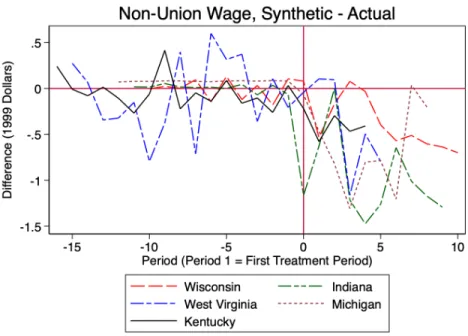
I find evidence that RTW generally reduces a state's union coverage rate, although there is considerable heterogeneity in the size of RTW's estimated effects across states. For Kentucky, it appears that RTW had little or no effect on the state's union coverage rate. First, states with both higher public sector union coverage and larger public sectors generally produced larger estimated effects of RTW.
First, it documents the heterogeneity of the effects of RTW on the level of union coverage across countries and provides additional support that these effects are for the most part not due to other changes in public policy. Missouri provides evidence that the estimated effects are not solely due to these unobservable factors and that RTW legislation has an independent effect on the level of union coverage and average hourly wages.
Setup
XJ+1 is a vector of observable predictor variables for each unit j with X1 representing the predictor variables for the treated condition j = 1.3 Predictor variables can include variables from a specific pretreatment period and also include variables averaged over multiple periods of the pre - treatment. Typically, predictor variables show high correlation with the outcome variable or have some theoretical basis for inclusion. Abadie (2021, p. 401) mentions that this vector of predictor variables can also include pre-intervention values of Yjt and this is usually implemented in practice to improve pre-intervention fit.
4vm was chosen to weight predictor variables based on their predictive power for the outcome variable. For more information on the weights of predictor variables, see Abadie et al. which can approximately correspond to X1, the vector of predictor variables for the treated condition.
Specification
By omitting one period of the selected outcome variable, I ensure that the synthetic counterfactual also approximates the treatment state's union coverage rate in the year immediately prior to RTW enactment. Taking the union coverage rate as a proxy for relative union power within a state, we want the synthetic counterfactual to exhibit a similar union coverage rate to the treatment state in the year immediately prior to RTW enactment. However, introducing multiple periods of the union coverage rate as predictor variables generally limits the ability of the synthetic control to approximate its treatment condition in the pretreatment period.
These other covariates are compared between the synthetic condition and the treatment in the year immediately preceding the entry into force of reintegration. Significant discrepancies between the synthetic condition and the treatment condition are addressed in robustness checks.
Current Population Survey Merged Outgoing Rotation Groups
I choose between a donor pool of entire states and a donor pool of individual counties, depending on which option provides a synthetic counterfactual that better approximates the treated state in the pretreatment period. Thus, using counties as the donor pool does not always create a better pretreatment match between the synthetic counterfactual and its respective treatment conditions. For some state/outcome variable combinations, a donor pool consisting of states provides a lower RM SP Epre, and for other state/outcome variable combinations, a donor pool consisting of individual counties provides a lower RM SP Epre.
All state and county average wage estimates are generated by weighting individual wage observations by hourly earnings. Based on these indicator variables for each individual worker, I use CPS observation weights to estimate the percent white, percent male, percent metropolitan, percent public sector, and the percent workers employed in each broad industry category for each state and county by year.
National Labor Relations Board (NLRB)
Bureau of Labor Statistics
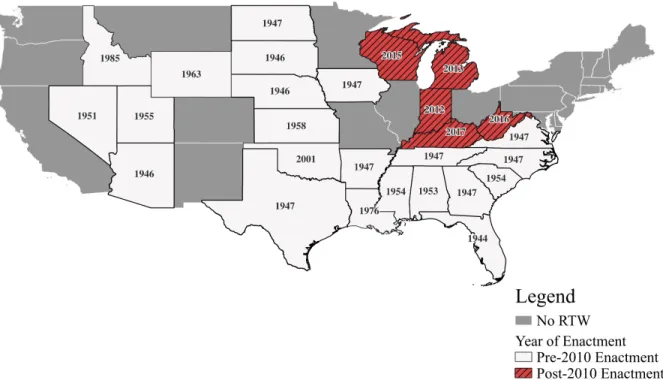
In all analyzes comparing the treatment condition with its synthetic counterpart, the first treatment period is the year in which RTW was implemented because the total observation for that year includes microdata after RTW was implemented, thereby exposing this total value to treatment. A lower RM SP Epre means that the synthetic counterfactual better approximates the true condition in the pre-treatment period, probably indicating that it serves as a more valid counterfactual in the post-treatment period. While Wisconsin enacted the typical RTW legislation in 2015 that banned all union shop arrangements, the state passed legislation that applies only to public sector workers and includes RTW provisions in 2011 (Act 10).11 For the Wisconsin pooled analyzes I use 2011 as the initial treatment period.
The Wisconsin public sector specifications use 2011 as the initial treatment period and the Wisconsin nonpublic sector specifications use 2015 as the initial treatment period. These balance sheets are used to identify substantive differences between a country and its synthetic counterfactual in the year immediately prior to RTW entry into force.
Main Results
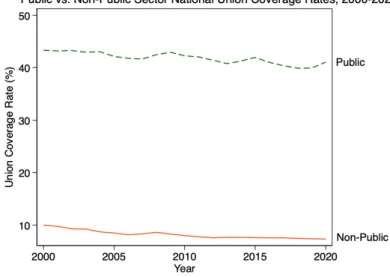
The estimated effect sizes are larger than the pooled and non-public analyses, possibly due to higher levels of union coverage in the public sector prior to RTW. In all states except Indiana, the estimated treatment effect is largest for the public sector. Meanwhile, West Virginia and Indiana's declines in union coverage rates are not as concentrated in the public sector.
All states show larger estimated effects in public sector average hourly wage than nonpublic sector average hourly wage. This may be due to higher union coverage rates in the public sector and greater effects of RTW on union coverage rates in the public sector compared to the non-public sector.
Robustness Checks
I repeat the union coverage analysis for Wisconsin, Indiana, and Michigan, only using Ohio, Pennsylvania, and Maine as potential. Thus, it is possible that the main results for Michigan's union coverage rate, average hourly wages, and average non-union hourly wages may be driven by Republican policy initiatives other than RTW. I repeat the union coverage analysis for West Virginia, using only Missouri and New Hampshire as potential donor states.
The trends toward treatment between West Virginia's union coverage and that of the Missouri-New Hampshire counterfactuals are not similar. It appears that West Virginia's past results for its union coverage rate are driven by RTW and not other Republican legislation.
Additional Results
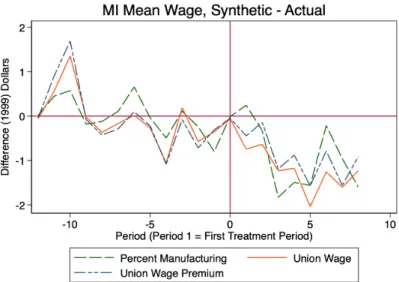
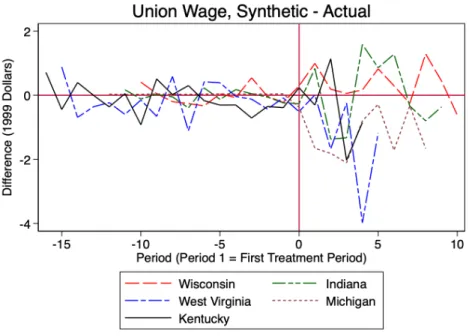
Removing border states does not materially change the results for each state's union coverage rate or any of the estimates of average hourly wages in Michigan. The synthetic control predicts a positive effect on the union wage premium in Indiana for all years after enactment, while Wisconsin experiences multiple periods of positive effects then multiple periods of negative effects. While this is not impossible, it seems unlikely that RTW would first increase the union wage premium and then decrease it in later years.
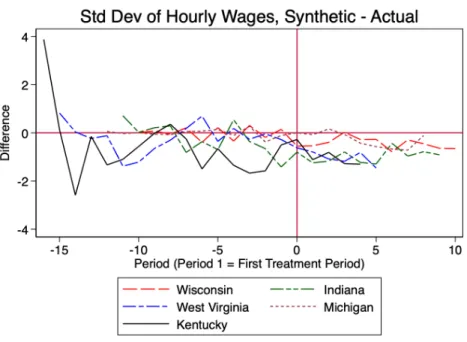
The union wage premium results show no broad trend across states, but there is evidence of an effect in Indiana and Wisconsin. For both total employment and the unemployment rate, all synthetic counterfactuals are constructed using states as the donor unit. There are no broad trends emerging from any of these figures, indicating that RTW likely does not have an independent effect on either of these variables.
These results suggest that, in general, RTW does not have a detectable effect on a state's employment as some proponents of RTW claim. I include two analyzes from Wisconsin, one with 2011 as the treatment period (when Act 10 was enacted) and one with 2015 as the treatment period (when RTW was enacted). Here, the donor pool consists of non-RTW states for all states examined, as the union election data is aggregated at the state level.
Indiana, West Virginia, and Kentucky appear to show that RTW had little effect on union elections after period 1, as the estimated treatment effects appear to converge around zero over several periods. Using 2015 as the first treatment period, Wisconsin exhibits negative estimated treatment effects for two periods before declining toward zero. While Wisconsin with 2011 as the first treatment period and Michigan appear to have large negative multiyear effects, the difference between each state and its synthetic counterfactual in the treatment period cautions against drawing conclusions from these results.
A Brief Examination of Missouri – Does RTW Have a Truly Independent Effect?
Thus, Missouri's results are inconsistent with previous findings that RTW reduces union coverage in a state and with the suggestive evidence that RTW reduces average hourly wages. Missouri's estimates for union coverage are statistically significant at the 5% level, but no other estimates are. Thus, it appears that reintegration has an independent effect on union coverage in a state and may also have an independent effect on average hourly wages.
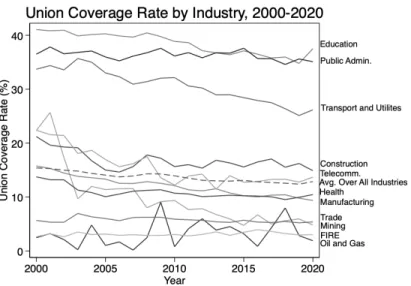
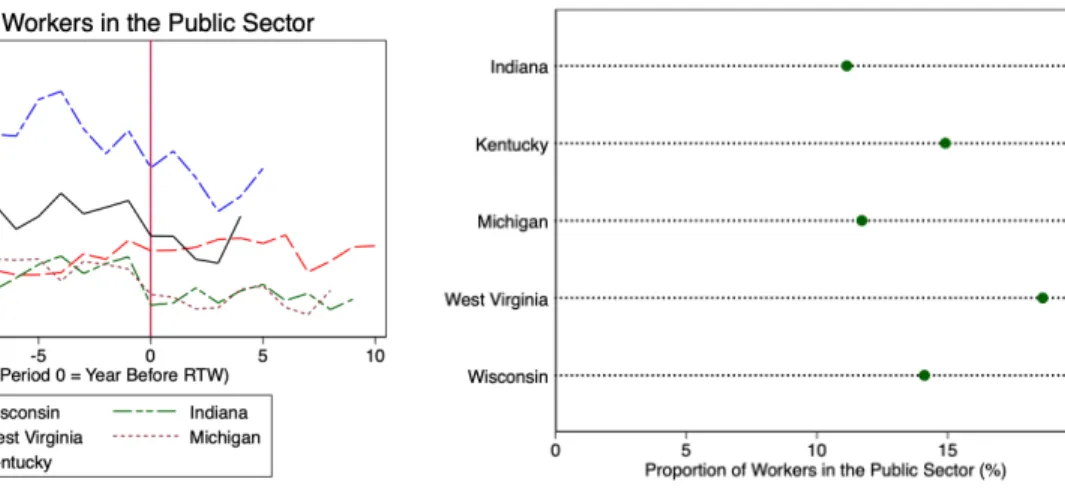
First, it appears that reintegration has a greater effect on union coverage in a state when the number of public sector unions is high and the state has a relatively large public sector. So it seems that the share of public sector employees can help explain the differences. in the effects of RTW on overall union coverage in each state. At the time Act 10 was passed, Wisconsin had high public union coverage and a moderate public sector compared to the other five states.
At the time of RTW passage, West Virginia had moderate public union coverage and a large public sector. Another factor that could help explain the differences in the effect of reintegration on union coverage is the response of local unions. This is another possible explanation for why there are differences in the estimated effects of reintegration on union coverage in a state.
These include industrial composition, size of the public sector, level of union coverage, and average education at the time of RTW adoption. Synthetic control methods provide evidence that RTW has a negative effect on important state-level variables that policymakers should consider—the degree of union coverage, average hourly rates, and average hourly wages of nonunion workers. RTW appears to have an independent effect on state union coverage rates only if the law is enacted.
Given the estimated effects of RTW on union coverage rates, there is considerable heterogeneity across states. The heterogeneity in the size of RTW's effect on the union coverage rate is likely due to the size of the state's public sector and its public sector union coverage rate.

Covariate Matching Details
Robustness Checks Figures
2015 is the first processing period for Wisconsin because that is the year Wisconsin passed the RTW covering the non-public sector.