Statistical and Numerical Methods for Chemical Engineers
Part on Statistics
Lukas Meier, ETH Zürich
Lecture Notes of W. Stahel (ETH Zürich) and A. Ruckstuhl (ZHAW)
November 2014
Contents
1 Preliminary Remarks 1
2 Summary of Linear Regression 3
2.1 Simple Linear Regression . . . 3
2.2 Multiple Linear Regression . . . 4
2.3 Residual Analysis . . . 6
3 Nonlinear Regression 8 3.1 Introduction . . . 8
3.2 Parameter Estimation . . . 12
3.3 Approximate Tests and Confidence Intervals . . . 16
3.4 More Precise Tests and Confidence Intervals . . . 20
3.5 Profile t-Plot and Profile Traces . . . 22
3.6 Parameter Transformations . . . 24
3.7 Forecasts and Calibration . . . 29
3.8 Closing Comments . . . 32
4 Analysis of Variance and Design of Experiments 34 4.1 Multiple Groups, One-Way ANOVA . . . 34
4.2 Random Effects, Ring Trials . . . 35
4.3 Two and More Factors . . . 36
4.4 Response Surface Methods . . . 37
4.5 Second-Order Response Surfaces . . . 42
4.6 Experimental Designs, Robust Designs . . . 46
4.7 Further Reading . . . 46
5 Multivariate Analysis of Spectra 48 5.1 Introduction . . . 48
5.2 Multivariate Statistics: Basics . . . 49
5.3 Principal Component Analysis (PCA) . . . 51
5.4 Linear Mixing Models, Factor Analysis . . . 56
5.5 Regression with Many Predictors . . . 56
I
1 Preliminary Remarks
a Several types of problems lead to statistical models that are highly relevant for chemical engineers:
• A response variable like yield or quality of a product or the duration of a pro- duction process may be influenced by a number of variables – plausible examples are temperature, pressure, humidity, properties of the input material (educts).
– In a first step, we need a model for describing the relations. This leads to regression and analysis of variance models. Quite often, simple or multiplelinear regression already give good results.
– Optimization of production processes: If the relations are modelled adequately, it is straightforward to search for those values of the variables that drive the response variable to an optimal value. Methods to efficiently find these optimum values are discussed under the label of design of ex- periments.
• Chemical processes develop according to clear laws (“law and order of chemical change”, Swinbourne, 1971), which are typically modelled by differential equa- tions. In these systems there are constants, like the reaction rates, which can be determined from data of suitable experiments. In the simplest cases this leads to linear regression, but usually, the methods of non-linear regression, possibly combined with the numerical solution of differential equations, are needed. We call this combination system analysis.
• As an efficient surrogate for chemical determination of concentrations of different compounds, indirect determination by spectroscopical measurements are often suitable. Methods that allow for inferring amounts or concentrations of chemical compounds from spectra belong to the field of multivariate statistics.
b In the very limited time available in this course we will present an introduction to these topics. We start with linear regression, a topic you should already be familiar with. The simple linear regression model is used to recall basic statistical notions. The following steps are common for statistical methods:
1. State the scientific question and characterize the data which are available or will be obtained.
2. Find a suitable probability model that corresponds to the knowledge about the processes leading to the data. Typically, a few unknown constants remain, which we call “parameters” and which we want to learn from the data. The model can (and should) be formulated before the data is available.
3. The field of statistics encompasses the methods that bridge the gap between models and data. Regarding parameter values, statistics answers the following questions:
a) Which value is the most plausible one for a parameter? The answer is given by estimation. An estimator is a function that determines a parameter value from the data.
b) Is a given value for the parameter plausible? The decision is made by using
1
a statisticaltest.
c) Which values are plausible? The answer is given by a set of all plausible values, which is usually an interval, the so calledconfidence interval.
4. In many applications the prediction of measurements (observations) that are not yet available is of interest.
c Linear regression was already discussed in “Grundlagen der Mathematik II”. Please have a look at your notes to (again) get familiar with the topic.
You find additional material for this part of the course on
http://stat.ethz.ch/˜meier/teaching/cheming
2 Summary of Linear Regression
2.1 Simple Linear Regression
a Assume we have n observations (xi, Yi), i = 1, . . . , n and we want to model the relationship between a response variable Y and a predictor variable x.
Thesimple linear regression modelis
Yi=α+βxi+Ei, i= 1, . . . , n.
The xi’s are fixed numbers while the Ei’s are random, called “random deviations” or
“random errors”. Usual assumptions are
Ei∼N(0,σ2), Ei independent.
The parameters of the simple linear regression model are the coefficients α,β and the standard deviation σ of the random error.
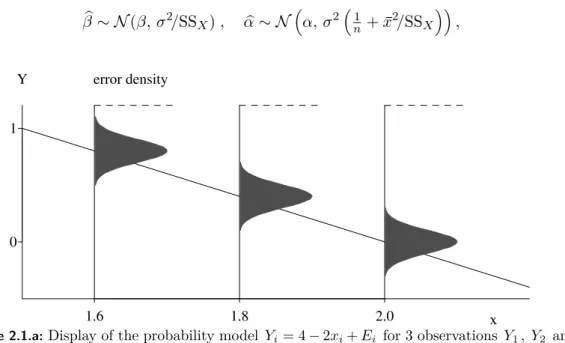
Figure 2.1.a illustrates the model.
b Estimation of the coefficientsfollows the principle of least squaresand yields β�= �ni=1(Yi−Y)(xi−x)
�n
i=1(xi−x)2 , α�=Y −β�x .
The estimates β� and α� fluctuate around the true (but unknown) parameters. More precisely, the estimates are normally distributed,
β�∼N(β,σ2/SSX), α�∼N�α,σ2�n1 +x2/SSX
��,
1.6 1.8 2.0
0 1
x
Y error density
Figure 2.1.a:Display of the probability model Yi= 4−2xi+Ei for 3 observations Y1, Y2 and Y3 corresponding to the x values x1= 1.6, x2= 1.8 and x3= 2.
3
4 2 Summary of Linear Regression
where SSX =�ni=1(xi−x)2.
c The deviations of the observed Yi from the fitted values y�i = α�+βx� i are called residuals Ri =Yi−y�i and are “estimators” of the random errors Ei.
They lead to an estimate of the standard deviation σ of the error,
�
σ2 = 1 n−2
�n i=1
R2i .
d Testof the null hypothesis β =β0: The test statistic T = β�−β0
se(β)� , se(β�) =�σ�2/SSX
has a t-distribution with n−2 degrees of freedom under the null-hypothesis.
This leads to the confidence interval of
β�±q0.975tn−2 se(β).�
e The “confidence band” for the value of the regression function connects the end points of the confidence intervals for E(Y |x) =α+βx.
Aprediction intervalshall include a (yet unknown) value Y0 of the response variable for a given x0 – with a given “statistical certainty” (usually 95%). Connecting the end points for all possible x0 produces the “prediction band”.
2.2 Multiple Linear Regression
a Compared to the simple linear regression model we now have several predictors x(1), . . . , x(m).
The multiple linear regression modelis
Yi = β0+β1x(1)i +β2x(2)i +...+βmx(m)i +Ei Ei ∼ N(0,σ2), Ei independent.
In matrix notation:
Y = Xβ+E , E∼Nn(0,σ2I),
where the response vector Y ∈ Rn, the design matrix X ∈ Rn×p, the parameter vector β∈Rp and the error vector E ∈Rn for p=m+ 1 (number of parameters).
Y =
Y1 Y2 ...
Yn
, X =
1 x(1)1 x(2)1 . . . x(m)1 1 x(1)2 x(2)2 . . . x(m)2 ... ... ... ... ...
1 x(1)n x(2)n . . . x(m)n
, β=
β0 β1 ...
βm
, E=
E1 E2 ...
En
. Different rows of the design matrix X are different observations. The variables (pre- dictors) can be found in the corresponding columns.
2.2 Multiple Linear Regression 5
b Estimation is again based on least squares, leading to β�= (XTX)−1XTY , i.e. we have a closed form solution.
From the distribution of the estimated coefficients, β�j ∼N
�
βj,σ2�(XTX)−1�
jj
�
t-tests and confidence intervals for individual coefficients can be derived as in the linear regression model. The test statistic
T = β�j−βj,0
se(β�j) , se(β�j) =�σ�2�(XTX)−1�
jj
follows a t-distribution with n−(m+ 1) parameters under the null-hypothesis H0 : βj =βj,0.
The standard deviation σ is estimated by
�
σ2= 1 n−p
�n i=1
R2i.
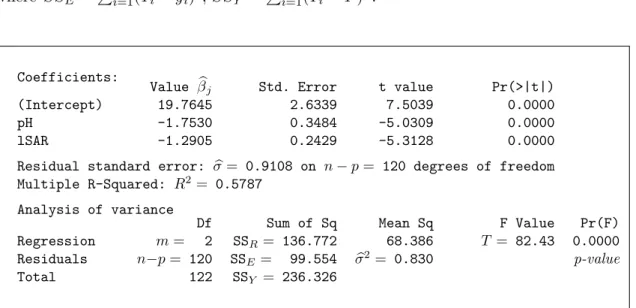
c Table 2.2.c shows a typical computer output, annotated with the corresponding mathematical symbols.
Themultiple correlation R is the correlation between the fitted values y�i and the observed values Yi. Its square measures the portion of the variance of the Yi’s that is
“explained by the regression”, and is therefore calledcoefficient of determination:
R2 = 1−SSE/SSY, where SSE =�ni=1(Yi−y�i)2, SSY =�ni=1(Yi−Y)2.
Coefficients: Value β�j Std. Error t value Pr(>|t|)
(Intercept) 19.7645 2.6339 7.5039 0.0000
pH -1.7530 0.3484 -5.0309 0.0000
lSAR -1.2905 0.2429 -5.3128 0.0000
Residual standard error: σ�= 0.9108 on n−p= 120 degrees of freedom Multiple R-Squared: R2= 0.5787
Analysis of variance
Df Sum of Sq Mean Sq F Value Pr(F) Regression m= 2 SSR= 136.772 68.386 T = 82.43 0.0000 Residuals n−p= 120 SSE= 99.554 σ�2= 0.830 p-value
Total 122 SSY = 236.326
Table 2.2.c:Computer output for a regression example, annotated with mathematical symbols.
d
6 2 Summary of Linear Regression The model is called linear because it is linear in the parameters β0, . . . ,βm. It could well be that some predictors are non-linear functions of other predictors (e.g., x(2) = (x(1))2). It is still a linear model as long as the parameters appear in linear form!
e In general, it is not appropriate to replace a multiple regression model by many simple regressions (on single predictor variables).
In a multiple linear regression model, the coefficients describe howY is changing when varying the corresponding predictor and keeping the other predictor variables constant. I.e., it is the effect of the predictor on the responseafter having subtracted the effect of all other predictors on Y. Hence we need to have all predictors in the model at the same time in order to estimate this effect.
f Many applications The model of multiple linear regression model is suitable for describing many different situations:
• Transformationsof the predictors (and the response variable) may turn origi- nally non-linear relations into linear ones.
• A comparison of two groups is obtained by using a binary predictor variable.
Several groups need a “block of dummy variables”. Thus, nominal (or cate- gorical) explanatory variablescan be used in the model and can be combined with continuous variables.
• The idea of different linear relations of the response with some predictors in different groups of data can be included into a single model. More generally,in- teractionsbetween explanatory variables can be incorporated by suitable terms in the model.
• Polynomial regression is a special case of multiple linear (!) regression (see example above).
g TheF-Test for comparison of modelsallows for testing whether several coefficients are zero. This is needed for testing whether a categorical variable has an influence on the response.
2.3 Residual Analysis
a The assumptions about the errors of the regression model can be split into
(a) their expected values are zero: E(Ei) = 0 (or: the regression function is correct),
(b) they have constant variance, Var(Ei) =σ2, (c) they arenormally distributed,
(d) they areindependent of each other.
These assumptions should be checked for
• deriving a better model based on deviations from it,
• justifying tests and confidence intervals.
Deviations are detected by inspecting graphical displays. Tests for assumptions play a less important role.
2.3 Residual Analysis 7
b Fitting a regression model without examining the residuals is a risky exer- cise!
c The following displays are useful:
(a) Non-linearities: Scatterplot of (unstandardized) residuals againstfitted values (Tukey-Anscombe plot)and against the (original)explanatory variables.
Interactions: Pseudo-threedimensional diagram of the (unstandardized) resid- uals against pairs of explanatory variables.
(b) Equal scatter: Scatterplot of (standardized) absolute residuals against fitted values (Tukey-Anscombe plot) and against (original) explanatory vari- ables. Usually no special displays are given, but scatter is examined in the plots for (a).
(c) Normal distribution: QQ-plot (or histogram) of (standardized) residuals.
(d) Independence: (unstandardized) residuals against time or location.
(e) Influential observations for the fit: Scatterplot of (standardized) residuals againstleverage.
Influential observations for individual coefficients: added-variable plot.
(f) Collinearities: Scatterplot matrix of explanatory variables and numerical out- put (of R2j or VIFj or “tolerance”).
d Remedies:
• Transformation (monotone non-linear) of the response: if the distribu- tion of the residuals is skewed, for non-linearities (if suitable) or unequal vari- ances.
• Transformation (non-linear) of explanatory variables: when seeing non- linearities, high leverages (can come from skewed distribution of explanatory variables) and interactions (may disappear when variables are transformed).
• Additional terms: to model non-linearities and interactions.
• Linear transformations of several explanatory variables: to avoid collinearities.
• Weighted regression: if variances are unequal.
• Checking the correctness of observations: for all outliers in any display.
• Rejection of outliers: if robust methods are not available (see below).
More advanced methods:
• Generalized least squares: to account for correlated random errors.
• Non-linear regression: if non-linearities are observed and transformations of vari- ables do not help or contradict a physically justified model.
• Robust regression: should always be used, suitable in the presence of outliers and/or long-tailed distributions.
Note that correlations among errors lead to wrong test results and confidence intervals which are most often too short.
3 Nonlinear Regression
3.1 Introduction
a The Regression Model Regression studies the relationship between a variable of interest Y and one or moreexplanatory or predictor variables x(j). The general model is
Yi =h(x(1)i , x(2)i , . . . , x(m)i ;θ1,θ2, . . . ,θp) +Ei.
Here, h is an appropriate function that depends on the predictor variables and pa- rameters, that we want to summarize with vectors x = [x(1)i , x(2)i , . . . , x(m)i ]T and θ = [θ1,θ2, . . . ,θp]T. We assume that the errors are all normally distributed and independent, i.e.
Ei∼N�0,σ2�, independent.
b The Linear Regression Model In (multiple) linear regression, we considered functions h that are linear in the parameters θj,
h(x(1)i , x(2)i , . . . , x(m)i ;θ1,θ2, . . . ,θp) =θ1x�(1)i +θ2x�(2)i +. . .+θpx�(p)i ,
where the x�(j) can be arbitrary functions of the original explanatory variables x(j). There, the parameters were usually denoted by βj instead of θj.
c The Nonlinear Regression Model In nonlinear regression, we use functions h that are not linear in the parameters. Often, such a function is derived from theory. In principle, there are unlimited possibilities for describing the deterministic part of the model. As we will see, this flexibility often means a greater effort to make statistical statements.
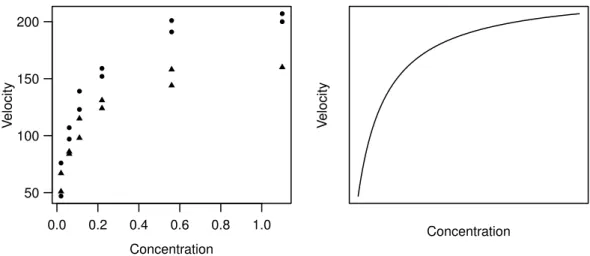
Example d Puromycin The speed of an enzymatic reaction depends on the concentration of a substrate. As outlined in Bates and Watts (1988), an experiment was performed to examine how a treatment of the enzyme with an additional substance called Puromycin influences the reaction speed. The initial speed of the reaction is chosen as the response variable, which is measured via radioactivity (the unit of the response variable is count/min2; the number of registrations on a Geiger counter per time period measures the quantity of the substance, and the reaction speed is proportional to the change per time unit).
The relationship of the variable of interest with the substrate concentrationx (in ppm) is described by the Michaelis-Menten function
h(x;θ) = θ1x θ2+x .
An infinitely large substrate concentration (x → ∞) leads to the “asymptotic” speed θ1. It was hypothesized that this parameter is influenced by the addition of Puromycin.
The experiment is therefore carried out once with the enzyme treated with Puromycin
8
3.1 Introduction 9
0.0 0.2 0.4 0.6 0.8 1.0 50
100 150 200
Concentration
Velocity
Concentration
Velocity
Figure 3.1.d:Puromycin. (a) Data (• treated enzyme; � untreated enzyme) and (b) typical shape of the regression function.
1 2 3 4 5 6 7
8 10 12 14 16 18 20
Days
Oxygen Demand
Days
Oxygen Demand
Figure 3.1.e:Biochemical Oxygen Demand. (a) Data and (b) typical shape of the regression function.
and once with the untreated enzyme. Figure 3.1.d shows the data and the shape of the regression function. In this section only the data of the treated enzyme is used.
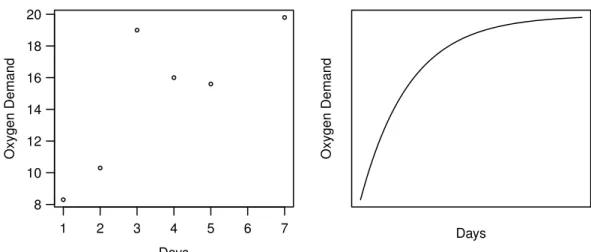
Example e Biochemical Oxygen DemandTo determine the biochemical oxygen demand, stream water samples were enriched with soluble organic matter, with inorganic nutrients and with dissolved oxygen, and subdivided into bottles (Marske, 1967, see Bates and Watts, 1988). Each bottle was inoculated with a mixed culture of microorganisms, sealed and put in a climate chamber with constant temperature. The bottles were periodically opened and their dissolved oxygen concentration was analyzed, from which the biochemical oxygen demand [mg/l] was calculated. The model used to connect the cumulative biochemical oxygen demand Y with the incubation time x is based on exponential decay:
h(x;θ) =θ1�1−e−θ2x�.
Figure 3.1.e shows the data and the shape of the regression function.
10 3 Nonlinear Regression
2 4 6 8 10 12
160 161 162 163
x (=pH)
y (= chem. shift)
(a)
x
y
(b)
Figure 3.1.f:Membrane Separation Technology. (a) Data and (b) a typical shape of the regres- sion function.
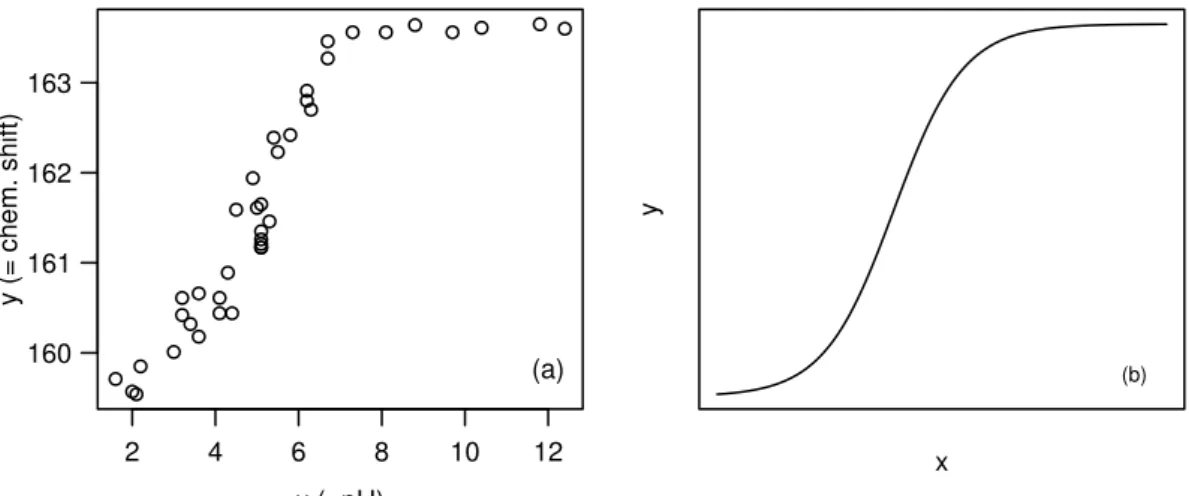
Example f Membrane Separation TechnologySee Rapold-Nydegger (1994). The ratio of proto- nated to deprotonated carboxyl groups in the pores of cellulose membranes depends on the pH-value x of the outer solution. The protonation of the carboxyl carbon atoms can be captured with 13C-NMR. We assume that the relationship can be written with the extended “Henderson-Hasselbach Equation” for polyelectrolytes
log10�θ1−y y−θ2
� =θ3+θ4x ,
where the unknown parameters are θ1,θ2 and θ3>0 and θ4 <0. Solving for y leads to the model
Yi =h(xi;θ) +Ei = θ1+θ210θ3+θ4xi 1 + 10θ3+θ4xi +Ei .
The regression function h(xi,θ) for a reasonably chosen θ is shown in Figure 3.1.f next to the data.
g A Few Further Examples of Nonlinear Regression Functions
• Hill model (enzyme kinetics): h(xi,θ) =θ1xθi3/(θ2+xθi3)
For θ3 = 1 this is also known as the Michaelis-Menten model (3.1.d).
• Mitscherlich function (growth analysis): h(xi,θ) =θ1+θ2exp(θ3xi).
• From kinetics (chemistry) we get the function
h(x(1)i , x(2)i ;θ) = exp(−θ1x(1)i exp(−θ2/x(2)i )).
• Cobbs-Douglas production function
h�x(1)i , x(2)i ;θ� =θ1 �x(1)i �θ2 �x(2)i �θ3.
Since useful regression functions are often derived from the theoretical background of the application of interest, a general overview of nonlinear regression functions is of very limited benefit. A compilation of functions from publications can be found in Appendix 7 of Bates and Watts (1988).
h Linearizable Regression Functions Some nonlinear regression functions can be lin- earized by transformations of the response variable and the explanatory variables.
3.1 Introduction 11
For example, a power function
h(x;θ) =θ1xθ2
can be transformed to a linear (in the parameters!) function ln(h(x;θ)) = ln(θ1) +θ2ln(x) =β0+β1x ,�
where β0 = ln(θ1), β1 = θ2 and x� = ln(x). We call the regression function h linearizable, if we can transform it into a function that is linear in the (unknown) parameters by (monotone) transformations of the arguments and the response.
Here are some more linearizable functions (see also Daniel and Wood, 1980):
h(x;θ) = 1/(θ1+θ2exp(−x)) ←→ 1/h(x;θ) =θ1+θ2exp(−x) h(x;θ) =θ1x/(θ2+x) ←→ 1/h(x;θ) = 1/θ1+θ2/θ11
x
h(x;θ) =θ1xθ2 ←→ ln(h(x;θ)) = ln(θ1) +θ2ln(x) h(x;θ) =θ1exp(θ2g(x)) ←→ ln(h(x;θ)) = ln(θ1) +θ2g(x)
h(x;θ) = exp(−θ1x(1)exp(−θ2/x(2))) ←→ ln(ln(h(x;θ))) = ln(−θ1) + ln(x(1))−θ2/x(2) h(x;θ) =θ1 �
x(1)�θ2 � x(2)�θ3
←→ ln(h(x;θ)) = ln(θ1) +θ2 ln(x(1)) +θ3 ln(x(2)).
The last one is the Cobbs-Douglas Model from 3.1.g.
i A linear regression with the linearized regression function of the example above is based on the model
ln(Yi) =β0+β1x�i+Ei,
where the random errors Ei all have the same normal distribution. We transform this model back and get
Yi =θ1·xθ2 ·E�i,
with E�i = exp(Ei). The errors E�i, i= 1, . . . , n, now have a multiplicative effect and are log-normally distributed! The assumptions about the random deviations are thus now drastically different than for a model that is based directly on h,
Yi =θ1·xθ2 +Ei∗,
with random deviations Ei∗ that, as usual, contribute additively and have a specific normal distribution.
A linearization of the regression function is therefore advisable only if the assumptions about the random errors can be better satisfied – in our example, if the errors actually act multiplicatively rather than additively and are log-normally rather than normally distributed. These assumptions must be checked with residual analysis.
j *Note: For linear regression it can be shown that the variance can be stabilized with certain trans- formations (e.g. log(·),√
·). If this is not possible, in certain circumstances one can also perform a weighted linear regression. The process is analogous in nonlinear regression.
12 3 Nonlinear Regression k We have almost exclusively seen regression functions that only depend on one predictor variable x. This was primarily because it was possible to graphically illustrate the model. The following theory also works well for regression functions h(x;θ) that depend on several predictor variables x= [x(1), x(2), . . . , x(m)].
3.2 Parameter Estimation
a The Principle of Least SquaresTo get estimates for the parameters θ= [θ1, θ2, . . ., θp]T, one applies – like in linear regression – the principle of least squares. The sum of the squared deviations
S(θ) :=�n
i=1
(yi−ηi(θ))2 where ηi(θ) :=h(xi;θ)
should be minimized. The notation that replaces h(xi;θ) with ηi(θ) is reasonable because [xi, yi] is given by the data and only the parametersθremain to be determined.
Unfortunately, the minimum of S(θ) and hence the estimator have no explicit solu- tion (in contrast to the linear regression case). Iterative numeric procedures are therefore needed. We will sketch the basic ideas of the most common algorithm. It is also the basis for the easiest way to derive tests and confidence intervals.
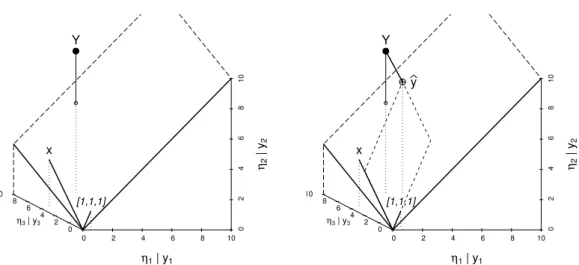
b Geometrical Illustration The observed values Y = [Y1, Y2, . . . , Yn]T define a point in n-dimensional space. The same holds true for the “model values” η(θ) = [η1(θ),η2(θ), . . . ,ηn(θ)]T for a given θ.
Please take note: In multivariate statistics where an observation consists of mvariables x(j), j= 1,2, . . . , m, it’s common to illustrate the observations in the m-dimensional space. Here, we consider the Y- and η-values of all n observations as points in the n-dimensional space.
Unfortunately, geometrical interpretation stops with three dimensions (and thus with three observations). Nevertheless, let us have a look at such a situation,first for simple linear regression.
c As stated above, the observed values Y = [Y1, Y2, Y3]T determine a point in three- dimensional space. For given parameters β0 = 5 andβ1 = 1 we can calculate the model values ηi�β�=β0+β1xi and represent the corresponding vector η�β�=β01 +β1x as a point. We now ask: Where are all the points that can be achieved by varying the parameters? These are the possible linear combinations of the two vectors 1 and x: they form a plane “spanned by 1 and x”. By estimating the parameters according to the principle of least squares, the squared distance between Y and η�β� is minimized. This means that we are looking for the point on the plane that is closest to Y . This is also called theprojection of Y onto the plane. The parameter values that correspond to this point η� are therefore the estimated parameter values β�= [β�0,β�1]T. An illustration can be found in Figure 3.2.c.
d Now we want to fit a nonlinear function, e.g. h(x;θ) =θ1exp(1−θ2x), to the same three observations. We can again ask ourselves: Where are all the points η(θ) that can be achieved by varying the parameters θ1 and θ2? They lie on a two-dimensional curvedsurface (called themodel surfacein the following) in three-dimensional space.
The estimation problem again consists offinding the point η�on the model surface that is closest to Y. The parameter values that correspond to this point η� are then the
3.2 Parameter Estimation 13
0 2 4 6 8 10 0 2 4 6 810 2 0
6 4 10 8
η1 | y1
η2 | y2
η3 | y3
Y
[1,1,1]
x
0 2 4 6 8 10 0 2 4 6 810 2 0
6 4 10 8
η1 | y1
η2 | y2
η3 | y3
Y
[1,1,1]
x
y
Figure 3.2.c:Illustration of simple linear regression. Values of η�
β� = β0+β1x for varying parameters [β0,β1] lead to a plane in three-dimensional space. The right plot also shows the point on the surface that is closest to Y = [Y1, Y2, Y3]. It is thefitted valuey�and determines the estimated parameters β�.
estimated parameter values θ�= [θ�1,θ�2]T. Figure Figure 3.2.d illustrates the nonlinear case.
5 6 7 8 9 10 11
101214161820
19 18 21 20 22
η1 | y1
η2 | y2
η3 | y3
− Y
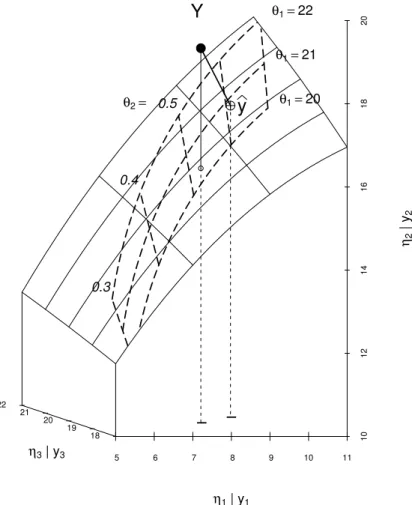
Figure 3.2.d:Geometrical illustration of nonlinear regression. The values of η(θ) =h(x;θ1,θ2) for varying parameters [θ1,θ2] lead to a two-dimensional “model surface” in three-dimensional space. The lines on the model surface correspond to constant η1 and η3, respectively.
14 3 Nonlinear Regression e Biochemical Oxygen Demand (cont’d) The situation for our Biochemical Oxygen Demand example can be found in Figure 3.2.e. Basically, we can read the estimated parameters directly offthe graph here: θ�1 is a bit less than 21 and θ�2 is a bit larger than 0.6. In fact the (exact) solution is θ�= [20.82,0.6103] (note that these are the parameter estimates for the reduced data set only consisting of three observations).
5 6 7 8 9 10 11
101214161820
19 18 21 20 22
η1 | y1
η2 | y2
η3 | y3
− Y
θ1=20 θ1=21 θ1=22
0.3 0.4
θ2= 0.5
− y
Figure 3.2.e:Biochemical Oxygen Demand: Geometrical illustration of nonlinear regression.
In addition, we can see here the lines of constant θ1 and θ2, respectively. The vector of the estimated model values y�=h�
x;�
is the point on the model surface that is closest to Y. f Approach for the Minimization Problem The main idea of the usual algorithm for
minimizing the sum of squares (see 3.2.a) is as follows: If a preliminary best value θ(�) exists, we approximate the model surface with the plane that touches the surface at the point η�θ(�)�=h�x;θ(�)� (the so called tangent plane). Now, we are looking for the point on that plane that lies closest to Y . This is the same as estimation in a linear regression problem. This new point lies on the plane, but not on the surface that corresponds to the nonlinear problem. However, it determines a parameter vector θ(�+1) that we use as starting value for the next iteration.
g Linear Approximation To determine the tangent plane we need the partial derivatives A(j)i (θ) := ∂ηi(θ)
∂θj ,
that can be summarized by an n×p matrix A. The approximation of the model
3.2 Parameter Estimation 15
surface η(θ) by the tangent plane at a parameter value θ∗ is
ηi(θ)≈ηi(θ∗) +A(1)i (θ∗) (θ1−θ1∗) +...+A(p)i (θ∗) (θp−θ∗p) or, in matrix notation,
η(θ)≈η(θ∗) +A(θ∗) (θ−θ∗). If we now add a random error, we get a linear regression model
Y� = A(θ∗)β+E
with “preliminary residuals” Y�i=Yi−ηi(θ∗) as response variable, the columns of A as predictors and the coefficients βj =θj−θj∗ (a model without intercept β0).
h Gauss-Newton Algorithm The Gauss-Newton algorithm starts with an initial value θ(0) for θ, solving the just introduced linear regression problem for θ∗ =θ(0) tofind a correction β and hence an improved value θ(1) =θ(0)+β. Again, the approximated model is calculated, and thus the “preliminary residuals” Y −η�θ(1)� and the partial derivatives A�θ(1)� are determined, leading to θ2. This iteration step is continued until the the correction β is small enough.
It can not be guaranteed that this procedure actuallyfinds the minimum of the sum of squares. The better the p-dimensional model surface can be locally approximated by a p-dimensional plane at the minimum θ�= (θ�1, . . . ,θ�p)T and the closer the initial value θ(0) is to the solution, the higher are the chances of finding the optimal value.
*Algorithms usually determine the derivative matrix A numerically. In more complex problems the numerical approximation can be insufficient and cause convergence problems. For such situations it is an advantage if explicit expressions for the partial derivatives can be used to determine the derivative matrix more reliably (see also Chapter 3.6).
i Initial Values An iterative procedure always requires an initial value. Good initial values help to find a solution more quickly and more reliably. Some possibilities to arrive at good initial values are now being presented.
j Initial Value from Prior Knowledge As already noted in the introduction, nonlinear models are often based on theoretical considerations of the corresponding application area. Already existingprior knowledgefrom similar experiments can be used to get an initial value. To ensure the quality of the chosen initial value, it is advisable to graphically represent the regression function h(x;θ) for various possible initial values θ=θ0 together with the data (e.g., as in Figure 3.2.k, right).
k Initial Values via Linearizable Regression Functions Often – because of the distri- bution of the error term – one is forced to use a nonlinear regression function even though it would be linearizable. However, the linearized model can be used to get initial values.
In the Puromycin example the regression function is linearizable: The reciprocal values of the two variables fulfill
� y= 1
y ≈ 1
h(x;θ) = 1 θ1 +θ2
θ1 1
x =β0+β1x .�
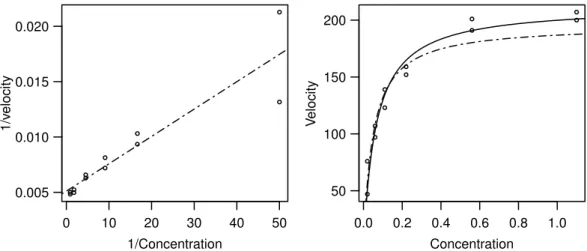
The least squares solution for this modified problem isβ�= [β�0,β�1]T = (0.00511,0.000247)T (Figure 3.2.k, left). This leads to the initial values
θ(0)1 = 1/β�0 = 196, θ(0)2 =β�1/β�0= 0.048.
16 3 Nonlinear Regression
0 10 20 30 40 50
0.005 0.010 0.015 0.020
1/Concentration
1/velocity
0.0 0.2 0.4 0.6 0.8 1.0 50
100 150 200
Concentration
Velocity
Figure 3.2.k:Puromycin. Left: Regression function in the linearized problem. Right: Regres- sion functionh(x;θ) for the initial valuesθ=θ(0) ( ) and for the least squares estimation θ=θ�(——–).
l Initial Values via Geometric Interpretation of the Parameter It is often helpful to consider the geometrical features of the regression function.
In the Puromycin Example we can derive an initial value in another way: θ1 is the response value forx=∞. Since the regression function is monotonically increasing, we can use the maximal yi-value or a visually determined “asymptotic value” θ1(0)= 207 as initial value for θ1. The parameter θ2 is the x-value, such that y reaches half of the asymptotic value θ1. This leads to θ(0)2 = 0.06.
The initial values thus result from a geometrical interpretation of the parameters and a rough estimate can be determined by “fitting by eye”.
Example m Membrane Separation Technology (cont’d)In the Membrane Separation Technology example we let x→ ∞, so h(x;θ) → θ1 (since θ4 <0); for x→ −∞, h(x;θ) → θ2. From Figure 3.1.f (a) we see that θ1 ≈163.7 and θ2 ≈159.5. Once we know θ1 and θ2, we can linearize the regression function by
�
y:= log10
�θ(0)1 −y y−θ2(0)
�
=θ3+θ4x .
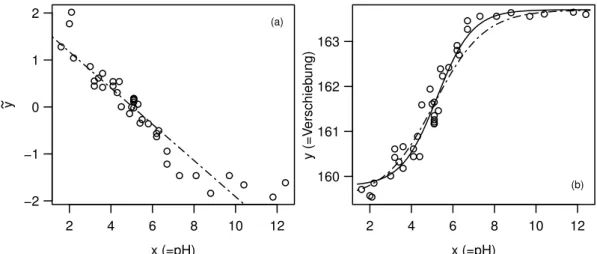
This is called aconditional linearizablefunction. The linear regression model leads to the initial value θ(0)3 = 1.83 and θ4(0)=−0.36.
With this initial value the algorithm converges to the solution θ�1 = 163.7, θ�2 = 159.8, θ�3 = 2.675 and θ�4 =−0.512. The functions h(·;θ(0)) and h(·;θ) are shown in Figure� 3.2.m (b).
*The property of conditional linearity of a function can also be useful to develop an algorithm specifically suited for this situation (see e.g. Bates and Watts, 1988).
3.3 Approximate Tests and Confidence Intervals
a The estimator θ� is the value of θ that optimally fits the data. We now ask which parameter values θ are compatible with the observations. The confidence region is the set of all these values. For an individual parameter θj the confidence region is a confidence interval.
3.3 Approximate Tests and Confidence Intervals 17
2 4 6 8 10 12
−2
−1 0 1 2
x (=pH)
y
(a)
2 4 6 8 10 12
160 161 162 163
x (=pH)
y (=Verschiebung)
(b)
Figure 3.2.m:Membrane Separation Technology. (a) Regression line that is used for deter- mining the initial values for θ3 and θ4. (b) Regression function h(x;θ) for the initial value θ=θ(0) ( ) and for the least squares estimator θ=θ�(——–).
The following results are based on the fact that the estimator θ�is asymptotically (mul- tivariate) normally distributed. For an individual parameter that leads to a “Z-Test”
and the corresponding confidence interval; for multiple parameters the corresponding Chi-Square test is used and leads to elliptical confidence regions.
b Theasymptotic propertiesof the estimator can be derived from the linear approx- imation. The problem of nonlinear regression is indeed approximately equal to the linear regression problem mentioned in 3.2.g
Y� = A(θ∗)β+E ,
if the parameter vector θ∗ that is used for the linearization is close to the solution. If the estimation procedure has converged (i.e.θ∗=θ), then� β = 0 (otherwise this would not be the solution). The standard error of the coefficients β� – or more generally the covariance matrix of β� – then approximate the corresponding values of θ.�
c Asymptotic Distribution of the Least Squares Estimator It follows that the least squares estimator θ� is asymptotically normally distributed
θ�as.∼ N(θ,V (θ)),
with asymptotic covariance matrix V (θ) = σ2(A(θ)T A(θ))−1, where A(θ) is the n×p matrix of partial derivatives (see 3.2.g).
To explicitly determine the covariance matrixV(θ), A(θ) is calculated using θ�instead of the unknown θ. For the error variance σ2 we plug-in the usual estimator
V�(θ) =σ�2
�
A��T A���
−1
where
σ�2= S(θ)�
n−p = 1 n−p
�n i=1
�yi−ηi�θ�� �2.
Hence, the distribution of the estimated parameters is approximately determined and we can (like in linear regression) derive standard errors and confidence intervals, or confidence ellipses (or ellipsoids) if multiple variables are considered jointly.
![Figure 3.2.d: Geometrical illustration of nonlinear regression. The values of η (θ) = h(x; θ 1 , θ 2 ) for varying parameters [θ 1 , θ 2 ] lead to a two-dimensional “model surface” in three-dimensional space](https://thumb-ap.123doks.com/thumbv2/123dok/11958321.0/15.892.265.683.561.1071/figure-geometrical-illustration-nonlinear-regression-parameters-dimensional-dimensional.webp)