Education
2018-1-TR01-KA204-059285
EFFECTIVE TIME MANAGEMENT IN PERSONAL
DEVELOPMENT
ii
CONTENTS
LEARNING OBJECTIVES “Effective Time Management In Personal Development”……..…..3
INTRODUCTION………..4
1. BASIC INFORMATION AND CONCEPTS ABOUT TIME MANAGEMENT………...5
1.1.Time and Time Concept ... 5
1.2.Time Types ... 6
2. TIME MANAGEMENT CONCEPT AND APPROACHES……….8
2.1.Time Management Concept ... 8
2.2.Time Management Approaches ... 10
3. TIME TRAPS……….14
3.1.Time Traps Caused by Individual ... 15
3.2.Time Traps Causd by Exterior Reasons ... 19
3.3.Time Traps Caused by Organisational Reasons ... 20
3.4.Time Traps Caused by Mechanical Reasons ... 22
4. EFFECTIVE TIME TECHNIQUES………23
4.1.Methods that Enable Productive Usage of Time ... 23
4.2.Not Getting Caught in Time Trap and Points to be Considered to Use Time Effectively ... 23
4.3.Rules of Good Usage of Time ... 24
CONCLUSION………...25
REFERENCES………..26
TABLE OF FIGURES
Figure 1 : Process In Alan Lakein’s Time Management Definition ... 9Figure 2: Time Management Table ... 14
Figure 3: Delaying Reasons ... 16
3
LEARNING OBJECTIVES “Effective Time Management In Personal Development”
1. Actions/Achievements
Setting target, prioritisation and learning timing methods and techniques in order to overcome challenges of personal and occupational time management
2. Knowledge
Gets to have knowledge about time concept and types
Learns Time Management Approaches
Gets to have knowledge about time traps
Learns the Methods that Enables to Use Time Efficiently 3. Skills
Setting purpose and targets for effective time management
Classifies priorities by determining time traps
Determining short and long term time schedule
Determining emergency plan by evaluating time traps 4. Competences
Noticing the importance of time and time management in the individual
Managing the process by time perception
Noticing time obstructors, improving coping-with methods
Learning time management techniques
Improving personal time management
Carrying into action by effective and productive planning
5. Workload / Total Hours of Learning
2 hours
4
INTRODUCTION
There are various factors that affect people to be successful in their career and social lives nowadays. We ought to understand the importance of time since having the skill of good management of time is one of these factors.
Time is briefly described as ‘’the period that past, will pass or is passing within a work or formation’’. In fact time is a concept which we live in our daily lives and every moment however do not contemplate much about. Besides time is also the resource which is badly used and wasted in our lives. Therefore everyone must use time rationally. Because time is a resource that cannot be replaced, reversed, renewed, reproduced, stored and purchased.
It is obligatory to manage time in order to use it efficiently and productively.
Nowadays which is described as information age, every person, every society, every company and every manager mostly complains about timelessness or shortness of time.
These mentioned people, societies and organisations -especially those who are in professional business life- are obliged to perform multiple jobs within limited duration. Thus, time management subject has the most important place among personal development subjects.
For everyone who complains about lack of time, the Time Management training presents keys of making their times more valuable, being successful and effective in their jobs, by presenting sections from daily lives. Besides, improving knowledge and skills of participants about ‘’managing time effectively’’ in their business and social lives was aimed with this training.
5
1. BASIC INFORMATION AND CONCEPTS ABOUT TIME MANAGEMENT
Time management is one of the most complicated, most inextricable concepts that prepossesses both philosophers and scientists and has been discussed since 1950’s.
Some concepts, approaches and time managemenet tools about ‘’time management’’ concept has suggested which incorporates new concepts and modules, somehow connected with most of executive applications and even nested with them; that develops along with great developments within technology, information and communication fields in business and social life.
1.1. Time and Time Concept
Time as a word is renowned by everyone, however it is complicated to describe and tell it. Since time is a relative concept it is not possible to make a general and net description of it. Time is a quite important and unique scarce resource which everyone has got but does not use in the same way.
There has been many descriptions of time, of which some are listed below:
According to Newton "Time flows continuously in a single direction". And according to Einstein, " Time is a dimension that arrays events according to formation and gives meaning to events" (Boslough, 1990: 15).
"Time is an uniterrupted continuum of events coming to present from past and following each other towards future" (Smith, 1998: 24).
"Time is a part of human life that is measurable with hour which is long or short termed depending on location, impossible to renew, of which beginning and end is certain "
(Tezcan,1982: 7).
6
"Time is perception of consecutively lined up events and phenomenons. Time is a continuum that we can measure events. " (Açikalin, 1998: 113).
According to Voltaire time is a concept which “is the longest, the shortest, the slowest, the tiniest and the largest, the most neglected and the most remorsed of everything in the world; nothing can be done without it (Eroğlu ve Bayrak, 1994: 255)
And according to Passig (2005: 27) time is; felt but non-touchable, non reversable, the most important and at the same time hard to describe and intangible concept.
Time includes these features:
Time is more valuable than the most valuable things. Time is priceless and can not be replaced,
Time is a quite important and unique scarce resource which everyone has got but can not use in the same way.
Time is a resource that cannot be replaced, reversed, renewed, stored and purchased.
Time is non savable,
Time cannot be rented, purchased and borrowed,
Time cannot be multiplied,
Time cannot be reversed,
Time can only be used and consumed,
Time ise perceived and evaluated differently according to individuals, physical environment and events.
1.2. Time Types
Real Time (Objective Time)
It is the time that clock shows. It is the time which does not change according to individual, is objective and accepted by everyone and determined according to physical incidents. It is the type of time that can be measured and observed. Can be measured via a time unit and underlines clock time. Real time has been digitised based on physical events such as the movements of moon and sun. Even though one hour period is perceived differently by individuals, the period is unchanging and constant. Therefore clock time reflects common reality. This time concept is constant for all individuals and happens in the same way.
7
Perceived Time (Subjective Time)
It is the time that individual psychologically feels. It can be evaluated as shorter or longer than that of real time. When individual gets bored, he/she feels like time passes too slowly. And when individual enjoys the moment he/she is living, time passes quickly. It is the time type that every living being psychologically perceives, without depending on the real time. Perceived time may differ according to individual, circumstance. It is situational and depends on subjective reality.
Psychological perception of time can be shorter than the real time when; individual is happy and can be longer than the real time when he/she is unhappy. In this case, theory of relativity improved by Einstein, enables us to think about connection between concept of time and place. Even though it is known that every hour includes exactly sixty minutes and every minute includes sixty seconds, everyone might perceive these periods differently. Sometimes we cannot notice how time passes, and sometimes time passes faster or slower than we think; because time has psychology of its own.
Biological (instinctive) Time
It is the time that human body feels physically. It is established based on habits.
Biological time must be considered in order to increase cost and ensure outturn. It is the time that body is dependant on its own physical program. For example; birds knowing the season of migration, animals knowing the time of hibernation. Some plants blossom or drop leaves according to their biological hours, not depending to day and night or hot and cold. The factor that makes all these automatic behaviors done, is biological time. Biological time is the rythm that is based on unique to individuals’ features, natal and enables to protect inner balances. For example; it is accepted that every living being has a ‘’body clock’’ that regulates its live. It is quite important to consider this rythm, performing important works when performance is at peak and leaving unimportant ones for later, in terms of using time effectively.
8
Economic Time
From the point of establishment, time is the total of time periods spent for a certain product. Economically time is a real measure unit.
Wage which is equivalant of labour, is calculated on hour, day, week or month.
Interest payment is performed by considering certain time period.
From the point of establishment, time in terms of total of periods spent for a certain production, is productivity gauge.
Time is an organisational editing tool in institutions, also in terms of executive processes such as arrangement of working hours, continuing to work ratios.
Executive Time
It is the time type that managers use to perform management processes. In other words, the time that managers at all levels reserve for executive Works, is considered within executive time concept. Management Processes are divided as Making Decision/Planning, Organizing, Guiding (Giving order), Coordination, Inspection.
Besides, time in management is one of most scarce -may be first of all- resources.
Such that, management has the responsibility to effectively use management processes in order to achieve certain goals.
2. TIME MANAGEMENT CONCEPT AND APPROACHES
2.1. Time Management ConceptTime management concept has come into view in 1970s and starting from 1980s, time has been perceived as a resource to be managed and researched. Time management had born in Denmark as a training tool in order to help managers with busy schedule to organise their time much better, and spread across the world.
And at the present which is described as information age, it has become one of the most important factors of success especially in professional business life.
Although there is no consensus about definition of time management conpcept; the definition that A. Lakein suggested in his 1973 dated work
“How to Get Control of your Time and Life”, of which many authors have taken as reference and is one of the earliest definitions, is as below:
“Time management includes; describing needs, describing goals that meets these needs, priority queuing the required duties and making these
duties compatible with time and resources by putting them in planning, listing and time program. ”. If we assume that this definition studies actions that constitute the frame of time management, arrangement as follows might be formed:
9 Figure 1: Process in Alan Lakein’s time management definition
Source: Stephen R. Covey, a.g.e., s.169-181
When examining other definitions of time management; time management means planning our time according to the ability to carry out activities including our goals, our responsibilities, our pleasures and our social life all together. Purpose of time management is to increase quality of activities conducted within limited time, not to increase the limited time itself. In other words, it is efficient and productive usage of all resources in order to finish works and actions that leads to goals, within a certain period of time. Time management can be briefly defined as planning of what sort of things can be done within existing time.
Usage and management of time nowadays, is quite important for individuals. Time management is in fact our self management. It is establishing control of events we experience and management of them. How much of the events that we live happens according to our will? How much of them do we determine to happen?
What is our effects on happening of events? Answers of all these questions indicates to our success on the management of our time. For this reason managing time is, in some way, managing ourselves and gaining control of our lives.
Describing Needs
Describing goals that meets
these needs
Priority queuing the required duties
Making duties compatible with
time
10 2.2. Time Management Approaches
Time management has been an important concept, subject and manner of rule that entered into literature of management science and public administration in the recent years. For this reason there are various time management approaches. These approaches are as follows:
Get A Grip on Yourself Approach (Order): This approach argues that most of problems in time management originates from disorder in our lives. The main problem in this approach is planlessness and untidiness. Often we cannot find what we seek when we seek. Some things consistently get lost in the shuffle. The solution is installing a good system. This approach focuses on arrangement in three fields. These fields are arrangement of objects (keys, files, paper cabinets etc.), arrangement of duties (queuing and putting in order of works to be done, from simplest to the complicated) and arrangement of humans (such as defining works that everybody can do, delegate and installing tracking system about activities). There are strong and weak sides of this approach.
-Strong Sides: This approach saves us time and makes us more productive. We do not waste time searching objects (such as keys, clothes or missing reports). We do not waste our efforts. Arrangement illuminates and makes tidiness.
-Weak Sides: Arrangement becomes a tool itself, rather than being a tool for greater purposes. This is the dangerous one. Most part of time is spent for planning rather than production. Most of people think they are doing their jobs while strive with plans. But in fact they delay. When gone too far, planning power turns into weakness. We might become over settled, hair splitting, away from elasticity and mechanical.
Warrior Approach (Survival and Independent Production): In this approach individual focuses on protection of the time spared for him/her and production.
According to this approach time flies by in the day. For this reason individual cannot be efficient and productive. Main theme argues focusing on regulating time stealing environment and objects in life. This approach includes isolation (unavailable for unnecessary communication, using secretary, answer phone etc.), being alone (preferring lonesome environment to not get disturbed) and delegation (distributing one’s duties to others in order not to get overwhelmed in details and sparing time for better works). This approach is human – being under pace and pressure of life, job environment - gaining habit of doing works according to priority, rather than separating them as important and unimportant. Warrior approach is eliminating traps. The individual fighting against time, tries to eliminate traps. Hence, warrior approach focuses on self protection, claiming time in order to work sufficiently efficient and independent. There are strong and weak sides of this approach.
-Strong Sides: The strong side of this approach is depending on personally undertaking the responsibility of our time. We can be creative and productive when there is a time that is queit, away from disturbing factors, in order to work productively and independently. Time to time everyone requires such type of a time when they start a creative work.
-Weak Sides: This approach, basically, regards others as enemy. Looks out for survival. For individuals depends on understanding “before they become a time trap for you, you become one for them”. It is a survival struggle approach. There are isolation, digestion and limitation ideas.
11
Target Approach (Success): This approach is based on know what you want and make an effort to success. Individual must know where to go, plan his/her targets. Targets need to be planned as long, middle and short termed. It also contains techniques such as target distorting, visualizing, self motivation and creating a positive mentality. There are strong and weak sides of this approach.
-Strong Sides: This is the approach of those who performed performance worldwide and olympic athletes. It is the performance surpassing power of individuals with less talents, of much more talented ones; willing compensate, meaning organising forces, intensifying energy, not letting an obstacle intervene. It is a known fact that individuals and institutions who set targets in front of them are more successful.
-Weak Sides: There are countless people who use Target Approach to climb success ladder. They set the targets and make an extraordinary effort to achieve them. However when they achieve what they want, they witness that this does not bring the outcome they expected. Thus there might be disappointment. If targets are not based on principles and basic needs, achieved target take away somethings from personality.
ABC Approach (Putting Priorities in Order and Defining Values): This approach is based on the idea of putting priorities in order and defining values. Putting priorities in order is important. The most important and urgent works should be put forward, and put in order according to value order. This approach states that "You can do whatever you want, however you can’t do everything". These are the main principles of ABC approach: first of all focus your efforts on your most important works. There are weak and strong sides of this approach.
-Strong Sides: ABC Approach is the traditional "priority for important works"
approach. It provides order and consecutiveness. This approach ensures to understand the difference between to do works and and the highest priority missions.
12 -Weak Sides: Its primary dilusion is ignoring the fact that principles and natural laws determines the quality of life, clarifying the values. This negligence often causes people to adopt principles contradictory with laws of nature and follow them. These values only cause the feeling of obstructedness and failure.
Magical Tool Approach (Technology):In this approach “good works are done by good tools” rule is followed and thus it is important to choose the correct tool.
Good usage of system and technological tools and correct tool choice provides saving on time. This approach is based on the assumption that correct tool (correct calendar, correct planning, correct computer program, correct computer) gives us the power of creating the quality of life. These tools indeed help us to watch priorities, plan our works and easily access information.
-Strong Sides: Without doubt effective usage of tools is quite important.
Correct tool enables to do the works within shorter period of time and more efficiently. Improvement of technological devices is only performed to finish the works within shorter period of time and more efficiently.
-Weak Sides: Assumption of the correct tool (Technology) is the answer for everything, is incorrect. Good tools are required for “doing works correctly” however good tools are not sufficient “for correct works”. This requires vission, mission, correct decision and strategy development skill. Even the most perfect tool cannot replace vision, creativity, calculating, character or competence. A huge camera does not create a huge photographer. And perfect planner does not create perfect life.
Time Management 101 Approach (Skill): This approach is based on the paradigm that basically time management is a skill such as accounting or wordprocessing and upholds that for the effective usage of time, individuals must possess certain skills. These skills are using a planner of appointment notebook, making correct decision, making to do list, defining target/goal, smart delegation, planning, putting priorities in order. According to this approach, these basic skills are creating a sort of social literacy which is required to be able to sustain life.
13 -Strong Sides: Excessive working might not be sufficient to become successful nowadays, even this will not be necessary most of the time. Working effectively is required instead of this. And effective working can be only possible with knowledge and skill. Skill enables to finish works spending less energy and time.
-Weak Sides: It is more dependant on the skill of making characters and behaviors of individuals compatible with principles, rather than personal or institutive quality, skill and technique. Nowadays most of the time management training programs are consist of a mixed package which is sprinkled one or two principles such as planning and putting priorities in order, along with various techniques and time saving cheats. Skills themselves do not form answer.
Going With the Flow Approach (Harmony and natrual rythms): It is an approach appropriate with “All rivers fall into the sea” philosophy. Life is flying by, individual should catch the rythm of natural life by acting natural. This approach opposes time management. According to this approach individual, unifying him/herself with natural flow in time, is the important thing; not managing time.
Improving Approach (Rehabilitaion, self-consciousness): In this approach personal behaviors and state of mind of individual affects the time managements, is supported. And for issues about time management; it assumes that they might show- up depending on environmental, social, cultural or psychological reasons. The solution this approach advices, cures the cultural and psychological factors that forms time management problems. Individual might be in a state of obsessed with details or showing tendency to perfectionism. Perfection is beautiful but the idea of doing every work in such way might prevent the other works to be done within time.
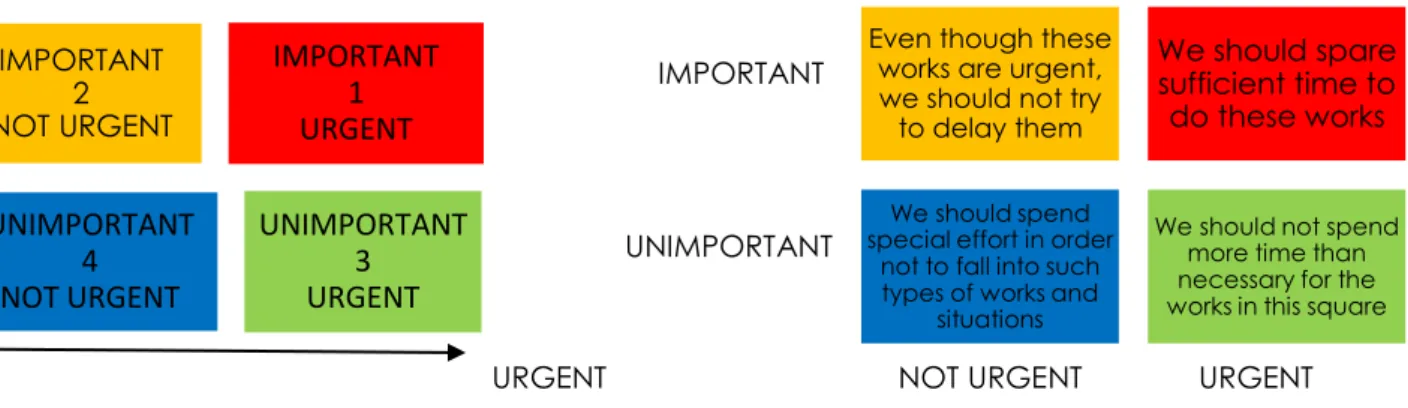
Covey’s Time Management Approach: This approach opposes the traditional time management approaches and drew attention to these two situtations.
1. Caring for prior: this states expectations and directs human to run after priorities.
2. Caring for important thing: this states purposes and directs individual to maintain his/her life according to purposes.
14
Even though these works are urgent, we should not try
to delay them
We should spare sufficient time to do these works
We should spend special effort in order
not to fall into such types of works and
situations
We should not spend more time than necessary for the works in this square IMPORTANT
2 NOT URGENT
IMPORTANT 1 URGENT
UNIMPORTANT 4 NOT URGENT
UNIMPORTANT 3 URGENT
The life we live, forces us to make some choices. We have to maintain our lives according to these choices we make. The choice between above two situations is the basic problem that lies in front of life. The solution of this problem is explained by Covey with clock compass contrast. While clock states how individuals spend their promises, appointments, programs, goals and activities meaning with what they spend their time; compass symbolizes their vission, values, principles, missions and conscience, meaning what is important for them and how they direct their lives. The basic problem in time management shows-up when there is a gap between clock and compass, meaning when the things we do, don’t contribute to the important things in our lives.
IMPORTANCE and URGENCY IMPORTANT
IMPORTANT
UNIMPORTANT
URGENT NOT URGENT URGENT
Figure 2: Time Management Table Source: Stephen R. Covey
3. TIME TRAPS
Time planning is the most important component of time management. Effective planning of time plays important role at increase of productivity, achieving success and targets. Obstacles that are in front of effective usage of time are called time trap. Time traps are based on various factors. These are personal, external, organisational and mechanical reasons.
1) Personal reasons
- Planlessness - Disorder
- Delay - Being not able to define and put in order priorities - Procrastinate - Routine and unnecessary works
- Not transfering - Hurriedness - Being not able to say No
2) External reasons - Guests
- Occupational accidents - Natural incidents
3) Organisational reasons
- Lack of authority and delegation - Organisational conflicts - Indecision - Unfavorable working environment - Unproductive work and meetings - Bureaucracy
- Lack of management of crisis and stress - Unproductive secretariat services
4) Mechanical reasons
15 Managers and individuals get trapped in time trap for various reasons. Not using time in appropriate place and planned, causes managers to get trapped in time trap.
Management mentality, personal behaviors and organisational structure needs to organise as to not make a time trap, for effective usage of time. The most obvious indicator of time waste is crises that occur in the system and repeat. Factors that causes time waste often originate from excess of staff and bad organizing. One other important reason that causes time waste is distortions of informations.
There are various reasons of time waste. These originate from people, operation of machines, methods, delays, excessive management, lack of planning, inclining towards other activities, indecision, lack of communication, untidiness and so forth.
These are time traps at the same time. Human is obliged to use time efficiently since he/she got limited life. Those who complain of timelessness are the ones who get trapped in above mentioned time traps.
3.1. Time Traps Caused by Individual
PLANLESSNESS
Not making conscious plannings prevents works to be done within time. The reason of planlessness originates from seeing useless, tendency for doing not managing, thinking that planless might bring success. As for solution of planlessness;
1) List up and put in proiority order the things that you want to do during the week. Prepare “things to be done daily” list according to priority.
2) Approach gingerly to the works at the top of you list.
3) Finish the job that you started in one go.
4) Ask yourself “How can I benefit from my time?” and apply it.
16
DELAY (LINGERING)
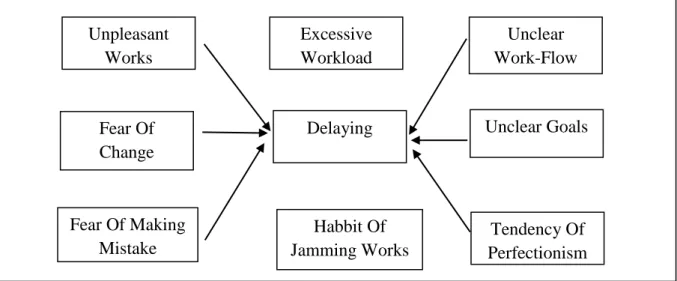
Delaying is generally the outcome of deceiving ourselves. However delaying the works that need to be done and have priority, might multiply the required time by two or three than of normal. Thinking of available time might not be sufficient for the works need to be done, destroys motivation. Individuals might have to spend more time than necessary in their offices and might not be able to use the time they are productive, in case delay becomes a habbit. Sub-reasons that lay under delaying habit can be summerizde as; laziness, carelessness, forgetfulness, intense working. But the main reason is failure and fear of losing effectiveness. Person who does not wish to lose time must start work at once and quit the habbit of delaying the works.
Figure 3: Delaying Reasons Source:Marc Mancini,a.g.e.,s.43
PROCRASTINATE
One of the most confronted situatins, in case of delays in the plan made at time management, is procrastinating a work. After an individual or a manager who makes planning, starts work, in case it lasts for a long period; falling into a mistake such as getting bored of work and leaving and starting a more attractive work, is the reason for getting caught in time trap. Also as it can be seen in certain situtations, individual being obsessively perfectionist causes the work to take more time and delays in planning. One must set separate time limitation for each work, to not experience such delays and for effective time management. In addition to this, individual should continue work by ensuring self dicipline and determination at works that will take long time and one should reward him/herself to raise motivation after he/she finishes the work.
Unpleasant Works
Fear Of Change
Excessive Workload
Unclear Work-Flow
Delaying Unclear Goals
Fear Of Making Mistake
Habbit Of Jamming Works
Tendency Of Perfectionism
17
ESCHEWAL FROM DELEGATION
There might occur situations where some managers won’t trust on their subordinates’
knowledge and transaction of business skill. Such situation, where subordinates being untalented and potentially not having sufficient knowledge, direct managers to behave more cautiously towards their subordinates and mostly abstain from transference of authority. Whereas manager gets more chance of earning time, the more authority they transfer to his/her subordinate according to his/her knowledge and skill level.
The most logical duties to be transfered are routine and repeating works that occupies important part of manager’s time. But transference of such duties create activity gap that are hard to accept for some managers. One of the most important benefits of duty transference is, without doubt, saving manager from routine activities and saving him/her time for more important works. For this reason, responsible person of each grade should be specified in a structure where grades exist and making duty transference between subordinates will save on time.
BEING NOT ABLE TO SAY NO
A manager who wishes to use time efficiently, must know to say no. However since managers do not like this word, they attend to a tiny piece of quite alot work; consequently they cannot completely finish any work. The first golden rule at time management is finishing an already started work. Managers need to learn to say no.
Reasons of them being not able to say no; Fear of not being loved, lack of self-confidence, fear of acting selfishly, fear of being left alone, not being accepted, fear of being neglected.
One of the most key point of time management is maybe saying “no” matter. Because factors that lie underneath this perspective reach out to communication skill and personal discipline from defining purpose and priority. Because strictly giving attitude to a non-prior work, is both difficult and an effective time management behavior.
This situation does not mean to consistently refuse people around. It is only to make those people to understand what needs to be focused at that moment, with valid reasons.
Nobody can obtain efficiency unless they direct their efforts towards favorable fields. For this reason manager should say, for the project that takes second place in priority order, so: “It is very beautiful however it is not priority, if it certainly needs to be done then make some one else do it.”. Managers need to learn to say no.
Managers should be able to say no with their body language at the same time they say no with words. His/her voice’s emphasis must be on the word no and he/she should definitely shake his/her head and look concerned.
18
DISORDER (MESSY TABLE)
Messy table sickness which is one of the most important of time traps, originates from the desire of stocking up all the received written papers on the table.
Order of table affects performance closely. Information scannings are made quicker and mentally less tiring. Greatest indicator of disorder is individual’s working place. If time is wasted while searching for things that are replaced or put on the ground, or if time is wasted due to mess; and if these require an individual to start over and stop an unfinished work multiple times, in that case individual needs to evaluate his/her working place. Individual’s desktop is a place where he/she performs his/her works, not a place where he/she hides some things. For this reason managers should only keep the required files on their tables. Pile of unnecessary papers and documents on table creates pressure on the managers, increases tension.
One of the most important habits of managers is to clear up their tables of unnecessary piles of papers in no time and keeping the required files at least in order.
A good manager does not let pad of papers to get piled up on the table and either sends the papers he received to others or files them up or throws them to garbage.
UNCERTAINTY OF PRIORITIES
The first thing that an efficient manager will do is to determine the priorities under the scope of a plan. A manager who determines priorities will keep his/her activities to achieve them and will not waste time on unnecessary works. The manager will get the oppurtunity to efficiently use his/her time when the activities that does not contribute to purposes are determined and eliminated. Thus focusing on works that have meaning for business and working more productively, without wasting time on unnecessary works.
Managers can not spare time for subjects that affect their main works when they are focused on the works which are not priority for them. Qualifying means individual doing his/her works quickly and correctly. Individual needs to be efficient at the same time, in order to reach their own and their businesses’ goals. What this means is individual must know his/her priorities and executing them at the right time and as necessary.
Way of spending your time is a result of way of seeing your time and priorities. The key in your business life is not putting the works in your program in order according to priority, but programming primary works. You need to make sure that your most urgent works are on top of to do list and you must frequently re-evaluate this matter.
HURRIEDNESS
Some people enjoy time pressure. They concsistently feel to do some things.
Hurriedness is not a behavior that suits time management. Reasons of hurriedness;
Being impatient about details
Being not able to make a plan for the future
Overreacting to emergency situations
Trying to finish the work within a short period of time
19 Precautions to be taken to do works in time and to not hurry:
Do the main works first,
Spare a daily thinking time for yourself for planning and evaluating,
At the beginning clearly present what you want to achieve, before deciding how to do the work,
Work on your personal schedule at any moment when you find tiny working gaps during work,
Fill your alarm and excitement quota positively
Instead of last hour of works, divide works to appropriate timeframes and finish each frame within its own hour.
3.2. Time Traps Caused by Exterior Reasons
UNEXPECTED GUESTS
There are many reasons for the troubles guests make for managers. One of these is caused from human not able to know what he/she must already know. It is of the desire of visiting more recognizer people. Conducted researches showed that a typical manager spares at least his/her three and half hours daily for guests. An unexpected guest ruins your flow of time program, either you like him/her or not.
Because the time that that person seized had already been reserved for another work.
20
3.3. Time Traps Caused by Organisational Reasons
LACK OF AUTHORITY AND DELEGATION (CENTRAL MANAGEMENT PERCEPTIVE ) A company having feature of centripetal causes the authority and decisions to be gathered at highest grade. Authority of making decision involves a limited area in centripetal structure. In centripetal structure transference of authority can not be made. This situation causes subordinates to be able to not grow up, limits and blunts personal skills. Since unauthorised subordinates will transfer every trouble they face to top manager, decisions will be made within long period of time and their efficiency will decrease.
Centripetal management destroys sense of obligation and initiative of individuals.
Besides since top managers are busy of unnecessary works, they will not have time to deal with business’s main goals.
INDECISION
Making decision is perceiving and defining problems, gathering information and data, improving solution alternatives, comparing this alternatives and choosing one among them by him/herself or with others. Even though perceiving the management job as ‘making decision’ and it is told that the worst decision is better than indecision;
some managers stays undecided and can not make a decision.
The most important result of indecision at management is, all other features aside, process of time cost. Due to their unmade decisions and unmade choices, reaching goals or solving problems will require more resource and since it will gather troubles, it will become more complicated.
Besides destination will be unclear, for many workers that works in accordance with the choices of manager, due to indecision; therefore there will be a loss. Jumping from one duty to another and being undecided while performing duties, is one of the most important time traps of manager.
UNPRODUCTIVE MEETINGS
Meetings are one of the most important duties that manager from every level needs to frequently perform. Because distribution of duty, sharing of authority and responsibility, making decision, communicating, motivation, taking part in management, uncovering creativity are conducted through meetings. Number of meetings increases as gone higher in organisational levels. General manager spends most of his/her time with meetings. Meetings are classical time killer. Those who say things unrelated with the subject, enter into an out-of-purpose discussion;
unprepared participants, chairman losing control, meetings that are made to gather not because it is required, are phenomenons that also seize time of manager.
21
CRISES
Crisis requires close attention of manager. Not only it threatens the current activity but also business’s life, it makes production capacity unusable and shakes competition. Crises have a critical effect on interaction and change of groups.
Problems become small and easy to overcome, with crises. Because you will have thought of ahead, worked and taken precautions that will prevent events turn into crises. In time management language it’s known as “Pareto Principle”. Briefly, eighty percent will result in, out of twenty percent activity. Pareto’s Rule gives us the message “focus on 20% and prioritise”. Because 80% of the result is here. If so, we have to determine what should we prioritise in our doings. The rule can be used in many fields and it might decrease the risk of missing out the important one.
CENTRAL AND HIERARCHIC INSTITUTION STRUCTURE
Managers who wish to see authority and power on themselves, causes pathology get deepen in institutions. A manager who is always trying to prove his/her skill and worthiness, see and show him/herself never unfailing in his/her decisions; is the source of institutional disease. Therefore starting from the source to get rid of disease is the most rational way. Because as Goethe states, those who do not contribute to solution of problem, are personally a piece of the problem. Excess of hierarchic steps, giving excessive place for written communication and strict application of figural rules; causes bureaucracy. Basing on institutional simplification that will remove bureaucracy, decentralised and generalising authority transference structure and management; will decimate time extravagance.
UNFAVORABLE WORKING PLACE
It is a known fact that almost all of the factors such as being tidy, quiet, airy, well heated or cooled, illuminated, color of walls, design of objects and room, location of working place affect human productivity. According to World Health Organisation (WHO) “health is a state of complete physical, mental and social well-being and not merely the absence of disease or infirmity.” This definition is not the organisation’s only human factor involving definition. It also involves physically, psychologically and socially; from making organisation’s design suitable for health conditions of human, to forming organisational climate and culture factors in a work-satisfying manner.
The overall purpose of arranging ergonomic workplace is to maximize performance of employee and all work systems, enabling physically and mentally improvement, properly gathering the work’s requirements and human’s skills in terms of human’s security and satisfaction.
BUREAUCRACY AND PAPERWORK
Reformed by German origin Weber, bureaucracy approach, defended hierarchical structure with strict rules and principles and concentrated on written communication.
Relations contacted between hierarchical duties are based on written communication and these papers are kept in documents as evidences.
Excess of hierarchical steps, giving excess place to written communication, strict application of figural rules makes bureaucracy inevitable. Stationary flow arriving on your table should be minimised; delegation of works, elemination of work distibution and working on computer will decimate time extravagancy.
22
3.4. Time Traps Caused by Mechanical Reasons
Growth especially at communication and computer technologies is dazzling, at these days where technology is post-hasting. However these developments become one of obstructing reasons of time management when not used or used out-of- purpose. These obstacles can exemplified as telephones and technology.
Economical developments and increase of competition nowadays, caused executive changes and distinctness in usage of working time. Now, inspecting and repressive managers left their places for managers and workers who especially care for information flow and good usage of time. These types of managers and workers are qualified as more successful.
23
4. EFFECTIVE TIME TECHNIQUES
4.1. Methods that Enable Productive Usage of Time
Knowing How to Manage Yourself
Improving Making Plan Habit
Regarding for Planning
Listing and Using Agenda
Keeping diary/agenda, recording of works done
Determining Priority with Need, Desire, Purpose and Goals
Progamming the Time
Arranging Easy and Difficult Works in a Successive Way
Starting the Works from Difficult Parts
Dividing Large Works into Smaller Sections
Focusing on One Work at the Same Time
Avoiding to Delay Work or Preventing Delay
Overcoming Stress
Transference of Authority
Being Able to Say No
Guest Arrangements
Telephone Arrangements
Meeting Arrangements
Managing Subordinates’ Time
Arrangement of Workplace
Imrpovement of Effective and Quick Reading/Writing Techniques and Skills
Effective Meeting Management
Active Communication
Effective Usage of Information and Communication Technologies (Telephones, Voice Recording Device, Connection Manager Softwares, E- Mail Management, Personal Digital Assistants (PDA) and Electronic Agenda Type Devices)
Simultaneously replying E-mail, answering letters and making call backs
Individual taking care of him/herself, having regular nutrition, sleeping well and doing excersices, keeping brain vigorous
4.2. Not Getting Caught in Time Trap and Points to be Considered to Use Time Effectively
Being conscious that planning takes time however afterwards it earns time,
Discoursing on acquired results, not on the things done and using day realistic,
Defining the rule that brings success is not only with applied methods but applying methods are inevitable too.
Finishing the already started work,
Determining targets, being intent on active usage of time and starting right away,
Queuing works according to priority and carrying out within the scope of a program
Being intent and finisihing the started work
24
Doing at right and first moment,
Application of solution ways about planlessness
Enabling the required information to be spread out quickly in order to correct decisions,
Enabling the required information to be spread out quickly in order for processes to be done correctly,
Evaluating the difference between important and urgent,
Keeping individual his/her notebook, always having pen or using his/her cell phone actively to take notes,
Noting down subjects such as idea that comes in mind, subject, offer, complaint etc,
Effectively using agenda, Outlook and cell phone/computer programmes.
4.3. Rules of Good Usage of Time
Think.
Be reintegrative.
Be selective.
Be decisive.
Make distinction.
Concentrate.
Be regular.
Be evaluator.
Think of yourselves too.
Be flexible.
25
CONCLUSION
Nowadays active and productive usage of time or time management subject, is also an important subject for education life as much as in business life. From students to working people, everyone is facing the problem of using the limited time actively and productively.
In the base of time and self management, determining personal and professional priorities and making all the arrangements according to these, need to be done. We have to focus on our works and priorities in order to have our time under control. This does not mean to work more and for more time, it means to work more systematically.
The way of good usage and management of time which is an extremely valuable resource, is consistently personally improvement and working development process.
Researches show that trainings about time management that individuals received enhances their behaviors about time management. However personal time management efforts will be limited in an institution where there is no coordination between units, and there is no planning made on the basis of unit. Hence time management subject needs to be dealt as part of continuous improvement and development within the scope of total quality approach.
As a conclusion we can say that using or not using the time we have got, is largely in our hands. We do not have the luxury of stoping time at some point and start it over.
If so what we need to do is to utilise to the best advantage and in an optimum way, the time that we cannot stop and is flowing, for ourselves and the institiution we work for.
26
References
Boslough, J. (March, 1990). “Time”, National Geographic, (Der. F. Mefkure Ekici, 1999).
Smith, H. W. ( 1998). 10 Natural Rules of Managing Life and Time. (Çev. Adalet Çelbiş). İstanbul: Sistem Yayıncılık
Tezcan, M. (1982). Psychologically Making Use of Leisures . Ankara: A. Ü.E.B. F.
Açıkalın, A. (1998). School Management with Social, Intstitutional and Technical Sides. (4. Printing), Ankara: Pegem.
EROĞLU, F. ve Bayrak, S. (1994). “Time Management in terms of Organisation Activities”, Economic and Administrative Sciences Magazine, 10(3-4), 255-270 Bülent AKYÜZ - Ömer Faruk ÜNAL - Mehmet METE - Fettah DOGER
Viktoriya Varlamova, The Relationship Between Time Management And Decision Making Processes, (Tez), University Of Canterbury, 2008 s.6