Part 1
GENERAL OUTLINE SECTION
Chapter 2
Strategic Planning and R&D Management
While pointing out that modern corporations tend to cut back on R&D expenditures as they shift towards the adoption of a business approach that prioritizes investors, this chapter shows that we should be demanding the promotion of R&D activities that can lead to profitability. And in order to promote effective R&D activities, this chapter points out that it is necessary to promote tie-ups between the R&D department and other operating departments through the determination of clear management strategies.
2.1 The Modern Enterprise and R&D 2.1.1 The necessity of R&D
In the US during the 1950s and 1960s, consumer durable goods such as automobiles and household electrical appliances rapidly achieved diffusion due to economies of large scale and brought about afflu- ent living for the people. J.K. Galbraith proved that stable economic growth could be attempted through the control of consumer demand by the technological group made up of technical experts and the man- agerial class of major corporations, known as the technostructure, and the bureaucratic organization of the government.1
Subsequently, the major corporations went on to stimulate con- sumer desire for their mass-produced products through the full use of advertising and sales techniques. Galbraith called this phe- nomenon of private business-led expansion of consumption the
17
“dependence effect” and showed that consumers may be passive, but they nevertheless carry out consumption to attain satisfaction.2
In contrast to the production-to-order method adopted for the traditional craft manufacturing system, the mass production system, with its use of machines, required the adoption of the production-to- stock method, which called for carrying out production on the basis of predictions made for quantity demanded by consumers. Amid such a historical backdrop, Japan’s R&D made use of the results of basic research conducted by mainly other countries and carried out product developments which made industrialization and commercialization practicable. And the produced products were sold by applying push- sales techniques.
From the 1970s through the 1980s, a shareholder counterrevolu- tion occurred in the US and demands were made to sell or reorganize unprofitable operations that had become uncontrollable by the man- agement of major corporations, which had become excessively large.
Additionally, demands were also made to curb investments in R&D that were carried out for the mere purpose of realizing scale expansion.
As a result, since around the 1980s in the US, research expenditure for cultivating technological seeds within companies and development expenses for connecting those seeds with consumer needs began to see cutbacks, and outsourcing of R&D came to be promoted.
However, in terms of the efficiency of R&D activity, it gradu- ally became clear that it was difficult to justify from an economic standpoint, which aims to realize maximum output from minimum input. Research activities, whose investment effects are difficult to measure, and development activities that require considerable time to confirm profitability, became impediments to achieving high-share price management, which pursues short-term upward swings in stock prices and excessive dividends. This fact led to the demand to have the quarterly results of R&D activities reported.
Consequently, to carry out effective R&D activity, it is necessary for executive officers to devise long-term strategies and help make
researchers aware that they are members of the organization as well.
And it is also necessary for managers to sufficiently persuade share- holders and creditors to acknowledge the importance of carrying out R&D activity over a long period of time.
Traditionally, most of Japan’s major corporations have been indi- rectly financed through the main banking system, rather than directly through shareholders and bondholders. As a result, there was a rollover, or in other words, an abundant amount of money was provided through continual refunding. For this reason, it was rare to be inquired on the results of R&D undertakings in any strict fashion. However, currently, it has become necessary for individual researchers to consider how R&D can lead to profitability by con- firming the direction of the organization as a whole, while attempting tie-ups with other operating departments, including the marketing department.
Michael J. Piore and Charles F. Sabel in The Second Industrial Divide indicated that from the 1980s onwards the “flexible special- ization system” had arrived as an industrial structure superseding the declining, private business-led mass production system.1),3
The craft element, which was supposed to have been rejected by the technological system of mass production, is seeing a possible revival in such places as the Toyota Production System in Japan and in industrial clusters of the various communities of Europe. In this chapter’s first section, we will point out that the efficiency of R&D has been deteriorating in recent years, and in the second section, we will attempt to investigate the relevance between management strategy and R&D, while taking into account the Management of Technology (MOT) in order to arrive at a measure for overcoming the deterioration.
1)Here, Piore and Sabel raise the emergence of mass production, which began around 1800, as the first industrial divide and consider it to have been established mainly in America around the 1890s.
2.1.2 International comparison of R&D investment
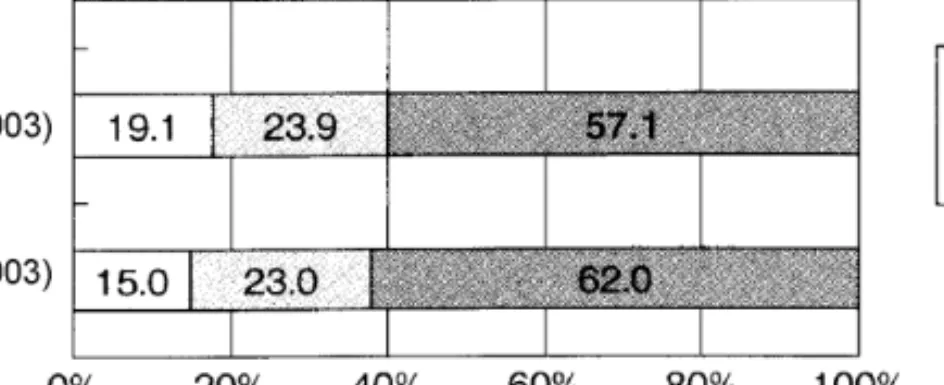
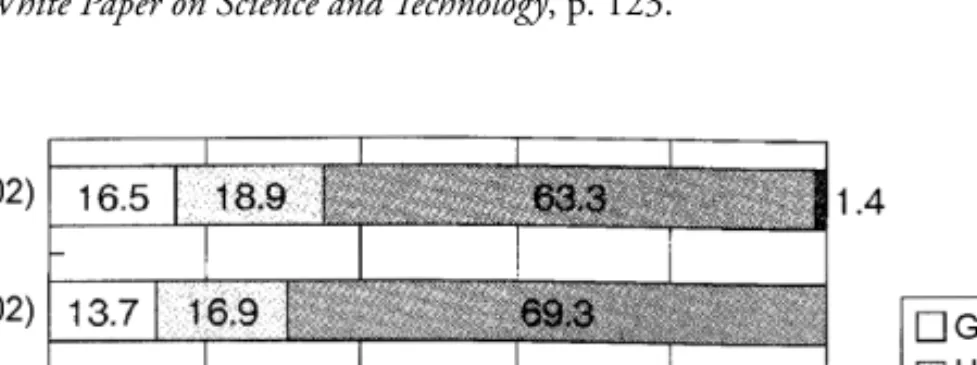
As seen in Figures 2-1 and 2-2, compared to other developed nations, a high percentage of the total R&D amount in Japan is made up by expenditures from private enterprises that are chiefly channeled into applied research in engineering. On the other hand, regarding basic research in the science, Japan’s percentage is low, and this fact is contributing towards weakening such areas as Japan’s chemical industry.
Meanwhile, in Germany and France, the proportion of basic research and governmental expenditure is high. And in recent years
Figure 2-1: Research Expenditure by Characteristic Source:2005 White Paper on Science and Technology, p. 123.
Figure 2-2: Major Country Usage Ratios of Research Funds by Organization Source:2005 White Paper on Science and Technology, p. 116.
in the US, industry-university tie-ups that are seeing collaborations between private enterprises and universities have been flourishing (especially in the physical sciences area), and the fruits of their col- laborations have been appearing in such sectors as the petrochemical industry and the bioindustry. Japanese enterprises, on the other hand, have been paying attention to applicable technologies that can lead to the creation of products, such as radios, desktop calculators, or flat-screen TVs, instead of focusing on deepening basic technology like transistor technology and liquid crystal technology, which had been invented through basic research in the US.
Since the 1980s, the US has been seeing reductions in R&D spending. This trend is largely attributable to the impact made by the strengthening of the shareholder’s voice.
According to Lester and Piore, science and technology policies of the past had inclined towards analytical initiatives, where results were already known and clearly definable. For this reason, engineers had been bound by an existing sense of values and had been carrying out rational decision-making that involved grappling with problems that were givens, while feeling the pressures of global competition. Con- sequently, towards discovering and understanding problems from now on, they suggest that it is necessary to promote an interpretive approach that goes beyond the boundaries of the organization.4
In recent years, within major industries of the US such as the chemical and semiconductor industries, the promotion of basic research areas has become essential, and active promotion of industry-university cooperation is being carried out. These basic research areas are not premised on any requirement to realize busi- nesses, but are instead geared towards the accumulation of tech- nological seeds. Upon promoting the interpretive approach, which attempts the integration of a diversity of knowledge, the industry- university cooperation activates new exchanges between universities and business enterprises, which are two absolutely disparate entities.
Consequently, such cooperation can be said to be offering the oppor- tunity for businesses to reexamine their management practices.
2.1.3 International comparison of product architecture
As indicated on the previous page, a substantial discrepancy can be seen between the US and Japan in terms of how they weigh their R&D investments. To explain the cause of this, we can start by look- ing at differences in product architecture.
When Japanese companies seek to procure raw materials and parts, they have not been doing so through the market, but instead through taking advantage of long-term transactions with specific business connections. In areas such as automobiles and house- hold electrical appliances, which are Japanese companies’ fields of expertise, the assembling manufacturer cannot complete a com- ponent before product design is carried out, since close coordina- tion is required between components. For this reason, there have been many cases where such manufacturers have carried out prod- uct development and production in sync with relevant companies.
This type of product architecture is referred to as integral archi- tecture. As the phrase suggests, it is a design that is an integrated whole and it is reached through bouncing ideas off each member of a group.
On the other hand, with US companies, after creating new technologies through industry-university tie-ups for basic research or through tie-ups between technology-led venture businesses and major corporations for development purposes, a modular form of product design is promoted.5This approach entails division of labor by component processes and goes beyond the framework of the com- pany in terms of even business creation and productization. The merit of the modular architecture is that it lets companies procure compo- nents from extensive companies and helps build more open-ended relationships between them. On the other hand, in the case of the
integral architecture, the relationship between companies will neces- sarily become closed-ended.
The desktop PC is a typical example of the modular architecture.
With this approach, standardized interfaces for linking components (such as USB and SCSI) are pre-established, making it possible for companies to realizeex post factocombinations of their components with even those components designed by makers who do not closely cooperate, as long as the specifications meet the standards. For this reason, it also becomes possible to promote the outsourcing of not only the R&D department, but also the production department.
Additionally, if the production of components can be carried out at a comparatively low technical level, it becomes possible to put together components that have been manufactured in developing countries, and, as a result, realize sales at low prices.
Therefore, whereas US companies lead in the production of desk- top PCs, for which the modular architecture approach is easy to apply, when it comes to the production of small-scale and lightweight note- book PCs, which require close coordination between components, the market share of Japanese companies is relatively high, thanks to their expertise in integral architecture.
2.1.4 Innovation and economic progress
Technological innovation is one of the causes of economic growth.
Inventions drawn from new technologies and their rapid commer- cialization are bringing about a material richness in the lives of people.
The 50-year business cycles, as conceived by Kondratiev, helped to explain the periodic phenomenon of the discoveries, inventions and technological innovations of epoch-making new technologies that emerged after the Industrial Revolution. However, to make the results of basic research lead to commercialization and industrializa- tion, the ability for the entrepreneur to innovate started to become necessary. The Austrian economist, Schumpeter, while depending
on Kondratiev’s business cycles, paid attention to simply the dif- ference between invention and innovation, and pointed out that entrepreneurial features were indispensable to the realization of innovation.6To promote economic progress, a company should not just hope for spontaneous evolution to take its course, but instead it should take note that “new combinations” of management resources are needed.2)
For this reason, in recent years, to contribute to economic progress, a switch from the Keynesian, government-led financial and fiscal policy to Schumpeterian ideas is being demanded to help fos- ter new industries and entrepreneurs and to support the creation of innovation. For example, in the revival of the American economy, the contribution from R&D-oriented venture companies were substan- tial and helped to supplement activities designed to foster innovation for major companies, whose R&D investments were declining. On the other hand, Japanese venture companies may find it difficult to follow the same road traveled by their American counterparts, since such Japanese companies are mainly Internet-based concerns that have relatively low start-up costs and are a combination of informa- tion and financial services, which can readily be listed on the stock exchange. Moreover, there is a lack of talent who can start companies through creating spin offs from major corporations.
When carrying out big-business centered innovation policies that accord with Japan’s existing set of circumstances, referring to Drucker’s ideas can prove helpful. While pointing out that the high-tech industry did not lead to rapid employment creation, despite the fact that it supports America’s economic growth, Drucker had indicated that organizational innovation coming from within the
2)As cases of “new combinations,” Schumpeter raises the following: 1) development of new products; 2) introduction of new production techniques; 3) cultivation of new markets; 4) acquisition of new sources of supply for raw materials; and 5) organiza- tional reform.
company helps to shorten long-term business cycles, and that this innovation does not stop short at technological inventions, pointing out the significance of the role of management.7 Drucker inher- its Schumpeter’s concept that considers the entrepreneurial function to be the leading factor driving economic progress, and is thought to be suggesting an ideal form of R&D activity for the business organization.
The prosperity of Japan’s economy in the future hinges on the business organization’s ability to innovate in order to create tech- nologies indispensable to society and then have such creations lead to industrialization.
2.1.5 Governmental policy on technology
An examination of the scope of governmental budgets related to science and technology reveals that Japan’s governmental budget is around 3.4 trillion yen, whereas America’s budget rises to around 11 trillion yen (90.9 billion dollars). A salient distinction of the Bush Administration can be seen in the fact that it had attempted the expansion of the energy supply through means such as drilling for natural gas and petroleum by having strongly promoted the National Energy Policy (NEP), which was chiefly advocated by Vice President Cheney.
A distinction of the previous Clinton Administration, on the other hand, can be seen in the fact that it had helped to increase investments in basic research and the building of the information infrastructure by having promoted cooperation between businesses and universities in the IT sector through the administration’s adop- tion of its science and technology policy, which had been mainly championed by Vice President Gore.8Both of these administrations focused their attention on industries considered to be America’s forte and carried out concentrated investments in them.
Additionally, the role private think tanks and nonprofit research institutions or foundations play in the determination or assessment of American policy on technology is large. They carry out assessments regarding the merits and impact of various researches, consider which fields should receive concentrated budget allocations, and offer reg- ular assessments after the allocations are made.
Meanwhile, in the case of the Japanese government, while they put forward the importance of facing the challenges of technology, they rarely commit to offer any active support, and in most cases, strictly remain at the level of offering lateral support (such as grants).
Since 1996, the Japanese government has been formulating a basic plan for science and technology once every five years. In the second basic plan set by the Cabinet in 2001, the following three points were made: a nation that can contribute to the world through the creation and application of intelligence; a nation that is internationally com- petitive and can continue to develop permanently; and a nation with security and high standards of living. The plan went on to confirm
“life science,” “information communication,” “the environment,”
“nanotechnology materials,” and other such primary fields as areas for key policy considerations, while proposing to expand investment in basic research, carry out third-party assessments of research themes, and implement reforms in industry-academe-government coopera- tion in an attempt to make Japan’s science and technology policy approach closer to America’s science and technology policy. However, it cannot be denied that the government still tends to be oriented towards product development (see Figure 2-3).
2.1.6 R&D challenges facing the Japanese company
Since the 1970s through the 1980s, the management approach of Japanese companies, which attached great importance to commercialization, achieved great results. The companies were able to realize a high level of productivity and profitability by specializing
Strategic prioritization of science and technology 1. Promotion of basic research
2. R&D that responds to national and societal challenges Examples: Nanotechnology, life science, etc.
3. Apt response for fields showing the potential for rapid development Examples: Bioinformatics, nanobiology, etc.
Promotion of the internationalization of science and technology activities 1. Promotion of independent international collaborations
2. Reinforcement of the capability to internationally transmit information 3. Internationalization of the domestic research environment
Reform of the science and technology system to
•
•
• realize superior achievements and applications
1. Reform of the R&D system
Examples: Redoubling of competitive funds, reform of evaluation systems for making appropriate resource allocations
2. Reinforcement of industrial technology and reform of the industry-government-academia setup for cooperation
3. Arrangement of conditions for the promotion of science and technology in local communities 4. Training of superior science and technology talent and reform of education regarding science and
technology
5. Promotion of study related to science and technology, building of channels to society 6. Ethics and social responsibility related to science and technology
7. Maintenance of foundations for promoting science and technology Example: Maintenance of facilities such as universities
Figure 2-3: Key Policies of the Science and Technology Basic Plan Source: Cabinet Office’s science and technology policy website
(http://www8.cao.go.jp/cstp/kihonkeikaku/point.pdf ).
in the development of products that were particularly easy to mass produce and improve in terms of quality, and by practicing a bottom- up style of management that actively paid attention to the voices of employees at the manufacturing floor.
However, according to the concept of Abernathy’s “Productivity Dilemma,” industries that have reached their mature phase experi- ence a decline in productivity, and the conventional management approach starts to become incompatible. The infancy of an indus- try is the period that sees the birth of many product innovations.
Thereafter a dominant design within the industry gets established, and when the industry reaches its growth stage, process innovation,
which pursues efficient production approaches based on this design, occurs one after the other. Furthermore, when it reaches its mature phase, innovation activities see a decline9(see Figure 2-4).
After the 1990s, many of Japan’s globally competitive industries, such as the automotive industry and the consumer electronics indus- try, saw a decline in innovation activities and became exposed to the surge of price competition. As a result, the scalpel of reform had pierced R&D departments, which has traditionally been considered to be sacrosanct in Japanese companies. This caused concerns that the motivation of researchers might deteriorate.
However, even in the consumer electronics industry, where many of its sectors are believed to have reached their mature phase, room to develop popular products such as the videodisc recorder still remains in many cases. By having made good use of the hard disk’s inher- ently beneficial capability to store recorded content within its own framework, the videodisc recorder, which became a hit, responded to the user’s reluctance toward having to frequently swap media for storage purposes and went on to trigger active competition over developments that aimed to improve performance. Makers who neglected R&D suddenly found themselves in a predicament and were compelled to engage in price competition to recapture their
Product innovation
Dominant design Time
Process innovation
Frequency
Figure 2-4: The Dilemma of Productivity Source: Adapted from Abernathy (1978, Figure 4.1).
market share. Additionally, even in the home appliances sector, where products may not be low priced at all, such as the popular washing machine with a built-in dryer, there is scope for realizing profit, just as long as a substantial number of customers who recognize the value of such a product exists.
Consequently, with future prospects for attaining profitability through product development becoming difficult, the leadership of managers will be called to account when attempting the invention of new technologies and their effective use. Specifically, the top level will be asked to harmonize the orientation of members through the development of clear management strategies, instead of overly rely- ing on bottom-up inputs from the work front. Concurrently, at the middle level, project leaders of R&D departments will be expected to help their members assert their independence, while coordinating with corporate-wide policies at the same time.
2.2 Management Strategy and Its Relationships with R&D and Product Development Management 2.2.1 Requirements for the Management of Technology
(MOT)
Throughout the 1990s, Japanese corporations saw the efficiency of R&D gradually deteriorate. For the future, it became necessary not to reduce R&D expenses, but pursue how R&D could lead to prof- itability. Toward this end, the need arose to bury the perception of distance between executive officers, who carry out corporate opera- tions, and the R&D department.
Consequently, Japanese corporations recognized that original product development was indispensable to long-term progress and began to pay attention to the Management of Technology (MOT) concept from around 2000 as a management technique that could make sufficient use of the talents of the engineer. Riding this trend,
the “technological management consortium” led by the Ministry of Economy, Trade and Industry, was established in 2003 with the aim of cultivating experts in the management of technology through cooperation between industry, government, and the aca- demic community.
The idea of technological management resulted from the pur- suit of efficient R&D in the American manufacturing industry from about the 1970s, and in the academic world, it has been treated as a part of the industrial engineering discipline. The context that gave rise to the general adoption of the name of MOT can be found in the fact that there was a need to integrate with the field of busi- ness administration to primarily realize R&D activities that led to industrialization and profitability. For this reason, in American grad- uate schools today, curriculums oriented toward the management of technology are established in not only engineering schools, but also business schools.
Even in Japan, MOT courses are seeing a trend of being set up in mainly engineering-oriented graduate schools. In the future, even the engineer will be expected to acquire the kind of sophisticated knowledge that is comprised of not only the knowledge of technology, but also of the management field.
2.2.2 Corporate strategy and R&D
When promoting cooperation between R&D and business, set- tling on a long-term corporate strategy becomes initially neces- sary. In management strategy theory, it is common to distinguish between corporate strategy and competitive strategy (business strat- egy). The corporate strategy focuses on the corporation as a whole and helps to select the relevant business domain and determine the method of allocating management resources, such as people, objects, and money. The competitive strategy helps to analyze competitive relations with other companies in terms of business and product.
To have corporate strategy decisions reflect MOT principles, the concept of “core competence” as conceived by Prahalad and Hamel will prove helpful.
They have built a resource-based theory of corporate strategy that explains that the way to secure long-term competitiveness is through the accumulation of proprietary management resources held by the corporation.10The administration recognizes the corporation’s tech- nological expertise, and by devising a corporate strategy that places this at its core, the business domain becomes established, making it possible to precisely give direction without diffusing the activities of employees, including engineers.
Therefore, the engineer will be sought to accomplish the accumu- lation of technological seeds by taking future commercialization and productization into consideration and carrying out R&D in align- ment with the corporation’s expertise. By having the R&D depart- ment adopt an attitude that favors cooperation with other business departments, it will be able to move toward ridding itself of the “sanc- tuary” image, which will in turn lead to the prevention of curtailing R&D expenses.
The idea of “core competence” aims at fostering the ability to innovate, which ties to the realization of long-term and stable prof- itability. It is not merely something that is maker-centric and product- oriented. Certainly, much technological accumulation in Japanese companies until now was made possible through an ample R&D bud- get procured through the stable supply of funds made available from banks. Consequently, many businesses were developed in a bottom- up fashion, which involved carrying out product developments that incorporated new technologies and functions created through such R&D. However, from now on, companies need to recognize the necessity of securing future profitability not through research for research’s sake, but through carrying out R&D that reflects the over- all corporate strategy.
2.2.3 Competitive strategy and R&D
In competitive strategy, since offering products with originality becomes key in staying ahead of the competition, the relevance of product development in particular to R&D activity becomes a focal point. While it cannot be denied that research activities remain to this day seeds-oriented for the purpose of accumulating technology for the future, when it comes to product development activities, we need to link them directly to business success by making them needs-oriented, as it is necessary to be able to respond to customers.
The problem that arises here are the various obstacles that stand in the way of fostering the ability to innovate, such as those known as the “Death Valley” and “Darwinian Sea.”
“Death Valley” points to the large gulf that occurs between basic research/invention and applied research/product development. This shows that it is not easy to adjust the technological seeds accumulated in a corporation to meet the needs of customers and turn them into useful technology. A typical precedent of overcoming the “Death Valley” obstacle is the case of the DNA chip, which gauges genes that could cause illnesses. The US government recognized the “Death Valley” gap existing in the development of this chip and overcame it by supplying funds for its industrialization.
The “Darwinian Sea,” on the other hand, points to the fact that prospects for manufacturing a product do not necessarily lead to com- mercialization at once, even if applied research shows such prospects to be good, since there are the issues of building production facilities and distribution channels to contend with. As concrete examples for this type of obstacle, the cases of the next-generation DVD standard (HD-DVD system and Blu-ray Disc system) and the next-generation TV panel technology (the SED system) can be cited.
Toward clearing these two obstacles, the development of a clear competitive business strategy is demanded. As representative types of such a strategy, cost leadership strategy, differentiation strategy, and
segmentation strategy3) can be cited, but the one with a strong rele- vance to R&D activity is the differentiation strategy.11If a corpora- tion only adopts the cost leadership strategy, which aims to drop the selling price by holding down personnel and distribution costs, there is the danger of seeing a rapid decline in profitability once other com- panies begin to imitate. For this reason, it is necessary to promote a differentiation strategy and aim for the establishment of a long-term competitive advantage. In such a case, the R&D department will have to bear the heavy responsibility of overcoming both the Death Valley and Darwinian Sea obstacles at the same time. Toward this end, the department will have to recognize the product functions and level of quality demanded by customers with precision and thereby promote the type of product development that helps to prevent imitation.
2.2.4 Product strategy and R&D engineering
To make R&D relevant to product strategy, it is necessary to ascertain the required technology by sufficiently grasping the product’s life cycle (PLC).
In the introduction stage, companies need to allow the developed product to create a new market for itself. At this stage, since signif- icant cost build-up occurs for the development of new technology, interest in the new product runs extremely high among principal customers, the targets who are enthusiastic innovators and do not mind the high price tag.
Subsequently, when consumers gradually start to recognize the product as it enters its growth stage, the market expands and a battle against rival firms for market share unfolds as a performance upgrade
3)Regarding segmentation strategy, Porter defines it as one that concentrates manage- ment resources on 1) specific buyer groups, 2) product types, and 3) specific regional markets in order to aim for cost reduction and differentiation via narrowing down targets.
is attempted. At this stage, it is necessary to carry out product devel- opment that meets the needs of opinion leaders who possess exten- sive knowledge and whose will to consume are comparatively high.
Everett M. Rogers, in his landmark work Diffusion of Innovations, asserts that these very opinion leaders have substantial influence in achieving diffusion among general consumers and that they deter- mine the merits of competing in a business.12
In the maturity stage, since product diffusion extends up to gen- eral consumers, companies will not be able to anticipate any further market expansion. However, they will be securing stable profitability by deploying an unmatchable differentiation strategy made possible through process innovation in production.
Furthermore, during the decline stage, although market growth comes to an absolute stop, companies that had succeeded in the mature phase with their differentiation strategy do not necessarily have to withdraw. In fact, they can anticipate even more profitability through further process innovation.
When seen in the light of the life cycle concept, many business sectors in Japan’s manufacturing industry are facing the maturity stage or the decline stage and need to reexamine their existing state of technology-development competition that pursues all-out perfor- mance enhancements, which had proved beneficial in bringing about success in the past. The product development strategies of Japanese companies had tended to lapse into becoming product-centric out of a sense of rivalry against competitors, and often ignored customers in the process. From now on, it is demanded that product development adequately takes customer viewpoints into account.
For example, the succession of hit products appearing in the household appliance sector in recent years such as washing machines and vacuum cleaners can be said to be offering a large hint for gener- ating substantial profitability during the maturity and decline stages for companies that have survived competition in the course of the life cycle process.
2.2.5 Marketing research for new product development
While Japanese companies switch from a seller’s market to a customer-centric one, they need to extend and tie the idea of mar- keting to the product development stage. Traditionally, it could not be said that cooperation between the R&D department and the mar- keting department was sufficiently attempted. Since the search for target customers had been entrusted to the marketing department, in the event a product did not lead to viable sales after it had overcome technical difficulties to reach the stage of production, the chances the R&D department was held responsible was close to none. How- ever, from now on, the department will be required to try to maintain interaction with customers and demonstrate the imagination to carry out developments that take the user’s viewpoint into account.
However, it should be noted that this measure by no means downplays the importance of technological improvement. The R&D department, with the cooperation of the marketing department, needs to have the ability to access their repository of technological seeds and extract appropriate technology that suits product functions that respond to user needs.
With existing products, to make improvements for the purpose of securing sustained profitability through high value-added produc- tion, we need to accurately grasp the needs of target customers. By incorporating marketing ideas into the R&D field, it will become possible to switch from the technology-push paradigm, which only requires packing in numerous features that correspond to price, to the demand-pull paradigm. As a solution, companies can narrow down their technologies to those that can turn into products and propose them as an answer to the problems troubling customers, persuading the importance of their necessity.
The need to connect with marketing ideas is necessary not only for existing products, but for building new business domains as well.
Toward this end, companies will have to carry out marketing research
for the purpose of aligning their core technologies with market trends.
However, with new businesses, investigating the needs of future cus- tomers is not easy, and more often than not, there will be a risk involved in promoting its commercialization and industrialization.
The idea of the “co-creation” of value by Prahalad and Ramaswamy offers a hint toward a solution.13 In the present age, when it has become and possible to convey opinions on purchased products at blogs and websites, consumers can reach the decision to make a purchase not only via advertisements, but via word-of-mouth as well. For this reason, certain company-led marketing activities are beginning to show their limitations; specifically, activities that aim to control demand by relying on ads that help consumers recognize the features and image of a product (see Figure 2-5).
As a result of companies aggressively pursuing cost-cutting com- petition and business process improvements, the market is overflow- ing with products that incorporate diverse functions and those that have realized low prices. However, just offering an increased num- ber of choices will not satisfy customers. To acquire customers who can support the continuation and progress of a corporation on a long-term basis, the imagination to build a solutions-oriented busi- ness is demanded. What buyers seek is not simply the possession of a product. From now on, it will become crucial to be able to answer to problems troubling customers through the very use of the products themselves.
Until now In the future
Bearer Business led Customers and businesses Basis Products and services Co-creative experience Result Consumer demand
management
Problem solving for customers
Figure 2-5: Framework of Value Creation Source: Adapted from Prahalad and Ramaswamy (2004).
2.2.6 R&D alliances and outsourcing
As can be drawn from the ideas expressed in the preceding paragraph, it could be seen that companies would face difficulty if they were to assume risks on their own. When a firm is not able to advance developments with its internal management resources alone, it is supposed that there will be many occasions when the use of external technological expertise becomes necessary. We believe this can be attributed to budgetary and time constraints that accompany the need to carry out R&D with speed and sophistication. Depending on the situation, there may be times when carrying out technological cooperation with rival firms is preferable.
Regarding alliances with other companies, many of them are car- ried out to conduct long-term R&D oriented toward the creation of future customers, and in the case of outsourcing, many of them are carried out when rapid industrialization is required once the oppor- tunity arrives to expand market share and realize profits.
An examination of the forms of alliances forged between compa- nies reveals that within companies of different business types, they take the form of complimentary alliances. Namely, in some cases, they involve companies carrying out industrialization/commercialization through mutual technology contributions, or in other cases, they involve cooperation between companies without the capacity to produce and companies with distribution channels ready. Within companies of the same business type, joint-development alliances are promoted to aim for the industrialization of next-generation technologies.
A typical case of outsourcing can be seen when a maker of fin- ished products entrusts the production of electronic parts for such products as personal computers and digital cameras. In the case of digital appliances, demand trends are hard to grasp, and despite investing large sums of money to cover development and produc- tion costs, there is a possibility of not being able to acquire sufficient
profit. So finished-product makers outsource production to Elec- tronics Manufacturing Service (EMS) companies and attempt risk reduction.
EMS companies can readily reduce production costs, even if all the orders they receive are small in scale, as such orders help to enlarge their total volume of orders in the end, since they under- take orders from many companies. On the other hand, businesses hiring EMS companies are able to heighten the added value of the whole product by being able to specialize in production processes that require advanced technological expertise. Whereas outsourc- ing is realized in fields where modular architecture is carried out, in fields where integral architecture is carried out, production is still accomplished in most cases through long-term, vertical rela- tionships with affiliated subcontractors. However, in recent years, even in the home appliance industry, which had been adopting the integral approach to product design, the movement to introduce an outsourcing system that makes effective use of EMS companies is gaining ground.
However, since there are demerits to outsourcing that can be con- sidered, careful judgment becomes necessary. As indicated previously, there is little hope of acquiring customers through just reducing the production cost. Additionally, if a corporation fails to sufficiently recognize the core technology it possesses, a loss in long-term com- petitiveness may result due to the disappearance of its technological advantage.
Furthermore, in the case of alliances, due to disparities in bar- gaining power or conflicts of interest arising from differences in objectives, a tie-up may cease to make progress. Therefore, compa- nies need to reevaluate the suitability of their alliances on a retroac- tive basis. As measures, non-disclosure contracts can be concluded or cross licensing that sees both parties acknowledging the imple- mentation of patented technologies can be carried out. By adopt- ing such measures, companies can promote the active application
of their respective proprietary technologies, while attempting intellectual-property protection.
Therefore, businesses need to make good use of technologies accumulated internally, and reexamine the appropriateness of the balance they maintain between development activities that could be completed within the corporation and activities that make use of external resources. To gain a grasp of management resources within the corporation and appropriately apply stakeholder knowl- edge, the formulation of a clear corporate strategy is required.
Toward this end, it can be said that the ability to lead executive officers is a sought-after talent.
Junpei Nakagawa
References
1. J.K. Galbraith,The New Industrial State, 3rd edition, Houghton Mifflin, 1978, Chapters 6 and 28.
2. J.K. Galbraith,The Affluent Society, 4th edition, Houghton Mifflin, 1984, Chapter 11.
3. M.J. Piore, C.F. Sabel,The Second Industrial Divide, Basic Books, 1984, Chapter 1.
4. R.K. Lester, M.J. Piore,Innovation: The Missing Dimension, Harvard University Press, 2004, Preface and Chapter 2.
5. Takahiro Fujimoto,Akitekucha no sangyo ron(transl. “The industrial theory of architec- ture”), edited by Takahiro Fujimoto, Akira Takeishi, and Yaichi Aoshima,Business Archi- tecture, Yuhikaku Publishing, 2001, Chapter 1.
6. J.A. Schumpeter,The Theory of Economic Development: An Inquiry into Profits, Capital, Credit, Interest and the Business Cycle,Harvard University Press, 1934, Chapter 2.
7. P.F. Drucker,Innovation and Entrepreneurship, Harper & Row, 1985, Prologue.
8. The Research Center of Technology Trends of the National Institute of Science and Tech- nology Policy of the Ministry of Education, Culture, Sports, Science and Technology, Technology Trends, June 2001 issue, Chapter 4
(http://www.nistep.go.jp/achiev/ftx/jpn/stfc/stt003j/index.html).
9. W.J. Abernathy,The Productivity Dilemma: Roadblock to Innovation in the Automobile Industry, The Johns Hopkins University Press, 1978.
10. G. Hamel, C.K. Prahalad,Competing for the Future, Harvard Business School Press, 1994, Chapter 9.
11. M.E. Porter,Competitive Strategy, Free Press, 1980, Chapter 2.
12. E.M. Rogers,Diffusion of Innovations, 3rd edition, Free Press, 1983.
13. C.K. Prahalad, V. Ramaswamy,The Future of Competition, Harvard Business School Press, 2004, Chapter 1.