Cha pter
21
In This Chapter, We Will Address the Following Questions
1. What factors should a company review before deciding to go abroad?
2. How can companies evaluate and select specific foreign markets to enter?
3. What are the differences between marketing in a developing and a developed market?
4. What are the major ways of entering a foreign market?
5. To what extent must the company adapt its products and marketing program to each foreign country?
6. How do marketers influence country-of-origin effects?
7. How should the company manage and organize its international activities?
India’s Tata Group has a wide range of global businesses, including one that produces the remarkably priced $2,500 Tata Nano or the “People’s Car.”
With ever faster communication, transportation, and financial flows, the
world is rapidly shrinking. Countries are increasingly multicultural, and products and services de- veloped in one country are finding enthusiastic acceptance in others. A German businessman may wear an Italian suit to meet an English friend at a Japanese restaurant, who later returns home to drink Russian vodka and watch a U.S. movie on a Korean TV. Emerging markets that em- brace capitalism and consumerism are especially attractive targets. They are also creating mar- keting powerhouses all their own.1
Tata Group, India’s biggest conglomerate, operates successful businesses that range from software, cars, and steel to phone service, tea bags, and wristwatches. Its busi- ness dealings stretch far and wide and have included purchases of South Korea’s Daewoo Motors truck unit, Dutch-British steel giant Corus Group, and UK-based Tetley Tea. The proprietor of the Taj luxury hotels, Tata also owns or manages the rebranded Ritz-Carlton in Boston, the Pierre in New York City, and Camden Place in San Francisco. Tata Consultancy Services, India’s largest tech-services company, collects roughly half its revenues in North America. Tata is also India’s largest commercial vehicle maker and created a stir with the recent launch of its $2,500 Tata Nano, dubbed the “People’s Car.” Although impossibly low-priced by Western standards, at one Indian lakh the Nano’s price is three times higher than India’s annual per capita income. Looking somewhat like an egg on wheels, the Nano comfortably seats five while run- ning a 33-horsepower engine that gets nearly 50 miles per gallon.
Aiming to sell 250,000 units annually, Tata is targeting the 7 million Indians who buy scooters and motorcycles every year, in part because they cannot afford a car. The market potential is huge—there are just seven automobiles per 1,000 people in India. Tata is also targeting other “bottom of the pyramid” markets such as Africa and Southeast Asia and perhaps even parts of Eastern Europe and Latin America.
595
Companies need to be able
to cross boundaries within and outside their country. Although opportunities to enter and compete in international markets are significant, the risks can also be high. Companies selling in global industries, however, have no choice but to internationalize their operations. In this chapter, we review the major decisions in expanding into global markets.Competing on a Global Basis
Many companies have been global marketers for decades—firms like Shell, Bayer, and Toshiba have sold goods around the world for years. In luxury goods such as jewelry, watches, and handbags, where the addressable market is relatively small, a global profile is essential for firms like Prada, Gucci, and Louis Vuitton to profitably grow. But global competition is intensifying in more product categories as new firms make their mark on the international stage.2
The automotive market is becoming a worldwide free-for-all. In Chile, with no domestic auto manufacturers, imports are coming from all over the world, including 14 different brands of Chinese cars, trucks, and commercial vehicles.3In China’s fast-moving mobile-phone market, Motorola found its market share cut in half over a two-year period from inroads by Nokia and Asian competitors.
Competition from developing-market firms is also heating up. Mahindra Motors’ four-door, diesel-powered short-bed trucks from India are tackling Europe, Asia, and the United States, prom- ising superior fuel economy.4 Founded in Guatemala, Pollo Campero (Spanish for “country
chicken’) has used Latin American immigrants to launch over 50 U.S. stores, blending old favorites such as fried plantains and milky horchatadrinks with traditional U.S. fare such as grilled chicken and mashed potatoes.5
Although some U.S. businesses may want to eliminate foreign competition through protective legislation, the better way to compete is to continuously improve products at home and expand into foreign markets. In a global industry, competitors’ strategic positions in major geographic or national markets are affected by their overall global positions.6Aglobal firmoperates in more than one country and captures R&D, production, logistical, marketing, and financial advantages not available to purely domestic competitors.
Global firms plan, operate, and coordinate their activities on a worldwide basis. Otis Elevator uses door systems from France, small geared parts from Spain, electronics from Germany, and mo- tor drives from Japan; systems integration happens in the United States. Consider the international success of Hyundai.7
Hyundai
Once synonymous with cheap and unreliable cars, Hyundai Motor Company has experienced a massive global transformation. In 1999, its new chairman, Mong-Koo Chung, declared that Hyundai would no longer focus on volume and market share but on quality instead.A number of changes were instituted: Hyundai began to benchmark industry leader Toyota, adopted Six Sigma processes, organized product development cross-functionally, partnered more closely with suppliers, and increased quality oversight meetings. From a place near the bottom of J.D.
Power’s study of U.S. new vehicle quality in 2001—32nd out of 37 brands—Hyundai zoomed to number four by 2009, surpassed only by luxury brands Lexus, Porsche, and Cadillac. Hyundai also transformed its market- ing. Its “Assurance” campaign, backed by a pricey Super Bowl ad, allowed new buyers to return their cars risk-free if they lost their jobs. Other programs guaranteed customers low gas prices for a year and tax cred- its in advance of the government’s “Cash for Clunkers” program. The U.S. market was not the only one receiving attention from Hyundai and its younger, more affordably priced brand sibling, Kia. Hyundai is the second-largest car-maker in India, it is supplying Europe with a new €1 billion factory in the Czech Republic, and a joint venture with Beijing Automotive is targeting China.
Many successful global U.S. brands have tapped into universal consumer values and needs—
such as Nike with athletic performance, MTV with youth culture, and Coca-Cola with youthful optimism. These firms hire thousands of employees abroad and make sure their products and marketing activities are consistent with local sensibilities.
Hyundai
Latin America’s fried chicken favorite, Pollo Campero, has entered the U.S. market in part by targeting areas populated by Hispanic immigrants.
Global marketing extends beyond products. Services represent the fastest-growing sector of the global economy and account for two-thirds of global output, one-third of global employment, and nearly 20 percent of global trade. Although some countries have erected entry barriers or regula- tions, the World Trade Organization, consisting of 150 countries, continues to press for more free trade in international services and other areas.8
For a company of any size or any type to go global, it must make a series of decisions (see Figure 21.1). We’ll examine each of these decisions here.9
Deciding Whether to Go Abroad
Most companies would prefer to remain domestic if their domestic market were large enough.
Managers would not need to learn other languages and laws, deal with volatile currencies, face political and legal uncertainties, or redesign their products to suit different customer needs and expectations. Business would be easier and safer. Yet several factors can draw companies into the international arena:
• Some international markets present better profit opportunities than the domestic market.
• The company needs a larger customer base to achieve economies of scale.
• The company wants to reduce its dependence on any one market.
• The company decides to counterattack global competitors in their home markets.
• Customers are going abroad and require international service.
Reflecting the power of these forces, exports accounted for roughly 13 percent of U.S. GDP in 2008, almost double the figure 40 years ago.10Before making a decision to go abroad, the company must also weigh several risks:
• The company might not understand foreign preferences and could fail to offer a competitively attractive product.
• The company might not understand the foreign country’s business culture.
• The company might underestimate foreign regulations and incur unexpected costs.
• The company might lack managers with international experience.
• The foreign country might change its commercial laws, devalue its currency, or undergo a political revolution and expropriate foreign property.
Some companies don’t act until events thrust them into the international arena. The internationalization processtypically has four stages:11
1. No regular export activities
2. Export via independent representatives (agents) 3. Establishment of one or more sales subsidiaries 4. Establishment of production facilities abroad
The first task is to move from stage 1 to stage 2. Most firms work with an independent agent and enter a nearby or similar country. Later, the firm establishes an export department to manage its agent relationships. Still later, it replaces agents with its own sales subsidiaries in its larger export markets. This increases investment and risk, but also earning potential. Next, to manage sub- sidiaries, the company replaces the export department with an international department or divi- sion. If markets are large and stable, or the host country requires local production, the company will locate production facilities there.
By this time, it’s operating as a multinational and optimizing its sourcing, financing, manufacturing, and marketing as a global organization. According to some researchers, top management begins to focus on global opportunities when more than 15 percent of revenue comes from international markets.12
Deciding Which Markets to Enter
In deciding to go abroad, the company needs to define its marketing objectives and policies. What proportion of international to total sales will it seek? Most companies start small when they venture abroad. Some plan to stay small; others have bigger plans.
Deciding whether to go abroad
Deciding which markets to
enter
Deciding how to enter the
market
Deciding on the marketing
program
Deciding on the marketing
organization
|Fig. 21.1|
Major Decisions in
International
Marketing
How Many Markets to Enter
The company must decide how many countries to enter and how fast to expand. Typical entry strategies are the waterfallapproach, gradually entering countries in sequence, and the sprinkler approach, entering many countries simultaneously. Increasingly, firms—especially technology- intensive firms—are born globaland market to the entire world from the outset.13
Matsushita, BMW, General Electric, Benetton, and The Body Shop followed the waterfall approach. It allows firms to carefully plan expansion and is less likely to strain human and financial resources. When first-mover advantage is crucial and a high degree of competitive intensity prevails, the sprinkler approach is better. Microsoft sold over 150 million copies of Windows 7 in 100 countries in fall 2009 with only minor tweaks in its marketing. The main risk is the substantial resources needed and the difficulty of planning entry strategies for many diverse markets.14
The company must also choose the countries to consider based on the product and on geography, income and population, and political climate.
Developed versus Developing Markets
One of the sharpest distinctions in global marketing is between developed and developing or emerging markets such as Brazil, Russia, India, and China (often called “BRIC” for short: Brazil, Russia, India, and China).15Two other developing markets with much economic and marketing sig- nificance are Indonesia and South Africa. The unmet needs of the developing world represent huge potential markets for food, clothing, shelter, consumer electronics, appliances, and many other goods. Market leaders rely on developing markets to fuel their growth. Consider the following:
• Coca-Cola, Unilever, Colgate-Palmolive, Groupe Danone, and PepsiCo earn 5 percent to 15 percent of their total revenues from the three largest emerging markets in Asia—China, India, and Indonesia.16
• Developing markets make up over 25 percent of Kraft’s total business, almost 40 percent of Cadbury’s, and over 50 percent of Tupperware’s sales.17
• Nestlé estimates about 1 billion consumers in emerging markets will increase their incomes enough to afford its products within the next decade. The world’s largest food company gets about a third of its revenue from emerging economies and aims to lift that to 45 percent within a decade.18
Developed nations account for about 20 percent of the world’s population. Can marketers serve the other 80 percent, which has much less purchasing power and living conditions ranging from mild deprivation to severe deficiency? This imbalance is likely to get worse, as more than 90 percent of future population growth is projected to occur in the less developed countries.19
Successfully entering developing markets requires a special set of skills and plans. Consider how these companies pioneered ways to serve “invisible” consumers:20
Microsoft launched Windows 7 with a massive global campaign.
• Grameenphone marketed cell phones to 35,000 villages in Bangladesh by hiring village women as agents who leased phone time to other villagers, one call at a time.
• Colgate-Palmolive rolled into Indian villages with video vans that showed the benefits of toothbrushing.
• Corporación GEO builds low-income housing in Mexico. The two-bedroom homes are mod- ular and expandable.
These marketers capitalized on the potential of developing markets by changing their conven- tional marketing practices.21Selling in developing areas can’t be “business as usual.” Economic and cultural differences abound, a marketing infrastructure may barely exist, and local competition can be surprisingly stiff.22
Local Dynamos
An extensive study by the Boston Consulting Group identi- fies 50 firms in 10 emerging economies as “local dynamos.” According to BCG, a local dynamo is (1) prospering in its home market, (2) fending off multinational rivals, and (3) not focused on expanding abroad. India’s Amul farmers’ cooperative sells dairy products through a network of 2.8 million members supported by one of the longest-running and best-loved ad campaigns in India. Its ice-cream and chocolate milk businesses have survived the entry of Unilever and Nestlé, respectively. Brazilian budget airline Gol has targeted thrifty Brazilian consumers willing to sacrifice convenience for price; planes often depart at odd hours and make multi-ple stops. In Mexico, retailer Grupo Elektra [a Mexican financial and retail corporation owned by Grupo Salinas that is listed on the New York Stock Exchange (EKT), the Bolsa Mexicana de Valores (ELEKTRA), and the Spanish Stock Market Latibex (XEKT)] is selling washing machines, refrig- erators, televisions, and other items on credit to people making less than
$10 a day. The company’s many stores double as bank branches where people can withdraw, deposit, and transmit cash, as well as get loans.
According to BCG, local dynamos often combine in-depth understanding of consumer tastes with cost-effective production techniques to create a locally laser-focused business model.23
Getting the marketing equation right in developing markets can pay big dividends:
• Smaller packaging and lower sales prices are often critical when
incomes and housing spaces are limited. Unilever’s 4-cent sachets of detergent and shampoo were a big hit in rural India, where 70 percent of the population still lives.24
• Eighty percent of consumers in emerging markets buy their products from tiny bodegas, stalls, kiosks, and mom-and-pop stores not much bigger than a closet, which Procter & Gamble calls
“high-frequency stores.” In India, 98 percent of food is still purchased from the 12 million neighborhood mom-and-pop outfits called kirana stores.25
• Nokia sends marketing, sales, and engineering staff from its entry-level phone group to spend a week in people’s homes in rural China, Thailand, and Kenya to observe how they use phones.
By developing rock-bottom-priced phones with just the right functionality, Nokia has become the market-share leader in Africa and Asia.26
• A Western image can be helpful. Coca-Cola’s success against local cola brand Jianlibao in China was partly due to its symbolic values of modernity and affluence.27
Competition is also growing from companies based in developing markets. China has been ex- porting cars to Africa, Southeast Asia, and the Middle East. Tata of India, Cemex of Mexico, and Petronas of Malaysia have emerged from developing markets to become strong multinationals sell- ing in many countries.28
Many firms are using lessons gleaned from marketing in developing markets to better compete in their developed markets (recall the “bottom of the pyramid” discussion from Chapter 3). John Deere’s research facility in Pune, India, developed four no-frills tractors whose affordability and
Grupo Elektra’s retail stores in Mexico and Latin America sell appliances and offer financial services to low-income consumers.
maneuverability also found a market in the United States and elsewhere. About half the tractors Deere makes in India are sold overseas.29
Product innovation has become a two-way street between developing and developed markets.
The challenge is to think creatively about how marketing can fulfill the dreams of most of the world’s population for a better standard of living.30Many companies are betting they can do that.
“Marketing Insight: Spotlight on Key Developing Markets” highlights some important develop- ments in the BRIC countries plus South Africa and Indonesia.
Marketing Insight Marketing Insight
Spotlight on Key Developing Markets
Brazil
According to the World Bank, 25 percent of Latin Americans live on less than $2 a day; millions more earn only a few hundred dollars a month. In Brazil, the region’s biggest market, low-income groups make up 87 percent of the population but earn only 53 percent of the income. Marketers are finding innovative ways to sell products and services to these poor and low-income residents. Nestlé Brazil boosted sales of Bono cookies 40 percent after shrinking the package from 200 to 140 grams and lowering the price. With illiteracy widespread, Unilever launched a brand of soap in northeast Brazil with the simple name, “Ala.”
Brazil experienced some “go-go” growth years in the 1960s and 1970s, when it was the world’s second-fastest-growing large economy.
As a result, it now boasts large and well-developed agricultural, mining, manufacturing, and service sectors. Brazilian firms that have succeeded internationally include aircraft manufacturer Embraer, sandal maker Havaianas, and brewer and beverage producer AmBev, which merged with Interbrew to form InBev. It also differs from other emerging markets in being a full-blown democracy, unlike Russia and China, and it has no serious disputes with neighbors, unlike India.
A number of obstacles exist, however, that are popularly called custo Brasil (“the cost of Brazil”). The cost of transporting products eats up nearly 13 percent of Brazil’s GDP, five percentage points more than in the United States. Unloading a container is twice as expensive as in India and takes three times longer than in China. Most observers see Brazil’s economic, social, and political transformation as a work in process, although it emerged from the recent economic recession rela- tively unscathed.
Russia
The 1991 splintering of the Soviet Union transformed Russia’s isolated, centrally planned economy to a globally integrated, market-based econ- omy. Russia is the largest exporter of natural gas, the second-largest
exporter of oil, and the third-largest exporter of steel and primary aluminum. Reliance on commodities has its downside, however.
Russia’s economy was hammered in the recent recession by plunging commodity prices and the credit crunch.
Dutch brewer Heineken, Swedish retailer IKEA, U.S. banker Citibank, and more than a dozen carmakers recently ramped up opera- tions in Russia to target its growing middle class, now one-quarter to one-third of the population with fast-rising salaries and access to con- sumer credit. But the average Russian still earns only $700 a month, a fraction of the U.S. average, and many feel left behind. The economic crisis also saw a significant reduction in foreign investment in the country.
Russia has a dwindling workforce and poor infrastructure. The Organization for Economic Cooperation & Development (OECD) cautions that economic reforms have stagnated and ranks Russia as one of the most corrupt countries in the world. Many feel Vladimir Putin’s govern- ment has been unpredictable and difficult to work with.
Still, companies remain optimistic. In 2006, more than 167,000 Motorola handsets were seized on arrival at Moscow airport. The interior ministry supposedly destroyed around 50,000 as smuggled or counter- feit, though some were later reported found on the black market.
Eventually most were returned, but more telling was Motorola’s reac- tion. With Russia as its third-biggest handset market in the world at the time, an unshaken Motorola stayed the course.
India
Reforms in the early 1990s that lowered trade barriers and liberalized capital markets have brought India booming investment and consump- tion. But it’s not all about demand. With many low-cost, high-IQ, English-speaking employees, India is gaining programming and call center jobs once held by U.S. workers. Its growth has been driven largely by the manufacturing and service sectors where most of its workers reside.
India’s ascent opens a larger market for U.S. and Western goods.
Almost two-thirds of the population is under 35, and about 16 million, or 3 percent, are high-earning targets of youth lifestyle brands connoting status and affluence. Luxury cars and shiny motorbikes are the most sought-after status symbols, followed by clothing, food, entertainment, consumer durables, and travel.
India still struggles with poor infrastructure and public services—
education, health, and water supply—and restrictive labor laws. Its 28 separate states each have their own policies and tax rules. But global firms such as Mittal, Reliance, Tata, Wipro, and Infosys all have achieved international success, and many outside firms are setting their sights there.
China
China’s 1.3 billion people have marketers scrambling to gain a foothold, and competition has heated up between domestic and international firms. Its 2001 entry into the World Trade Organization eased China’s manufacturing and investment rules and modernized retail and logistics industries. Greater competition in pricing, products, and channels re- sulted, but publishing, telecommunications, oil exploration, marketing, pharmaceuticals, banking, and insurance remained fiercely protected or off-limits to foreigners altogether. Foreign businesses complain about subsidized competition, restricted access, conflicting regulations, lack of protection for intellectual property, and opaque and seemingly arbitrary bureaucracy.
Selling in China means going beyond the big cities to the 700 million potential consumers who live in small communities in the rural interior.
About half of potential PC buyers live outside major cities; only one-third of overall retail revenues come from China’s 24 largest cities. Rural consumers can be challenging; they have lower incomes, are less sophisticated, and often cling to local habits. PC maker Lenovo, mobile- phone provider TCL, and appliance manufacturer Haier have thrived despite strong foreign competition. Besides their sharp grasp of Chinese tastes, they have vast distribution networks, especially in rural areas.
China’s emerging urban middle class is active and discerning, de- manding higher-quality products and variety. Although they number four times the U.S. population, Chinese consumers spend a fraction of what U.S. consumers spend. Luxury cars are the fastest-growing auto seg- ment thanks to China’s swelling ranks of millionaires.
Indonesia
Indonesia’s reputation as a country historically struggling with natural disasters, terrorism, and economic uncertainty is quickly being replaced by a country characterized by political stability and economic growth.
The fourth largest country in the world and the largest Muslim country, given all its progress, it is perhaps no surprise that Morgan Stanley sug- gested adding Indonesia to the four BRIC countries to make it the BRICI countries.
Indonesia has become the third fastest-growing economy in the region—behind India and China—largely on the basis of its 240 million consumers. Foreign direct investments account for only 25 percent of gross domestic product. Although half the population live on less than
$2 a day, their spending and those of an active younger population is driving economic growth.
Some foreign firms are taking advantage of opportunities there.
Indonesia is one of Reach In Motion’s (RIM’s) hottest markets, and the BlackBerry has achieved iconic status in the country. RIM has taken ad- vantage of a mobile-friendly environment (broadband service is patchy and expensive) and has also customized its offerings with dozens of ap- plications designed specifically for the Indonesian market. Its success is not without some downside though—it has inspired scores of knockoffs from China dubbed “Chinaberries” by locals.
Indonesia presents other challenges. An archipelago with more than 14,000 islands in a hot and humid climate, effective, efficient dis- tribution is critical. Large importers have established extensive distribu- tion networks which allow them to extend beyond the one-third of the population that lives in the six or seven largest cities. Like many devel- oping countries, infrastructure can be lacking.
But the progress of Indonesia in recent years is noteworthy. As fur- ther proof, with over 20 percent of the Indonesian Internet users having a Twitter account, Indonesia is the sixth most active country on the micro-blogging site.
South Africa
Although South Africa is a developed market, it is included here in its role as an access point to the African region as well as an important market in its own right. According to the World Bank, of the 35 least business-friendly countries, 27 are in sub-Saharan Africa; 42 percent of the region’s economy is informal. Bad roads, unreliable electricity, and volatile currency fluctuations add logistical and financial challenges.
War, famine, AIDS, and disaster are even more significant human diffi- culties. Most Africans live in poverty; 60 percent still engage in agricul- ture for their primary income.
But a recent period of relative stability has coincided with improve- ments in health, education, and social services. The 2010 World Cup of- fered a chance to reexamine economic progress in South Africa and other African countries. Many international companies are using South Africa as a launch pad.
• Mobile phone operator Celtel invested in rural services by introduc- ing the Me2U service, by which callers could send airtime credit to other mobile phones. Because most Africans don’t have bank ac- counts, it became a convenient and cheap way to transfer money, even substituting for cash in some villages.
• South Africa’s MTN, the region’s largest mobile phone company, built its own microwave transmission backbone and power sup- plies in Nigeria, and the first solar pay phone in Lake Victoria, Uganda.
• South Africa’s Net1 has built a customer base of 3.6 million ac- counts by issuing free smart cards to indigent people who lack bank accounts or credit cards, taking tiny percentages of their transactions for revenue.
The payoff for companies willing to do business in Africa is often large margins and minimal competition. SABMiller, the world’s second- largest brewer, enjoys its best operating margins in Africa. Finding a lo- cal partner can add expertise and contacts. SABMiller’s African opera- tions are joint ventures with locals, some of them government. The Boston Consulting Group has dubbed eight of Africa’s strongest economies the “African Lions”: Algeria, Botswana, Egypt, Libya, Mauritius, Morocco, South Africa, and Tunisia.
Sources:Brazil:Antonio Regalado, “Marketers Pursue the Shallow Pocketed,”
Wall Street Journal,January 26, 2007; “Land of Promise,” Economist,April 12, 2007; Melissa Campanelli, “Marketing to Latin America? Think Brazil,” DMNews, June 20, 2006. Russia:Jason Bush, “Russia Economy Turns Swiftly Siberian,”
BusinessWeek, December 15, 2008, p.68; “Risk and Reward in Russia,”
BusinessWeek Emerging Market Report, October 20, 2008; “Dancing with the Bear,”
Economist,February 3, 2007, pp. 63–64; Jason Bush, “Russia: How Long Can the Fun Last?” BusinessWeek,December 18, 2006, pp. 50–51; Steven Lee Myers,
“Business as Usual, Russian-Style,” International Herald Tribune, June 13, 2006.
India:Nandan Nilekani, Imagining India: The Idea of a Renewed Nation(New York:
Penguin Press, 2009); Anil K. Gupta and Haiyan Wang, “Five Myths about India,”
Economic Times, December 29, 2009; “India on Fire,” Economist,February 3, 2007, pp. 69–71; “16m. Young High-Earning Consumers Are Targets of High-End Lifestyle Products,” News India Times, August 4, 2006, p. 16. China:Edward Wong, “China’s Export Economy Begins Turning Inward, New York Times, June 24, 2010; Arthur Kroeber, “Five Myths about the Chinese Economy, Washington Post, April 11, 2010;
“Impenetrable: Selling Foreign Goods in China,” Economist, October 17, 2009;
TABLE 21.1
Regional Trade Areas and Agreements
The European UnionFormed in 1957, the European Union set out to create a single European market by reducing barriers to the free flow of products, services, finances, and labor among member countries, and by developing trade policies with nonmember nations. Today, it’s one of the world’s largest single markets, with 27 member countries, a common currency—the euro—and more than 495 million consumers, accounting for 37 percent of the world’s exports. Still, companies marketing in Europe face 23 different languages, 2,000 years of historical and cultural differences, and a daunting mass of local rules.
NAFTAIn January 1994, the North American Free Trade Agreement (NAFTA) unified the United States, Mexico, and Canada in a single market of 440 million people who produce and consume $16 trillion worth of goods and services annually. Implemented over a 15-year period, NAFTA eliminates all trade barriers and investment restrictions among the three countries. Before NAFTA, tariffs on U.S. products entering Mexico averaged 13 percent, whereas U.S. tariffs on Mexican goods averaged 6 percent.
MERCOSURMERCOSUR (or MERCOSUL) links Brazil, Argentina, Paraguay, Uruguay, and (soon) Venezuela to promote free trade and the fluid movement of goods, people, and currency. These five countries have 270 million citizens and collective GDP of $2.4 trillion. Bolivia, Chile, Columbia, Ecuador, and Peru are associate members and do not enjoy full voting rights or access to all the same markets. NAFTA will likely eventually merge with this and other arrangements to form an all-Americas free trade zone.
APECTwenty-one countries, as well as the NAFTA members and Japan and China, are working to create a pan-Pacific free trade area under the auspices of the Asian Pacific Economic Cooperation (APEC) forum. These countries account for approximately 40.5 percent of the world’s population, approximately 54.2 percent of world GDP, and about 43.7 percent of world trade. Heads of government of APEC members meet at an annual summit to discuss regional economy, cooperation, trade, and investment.
ASEANTen countries make up the Association of Southeast Asian Nations: Brunei Darussalam, Cambodia, Indonesia, Lao PDR, Malaysia, Myanmar, Philippines, Singapore, Thailand, and Viet Nam. The region is an attractive market of over 590 million people with $1.2 trillion in GDP.
Member countries aim to enhance the area as a major production and export center.
Sources:www.europa.eu; “World Trade Report 2009,” www.wto.org; www.naftanow.org; Council on Foreign Relations, “Mercosur: South America’s Fractious Trade Bloc,” www.cfr.org; www.apec.org;
www.asean.org.
Regional economic integration—the creation of trading agreements between blocs of countries—
has intensified in recent years. This means companies are more likely to enter entire regions at the same time. Certain countries have formed free trade zones or economic communities—groups of nations organized to work toward common goals in the regulation of international trade (see
Table 21.1).
Evaluating Potential Markets
However much nations and regions integrate their trading policies and standards, each still has unique features. Its readiness for different products and services, and its attractiveness as a market, depend on its demographic, economic, sociocultural, natural, technological, and political-legal environments.
How does a company choose among potential markets to enter? Many prefer to sell to neighbor- ing countries because they understand them better and can control their entry costs more effec- tively. It’s not surprising that the two largest U.S. export markets are Canada and Mexico, or that Swedish companies first sold to their Scandinavian neighbors.
At other times,psychic proximitydetermines choices. Given more familiar language, laws, and culture, many U.S. firms prefer to sell in Canada, England, and Australia rather than in larger markets such as Germany and France. Companies should be careful, however, in choosing markets according to cultural distance. Besides overlooking potentially better markets, they may only super- ficially analyze real differences that put them at a disadvantage.31
Dexter Roberts, “Cadillac Floors It in China,” BusinessWeek,June 4, 2007, p. 52;
Bruce Einhorn, “Grudge Match in China,” BusinessWeek,April 2, 2007, pp. 42–43;
Russell Flannery, “Watch Your Back,” Forbes,April 23, 2007, pp. 104–5; Dexter Roberts, “Cautious Consumers,” BusinessWeek,April 30, 2007, pp. 32–34; Seung Ho Park and Wilfried R. Vanhonacker, “The Challenge for Multinational Corporations in China: Think Local, Act Global,” MIT Sloan Management Review(May 31, 2007);
Dexter Roberts, “Scrambling to Bring Crest to the Masses,” BusinessWeek,June 25, 2007, pp. 72–73. Indonesia: Louise Lavabre, “Talking with Our Thumbs: Twitter in Indonesia,”Jakarta Post, September 22, 2010; Alexandra A. Seno, “Gung-ho
Attitude Delivers Success in Indonesia,” Globe and Mail, March 25, 2010; Mark MacKinnon, “RIM’s Indonesian Bonanza,” Globe and Mail, March 24, 2010; Peter Geiling, “Will Indonesia Make It BRICI?” GlobalPost, July 7, 2009; Margie Bauer, Indonesia—An Economic Success Story,” www.fas.usda.gov, October 14, 2004.
South Africa:“The Price of Freedom: A Special Report on South Africa,” Economist, June 5, 2010; “Africa’s Dynamo,” BusinessWeek Emerging Market Report, December 15, 2008; Frank Aquilla, “Africa’s Biggest Score: A Thriving Economy,”
BusinessWeek, June 28, 2010; Helen Coster, “Great Expectations,” Forbes, February 12, 2007, pp. 56–58; All:CIA World Factbook, www.cia.gov.
Busy ports, such as in Buenos Aires, Argentina, are fueling the de- mand for greater trade cooperation.
Joint ventures
Direct investment
Indirect exporting Licensing
Commitment, Risk, Control, and Profit Potential
Direct exporting
|Fig. 21.2|
Five Modes of Entry into Foreign Markets
It often makes sense to operate in fewer countries, with a deeper commitment and penetration in each. In general, a company prefers to enter countries that have high market attractiveness and low market risk, and in which it possesses a competitive advantage. Consider how these firms have assessed market opportunities:
• Coke and Suntory are looking for energy-drink distribution opportunities outside saturated North America where Red Bull and Monster rule, focusing on less competitive markets in Western Europe and Asia. Both companies are considering using their extensive distribution networks to sell brands whose rights they have acquired, Monster and V, respectively.32
• Jamaica-based Digicel has conquered politically unstable developing countries such as Papua New Guinea, Haiti, and Tonga with products appealing to poor and typically overlooked con- sumers, whose fierce loyalty helps protect Digicel from aggressive government interventions.33
• Bechtel Corporation, the construction giant, does a cost-benefit analysis of overseas markets, factoring in the position of competitors, infrastructure, regulatory and trade barriers, and cor- porate and individual taxes. It looks for untapped needs for its products or services, a skilled labor pool, and a welcoming environment (governmental and physical).34
Deciding How to Enter the Market
Once a company decides to target a particular country, it must determine the best mode of entry.
Its broad choices are indirect exporting, direct exporting, licensing, joint ventures,and direct invest- ment,shown in Figure 21.2. Each succeeding strategy entails more commitment, risk, control, and profit potential.
Indirect and Direct Export
Companies typically start with export, specifically indirect exporting—that is, they work through in- dependent intermediaries.Domestic-based export merchantsbuy the manufacturer’s products and then sell them abroad.Domestic-based export agents,including trading companies, seek and negotiate foreign purchases for a commission.Cooperative organizationsconduct exporting activities for several producers—often of primary products such as fruits or nuts—and are partly under their administra- tive control.Export-management companiesagree to manage a company’s export activities for a fee.
Indirect export has two advantages. First, there is less investment: The firm doesn’t have to de- velop an export department, an overseas sales force, or a set of international contacts. Second, there’s less risk: Because international marketing intermediaries bring know-how and services to the relationship, the seller will make fewer mistakes.
Many states’ export-promotion offices also have online resources and allow businesses to link to their sites.
Licensing
Licensing is a simple way to engage in international marketing. The licensor issues a license to a for- eign company to use a manufacturing process, trademark, patent, trade secret, or other item of value for a fee or royalty. The licensor gains entry at little risk; the licensee gains production expertise or a well-known product or brand name.
The licensor, however, has less control over the licensee than over its own production and sales facilities. If the licensee is very successful, the firm has given up profits, and if and when the con- tract ends, it might find it has created a competitor. To prevent this, the licensor usually supplies some proprietary product ingredients or components (as Coca-Cola does). But the best strategy is to lead in innovation so the licensee will continue to depend on the licensor.
Licensing arrangements vary. Companies such as Hyatt and Marriott sell management contracts to owners of foreign hotels to manage these businesses for a fee. The management firm may have the option to purchase some share in the managed company within a stated period.
In contract manufacturing,the firm hires local manufacturers to produce the product. When Sears opened department stores in Mexico and Spain, it found qualified local manufacturers to produce many of its products. Contract manufacturing reduces the company’s control over the process and risks loss of potential profits. However, it offers a chance to start faster, with the oppor- tunity to partner with or buy out the local manufacturer later.
Finally, a company can enter a foreign market through franchising,a more complete form of licens- ing. The franchisor offers a complete brand concept and operating system. In return, the franchisee invests in and pays certain fees to the franchisor. McDonald’s, Ramada, and Avis have entered scores of countries by franchising their retail concepts and making their marketing culturally relevant.36
KFC Corporation
KFC is the world’s largest fast-food chicken chain, serving more than 12 million customers at more than 5,200 restaurants in the United States and more than 15,000 units in 109 countries and territories around the world. KFC is world famous for its Original Recipe fried chicken—made with the same secret blend of Companies may eventually decide to handle their own exports.35The investment and risk are somewhat greater, but so is the potential return. Direct exporting happens in several ways:• Domestic-based export department or division. A purely service function may evolve into a self-contained export department operating as its own profit center.
• Overseas sales branch or subsidiary. The sales branch handles sales and distribution and per- haps warehousing and promotion as well. It often serves as a display and customer-service center.
• Traveling export sales representatives. Home-based sales representatives travel abroad to find business.
• Foreign-based distributors or agents. These third parties can hold limited or exclusive rights to represent the company in that country.
Many companies use direct or indirect exporting to “test the waters” before building a plant and manufacturing their product overseas. A company does not necessarily have to attend international trade shows if it can effectively use the Internet to attract new customers overseas, support existing customers who live abroad, source from international suppliers, and build global brand awareness.
Successful companies adapt their Web sites to provide country-specific content and services to their highest-potential international markets, ideally in the local language. Finding free informa- tion about trade and exporting has never been easier. Here are some places to start a search:
www.trade.gov U.S. Department of Commerce’s International Trade Administration www.exim.gov Export-Import Bank of the United States
www.sba.gov U.S. Small Business Administration
www.bis.doc.gov Bureau of Industry and Security, a branch of the Commerce Department
11 herbs and spices Colonel Harland Sanders perfected more than a half-century ago. Its success in Asia is instructive:
• When KFC entered the Japanese market in 1970, the Japanese saw fast food as artificial, made by mechanical means, and unhealthy. To build trust in the brand, advertising depicted Colonel Sanders’s beginnings in Kentucky to convey Southern hospitality, old U.S.
tradition, and authentic home cooking. The campaign was hugely successful. KFC now offers sesame and soy sauce–flavored chicken and a panko-fried salmon sandwich.
• In China, KFC is the largest, oldest, most popular, and fastest-growing quick-service restaurant chain, with over 3,400 locations in 650 towns or cities and healthy margins of 20 percent per store. Using its own supply and distribution system, it has expanded quickly into ever-
smaller cities. The company has also tailored its menu to local tastes with items such as the Dragon Twister, a sandwich stuffed with chicken strips, Peking duck sauce, cucumbers, and scallions. KFC even has a Chinese mascot—a kid-friendly character named Chicky, which the company boasts has become
“the Ronald McDonald of China.”
Joint Ventures
Historically, foreign investors have often joined local investors in a joint venturecompany in which they share ownership and control. To reach more geographic and technological markets and to di- versify its investments and risk, GE Money—GE’s retail lending arm—views joint ventures as one of its “most powerful strategic tools.” It has formed joint ventures with financial institutions in South Korea, Spain, Turkey, and elsewhere.37Emerging markets, especially large, complex countries such as China and India, see much joint venture action.
A joint venture may be necessary or desirable for economic or political reasons. The foreign firm might lack the financial, physical, or managerial resources to undertake the venture alone, or the for- eign government might require joint ownership as a condition for entry. Joint ownership has draw- backs. The partners might disagree over investment, marketing, or other policies. One might want to reinvest earnings for growth, the other to declare more dividends. Joint ownership can also prevent a multinational company from carrying out specific manufacturing and marketing policies on a worldwide basis.
The value of a partnership can extend far beyond increased sales or access to distribution. Good partners share “brand values” that help maintain brand consistency across markets. For example, McDonald’s fierce commitment to product and service standardization is one reason its retail out- lets are so similar around the world. McDonald’s handpicks its global partners one by one to find
“compulsive achievers” who will put forth the desired effort.
Direct Investment
The ultimate form of foreign involvement is direct ownership: the foreign company can buy part or full interest in a local company or build its own manufacturing or service facilities. Cisco had no presence in India before 2005 but opened a second headquarters in Bangalore to take advantage of opportunities in India and other locations such as Dubai.38
If the market is large enough, direct investment offers distinct advantages. First, the firm secures cost economies through cheaper labor or raw materials, government incentives, and freight savings.
Second, the firm strengthens its image in the host country because it creates jobs. Third, the firm deepens its relationship with government, customers, local suppliers, and distributors, enabling it to better adapt its products to the local environment. Fourth, the firm retains full control over its investment and therefore can develop manufacturing and marketing policies that serve its long- term international objectives. Fifth, the firm assures itself of access to the market in case the host country insists locally purchased goods have domestic content.
The main disadvantage of direct investment is that the firm exposes a large investment to risks such as blocked or devalued currencies, worsening markets, or expropriation. If the host country requires substantial severance for employees, reducing or closing operations can be expensive.
By adapting its marketing to dif- ferent regions of the world, KFC has met with much global success, such as with its many restaurants in Tokyo, Japan.
Deciding on the Marketing Program
International companies must decide how much to adapt their marketing strategy to local condi- tions.39At one extreme is a standardized marketing programworldwide, which promises the lowest costs; Table 21.2 summarizes some pros and cons. At the other extreme is an adapted marketing programin which the company, consistent with the marketing concept, believes consumer needs vary and tailors marketing to each target group.
Global Similarities and Differences
The development of the Web, the spread of cable and satellite TV, and the global linking of telecom- munications networks have led to a convergence of lifestyles. Increasingly common needs and wants have created global markets for more standardized products, particularly among the young middle class. Once the butt of jokes, after being acquired by VW, the Czech carmaker Skoda used its investments to upgrade its quality and image and offer an affordable option to lower-income consumers worldwide.40
At the same time, consumers still vary across markets in signifi- cant ways.41The median age is about 25 in India and China, and around 43 in Japan, Germany, and Italy. When asked if they are more concerned with getting a specific brand than the best price, roughly two-thirds of U.S. consumers agreed, compared to around 80 per- cent in Russia and India.42Consider the following beverage facts.43
• U.S. per capita consumption of soft drinks is 760 eight-ounce servings, the highest in the world. Mexicans drink 674 servings per year, Brazilians 315, Russians 149, and the Chinese 39.
• When it comes to beer, the Czech Republic leads the pack in Europe with 81.9 liters per capita; Norway is among the lowest at 40.3 liters.
• With wine, Portugal tops Europe with 33.1 liters per capita, while Finland is among the lowest at 9.9 liters.
TABLE 21.2
Globally Standardized Marketing Pros and Cons
Advantages
Economies of scale in production and distribution Lower marketing costs
Power and scope
Consistency in brand image
Ability to leverage good ideas quickly and efficiently Uniformity of marketing practices
Disadvantages
Ignores differences in consumer needs, wants, and usage patterns for products Ignores differences in consumer response to marketing programs and activities Ignores differences in brand and product development and the competitive environment Ignores differences in the legal environment
Ignores differences in marketing institutions Ignores differences in administrative procedures
As this Prague waiter demonstrates, many Czech people like to drink beer!
Consumer behavior may reflect cultural differences that can be pronounced across countries.44 Hofstede identifies four cultural dimensions that differentiate countries:45
1. Individualism versus collectivism—In collectivist societies, the self-worth of an individual is rooted more in the social system than in individual achievement (high collectivism: Japan;
low: United States).
2. High versus low power distance—High power distance cultures tend to be less egalitarian (high: Russia; low: Nordic countries).
3. Masculine versus feminine—This dimension measures how much the culture is dominated by assertive males versus nurturing females (highly masculine: Japan; low: Nordic countries).
4. Weak versus strong uncertainty avoidance—Uncertainty avoidance indicates how risk-aver- sive people are (high avoidance: Greece; low: Jamaica).
Consumer behavior differences as well as historical market factors lead marketers to position brands differently in different markets.46
• Heineken beer is a high-end super-premium offering in the United States but middle-of-the- road in its Dutch home market.
• Honda automobiles denote speed, youth, and energy in Japan and quality and reliability in the United States.
• The Toyota Camry is the quintessential middle-class car in the United States but is at the high end in China, though in the two markets the cars differ only in cosmetic ways.
Marketing Adaptation
Because of all these differences, most products require at least some adaptation. Even Coca-Cola is sweeter or less carbonated in certain countries. Rather than assuming it can introduce its domestic product “as is” in another country, the company should review the following elements and deter- mine which add more revenue than cost if adapted:
• Product features
• Labeling
• Colors
• Materials
• Sales promotion
• Advertising media
• Brand name
• Packaging
• Advertising execution
• Prices
• Advertising themes
The best global brands are consistent in theme but reflect significant differences in consumer be- havior, brand development, competitive forces, and the legal or political environment.47Oft-heard—
and sometime modified—advice to marketers of global brands is to: “Think Global, Act Local.” In that spirit, HSBC is even explicitly positioned as “The World’s Local Bank.” Take McDonald’s for example.48
McDonald’s
McDonald’s allows countries and regions to customize its basic layout and menu staples. In China, corn replaces fries in Happy Meals, some U.S. stores blend fruit smoothies, and Australia and France have Starbucks- like lounges. In India, the mutton-based Maharaja Mac replaces the beefy Big Mac, and cottage cheese wraps and potato patties are offered for vegetarians. In cities plagued by traffic tie-ups like Manila, Taipei, Jakarta, and Cairo, McDonald’s delivers via fleets of motor scooters.Companies must make sure their brands are relevant to con- sumers in every market they enter. (See “Marketing Memo: The Ten Commandments of Global Branding.”)
We next consider some specific issues in developing global product, communications, pricing, and distribution strategies.
McDonald’s customizes its menu offerings and even its service delivery to suit the markets to which it sells—in busy cities, it may deliver meals via scooters.
Source:Adapted from Kevin Lane Keller and Sanjay Sood, “The Ten Commandments of Global Branding,”Asian Journal of Marketing 8, no. 2 (2001), pp. 97–108.
m a r k e t i n g
Memo The Ten Commandments of Global Branding
These guidelines can help a company retain the advantages of global brand- ing while minimizing potential disadvantages:
1. Understand the global branding landscape. One international market is rarely identical to or completely different from another in brand devel- opment, consumer behavior, competitive activity, or legal restrictions.
2. Avoid shortcuts in brand building. Build from the bottom up, creating awareness before brand image (strategy) and developing the right sources of brand equity (tactics).
3. Establish a marketing infrastructure. Build marketing infrastructure from scratch or adapt to and modify existing infrastructure in other countries.
4. Embrace integrated marketing communications. Many forms of com- munication work in overseas markets, not just advertising.
5. Establish brand partnerships. Most global brands carefully choose market- ing partners that help improve distribution, profitability, and added value.
6. Balance standardization and customization. Packaging and brand name can often be standardized, while distribution channels and communica- tions typically require greater customization.
7. Balance global and local control. Companies must balance global and local control within the organization and distribute decision making be- tween global and local managers.
8. Establish operable guidelines. Brand definition and guidelines let mar- keters everywhere know what to do and not do. The goal is to communi- cate and enforce rules for positioning and marketing the brand.
9. Implement a global brand-equity measurement system. Information from a global brand-equity system lets marketers make the best short- run tactical and long-run strategic decisions in each market.
10. Leverage brand elements. Proper design and implementation of brand name and trademarked identifiers can be an invaluable source of brand equity worldwide.
Global Product Strategies
Developing global product strategies requires knowing what types of products or services are easily standardized and appropriate adaptation strategies.
PRODUCT STANDARDIZATION Some products cross borders without adaptation better than others. While mature products have separate histories or positions in different markets, consumer knowledge about new products is generally the same everywhere because perceptions have yet to be formed. Many leading Internet brands—Google, eBay, Amazon.com—made quick progress in overseas markets.
High-end products also benefit from standardization, because quality and prestige often can be marketed similarly across countries. Food and beverage marketers find it more challenging to stan- dardize given widely varying tastes and cultural habits. Culture and wealth factors influence how quickly a new product takes off in a country, although adoption and diffusion rates are becoming more alike across countries over time.49
A company may emphasize its products differently across markets. IBM takes a two-track approach for its services business: because U.S. clients often are economizing, it focuses on helping them cut costs; for developing-market clients seeking to modernize and catch up with other coun- tries, IBM helps develop their technology infrastructure. In its medical-equipment business, Philips reserves higher-end, premium products for developed markets and emphasizes products with basic functionality and affordability in developing markets.50
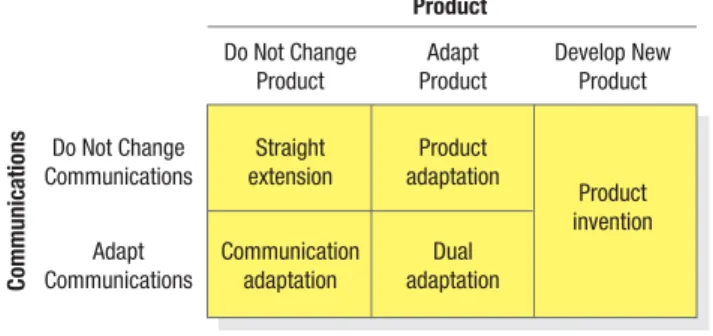
PRODUCT ADAPTATION STRATEGIES Warren Keegan has distinguished five product and communications adaptation strategies (see Figure 21.3).51We review the product strategies here and the communication strategies in the next section.
Straight extensionintroduces the product in the foreign market without any change. Tempting because it requires no additional R&D expense, manufacturing retooling, or promotional modifi- cation, it’s been successful for cameras, consumer electronics, and many machine tools. In other cases, it has been a disaster. Campbell Soup Company lost an estimated $30 million introducing condensed soups in England; consumers saw expensive small-sized cans and didn’t realize water needed to be added.
Product adaptation alters the product to meet local conditions or preferences. Flexible manufacturing makes it easier to do so on several levels.
• A company can produce a regional versionof its product, such as a Western European version.
Finnish cellular phone superstar Nokia customized its 6100 series phone for every major market. Developers built in rudimentary voice recognition for Asia, where keyboards are a problem, and raised the ring volume to make it audible on crowded Asian streets.
• A company can produce a country version. Kraft blends different coffees for the British (who drink coffee with milk), the French (who drink it black), and Latin Americans (who want a chicory taste).
• A company can produce a city version—for instance, a beer to meet Munich’s or Tokyo’s tastes.
• A company can produce different retailer versions, such as one coffee brew for the Migros chain store and another for the Cooperative chain store, both in Switzerland.
Some companies have learned adaptation the hard way. The Euro Disney theme park, launched outside Paris in 1992, was harshly criticized as an example of U.S. cultural imperialism that ignored French customs and values, such as serving wine with meals. As one Euro Disney executive noted,
“When we first launched, there was the belief that it was enough to be Disney. Now we realize our guests need to be welcomed on the basis of their own culture and travel habits.” Renamed Disneyland Paris, the theme park eventually became Europe’s biggest tourist attraction—even more popular than the Eiffel Tower—by implementing a number of changes and more local touches.52
Product inventioncreates something new. It can take two forms:
• Backward invention reintroduces earlier product forms well adapted to a foreign country’s needs. The National Cash Register Company reintroduced its crank-operated cash register at half the price of a modern model and sold substantial numbers in Latin America and Africa.
• Forward inventioncreates a new product to meet a need in another country.
Less-developed countries need low-cost, high-protein foods. Companies such as Quaker Oats, Swift, and Monsanto have researched their nutrition require- ments, formulated new foods, and developed advertising to gain product trial and acceptance.
BRAND ELEMENT ADAPTATION When they launch products and services globally, marketers may need to change certain brand elements.53Even a brand name may require a choice between phonetic and semantic translations.54When Clairol introduced the “Mist Stick,” a curling iron, in Germany, it found that mistis slang for manure. Brand slogans or ad taglines sometimes need to be changed too:55
• When Coors put its brand slogan “Turn it loose” into Spanish, some read it as
“suffer from diarrhea.”
• A laundry soap ad claiming to wash “really dirty parts” was translated in French-speaking Quebec to read “a soap for washing private parts.”
• Perdue’s slogan—“It takes a tough man to make a tender chicken”—was rendered into Spanish as “It takes a sexually excited man to make a chick affectionate.”
• Electrolux’s British ad line for its vacuum cleaners—“Nothing sucks like an Electrolux”—would certainly not lure customers in the United States!
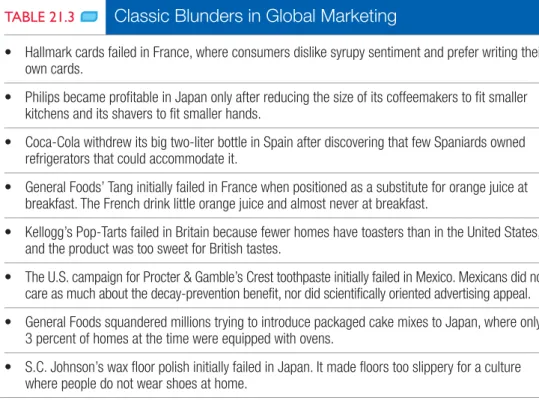
Table 21.3 lists some other famous marketing mistakes in this area.
Do Not Change Product
Adapt Product Product
Communications
Develop New Product Straight
extension
Product adaptation
Product invention Communication
adaptation Do Not Change
Communications Adapt Communications
Dual adaptation
|Fig. 21.3|
Five International Product and Communication Strategies
Disneyland Paris found greater success when it adapted more closely to the local culture and traditions in France.
Global Communication Strategies
Changing marketing communications for each local market is a process called communication adaptation. If it adapts both the product and the communications, the company engages in dual adaptation.
Consider the message. The company can use one message everywhere, varying only the lan- guage, name, and perhaps colors to avoid taboos in some countries.56Purple is associated with death in Burma and some Latin American nations, white is a mourning color in India, and in Malaysia green connotes disease.57
The second possibility is to use the same message and creative theme globally but adapt the execu- tion. GE’s global “Ecomagination” ad campaign substitutes creative content in Asia and the Middle East to reflect the cultural interest there. Even in the high-tech space, local adaptations may be necessary.58
Apple
Apple Computer’s highly successful “Mac vs. PC” ad campaign featured two actors bantering. One is hip (Apple), the other nerdy (PC). Apple dubbed the ads for Spain, France, Germany, and Italy but chose to reshoot and rescript for the United Kingdom and Japan—two important markets with unique advertising and comedy cultures. The UK ads followed a similar formula but used two well-known actors in character and tweaked the jokes to reflect British humor; the Japanese ads avoided direct comparisons and were more subtle in tone. Played by comedians from a local troupe called the Rahmens, the two characters were more alike and represented work (PC) vs. home (Mac).The third approach, which Coca-Cola and Goodyear have used, consists of developing a global pool of ads from which each country selects the most appropriate. Finally, some companies allow their country managers to create country-specific ads—within guidelines, of course. The challenge is to make the message as compelling and effective as in the home market.
GLOBAL ADAPTATIONS Companies that adapt their communications wrestle with a number of challenges. They first must ensure their communications are legally and culturally acceptable. Beer, wine, and spirits cannot be advertised or sold in many Muslim countries. Tobacco products are subject to strict regulation in many places. U.S. toy makers were surprised to learn that
TABLE 21.3
Classic Blunders in Global Marketing
• Hallmark cards failed in France, where consumers dislike syrupy sentiment and prefer writing their own cards.
• Philips became profitable in Japan only after reducing the size of its coffeemakers to fit smaller kitchens and its shavers to fit smaller hands.
• Coca-Cola withdrew its big two-liter bottle in Spain after discovering that few Spaniards owned refrigerators that could accommodate it.
• General Foods’ Tang initially failed in France when positioned as a substitute for orange juice at breakfast. The French drink little orange juice and almost never at breakfast.
• Kellogg’s Pop-Tarts failed in Britain because fewer homes have toasters than in the United States, and the product was too sweet for British tastes.
• The U.S. campaign for Procter & Gamble’s Crest toothpaste initially failed in Mexico. Mexicans did not care as much about the decay-prevention benefit, nor did scientifically oriented advertising appeal.
• General Foods squandered millions trying to introduce packaged cake mixes to Japan, where only 3 percent of homes at the time were equipped with ovens.
• S.C. Johnson’s wax floor polish initially failed in Japan. It made floors too slippery for a culture where people do not wear shoes at home.
Apple
in many countries (Norway and Sweden, for example) no TV ads may be directed at children under 12. To play it safe, McDonald’s advertises itself as a family restaurant in Sweden.
Firms next must check their creative strategies and communication approaches for appropriate- ness. Comparative ads, although acceptable and even common in the United States and Canada, are less frequent in the United Kingdom, unacceptable in Japan, and illegal in India and Brazil. The EU seems to have a very low tolerance for comparative advertising and prohibits bashing rivals in ads.
Companies also must be prepared to vary their messages’ appeal.59In advertising its hair care products, Helene Curtis observed that middle-class British women wash their hair frequently, Spanish women less so. Japanese women avoid overwashing for fear of removing protective oils.
Language can vary too, whether the local language, another such as English, or some combination.60 Many messages need adjustment because the brand is at an earlier stage of development in its new market. Consumer education about the product itself may then need to accompany brand development efforts.
• In certain developing markets in Asia, consumers loved the Coca-Cola brand but had never tasted it. They needed to be advised to drink it cold.61
• When launching Chik shampoo in rural areas of South India, where hair is washed with soap, CavinKare showed people how to use the product through live “touch and feel” demonstrations and free sachets at fairs.62
Personal selling tactics may need to change too. The direct, no-nonsense approach favored in the United States (“let’s get down to business” and “what’s in it for me”) may not work as well in Europe or Asia as an indirect, subtle approach.63
Global Pricing Strategies
Multinationals selling abroad must contend with price escalation and transfer prices (and dumping charges). Two particularly thorny pricing problems are gray markets and counterfeits.
PRICE ESCALATION A Gucci handbag may sell for $120 in Italy and $240 in the United States.
Why? Gucci must add the cost of transportation, tariffs, importer margin, wholesaler margin, and retailer margin to its factory price.Price escalation from these added costs and currency- fluctuation risk might make the price two to five times as much in another country to earn the same profit for the manufacturer.
Companies have three choices for setting prices in different countries:
1. Set a uniform price everywhere. PepsiCo might want to charge 75 cents for Pepsi everywhere in the world, but then it would earn quite different profit rates in different countries. Also, this strat- egy would make the price too high in poor countries and not high enough in rich countries.
2. Set a market-based price in each country. PepsiCo would charge what each country could af- ford, but this strategy ignores differences in the actual cost from country to country. It could also motivate intermediaries in low-price countries to reship their Pepsi to high-price countries.64 3. Set a cost-based price in each country. Here PepsiCo would use a standard markup of its costs
everywhere, but this strategy might price it out of markets where its costs are high.
When companies sell their wares over the Internet, price becomes transparent and price differ- entiation between countries declines. Consider an online training course. Whereas the price of a classroom-delivered day of training can vary significantly from the United States to France to Thailand, the price of an online-delivered day would be similar everywhere.
In another new global pricing challenge, countries with overcapacity, cheap currencies, and the need to export aggressively have pushed prices down and devalued their currencies. Sluggish de- mand and reluctance to pay higher prices make selling in these markets difficult. Here is what IKEA did to compete in China’s challenging pricing market.65
IKEA
IKEA has used market-penetration pricing to get a lock on China’s surging market for h