THE STRATEGY USED BY THE ENGLISH TEACHER TO IMPROVE STUDENTS’ WRITING ABILITY ON NARRATIVE
TEXT
(A Descriptive Study at the English Teacher SMP Negeri 7 Bulukumba)
SKRIPSI
TUTI ISMUDIATI 10535 5714 13
ENGLISH EDUCATION DEPARTMENT
FACULTY OF TEACHERS TRAINING AND EDUCATION MUHAMMADIYAH UNIVERSITY OF MAKASSAR
2017
ii
iii
iv
v
vi
vii
viii
MOTTO
Jika kita tidak pernah bersyukur atas hari-hari lapang dan menyenangkan, maka apa pantasnya kita mengeluh
pada tuhan saat kita sempit dan menyedihkan?
(Tere Liye) Sedangkan
Jika kalian bersyukur, niscaya aku tambahkan nikmatku untuk kalian .
(Qs. Ibrahim:7)
ix ABSTRACT
TutiIsmudiati. 2013. The Strategy Used by the English Teacher to Improve Students Writing Ability on Narrative Text. A Thesis of English Education Department, Muhammadiyah University of Makassar.
This objective of the study to identify and to investigate the teacher strategy in teaching writing narrative text that can improve students writing ability. The participant of the research was one English teacher of SMP Negeri 7 Bulukumba year 2017-2018. The researcher applied a qualitative descriptive design through structured interview is one of main point that used to find out the implementation of teacher strategy. Direct observation was used as a supporting to investigate the extent the implementation the strategy that improved student writing ability.
The research findings showed some strategies that used in teaching narrative. They are Mastery learning, Shared Writing Strategy, and Short Animate Story. English teacher most often used Shared Writing Strategy because it has several emerging themes as the teacher understanding of the roles of the teacher, teaching writing, and shared strategy. The teacher was able to instill in the students positive ideas about writing task and to boost the students‟ motivation in learning to write. Similarly, the strategy also motivated the teacher to invest her patient in seeking understanding the students‟ individual characteristic and learning style and to cope with the challenges and constrains during teaching of writing.
It can be concluded that shared writing strategy has suitable for students in learning. It is helpful students to understand and show progressing interest in classroom. It This study conclude with some suggestion about teaching writing to be considered for further research in the future.
Keywords: Teaching Writing, Narrative Text, Strategy, Teacher Competence, Teacher Strategy, Teacher Performance.
x
ACKNOWLEDGMENT
In the name of Allah, Most gracious, Most Merciful.
Alhamdulillah Rabbil A‟lamin, the researcher expresses thank you very much for the gratitude Allah Subhaanahu Wa Ta’alafor blessing and mercy on the researcherduring the process until the finished this thesis. Shalawat and Salam are addressed to the final, chosen, religion, messenger the prophet Muhammad Sallalahu Alaihi Wasallam, who has given him the best everything to complete the whole process of this work.
The researcher would like to profound and gratitude to her beloved mother, her stepfather, and her sister, her stepfather is Arman and her mother Nursia for their blesses, prayers, financial, motivation, and sacrificed and also for all of her big Family for their support, love and care.
The researcher realized that many people had given their helped and useful suggestion for the finishing of this thesis. Without the assistance of them, this thesis would never have existed. Therefore, the researcher would like to say thank you very much for the people who gave spirit, advice, suggestion, and helping to the researcher to the write as follows:
1. Dr. H. Abd Rahman Rahim, SE.,MM. The Rector of Muhammadiyah University of Makassar.
2. Erwin Akib, S.Pd.,P.Hd. The Dean of Training and Education Faculty.
xi
3. Ummy Khaeraty Syam, S.Pd.,M.Pd. The Head of English Education Department FKIP Muhammadiyah University of Makassar.
4. The researcher high appreciation and great thankfulness to Ummy Khaeraty Syam, S.Pd., M.Pd, as first consultant and Nunung Anugrawati, S.Pd.,M.Pd, as the second consultant who have given their valuable time and guidance to finish this thesis.
5. Specially thanks to all lectures of the FKIP Muhammadiyah University of Makassar especially of the English Department for their guidance during herstudy.
6. Headmaster of SMP Negeri 7Bulukumba, kabupaten Bulukumba,especially for Irmayanti, S.Pd as the English teacher and students of SMP Negeri 7 Bulukumba, kabupaten Bulukumba.
7. Specially for herclassmate Innovation Class and special for (Surni Eriyana, Reni Nurjayanti, risma Bakkalang, Resky Novianti, Puspa Amelia, Ayulia Cam, Hadriana Ismail, Inayatul Mutmainnah, Andi Sri Atira, Sri Wahyuni, Riri Aprianti, Nurlinda, Nurmila,Wahyu Risaldi, and Muh. Akbar Ikramullah)that given support and love starting from the first semester until finished this thesis. All the members of the students English Department that could not be mentioned one by one.
8. Specially for her best friends that always gave motivation and entertain the researcher when she fell down, of course for this close friends (Mely Ambarwati, Fira Afriani, Avianti, and aufit).
xii
The researcher realized that this thesis still have not been perfect yet.
Therefore, a constructive criticism will be appreciated. May Allah bless us forever. Amin
Billahi Fii Sabilil Haq Fastabiqul Khaerat
Makassar, Desember2017 The Researcher
Tuti Ismudiati
xiii
TABLE OF CONTENTS
Page
TITLE PAGE ... i
APPROVAL SHEET ... ii
COUNSELLING SHEET ... iii
SURAT PERNYATAAN ... iv
SURAT PERJANJIAN ... v
MOTTO ... vi
ABSTRACT ... vii
ACKNOWLEDGEMENT ... viii
TABLE OF CONTENTS ... ix
LIST OF FIGURE ... xii
CHAPTER I : INTRODUCTION A. Background ... 1
B. Problem Statement... 2
C. Objective of the Research ... 3
D. Significance of the Research ... 3
E. Scope of the Research ... 3
CHAPTER II : REVIEW OF RELATED LITERATURE A. Preview of Related Literature ... 4
B. Teaching ... 6
C. Writing ... 7
xiv
D. Strategy ... 13
E. Conceptual Framework ... 19
CHAPTER III : RESEARCH METHOD A. Research Design ... 21
B. Research Subject ... 21
C. Research Instrument ... 22
D. Technique of Data Collection ... 22
E. Technique of Data Analysis ... 23
CHAPTER IV : FINDINGS AND DISCUSSION A. Findings ... 25
B. Discussion... 33
CHAPTER V : CONCLUSION AND SUGGESTION A. Conclusion ... 47
B. Suggestion ... 48 BIBLIOGRAPHY
APPENDICES
CURICULUM VITAE
xv
LIST OF FIGURE
FIGURE 2.1 Conceptual Framework ... 19
FIGURE 4.1 Students Writing ... 26
FIGURE 4.2 Students Writing ... 28
FIGURE 4.3 Students Writing ... 30
CHAPTER I INTRODUCTION
A. Background
Writing is one of the four language skill that can use as a communication tool and to express people ideas on a paper become sentences. Lines (2006) Writing is a combination of process and product of discovering ideas, putting them on paper and working with them until they are presented in manner that is polished and comprehensible to readers. Writing is also a process of communicating the writer‟s idea to the reader in a written form. The ideas will be in a sentence, a paragraph and a text. There are some texts to gather the ideas such as descriptive text, recount text, and narrative text.
A narrative text is a story that purposes to tell the series of events or people experience and to entertain the readers. Zuhri (2013:2 ) state that narrative is a type of essay that tells a story or a series of events in which they occur. Its purpose is to give meaning to an event or a series of events by telling story.
Furthermore, a writer should be able to write interesting stories to entertain the reader.
Based on the observation did by researcher that many students got problems in expressing their ideas, opinion, and feelings. One of possible reason for this phenomenon was because the students had to write the text in English as their foreign language. Another possible reason was because they did not know what they were going to write and how to start writing. In teaching writing, a
2
teacher should be able to encourage students to write. For EFL (English as a foreign language) students, writing in English is a significant challenge so that they feel difficult to write a text based on what they think in their mind. Because writing is the difficult activity for students especially in junior high school.
Therefore, in this research, the researcher interested to know what strategy that teacher used and the researcher focused on the teacher‟s side.
English in teaching writing especially narrative text certainly has a strategy.
The strategies used did indeed provide progress in the ability of students to study.
In applying the teaching of writing, a teacher should be able to encourage his students to understand, remember, explore, and expand what is learned so that writing can be a means to help and improve student learning.
Based on the previous description, the researcher interested to identifying
”The Strategy Used By The English Teacher To Improve Students’ Writing ability on Narrative Text”. Beside the researcher conducted in The Teacher‟s of SMP NEGERI 7 BULUKUMBA
B. Problem Statement
Based on that statement on the background above the writer formulated the following problem statement!
1. What are the teaching strategies used by the English teacher in teaching writing narrative text?
2. What is the teaching strategy used by the English teacher to improve students writing narrative text?
3 C. Objective of the Research
1. To identify the English teacher strategies in teaching writing.
2. To investigate the strategy that improves students writing ability especially in narrative text.
D. Significant of the study
The significances of this research are:
1. For Teacher, this research was expected that the teacher knew which strategies that most suitable to be applied in teaching writing especially in narrative.
2. For Students, this research was expected that the students could be more active in developing their activity in writing.
3. For the researcher, this research expected to be a great experience to face the future when she/he became a real teacher.
4. For other researchers, this study was expected to be one of references for relevant researches.
E. Scope of Research
The scope of this research was the researcher focused on the teacher strategies namely pedagogical competence. Aspects of pedagogical competence, they are understanding the learner in depth, designing lesson, implementing learning, designing and implementing learning evaluation, and developing learner to actualize their various potential.
4 CHAPTER II
REVIEW OF RELITED LITERATURE
A. Previous Study
There are some previous researches conducted by researcher was an attempt to investigate teaching writing to improve writing ability the students.
1. A thesis that written by Wijayati (2014) stated that teaching second language writing is teacher as the central part in teaching writing learning process must develop a set of steps to assist student in second language writing, teacher, therefore, has to facilitate the students through a variety of interactions in writing and writing instruction as well.
2. Mulyaningsih(2013) stated that teachers should apply specific approaches and techniques in teaching writing to improve students‟ ability particularly in narratives. Moreover, the teachers need to put more effort in teaching low achiever since they need more guidance in writing narratives.
3. Research entitled The Writing Process and Process writing written by Seow (2002:319). Gives some pointers for teachers in implementing teaching writing, those are :
1) Teacher modeling, means that the teacher should model the writing process at every stage and teach specific writing strategies to students through meaningful classroom activities.
4
5
2) Relating process to product means that the teacher guides students in achieving specific writing goals. Although students have to make different draft from the earlier draft because of revision, they will begin to understand the result expected in every stage.
3) Working within institutional constraints means that teaching the process skill can be done through stages such as planning drafting, responding, revising or editing within a regular two-period composition lesson. Process skill can be repeated until it reaches the improvement
4) Catering to diverse students needs, means that the teacher should implement a flexible programmed to cater to different student needs. The teacher may also decide to have students enter into different writing groups as planners, drafters, responders, revisers or editors during a writing session. A student may be with the planners for one writing task, but move to be with the editors later for the same or another task, according to his or her need or developmental stage in writing.
5) Exploiting the use of computers in process writing. that teaching writing in responding or editing stage, the teacher can use computer and OHP. By using computer, students will easily delete the wrong words and replace them without writing other words in a text anymore.
Based on the explanation above it can be conclude that teachers as a facilitators must be able interesting their students to writing narrative with various way. Teaching writing don‟t easy to do, so that, the teachers have to has techniques, methods, or models when teaching students in classroom.
6 B. Teaching
a. Definition of Teaching
Teaching can be viewed from two different paradigms, the old paradigm of teaching and new paradigm. The old paradigm focuses on keeping students on the teacher‟s toes (cox,2012) In which students are explores with set of strict instruction. Edwards, et.al (2007) also adds that old teaching habits consider the teacher as the expert he or she is center of knowledge who can make list of desirable communication behaviors and responsible for the primary communication to the students. On the other hand, the new paradigm teaching focuses on providing someone with opportunity t learn, it is opportunistic process (Parkay, 2010).
Teaching is the process of attending to people‟s needs, experiences and feelings, and making specific interventions to help them learn particular things.
Interventions commonly take the form of questioning, listening, giving information, explaining some phenomenon, demonstrating a skill or process, testing understanding and capacity, and facilitating learning activities (such as note taking, discussion, assignment writing, simulations and practice).
Wijayati (2014) asserts the teaching should enable the teacher to help students by providing opportunities of learning to gain knowledge in a set of activities through effective communication.Brown (2000) asserts that teaching is guiding and facilitating learning, enabling the learner to learn, and setting the conditions for learning. Richard and Farrell (2005) highlight that teaching is a
7
complex cognitive activity and focuses on the nature of teachers‟ belief and thinking and how these influence their teaching and learning.
b. Role of Teacher
In teaching process a teacher still plays some important roles. For most, people, a teacher is mostly describe as a person who teaches students in classroom. Students frequently consider their teacher as the source of knowledge since the teacher is older than them. The teacher does not merely give all knowledge or materials for students in classroom, but they are also suppose to become a facilitator or a motivator for their students (Harmer, 2008).
According Harmer(2001:57), a teacher is no longer the giver of knowledge, the controller, and the authority, but rather a facilitator and a resource for the students to draw on. it means that students become the center of teaching process. The student should be able to develop their competence for teacher‟s help, but develop mostlyby their own experience.
Tylee (1999:48) asserts that the teacher who is a variable outside the classroom context, is charged with the function of acting as an intermediary between the variables outside the classroom and the students to assist the students in their learning.
C. Writing
a. Definition of Writing
Writing is also one of the ways to communicate the writer‟s is the integrating part in learning process, because writing is one of the language skills that have to be mastered by the students as a medium of intellectual
8
communication. Writing is a developmental process that each students can successfully experience at different levels when it‟s approached systematically.
Agusta(2015) states that writing skill is an ability to communicate all the ideas or imaginations into form of structured pattern so that the reader may understand what the writer mean in their writing. Nura(2003:71) says that writing is an activity. Writing is not merely symbolize spoken language. Writing is a person‟s way to express him/herself and to adapt with the society. Through writing, readers will understand the writer‟s way thinking. It means that writing can be a reflection of the writer‟s mind.
Furthermore Randal (2004:160) stated that writing is an ability to make a form of words that it has set it down. It means that the product of writing should be truly acceptable by the readers. Besides, it must contain meaningful values so that the readers can get the benefit from writing. Meanwhile, Sudaryanto (2001:64) says that writing is a person‟s ability to express his/her mind and feeling which is expressed in a written language, in graphic symbols so that the readers are able to understand the message inside.
In addition Harmer (2004:86) states that writing is a process that what we write is often heavily influenced by the constraints of genres, then these elements have to be present in learning activities. It means that writing cannot be separated with genres especially in teaching learning activity of writing.
9 b. Writing Text
1. Kinds of writing text
Dalman (2016) The term “genre” is used to refer to particular text types. It is a type or kind of text defined in terms of its social purposes, also the level of context dealing with social purpose. Genre is a term for grouping texts together, representing how writers typically use language to respond to recurring situations. There are many kinds of genres (text type). They are:
a) Recount
It is a kind of genre that social function to retell event for the purpose of informing people entertaining.
b) Report
Report is a kind of genre that social function to describe the way things are with reference to range of natural, man-made and social phenomena in our environment.
c) Narrative
Narrative is a kind of genre that social function to amuse, entertain and to deal with actual or vicarious experience in different ways.
Narratives deal with problematic events which lead to crisis or turning point of some kinds, which in turn finds a resolution.
d) Description
It is a kind of genre that social function to describe a particular person, place, or thing. socio cultural phenomena.
10 e) Procedure
Procedure is a kind of genre that social function to describe how something is accomplished through a sequence of actions or steps.
2. Narrative text
Narratives are stories about person or a group of people overcoming problems (joyce, 2000,p.24). They also explain that narratives show how people react to experience, explore social and cultural values and entertain the audience. It aims to entertain, to get and retain the attention of the reader or listener of the story (Derewianka, 1990).
According to Ayres (2008), narrative texts are a form of discourse that has been fixed by writing. Anderson and Anderson (1997: 8) say that narrative text is a piece of text which tells a story and in doing so entertains and informs the reader or listener. Meanwhile, Permana and Zuhri (2013: 2 ) state that narrative is a type of essay that tells a story or a series of events in which they occur. Its purpose is to give meaning to an event or a series of events by telling story. From these statements it can be inferred that narrative texts is concerning with a story. The story includes some events which is presented to amuse the readers or listeners. So, written narrative texts are aimed to entertain the readers.
c. TeachingWriting
Harmer (2004) In teaching writing, the teacher should be able to make the students write their ideas well. The teacher should consider writing skills that the students have to master.
11 a) Reason of Teaching Writing
There are four reasons for teaching writing to students of English as foreign language. First is reinforcement: Some students acquire language in a purely oral or aural way, but most of students‟ benefit greatly from seeing the language written down. The visual demonstration of language construction is invaluable for our understanding of how it all fitstogether and as an aid to committing the new language to memory. Students often find it useful to write sentences using new language shortly after they have studied.
Second is language development: Students improve their writing mainly through writing itself. When they are writing, they construct proper written text to be adventurous with the language. Third is learning style:
Some students are able to find easier to pick up language just by looking and listening. By writing, they have much time to think things and to produce language in slower way. Writing is appropriate for learners. It can also be a quiet reflective activity instead of the rush and bother of interpersonal face-to- face communication.
Fourth is writing as a skill: Writing is as important as speaking, listening, and reading. Students need to know how to write letters, how to put written report is together, how to replay to advertisements and increasingly, how to write using electronic media. They need to know some of writing‟s special convention (punctuation, paragraph construction etc).
12 b) Teacher Role in Writing
Writing is an essential skill in students` everyday lives and that makes it a really important aspect of their teaching. Students need to know how to take notes as well as how to write essays and letters, which makes this basic skill as important as speaking or listening. Writing skills are important because they are a good way to reinforce what a student has learned as they will benefit from seeing new vocabularies or words can be a paragraph.
Teacher, in that case needs to be responsive to the classroom situation in order to take an accurate measure. When helping students to become better writers, teachers have a number of crucial tasks to perform.
There are numbers of crucial tasks to perform. First is demonstrating, teachers need to be able to draw about writing convention and genre constraints in specific types of writing to their attention. In whatever way students are made aware of layout issues or the language used to perform certain written functions. The second is motivating and provoking, students often find themselves lost for words, especially in creative writing task. This is where the teacher can help provoking the students into having ideas, enthusing students with the value of the task, and persuading them what fun it can be. The teacher goes into class with prepare suggestions, so the students can immediately get help rather than they think ideas by themselves.
Third is supporting, students need to a lot of help and reassurance once they get going both with ideas and with the means to carry them out.
Teachers need to be extremely supportive when students are writing in the
13
class, always available and prepared to help them overcome difficulties.
Fourth is responding, when responding, teachers react to the content and construction of a piece supportively and often make suggestion for its improvement. When teacher responds to a students` work at various draft stages, he/she tells the students how well it is going so far.
The last is evaluating, there are many occasion, however, when the teachers do to evaluate students` work, telling both them and us how well they have done. All of teachers want to know the students achievement.
When the teacher evaluates students` writing for test purposes, he/she can indicate where they wrote well and where they make mistakes.
D. Strategy
a. Definition of Strategy
Sanjaya (2006) states in education world that , the strategy is as “a plan, method, or series of activities designed to achieves, a particular educational goal;
thus a strategy of learning can be interpreted as a planning containing in the design to reach a certain education. Mely (2015) says that planning the ways that will be used by the teacher in the learning where in the learning process focused on student activities. The selection is done with consider the situation and condition, the source of learning, need and the characteristics of learners faces in order to reach the learning objectives are effective and efficient.
Djamarah (2006) suggests that the general strategy is "an outline of the bow to act in an effort to achieve a predetermined goal." According to Hamalik (2001) the definition of teaching strategy is: "overall methods and procedures that
14
focus on the activities of students in Learning process to achieve certain goals."According to Uno (2009) own understanding of learning strategies are:"
The ways that will be used by the teacher to choose the learning activities that will be used during the learning process. The selection is made by considering the circumstances, Learning resources, needs and characteristics of learners encountered in order to achieve certain learning objectives”
b. Kinds of Strategy in Teaching Writing 1. Shared writing strategy
Shared writing strategy offers an opportunity that allows the teacher to model good writing for his/her students (Booth & Swartz, 2004). Shared writing is a joint writing strategy in which both tutor and learners contribute to the plan, the ideas, and the language of the text they construct together (tertiary Education commission, 2009). The teacher begins the teaching writing by gathering the students around an easel and starts a discussion about a shared experience
Shared writing strategy facilitates students to model good writing from the teacher. it establish an activity in which students are gathered around an easel and start a discussion about shared experience that they are studying now or ever experience before. Student can benefit from practice at writing about the result of their own research, as well as expressing their own feeling and experiences (Wijayati 2014)
15 2. Mastery Learning Strategy
Anderson (1982) Mastery Learning Strategy is advised that educator desiring to plan and implement mastery learning strategy in school and classroom mush accomplish 4 major tasks, such as defining mastery, planning for mastery, teaching for mastery and grading for mastery. Defining mastery is teacher related to identification of the most essential, critical course outcomes or objective. Preparation the final, summative test is functions to assess the degree of student learning over the entire course and to evaluate the overall quality of students learning. The entire course is divided into a series of smaller learning unit. Te unit are sequentially arranged so that the facts, concept, principle, skills and appreciations acquired in one unit are used over and over again in subsequent unit.
Planning for mastery includes the designing of plan for helping students acquire the objective of each unit such activities and materials. Planning helps teachers to monitor student learning on a unit-by-unit basis. The evidence gathered from formative tests helps the teacher to take necessary steps to overcome the errors and misunderstandings identified by the tests. Teaching for mastery is function of the teacher is to specify what is to be learned, to motivate pupils to learn it, to provide them with instructional materials, to administer these materials at a rate suitable for each pupil, to monitor student's progress, to diagnose difficulties and provide proper remediation for them, to give praise and encouragement for good performance, and to give review and practice that will maintain pupil's learning over long periods of time.
16
Grading for mastery, function of grading in mastery learning process is to reward students for the acquisition of the essential, critical course objectives.
Thus grades are assigned to students based on their performance on the summative test relative to the pre-determined performance standard, not based on their performance relative to the performance of other students.
3. Short Animated Story
Agusta (2015), animated stories are stories which are presented in the form of animation. It means that the stories are displayed in moving pictures to help the viewers understand the stories. Using animation as a tool to encourage and develop children‟s learning is not only fun but effective. It means that the students will enjoy the teaching learning process when the teacher uses animation because it is more interesting. The brochure also states that by using animation, children develop skills competencies in storytelling, visual communication, cognition, emotional, ethic and aesthetic aspects, observation, and sensory aspects, concentration, problem-solving and innovative aspects.
Additional, animation is a good choice to develop students‟ competence.
So, it can be seen that in story telling in the form of written language, animated stories are the most interested media for young students or junior high school students. Besides, animation is very helpful for teachers to motivate students in learning and to improve students‟ imagination or creative mind. Meanwhile, the teacher should choose an appropriate animation and he or she should consider the duration. Short animated stories, therefore, are the most effective media to use.
17
Gartenberg in Miller (2003: 1) defines animation as “the arts, techniques and processes involved in giving apparent movement and life to inanimate objects by means of cinematography”. In line with the definition, Gonzales in Betrancourt (2005: 287) defines animation as “a series of varying images presented dynamically according to user action in ways that help the user to perceive a continuous change over time and develop a more appropriate mental model of the task”. Meanwhile, Wright in Sulaiman (2012: 1) states that the words animate comes from the Latin verb animate, meaning “to make alive or to fill with breath.” In animation we can completely restructure reality. It means that animation is a moving picture which seems to be alive. So, 20 when watching animation, viewers feel that they are seeing living creatures in reality like in a movie. From the definitions, it can be concluded that animated stories are stories which are presented in the form of animation. It means that the stories are displayed in moving pictures to help the viewers understand the stories.
c. Teacher Competence
Competencies are defined as “the set of knowledge, skills, and experience necessary for future, which manifests in activities” (Katane et. al. 44). Gupta (4) define competencies as “knowledge, skills, attitudes, values, motivations and beliefs people need in order to be successful in a job.”The regulation of the minister of national education Indonesia Republic (2007) on academic qualification standards and teacher competencies, as for the various
18
competencies that must be owned by teacher include : pedagogic, personality, professional and social competence.
Keymet (2010) Pedagogic is the teachers‟ ability in management of learning for the benefit of learners. Aspects of pedagogic competence, they are : 1. Understanding the learner in depth understands learners by utilizing the
principles of cognitive development; Understand learners by utilizing the principles of personality; and identify the initial teaching supplies of learners.
2. Designing lesson understands the educational foundation for learning needs has an essential indicator: understands the educational foundation; Apply learning and learning theory; Determine learning strategies based on the characteristics of learners, the competencies to be achieved, and teaching materials; As well as drawing up a learning plan based on the chosen strategy.
3. Implementing learning is setting the learning setting; And conducting conducive learning.
4. Designing and implementing learning evaluations is designing and executing continuous evaluation of processes and learning outcomes with a variety of methods; Analyzing the results of process evaluation and learning outcomes to determine the mastery learning level; And utilize the results of the assessment of learning to improve the quality of the general learning program.
19
5. Developing learners to actualize their various potentials, facilitating learners for the development of academic potentials; and facilitate learners to develop various non-academic potentials.
E. Conceptual Framework
This part presented the framework used in this study. It connected and covered the related theories which lead conceptual of the strategy in teaching writing that used by the teacher. This part also stated the answer to the research question that is determined tentatively. Teaching writing strategy is planned that used by the teacher to teach writing to the students. The purpose of using strategy is to find an easy and interesting way of teaching writing. The strategy can also make the learning process more effective
20
`
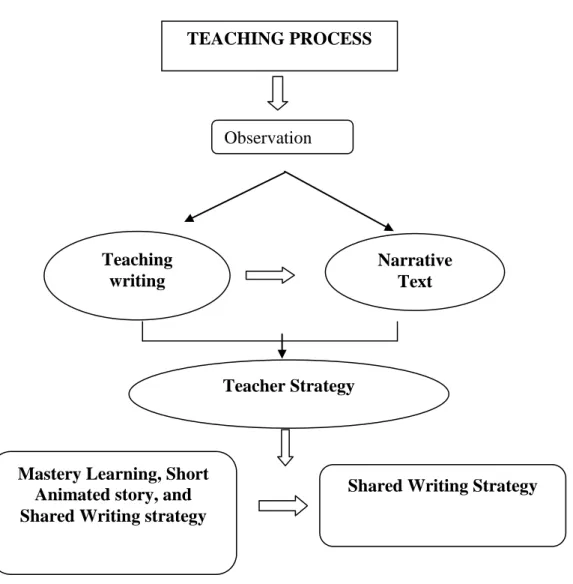
Figure 2.1.The researcher conceptual framework.
The researcher identified teacher strategy in teaching writing especially in Narrative text. So that, to know the teacher strategy, the researcher identified with using observation and interview toward the process. On teaching and learning process the researcher would be observed the teacher in teaching writing narrative text. And then, the researcher would be interview about the teacher strategy that applied in teaching writing.
TEACHING PROCESS
Observation
Narrative Text Teaching
writing
Teacher Strategy
Shared Writing Strategy Mastery Learning, Short
Animated story, and Shared Writing strategy
21 CHAPTER III RESEARCH METHOD
A. Research Design
This research included field research which was qualitative with descriptive method. The reason for choosing descriptive method because this research was aimed to obtain information about symptom status at the time of the research, ie field research conducted at SMPN 7Bulukumba, Gantarang Sub-district, Bulukumba District. In field research, all objects are basically in the field.
This research approach used qualitative approach. Qualitative research was a study that produces analytical procedures that did not used statistical analysis procedures or any other quantification method. Qualitative approach was used because it can reveal the data in depth about: 1) the strategy used by the English teacher as an effort to improve students' writing skills, especially on the type of narrative text in SMPN 7Bulukumba 2) the application of the strategy used by the English teacher as an effort to improve students writing skills especially on the type of narrative text in SMPN 7Bulukumba whether the strategy succeeded in improving students' writing skills or not.
B. Research Subject
The English teacher at SMP Negeri 7 Bulukumba.The number of participants was one English teacher. The teacher was woman. The participant of this study was Mrs. I. she was one of English teachers in SMP Negeri 7
22
Bulukumba. She has been teaching English since 2011 after finishing her study in English department. She chose English as her major because she liked it. The participant was hoped to provide complete and various data needed in the research.
C. Research Instrument
The researcher acted as a research instrument supported by structured interviews, namely in conducting interviews, the interviewer bought structured interview questions and only an outline of the things that will be asked. Then, subject observation conducted by an observer and the last was documentation that investigates written objects such as students writing, documents, regulations, photographs and Etc.,
D. Technique of data collection
For the process of the research, to attain comprehensible description of phenomenon, classroom observations, interviews, and document. To find out the data require, firstly gather the data that the researcher have. Then the researcher arranged the data well, this data source would be analyzed, identified and discussed.
1. Observation
The observation do at SMPN 7 BULUKUMBA. These observations made in the area of the school and in the classroom, where the researcher examined the situation of students and teacher in teaching and learning process and examined strategies used by the English teacher to improve students‟ writing. These observations were targeted at discovering information on whether the teachers‟
23
action in the classroom were in accordance with the teacher statements in the lesson plan.
2. Interview
In this process, the data attached relate structured interview. The interviews were the main data resourced that used to describe and interpreted the implementation of strategy in teaching writing used by the teacher. During the interviews, the researcher took notes in the event with the way record. To conduct the interviews, the researcher used structured interview based on the outline of the things that will be ask.
3. Documentation
In this documentation attached the data related to this study. The documents needed namely the lesson plans of the participant. These documents were essential to know whether the teacher actions in the classroom were in accordance with the lesson plans.
The data was obtained from a sequence of teacher stories, her teaching practices, and observation of classroom situation. The sources of text were (1) one teacher as the participant of the research, (2) recorded in interviews, (3) classroom actions of the participants, and (4) documents. In brief, the interviews , observations, and documents are sources of data
24 E. Technique of data analysis
In analyzing the qualitative data, the researcher did some proposed by burns (2010: 104-105).
1. Assembling the data. In this step, and start to look for broad patterns, ideas, or trends seem to answer the question.
2. Coding the data. In this step, the researchers grouped the data into more specific categories and identify which data were qualitative.
3.
Comparing the data. In this step, the researcher compared the categories of different sets of data to see whether the data said the same thing or whether there were contradictions.4. Reporting outcomes. In this step, the researcher described the context of the research, outlining findings, and considered how she would organize the whole research not only the analysis and findings
25 CHAPTER IV
FINDING AND DISCUSSION
This chapter deals with the findings and discussion of the research.
The finding of the research consist the description of data analysis result. While, the discussion deals with the board explanation interpretation of the research findings.
A. Findings
The data that had been collected by using observation and structured interview are explained in this part. The finding of this research is about the teachers‟ strategy in teaching English that improve writing ability of students.
1. The English Teachers’ Strategies In Teaching Writing Narrative Text The teacher who taught English at SMP Negeri 7 Bulukumba. Based on the observation and interview, the researcher found that the teacher applied three types strategy of teaching writing narrative text. She used that strategies based on the students need in every meeting. The types of strategies that used by the English teacher were Mastery Learning, Shared Writing Strategy, and Short Animated story.
Actually, I used some strategy when I teach narrative text. They were 1). Mastery learning, 2) shared writing strategy, and 3) short animated story.
Extract 01: teacher interview result
25
26 a. Mastery Learning strategy
1. Finding of Mastery Learning Strategy
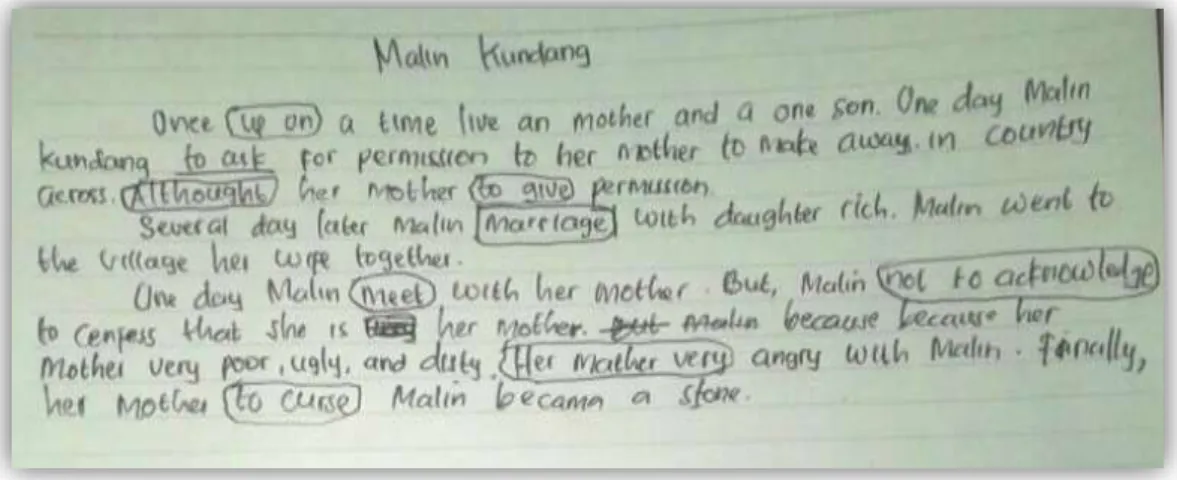
Mastery learning was one of strategy used by the teacher when teaching writing on narrative. Based on the figure 02 above showed, teacher used the mastery learning strategy. Mastery learning applied to improve students‟ ability especially on writing narrative text.
Teacher used mastery learning when teaching narrative text. Where teacher given instruction to students with the way teacher asked to make a paragraph into a good narrative without explained how to write a narrative, like its generic structure, what tenses used. So that, students felt difficult in how start write. The language use of every student was poor in writing. They didn‟t know to make a story with the generic structure of narrative text. They often jumped from one event to another that made the story become confusing and also disconnected.
Figure 4.1: Students writing narrative text
27
The explanation above the researcher can stated that this strategy did not improve ability of the students. Because from the result of the students‟
writing above showed that most of the students had many problems in writing narrative text. They also showed many mistakes in terms of organization and vocabulary. Mistakes of students showed in their writing in vocabulary like
“upon” they wrote “up on”, or they also written double words which same meaning “to acknowledge and to confess” in one sentence at third paragraph.
Besides mistakes on vocabulary, the also has mistakes on tenses. For example
“meet” word, they should wrote “met” because ”met” is past tense whereas students written were present tense.
The event above occurred because on this strategy teacher didn‟t explain about what tenses used in writing narrative or how to write good word.
Here teacher only asked student write a good narrative in paragraph without explained the detail the narrative and teacher also must explained the story which students would wrote.
2. The Advantages and disadvantages
The advantages of mastery learning is the teacher chill out when learning teaching process because only given instruction to students then students did the assignment or wrote narrative paragraph. And disadvantages of this strategy is the students‟ didn‟t improve writing ability because the students don‟t know how and what should they wrote on their paper.
28 b. Short animated story
1. Finding of Short Animated Story
Short Animated story also used by the English teacher in teaching writing process. This strategy mentioned when interview result. The table above was proof that teacher also used short animated story in teaching writing. This strategy used to help the teacher and students when learning teaching process.
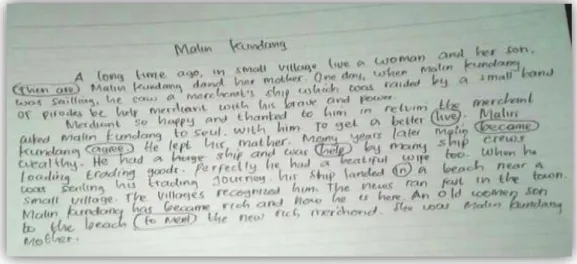
Many students had a limited vocabulary and still many errors of word choice in their sentence. But, different with the first strategy, animated story could be make students writing a bit better.
Figure 4.2: students writing narrative text
It can be seen that students writing had not a lot of problems were displayed. The language use of the students was also rich in vocabulary, used words correct. It means that this strategy really can motivate students in express their ideas. Besides, it helped the teacher as a facilitator, motivator in achieve the goals. So, it can be said that animated story strategy improved students‟ ability in writing.
29
The students writing result above can be said that only a few words wrong in writing. For instance at line 2 in the first paragraph students wrote
“then are” but actually the true word is “they are”. Beside words wrong, there were mistakes tenses used. For instance at line 4 at paragraph 2 “help”, actually the true word “helped” and auxiliary verb “was” don‟t use again. Same cased
“become”, “to meet”. But, the students writing result on this strategy is good enough because word sequence and plot of the story be better then mastery learning. For junior high school the use of vocabulary was quite a lot.
Figure above occurred because when applying short animated story strategy, teacher given an explanation what will they write and about what to students before instruct to do the task. And displaying the story what story will discuss at the time. It can be seen the result of students‟ writing only a few of words wrong.
2. The Advantages and Disadvantages
The advantages of short animated story are very helpful for teachers to motivate students in learning and to improve students‟ imagination or creative mind. Meanwhile, the teacher should choose an appropriate animation and he or she should consider the duration. Short animated stories, therefore, are the most effective media to use. Meanwhile, the disadvantage of this strategy is taken much time.
30 c. Shared writing strategy
1. Finding of Shared Writing Strategy
The last strategy was shared writing strategy. It used to measure students‟ ability and to achieve teacher goals. Because, a teacher hoped expect the students clever in writing English especially in narrative. It also mentioned in interview like two strategies before.
In the implementation of the strategy, students displayed good respond with listening. So that, they had good writing as like as the grammatical, words spelling, words sequence.
Figure 4.3: students writing narrative text
Shared writing almost same with the second strategy, it helped the students to add and to develop their knowledge. Because, Mrs. I narrate some stories to students. In addition to remind the students was known the story or students wasn‟t known, it also given inspiration to students.
The mistakes that owned of students when teacher applied this strategy only on mistype word. It can be seen on the figure above, for example in
31
the first line at the first paragraph there is “girls” and should only “girl” because there is a previous article a and auxiliary verb was. The other mistake in first line at second paragraph “Cinderella father” and actually students should add s in Cinderella word like “Cinderella‟s father”. It can be seen from figure 4.3 above that word sequence and tenses were corrected, and use of vocabulary also too much.
Additional, it happened because the teacher was more talk than the students. So that students just hear the teacher explained the lesson. If there weren‟t know, it will discussed by teacher directly.
2. The Advantages and Disadvantages
The advantage of shared writing strategy is helpful the students to understand what they learn because teacher have a role more than the students in learning. And disadvantage of this strategy is the students don‟t speak much and only hear then writing.
The data findings above that the strategies used when the teacher taught in the first meeting as attempt whether the strategy suitable with students.
Among of the strategies, she most often used shared writing strategy because this strategy modeled how to clarify ideas, choose appropriate vocabulary, draws on language and text knowledge to compose and revise text, and helped students to do several activities. Besides, she worked with students to organize the ideas and plan an outline.
The explanation above supported by the result of the teachers‟ interview and observation in the class. The teacher said that she used or applied a strategy
32
that made the students more active in writing. She applied shared writing strategy because this strategy created an affinity to each student until students able to express their idea in the paper. She always applied the strategy in order to make class life. According the teacher, the students like the strategy more than the others strategies. Because the strategy made them more active in the classroom.
2. The Teacher Strategy improved students’ achievement in narrative text According to the observation result, the teacher said that the students‟
response when she applied Shared Writing strategy more interest, make students more active and enthusiast of express their ideas. As a teacher, she had an intention to good things to the students. One of good things was knowledge about English because she believed that English was important for the students‟
future. English could be used as a means to communicate with people around the world especially in writing narrative. Some students did not have an opportunity to speak or they didn‟t confidence speak in public residents.
During the teacher taught writing narrative text, she had believed with Shared Writing would help her as a teacher to teach writing to students. Since she had understanding about students‟ characteristics, she believed that students‟
needed to listen. The objective of her action was to provide a description of narrative text to the students. Before she taught her students she also studied before come to the class, because mastering lesson would be achieved the main purpose.
33 B. Discussion
In this part represent the board explanation about the research finding.
There were two research findings; they were the teacher strategies in teaching writing narrative text, and the teacher strategy that improved students‟ writing ability. The following part is the participant intention and action of teaching writing narrative. It could be seen from the explanation below:
1. The Teacher Strategies in Teaching Writing Narrative Text based on the Direct Observation and interview that Found by the Researcher are:
As stated before that there were three strategies that applied by the English teacher in teaching writing narrative text at SMP Negeri 7 Bulukumba.
They were Mastery Learning, shared writing strategy, and short animated story.
The details explanation about the three strategies based on direct observation with used field notes below.
a. Mastery Learning Strategy (MLS)
The first strategy was mastery learning. The important to pay attention to the facts on the teaching learning process of writing in class IX C based on the observation done on Tuesday, October 17th 2017 at 09.30 wita as a part of identification the problem of the field. The lesson was started with greeting, and checking the students‟ presence. After opening the class Mrs. I asked students take out their book and pointed one page.
After that, Mrs. I asked students to do task. It was made a paragraph into a good narrative text. Most of students felt difficult in translating their paragraph to be English paragraph. So, she asked students to borrow dictionaries
34
from other schoolmates or from the library. Therefore, many students‟ go out and into the class to borrow dictionaries. After students finished their tasks, she asked them to read in front of and they started to do it. Meanwhile, teacher monitored the students‟ work. In turns, they did the task. After that she discussed the story. Then she gave another task and students were asked to write a narrative text about their own experience in the week before but most of students were confused how to start writing.
The detailed above when teacher applied mastery learning strategy. It can be seen that mastery learning was less for students to write narrative especially wrote in English. There wasn‟t interest for the students to study while students were constant to do what teacher asked. Whereas, students in junior high school needed more games something that can make them to be able develop their brain. But, in this strategy I felt not suitable enough for teaching writing narrative in learning process. This strategy also didn‟t explained how the generic structure to write a narrative.
It similar to Anderson (1982) that mastery learning has 4 major they are defining mastery, planning for mastery, teaching for mastery and grading for mastery. Among of these major that teacher used when she taught was teaching for mastery when teacher just given instruction and monitored the students work.
Bloom (1971), found that who considered how teachers might adapt the most powerful aspects of tutoring and individualized instruction to improve student learning in general education classrooms. Bloom suggested that although students vary widely in their learning rates and modalities, if teachers could
35
provide the necessary time and appropriate learning conditions, nearly all students could reach a high level of achievement.
The researcher can conclude that based on the theory mastery learning strategy is good for students to improve students‟ learning. But the data collected prove mastery learning wasn‟t good for students. This is caused because when implementation this strategy teacher didn‟t run in accordance with the aspects of the strategy. So that, mastery learning not suitable for teaching writing.
b. Short Animated Story (SAS)
The second strategy that used is animated story. The researcher observed this strategy on Tuesday, October 24th 2017 at 09.30 wita. The allocation time was 80 minutes. Same with the observation before researcher fallowed the teacher came to the class. Researcher sat at the back of the class.
The lesson was started with a greeting, and a question about who was absent that day. After checking their presence, the students were asked about several questions to check their readiness, starting with “Did you study last night?”, “What did you study?”, “Have you ever heard an interesting story?
Maybe about a legend of a place, or a fairy tale?” The students tried to answer them in English and explained shortly the story they had heard before. Most of them answered “Roro Jonggrang”, “Malin Kundang”, “Bawang Merah Bawang Putih”, and “Sangkuriang” After that, the students were asked about the homework that was given in the day they took the pre test scores. Some students made noises and the researcher asked them to pay attention to her.
36
Then, they were asked whether they brought their dictionary with them or not. Half of the students did not bring theirs. Then, the students were informed about what they would do that day. They were asked about what verb is. Some of them answered correctly but the rest kept silent. There were also some of them who gave incorrect answers. Then, the researcher gave brief explanation about it.
Continuously, the teacher gave some examples about verb base, to be and also modal to make them know the differences between the three of them.
She explained it by highlighting the words in the text through an LCD. She also told them about how to check whether a word is a verb or not using a dictionary.
After listening to the brief explanation, the students were given a task to find some words and the meanings of those words in the text. They were allowed to open their dictionaries. Most of them were still confused about the instruction given by the teacher. Therefore, she explained again slowly and let the students ask questions if they were still confused about something.
Actually, that happened because they were not really focused on the lesson. There were some of them who were having conversation and not listening to the teacher. They were given time to do the task. However, while doing the task, they asked many questions like whether particular words are verbs or not. In this stage, they were still guided by the researcher and also the collaborator since they still needed it. The female students were the ones that finished the task faster. Some of the male students were not really enthusiastic in doing the task. Then, she was told that after they finished the first task, they
37
would be watching an interesting movie. They were excited and try to finish the task faster.
Additional, the teacher came closer to some of them and tried to help them if they faced any difficulty. After that, she was informed that the remaining time to do the task was only 15 minutes. All the female students were done doing the task. The male students were having discussion in group or with their friend beside them. There were also some of them who asked for help from the female students. The teacher let them do that as long as they understood the materials.
When the time was only seven minutes left, there was a male student who asked whether “when” was a verb or not. He was told to open the dictionary to know the answer. He opened the dictionary and found the answer. The time was over, the students were asked to pay attention to the teacher because they were going to discuss the task. She read the first sentence of the text and asked them the meaning of the sentence. They tried to tell the meaning of it. Then she reminded them that “was”, “were”, etc are verbs. She continued to ask what the meaning of the next sentences one by one.
Similar with the statement above, she also asked continuously the verbs they found in each sentence they read. She also discussed the meaning of the words by relating them with the contexts in the story. After done discussing all the verbs in the text, she later asked the students what type of verb was used in the text they had read. Some of them knew the answer. Then she asked again about what kind of text it was, they answered that it was a narrative text.
38
The teacher explained about the generic structure of narrative text. Then she led the students to discuss which parts were the orientation, complication and the resolution. She also asked several questions about the text to check their understanding about the text. After that, she played the video entitled “Maling Kundang”. The students paid full attention to the video. They were later asked about the story of the video. Some of them were pointed to tell the rest of them about the story. The time was over. In the end of the lesson, they were asked if they had questions. The lesson was concluded and they were asked to study at home.
In writing a narrative text, sure students need ideas, grammar mastery, vocabulary mastery, and also the order of the stories themselves. That is why animated stories would be useful for the students. Animated stories provide many things such as the order of the story, the proper example of grammar usage as the stories in the video contain sentences that make the story perfect. They also provide the vocabulary needed to write a text.
Based on the observation result that this strategy was invited some of students‟ interest at that moment. Because teacher used a media LCD showed the animation picture. It can be seen that young students can develop their competence in storytelling, visual communication, emotional, etc.
The common misconception which students felt when would be storytelling a story did committed mistakes when writing irregular as regular ones, less vocabulary and limited knowledge about story they wrote. However
39
with this strategy students can improve their writing narrative. Here was interview result that same case with the field notes.
” Every student has a fear in terms of writing that is in the use of grammar and lacks of vocabulary, well here our duty as a teacher and facilitator to develop the students’ abilities. Like giving motivation by praising each student’s writing result as an indirect impulse. Because writing is not tidy, bad spelling is not a problem, but we must diligent in giving instructions to continue to express their ideas in the form of writing so students will be accustomed to writing with spelling well and will be slowly neat”
The extract interview above indicated that sure most of students had misconceptions in writing especially in narrative but by using short animated story strategy have progress in their writing like spelling, tenses, and utilizing verbs. It is similar to Agusta (2015) where found that animated story strategy when applied by the teacher agrees with the theory that it‟s very helpful for teachers to motivate students in learning and to improve students‟ imagination or creative mind. Using animation as a tool to encourage and develop children‟s learning is not only fun but effective. It means that the students will enjoy the teaching learning process when the teacher uses animation because it is more interesting. The brochure also states that by using animation, children develop skills competencies in storytelling, visual communication, cognition, emotional, ethic and aesthetic aspects, observation, and sensory aspects, concentration, problem-solving and innovative aspects.
In line with definition, Betrancourt (2005) animation as a series of varying images presented dynamically according to user action in ways that help the user to perceive a continuous change over time and develop a more appropriate mental model of the task. Meanwhile, it is also similar to miller (2003)
40
animation the art techniques and process involved in giving apparent movement and life to inanimate objects by means of cinematography.
Thus, short animated story strategy could be improving the students‟
ability in writing especially on narrative. Because this strategy given anxiety to student to build their knowledge and ideas of the narrative texts. By using a video the students would increase their vocabulary through reading the subtitle text.
c. Shared Writing strategy (SWS)
The third strategy was shared writing strategy. The researcher observed this strategy on Tuesday, October 31th 2017. The allocation time was 80 minutes. Before teacher taught in class, she started lesson with a greeting and then checking their presence. After finishing do the introduction. Teacher began sharing a story with student. The story was about Cinderella. Some of students listened the teacher and another wrote what the teacher said.
Continuously, teacher instructed to make a group because they would be writing collaboratively. She explained what narrative text is. Next teacher and students tried to write narrative text with their own words. She also explained that the activity aimed to be able students in identified, clarified narrative text yet different topic. She learned together and teacher helped students. Besides, the students be able to help their friends as well. Several minutes pass, she asked her students “have you finished your work?”. And only a lot of students answer the question of teacher because they still did their tasks. Teacher continued her