142
STRENGTHENING MADRASAH STUDENTS’ CREATIVITY OF NON-ACADEMIC ACHIEVEMENT IN LOMBOK INDONESIA
Ahyar
Universitas Islam Negeri Mataram, Mataram, NTB [email protected]
Abstract
Student achievement is often measured by report cards, even though students have a lot of potential for non-academic achievements that have not been widely disclosed and developed. It is the Madrasah Aliyah Negeri 2 Mataram that has placed a parallel between academic achievement and non-academic achievement, so that the madrasah harvests achievements from these two aspects. For this reason, this study reveals how to strengthen non-academic achievement and its impact. Field research at MAN (State Islamic School) 2 Mataram Model uses descriptive qualitative analysis, data collection was conducted with interviews involving the Head of Madrasah, teachers, and students as key informants, observation, and documentation elaboration. The results showed that strengthening non-academic achievements by forming creative groups, creative group innovations; building creative group hard work that is supported by an attitude of appreciating the heterogeneity of inputs; appreciate various potentials, uphold creativity; thus producing a variety of creative innovations such as hafiz hafizah, peer mentors, films, talk shows, presenters, entrepreneurial spirit and leadership.
Keywords: Creativity; Non-Academic Achievement; Its Implications.
INTRODUCTION
Education is organized by giving simplicity, building will, and developing the creativity of the pupils in the learning process (Sikdiknas, 2003). This Sikdiknas Act (National Education System) is an important part of the non- academic programming in the madrasah. The non-academic program of the learner is that which is beyond the intellectual capacity of the apprentice or external factors. According to Tjalla, the things that are included in the external factors are the school environment, the family environment, and the situational factors (Tjalla, 2008).Those three factors are interrelated in influencing the journey of students to discover their creativity. For example,
143
the art of communicating, organizing, teamwork, independence, and leadership. A growing public understanding that the success of a madrasah is always measured by academic achievement in the field of science, while indeed non-academic accomplishment is also a contributor to the madrasah, is said to be successful. For example, the debate stage, the Qur'an, being an organization leader (OSIS), art, and sports are important parts to be developed in the madrasah. Research results (Jose ́-Vicente Toma ́s-Miquel, Manuel Expo ́sito-Langa, 2016) revealed that the role of creativity in the discipline of study can affect the relationship between academic bonds and student performance. Wahyu, Kurnia, and Syaadah (2018) found that overall student academic achievement and creativity increased. There's a correlation between academic achievement and a student's creative thinking.
Mohammad Ali and Bahrul Hayat found that non-academic factors affecting the performance of MTs, among others, were student background, student perception of school, school physics, and human resources (Hayat, 2019).
Similarly, there are several studies showing that creativity has significant implications for increased non-academic and academic aspects such as, impact of non academic websites usage on female students academic performance (Oskouei, 2010), cultural differences in the evaluation of student teachers' narrative in non-accademic fields: school report studies of students from four ethnic backgrounds (Ni and Li, 2013), the need for non- Academic schools for men (Bryan, no date), non-Accademic leadership as a supporter (Vilkinas, 2014), the effect of non- Academic investment on school dropouts (Borgen and Borgen, 2015), the retention of values and non- academic and academic outcomes of students (Martin, 2011), non -academics as an alternative to education (Hindson, 1985), the patterns of innovation of academic products and non – academic (Löfsten and Lindelöf, 2005), the framing of a set of criteria of non -Academical self-education for occupational therapy students (Lyons et al., 2006), the role of reflexiveness and reflectivity in student capacity development (Shadrikov, 2013), the influence of a
144
creative learning environment on student academic achievement in lifelong learning (Tatarinceava and Liduma, 2000), comparative studies between students from creative and non-creative disciplines (Tomás-Miquel, Expósito-Langa, and Nicolau-Juliá, 2016). These studies show that non- academic programs have an important role to play in bridging and giving students space to thrive dynamically without any constraints or impediments to performance.
Thus, it is MAN 2 Mataram, putting non-academic and academic programs in parallel positon to build student’s the creativity of pupils. With this strategy, MAN 2 Mataram has proven to have improved the bidding position and competitiveness of the madrasah at the regional, national, and even international levels. The urgency of this research, especially carried out in the midst of its efforts to build a madrasah education that appreciates the heterogeneity of potential and talents of the pupils without affecting their non-academic abilities, For that, this research wants to find 1) the characteristic enhancement of non-academic achievement, 2) the enhancement of non-academic accomplishment, and 3) its implications in MAN 2 Mataram Lombok Indonesia. This research uses descriptive qualitative research of phenomena, symptoms, events, and realities about the creativity of students in non-academic programs at MAN 2 Mataram. Data sources are from Chief Madrasah, class teacher, and student MAN Model 2 Mataram. Other supporting data, such as records of various achievements, programs of non-academic activities, artifacts, and symbols displayed,
Creativity studies show that creative destruction: academic libraries and the burden of change (Shuler, 2005), creativity and academic achievement (Bentley, 1966), M. Nur Ghufron and Rini Risnawita, show that creativity is a remarkable accomplishment in creating something new based on material, information, data, or elements that already exist to become meaningful and useful things, finding ways to solve problems that most people cannot find, and seeing the possibilities (Risnawita, 2014). Gullford says in Utami
145
Munandar that "creativity involves a divergence of learning processes, that is, the ability to provide alternative answers based on information given (Munandar, 2002). Creativity is the unique ability of a person to want and be able to create something new or start something new, at least for himself.
Creativity is also understood as the mental process involved in the development of ideas or concepts, or the process of discovering creative thinking in a new relationship between an existing idea or concept (Michalko, 2001). Referring to the study of creativity presented by Gullford and J.P.
Chaplin, it has encouraged children to function their creative ideas more functionally, creativity becoming more dynamic when supported by a conducive and adequate school environment. The creativity of the student must be related to how they are able to function in their mental condition by creating new things, building new conditions, and solving their own problems with their own abilities, according to the non-academic program in demand.
Non-academic activities are not only related to curricular activities, but also it is activities related to management, administration, the physical condition of institutions, social issues in the educational environment, other practices, etc. Palardy revealed non-academic attributes of students, such as forms of involvement, disposition, and social and emotional skills (Palardy, 2019), Non-academic activities, including those to build upon the potential of the students, aim at stimulating their commitment and willingness to partake in the development of society (Rosell, 2011). Similarly, supporting aspects such as the role of teachers and parents have an impact on the non-academic work of students, such as engagement, accessibility, and responsibility (Martin et al., 2010). While academic achievement is associated with pretasi report, acceleration of learning (Justman, 1954), four characteristic factors of non-intellectual and academic performance such as (1) social introversion- extroversion, (2) emotional sensitiveness, (3) impulsiveness, and (4) interest in self (McQuary, 1953), confidence: the best non-cognitive predictor of
146
academic accomplishment (Stankov, Morony and Lee, 2014), not-cognitively variable and academically achieved (Khoury, 2016), and the impact of peer personality on academic achievement (Golsteyn, Non and Zölitz, 2021). This study has provided a conceptual understanding that academic achievement is not only supported by the intellectual intelligence of the student but also by his emotional intelligence. Thus, non-academic achievement is a non- intellectual accomplishment, the result of the student's ability to engage social and emotional skills in school extracurricular activities. MAN 2 Mataram has provided non-intellectual workspaces such as sanggar art group creativity, glory, sports, leadership, tahfiz, and qiraat. Non-academic achievement is influenced by emotional intelligence, as Zins, Bloodworth, Weissberg, and Walberg compile a variety of surveys on the positive impact of adolescent emotional intelligence on school success. It is said that there are risk factors for student failure at school. The above-mentioned risk factors do not lie in the intelligence of the brain but in the character, namely, self-confidence, the ability to work together, the capacity to be sociable, concentration, empathy, and communication (Rachmawati, 2014a).
147
METHODS
This research uses a qualitative approach to phenomenology, in which the author tries to uncover phenomena, symptoms, events, and realities about the creativity of pupils in non-academic programs at MAN 2 Mataram.
This approach is used with the assumption that it is a situational activity that locates the observer in the world. It consists of a set of interactive, material practices that make the world visible (Fryer, 2006), is a field of inquiry in its own right (Norman K. Denzin, 2013).
Data collection through unstructured interviews, live observations, and the use of documents such as recordings of various achievements, programs of non-academic activities, artifacts, and symbols displayed in MAN 2 Mataram were conduction.
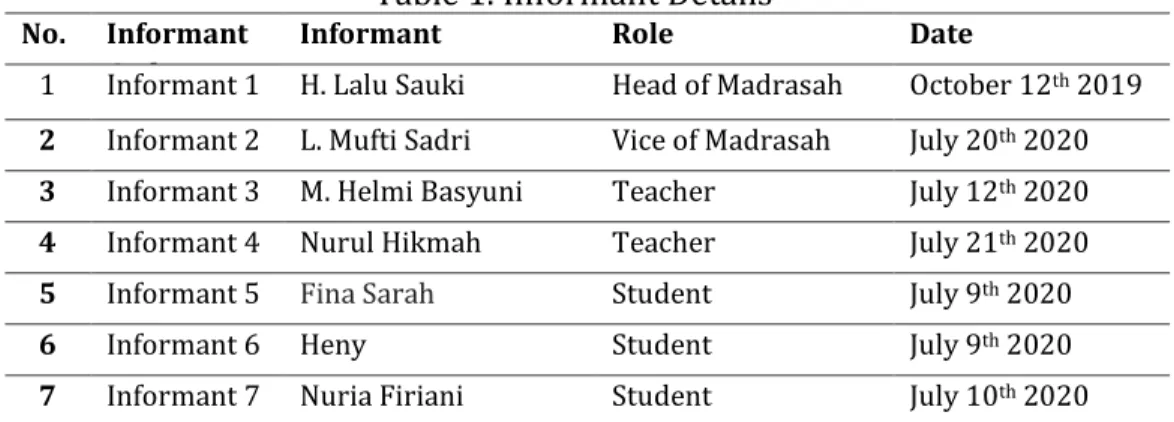
Table 1. Informant Details
No. Informant Code
Informant Role Date
1 Informant 1 H. Lalu Sauki Head of Madrasah October 12th 2019 2 Informant 2 L. Mufti Sadri Vice of Madrasah July 20th 2020 3 Informant 3 M. Helmi Basyuni Teacher July 12th 2020 4 Informant 4 Nurul Hikmah Teacher July 21th 2020 5 Informant 5 Fina Sarah Student July 9th 2020
6 Informant 6 Heny Student July 9th 2020
7 Informant 7 Nuria Firiani Student July 10th 2020
Data analysis techniques are done by referring to the data analysis model introduced by Spradley (1980), namely: 1) domain analysis (domain analysis). Researchers seek to read and examine data manuscripts generally and thoroughly to acquire a domain or area about the characteristics of student creativity, non-academic reinforcement, and its impact. At this stage, the researchers have not yet read and understood the data in detail because the goal is only to sort the data into three domains. 2) Taxonomic analysis (taxonomy analysis) were the researchers are trying to understand the three domains that are the subject of the study. Each domain begins to be understood in depth and is divided again into sub-domains, and from that
148
sub-domain, it is further detailed into more specific sections until there is nothing left, i.e., it is exhausted. (exhausted). 3) Component Analysis (Componential Analysis). At this stage, the researchers attempt to contrast the three domains or elements, so that the researcher finds the elements that are contrasted and subsequently makes a categorization that is relevant to the three objects of the study. 4) Cultural Theme Analysis (Discovering Cultural Themes). The author understands the symptoms and tries to gather the themes, cultural focus, values, and cultural symbols that exist in each region or domain. The author also seeks to find relationships between the three domains so that they are structured holistically, which ultimately reveals the dominant and the less dominant themes. The author also (1) read carefully the entire important notes, (2) provided code on important topics, (3) compiled typologies, and (4) read libraries related to the problem and context of the research.
To ensure that the field data has good credibility, the researchers used the triangulation technique suggested by Norman K. Denkin (2013), which covers four things, namely: 1) triangulating methods; 2) inter-researcher triangularization; 3) triangulators of data sources; and 4) theoretical triangulasi. Triangulation of methods is done by comparing data in different ways, i.e., methods of interviews, observation, and use of documents.
Triangulations between researchers in enriching information and the completeness of field data. triangulation of data sources by involving civitas of schools (heads of school, teachers, and students), triangulation theory by producing an information formula or thesis statement related to strengthening creativity for non-academic achievement in MAN 2 Mataram.
RESULT AND DISCUSSION
Creativity Enhancement Characteristics
The non-academic performance enhancement characteristics of the MAN Model 2 Mataram emphasize the elements of appreciating the heterogeneity
149
of input, appreciating diverse potential, and fostering creativity. This reinforcement is in line with the motto MAN Model 2 of Mataram, which focuses on achievement and religiousness in the entire series of non- academic activities.
Appreciate Input Hetroginity
MAN 2 Mataram has made an important breakthrough since 2015 with a selection model that values input heterogeneity. This is reflected in the fact that there are two selection paths for admission of new candidates, namely an academic selection path with a selection criterion of a minimum score average of 85 in the four subjects, including mathematics, IPA, English, and Indonesian, and if it does not meet the criteria of the academic path, then the candidate student can go through the non-academic selection track (minimum championship at the district or city level).
M. Helmi Basyuni said a model of input selection through non-academic paths is an attempt to strengthen non-academic achievement by appreciating the heterogeneity of input (Interview, July 12th 2020) The application of this selection model is an attempt to give students room to develop dynamically and positively. For example, creativity in the arts of communication, organization, teamwork, and leadership skills. All this is packed in the form of creative activities in sanggar film activities, journalism, martial arts, marching bands, Islamic cultural art groups, institutions of prestige, interpreneurship and leadership, tilawah, and tahfiz.
This effort, as a form of commitment, madrasah, appreciates a variety of input that does not merely point to the academic dimension.
Appreciate the diversity of potential
MAN 2 Mataram has placed pupils not only as objects but as dynamically evolving subjects. Students are given sufficient space and time and are intensely guided. Every non-academic program has a work program based on the values of creativity, such as helping each other, accepting each other's
150
shortcomings, and enjoying hard work. For example, in the leadership cadre program, all members are expected to be role models for their friends.
H. Lalu Sauki said, MAN 2 Mataram has given extensive space to students to develop talents, interests, and skills with several program centers (Interview, October 12th 2019).
These findings borrow Suyanto's concept of using the methods of knowing the good, feeling the good, and acting the good. Knowing the good is easy to teach because knowledge is cognitive. Knowing the good must be cultivated by feeling and loving the good, that is, how to feel and love goodness into the engine that can make people always want to do something good and happy employees, so growing awareness that people want to conduct productive behavior because they love their work. Once you get used to productivity, acting well becomes a habit (Suyanto and M.S. Abbas, 2001).
Zins, Bloodworth, Weissberg, and Walberg compiled a series of studies on the positive impact of adolescent emotional intelligence on school success. It is said that there are risk factors for adolescent school failure. The above- mentioned risk factors do not lie in the intelligence of the brain but in the character, namely, self-confidence, the ability to work together, the capacity to be sociable, concentration, empathy, and communication (Rachmawati, 2014b).
Gardner in Goleman says that it's not just one kind of monolithic intelligence that's important for success in life, but there's a broad spectrum of intelligence with seven major varieties: linguistic, mathematical/logical, spatial, kinesthetic, musical, interpersonal, and intrapersonal (Goleman, 2005). This intelligence is called by Gardner personal intelligence, which by Daniel Goleman is called emotional intelligence. Thus, non-academic achievement is more about the development of creativity that emphasizes the talents, interests, and skills of the pupils, and MAN 2 Mataram has prepared a non-academic excellence program based on the interests and skills of pupils
151
in the fields of religion, martial arts, sports, arts, tahfiz, and public examinations.
MAN 2 Mataram has provided adequate spaces and environments such as dormitories, places of worship, and non-academic activity centers. The art center (drumband, paskibra, leadership), the sports center (putsal team, basketball, furs), the religious center (kaligraphy, tahfiz, khitobah), the pramuka center, the PMR, and the silat peak. Each of these centers works together, reinforcing each other between centers. In order to strengthen the creativity of students, Madrasah has synergized with various parties, such as academics, mentors, trainers, and builders, to provide optimal service. MAN 2 Mataram has achieved several non-academic achievements, such as being the first national leadership champion in 2018, the chess champion, and the provincial Marcing Band champion. This torehan has strengthened the image of the madrasah as a model madrasha in the city of Mataram.
The collaboration of the madrasah with academics and mentors has become an important element in the process of developing creativity in the MAN 2 Model Mataram, and this process has become a collective consciousness between madrasas, parents, and society. These three elements have been synergistic and collaborative as a symbol of commitment to raising the creativity of students through a variety of non-academic activities. The non-academic program has become a program that has a positive effect on the progress of the madrasah. The impact is that the student becomes a role model for his friend and is able to synergize with his friends (learning to live together). The pupil is able to be innovative with his friend in terms of discipline, orderly movement, clean movement, zero-bolos movement, smoking, and being drug-free.
The non-academic program in MAN 2 Mataram is not just to engage students with a variety of creativity but to instill religious values such as Siddiq (honesty), that is, an attitude of honesty, keeping promises, and trying to apply the harmony between words and deeds in every non-academic
152
activity. Trustworthy, that is to say, students can be trusted and responsible for the trust or task given. Tabligh (reliable); that the students deliver the message to share information and not cover up the truth (active, communicative, cooperative, and aspirational) in the non-academic activities;
and fatanah (smart), which is intelligent, clever, creative, appreciating time, and professional in the performance of their tasks.
Strengthening the non-academic curriculum by touching the three dimensions of the humanity of the pupils, such as (1) the affective pupils that are reflected in the moral qualities or noble behavior in their interactions; (2) the cognitive pupils reflected on the creativity and intellectual capacity to dig and learn to solve problems and find solutions; and (3) the psychomotor pupils, which are reflective on the ability to develop creativity, for example, martial arts products, calligraphy, madding, sports, fiction products, interpreter products, and leadership products.
The creativity of the student, MAN 2 Mataram, is closely linked to his emotional intelligence and his ability to manage his emotions. According to Daniel Goleman, a person's success in society turns out to be 80 percent influenced by emotional intelligence, and only 20 percent is determined by brain intelligence (IQ) (Goleman, 2005). Children who have problems with their emotional intelligence will have difficulty learning, socializing, and being able to control their emotions (Alex Tridhonanto and Beranda Agrncy, 2010). The prolonged incapacity that will form a self-confident individual will cause prolonged stress. In adolescence, these conditions usually encourage teenagers to behave negatively. Students have two distinct types of intelligence: rational intelligence and emotional intelligence. Students' success is determined by both, not only by Quistion Intelligence (IQ), but emotional Intelligence plays an important role. (Danah Zohar and Ian Marsal, 2002).
The characteristics of the non-academic program that develops in MAN 2 Mataram in the context of learning to be, how learning can reflect or give rise
153
to an attitude of learning, to learn to be, and how learning can produce something that can reflect the obedience, obedience, creativity, and sincerity of the student. Therefore, the Head of Madrasah MAN 2 Mataram has set the policy of the non-academic program as a program of the formation of creativity in pupils towards MAN 2 Mataram becoming the best school.
Enhancing Creativity for Non-Academic Achievement
Field findings show some reinforcement of creativity for non-academic achievement, namely forming creative groups, creative group innovation, and building creative group hard work.
Forming creative groups
MAN 2 Mataram has undertaken non-academic reinforcement by forming creative groups such as art groups consisting of film sanggar, journalism, martial arts, marching bands, Islamic cultural art groups, institutions of worship, interpreneurship, leadership, tilawah, and tahfiz.
These creative groups are metamorphosing in cycles based on the importance of seeing the heterogeneity of input, talent, and potential of learners. Students develop dynamically according to their respective potentials. Here's one of the portraits of MAN 2 Mataram's non-academic reinforcement program in the competition.
Fina Sarah explained…Governor of the Cup, MANDA is the Best
There's good news for readers of our school's exotic mading. UKA-UKA MAN 2 MATARAM, thank you this year. Mading Uka-UKA became the best in the 3D Mading Race Gubenur Cup Nusa Tenggara West on March 14, 2015. What's great is that the hard work of a week was rewarded by a winning championship in a 3D mading race (Interview, July 21th 2020).
Image 1: UKA-UKA Mading (Wall Magazine) MAN 2 Mataram
154
This long-term experience has invited readers to learn a little bit about success. Success is achieved when there is hard work, seriousness, focus, diligence, and stubbornness. This is a social capital that is considered important by MAN 2 Mataram. Together, shoulder-to-shoulder, we organize and run programs that are structured together. The wall magazine (Mading) has become a medium of inspiration for students to pour ideas, experiences, and suggestions, as well as to share with their friends.
Next, a picture of the achievement developed in MAN 2 Mataram is cinematographic with his MandaTV. The activity of making a documentary film of every important moment in MAN 2. One of the examples produced is in the Social Bakti (Baksos) Youth Red Cross activities (PMR).
Image 2: MandaTV: BAKSOS (Social Charity) PMR (Student Red Cross)
Image 3: MandaTV: Construction of Mushalla
155
Two examples (Image 2 and 3) of the above pictures are the manifestation of the commitment of MAN 2 Mataram has given the pupils creative space along with hard work and perseverance that are embedded in the values of integrity. This value continues to grow, develop, and be nurtured at various moments and occasions.
Fina Sarah A., as the initiator and narrator of the documentary story, loves it a lot but doesn't feel so much sadness. His pleasure, much of the valuable experience we've gained, like how to cover, record, edit, and compile a script, and this isn't enough for a day or two. It looks like we're tired. We have to learn from a lesson that's so intense. Sometimes we fall asleep in the production room (Interview, July 21th 2020)
All students’ activities to enhance non-academic achievement have provided the creative space of the students, continuously developing dynamically and supported by the spirit of religion, such as the Friday Morning Imtaq program. This program is a room for reflection of faith, refreshment of the inner and practice of the pupils, as well as the essence of the implementation of the vision of the madrasah. "Friday is imtaq day" is the spirit and has received the response and support of all the good parties from pupils, administrative staff, security, and the teachers' council, so awaken the atmosphere of affinity, mutuality, and the relationship of collegiality between the elements of madrasah. This support is social and spiritual capital for improving the performance and achievement of the madrasah.
The record of achievements is also marked by the awarding of prizes for the achievements of the pupils. For example, based on a document search that, since 2015, has cited a fairly positive improvement in performance, In 2015, the national achievement was presented on behalf of Nurul Aulia Annisa, the national champion I, with a prize money award of 2.5 million rupees in the contest to write letters for Jokowi organized by the organization International NGO Forum on Indonesia Development (INFID), which previously also won the champion II/Runner Up 1 National in August 2015 in the same field of competition, namely the letter writing competition.
156
PMR MAN 2 Mataram General Champion Five cups were presented by the representatives of the PMR Man 2 mataram contingent to the Chief Madrasah at the imtaq event on November 13, 2015, as a symbol of his achievement of becoming the general champion at the Disaster Management Race, October 31–November 4, 2015, organized by the NTB Regional Disaster Control Body.
This activity was followed by the high school/SMA/MA, and the PMR contingent, MAN 2 Mataram, can outperform the participants from other schools/Madrasah and earn the most trophy achievement for some of the materials. Five cups were won: two Champions Cups for the Evacuation and First Aid (PP) race, and three Championships for the Tandu, and Pasang Bongkar Tenda (PBT) races (Document of MAN 2 Mataram).
The quotation from this achievement document confirms the spirit of struggle, hard work, and courage to work to honor the good name of his alma matera through the strengthening of non-academic achievements. Respect for wanting to fight paved the way to achieving achievements in the various races that followed. Similarly, the spirit built is not just born but built over a relatively long time, developing the spirit for achievement and cultivating the race as a way of building the creativity of the pupils.
Looking at the various records of achievements that have been achieved, two things should be noted: first, the various records of accomplishments that have been accomplished by MAN 2 Mataram are part of the picture of the creativity of the school organization, including the creativity of pupils as part of a component of the school organization; second, pupils' creativity is not only born because it is supported by the completeness of supporting facilities, but also because there are elements of social capital that are implanted, grown, and developed in the pupils themselves through non- academic achievement.
Ki Hajar Dewantara of Student Park in Yogyakarta in October 1949 once said that “life must be directed to progress, civilization, culture, and unity." In this connection, human beings, both individually and collectively, have what
157
determines their character, i.e., the basis and the teaching. Basic can be seen as biological capital (genetic) or the result of experience already possessed (constructivism theory), while teaching is the condition of which nature is obtained from a network of education or changes planned or programmed.
Humanistic psychologists like Maslow and Rogers have also argued that self- development is the highest goal of every individual. Self-development, character formation, and fulfillment of potential can be achieved through education. Thus, the non-academic achievement of MAN 2 Mataram emphasizes more progressive education, that is, education that calls for the re-establishment of growing values (values of integrity, patience, and hard work) as important instruments in developing the creativity of learners. The image of strengthening non-academic achievement that is growing in MAN 2 Mataram has become a pillar of climate change madrasah to madrasas belonging to all madrasash citizens. Fahrurrozi said that he was piloting the climate of the madrasah with an integrative model of the various activities of the madrasah, for example, healthy madrasas. If you want to be healthy, you need a clean movement, a drug-free movement, students fighting with friends, bolos, etc. This movement has become a package of excellence programs with non-academic achievement programs. It's also developed through piloting teacher modeling. This reinforcement does not only come from the leadership but must come from all the components that exist in the institution of the madrasah. The teacher is the tip of the spear in the classroom, and she faces the student directly. For this, cultural education and creativity need to be built from an early age, such as husnuzhan attitudes, tasammuh, takrim, tafahum, trust, ihsan, islah, sulh, lin, and salutation (Fahrurrozi, 2012).
Creative Group Innovation
MAN 2 Mataram is becoming a madrasah modeled by other madrasas. In accordance with the vision and mission that were built to be the MAN 2 of Iptek and Imtaq, the entire civitas madrasah, under the leadership of HM to
158
HS have planned various breakthroughs in program innovation, such as the boarding school package program, the language package program, the religious program package, and the extracurricular program package.
Here's an overview of the students' out-of-bond activities. Class X Religious Advocacy conducted Field Practice or Out Bond activities on October 29, 2015, at a different time than the four bribes that conducted the field practice or out bond activities this year.
L. Mufti Sadri, S.PdI, M.A., said however, the valuable insights and lessons learned by the group at the Ponpes Hidayaturrahman NW Menggala district of North Lombok are not far from the other battalions. Various valuable insights and lessons were learned by the Out Bond participants, both through the dialogue with the Builder of the Ponpes and with the mansion gentlemen, as well as the observation of the enthusiastic centrivati orating in the teaching of the muhadra in the two buildings fast-paced just above the pool (Interview, July 20th 2020).
However, the pearls that can be taken as a lesson for the Out Bond participants are the wisdom lessons of the spirit of the centurion in the conditions of the simple ponpes facilities that it houses. The presence of the Out Bond participants at the Ponpes Hidayaturrahman NW Menggala was welcomed by the founder of the Islamic boarding school, namely Dr. Najmul Akhyar, former Deputy Bupati Lombok North. In his greeting, he appreciated and welcomed the presence of the participants, with the teacher escorting out Bond. At least in his view, the activities of the Out Bond as a day of mercy, sharing, and sharing experiences of various good programs developed by both sides should be applied jointly (Observation, July 20th 2020).
Out Bond is one of the programs developed by MAN Model 2 Mataram to strengthen the non-academic climate. The student experience becomes urgent; learning by doing becomes learning by being. The existence of MAK MAN 2 Mataram has been packed with a science-oriented integration package of science and religion.
Based on the statement of the Head of Madrasah, MAN 2 Mataram (Interview, October 12, 2019), the existence of MAK MAN 2 Mataram is in
159
line with the spirit of madrasah, which must have excellence not only limited to the excellency of science but must be bounded by excellence in the field of religious and non-academic studies. There are some reasons why MAK MAN 2 Mataram has been revived since MAPK was dissolved. First, there is public concern that the madrasah will slowly lose its identity; second, the religious madrasas will remain only by name; third, the madrasah as the pride of society will be increasingly lost; and fourth, the student's understanding of religion is still relatively low because it is confined by a very short curriculum wall.
This reality is also acknowledged by the H. Lalu Sukri Vice of Head Madrasah curriculum: indeed, MAK MAN 2 Mataram is the result of a thorough and comprehensive study of the problems faced by the madrasah, in particular with regard to weakening in the field of religious studies. This idea is passed on to the student guardian and approved by the pupil guardian, with the consequences for the student who bears the cost (Interview, July 21th 2020).
Every competition MAN 2 Mataram follows on a local, regional, and even national scale has made a lot of achievements. It is evidence and, at the same time, the commitment and determination of the entire Civitas madrasah.
Discipline, hard work, and competition for achievement have truly become the pattern, culture, and learning style of the student and the teaching style of the teacher, and the important thing is the courtesy to pursue a career achieving achievements for accomplishments. Yogyakarta State University Postgraduate Program Research Team has conducted a piloting of the cultural development of schools in higher secondary schools at 14 SLTAs in Indonesia, one of which is SMAN 2 Klaten Central Java. The team's research notes several things related to the positive and negative cultures in the schools, as follows: These include the positive culture in SMAN 2 Klaten are:
first; there is a high enthusiasm of students to proceed to colleges, especially state colleges such as UGM, UNY and UNS, second; there was a high competition among students to the best achievement in their class, third; the
160
relationship of the head of school with the teachers and employees as well as the students are quite good, fifth; the head always encourages all levels of school to perform more increased, sixth; the students very much respect their professors and employees, seventh; commonality and affinity between the students is good enough so that the care of each other is visible in the daily life of the school, eighth; all decisions about the school are made democratically and openly through the break-up, ninth; a family atmosphere is implemented in the meetings of the teacher and the tenth; students with disciplines so that rules of school are rarely seen violations in schools (Mardapi, 2003).
Build a hard-working creative group.
Building the hard work of creative groups in order to encourage students to be able to compete, be ethical, moral, polite, and interact with their friends as part of the group social system of madrasah. For example, learners who have engaged in non-academic activities show diverse and positive attitudes, actions, behaviors, and creativity. This finding is relevant to research at Harvard University in the United States, which found that a person's success is not determined solely by knowledge and technical skills (hard skills), but more by the ability to manage himself and others (emotional intelligence). In fact, the most successful people in the world can succeed because of more supported emotional intelligence. It suggests that non-academic programs play an important role in cultivating and strengthening the creativity of learners.
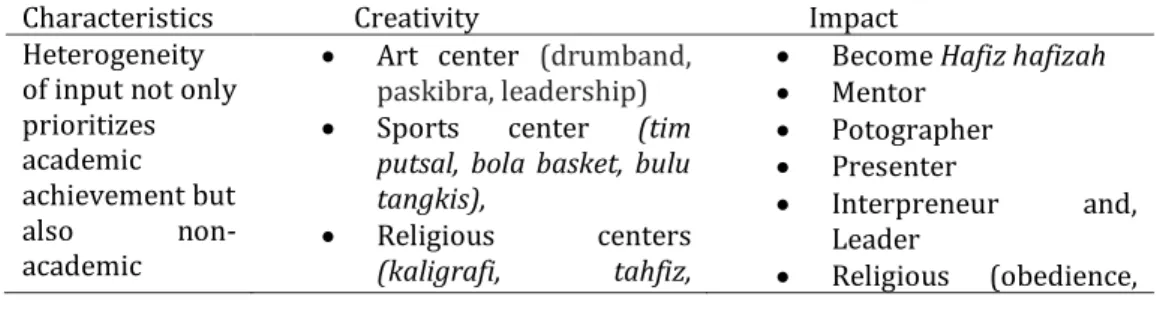
Table 2. Enhancing Creativity for Non-Academic Achievement (MAN 2 Mataram)
Characteristics Creativity Impact
Heterogeneity of input not only prioritizes academic achievement but
also non-
academic
• Art center (drumband, paskibra, leadership)
• Sports center (tim putsal, bola basket, bulu tangkis),
• Religious centers (kaligrafi, tahfiz,
• Become Hafiz hafizah
• Mentor
• Potographer
• Presenter
• Interpreneur and, Leader
• Religious (obedience,
161
Table 1 shows that MAN 2 Mataram has built on the principle that the heterogeneity of input does not hinder or become an obstacle to the performance of the madrasah. The principle is that if the heterogeneity of the input is built and supported with a program of excellence and processed with excellence, then it is not impossible to give birth to a creative student.
Strengthening of non-academic achievement through several centers: art centers (drumband, paskibra, leadership), sports centers (putsal teams, basketball, tangkis feathers), religious centers (tahfiz, khitobah), sailors' centers, PMR, silat tops, and arts centers (kaligrafi, karya ilmiah). The existence of this center has given rise to hard work reflected; first, the creativity of the students is worship. Therefore, achieving achievement is not a goal but a process of self-determination. Success cannot be achieved without hard work, stubbornness, diligence, and tawakkal. Second, examples or role models: students who have achieved non-academic achievements have been able to be role models or models for their friends and the social environment of the madrasah; characteristics have been capable of learning to give an example to their friends, such as Siddiq (honest); being honest, disciplined, firm, trustworthy (trustworthy); that is, being responsible for the task given; tabligh (reliable); i.e., having abilities such as active, communicative, cooperative, and aspirational; and fatanah (smart); which is creative and solvent.
Thus, grand design enhancement of non-academic achievement has become an academic need and responsibility of MAN 2 Mataram that is grouped into three dimensions, namely: mental (spiritual and emotional development), mental (intellectual development), physical and kinesthetic
khitobah),
• Sport Center (Sprut, PMR, silat pinch).
• Art Center (kaligrafi, and scientific papers)
patience, istiqomah)
• Psychological (Role model, tutor sebaya)
• Social (Social action to Islamic boarding schools-Pondok
Pesantren- and Panti)
162
development, and physical and physical development. (affevtive and creative development).
Impact of Creativity Enhancement
Students in academic fields are quite numerous who have achieved proud achievements. In 2021, the graduates or alumni of MAN 2 Mataram are accepted in the State Department at home and abroad, i.e., 10 people are admitted through the selection of the written test, 2 people through the invitation of the Medical Faculty of the University of Mataram, and one person at the Air Langga University of Surabaya (Interview, Lalu Sauki).
While in the non-academic field in 2021, the students of MAN 2 have already won several awards, such as: Finalis Indonesia Delegation at the Asia World Model United Nations: Muhammad Andrianudin, Champions II Proomsae Junior Individual Princess Gorontalo International Virtual Championshio Tiara Wahyuni Rahmawati, Champions III Proomse Junior Individuals Princess Gorentalo International Virtually Championshio, Champions IV Proomsea Junior Indival Princess Goronto International Virtual Championshio Adhwa Dhwiya Patin. Ambassador of Youth Parliament Representative of NTB-Parliament of Youth of the DPR RI Afifah Kamilatul Unsa. 10 great ambassadors of Harmony Moderation religious Ministry of Religion of Republic Indonesia, Khairul Hamim. (Document of MAN 2 Model Mataram).
Image 4: Performance of the MAN 2 Mataram Students in the Year 2017/2018 s/d 2020/2022
163
The data above shows a picture of how the student performance over the last four years has shown a significant improvement. His achievements are not only academic but also non-academic. Total achievements in 2020/2021 amounted to 384 accomplishments, 152 of which were non-academic, or 40 percent. This means that the reinforcement of creativity for non-academic achievement in MAN 2 Mataram has given positive contributions and a position to tender madrasah. Thus, the strengthening of student creativity is reflected in three dimensions. First, the religious dimensions are reflected in the obedience, patience, and perseverance of students who follow non- academic programs. This dimension is intangible but has been proven by the products of its creativity, such as the creativity of the film product, talkshow creativity, group presenters, the soul of interpreters, and leadership.
Secondly, the psychological dimension reflects the attitude of the student as a role model or example to his friends. Like a peer tutoring program. (tutor sebaya). The program is able to cultivate a spirit of achievement for those with proven achievements in the fields of leadership, interpreneurship, sports, tahfiz, and the arts. Third, the social dimension is reflected in the attitude of the pupils, who like to help and facilitate their friends in social action activities in the madrasah and outside the madrasah. This dimension is reflected in Madrasah's out-of-school bond activities, school visits to the reception house, and Panti-Panti as a form of social responsibility.
Enhancing creativity becomes a productive space for achieving non- academic achievement among students at MAN 2 Mataram. A portrait of non- academic achievement in MAN 2 Mataram as a result of the model developed through the model appreciates the diversity of input, fosters diverse potential, and fosters creativity. This finding has strengthened the findings of (Ida et., (2021) that creative thinking ability is the ability to bring up or bring up a new idea based on previous experience. The learning model that supports students in solving story problems is problem solving. It has also strengthened Harto's findings that the changes that occur in the institutions
164
of education must be able to cope with the emergence of ideas, innovations, and creativity (Harto, 2018).This finding has relevance to what Shuler studied: that creativity shows creative destruction and the burden of change.
(Shuler, 2005). Similarly, in line with the findings of M. Nur Ghufron and Rini Risnawita, creativity is a special achievement in creating something new, meaningful, and useful. (Risnawita, 2014). Gullford, in Utami Munandar, sees creativity as a divergence of learning. (Munandar, 2002). The creative centers built in MAN 2 Mataram are the ideas and models of creative thinking of leaders and teachers. This finding has reinforced Michlako's finding that creativity is a mental process in the development of ideas and in the discovery of creative thinking (Michalko, 2001).
Similar research has also emphasized that creativity in improving non- academic achievement has changed the way we look at students. Like a view relating to the importance of student involvement in their social and emotional skills (Palardy, 2019), building upon the potential of the students aims at stimulating their commitment and willingness to participate in the development of society (Rosell, 2011). Similarly, supporting aspects such as the role of teachers and parents have an impact on the non-academic work of students, such as engagement, accessibility, and responsibility (Martin et al., 2010), confidence: the best non-cognitive predictor of academic accomplishment (Stankov, Morony, and Lee, 2014), non-cognitive variables and academic achievement (Khoury, 2016), and the impact of peer personality on academic achievement (Golsteyn, Non, and Zölitz, 2021). So that all students develop dynamically according to their respective intelligence and excellence in MAN 2 Mataram.
Thus, these findings have provided a practical understanding that non- academic achievement is not only supported by intellectual intelligence but also by emotional intelligence. a demonstration of the student's ability to engage in demonstrations of his social skills and his emotional. Non- intellectual workspaces such as sanggar art group creativity, glory, sports,
165
leadership, and tahfiz rent have become the spaces of student creativity. The findings are consistent with Zins, Bloodworth, Weissberg, and Walberg's in Rachmawati finding that there is a positive influence of students' emotional intelligence on school success. It is said that there are risk factors for student failure at school. The above-mentioned risk factors do not lie in the intelligence of the brain but in the character, namely, self-confidence, the ability to work together, the capacity to be sociable, concentration, empathy, and communication (Rachmawati, 2014).
CONCLUSION
The characteristic of enhancing creativity and performance for non- academic achievement in MAN 2 Mataram emphasizes the dimension of appreciating the diversity of input, diversifying potential, and raising creativity. Strengthening the creativity of non-academic programs has raised the position of the madrasah at the regional, national, and international levels by reminding us of some of the non-academic achievements of the region at the national and international levels. Torehan's achievements include showing creativity at the center of art, sports, and religion and being role models for other friends. The role model is reflected in three dimensions:
religious dimensions, psychological dimensions, and social dimensions.
REFERENCES
Alex Tridhonanto dan Beranda Agrncy (2010) Meraih Sukses dengan Kecerdasan Emosional. (Jakarta: Alex Media Komputindo Kelompok Gramedia.
Bentley, J. C. (1966) ‘Creativity and academic achievement’, Journal of Educational Research, 59(6), pp. 269–272. doi:
10.1080/00220671.1966.10883353.
Borgen, S. T. and Borgen, N. T. (2015) ‘Folk high schools and dropouts from upper secondary school: Effects of non-academic investments in dropouts’, School Effectiveness and School Improvement, 26(2), pp. 153–
168. doi: 10.1080/09243453.2014.896384.
166
Bryan, W. (no date) ‘Non-Academic School for Boys’.
Danah Zohar dan Ian Marsal (2002) Memanfaatkan Kecerdasan Spritual dalam Berfikir Integratif dan Holistik Untuk Memaknai Kehidupan.
Bandung: Mizan.
Fahrurrozi (2012) Pendidikan dan Dakwah Transformatif Based on Ethics:
Orientasi Pembangunan Karakter Peserta Didik. Makalah Seminar disampaikan pada Penguataan Parthership dengan Kepala Sekolah Se Pulau Lombok. Mataram.
Fryer, D. (2006) ‘The Sage Handbook of Qualitative Research[1]’, Qualitative Research in Organizations and Management: An International Journal, 1(1), pp. 57–59. doi: 10.1108/17465640610666642.
Goleman, D. (2005) Kecerdasan Emosional, Tej. Hermaya, cet. ke-5. Jakarta:
Gramedia Pustaka Utama.
Golsteyn, B. H. H., Non, A. and Zölitz, U. (2021) ‘The impact of peer personality on academic achievement’, Journal of Political Economy, 129(4), pp. 1052–1099. doi: 10.1086/712638.
Hayat, M. A. and B. (2019) ‘Non-academic factors influencing students’
achievement: a study in the Indonesian madrasahs’, International Journal of Learning and Intellectual Capital, 16(2). Available at:
https://www.inderscienceonline.com/doi/pdf/10.1504/IJLIC.2019.098 944.
Harto, K. (2018). TANTANGAN DOSEN PTKI DI ERA INDUSTRI 4.0. Tatsqif, 16(1), 1-15. http://journal.uinmataram.ac.id/index.php/tatsqif
Hindson, C. (1985) ‘Post-primary School Non-academic Alternatives: A South Pacific study’, Comparative Education, 21(2), pp. 135–156. doi:
10.1080/0305006850210203.
Ida, et. al., (2021). CRITICAL AND CREATIVE THINKING SKILLS FOR MATH STORY PROBLEMS INSTRUCTION AT ELEMENTARY SCHOOLS.
Tatsqif, 19(2), 98-113. doi:https://doi.org/10.20414/jtq.v19i2.4069 Jose ́-Vicente Toma ́s-Miquel, Manuel Expo ́sito-Langa, D. ́bora N.-J. ́ (2016)
‘The influence of relationship networks on academic performance in higher ducation: a comparative study between students of a creative and a non-creative discipline’, Jurnal Higher Education, 71(3), p. 1.
Justman, J. (1954) ‘Academic Achievement of Intellectually Gifted Accelerants and Non-Accelerants in Senior High School’, The School Review, 62(8), pp. 469–473. doi: 10.1086/442153.
Khoury, J. E. L. (2016) ‘NON-COGNITIVE VARIABLES AND’, pp. 65–85.
Löfsten, H. and Lindelöf, P. (2005) ‘R&D networks and product innovation patterns - Academic and non-academic new technology-based firms on Science Parks’, Technovation, 25(9), pp. 1025–1037. doi:
10.1016/j.technovation.2004.02.007.
Lyons, M. et al. (2006) ‘Framing a set of non-academic selection criteria for occupational therapy students: An Australian study’, Australian Occupational Therapy Journal, 53(4), pp. 284–292. doi: 10.1111/j.1440-
167
1630.2006.00591.x.
Mardapi, D. (2003) Pengembangan budaya sekolah. Makalah disajikan dalam Seminar Pengembangan Budaya Sekolah. Yogyakarta.
Martin, A. J. et al. (2010) ‘Fathers and Male Teachers: Effects on Boys Academic and Non-Academic Development’, Childhood Education, 86(6), pp. 404–408. doi: 10.1080/00094056.2010.10523178.
Martin, A. J. (2011) ‘Holding back and holding behind: Grade retention and students’ non-academic and academic outcomes’, British Educational Research Journal, 37(5), pp. 739–763. doi:
10.1080/01411926.2010.490874.
McQuary, J. P. (1953) ‘Some relationships between non-intellectual characteristics and academic achievement’, Journal of Educational Psychology, 44(4), pp. 215–228. doi: 10.1037/h0062538.
Michalko, M. (2001) Permainan Berfikir, terj. Word Translation Service.
Bandung: Kaifa.
Munandar, U. (2002) Kreativitas dan Keterbakatan Strategi Mewujudkan Potensi Kreatif dan Bakat. Jakarta: Gramedia Pustaka Utama.
Ni, H. and Li, C. (2013) ‘Cultural differences in teachers’ narrative evaluations of students in non-academic areas: a study of school report cards of students from four ethnic backgrounds’, International Journal of Quantitative Research in Education, 1(2), p. 123. doi:
10.1504/ijqre.2013.056464.
Norman K. Denzin, Y. S. L. (2013) ‘Collecting and Interpreting Qualitative Materials’.
Oskouei, R. J. (2010) ‘Impact of Non Academic Websites Usage on Female Students Academic Performance ( A Case Study )’, (Icent), pp. 29–33.
Palardy, G. J. (2019) ‘School Peer Non-academic Skills and Academic Performance in High School’, Frontiers in Education, 4(June). doi:
10.3389/feduc.2019.00057.
Rachmawati, A. (2014a) ‘Kecerdasan Emosi Pada Siswa Yang Bermasalah Di
Sekolah’, Cognicia, 2(2). Available at:
https://ejournal.umm.ac.id/index.php/cognicia/article/view/2018.
Rachmawati, A. (2014b) ‘Kecerdasan Emosi Pada Siswa Yang Bermasalah Di
Sekolah’, Cognicia, 2(2). Available at:
https://ejournal.umm.ac.id/index.php/cognicia/article/view/2018.
Risnawita, M. N. G. dan R. (2014) Teori-Teori Psikologi. Jogjakarta: Ar-Ruzz Media.
Rosell, A. W. J. and E. (2011) ‘Academic and non-academic education for societal entrepreneurship’, Icsb, (June), pp. 1–23.
Shadrikov, V. D. (2013) ‘The role of reflection and reflexivity in the development of students’ abilities’, Psychology in Russia: State of the Art, 6(2), pp. 55–64. doi: 10.11621/pir.2013.0205.
Shuler, J. A. (2005) ‘Creative destruction: Academic libraries and the burden of change’, Journal of Academic Librarianship, 31(6), pp. 593–597. doi:
168
10.1016/j.acalib.2005.09.003.
Sikdiknas, U. (2003) ‘Undang-Undang Republik Indonesia Nomor 20 Tahun 2003 Tentang Sistem Pendidikan Nasional Pasal 4 ayat 4.’
Stankov, L., Morony, S. and Lee, Y. P. (2014) ‘Confidence: The best non- cognitive predictor of academic achievement?’, Educational Psychology, 34(1), pp. 9–28. doi: 10.1080/01443410.2013.814194.
Suyanto dan M.S. Abbas (2001) Wajah dan dinamika pendidikan anak bangsa.
Yogyakarta: Adicita Karya Nusa.
Tatarinceava, A. and Liduma, A. (2000) ‘the Influence of the Creative Learning Environment on Students ’ Successful Academic Achievements in Their Lifelong Learning’, (1992), pp. 468–471.
Tjalla, A. (2008) Hubungan Komunikasi Interpersonal antara Mahasiswa dan Dosen dengan Prestasi Akademik Fakultas Psikologi Universitas Gunadarma. Yogyakarta: Fakultas Psikologi Universitas Gunadarma.
Tomás-Miquel, J. V., Expósito-Langa, M. and Nicolau-Juliá, D. (2016) ‘The influence of relationship networks on academic performance in higher education: a comparative study between students of a creative and a non-creative discipline’, Higher Education, 71(3), pp. 307–322. doi:
10.1007/s10734-015-9904-8.
Vilkinas, T. (2014) ‘Leadership provided by non-academic middle-level managers in the Australian higher education sector: the enablers’, Tertiary Education and Management, 20(4), pp. 320–338. doi:
10.1080/13583883.2014.966141.
Wahyu, W., Kurnia and Syaadah, R. S. (2018) ‘Implementation of problem- based learning (PBL) approach to improve student’s academic achievement and creativity on the topic of electrolyte and non- electrolyte solutions at vocational school’, Journal of Physics: Conference Series, 1013(1). doi: 10.1088/1742-6596/1013/1/012096.
Interview, Vice Headmaster of Curriculum MAN 2 Mataram Interview, Head of Madrasah MAN 2 Mataram
Interview, Teachers of MAN 2 Mataram Interview, Students of MAN 2 Mataram