156
8
Structuring the Organization—
Specialization and Coordination
Overview
All organizations have to be structured or organized. The tasks that are performed must be divided among the workers, and the work being done must be coordinated so that various tasks are performed at the right times. As organizations grow in size and complexity, the need to structure becomes more critical. An increased emphasis on structure is reflected in the history of all organizations that grew in size as they became success- ful. Take, for example, the U.S. Library of Congress, the largest library in the world, which was established in 1800 with an appropriation of
$5,000. The library’s first collection consisted of 740 books and three maps, and its first librarian also served as clerk of the House of Repre- sentatives.1 A library of that size with a part-time librarian did not need to pay much attention to structure and organization. Today’s Library of Congress is a much different organization. It has a collection of more than 130 million items on 530 miles of bookshelves. The library has more than 4,000 employees and adds more than 10,000 items to its collection each day.2 The Library of Congress now has a very elaborate organiza- tional structure.3 Obviously, it is essential that an organization of this size and complexity have a structure that not only allows its workers to specialize in the type of work each does but also permits its managers to coordinate this work.
This chapter will cover some key concepts in the managerial function of organization, including the ways in which an organization is subdi- vided (specialization), as well as the ways in which it is brought back to- gether (coordination). Other key elements of organization, such as span of
i
The larger the organization, the more complex its structure will be. As was discussed in chapter 7, small organizations can have very simple organiza- tional structures. When there are only one or two or three people working in a library or any other type of organization, there is not a great need for either specialization—that is, breaking down the tasks to be done into discrete parts for various individuals to accomplish—or coordination—that is, being sure that all the tasks are being accomplished in the appropriate sequence. As organizations grow larger, however, attention has to be paid to both specializa- tion and coordination if the goals of the organizations are to be accomplished.
Structuring involves these two fundamental requirements: the division of labor into distinct tasks and the achievement of coordination among these tasks.
Specialization
An organization divides all the tasks to be done (or specializes) in two ways.
The first is by establishing horizontal specializations, which results in the creation of various departments, each performing specific tasks. The second is by establishing vertical differentiation, or a hierarchy of positions. Vertical differentiation involves structuring authority, power, accountability, and re- sponsibility in an organization.
An organization is structured horizontally by identifying and grouping simi- lar or related activities or tasks into subunits or departments. Grouping tasks creates blocks of activity-oriented tasks and people-oriented tasks. Blocks of activity-oriented tasks, such as cataloging books or acquiring materials, put primary emphasis on process, procedure, or technique. These tasks can vary from the most routine, requiring little skill, to the very complex, requiring ex- tensive ability and knowledge as well as conformity with a process, procedure, or technique. Examples of routine activity-oriented tasks in a library are shelv- ing books or copy cataloging; complex activity-oriented tasks might include the selection of books in accordance with a book-selection policy, creating metadata or the development of an Internet user instruction module. People- oriented tasks, which place primary emphasis on human relationships, require the ability to communicate, to guide or direct, and to motivate other individu- als. People-oriented tasks include the relationship of the reference librarian to the library user, the attitude of the supervisor to subordinates, or the ability of a public library director to work with higher officials in government.
Once a manager has identified blocks of tasks that need to be accomplished, then those tasks must be grouped in a logical order. The manager must an- swer the questions, “What blocks should be put together or kept apart?” and
“What is the proper relationship of these blocks?” Some of the blocks will be of primary importance; others will be secondary.
According to Peter Drucker, it is more important to identify the key tasks within the organization than to identify all the tasks. He proposes that someone
control, delegation, power and authority, unity of command, and line and staff, also will be discussed. The chapter also will cover the advantages and disadvantages of centralized organizational structures.
designing an organization start with the following questions: In what areas is excellence required to obtain the organization’s objectives? In what areas would lack of performance endanger the results, if not the survival, of the en- terprise? He recommends, in short, that organizers ask why the organization exists and build on that basis.4 These are questions that all library managers need to ask and have answered before structuring the organization.
What Do You Think?
Like powerful elephants, many companies are bound by earlier con- ditioned constraints. “We’ve always done it this way” is as limiting to any organization’s progress as the unattached chain around the elephant’s foot. Success ties you to the past. The very factors that produced today’s success often create tomorrow’s failures.
James Belasco compares organizations to elephants that are con- strained by chains. Do you agree that the factors that produce success today may creature failure tomorrow? Can you think of any examples from libraries that illustrate his point? What can organizations do to avoid this?
James A. Belasco, Teaching the Elephant to Dance: Empowering Change in Your Organization (New York: Crown, 1990), 2.
In a similar vein, other management experts urge organizations to ask,
“What business are you in?” They point to the plight of the U.S. railroad com- panies, which almost became extinct because they thought they were in the business of trains, not realizing that they were actually in the transportation business.5 Pitney Bowes provides an example of a corporation that was able to reenvision itself. After Pitney Bowes lost its monopoly on postage meters, it went through a troubled financial period until it was able to move beyond viewing itself as a postage meter company and realize that it could be highly successful if it thought in a broader fashion and concentrated on providing so- called messaging to organizations.6 In a similar fashion, libraries and informa- tion centers have had to reexamine their purpose during the past few decades.
Libraries have refocused and now consider themselves to be in the information business (and not just in the book or printed material business). They also re- alize that they have competitors in the private sector that did not exist before.
Modern libraries have had to redefine themselves, and this redefinition has necessitated a change in their structure to reflect their new mission.
partS of an organization
Organizational design can be seen as the putting together of a fairly stan- dardized set of building blocks; it is a process similar to building a house.
Although houses may have many types of design, ranging from traditional
colonial to modern contemporary, and although their sizes may range from small cottages to large mansions, almost all houses share common character- istics. They will all have a foundation, a roof, certain essential rooms, and ways to provide such services as electricity and water. Organizations are designed in a similar fashion. Although the variety and number of blocks will vary with the size and the type of institution, with pieces that can be put together in different ways, all organizational structures have a great deal in common.
Managers who are attempting to organize (or reorganize) are, metaphorically speaking, the architects of the structure—they are shaping the space to meet the needs and aspirations of the organization.7 So, most organizations contain the same basic parts. Henry Mintzberg has categorized the five basic elements of organizations as:
• A strategic apex, which consists of the organization’s top management and is responsible for the overall functioning of the organization.
• The middle line, which is composed of the midlevel managers who coordinate the activities of the various units. They serve to link the operating core to the strategic apex. One of the major activities of the midlevel managers is to transmit information about the operating core to the top-level managers.
• The operating core, which is made up of the workers who carry out the mission of the organization.
• The technostructure, which consists of those units that provide the organization with technical expertise.
• The support staff, which is composed of the workers who provide the organization with expertise in areas such as labor relations or personnel.8
These components are illustrated in figure 8.1.
In a large library, the director and the assistant and associate directors form the strategic apex. The heads of the various departments make up the middle line. Employees in units such as library systems and original cataloging make up the technostructure, whereas employees in units such as personnel and public relations constitute the support staff. The largest group, the operating core, consists of the employees who work in areas such as circulation and reference. They are the ones carrying out the organization’s mission of linking people to information. Although some small organizations do not contain all of Mintzberg’s categories, most larger ones do, although the size of each com- ponent in relation to the others varies according to factors such as type and complexity of endeavor, age of the organization, and its size.
MethodS of departMentalization
In the past, organizations have traditionally used five methods to establish departments: function, territory, product, customer, and process. In addition, libraries have developed two other methods to establish departments: subject and form of resources. In both businesses and libraries, these methods are
used in varying combinations to produce a hybrid structure. Although these methods of departmentalization are being affected in many organizations by new approaches to organizational structure, they still serve as the primary ap- proach for establishing subdivisions within an organization. Each method of departmentalization is discussed in the following sections.
Function
In business, the most common organizational design is the functional struc- ture. For instance, a company that makes furniture would have departments dealing with production, marketing, sales, and accounting. In libraries, too, this method of departmentalization is extensively used. Functions such as cir- culation, reference, acquisition, cataloging, and management historically have been the bases of library organization.
Functional design has a number of advantages. It groups together special- ists with similar backgrounds and interests, and it allows specialization within that function. For instance, a library might have both a Slavic and an East Asian cataloger. Functional design also ensures that higher organizational lev- els will be aware of the contributions and the needs of the various subunits of the organization. There are, however, three major disadvantages of functional
Strategic Apex
Middle Line
Support Staff
Operating Core Technostructure
Figure 8.1—Mintzberg’s Model of the Organization
Source: From Henry Mintzberg, Structure in Fives: Designing Effective Organizations (Engle- wood Cliffs, NJ: Prentice-Hall, 1983). Reprinted by permission of Prentice-Hall, Inc., Engle- wood Cliffs, NJ.
division. First, it may lead to competition among various departments—for example, competition for resources or disagreements over the most appropri- ate procedures. In some libraries, the reference and cataloging departments may disagree about the best classification or subject headings for a particular book. Second, workers in functional settings may lose sight of the end product of the whole organization, especially when they are distanced from the ulti- mate users of the product. Finally, this organizational design is not as effective if the organization has units in different locations. The functional design ap- pears to work best in organizations that do not need close collaboration among the functional departments.
Territory
In industries that operate over a wide geographic area, all activities in a desig- nated geographic territory are commonly grouped together and placed under the direction of a manager. For instance, multinational organizations have divisions to deal with specific parts of the world, such as North America, South America, or Europe. This structure permits the organization to adapt to local situations, as far as the local labor market, local needs and problems, and local produc- tion issues are concerned. Libraries also use this principle of territory or area in their organizational structure. For instance, public libraries always have been very concerned about the location of their central facility and the areas to be served by their branch libraries, bookmobiles, and storefront libraries. Academic libraries that have branches, such as a science library, an architecture library, or an education library, are concerned that these facilities be in the area where the appropriate clientele will be located. School systems usually have individ- ual schools and their media centers located throughout their service area, and students typically will go to the school geographically nearest to their homes.
The primary advantage of this type of organization for libraries is that the individual units can be located close to their users, can get to know these users’ needs better, and, it is hoped, can thus serve them better. Territorial organization also provides a training ground for managers because it gives a manager a chance to work relatively autonomously in managing a smaller unit that is geographically separated from the central organization. It is not uncommon for a librarian who has directed a branch library to be promoted to head of the library system.
The biggest disadvantage of territorial organization is that it increases the difficulty of coordination and communication within the organization. In addi- tion, rivalries often crop up between the different locations. Many large public libraries hard hit by funding cuts have had to make difficult decisions about whether it is better to maintain the quality of the central collection or to main- tain service to various neighborhoods through the branches. Finally, terri- torial organization often leads to duplication, for example, in resources like standard reference books.
In librarianship, there always has been disagreement about the degree of geographic centralization that should prevail. Typically, library administrators have favored a more centralized organization because of the tight control and budgetary advantages associated with that design. On the other hand, users
typically prefer a more decentralized system because of its convenience and more personalized service (in spite of the special problems of users working in interdisciplinary areas).
The degree of decentralization varies according to country and type of li- brary. For example, academic libraries in the United States traditionally have been more centralized than those in Europe, especially those within the older European universities where individual units such as institutes or colleges often provided library service before it was provided centrally. Some of the arguments against decentralization have been weakened by the increasing importance of information technology and the advent of new methods of docu- ment storage and retrieval that lessen some of the costs involved in the du- plication of material in decentralized locations.9 The advent of online catalogs and online access to reference and bibliographic material and full-text journals and books has made decentralization less expensive.
Product
Organization by product is particularly useful in diversified industries in which the production of one product is sufficiently large to employ fully specialized facilities. In such cases, departmentalization by product allows a product manager complete control over all functions related to that product, including profit responsibility. For instance, Time Warner is organized into di- visions that are based on product lines: AOL; Time, Inc.; Turner Broadcasting;
Warner Brothers; and so forth.10 Product organization is used infrequently in libraries. Although the product of a print shop (a bibliography or a brochure) or a product of the systems office (such as the library’s Web site) might be considered a product, in almost every case this product is a minor part of the total operation of the library.
Customer
Businesses, especially retail stores, use this structure to appeal to the needs and desires of clearly defined customer groups. Department stores have children’s, preteen, men’s, misses, and petite departments to cater to specific customer groups. Libraries often use the same structure. Since the late 1800s, special children’s sections have been one of the most used sections in public libraries. Public libraries also have aimed their services at other customer groups, such as young adults or business users. Academic libraries have used this structure when establishing undergraduate libraries.
The advantage of this type of departmentalization is that it allows librar- ies to meet the special and widely varying needs of users. The disadvantages are similar to those involved in territorial departmentalization. Coordination among departments is difficult, and competition among various depart- ments, especially for resources, may arise. In addition, when budgets get tight, services to some groups may have to be eliminated. For example, some public libraries have eliminated their young-adult departments. In some universities, previously existing undergraduate libraries have been closed
because it was felt that undergraduates could be better served by the main library.
Process
In the process method of departmentalization, workers are grouped together based on process or activity. A process is “a set or collection of activities that take more than one kind of input and that, taken together, produce a result of value to the customer.”11 So a process approach to departmentalization fo- cuses upon how work is done within an organization. Processes usually have two characteristics. The first is that the process has customers, either internal or external. Second, processes usually cross organizational boundaries; they occur across organizational subdivisions. Consider the common library pro- cess of getting a specific book on the shelf. That process could involve several departments, including collection development, acquisitions, cataloging, and so forth.
So a process is not a function or a department but a series of activities that result in an output that is a value to a customer. An organizational output that is of value only to the organization itself is one that likely should be either im- proved or eliminated.12 Looking at functions instead of processes often leads to fragmentation and low customer satisfaction because no single department owns the entire process. Because customers are not interested in the steps in the process but in the output, designing libraries around process should lead to greater customer satisfaction.13
Focusing on improving processes usually provides a competitive advantage for an organization. Michael Porter and Victor Millar suggest the use of the so-called value chain as a means of analyzing processes.14 The value chain is a representation of the activities carried out in an organization. An orga- nization may gain competitive advantage by managing its value chain more efficiently or effectively than its competitors. Each step in the value chain has both a physical and an information processing element. Competitive advan- tage is often gained by increasing the information content of parts of the value chain.
Maxine Brodie and Neil McLean have described the components involved in restructuring the provision of information resources within a library and also have provided an outline of the organizational impact of adopting a process framework. These can be seen in table 8.1.
Business process reengineering, discussed in chapter 7, is built around the restructuring of process. Total quality management also focuses upon processes. For organizations that have departmentalized using functional or other traditional approaches, changing and focusing upon process is difficult.
Although a few libraries have reorganized using the process approach,15 to date process is not a widely used method of departmentalization in libraries.
However, team and matrix organization, discussed in chapter 9, usually do provide more attention to process than more traditional structures.
In addition to these five conventional ways of establishing departments, libraries have used two additional methods: subject and form of resources departments.
Subject
Large public and academic libraries use this method extensively. It provides for more in-depth reference service and reader guidance, and it requires a high degree of subject knowledge on the part of the staff. There is no one pattern of subjects included in a subject department and no set number of subject departments. In academic libraries, subject departments are usually broad in scope and include all related subjects in areas like humanities, social sci- ences, or science. In large public libraries, subject departments such as busi- ness, fine arts, and local history are common.
There are definite advantages of subject departments. All materials dealing with one topic are gathered together, which is convenient for users. The librar- ians working with this material usually have special training in the subject matter. The disadvantages include the increased cost of the necessary duplica- tion of material and the hiring of specialized personnel. Each department must be staffed, even when usage is low. One reference librarian might be sufficient to handle all reference inquiries at a central desk when demand is low, but if there are four subject-area reference desks, four librarians are required, even if there are few inquiries. In addition, although subject divisions are convenient Table 8.1 The Results of Adopting a Process Framework in Restructuring a Library
Steps in the process will be performed in natural order.
Work will be done where it makes most sense.
Work units will change from functional departments to process teams.
Jobs will change from simple to multidimensional.
Processes will not be standardized but will have different versions for different clients.
Staff will become empowered to make decisions.
Performance appraisal measures will shift from activities to results.
Values will cease to be protective and become productive.
Managers will become coaches, not supervisors.
Organizational structure will become flatter.
Top managers will become leaders, not scorekeepers.
A hybrid centralized/decentralized structure may be used based on shared information systems.
A “one-stop shopping” case manager with easy access to all information sys- tems will serve as a single point of contact for users.
Checks and controls will be introduced.
Source: Maxine Brodie and Neil McLean, “Process Reengineering in Academic Libraries:
Shifting to Client-Centered Resource Provision,” CAUSE/EFFECT 18 (Summer 1995): 45.
for users working strictly within a subject field, users pursuing interdisciplin- ary topics must go to many departments to find the materials they need.
Form of Resources
Many libraries have used format, or the form in which resources are issued, as a basis for organization, especially as the quantity of nonbook and nonprint material has increased. It is not unusual to find separate map, microform, au- diovisual, periodicals, online services, electronic resources, or documents de- partments in a library. Many of these specialized forms present special problems in acquisition, storage, handling, or organization. Often, librarians working in format-based departments handle all functions relating to that department’s re- sources, including functions that are normally performed centrally. For instance, a government documents department may order, process, provide reference ser- vice for, and circulate all government documents. Format-based departments are most useful for patrons seeking one type of resource, such as audiovisual materials. More commonly, however, users seek information on specific topics, and they may easily miss relevant materials that are housed in various format- based departments. As digital material replaces printed material in libraries, departments based on form of resources will need to be restructured.
Summary
As can be seen in figure 8.2, libraries use a number of ways to establish their departments. Only in the most specialized library would a single organizational method be used. A large public library, for example, generally has a circula- tion department (function), subject department (combining several functions), branch libraries (territory), children’s services (customer), business services (customer), government documents collections (form), and several others.
There is no one right way to establish departments in an organization.
There are advantages and disadvantages associated with each method, and a manager interested in organization should be aware of both of them. Also, as stated previously, no organizational structure, no matter how good, is in- tended to last forever. Institutions change, and organizational structures must change to reflect new situations. Managers need to look first at the tasks that need to be accomplished, the people involved in accomplishing them, the users being served, and the pertinent external and environmental factors, and then they need to design a suitable departmental organization. Often, employees feel threatened by any change in organizational structure; managers should communicate the reasons for changes and provide reassurance to employees who need it.
the hierarchy
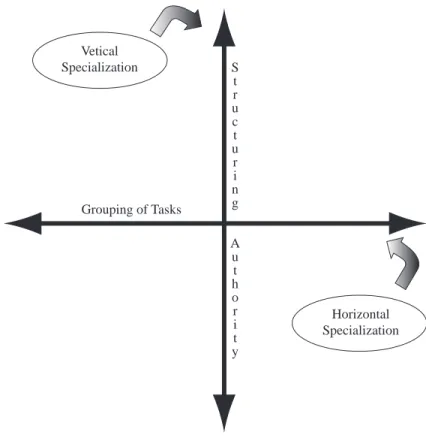
Within the structure of an organization, specialization exists in two di- mensions. We have just discussed the specialization found on the horizontal
axis—the grouping of tasks into departments and subunits. The vertical axis contains a different type of specialization—the structuring of authority. In or- ganizations, authority is the degree of discretion conferred on subordinates that makes it possible for them to use their judgment in making decisions and issuing instructions. A manager is assigned to each department or subunit within an organization. Each manager has a measure of responsibility and authority, delegated by his or her superior. The need for such delegation is obvious; if managers are responsible for the accomplishment of designated tasks and the supervision of employees, they must have the authority to guar- antee efficient performance. The vertical hierarchy provides a channel through which authority flows from top management down to the managers of sub- units. It also provides a means to coordinate the efforts of many individuals performing a variety of tasks. The concept of a vertical hierarchy is central to the classic theories of organizing. Now that so many organizations are using teams, encouraging horizontal communication, and instituting multiple re- porting patterns, the vertical hierarchy may be less critical than it used to be.
Process Client Services Departments
Customer Children, Undergraduates,
or Young Adults
Product Library Web site
Subject Local History,
Music, Business
Form of Resources Government
Documents, DVDs, or Maps Territory
Branch Libraries, Departmental
Libraries Function
Reference, Circulation, Interlibrary
Lending
Ways that Libraries Establish Departments
Figure 8.2—Types of Departments Found in Libraries
Nonetheless, it is important to understand this concept, even if many organi- zations are deemphasizing its importance.
the Scalar principle
As departments and subdepartments are assigned various tasks, primary and secondary units of the organization emerge. Primary organizational departments have numerous tasks and broad responsibilities; secondary or subdepartments have specific tasks and limited responsibility. For example, a copy catalog unit would be a subdepartment of a cataloging department. A subdepartment’s tasks contribute to the fulfillment of the responsibilities of the primary department.
The manager of the primary department supervises the manager of the sub- department to assure compliance with the needs of the primary department.
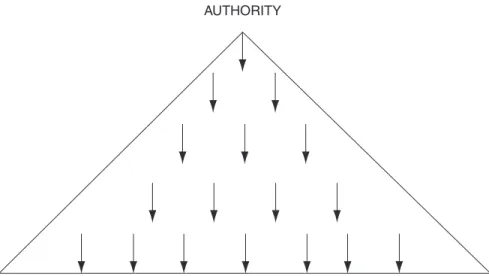
Authority flows from the primary to the secondary manager.
The scalar principle requires that there be final, ultimate authority and that lines of authority descend to every subordinate position. The clearer the line of authority, the more effective the organizational performance and communica- tion. Henri Fayol described the scalar principle as “the chain of supervisors ranging from the ultimate authority to the lowest ranks. The line of author- ity is the route followed—via every link in the chain—by all communications which start from or go to the ultimate authority.”16
Vetical Specialization
Horizontal Specialization Grouping of Tasks
St ur ct ur ni g
Au ht or it y
Figure 8.3—Vertical and Horizontal Specialization within Libraries
A clear understanding of the scalar principle by each subordinate is neces- sary for an organization to function effectively. Subordinates must know to whom and for what they are responsible, and the parameters of each manager’s authority should be clear.
This vertical hierarchy develops as a result of the ranking of organiza- tional units. A scalar hierarchy may be illustrated as a pyramid, with the ultimate authority at the apex and authority fanning out as it flows down- ward. The positions at the top of the pyramid deal with broader tasks and responsibilities, those at the bottom with more specific tasks and responsi- bilities. Even though the vertical hierarchy may remain stable over a period of time, tasks and responsibilities may shift as managers and supervisors delegate.
power and authority
The words power and authority are sometimes used interchangeably, but these terms are not synonymous. A person may possess power but still not necessarily possess authority. Authority is the legitimate right of a supervi- sor to direct subordinates to take action within the scope of the supervisor’s position. Authority flows down the vertical chain of command within the or- ganization. The authority is vested in the organizational position, not in the person holding that position, and it is accepted by subordinates. Power is the potential ability to influence the behavior of others. John French and Bertram Raven have identified five types of power:
• Legitimate power is the power that comes from a formal manage- ment position and is based upon authority recognized in accordance with position in an organizational structure.
• Reward power stems from the power to provide rewards for people.
Figure 8.4—The Flow of Authority within a Traditional Organization AUTHORITY
• Coercive power is power that derives from the potential to inflict punishment.
• Expert power is the power derived from expertise or knowledge.
Often people whose positions are not high in the chain of command have a great deal of power because of their knowledge.
• Referent power refers to power that derives from the respect and esteem accorded to an individual by virtue of personal attributes that command respect and admiration.17
Authority is the ability to influence that is associated with a person’s posi- tion within the organization. Power can be derived from sources other than a formal position. In many organizations there are people who have more power than might be expected as a result of their position.
Try This!
The Kingsbury Group is a medium-size information consulting company with about fifty employees. Bob Smith has just been appointed the new chief executive officer of the group. He will be in charge of all operations of the company. Also working at Kingsbury is Mark Simonds, who is in charge of all the firm’s information technology (IT) and computers. He has a keen sense of what is needed to keep the company’s complicated IT sys- tem running well. Whenever there is an IT problem, the employees always turn to Mark for a solution. Mary Malone is Bob Smith’s administrative assistant. She has worked at Kingbury for more than twenty years and makes the decisions about how vacation days are allocated and how travel expenses are reimbursed. Name the type of power that each of these indi- viduals possesses and give one example of how he/she might demonstrate that power for the benefit of the organization.
delegation
A supervisor with authority may delegate some of that authority downward.
Delegation is the transfer of authority within prescribed limits. In an effective organization, the person in the position holding ultimate authority delegates au- thority to subordinate managers. The delegation of authority to subordinates does not relieve the manager from ultimate responsibility; a manager is responsible for the actions of subordinates, even if authority has been delegated. A manager can delegate to subordinates almost anything for which that manager has responsi- bility. Of course, managers cannot delegate all authority without abdicating their managerial role. This is rarely a problem, however. Most managers delegate too little; some clutch tenaciously to authority and dislike delegating anything.
Many managers find it difficult to delegate adequate authority because they fear that a subordinate might make a mistake or perform poorly. In addition, some managers feel that they are not doing their jobs unless they make all
of the decisions, even the smaller ones that subordinates could easily make.
These managers spend a disproportionate amount of time on minor decisions, not realizing that, by doing so, they are taking time and attention away from the more important decisions that only they can make.
Effective managers have learned to delegate. They are willing to let go of some of their authority and to trust their subordinates. They know that these subordinates sometimes make mistakes, and they are still willing to take the risk because they realize that delegation is necessary in any organization. In addition, effective managers always remember that responsibility cannot be delegated without authority. A subordinate given responsibility without au- thority probably will be unable to function effectively.
What Do You Think?
Delegation without authority is empty. Before delegating think care- fully whether you are willing to permit work to be done without your direct oversight or review. Too much review, especially of profession- als, breeds apathy, dependency, and passive resistance, and de- stroys motivation.
Do you like to be micromanaged? Why do you think that so many su- pervisors find it hard to delegate? What can be done to encourage manag- ers to feel more confident in delegating work to their subordinates?
Allen B. Veaner, Academic Librarianship in a Transformational Age (Boston: Hall, 1990), 129.
centralization and decentralization
In describing the departmentalization process in organizations, the issues of centralization and decentralization were discussed. These same issues, al- though in a different form, are also relevant to a discussion of hierarchy. In the context of the vertical hierarchy of an organization, centralization and decentralization do not refer to geographic dispersal but to the dispersal of authority for decision making. In highly centralized organizations, authority is concentrated in the highest echelons of the hierarchy; almost all decisions are made by those at the top. For example, in the traditional organization, authority was highly centralized in the hands of top managers. These types of organizations have been termed command and control organizations because they were structured to centralize both the command and control of the orga- nization in the ranks of top management. It was assumed that whoever was in command also would tightly control the organization.
In contrast, in decentralized organizations the authority to make decisions is pushed down the organizational structure. As institutions become larger and more complex, there is a tendency toward decentralization. Centraliza- tion and decentralization can best be envisioned as two ends of a continuum.
Organizations marked by a high degree of retention of power, duties, and au- thority by top management are centralized; those marked by a high degree of delegation of duties, power, and authority at lower levels of the organization are decentralized. Decentralized organizations are often described as “participa- tive” because they allow for greater employee participation in decision making.
As mentioned earlier, many of today’s organizations are moving away from a command and control configuration toward a more decentralized structure.
The advantages of decentralization are several. First, the decisions to be made in many organizations are so numerous that if they are centralized, the man- ager may be overwhelmed by the amount of decision making that needs to be done. The organization may therefore become paralyzed by the inaction of these managers. Today, more libraries allow decisions to be made at the levels in the organization at which the most information about these decisions exists.
This greater access to inclusion in the decision-making process is contrary to practice in the typical bureaucracy, in which decisions and the information needed to make them are pushed up the hierarchy to a top manager. Most modern organizations attempt to bring together people who have the neces- sary information and let them make the decisions that will affect them. The effect is to create groups that can focus on problems, projects, or products better than the traditional hierarchy can. These overlays allow the organiza- tion to cut across departmental lines and to decentralize decision making.
They make the organization more flexible.
A second advantage of decentralization is that it permits organizations to be more responsive to local conditions. Because the transmission of information for decision making takes time, a decentralized organization is able to make more timely decisions. A final advantage of decentralization is that it serves as a stimulus to motivation. An organization that wishes to attract and retain creative and intelligent people is better able to do so when it permits them considerable power to make decisions.
What Do You Think?
James Neal, the vice president for Information Services and university librarian at Columbia University was quoted recently as saying:
We invest enormously in the people who work in a library organization both in terms of the responsibilities we assign them and in their growth and development; yet we don’t always provide them with the authority to make decisions and carry out their assignments effectively.
Has there ever been a time when you have felt as though you lacked the authority to carry out something you had been assigned to accomplish?
What is the result of failing to provide appropriate authority to accomplish a task?
Gregg Sapp, “James Neal on the Challenges of Leadership: An LA&M Exclusive Interview,” Library Administration and Management 19, no. 2 (Spring 2005): 64.
Both centralization and decentralization offer advantages.18 The major ad- vantage of centralization is that it offers the tightest means of coordinating decision making in the organization. Managers have a great deal of control over the decisions that are made because only a small number of managers are permitted to make them.
As mentioned previously, most large organizations have cut back the num- ber of middle managers, resulting in a flatter, more decentralized structure.
Much of this flattening has been permitted by the introduction of information technology. Technology has the potential to increase top-down control and to demotivate and deskill jobs, but, if it is used to provide employees with infor- mation needed for decisions, it can empower them. Information technology makes more reliable information available much more quickly than it ever was before to both top managers and those who work at lower layers in an organi- zation.19 Midlevel managers have been replaced with information technology.
Now top managers can receive up-to-the-minute information on operations via their computers—information that once was collected and interpreted by middle managers. Information technology also permits the easy sharing of in- formation both up and down the organizational ladder. In organizations such as libraries and information centers, where there are a number of highly edu- cated and skilled workers, it is likely that technology will play a key role in permitting further decentralization of decision making.
unity of coMMand
A classic management principle that provides clarity in the vertical hierarchy is that of unity of command. This principle states that organizational struc- ture should guarantee that each employee has one supervisor who makes assignments and assesses the success of the employee in completing those as- signments. In many organizations, however, employees have several supervi- sors. In libraries, this is often true; for example, in many large libraries, subject bibliographers are responsible to both the head of collection development and the head of technical services. An employee with more than one supervisor is placed in the awkward position of determining whose work to do first, how to do the work, and which instructions to follow. Unity of command protects the employee from such undesirable situations. As modern organizations have become more complex, theorists have realized that employees are often sub- ject to multiple influences. When faced with these conflicting pressures, the employee should have a single supervisor who can resolve the conflict. In addition, job descriptions should clearly spell out the worker’s duties and the amount of time to be spent on each.
Span of control
Just as employees should not be accountable to too many supervisors, managers should not be responsible for too many employees. Span of control (sometimes called span of management) refers to the number of people or ac- tivities a manager can effectively manage. When a manager supervises a large
number of employees, that manager is said to have a wide span of control, whereas one who supervises a small number is said to have a narrow span of control. When the number of subordinates exceeds the span of control of a single manager, something must be done to reduce their number. Manag- ers usually solve the problem by grouping some of the jobs and by placing an individual in charge of each of the groups. The manager then deals primarily with the individuals in charge of the groups rather than with all of the subor- dinates. Obviously, span of control is closely related to how many levels exist in an organization’s hierarchy. When there is a broad span of control, there are fewer managers, and the organization tends to be flatter.
What Do You Think?
The Manning University Library is growing at a rapid rate. A few years ago, the library employed only 20 people. Now, it has 150 employees. The heads of more than twenty diverse departments report directly to Wilma Smith, the library director. Lately, Ms. Smith has felt that that all she does is supervise and respond to problems. There is never time to concen- trate on her other managerial responsibilities, and she feels as though she is getting further and further behind in planning and budgeting. Using management terminology, what problem does she face and what do you recommend that she might do to improve the organizational effectiveness of the library?
There is no set number of subordinates that constitutes the ideal span of control. Recent research shows that the size of an effective span of control var- ies widely, depending on the type of organization and the type of activity being supervised. Managers have moved away from trying to specify the so-called ideal span of control to considering which is most appropriate to a specific situation.
One of the criteria used to determine the number of people a manager can adequately manage is the number and variety of tasks being managed. If the activities of the units assigned to one manager are similar, the span of con- trol can be increased. If the activities vary extensively and require thorough knowledge, the span of control should be decreased. One must consider what knowledge the manager must have to do an adequate job; the broader and more detailed the required knowledge, the fewer units that should be assigned to him or her.
Another criterion used to determine span of control is the amount of time available to be spent on communication. Time is a critical element in many enterprises. A manager who has many subordinates must reduce the time spent supervising each. Thus, it will be necessary for a manager with a large number of subordinates to spend more time on the initial training of each new supervisor, to give assignments in broad terms of goals or objectives to be achieved, and to delegate authority so that the supervisors may manage their personnel. If the span of control is wide and the manager fails to function as
described, time will be consumed by frequent conferences, daily meetings, and repetitive instruction.
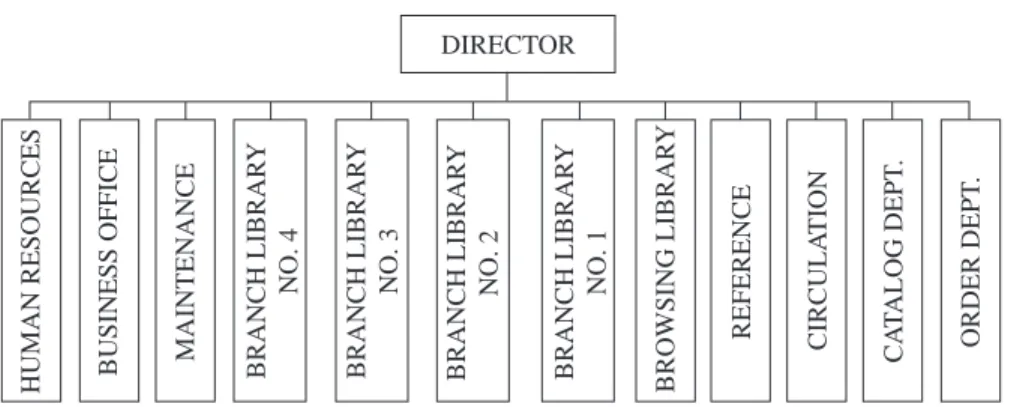
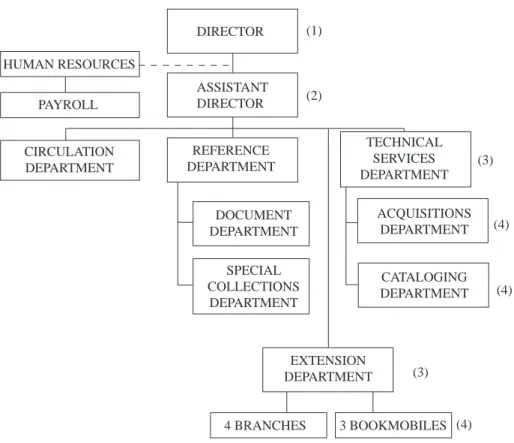
When many organizational units report to one manager, a flat or horizon- tal organization is created, and a wide span of control prevails. There are few levels of operation in a flat organization. Figure 8.5 shows only two levels of operation: the director and the manager of each unit to which specific activi- ties have been assigned. But the scope of knowledge required of the director is extensive indeed. When a manager has many subordinates, supervision of each unit is likely to be minimal. In organizations with narrow spans of man- agement, a tall, vertical organization is created. Figure 8.6 shows a vertical organization with four levels of operation. Each supervisor’s span of control is narrow—in this organization, the director has direct supervision over only two people—a great reduction from the 12 positions shown in figure 8.5.
line and Staff poSitionS
An important but sometimes confusing authority relationship in any organi- zation is that of line and staff positions. The concept of line and staff has been used for many years, but it still causes friction and difficulty. Line positions are those that are responsible and accountable for the organization’s primary objectives. Staff positions are those that provide advice, support, and service to the line positions. Line and staff also are distinguished by their decision- making authority. Because line positions are responsible for accomplishing the organization’s primary objectives, they have the final authority to make decisions. Staff positions, on the other hand, provide suggestions and advice for the line positions but cannot, theoretically, make decisions for them. As the old saying goes, “Line tells; staff sells.” In other words, people in line posi- tions have the authority to give orders, whereas those in staff positions must convince the line managers to adopt their suggestions. By maintaining final decision-making authority in the line positions, an organization seeks to keep it in those positions accountable for results and to preserve a clear chain of command from the top to the bottom of the organization.
As libraries have grown in size and complexity, they have relied more heav- ily on staff positions to provide support, advice, and information. Many li-
DIRECTOR
HUMAN RESOURCES BUSINESS OFFICE MAINTENANCE BRANCH LIBRARY NO. 4 BROWSING LIBRARY
BRANCH LIBRARY NO. 3 BRANCH LIBRARY NO. 2 BRANCH LIBRARY NO. 1 REFERENCE CIRCULATION CATALOG DEPT. ORDER DEPT.
Figure 8.5—A Flat Organization Chart
braries now have a number of staff positions dealing with public relations, systems, personnel, planning, fund-raising, and budgeting. These staff positions are held by individuals skilled in specific functions who provide the facts and information needed by the decision makers. A library human resources office, for example, may be responsible for receiving applications, interviewing appli- cants, maintaining personnel files, and recommending promotion or transfer.
But, generally, the human resources director does not have the authority to make human resources decisions. For instance, the human resources depart- ment facilitates the search for a new department head, but the actual decision about whom to hire is made by someone else—most likely by the library director, often with input from a search committee. Only individuals in a line position—the authority position—make these kinds of decisions. Although the head of the human resources department serves in a staff position for the en- tire library, he or she would, at the same time, have a line position within the human resources department and make decisions relating to its operation.
Conflicts often develop between line and staff personnel, usually when there are unclear notions of duties and authority. If staff employees do not under- stand their role in the organization, they will be frustrated and confused. On the other hand, if line managers continually disregard the advice of the staff, fearing that staff members may undermine their position and authority, the
DIRECTOR
DOCUMENT DEPARTMENT
SPECIAL COLLECTIONS
DEPARTMENT
TECHNICAL SERVICES DEPARTMENT
ACQUISITIONS DEPARTMENT
CATALOGING DEPARTMENT
EXTENSION DEPARTMENT REFERENCE
DEPARTMENT ASSISTANT DIRECTOR
(1)
(2)
(3)
(4)
(4)
(4) (3) HUMAN RESOURCES
CIRCULATION DEPARTMENT
PAYROLL
4 BRANCHES 3 BOOKMOBILES
Figure 8.6—A Vertical Organization Chart (figures in parentheses indicate level according to authority lines)
staff will be underutilized and its expertise wasted. Managers should be sure that authority relationships are understood and should encourage line per- sonnel to listen to staff and keep them fully informed so that staff positions can play their intended role of offering support and advice.
What Would You Do?
Samuel Shea has been employed by the Sullivan State University Library for the past 45 years. He came to SSU (when it was still Sullivan State Col- lege) as a new graduate from library school. He rose through the ranks and has been library director for 36 years. When he was first hired there were only three professionals on the staff. Since then, the library has grown and now employs 12 professionals, 25 clerical workers, and a number of student assistants. Nonetheless, Mr. Shea still runs the library like a one- man show. He tightly controls everything that goes on. He originates every procedure and service. He even draws up the schedules for the student assistants because he is sure he knows better than anyone else when and where they are needed. After 45 years, Mr. Shea is retiring next month, and you have just been hired as the new director. You are excited but a bit concerned about what you learned when you were interviewed.
• There is no organizational chart, but the library seems to be organized as it was 45 years ago. Although there are the usual departments, the department heads are ignored. Everyone goes to Mr. Shea for answers because he makes all of the decisions.
• There have never been any regularly scheduled staff meetings.
• Orders for supplies are only placed once a year, because Mr. Shea han- dles them.
• There is no user instruction provided, because Mr. Shea thinks college students should arrive knowing how to use the library.
• Mr. Shea refuses to have either telephone or online reference, because he feels that people should come to the library for service.
What difficulties do you see in making changes in a library like this one? Where will you start? What changes will you try to implement first?
coordination
Division of work, or specialization, is one important task in setting up an or- ganization, but it is equally important to make provisions for coordination. As mentioned earlier, every organization must specialize by dividing the tasks to be done. It also must coordinate or integrate these activities, bringing together all the individual job efforts to achieve a particular objective.
It is sometimes hard for a manager to strike the right balance between too much and too little coordination between departments. If there is too little, each department will focus inward on its own responsibilities. There will be
too little attention given to the organization’s overall objectives, and likely there will be both duplications and omissions in what is done because of the lack of the overall big-picture view. At the same time, too much coordinating can lead to departments getting in one another’s way and little getting ac- complished. Sometimes in libraries, one hears the complaint that librarians spend all their time in committee meetings and hence do not have time to do their “real” work. Although this is almost always an exaggeration, it is true that in all types of organizations a great deal of time is consumed by com- mittees and meetings. These are good means of achieving coordination and integration among units, but if allowed to proliferate uncontrolled, they can take far too much time away from the real work of the organization. Therefore, managers need to strive to maintain a balance between specialization and coordination.
coordinating MechaniSMS
There are a number of ways that coordination can be achieved. The verti- cal hierarchy is the primary means of providing coordination and integration, because the power and accountability associated with the hierarchy help en- sure that all parts of the organization work compatibly with one another. The planning techniques discussed in chapters 4 and 5 provide another means of coordinating. Policies, procedures, and rules provide guidance for members of the organization. When organizational members follow agreed-upon guide- lines, they are more likely to perform in a manner that is consistent with the organization’s overall goals. In a similar fashion, the organizational manual serves as a coordinating mechanism by specifying the activities that are to be conducted in each unit. The functional statements in the manual are designed to ensure that all work is covered and that the separation of the overall duties and functions provides the mix necessary to achieve organizational objectives.
Committees provide another means of coordination among specialized units, because they often draw members from various parts of the organization and because they encourage communication and participation in decision mak- ing. Staff positions, because they provide assistance and advice to managers throughout an organization, also promote coordination.
Many management experts recommend that organizations maintain a basic simplicity of form. Thomas Peters and Robert Waterman, in their study of successful organizations, found that the most successful organizations had a simple form that was easily understood by their employees. In their words,
“making an organization work has everything to do with keeping things un- derstandable for the tens or hundreds of thousands who must make things happen. And that means keeping things simple.”20 Any good organization structure has to have a clear delineation of boundaries and accountabilities.
Thus, simplicity in form aids in coordination.
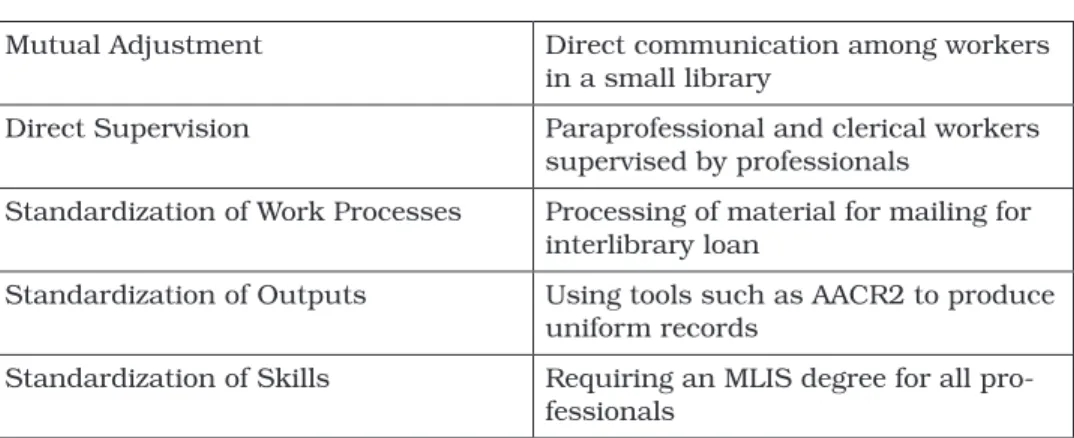
Henry Mintzberg provides another viewpoint on coordination. He identifies five mechanisms that explain the fundamental ways organizations coordinate their work. These five mechanisms—mutual adjustment; direct supervision;
and the standardization of work processes, outputs, and skills—provide the means to hold the organization together.
• Mutual adjustment means informal communication. Because it is such a simple mechanism, mutual adjustment is the coordinating mechanism used in the simplest of organizations, such as in a small library with a limited number of employees. Where there are just a few workers, there is no need for an elaborate hierarchy, and direct communication among all workers is unimpeded. Hence, informal communication permits the coordination of activities without the use of a more complicated mechanism. And as will be discussed later, mutual adjustment also is used by the most complex of organizations, in which sophisticated problem solvers facing extremely complicated situations must communicate informally to accomplish their work.
• In direct supervision, one individual takes responsibility for the work of others, issuing instructions to them and monitoring their actions.
In a library that has individual departments, mutual adjustment does not suffice to coordinate work. A hierarchy in which, as Mintzberg says, “one brain coordinates several hands,”21 needs to be estab- lished.
Mintzberg’s remaining methods of coordination all involve standardization.
With standardization, coordination is achieved before the work is undertaken.
In a sense, standardization incorporates coordination into the design of the work; this reduces the need for external coordinating mechanisms.
• Standardization of work processes occurs when the content of specific jobs is specified and programmed; that is, the processes are stan- dardized to a high degree. Supervisors overseeing such workers have little need to coordinate because a high degree of specificity is built into the jobs that are to be performed. The classic case of this type of standardization is found on assembly lines where workers perform highly specified tasks.
• Standardization of outputs occurs when the results of the work—for example, the dimensions of the product or the performance—are speci- fied. Certain outputs are standardized in libraries and information centers; for instance, the records in an online catalog are usually stan- dardized by means of a tool like AACR2.
When neither the work nor its outputs can be standardized, some coordina- tion is attained by standardizing the worker.
• Standardization of skills occurs when the training required to perform the work is specified. In most libraries and information centers, an ALA-accredited master’s degree is required for entry-level professional positions. Although curricula differ among LIS schools, it is assumed that a person who has earned an accredited MLIS degree possesses the initial skills and knowledge needed.
Mintzberg sees the five coordinating mechanisms as a continuum; as orga- nizational work becomes more complicated, the means of coordination shifts from mutual adjustment to direct supervision and then to standardization of
work processes, to standardization of outputs, and, finally, to standardization of skills. As mentioned previously, the most complex organizations revert to the beginning of the continuum and use the coordinating device of mutual adjustment.22
Although organizations may favor one coordinating mechanism, no orga- nization relies on a single one, and most mix all five. At the least, a certain amount of mutual adjustment and direct supervision is always required, re- gardless of the extent to which the organization relies on standards. Libraries use all five of the coordinating mechanisms.
Managers should remember the importance of coordination. It serves as the glue that permits the various units of the organization to move together toward the achievement of organizational objectives. The larger and more complex an organization becomes, the more those coordinating mechanisms are needed.
concluSion
This chapter has covered the methods that organizations use to decide how to subdivide into smaller subunits to permit specialization, as well as the ap- proaches they use to integrate the organization to permit coordination among the functions. The next chapter will look at the various overall organizational structures that are found in libraries and other organizations today and also will discuss how those structures may be different in the organizations of to- morrow.
noteS
1. John Cole, “Jefferson’s Legacy: A Brief History of the Library of Congress,”
Library of Congress (2006), http://www.loc.gov/loc/legacy/librs.html.
2. For these and other interesting facts about the Library of Congress, see
“Fascinating Facts” (2005), http://www.loc.gov/about/facts.html.
3. An organizational chart (2004) for the Library of Congress may be seen at http://www.loc.gov/about/LC_org_Sep04.pdf.
Table 8.2 Examples of Mintzberg’s Coordinating Mechanisms in Libraries Mutual Adjustment Direct communication among workers
in a small library
Direct Supervision Paraprofessional and clerical workers supervised by professionals
Standardization of Work Processes Processing of material for mailing for interlibrary loan
Standardization of Outputs Using tools such as AACR2 to produce uniform records
Standardization of Skills Requiring an MLIS degree for all pro- fessionals
4. Peter Drucker, Management: Tasks, Responsibilities, Practices (New York:
Harper & Row, 1974), 530.
5. Theodore Leavitt, “What Business Are You In?” Harvard Business Review 84, no. 10 (October 2006): 128.
6. Jim Collins, Good to Great: Why Some Companies Make the Leap and Others Don’t (New York: HarperBusiness, 2001), 133–34.
7. Robert Howard, “The CEO as Organizational Architect: An Interview with Xerox’s Paul Allaire,” Harvard Business Review 70 (September/October 1992):
120–21.
8. Henry Mintzberg, “Organization Design: Fashion or Fit?” Harvard Business Review 59 (January–February 1981): 103.
9. Vesa Kautto and Joma Niemitalo, “Organization and Efficiency of Finnish Academic Libraries,” Libri 9 (December 1996): 201–8.
10. See TimeWarner, “About Us: Our Company” (2007), http://www.timewarner.
com/corp/aboutus/our_company.html.
11. Michael J. Hammer and James Champy, Reengineering the Corporation: A Manifesto for Business Revolution (New York: HarperBusiness, 1993), 3.
12. Maxine Brodie and Neil McLean, “Process Reengineering in Academic Librar- ies: Shifting to Client-Centered Resource Provision,” CAUSE/EFFECT 18 (Summer 1995): 42.
13. Ibid.
14. Michael E. Porter and Victor E. Millar, “How Information Gives You Competi- tive Advantage.” Harvard Business Review 63, no. 4 (July–August 1985): 149–174.
15. See, for example, Sandra Yee, Rita Bullard, and Morell Boone, “We Built It and They Came: Client Centered Services in a New Building,” Proceedings of the ACRL 10th National Conference (Chicago: American Library Association, 2001), 261–64.
16. Henri Fayol, General and Industrial Administration (New York: Pitman, 1949), 14.
17. John R. P. French Jr. and Bertram Raven, “The Bases of Social Power,” in Group Dynamics: Research and Theory, ed. Dorwin Cartwright and Alvin Zander (Evanston, IL: Row, Peterson, 1960), 607–23.
18. Edward E. Lawler III, From the Ground Up: Six Principles for Building the New Logic Corporation (San Francisco: Jossey-Bass, 1996), 90.
19. Kenneth Chilton, “American Manufacturers Respond to the Global Market- place,” in The Dynamic American Firm, ed. Kenneth Chilton, Murray L. Weidenbaum, and Robert Batterson (Boston: Kluwer Academic, 1996), 166.
20. Thomas J. Peters and Robert H. Waterman Jr., In Search of Excellence: Les- sons from America’s Best Run Companies (New York: Harper & Row, 1982), 306.
21. Henry Mintzberg. The Structuring of Organizations (Englewood Cliffs, NJ:
Prentice-Hall, 1979), 4.
22. Ibid.