STUDENT PERCEPTIONS ON BEING ASSESSED BY THE ACTFL OPI BEFORE AND AFTER STUDYING ABROAD
by
Kayla P. VonBurg
A thesis submitted to the faculty of The University of Mississippi in partial fulfillment of the requirements of the Sally McDonnell Barksdale Honors College.
Oxford May 2019
Approved by:
___________________________________
Advisor: Dr. Maria Fionda
__________________________________
Reader: Dr. Douglass Sullivan-González
__________________________________
Reader: Dr. Donald Dyer
ii
©2019
Kayla Paulette VonBurg ALL RIGHTS RESERVED
iii
didn’t believe in myself. I also must thank Dr. Douglass Sullivan-González and Dr.
Jennifer Parsons of the SMBHC as with your assistance, I was able to pursue this topic.
Thank you to Dr. Donald Dyer for your guidance and support. Lastly, I must thank my Mom and Dad. Thank you for your support and love throughout these four years.
iv
In this study I investigated students’ perceptions of being assessed with the American Council on the Teaching of Foreign Languages (ACTFL) Oral Proficiency Interview (OPI) before and after studying abroad. This study aimed to determine if students’ study abroad experiences might affect their perceptions of being assessed by means of this exam and, if so, how. The participants were 96 college juniors and seniors who were International Studies majors at the University of Mississippi. Students in this program take a foreign language course every semester, study abroad for at least one semester, and take the ACTFL OPI before graduation. The participants completed an online survey that assessed their perceptions of being assessed by means of the ACTFL OPI. The results showed that post-study abroad students have negative opinions of being assessed by means of the OPI, and additionally, that these students feel that other aspects of their language acquisition like reading, listening, and culture would be important to highlight.
Conversely, pre-study abroad students had more positive opinions on being assessed with the OPI. These important findings demonstrate that students recognize other
improvements in the L2 they have developed while abroad and desire that what they have learned abroad is shown.
v
List of Tables and Figures .………....………...vi
Introduction….………..……….…….…6
Literature Review.………...9
Methodology…….………..……..….25
Results………29
Discussion………..………41
Conclusion………..……...…49
References………...52
Appendix A……….………...57
vi
Table 1: Participants’ Croft Study Abroad Experience & OPI/OPIc Experience……...30 Table 2: Total Classes Abroad and Total Classes in Target Language……….……31 Table 3: Living Arrangements, Lengths of Study Abroad Experience, & Additional Study Abroad Experience...………...…………..…32 Table 4: Feelings of Preparedness of OPI……….34 Table 5: Opinions on Being Assessed through OPI……….…….34
Student Perceptions on Being Assessed by the ACTFL OPI Before and After Studying Abroad
Introduction
Each year a growing number of students at universities get ready to spend a period of time studying at a university in another country. Kinginger (2009) defines study abroad as “a temporary sojourn of pre-defined duration, undertaken for educational purposes” (p. 11). Every year, an average of 300,000 American students participate in these meaningful multicultural experiences that can last from two weeks up to a full academic year (“Why Study,” n.d.), and this number is increasing. According to the National Association of Foreign Student Advisers (NAFSA), the number of students participating in a study abroad program for academic credit during academic years 2015- 2016 and 2016-2017 grew from 325,339 to 332,727 students, an increase of 2.3 percent (“Trends,” n.d.). USA Study Abroad claims that students who study abroad while
attending university are able to “navigate different cultures, work with diverse peers, and communicate in other languages” (“Why Study,” n.d.).
There are many benefits that may draw students to study abroad, including personal and intellectual growth, increased ability in intercultural communication, and a lasting impact on world view. Often, one of the goals of studying abroad is increased communicative proficiency in a foreign language. Previous work has supported the idea that studying abroad is one way to work towards this goal. In one of the earliest studies concerning second language acquisition in a study abroad context, Carroll (1967) looked
at 2,784 college seniors majoring in French, Spanish, German, Italian, or
Russian. Although the aim of the study was not to discover if there is a relationship between study abroad and language proficiency, the results of the survey demonstrated a strong correlation between skill level and study abroad. Research of second language gains during study abroad did not stop at Carroll (1967). Later studies (e.g., Magnan &
Back, 2007; Watson, Siska, & Wolfel, 2013) found that students often returned home from studying abroad with an increased development of oral proficiency.
Although there are several studies that argue studying abroad can improve oral proficiency, others have found that students who study abroad are not necessarily at an advantage in terms of grammatical performance in comparison to those who do not study abroad. For example, Segalowitz, Freed, Collentine, Lafford, Lazar, and Diaz-Campos, (2004) found that students who studied abroad showed more significant gains in oral proficiency and oral fluency when compared with those who studied at their home universities; however, the authors also found that the at-home group improved on grammatical performance while the study abroad group did not.
Students and educators alike may be eager to measure newfound foreign language communicative proficiency, which is where high stakes language tests like the American Council on the Teaching of Foreign Language’s (ACTFL) Oral Proficiency Interview (OPI) come into play. However, students taking this exam may not feel that this method of testing adequately demonstrates what was learned while abroad. The aim of this study is to examine whether the experience of studying abroad affects students’ perceptions on
being assessed by means of the OPI. While plentiful research has been conducted regarding the effects of studying abroad on second language acquisition (Diaz-Campos, 2004; Juan-Garau & Pérez-Vidal, 2007; Kinginger, 2009; Llanes, 2011), and several authors have expressed their concerns with the ACTFL OPI and the ACTFL Guidelines (Liskin-Gasparro, 2003; Magnan & Back, 2007; Salaberry, 2000), little research has considered the tester’s perceptions of the OPI (e.g., Kissau 2014), and, to the best of my knowledge, no research has investigated how study abroad students perceive this test.
Research shows that students who study abroad experience gains in several different aspects of second language acquisition, including fluency and grammar development (e.g., Guntermann, 1995; Juan-Garau & Pérez-Vidal, 2007; Lennon, 1990); however, some of these gains may go unnoticed as additional research shows that the ACTFL Guidelines and the OPI may not be “sensitive enough” to demonstrate some gains (Llanes, 2011; Magnan & Back, 2007).
The purpose of this study is to determine if time spent studying abroad affects students’ perceptions of being assessed by means of the OPI and, if so, why, and how their perceptions may differ from those of students who have not studied abroad. It is important to determine what students believe they have learned while abroad and if they believe it is reflected in the test. If it is the case that the current method of testing is not measuring all that students feel they have learned, it may be beneficial to find additional ways to measure other skills that students may have developed while abroad.
Literature Review
This literature review seeks to cover research that has investigated the American Council on the Teaching of Foreign Languages (ACTFL) Proficiency Guidelines, second language acquisition in a study abroad context, the ACTFL Oral Proficiency Interview (OPI), and washback of the ACTFL OPI. The goal of this literature review is to identify a gap within the current scope of literature that will be filled by the current study.
ACTFL Proficiency Guidelines. The Proficiency Guidelines are a set of
standards created by ACTFL in 1986 used to describe what language learners can do with a second language and assessing “functional language ability” in the areas of speaking, listening, reading, and writing (“ACTFL Proficiency,” 2012.) In each of the four skills, the standards break down a learner’s proficiency into one of five major levels of proficiency: Novice, Intermediate, Advanced, Superior, and Distinguished (“ACTFL Proficiency,” 2012). The major levels of Novice, Intermediate, and Advanced are each further divided into sublevels of Low, Mid, and High (“ACTFL Proficiency,” 2012).
ACTFL claims that the Guidelines are able to “describe the continuum of proficiency from that of the highly articulate, well-educated language user to a level of little or no functional ability” (“ACTFL Proficiency,” 2012).
When describing a certain level or sublevel, the Guidelines describe what a speaker is able to do in the L2 at that particular level. For example in the Advanced Low sublevel, speakers are able to communicate in informal conversations as well as formal conversations (“ACTFL Proficiency,” 2012). Topics usually involve leisure activities,
school, and home life, but more advanced topics can include current events and
employment (“ACTFL Proficiency,” 2012). Speakers at Advanced Low are able to speak in discourse that is paragraph length, and they are able to use the past, present, and future tenses (“ACTFL Proficiency,” 2012). Although the Advanced Low speaker is able to sustain their performance, there still is presence of “grammatical roughness,” and learners will still rephrase and circumlocute (“ACTFL Proficiency,” 2012). Native speakers who are unaccustomed to dealing with non-native speakers typically understand Advanced Low speakers, although sometimes repetition is required (“ACTFL Proficiency,” 2012).
Some authors argue that level-by-level within the Guidelines, a learner is
expected to have increasingly greater control over the L2, demonstrating oral proficiency exponentially instead of in a linear fashion (Magnan & Back, 2007). The criteria of each level within the Guidelines become increasingly broad as one moves up the scale;
therefore, when a student has a higher starting score, it can become more difficult to cross a higher threshold of oral proficiency (Magnan & Back, 2007). Anderson (2012) agrees with Magnan and Back (2007), stating that it is not well communicated by ACTFL that it is more difficult for an Intermediate speaker to become an Advanced speaker than it is for a Novice speaker to become an Intermediate speaker. The author references Salaberry (2000), arguing that although the intervals between levels and sublevels may seem equal, in reality the training and time required to move up in levels is not represented
(Anderson, 2012, p. 154). Lastly, Fulcher (1996) claims that the Guidelines are not based
on any empirical, documented evidence, but rather on teachers’ experiences (as cited in Kissau, 2014, p. 529).
Some authors criticize using the ACTFL Proficiency Guidelines as a
measurement of oral proficiency gains of study abroad participants. Magnan and Back (2007) hypothesized that it may be easier to see improvement in a learner’s oral
proficiency after studying abroad using the Guidelines when the learner enters their study abroad program with a lower starting proficiency level. Llanes (2011) supports this statement in claiming that the students with higher proficiency levels who spend shorter times abroad may not improve in terms of the Guidelines because the Guidelines may not be sensitive enough to measure the smaller gains from studying abroad.
Second Language Acquisition in a Study Abroad Context. Context plays an important role in understanding second language learning and acquisition. Context can be divided into two categories: instructed and naturalistic language development
(Kinginger, 2009, p. 30). Study abroad programs are often a combination of both types.
Students abroad often have access to language classes, and they potentially have greater access to L2 input and interaction outside of the classroom (Kinginger, 2009, p. 30). It is the combination of the two types of context that has driven the belief that studying abroad gives the student an advantage in learning a second language. Llanes (2011) states that the context in which a language is learned is crucial, as both speed and accuracy of learning can vary as a result of context (p. 189). Llanes asserts that the context of language learning alters the amount of opportunities a learner has to practice outside the
classroom, the quantity and quality of L2 input, and the type of instruction a learner receives in the L2 (2011, p. 189).
Some research suggests that studying abroad leads to gains in language proficiency. Watson, Siska, and Wolfel (2013) studied 498 third- and fourth-year
students of the United States Military Academy who participated in a semester-long study abroad experience in 14 countries. Students took classes in their respective target
language, and they lived with a host family or in an international dormitory. All students took the ACTFL OPI twice: upon arrival to the host country and upon their return home.
The results indicated that 88% of the participants scored one sublevel higher on the ACTFL Proficiency scale upon their return back to the United States. In fact, 49% of the participants crossed a major threshold (Novice, Intermediate, Advanced, Superior, Distinguished) within the ACTFL scale. In another study, Magnan and Back (2007) studied 24 American students who spent a semester in either Paris or Montpellier, France, and measured their proficiency gains using the OPI, predeparture and return
questionnaires, the Can-Do self-assessment scale1, and an edited version of the Language Contact Profile2. The authors found that all participants either maintained or improved their current level of proficiency by one or two sublevels on the ACTFL scale.
1The Can-Do Self Assessment scale is a 23-item measure that asks students to self-report their abilities to perform different tasks in the target language, from skills like ordering a meal or asking for directions to talking about abstract topics (Magnan & Back, 2007).
2The Language Contact Profile is a measure by which students self-report the approximate number of hours spent using the L2 in different types of situations (e.g. speaking the L2 with native speakers, speaking the L2 with classmates, etc.) (Magnan & Back, 2007).
A frequently researched skill in a study abroad context is fluency. Lennon (1990) investigated four participants’ oral fluency development during a six-month period abroad and found that the study abroad experience helped the participants improve their oral fluency. Juan-Garau and Pérez-Vidal (2007) examined 12 students learning English as an L3, who were already bilingual in Catalan and Spanish. The authors followed the students throughout their university career, collecting data at four distinct time points in time: their entrance to the university, before the study abroad experience, immediately after the study abroad experience, and one year after the study abroad experience. The authors found that although the study abroad experience did not improve oral accuracy, it did improve the students’ oral fluency (Juan-Garau & Pérez-Vidal, 2007).
Although the research is limited, pronunciation gains while abroad have shown to be not as promising. Teachers and students alike may believe that studying abroad improves a student’s pronunciation in the L2, but Diaz-Campos (2004) claims that studying abroad does not improve a student’s perception or production of pronunciation differences in the L2 (as cited in Llanes, 2011, p. 194). On the other hand, the author also claims that students who reported greater use of the L2 abroad showed more native- like pronunciation patterns than those who reported lower use (as cited in Llanes, 2011, p. 194).
Various researchers have examined how studying abroad impacts acquisition of L2 grammar. Guntermann (1995) investigated students at home and abroad learning Spanish, and the author found that students who studied abroad returned home with a
greater acquisition of Spanish tenses as well as a greater dominance of the Spanish verbs ser and estar (as cited in Llanes, 2011, p. 193). In a study of American undergraduates studying Spanish both abroad and at home, Collentine (2004) found that students who took classes at home showed greater improvement of discrete grammatical points than those who studied abroad.
Research is also limited in the areas of measuring L2 gains in the skills of
listening and reading. Cubillos, Chieffo, and Fan (2008) studied 48 participants enrolled in a short-term study abroad program, and they compared this group of participants to 92 participants at home. The authors found that the students who studied abroad scored higher on a listening post-test than the students in the at-home context. In a different study, Llanes and Muñoz (2009) investigated the listening skills of 24 participants and found that their listening skills significantly improved after going abroad, as the students had a higher number of correct answers on the pre-test than the post-test.
In one study regarding reading development in the L2, Dewey (2004) compared fifteen students learning Japanese as a L2 abroad to fifteen students learning Japanese at home. The students spent eleven weeks in Japan, and, upon returning, took a test that assessed reading comprehension and vocabulary knowledge. The only difference that appeared to the authors between those who studied abroad and those who did not was that the post-study abroad learners felt more confident while reading.
The practice of studying abroad to improve in target language proficiency is promising; however, it is important to remember studying abroad is a complex and multi-
variable experience. Factors including (but not limited to) age, program duration, living arrangements, and proficiency levels before studying abroad may have an impact on potential gains (Watson, Siska, and Wolfel, 2013). Some researchers argue that the alteration of any one of these variables could affect L2 language acquisition. In a study that looked at a group of students who studied abroad in Spain, Segalowitz, Freed, Collentine, Lafford, Lazar, and Díaz-Campos (2004) found that the amount of time spent speaking Spanish outside the classroom and with host families related negatively with the usage of communication strategies. Communication strategies included self-repair on the learner’s speech, accuracy checks on the learner’s speech, and restructuring for
understanding. According to the authors, these study-abroad students did not need to rely on communication strategies as much as at-home students because regular
communication with native speakers removed the need to use the strategies to manage information gaps.
In a different study, Baker-Smemoe, Dewey, Bown, and Martinsen (2014) found that in their investigation of 102 students who studied abroad in either Spain, Mexico, France, Russia, Egypt, or China, the students were most affected by pre-program proficiency, intercultural sensitivity, and social networks. Those participants who had scored lower on the pre-study abroad ACTFL OPI achieved a higher score on the post- study abroad OPI, and participants who had scored higher on the pre-study abroad OPI did not improve their post-study abroad score by much, if at all. The authors
hypothesized these findings can be explained by the difficulty in advancing sublevels on
the ACTFL scale because it progresses exponentially—to advance on the ACTFL scale, one must have an increasingly greater amount of dominance over the language.
Additionally, the authors suggested that a learner’s pre-departure intercultural sensitivity may have affected their L2 acquisition, which led the authors to argue that culture and language acquisition may work hand and hand. The authors’ results suggested that when a learner is able to deal with other cultures effectively, they are more apt to acquire the L2. Lastly, the authors found that one of the greatest predictors of success in gains of oral proficiency was the social networks of the participants. The authors divided the social networks into four different categories—the English proficiency of the
participant’s friends, the number of social groups a participant was involved in, the change of size of the participant’s social group through the experience, and the intensity of the connections. The authors suggested that “having deeper conversations with close friends is more important than the amount of time spent speaking the L2,” and by this suggested that having closer relationships with speakers of the L2 could predict gains in the L2 (Baker-Smemoe et al., 2014, p. 481).
This section has described research that has been conducted on second language acquisition in a study abroad context. Various authors have found that studying abroad can improve a learner’s oral fluency, grammar, and listening skills. On the other hand, reading and pronunciation have been found not to improve after a study abroad
experience. Other authors have pointed out that studying abroad involves many different
variables, and an alteration of a variable could alter the gains a learner has from studying abroad.
ACTFL Oral Proficiency Interview. A widely used instrument in measuring oral language proficiency is the Oral Proficiency Interview (OPI), developed by
ACTFL. The OPI is a live, thirty-minute phone conversation between candidate and an ACTFL Certified OPI Tester (“ACTFL Oral,” 2012). The OPI is a criterion-referenced exam that does not compare one individual’s performance to another’s; the exam compares an individual’s speech sample to the criteria set by the ACTFL Proficiency Guidelines—Speaking (Swender, 2003). The goal of the OPI exam is to elicit a ratable sample that demonstrates the “highest level of sustained performance” and the “level at which the speaker can no longer sustain the performance” (“ACTFL Oral,” 2012).
Interviewers ask open-ended questions to give the speakers the opportunity to show the full scope of their language ability. To achieve a ratable sample, the OPI exam features four different phases: warm-up, level checks, probes, and wind down (“ACTFL Oral,”
2012).
The warm-up phase consists of “greetings, informal exchanges of pleasantries, and conversation openers,” all of which are pitched at a level that is comfortable for the speaker (“ACTFL Oral,” 2012). When the conversation has settled and the interviewee has become more comfortable, the interviewer moves into the phase of level checks, which includes questions on topics of the speaker’s interest that elicit the linguistic tasks and contexts of any particular level (“ACTFL Oral,” 2012). The interviewer is trained to
determine what topics and level of language an interviewee can handle in real time during the interview (“ACTFL Oral,” 2012). Probes are used to establish the limits of the
speaker’s proficiency. To this end, the interviewer raises the linguistic level of difficulty of the interview in order to determine the level at which the speaker can no longer maintain performance (“ACTFL Oral,” 2012). Lastly, the conversation returns to a comfortable level for the speaker in the wind down (“ACTFL Oral,” 2012).
The proficiency rating of the speaker is determined by establishing the “ceiling”
and “floor” of the participant’s speech (“ACTFL Oral,” 2012). Using the 2012 ACTFL Proficiency Guidelines—Speaking, the raters determine the major level (Novice, Intermediate, Advanced, Superior, or Distinguished) and sublevel (Low, Mid, High) of the interviewee’s speech (“ACTFL Oral,” 2012). The criteria considered in the rating of the speaker are i) the functions or global tasks the speaker performs; ii) the social
contexts and specific content areas in which the speaker is able to perform them; iii) the accuracy; iv) the type of oral text or discourse the speaker is capable of producing (“ACTFL Oral,” 2012). Every OPI interview is scored once by the interviewer and once more by a second, blinded certified OPI rater (Swender, 2003). In order for a ranking to become official, both raters must agree exactly on both the level and sublevel of the speaker (“ACTFL Oral,” 2012). If the two parties disagree, the interview is analyzed once more by a third, blinded rater, and when two raters agree, the score becomes official (Swender, 2003).
As the demand for language proficiency testing has grown over time, ACTFL developed an alternate version of the Oral Proficiency Interview to meet the growing need: the Oral Proficiency Interview—Computer (OPIc). Unlike the OPI, the OPIc is a computerized test that gathers an oral sample from a test taker, and a certified rater is able to give the test taker a rating of oral communicative proficiency up to the level of
Superior, using the ACTFL Guidelines (“ACTFL OPIc,” 2014). Instead of a live interviewer controlling the sample of speech, a computer program determines the
delivery of interview questions (“ACTFL OPIc,” 2014). Like the OPI, the OPIc seeks to obtain a “ratable sample of speech,” which is then compared to the 2012 ACTFL
Proficiency Guidelines—Speaking to assign a proficiency level to the test taker (“ACTFL OPIc,” 2014). In order to rate a sample of speech, a rater considers the following criteria as they relate to the major proficiency levels of the 2012 ACTFL Proficiency Guidelines:
i) the functions and global tasks the speaker is able to sustain; ii) the accuracy or precision with which these tasks are accomplished and understood; and iii) the type of oral text or discourse the speaker is capable of producing (“ACTFL OPIc,” 2014).
The procedure for taking the OPIc is different than the procedure for the OPI.
Before beginning the exam, the test taker completes a background survey and a language self-assessment (“ACTFL OPIc,” 2014). During the background survey, a test taker answers questions regarding school, work, home, hobbies, and interests so that the computer can generate questions to customize the test for the test taker (“ACTFL OPIc,”
2014). Next, test takers select one of six different descriptions that they feels best fits
their level of language proficiency and, as there are different test forms for different language proficiency levels, this step determines which test form the test takers receive (“ACTFL OPIc,” 2014). At this point, the test takers are introduced to Ava, the
personification of the OPIc interviewer (“ACTFL OPIc,” 2014). Ava asks the interview questions throughout the exam and mimics the behavior of “a one-on-one conversation with a native speaker of the target language” (“ACTFL OPIc,” 2014). Every test taker begins the exam with Ava’s question, “Let’s start the interview now. Tell me something about yourself” (“ACTFL OPIc,” 2014).
Validity is an important topic when discussing the ACTFL OPI as various researchers argued that a notable weakness of this test is its rating criteria and interview process. Salaberry (2000) claims it is plausible that the OPI may be a better measure of strategic competence rather than communicative competence, arguing that a learner with high levels of strategic competence in conversational interaction management could earn a higher rating on the exam than a learner at the same level of communicative
competence but with a lower skill level of strategic competence. Likewise, Liskin- Gasparro (2003) questions the validity of the OPI assessment, stating that although the exam is intended to measure interpersonal language performance in “real-world” tasks, the OPI actually measures a candidate’s ability to engage in a formal interview (2003).
Kissau (2014) states that a test taker’s rating on the OPI may not necessarily be a full reflection of their communicative competence, but may also reflect on how well the test taker is able to understand the interviewer. Sandlund, Sundqvist, and Nyroos (2016) add
to the argument that if the OPI is intending to measure L2 oral proficiency, the OPI does not have validity, as the test takers are restricted in the freedom they have during the interview. The authors argue that test takers are not able to initiate new topics and have no control over the turn taking of the interview.
Freed (1990) wrote of difficulties using the OPI to measure language acquisition during study abroad. The author's research included a group of 40 undergraduate students participating in a summer study abroad program in France, and students were given both the College Entrance Examination Board Language Achievement Exam3 and the ACTFL OPI before the students went abroad and after they returned. Because very little change in proficiency was documented in the scores of the ACTFL OPI, Freed hypothesized that because the OPI uses holistic and global scoring, it was therefore not sensitive enough to detect changes in language ability from this short-term programs (1990).
Although various issues of validity have been discussed in research, it is also important to bear in mind that there may be no practical alternatives to the ACTFL OPI.
Salaberry (2000) notes that because the OPI may be the most practical, effective
instrument for measuring oral language acquisition we have right now, it is important that we understand the limitations with the test so that the results it elicits can be fully
understood (Salaberry, 2000).
3The College Entrance Examination Board Language Achievement Exam is a discrete-point multiple choice exam that is used to measure grammar and reading comprehension (Freed, 1990).
Oral Proficiency Interview Washback. Research is limited in terms of test takers' perceptions of and reactions to the ACTFL OPI. Kissau (2014) performed a study of foreign language teacher candidates and their perceptions of the OPI. This study followed a foreign language education program in southeastern United States, which required prospective teachers to take the OPI and score a rating of Advanced Low before beginning a semester of student teaching (Kissau, 2014). Students who scored at the required level were allowed to begin student teaching, while those who did not meet the requirement were still allowed to begin student teaching, but had to create an action plan to improve their proficiency (Kissau, 2014). In a cohort of 41 teacher candidates, 56%
(n=23) met or exceeded the required level of Advanced Low, while the remaining 18 candidates were rated Intermediate High. In terms of how the OPI requirement affected enrollment in the program, Kissau found that 95% of the teacher candidates reported that the OPI requirement had no impact on their decision to enroll in the program (Kissau, 2014). However, of the 41 candidates, two reported feeling apprehension about enrolling in the program due to the test, five (12%) reported feeling anxiety while taking the test, and an additional five participants (12%) found the test to be redundant and an
unnecessary expense for native speakers.
On the other hand, Malone and Montee (2010) argued that the OPI might create a positive incentive for students and teachers alike in the classroom. The authors theorized that students may be incentivized to speak up more during class, and teachers may be apt to present more speaking and communicative opportunities in the classrooms for
students. The authors also note, however, that implementation of the OPI in schools and universities could create negative “washback” in the classroom; that is, because the OPI is designed to elicit and evaluate a certain number of speaking situations, it could result in
“teaching to the test.” (2010).
Current Study. In light of the research reviewed above, the present study was designed to determine if studying abroad may affect students' perceptions on being assesed with the OPI; in other words, if there exists a difference in the perception on being assessed with the ACTFL Oral Proficiency Interview between students who have studied abroad and students who have not. Previous literature investigated the
relationship between study abroad and second language acquisition, and validity of the ACTFL OPI, but it has not attempted to determine the nature of a relationship in a perceptual study of the standardized test in study abroad test takers. Although the students may experience several gains, both intra- and extra-linguistic, the OPI may not be sensitive enough to measure all gains, leaving students with the perception that the OPI is unable to show their newly-developed skills.
The research questions that guided the study were: Do the perceptions of the OPI test differ between learners who have not studied abroad yet and those who have? If so, how do they differ? An additional question that guided this study was: More specifically, how do post-study abroad learners’ opinions on being assessed by means of the ACTFL OPI exam differ from those of pre-study abroad learners? The prediction is that learners who have studied abroad will likely have a more negative opinion on being assessed with
the test because they have had a complex, multicultural experience, and the learners will likely feel that the full scope of everything they have gained while abroad cannot be captured by this test. Participants who have not studied abroad, then, will likely have a more neutral or even positive opinion on being assessed with the test because they have not had this international experience.
Methodology
Materials. The materials used for this study consisted of a set of survey questions, distributed as an electronic questionnaire. It contained a total of nineteen questions on the topics of studying abroad and the ACTFL OPI, although participants may not have viewed all of the questions depending on their responses to previous questions. Appendix A lists the survey questions. The first question asked whether a participant had studied abroad as a part of the requirement for the Croft Institute for International Studies, and from there, the answer to this question determined which set of questions the participant received. The maximum number of questions for participants who had studied abroad was nineteen, and the maximum number of questions for participants who had not studied abroad was eighteen. The survey featured three different sections of questions—Croft Study Abroad Experience, Additional Study Abroad Experience, and Perception of Being Assessed by OPI. Figure 1 displays the flow of questions sets.
The first set of questions, Croft Study Abroad Experience, outlined the experience a participant had fulfilling the requirement for the Croft Institute for International
Studies. Participants were asked about their study abroad destination, length of stay, housing arrangements, and amount of classes in the target language, all of which were factors that could influence a participant’s language acquisition and study abroad experience as a whole.
Figure 1: Flowchart of Survey Questions
Regardless of the answer to the first question, all particpants received a question asking about any additional study abroad experiences a participant might have had besides the requirement for Croft. This question was asked to account for any other experience that might have influenced the participant’s perception. If the participant indicated that they had additional study abroad experience, the survey then moved into the Additional Study Abroad Experience section, which asked the same questions from the Croft Study Abroad Experience section. Any participant who indicated they had studied abroad for a purpose other than the requirement for the Croft Institute but had not
yet studied abroad as a requirement for the Croft Institute would still receive questions as though they had not studied abroad yet at all. This decision was made because the questions for those who had studied abroad were tailored for the knowledge and opinions of the OPI as they immediately relate to the study abroad requirement for the Croft Institute.
Lastly, the survey moved into the Perception of Being Assessed by OPI section, and all participants received this set of questions. This section featured four open-ended questions. Participants were first asked to indicate whether they had taken the ACTFL OPI or OPIc. The questions that followed gathered information about their knowledge of the OPI and what it tests, their opinion of being tested with the OPI, and their feelings of preparedness for the OPI.
Participants who indicated they had studied abroad as a requirement for the Croft Institute for International Studies received an additional question at the end of the survey, which asked if they felt that the OPI could capture everything they learned while they were abroad. This group received this question only because this group had an extended international experience and would be more equipped with experience to answer.
Participants. The data were collected from juniors and seniors enrolled in the Croft Institute for International Studies at the University of Mississippi as International Studies majors. In total, 96 students received the survey. Of the 96 students, 42 participated in the questionnaire. As International Studies majors, this group of participants takes a foreign language course every semester of university and studies
abroad for at least one semester. To measure the language skills the students have obtained during their four years in college, this group of students takes the ACTFL OPI in the semester immediately prior to their graduation.
Procedure. The Associate Director of the Croft Institute for International Studies recruited participants by distributing the survey via email. Participants received an email in their University-issued account on January 16, 2019 from the Croft Institute for
International Studies. The email contained a script that included the link to a secure and anonymous Qualtrics questionnaire. A copy of the script can be found in Appendix A.
Qualtrics is an online survey platform owned by SAP in which the user has the ability to create and distribute questionnaires, as well as analyze the responses. The script assured participants that no party other than the principal investigator and thesis director would see the participants' responses. When participants clicked on the link, the survey appeared on Qualtrics. The survey was designed to take approximately ten minutes to complete.
After an initial 22 responses, a reminder email, sent on February 2, 2019 gathered an additional 20 responses. The participants did not receive compensation in any form for their participation.
Results
This chapter is divided into two sections: the results of the Croft Study Abroad Experience section and the results of the Perception of Being Assessed by OPI section.
At the survey’s closing on February 16, 2019, a total of 42 students participated in the survey, which led to a response rate of just over 43 percent. Not all 42 participants finished the survey in full, and their answers were included regardless of whether the survey was completed.
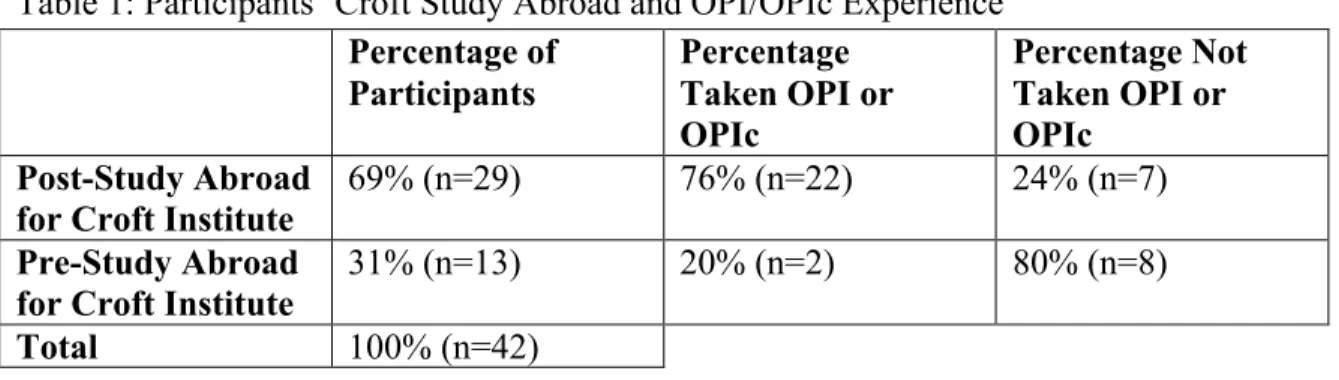
Croft Study Abroad Experience. Twenty-nine participants indicated that they had studied abroad as a requirement for the Croft Institute for International Studies whereas thirteen participants indicated they had not yet fulfilled the study abroad requirement. Of those who had not yet studied abroad, two participants indicated that they took the OPI or OPIc, and eight participants indicated they had not taken the OPI or OPIc. The other three participants of this group did not respond to this question. In the participant pool who had studied abroad, it was found that 22 participants had taken the OPI or OPIc, and six participants had not taken the OPI or OPIc. Table 1 demonstrates the breakdown of participants regarding their Croft Institute study abroad experience as well as their experience with the OPI or OPIc. “Post-Study Abroad” refers to participants who have studied abroad as a part of the requirement for the Croft Institute, and “Pre- Study Abroad” refers to participants who have not yet studied abroad as a part of this requirement.
Table 1: Participants’ Croft Study Abroad and OPI/OPIc Experience Percentage of
Participants
Percentage Taken OPI or OPIc
Percentage Not Taken OPI or OPIc
Post-Study Abroad for Croft Institute
69% (n=29) 76% (n=22) 24% (n=7)
Pre-Study Abroad for Croft Institute
31% (n=13) 20% (n=2) 80% (n=8)
Total 100% (n=42)
During these study abroad experiences, students were in control of several variables, including study abroad destination, living arrangements, and courses taken in the target language. Table 2 outlines the breakdown of Post-Study Abroad participants’
courses while abroad as well as Pre-Study Abroad participants’ plans for courses while abroad. Post-Study Abroad participants generally took three, four, or five classes abroad while Pre-Study Abroad participants stated they had plans to take a similar number of courses. Of the Post-Study Abroad participants, 82% took five courses in the target language abroad, while only 50% of Pre-Study Abroad participants planned to take five courses in the target language.
Table 2: Total Classes Abroad and Total Classes in Target Language Abroad
1 2 3 4 5
Post-Study
Abroad 0% (3%) 0% (17%) 4% (14%) 14% (7%) 82% (59%) Pre-Study
Abroad 0% (10%) 0% (20%) 10% (10%) 30% (10%) 60% (50%) Note: A percentage in parenthesis denotes the percentage of participants who took or planned to take that number of courses in the target language during the Croft Study Abroad experience.
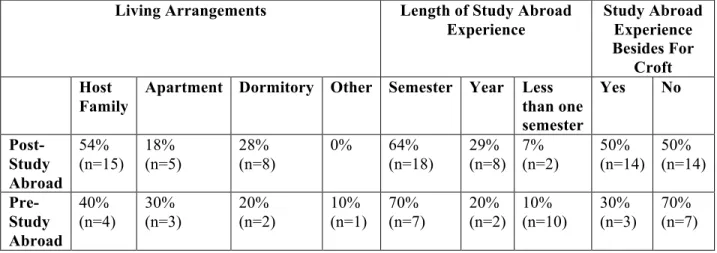
Table 3 expresses the living arrangements and lengths of experience of the participants. Both groups seemed to prefer a semester study abroad experience. In addition, more than half of Post-Study Abroad participants elected to stay with a host family, and only 40% of Pre-Study Abroad participants planned to stay with a host family while abroad.
All participants were asked if they had any additional study abroad experience besides for the requirement for the Croft Institute. Table 3 shows the breakdown of Pre- Study Abroad and Post-Study Abroad participants who had an additional study abroad experience besides the experience that fulfilled the requirement for the Croft Institute.
50% of students who had completed the study abroad experience for the Croft Institute had an additional study abroad experience, and only 30% of Pre-Study Abroad
participants had an extra study abroad experience. Of the 17 total participants who indicated they had this additional study abroad experience, 13 of these participants did so to take additional language classes, while the other four participants did so to take other academic classes.
Table 3: Living Arrangements, Lengths of Study Abroad Experience, and Additional Study Abroad Experience
Living Arrangements Length of Study Abroad Experience
Study Abroad Experience Besides For
Croft Host
Family
Apartment Dormitory Other Semester Year Less than one semester
Yes No
Post- Study Abroad
54%
(n=15)
18%
(n=5)
28%
(n=8)
0% 64%
(n=18)
29%
(n=8) 7%
(n=2)
50%
(n=14) 50%
(n=14) Pre-
Study Abroad
40%
(n=4)
30%
(n=3)
20%
(n=2)
10%
(n=1)
70%
(n=7)
20%
(n=2) 10%
(n=10)
30%
(n=3)
70%
(n=7)
Perception of Being Assessed by OPI. The next set of questions investigated Pre-Study Abroad and Post-Study Abroad students and their perceptions on being assessed by means of the ACTFL OPI. Three different focal points of the data are highlighted in this section: Studying Abroad and Preparedness for the OPI, Opinions on Being Assessed through the OPI, and ACTFL OPI and Capturing the Full Scope of Studying Abroad.
Studying Abroad and Preparedness for the OPI. Pre-Study Abroad participants were asked if they felt studying abroad would prepare them for the pre- graduation OPI, and Post-Study Abroad participants similarly were asked if they felt their time abroad had prepared them for the pre-graduation OPI. Of the seven Pre-Study Abroad participants, 100% felt that the experience would prepare them for the exam, whereas 83% of the twenty-three Post-Study Abroad participants felt that studying abroad had prepared them to take the OPI. The data indicate that Pre-Study Abroad
students believe that their abroad experience will prepare them for this exam, and
although Post-Study Abroad students still strongly felt prepared for the OPI, they did not feel as strongly as the Pre-Study Abroad students.
Furthermore, 92% of Post-Study Abroad participants who reported living with a host family reported feeling prepared for the OPI, more than those who reported living in a dormitory or apartment. Only 50% of Post-Study Abroad participants who reported living in a dormitory abroad and 0% of Post-Study Abroad participants who reported living in an apartment expressed feeling prepared for the OPI. Moreover, Post-Study Abroad participants who took more classes in the target language while abroad felt more prepared for the OPI than those who took fewer. Factors like study abroad destination, study abroad experience in addition to the requirement for the Croft Institute, and length of Croft Institute study abroad experience did not seem to impact participants’ feelings of preparedness for the OPI.
Table 4: Feelings of Preparedness of OPI
Living Arrangements Classes in Target Language Host
Family
Apartment Dorm Other 1 2 3 4 5
Prepared 92%
(n=11) 20%
(n=1)
50%
(n=3)
0% 0% 80%
(n=4) 50%
(n=2)
100%
(n=2) 88%
(n=15) Not
Prepared 8%
(n=1)
80%
(n=4)
50%
(n=3)
0% 100%
(n=1) 20%
(n=1) 50%
(n=2)
0% 12%
(n=2)
Opinions on Being Assessed through the ACTFL OPI. I predicted that Post- Study Abroad participants would have more negative opinions of being assessed through the OPI, and Pre-Study Abroad participants would have neutral, or even positive opinions of being assessed through the OPI. The responses to this survey question generally supported my hypothesis. Post-Study Abroad participants had slightly more negative opinions of the OPI whereas Pre-Study Abroad participants had mostly positive opinions of the exam. Table 5 demonstrates the breakdown of the responses of the participants.
Table 5: Opinions of Participants on Being Assessed through OPI
Positive Neutral Negative
Post-Study Abroad 35% (n=8) 26% (n=6) 39% (n=9) Pre-Study Abroad 57% (n=4) 14% (n=1) 29% (n=2)
Post-Study Abroad participants who had taken the OPI and who had a positive opinion often commented on the conversation led by the interviewer:
“I enjoyed the OPI. My interviewer handled the conversation easily and calmly.
I felt that I was aptly graded.”
“I honestly like it. It does a good job of emulating conversations in the target language while still examining our ability to speak for a long time in said language.”
Others commented on the OPI’s ability to assess linguistic ability:
“I think the OPI does about as good of a job as anything can do at assessing linguistic ability.”
“It is a well-developed way to evaluate language acquisition.”
A few of the participants with a neutral opinion commented on the OPI’s ability to assess only speaking skills.
“I think the OPI is a valid way to test one's ability to speak in their target
language. It allows for a student to understand their speaking level in relation to a fluent or native speaker. However, the OPI does not account for listening or reading levels which is also beneficial to understand since many students listen, read and speak on different levels.”
“It seems like an efficient way to gage [sic] my German speaking level; however, for a more complete, accurate score, I believe writing and reading comprehension should be a part of the test.”
Those participants with negative opinions of the test most often commented on anxiety and nervousness impacting their experience with the OPI. For example:
“I enjoy seeing my progress, but with any test it is hit or miss. A lot of people get very anxious and stressed over testing, so for some people it is difficult to put so much weight on a test.”
“I think that it is an extremely stressful form of testing, that may benefit some language learners over others.”
“I do not think that it adequately shows language acquisition because it can be stressful to take the test.”
“A lot of people get very anxious and stressed over testing, so for some people it is difficult to put so much weight on a test.”
“In personal experience, I am my most comfortable speaking a foreign language when I am "warmed up" and speaking to someone I know fairly well, so I can expect nerves can affect my results in an OPI exam.”
Like some of the participants with neutral opinions, some participants in this group commented on the OPI’s ability to measure only speaking and how they would be better suited with a test that can measure other language skills. For example:
“It also doesn’t show our reading and writing capabilities.”
“Some students are more adept at reading and translating textual language, while others are better at listening/comprehending native speakers and/or responding naturally. While all of these skills are vital to becoming fluent in a language, the OPI should be paired with other written forms of testing in order to accurately rate a student's linguistic ability.”
It was found that Pre-Study Abroad students who have not yet taken the OPI have more opinions on being assessed with it. These participants with negative opinions commented on anxiety they had about the exam, saying:
“I’m nervous about it.”
“Nervous.”
ACTFL OPI and Capturing the Full Scope of Studying Abroad. This question was only given to Post-Study Abroad participants, and the responses to this question were overwhelmingly negative. Of the 23 responses, 81% expressed the test would not be able to capture the full scope of everything they learned while abroad, and 19% of the responses expressed the test would capture the full scope of their abroad experience. Students who had a positive response commented:
“If regard to language level, yes.”
“Yes, because you can guide the OPI to be on the topics you wish to speak about.”
“Yes, but I wish I had taken it immediately after returning. My level of language ability severely decreased due to not using it as much when I returned to the US.”
Those who responded negatively often commented on the OPI’s inability to assess other skills acquired while abroad:
“Definitely not. It does not accurately assess my kanji acquisition from my year abroad, nor my overall comprehension and speed of reading Japanese. It does
assess how my conversational abilities improved, but not the more academic, textual side that my language courses happened to focus on.”
“I do not. I think that there is a lot of growing that a person does when they go abroad; mentally, physically and in your perspective [sic] language. Tests such as the OPI will never be able to capture the experience of study abroad. I think it is a good indicator of the language skills you possess, but definitely not the scope of an experience such as study abroad.”
“No. While my language skills may not have improved drastically while abroad, my understanding of the German culture and way of life improved greatly.”
“No. It doesn't touch on reading and writing, which in my target language are distinct enough skills from the speaking portions that it warrants separate tests for Chinese Flagship students, like myself. Even for people studying European languages (or at least languages with the same writing system as English), it still does not directly examine cultural proficiency, which I believe to also be
important for learning a language and studying abroad.”
“Also, much of the language I gained while abroad was unique to Ecuador, which is not reflected in the test.”
“No; it tests a small section of knowledge and does not take into account daily functions/common situations; Does not capture cultural knowledge; not a true reflection of ability to interact with the new environment.”
“No I don’t think it will. I do speak better but I also have learned so many
‘incorrect’ grammar/language skills because it’s what the people of Chile use when they speak. I’ve also learned a lot of words that are only used in Chile and not in ‘standard’ Spanish”
Other participants commented on having difficulty obtaining control over the conversation at-hand:
“During my OPI, my interviewer was not interested in hearing about my study abroad experience as opposed to asking me about my life here in the US and future plans.”
“I have learned that you can (theoretically) shift the conversation to topics that will show off new, more advanced vocabulary, such as a thesis topic or an interest in political policy. But I have found that even when I have mentioned these things, the proctor will still choose something that interests them more, such as previous study abroad experience.”
“I don't think the OPI can capture the full scope of everything I learned abroad—
if I amassed a stellar vocabulary when talking about political realities and current events in the US, something that could be relevant to future Spanish-speaking endeavors in work environments, this knowledge could not be shown in an OPI evaluation. Instead, I could be penalized for forgetting the word for "tire" or
"steering wheel" when being asked to describe a car accident, because this
vocabulary, though is important to whole language acquisition, is not as familiar to me.”
Lastly, other participants commented again on test anxiety and the ability to perform on the day of the test:
“No, because you’re given specific scenarios and take it on one day. If you don’t have the vocabulary for that scenario and are having an off-day where you can’t think on your feet to get around a lack of vocabulary, you’re not going to demonstrate a full scope of ability, though no test is really ever going to capture the full scope of one’s language abilities.”
“No, because I was not as relaxed during the interview as I was during daily conversation in Spain.”
The results of this study showed that Post-Study Abroad participants, in general, had more negative perceptions of being assessed with the OPI, and Pre-Study Abroad
participants, in general, had more positive perceptions of being assessed with the OPI. In addition, Post-Study Abroad participants felt very strongly that the OPI did not capture everything they learned while abroad. Therefore, this study suggests that post-study abroad learners’ perceptions on being assessed with the OPI differ from those of pre- study abroad learners in that they are more negative than those of pre-study abroad learners.
Discussion
When conceptualizing this study, I asked two questions to form this research.
The first was, “Do the perceptions of the ACTFL OPI differ between learners who have not studied abroad yet and those who have? If so, how?” The second research question asked to frame this study was, “More specifically, how do post-study abroad learners’
opinions on being assessed by means of the ACTFL OPI exam differ from those of pre- study abroad learners?” Researchers have investigated study abroad second language gains (Baker-Smemoe, Dewey, Bown & Martinsen, 2014; Llanes, 2011; Llanes &
Muñoz, 2009; Watson, Siska, & Wolfel, 2013), the usage of the ACTFL Proficiency Guidelines to measure study abroad gains (Magnan & Back, 2007; Llanes, 2011), the usage of the ACTFL Oral Proficiency Interview to measure study abroad gains (Freed, 1990), and the usage of the ACTFL Oral Proficiency Interview to create a benchmark of proficiency for a teacher education program (Kissau, 2014). There is, however, a gap in the literature in regards to how students who take the OPI after studying abroad perceive their assessment with the test in light of their study abroad experience.
With this in mind, I investigated if there was a difference in perception of being assessed with the OPI between students who have and have not studied abroad. The prediction was that learners who have studied abroad will likely have a more negative opinion of being assessed with this test because they have had a complex, multicultural experience, and the learners will likely feel that the full scope of everything they have gained while abroad cannot be captured by this test. Participants who have not studied
abroad, then, will have a neutral or even positive opinion of the test because they have not had this international experience. Referring back to Llanes (2011), the abroad
context is quite different than the at-home context (p. 189). Both the quality and quantity of L2 input dramatically increases in the abroad context, and a learner will have many more opportunities to use and practice the L2 everyday outside the classroom while abroad than in the at-home context (Llanes, 2011). Pre-study abroad students have not yet had the inundation of opportunity to practice the language while abroad. Post-study abroad students, on the other hand, have had this experience, and they have experienced their capabilities of using the L2 while abroad.
Two questions asked in the survey elicited the most relevant information to help answer the research questions: “What are your opinions on being assessed through the ACTFL OPI?” and “Do you believe the ACTFL OPI can capture the full scope of everything you have learned while abroad?” Participants' responses to the first question partially supported my hypothesis. Only approximately one-third of Post-Study Abroad4 participants had a negative opinion of being assessed with the test. On the other hand, more than half of Pre-Study Abroad students had a positive opinion of the OPI. Pre- Study Abroad participants could have reacted this way because they lack the experiential knowledge of learning abroad. In addition, only 20% of Pre-Study Abroad participants had actually taken the OPI or OPIc, so the positive reaction could have been due to
4“Post-Study Abroad” and “Pre-Study Abroad” groups refer to the division of participants who have or have not completed the study abroad requirement for the Croft Institute for International Studies.
inexperience with the test as well. Both Pre-Study Abroad and Post-Study Abroad participants with negative reactions to being assessed with the OPI cited nervousness and test anxiety as a major concern.
The answers to the second question supported my hypothesis, as they were
overwhelmingly negative. My findings suggest that students who have studied abroad do not feel that the OPI will be able to capture the full scope of everything they have learned while abroad. Several common themes appeared in the participants’ responses.
Participants mentioned that the OPI could not assess various other skills that developed during their time abroad (e.g. reading, writing), lack of control of the interview, and test anxiety. In their answers, many participants referred to their acquisition of culture, slang, and other language skills like reading and listening. As mentioned in the literature
review, the criteria used in the OPI do not involve these items (“ACTFL Oral, 2012”), but involve communicative competence and oral proficiency, so it is understandable that these skills the participants acquired would not be reflected in the OPI rating. However, these findings do suggest those skills developed abroad like reading and listening were important enough to participants that they felt they should be highlighted.
It is important to note a motif of previous literature (Kissau, 2014; Liskin-
Gasparro, 2003; Salaberry, 2000; and Sandlund et al, 2016) and of this study: test takers are restricted in the freedom they have over the conversation in the OPI. Consistent with the existing literature, some participants in the present investigation mentioned having little freedom in guiding the conversation towards their topic of interest during the
interview, which they believed impacted their experience and performance. An important participant comment to highlight shows a student who commented they did not feel prepared for the OPI:
“But also no, as the Japanese form of the test [the OPI] is somewhat rigid in its conversation format, a format uncommon in everyday student life.”
Because the participant felt that the conversation elicited in the OPI was much more rigid than the conversation they had everyday as a student in Japan, the student did not feel prepared. Post-Study Abroad participants’ responses align with these studies in the survey question regarding opinion of being assessed through the OPI as this theme appears in multiple participants’ answers. When asked if the OPI could capture the full scope of study abroad, Post-Study Abroad participants’ responses align with this response as many commented on their inability to talk about something that is important to them (e.g. their study abroad experience) as the interviewer is in control of the conversation, not the test taker.
Lastly, some students mentioned the test anxiety that comes along with the OPI and how it impacts their performance of the test. Kissau (2014) studied a teacher
education program where students must make an “Advanced Low” on the OPI or will not move on in the program. The author stated that test anxiety only appeared in about 12%
of 41 participants’ comments (p. 536). In this study when participants were asked how they felt about being assessed with the OPI, test anxiety is cited by almost 37% of the thirty participants.
The negative perception of the OPI among students who have already studied abroad is important to consider because many participants reported feeling that other language skills (e.g. reading, listening) improved while abroad. These participants are unable to show gains in these areas upon returning from abroad because the OPI is only designed to measure oral proficiency. An important comment made by a participant was:
“Some students are more adept at reading and translating textual language, while others are better at listening/comprehending native speakers and/or responding naturally. While all of these skills are vital to becoming fluent in a language, the OPI should be paired with other written forms of testing in order to accurately rate a student's linguistic ability.”
Although speaking is one of the more difficult skills for a student to develop in a second language, the response from the participants makes a point that it could be beneficial for other skills to be considered in the overall assessment in a student’s proficiency. The participants’ suggest that the OPI can only capture a snapshot of what the students learned while abroad, but supplementing the OPI with tests that measure other skills can capture a fuller picture of a student’s language proficiency.
Additionally, there is evidence to suggest that participants felt it would be important to highlight their acquisition of specialized terminology, culture, and written communication upon returning from abroad. The participants have suggested that while abroad, they have developed new abilities and capabilities to use in new contexts and situations in the L2. Participants have expressed that they feel it is important to have the
ability to highlight these new skills, but in a test like the OPI, they may be unable to do so. The OPI is a high stakes test, so it would be important for a student to show their best language in order to attain a high rating. Because some participants feel they lack the freedom to highlight developments they deem important in their L2, participants then feel they are not able to produce the strongest language they feel developed abroad.
Therefore, the evidence is suggesting the participants of this study feel it would be important to show what they are capable of doing with the L2 in other contexts and situations, besides those abilities that the OPI can already show.
Limitations. This study presents with several limitations. The first limitation is the sample size of the participants, a total of forty-two. Moreover, this study only investigated students of one program at one university. This study lacks quantified data, and therefore, lacks quantitative analyses. A larger sample size that collected data amenable to statistical analyses would more confidently show trends that are representative of the population and would allow the researcher to find significant relationships in the data.
Another limitation of this study was the lack of distinction between the OPI and OPIc that appeared in the survey questions. Although the OPI and OPIc both seek to measure oral language proficiency, the tests are administered in different ways—over the phone and on a computer, respectively. All participants, regardless of their experience with studying abroad as a requirement for the Croft Institute, were asked if they had taken the OPI or OPIc. However, because participants were not asked to distinguish between
taking the OPI and OPIc, it was impossible to distinguish which participant took which form of the test. The difference between the OPI and OPIc may be a contributor to how the participants perceive their assessment with exam before and after studying abroad, so it is an important distinction to make.
In this study, there was a lack of cohesion between the survey questions and the original research question posed. While the original research question sought out students’ perceptions of the OPI itself, the survey questions did not elicit responses to answer this question. The survey questions sought out students’ perceptions on being assessed with the OPI and not on the OPI itself. The difference on opinions of being assessed with the OPI and opinions of the OPI itself is subtle, but it is crucial when trying to answer the research question. To rectify the situation, a second research question was added asking what students’ perceptions were of being assessed with the OPI.
Future Research. To gain further understanding of the study abroad students’
perceptions of the ACTFL OPI, a study should be replicated with a larger participant pool that involves students enrolled in a wide range of universities, and the study should collect quantitative data as well. By using a larger participant pool and quantified data, a researcher will be able to see if the trends that occurred in this study occur in the
population.
While this study investigated students’ perceptions of being assessed with the OPI, it did not investigate students’ perceptions of being assessed with the OPIc. A future research study could investigate students’ perceptions of the OPI and the OPIc.
The OPI and OPIc are administered in different ways (over the phone and over a computer, respectively), and it could be valuable to know if students feel more strongly about one of the exams over the other.
Final Conclusions. This study makes a contribution to the current lack of research in students’ perception of their assessment with the high stakes ACTFL OPI exam after studying abroad. The findings of this study suggest that students who have not studied abroad yet have more positive and optimistic opinions of the test, while those who have studied abroad feel that their performance on OPI did not reflect everything they learned while abroad. Participants felt that they were not able to show other skills that had developed while abroad, such as reading, writing, and listening, and participants also felt that they may not have been able to show their best oral proficiency during the OPI because they had to speak about topics unfamiliar to them. Students have learned while abroad and have improved their language skills, skills including improved reading, improved listening, acquisition of slang in the L2, acquisition of L2 culture, etc. The students are able to recognize these improvements in themselves; however, they feel that the results of the OPI are unable to paint the picture of everything they learne