IN FIXED-BED REACTORS AT HIGH TEMPERATURES
Thesis by
Miguel Jorge Bagajewicz
In Partial Fulfillment of the Requirements for the Degree of
Doctor of Philosophy
California Institute of Technology Pasadena, California
1988
(Submitted June 23, 1987)
To Mita
lim (l + x)(1∕χ) ! times x→0
.... Experiments are many times falacious and always dif
ficult and even when they reach perfection, they do not show us more than the extrinsic accidents, never the nature of things.
The judgement falls on the results of the experiment and con
sequently it does not pass the limits of the exterior, and even this is perceived in an incomplete manner, not going beyond conjectures over the causes.
RENE DESCARTES (1596-1650)
ACKNOWLEDGMENTS
My wife Patricia deserves much more recognition than I can express in writing. Not only has she been crazy enough tomarry me, but she hasremained at my side for morethan 12 yearsaltogether. Even when there was badweather.
Moreover, she put aside her own career to allow mystudies at Caltech. Now it is her turn.
Next in line of those who made this thesis possible is my advisor, Dr George R. Gavalas. His presence and support when 1 had difficulties is deeply appreci ated. He also let me fly alone, whenever it was possible. And 1 like flying very much.
Caltech has provideda lot more than I hadexpected. My deep appreciation to Carol Mastin for her understanding and help. Whenmy son Marek was born in 1986, Caltech was present through her, helping us in those difficult financial times. Now that 1 am leaving this country, she remains in my memory as one example of the kind of good people that can be found in these lands.
The National Research Council of Argentina (CONfCET) and the Univer- sidad Nacional del Litoral in Santa Fe, Argentina, sent mehere to pursue these studies. I cannot feel less than infinitely grateful for their support. Especially, I want to mention Dr. Alberto Cassano, who made the fellowship possible, and believed in me when bureaucrats were after me.
Amongst the many new friends we made, Julio and Graciela Josefina de Haro deserve our best appreciation. It is perhaps one of the rare cases in which personal estime can coexist with sometimes strong dissent. Our love also goes, of course, to all the people who made oursocial life meaningful.
Our children, Marek, Alejandro, Alina and Andres enjoyed these years with us, and they deserveto be mentioned forproviding allthose wonderful moments.
ABSTRACT
Experimentaland theoretical studies in the field offuel gas desulfurization at high temperatures are presented. The performance ofdifferent oxides as sor bents for high temperature H2S removal is evaluated. A fixed-bed microreactor was used for this purpose. Basically, streams containing different H2S concen trations were passed through the reactor and the outlet H2S concentration was measured as a function of time. Comparisons between observed and theoreti cal maximum conversion values are used as a measure ofsorbent H2S removal efficiencies.
Most of the work was devoted to study zinc oxide and vanadium oxide, but other sorbents were also investigated. ZnO was studied becauseof its high equi librium constant for sulfidation. High surface alumina-supported ZnO and high surface bulk ZnO were tested. Alumina-supported ZnO proved to have a smaller desulfurization capacity than bulk ZnO. In the case of V2O5, chemisorption of H2S on reduced vanadium oxide, rather than bulk sulfide formation, was found to be the mechanism of sulfur removal. Adsorption-desorption measurements werecarried out in this case to investigate the behavior of the sorbent.
The regeneration step, whichrestores the oxide by means of oxidation of the spent sulfide, was also studied in detail. The rate ofZnS oxidation was measured using a thermogravimetric analyzer. For the range oftemperatures 650-700oC, therateof reaction was consistent with Langmuir kinetics. The activation energy and the free energy of oxygen chemisorption were determined. An undesirable side reaction during oxidative regeneration is sulfate formation. The kinetics of this reaction was also investigated by thermogravimetric measurements.
Theoretical studies dealing with reaction and diffusion processes in pellets and fixed-bed reactors were conducted, to a large extent motivated by the need
to describe desulfurization processes. One chapter is devoted to a survey of exact and approximate solutions for an isothermal fixed-bed gas-solid reactor.
Approximate analytical solutions to a class of models of reaction and diffusion inside sorbent pellets are presented next. The last chapter is devoted to a traveling wave solution describing reaction fronts inside non-isothermal fixed- bed reactors. This provides a good analytical approach for the prediction of conditions for the formation of zinc sulfate during the regeneration of ZnS.
CONTENTS
ACKNOWLEDGMENTS iv
ABSTRACT v
TABLE OF CONTENTS vii
LIST OF FIGURES x
LIST OF TABLES xiv
CHAPTER I 1
INTRODUCTION 1
BRIEF OUTLINE OF THE THESIS CONTENT 6
REFERENCES 8
CHAPTER II 9
BACKGROUND MATERIAL 9
Sulfidation in a Reducing Atmosphere 9
The Interaction with the Support 11
The Effect of the Reducing Atmosphere 12
The Desorption Step 13
The Regeneration Step 13
Regeneration with Oxygen 14
Regeneration with Water and Water-Oxygen Mixture 17
REFERENCES 19
CHAPTER III 23
INTRODUCTION 23
EXPERIMENTAL REACTOR SYSTEM 23
EXPERIMENTAL RESULTS FOR ALUMINA-SUPPORTED ZnO 24
REFERENCES 29
CHAPTER IV 34
MIXED-OXIDE SORBENTS FOR HIGH-TEMPERATURE
REMOVAL OF HYDROGEN SULFIDE 35
Experimental Section 36
Results and Discussion 38
Conclusions 42
Literature Cited 43
CHAPTER V 44 HYDROGEN SULFIDE REMOVAL BY SUPPORTED
VANADIUM OXIDE 45
ABSTRACT 46
Introduction 46
Experimental 48
Results and Discussion 50
THE DESORPTION PROCESS 54
CONCLUSIONS 55
REFERENCES 56
APPENDIX 63
CHAPTER VI 66
THE REGENERATION OF ZnS 66
BACKGROUND MATERIAL AND PRELIMINARY ANALYSIS 67
EXPERIMENTAL 70
RESULTS AND DISCUSSION 72
CONCLUSIONS 75
REFERENCES 76
CHAPTER VII 85
MODELING OF A FIXED-BED GAS-SOLID REACTOR 85
Equilibrium Case 88
A Useful Transformation 89
Some Exact Solutions 90
Approximate Solutions 92
REFERENCES 96
CHAPTER VIII 97
ANALYTICAL APPROXIMATE SOLUTIONS OF CERTAIN
GAS-SOLID REACTION MODELS IN PELLETS 98
ABSTRACT 99
INTRODUCTION 99
PROBLEM FORMULATION 100
SOLUTION PROCEDURE 101
The Approximate Solution 104
THE CASE OF LINEAR GAS KINETICS 104
First Members of the Sequences 105
Results 105
THE CASE OF NONLINEAR GAS KINETICS 106
CONCLUSIONS 108
REFERENCES 109
APENDICES 116
CHAPTER IX 121
PROPAGATION OF REACTION FRONTS IN EXOTHERMIC
GAS-SOLID FIXED-BED REACTORS 122
ABSTRACT 123
INTRODUCTION 123
MODEL FORMULATION 124
SOLUTION PROCEDURE 127
Approximate Solutions 128
Exact Solutions for the Adiabatic and/or Fast Kinetics Cases 131 Application to ZnS Oxidation in a Fixed Bed 133
CONCLUSIONS 135
NOMENCLATURE 136
REFERENCES 138
LIST OF FIGURES
CHAPTER II
Fig. 1.- Phase Equilibria in a System Me-S-O, Schematic. 21 Fig. 2.- Predominance Areas for Phases in the System Me-S-0 at
constant Temperature. 21
Fig. 3.- Effect of Temperature on Phase Equilibria in the System
Me-S-0 at constant SO2 Pressure. Schematic. 22 Fig. 4.- Equilibrium Partial Pressures of O2 and SO2 for
Coexisting Metal Oxides and Sulfates at 800oC. 22
CHAPTER III
Fig. 1.- Reactor System for Sulfidation-Regeneration Studies. 30 Fig. 2.- Breakthrough Curves for CAT-15Z and MCB Alumina 31
Fig. 3.- Breakthrough Curves for CAT-NZ. 32
Fig. 4.- Semilogarithmic Plot for Desorption of CAT-15Z
and MCB Alumina 33
CHAPTER IV
Fig. 1.- Scanning Electron Micrographs of Porous Copper Ferrite 37
Fig. 2.- Experimental Reactor System 37
Fig. 3.- Breakthrough Curves in Successive Sulfidation Cycles of ZnO. 38
Fig. 4.- SEM of Zinc Ferrite Sorbent Sulfided at 538oC 39 Fig. 5.- Breakthrough Curves in Successive Sulfidation Cycles
of Zinc Ferrite. 39
Fig. 6.- Breakthrough Curves in Successive Sulfidation Cycles
of Copper Ferrite. 40
Fig. 7.- Breakthrough Curves in Successive Sulfidation Cycles
of Copper Aluminate. 41
Fig. 8.- Breakthrough Curves in Succesive Sulfidation Cycles
of Sorbent CFA at 650 oC. 42
Fig. 9.- (a)SEM micrograph Cross Section of Sulfided CFA.
(b) Corresponding EDS map of Sulfur. 42
CHAPTER V
Fig. 1.- Breakthrough Curves in Successive Sulfidation Cycles
of NV1 Sorbent. 58
Fig. 2.- Breakthrough Curves in Successive Sulfidation Cycles
of NV2 Sorbent and UCI Alumina (Sample l). 59 Fig. 3.- H2S Desorption from Sulfided NV2 (Sample l). 60 Fig. 4.- Breakthrough Curves in Succesive Sulfidation Cycles
of NV2 Sorbent and UCI-Alumina (Sample 2). 61 Fig. 5.- H2S Desorption from Sulfided NV2 (Sample 2). 62
CHAPTER VI
Fig. 1.- Thermodynamic Stability Diagramfor the Zn-O-S System (800 oK).78 Fig. 2.- Possible Routes for ZnS Oxidation. 79 Fig. 3.- Material Balance Relation between Pso2 and Po2
inside a Fixed-Bed Reactor 80
Fig. 4.- Schematic of the Thermogravimetric Balance. 81 Fig. 5.- Typical Rate vs. Conversion Plot for ZnS Oxidation Experiments. 82 Fig. 6.- Maximum Rate Oxidation vs. Oxygen Concentration. 83 Fig. 7.- Arrhenius Plots for Rate Constant kχ and the Equilibrium
Constant K1 of ZnS Oxidation. 84
CHAPTER VIII
Fig. 1.- Plot of G[X(p,r)] and the Proposed
Approximating Functions Hp and Hr. 113
Fig. 2.- Plot of p(p,r)) and r(z7,r) and the Proposed
Approximating Functions P(p, ξ) and R(p, ξ). 113 Fig. 3.- Sequences of Upper and Lower Bounds of the Gas
Concentration Profile. Grain Model. 114
Fig. 4.- Sequences of Upper and Lower Bounds of the Solid
Conversion Profile. Grain Model. 114
Fig. 5.- Approximating Functions Fg(c) and Fj1(c). 115
CHAPTER IX
Fig. 1.- Schematic ofthe Approximating Function R(0). 139 Fig. 2.- (a) Solid Conversion Profile and Reduced Temperature
Profile obtained using the Approximate Method.
(b) Comparisonof Approximating Kernel R(0)
and Z(X(0),Y(0)) at convergence. 140
Fig. 3.- Comparison of Converged Kernels Roo for
different Values of-7. 141
Fig. 4.- Schematic of the Conversion and Temperature Profile
for a Steep Front developed for High 7. 142 Fig. 5.- Schematic of the Conversion and Temperature Profile
in a Finite Adiabatic Reactor at different Times. 143 Fig. 6.- Comparison of the Values of the Product Pso2Po∙, an^ K(T) for
the Oxidation of ZnS, as a Function of a Stretched Variable λ. 144 Fig. 7.- Critical Operating Temperature and Corresponding Maximum
Temperature as a Function of Oxygen Concentration in the Feed. 145
LIST OF TABLES
CHAPTER IV
Table 1.- Properties of Fresh Sorbents Used in Sulfidation Experiments 37 Table 2.- Crystalline Phases and Surface Areas of Various Sorbents 38 Table 3.- Equilibria of Sulfidation and Reduction Reactions 40
CHAPTER V
Table 1.- Properties of Supported Vanadium Oxides 57
CHAPTER VI
Table 1.- Maximum Rates Observed in ZnS Oxidation Runs 77
CHAPTER VIII
Table 1.- Rate Forms for G(X) for Various Gas-Solid Reaction Models 110 Table 2.- Gas Concentration and Solid Conversion (at η = 0) for
Selected Values of Time, Thiele Modulus and different
Models. Linear Gas Kinetics. Ill
Table 3.- Gas Concentration and Solid Conversion (at η = 0) for Selected Values of Time, Thiele Modulus and different
Models. Second Order Gas Kinetics. 112
CHAPTERI
No hay tiempo que nose acabe ni tiento que no se corte
del Martin Fierro
INTRODUCTION
Coal gasification to low Btu Gas is pursued as a route to synthetic natural gas, synthetic liquid fuels and, more significantly, fuel for turbine or fuel cell combined cycles for highly efficient electric power generation.
Sulfur, nitrogen, alkali, and halogencompounds, all found in coal constitute contaminants that are released during gasification or combustion. These com pounds not only pose environmental, corrosion andcatalyst poisoningproblems, but also limit the technical feasibility of some applications of coal gas such as fuel cells, which can tolerate only a very low level of contaminants.
Coal gasification consists primarily of the reactions with O2 and steam to produce a gas containing CO, H2 and, to a lesser extent, methane. The major non-fuel components are CO2, unreacted H2O and N2, if air is used as the oxidant.
Theconcentration of thesemajor components inthe gasification atmosphere determine theequilibrium levels ofvarious other compounds. Coalsulfur,which is present in both organic and mineralform, reacts to form H2S and COS. The mole fraction of H2S is in the range of 1() 3 — 102 (*) throughout the range ofpractical gasification temperatures, whereas the mole fraction of COS varies from approximately 10"~5 at low temperatures to 10~^4 above 1000oK. These two gases appear toequilibrate rapidly through reaction with CO and H2. Therefore, hot gas removal ofH2S will also remove COS. Mercaptans and CS2 are present insmaller amounts (30-50ppm) and must also be removedin some applications.
Coal nitrogen reacts forming NH3 in mole fractions around 10-4. Above 1000oK, it also forms HCN in mole fractions about 10 δ. Fortunately, in many cases the concentration of NH3 and HCN are below environmentally accepted levels and do not need to be removed. When removal is needed, NH3 decompo
sition to N2 and H2 can be enhanced by a heterogeneous catalyst.
Removal of H2S from cooled gasification products by wet, low temperature, chemical processes, such as absortion in alkaline solutions, is the standard com mercial technology. However, since combustion and some other applications use the coal gas at high temperatures, the cooling of the gas to carry out desulfu
rization and the subsequent reheating in the combustion environment involves substantial degradation of thermal efficiency. To improve process economics, new high temperature desulfurization technologies are currently under research and development. These technologies make use of metal oxides as desulfuriza tion agents. The following generic chemical reaction describes the metal oxide role
MO + H2S —> MS + H2O
(*) All concentrations are taken from [1].
Aside from this bulk chemical reaction, H2S adsorption on different types ofsurface sites may also take place.
Economics dictates that regeneration, rather than disposal of the sulfided sorbent, is essential in almost all cases. Different procedures can be used to regenerate the MeS. Regeneration can be carried out by reaction with either oxygen or H2O according to:
MeS + O2 —> MeO + SO2 MeS + H2O —> MeO + H2S
althoughthe second reaction is limited by equilibriumand is never used by itself.
In addition to the above two reactions, sulfate and elemental sulfur forma
tion take place to a smaller extent depending on reactor conditions. In the case of alumina-supported sorbents, metal aluminate formation is also possible, and has been mentioned as responsible for the elemental sulfur formation during the regeneration.
By means of a purge of the sorbent with some inert gas, the chemisorbed H2S can be removed before regeneration. If this step is ommitted, part of the adsorbed H2S will react on the regeneration reaction front, and part will evolve and decompose ahead of the front as in pure desorption.
Final sulfur recovery or disposal is an important part of the desulfurization process. Ifregeneration leads directly to elemental sulfur,then no other step is necessary. If, on the other hand, it produces SO2 or H2S, these gases must be further disposed. When SO2 is produced at sufficiently high concentrations it can be converted to sulfuric acid or reduced by carbon to elemental sulfur.
Various properties of the sorbents are important. From the standpoint of the sulfidation step, thermodynamic equilibrium , as well as reaction kinetics,
is crucial. Thermodynamic equilibrium determines the outlet concentration of II2S in the desulfurization reactor ahead of the reaction front, and therefore also the H2S content of the cleaned gas. Rate processes including specific reac
tion rates and diffusional rates determine the shape of the reaction front. The outlet concentration uptake at breakthrough is directly related to the shape of this front that travels along the reactor. Sharply decaying concentration profiles such as those typical of traveling shocks are preferred. The following schematic illustrates desirable and undesirable profiles.
In the case of slowly decaying concentration profiles, the maximum accept
able level of contaminant is rapidly reached at the outlet, resulting in poor utilization of the sorbent. Therefore, the width of the concentration wave on which significant changes in concentration occur is, aside from the desulfuriza tion capacity, a very important parameter, which can discourage the use of a thermodynamically promising material.
High specific surface area provides good gas accessibility to the solid and therefore enhances the reaction rate. It is therefore of importance to reduce sintering processes to a minimum. Also, the regeneration process should restore the original sorbent surface area. High O2 concentrations used in regeneration increase reaction kinetics, but produce high temperature spots at the oxidation front. High temperature can produce a considerable amount ofsintering and is undesirable. The reduction of the metal oxide to produce gaseous metal vapors
that leavethe reactor with the exit streamcan producesignificant sorbent losses and must be avoided. Finally, mechanical stability to facilitate sorbenthandling is necessary.
High levels of O2 in the regeneration step also imply high levels of SO2.
Both compounds can react with freshly formed ZnO at the oxidation front to form metal sulfate. Generally, sulfate decomposes at a very low rate, and if it is present during the sulfidationstep it will be reduced, producing undesirable SO2 in the exit stream. For this reason regeneration should be conducted selecting operating conditions that avoid or minimize the formation of sulfate.
In view of all these various requirements, there is not a single sorbent that will meet all of them. For this reason a lot of research is being done to select appropiate sorbents.
Westmorelandand Harrison [2] performed a thermodynamic screening of 28 metal oxides. Among the different oxides they showed that oxides of the metals Fe, Zn, Mo, Μη, V, Ca, Sr, Ba, Co, Cu, and W were the most promising from the thermodynamic point of view. Zinc and vanadium oxides have shown the highest desulfurization potential over a wide range of temperatures [2]. Kinetic investigations have been made on the reaction of H2S with ZnO [3], and the reaction rate was found to be high enough to encourage more theoretical and experimental studies on this oxide.
One chapter of this thesis presents studies on the desulfurizationproperties of selected mixed and pure oxides. The rest of this thesis is devoted to detailed studies on ZnO andV2O5 with the aim of obtaining deeper understanding of the mechanismsinvolved inselected steps of the desulfurization processes performed using these oxides.
As will be seen from the analysis included in this thesis, there is scope for
further fundamental researchin high-temperature MeO (metal oxide) sulfidation as well as in MeS (metal sulfide) regeneration. Fixed-bed reactor modeling is needed to anticipate the form of the concentration wave, especially in the sulfidation step, and to predict hot spots as well assulfur and sulfate formation during the regeneration step.
One chapterof this thesis isdevoted to the analysis of reaction and diffusion processes inside sorbent pellets. Another chapter is devoted to the modeling of some aspects of the regeneration process. These theoretical studies, although motivated by the field of H2S removal at high temperatures, are also more generally applicable to other gas-solid reactions.
BRIEF OUTLINE OF THE THESIS CONTENTS
In Chapter II a preliminary analysis based on a literature review is pre sented. In Chapter III a fixed bed microreactor setup used to conduct the desulfurization experiments is described. Some experiments carried out with alumina-supported ZnO are also described. Chapter IV is devoted to experi
mental results of the desulfurization performance of different pure and mixed oxides using a fixed bed microreactor. This work was done at JPL in collabora tion with other investigators. In Chapter V the H2S desorption from vanadium oxide sorbents is discussed and a mathematical model is used to interpret the results. Chapter VI is devoted to the study of the kinetics and mechanism of the ZnS regeneration reaction. Intrinsic reaction rates are presented and sulfate formation results are reported and discussed. In Chapter VII some problems relating to the mathematical description of sulfidation are outlined. Chapter VIII is devoted to a method for obtainingmonotone bounds for certain gas-solid
reaction problems. Finally, in Chapter IX an approximate traveling wave solu tion is proposed to obtaintemperature, concentrationand conversion profiles for the ZnS regeneration process. This model is then used to study the conditions under which ZnSO4 is formed during the process.
REFERENCES
1. -: Giner Inc., Finalreport to Argonne National Laboratory. Contract 31-109- 39-5804, Waltham MA, 1981.
2.-: Westmoreland P.R. and Harrison D.P. Env. Sci. & Tech., 1976, 10, 659.
3.-: Westmoreland P.R., Gibson J.B. and Harrison D.P. Enυ. Sci. & Tech., 1977, 11, 489.
CHAPTER II
Que son campanas de palo Las razones de los pobres
del Martin Fierro
BACKGROUND MATERIAL
In this chapter the thermodynamics, mechanism and kinetics of the dif
ferent steps of a desulfurization process are briefly reviewed. Some particular phenomena related to a fixed bed reactor are included. Reference is made to experimental work with a microreactor performed at JPL, which is described in a later chapter. Since the main emphasis of this thesis is placed on ZnO and V2O5, the basic issues and outstanding problems of the desulfurization process are discussed describing their performance. First, the main reaction and cer tain side reactions ofthe sulfidation step are discussed. Then, the intermediate desorption step is briefly analyzed, and finally regeneration is described and discussed.
Sulfidation in Reducing Atmosphere
Taking advantage of the high equilibrium constant for reaction with H2S at high temperatures, ZnO has been selected [l-4] as one of the most suitable
sorbents for gas desulfurization. The process is conducted normally in a fixed- bed reactor at temperatures in the range 550 — 700oC. As described earlier, the main constituents of the fuel gas are CO and H2. These determine a reducing atmosphere from which H2S is to be removed, lowering its concentration from 10~3 — I02 mole fractions to a few parts per million in some cases. Another component present in the fuel gas is H2O, whose concentration is important in establishing the level of equilibrium outlet conditions. To increase the reaction rate and make more ZnO accesible to the H2S, the sorbent is supported on alu mina, or it is prepared in a bulk form using a special technique, which produces a high surface area material.
Aside from possible interactions with the support, which are going to be mentioned later, the relevant reactions of the sulfidation step are
- Adsorption:
H2S,gl + («) _ H2S,ad, (1) where (*) denotes the chemisorption site.
- Sulfidation:
ZnO(s) + H2S(ad) ► H2O(g) + ZnS(s) (2) The sulfidation reaction (2) has been studied over low specific surface area ZnO [l] , by measuring the initial reaction rate. The reaction was found to be first order in gaseous H2S concentration, and the preexponential factor and activation energy were determined. In these experiments, like in other ZnO pel let sulfidations [2,3], the adsorption reaction (l) was not reported. In one case where itwas observed [4], it did not have a significant impact on the overall con
version. The total surface area used was 4.9 (m2∕g) for kinetic determinations
[1], and 17-34 (m2∕g) for pellet studies [2,3]. Contrasting with these low val ues, the surface area of alumina-supported ZnO is of the order of 80-100 m2∕g, increasing drastically the importance of the adsorption step.
Adsorption has been mentioned as an intermediate, but not a controlling step, of other sulfidationreactions as FeS sulfidation [5,6]. Adsorptioncan occur on ZnO as an intermediate but not as acontrolling step, but can also take place on ZnS and the alumina support. The interactions due to adsorption on these different sites are not fully understood.
In some other sorbents, like V2O5, adsorption is responsible for almost all the desulfurization capacity, as is described in detail in Chapter V of this thesis.
The Interaction with the Support
Before the desulfurization properties of any supported sorbent are studied, it is important to determine the role played by the support.
No sulfur compound is known to form by the alumina under desulfurization conditions. At the same time, adsorption on alumina is limited. For example, at 700oC and H2S concentration of 5000 ppm the coverage is only 8.0×10^8 moles∕m2, which is 100 times smaller than the adsorption capacityof supported V2O5 under the same conditions. Another type of alumina, used as a support for ZnO, showed a capacity in some cases equivalent to as much as 20 % of the overall capacity of supported ZnO, as is reported in Chapter III.
When bulk sulfide formation is the main reaction, as in the case of ZnO, the contribution ofchemisorptionon thesupport to the overall sorbent capacity cannot be determined unless the area of support exposed to the gaseous phase after impregnation is determined.
Othertypes ofinteractions can take place. Forexample, for the case ofalu mina-supported ZnO, a study conducted at IGT [7] showed that zinc aluminate (ZnAl2O4) reacts with H2S as follows:
ZnAl2O4 ÷ H2S —> ZnS + A12O3 + H2O (3) These experiments were performed using pure ZnAl2O4 mixed with alumina. In the caseof alumina impregnated with ZnO, a solid-solid reaction musttake place to give the aluminate first . If a substantial amount of this spinel compound is indeed forming during successive sulfidation-regeneration cycles, its degree of exposure to the gas phase is very important.
Nagata et al. [8] measured the rate of ZnAl2O4 formation. The solid state reaction follows the parabolic rate typical of this kind of solid-solid reactions.
Extrapolating their rate expression to 1000 oK for a specific area of 100 m2∕g and a loading of ZnO of 4.2 wt %, the time needed to convert all the ZnO to aluminate is around 5 sec. An x-ray diffraction test was performed on freshly impregnated sorbent as well as on sorbent calcined at 700oC over 12 hours. The results showed that the ZnAl2O4 was present in appreciable amounts.
The Effect of the Reducing Atmosphere
In the presence of H2 the side reaction
H2(g) + ZnO(s) > Z∏(g) + H2O(g) (4) could be significant, and normally can be avoided by increasing the H2O concen
tration. Low Btu gascontains as much as 10 % H2O. Considering bothreactions (l) and (4) being at equilibrium at the reactor outlet, the influence of the feed
water concentration on Zn(g) and H2S partial pressures can be calculated. Us
ing the thermodynamic data from [9] to calculate equilibrium constants, it is found that the addition of 10% H2O to a dry fuel gas produces a reduction of the Z∏(g) partial pressure by a factor of 13. At the same time, the equilibrium H2S concentration is increased 10 times, which may or may not exceed the limit of the H2S specification for the cleaning process. However, a further increase in water content to 20 % lowers the Z∩(g) partial pressure by only a factor of 2, and doubles H2S concentration. Contrasting with the above theoretical predic
tions, runs at JPL showed an increase in deposition downstream ofthe reactor, whenever water was present. This phenomenon as well as the reduction by CO needs to be further clarified.
The Desorption Step
A desorption step can be used between sulfidation and regeneration to increase the amount of H2S recovered in the regeneration step. In addition, elemental sulfur is produced during the desorption due to ¾S decomposition, which is slow in thegas phase, even at high temperatures, but is known to be cat alyzed by certain sulfides [1O]. ChapterV of this thesis is devoted to study both experimentally and theoretically this process for the case of alumina-supported
v2o5.
The Regeneration Step
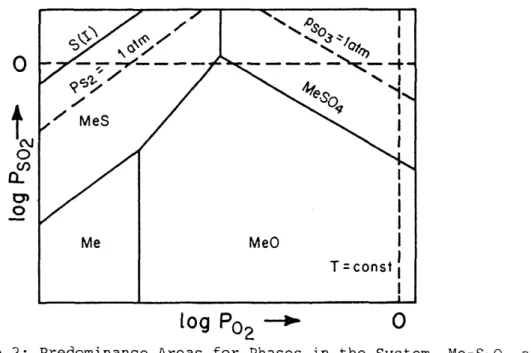
Before discussing reactions and mechanisms involved in the regeneration process, a few comments about the thermodynamic stability of the different phases are needed. The triangular diagram of Figure 1 shows the different compounds in equilibrium when all condensed phases are solids. The gas phase
may have any composition betwen pure S2 and pure O2. More familiar are diagrams like the one of Figure 2, where the phase equilibria are shown as a function of the partial pressure of two components in the gas phase. In this type of diagrameach phase is stable within apredominance region, bordered by lines that represent the coexistence with other phases. The slope ofeach curve is given by the stoichiometry of the corresponding reaction.
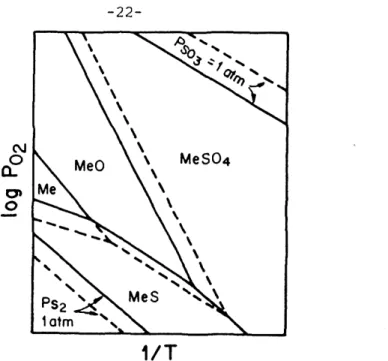
The effect of temperature is usually displayed by plotting In Po2 against l/T at constant Pso2 as shown in Figure 3 . Curves for different SO2 pressure can be obtained by shifting the curves as illustrated by the dotted lines. We notice that the oxygen potential for equilibriabetween Me andMeO and between MeS and MeSO4 , are not affected by the SO2 pressure. In addition to SO2 and S2, the gas will contain some SO3 produced by SO2 oxidation. Finally, some intermediate stable compounds such as 2ZnSO4.ZnO can be expected as can be seen in Figure 4. A complete diagram for the case of the system Zn-O-S was constructed and is shown in Figure 1 of Chapter VI.
Regeneration with Oxygen
The reactions that can take place are the following(*):
ZnS + 2 O2 —> ZnSO4 ΔG = —106.4 Kcal/mol (5) 3
ZnS + - O2 —> ZnO + SO2 ΔG = —87.7 Kcal/mol (6) 2
ZnO + SO2 + - O2 —> ZnSO4 ΔG = —18.7 Kcal/mol (7) 2
Different kinetic studies have been performed on reaction (6) [12-14]. Fukunata et al. [12] reviewed these studies and pointed out discrepancies among the
(*) All free energiesof formation given in this chapter are at 1000°K.
According to this suggestion ZnS would give first ZnSO4 at interface 1 reacting directly with O2. Decomposition would follow at interface 2, since no SO2 is present in the feed . If reaction at front 1 is faster, the two fronts will be clearly at different positions. Note that in this last case, reaction (5) would proceed in the presence of relatively high concentrations of SO2. According to figure 2, as SO2 concentration increases, oxysulfate and sulfate become the most stable species giving thermodynamic support to the above mechanism.
Twidwell and Larson [15] and Skachkov [16], studied the kinetics of ZnSO4 decomposition, alone and in the presence of ZnS. The crystalline form of ZnSO4 reported results. Consequently, there is a need for detailed rate determinations for this reaction. Some relevant results regarding the rate of reaction (6) are described in Chapter VI of this thesis.
Reaction (6) was assumed by almost all investigators to be the main mech
anism by which ZnS oxidation takes place. If this mechanism is assumed, the small amounts of sulfate formed are due to reaction (5) or (7). However, other mechanisms are possible. For example, if ZnSO4 forms according to reaction (5) and later decomposes according to reaction (7), two reaction fronts can form as shown in the diagram below.
is rhombic and requires crystallographic transformations to give the hexagonal ZnO. The reaction of hexagonal ZnS to form ZnSO4 requires crystallographic transformation as well. The absence of crystallographic changes from ZnS to ZnO suggests that reaction (6) is more facile than the other two reactions.
The above arguments do not allow an a priori determination in favor of one or the other route of ZnS oxidation. Additional experiments are needed for this purpose. The experiments reported in Chapter VI of this thesis give conclusive proof that oxidation takes place by reaction (6) followed by reaction (7). In Chapter IX a theoretical study is used to investigate the conditions that favor the occurrence of reaction (7) inside a fixed-bed reactor. From this study theoretical guidelines are given to avoid sulfate formation.
Once sulfate is formed, its decomposition is slow . If a nitrogen purge is carried out afterregeneration, a maximum in SO2 concentration isobserved after a few minutes. This gives some support to earlier reports [16] indicating that ZnSO4 decomposition is autocatalytic. The undecomposed ZnSO4 remaining in the sorbent would be reduced by the fuel gas during the sulfidation step, producing undesirable SO2 at the reactor outlet. If the solid product of the sulfate reduction is only ZnO, an exposure of the regenerated bed to a reducing gas would complete the preparation of the bed for a new sulfidation cycle. To explore such possibility, preliminary experiments were performed at JPL where aN2-H2 mixture waspassedthrougha regenerated bed to reduce ZnSO4, aiming to convert the residual ZnSO4 to ZnO. Evidence of ZnS presence as a result of this reduction was obtained by treatingthe bed again with a N2-airmixture and observing that SO2 is formed. Therefore, reduction of ZnSO4 produces ZnS in addition to ZnO.
In regeneration experiments performed at JPL using alumina-supported
ZnO, substantial amounts ofsulfur were seen during the first few minutes. This could be explained by the presence of H2S chemisorbed on ZnS at the end of the sulfidation step. The chemisorbed H2S would desorb ahead ofthe oxidation front, anddecompose dueto the absence of H2. This decomposition is catalyzed by the sulfide, as mentioned earlier. However, when desorption by an inert purge preceded the introduction of oxygen, sulfur was still seen to evolve in appreciable amounts. This indicates that some mechanism, in addition to H2S decomposition, is providing sulfur. The regeneration of ZnS with simultaneous ZnAl2O4 formation [7] as shown below could be this additional source of sulfur.
1 3
ZnS + AI2O3 + - SO2 —> - S2 i ZnAl2O4 ΔG = —6.6 Kcal/mol (8)
2 4
The formation of ZnO in a similar reaction, but without the intervention of the support has a relatively high positive ΔG :
ZnS + - SO2 —> - S2 + ZnO ΔG = 15.8 Kcal/mol (9) indicating that in the former case the formation of aluminate is essential in the production ofsulfur.
Regeneration with Water and Water-Oxygen Mixture
The reaction with H2O is exactly the opposite of the sulfidation reaction ZnS + H2O —> ZnO + H2S (10) Downstream of the reaction front, adsorption of H2S can take place and sulfur formation can occur via the already described surface decomposition. Since the equilibrium constant for reaction (l) is high, it can be anticipated that H2O is not effective as a regenerating agent. This was confirmed by Giner [4]. As
expected, they observed significant increase in the rate of regeneration when air was added.
ZnSO4 formation in the presence of O2 is somewhat retarded by the pres ence of H2O, as was observed by Giner [4] and confirmed in JPL experiments.
The inhibition ofZnSO4 formation constitutes an attractive property of the com
bined air-H2O regeneration, but is not well understood. It is highly probable that H2O competes for sites with oxygen, reducing the rate of sulfide oxidation and lowering the concentration of SO2 in the reactor. Under these conditions, sulfate formation according to reaction (7) would be less favorable.
REFERENCES
1.-: Westmoreland P.R., Gibson J.B. and Harrison D.P. Env. Sci. & Tech., 1976, 11, 489.
2. -: Gibson III J.B. and Harrison D.P. I&EC Proc. Des. & Dev., 1980, 19, 231.
3.-: Ranade P.V. and Harrison D.P. Chem. Engng. Sci., 1981, 36, 1079.
4. -: Giner Inc., Final report to Argonne National Laboratory. Contract 31-109- 39-5804, Waltham MA, 1981.
5. -: Turkdogan E.T. Trans, of the Metall. Soc. of ΑΙΜΕ, 1968, 242, 1665.
6. -: Worrell W.L. and Turkdogan E.T. Trans, of the Metall. Soc. of ΑΙΜΕ, 1968, 242, 1673.
7.-: Anderson G.L., Garrigan P.C. and Berry F.E. AlChE 89th National Meet
ing, 1980.
8.-: Nagata K., Sato K. and Goto K. . Metall. Transactions of ΑΙΜΕ, 1980, 11B, 455.
9.-: Barin I. and Knacke O. Thermodynamic Properties of Inorganic Substan
ces. Springer Verlag, New York, 1973.
10.-: Fukuda K., Dokiya M., Kameyama T. and Kotera Y. I&EC Fund., 1978, 17, 4, 243.
11. -: Turkdogan E.T. Physical Chemistry of High Temperature Technology.
Academic Press, New York, 1980.
12.-: Fukunata Y, Monta T., Asaki Z. and Kondo Y. Metall. Transactions, 1976, 7B, 307.
13.-: Denbigh L.G. and Beveridge K.G. Trans. Inst. Chem. Eng., 1962, 40, 23.
14.-: Cannon K.J. and Denbigh K.G. Chem. Engng Sci., 1957, 6, 145.
15.-: Twidwell L.G. and Larson A.H. Trans, of the Metallurgic Soc. of ΑΙΜΕ, 1966, 236, 1379.
16. -: Skachkov B.I. Chem. Abst., 53, 6860.
17. -: Rosenqvist T. Metall. Trans, of ΑΙΜΕ, 1978, 9B, 337.
Figure 1: Phase Equilibria in a System Me-S-O. Schematic, (from [17])
Figure 2: Predominance Areas for Phases in the System Me-S-0 at constant Temperature. Schematic (from [17]).
Figure 3: Effect of Temperature on Phase Equilibria in the System Me-S-0 at constant S02 Pressure. Schematic (from (17]).
Figure 4: Equilibrium Partial Pressures of 02 and S02 for Coexisting Metal Oxides and Sulfates at 800oC (from [1]).
CHAPTER III
Haysabios de todas menas Mas digo, sin ser muy ducho Es mejor que aprender mucho
El aprender cosas buenas
del Martin Fierro
INTRODUCTION
In this chapter a description is given of the experimental microreactor sys tem used to perform all the sulfidation and regeneration experiments. Subse quently, experimental results obtained studying the performance of alumina- supported ZnO as a desulfurization sorbent are described.
EXPERIMENTAL REACTOR SYSTEM
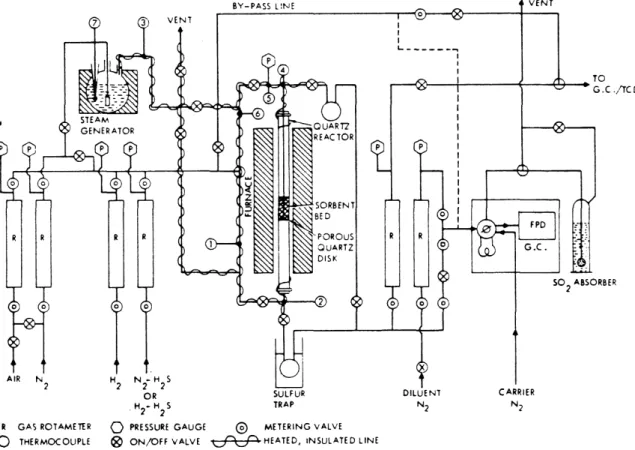
Experimentswerecarried out usinga reactor system, whichis schematically shown in Figure 1. The laboratory-scale reactor is a 1 cm-ID quartz tube, 41 cm in length mounted vertically inside an electric furnace. A porous quartz disk fitted 1 inch away fromthe tube centersupports the bed and a K-type (chromel- alumel) thermocouple is inserted through a 0.3 cm -ID quartz tube concentric to the reactor. An arrangement is made so that the desired mixture can flow
through the reactor either in the downward or upward direction. In either case an ice-cooled trap at the reactor outlet collects elemental sulfur and/or water.
Temperature is monitored at various points of the system.
Steam can be added to a nitrogenstream by means of a 3-neck flask, main tained at constant temperature. An absorber loop containing iodine solution is placed at the exit line for the purposeof analyzingtotal sulfur gases (H2S, SO2) during regeneration.
Downward direction of flow is used in desorption and regeneration runs, whereas upward direction is used in sulfidation. The concentrations of SO2 and H2S in the product gas are monitored as a function of time using a gas chro matograph(GC). In the GC, a 6 ft × 1/8” Tefloncolumn packed with Chromosil 310 separates the sulfur gases,which are then conducted through a flame photo
metric detector (FPD). A microprocessorrecords the chromatograms,integrates and obtains peak areas.
EXPERIMENTAL RESULTS FOR ALU MINA-SUPPORTED ZnO
As explained before, the outlet H2S concentration at breakthrough is re lated to the concentrationwave that travels along the reactor. We will call the breakthrough curve, the plot of the outlet H2S concentration as a function of time. Breakthrough time can be defined in different ways. Some authors define it as the time at which the outlet concentration reaches some predetermined value, called breakthrough concentration. This definition isvery useful from the practical point of view, but hasto be used together with a criterion for selecting the value of the breakthrough concentration. Another definition, which we will use, defines breakthrough time as the interception of the tangent at the inflex-
ion point of the curve with the time axis, as shown in the following schematic diagram.
The slope of the tangent at the inflexion point, which we call the breakthrough curve slope, is another useful quantity. High values of the slope are a desir
able sorbent characteristic. This definition provides means for analyzing the experimental breakthrough curve in terms of a kinetic model.
The first supported ZnO that was tested, denoted CAT-15Z, had a loading of 3.9 wt % of Zn on alumina. The alumina used to prepare this sorbent was -20+40 mesh MCB alumina. This alumina is commercially known as ALCOA F-l and was thermally stabilized at 800oC, washed with a solution of NH40H and finally dried. The surface area dropped from 240 to 100 m2∕g after stabi
lization. The manufacturer reported a pore volume of 0.25-0.3 cm3∕g and an average pore size of 600 A.(*) Figure 2 shows the breakthrough curves where t’
is the time corresponding to 100 % Zn conversion. The feed gas contained 0.2 % (vol) of H2S and 20 % (vol) of H2 to simulate the reducing atmosphere of a gasi fier gas. H2O was not added in these experiments. The succesive breakthrough curves had a similar shape but the breakthrough time declined from 0.44 to
(*) The pore size distribution was actually bimodal, accounting for 50 % of the pores having
an average pore size of 40-45 A.
0.23, indicatinga lossof sorbent capacity. The slope ofthe breakthrough curves remained roughly the same, indicating that reaction rate was not affected by repeated sulfidations and regenerations. The supported ZnO was treated with nitric acid to dissolve the Zn and the liquid sample was analyzed for Zn con centration, using atomic absorption. The measurements revealed a drop of Zn concentration in the particles to 1.2 wt%. Sorbent analysis by XRD showed the presence of ZnAl2O4 aswell as ZnO. Since ZnAl2O4 is not soluble in nitric acid, only part of the Zn losses detected by the atomic absorption technique can be attributed to vaporization of elemental zinc formed by reduction of the oxide.
Experiments usingblank MCB alumina were also performed. The H2S exit concentration profiles obtained for the sulfidation ofthis blank alumina are in
cluded in Figure 2. To make the comparison more useful, the same value of t* as for CAT-15Z was used. A relatively large amount of H2S was retained by this alumina (2.9 ×10^7 moles∕m2) which, upon exposure to nitrogen, des orbed completely either as H2S or as elemental sulfur, indicating that only H2S chemisorption takes place on the support. Almost 57 % of the adsorbed H2S desorbed as elemental sulfur, produced by decomposition of the adsorbed H2S.
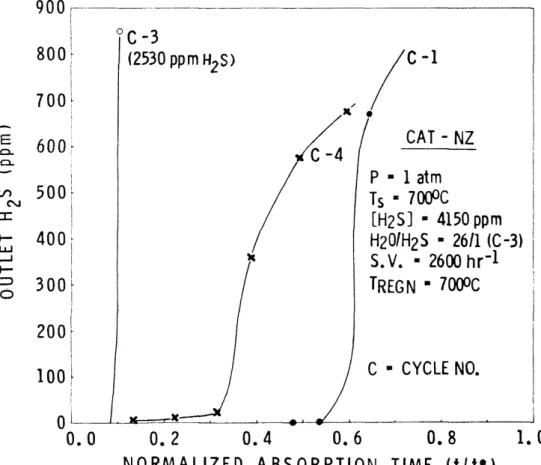
Sulfidation tests were also performed with another sorbent called CAT-NZ, which is UCI alumina containing 1.69 wt% of Zn. The properties of this UCI aluminaare given in Table 1 of Chapter V. Figure 3 shows breakthrough curves for this sorbent. Under dry conditions (cycles 1,4), considerable loss of zinc by evaporation was observed in a form of deposits on the cooler parts of the reactor. AA analysis was used to confirm that these deposits contained zinc.
Consequently, the H2S absortion capacity of this supported ZnO dropped rapidly in consecutive cycles.
The H2S breakthrough curve corresponding to cycle 3 in Figure 3 was ob
tained with 6.5 mol% H2O in the sulfidation gas, which contained 2530 ppm H2S. The drastic drop in breakthrough conversion is mainly due to the large H2O∕H2S ratio. Similarresultswereobtained withthesorbentCAT-NZ2, which had a higher loadingof ZnO (3.2 Zn wt %)on the same UCI alumina [l]. Water has been found to have a strong effect on sorbent adsorbing behaviour. Inter
rupting the flow of H2O in the feed after breakthrough time caused a drop of H2S concentration at the outlet to low values comparable to those obtained in the absence of H2O.
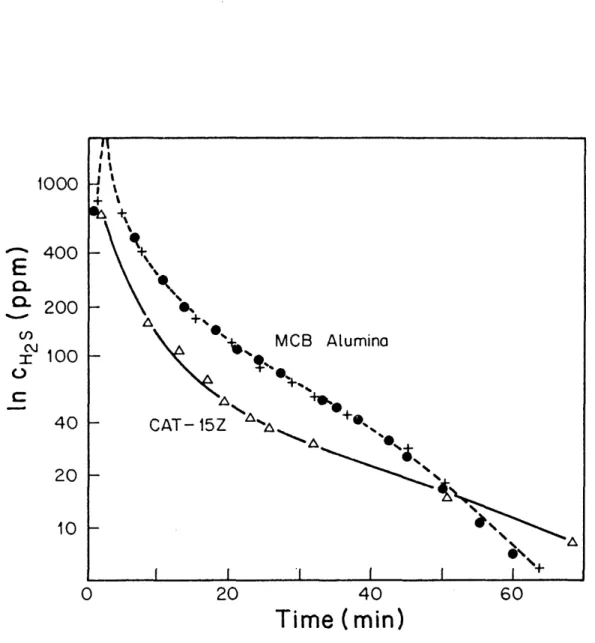
Desorption using a nitrogen purge was carried out for CAT-15Z and MCB alumina. The outlet H2S concentrations are shown in the semi-logarithmic plot of Figure 4. In the case of the alumina, the outlet concentration increases for a few minutes and reaches a maximum. After that, the plot corresponds to the sumoftwo negative exponential terms. The straight line changes slopeabruptly at about 45 minutes. This behavior of the support needs further study.
Regeneration of CAT-15Z was performed with 1-2 % of air in nitrogen. An initial rapid increase in both H2S and SO2 concentrations was observed, reach
ing values beyond the range of GC calibration curves. After a few minutes, the concentrations of both components decayed rapidly. After regeneration, if the system was left under N2 purge, the SO2 outlet concentration increased, reach
ing a maximum and then decaying slowly. This behavior is related to ZnSO4 decomposition, which could follow an autocatalytic mechanism of decomposi tion, as was mentioned earlier. Instead, if the system is treated with H2, ZnSO4 is reduced rapidly to ZnO and smaller amounts of ZnS. The secondary produc tion was shown by passing a mixtureof air-N2 through the reduced bed. During this treatment SO2 was detected at the bed outlet, which can come only from ZnS oxidation.
Regeneration steps were carried out for CAT-NZ using diluted air, observing a behavior similar to that of CAT-15Z. For this sorbent, exploratory regenera tions using a diluted air-H2O mixture were performed. No evidence of ZnSO4 formation was found, confirming that water somehow inhibits sulfate formation.
REFERENCES
1.-: Stephanopoulos M.F., Gavalas G.R., Tamhankar S.S., Sharma P.K., Final Report to DOE. DOE∕MC∕S0417-1898. 1985.
Figure 1.- Reactor System for Sulfidation-Regeneration Studies.
Figure 2: Breakthrough Curves for CAT-15Z and MCB Alumina.
Figure 3.- Breakthrough Curves for CAT-NZ.
Figure 4: Semilogarithmic Plot for Desorption of CAT-15Z and MCB Alumina.
CHAPTER IV
There are those who believe that destiny rests on the knees ofthe gods ; but the
truth is that it confronts the conscience ofmen with a burning challenge.
Eduardo Galeano
The content of this chapter was published as a paper in the Journal Ind. &
Eng. Chem., Proc. Des. and Dev. It dealswith the desulfurization performance of pure and mixed oxides at high temperatures. Results for high surface bulk ZnO show that this form of ZnO has a larger desulfurization capacity than the alumina-supported ZnO. For this reason the regeneration studies reported in chapter VI, were done on bulk ZnO.
Rβpri∩tθd from l&EG PROCESS DESIGN & DEVELOPMENT, «88, 25, 429.
Copyright © 1986 by the American Chemical Society and reprinted by permission of the copyright owner.
Mixed-Oxide Sorbents for High-Temperature Removal of Hydrogen Sulfide
S. S. Tamhankar,' M. Bagajewicz. and G. R. Gavalas
Department of Chemical Engineering, California Institute of Technology,Pasadena, California 91125
P. K. Sharma and M. Flytzanl-Stephanopoulos*
Jet Propulsion Laboratory, CaliforniaInstituteof Technology, Pasadena,California 91109
Several pure and mixed oxides (ZnO, CuO, ZnO-Fe2O3, CuO-Fe2O3, CuO-AI203, and CuO-Fe2O3-AI2O3) were investigated as regenerable sorbents for the removal of K2S at high temperatures. A special technique was used to prepare the sorbents In highly porous form. The sorbents were subjected to successive sulfidation-regeneration cycles in a packed-bed mk-oreactor. Sulfidation was carried out at 538-650 oC with H2S-H2O-H2-N2 mixtures, regeneration with O2-N2-H2O mixtures. Fresh, sulfided, and regenerated sorbents were characterized by ×RD, SEM-EDS, and BET surface area analysis. Solid conversion and the prebreakthrough exit concentration of H2S are discussed in terms of physical structure and thermodynamic properties of the sorbents. The performance of the sorbents CuO-Fe2O3, CuO-AI2O3, and CuO-Fe2O3-AI203 is discussed in terms of changes in the oxidation state of copper during sulfidation.
Coal-derived gas used in power generation must be substantially free of H2S and other sulfur compounds deriving from the gasification of coal. The sulfur content must be reduced from several thousand parts per million (ppm) toa few hundred parts permillionfor combined-
•To whomall correspondence should beaddressed. Presently withthe Department of ChemicalEngineering,Massachusetts Institute of Technology, Cambridge, MA 02139.
’Presently with the BOC Group, Inc., Technical Center, MurrayHill,NJ 07974.
0196-4305/86/1125-0429601.50/0
cycle and to only I ppm for molten carbonate fuel cell power generation. In the former case, the H2S level is dictated byenvironmental regulations, while in the latter by the need to avoid foulingof the electrodes. Well-es tablished desulfurization processes operate at ambient temperatures andentail considerable efficiency lossin the cool⅛g and reheating of the fuelgas. The thermal effi ciency of the power cycle can be substantiallyimproved by carrying out the sulfur removalat high temperatures.
A numberof studies have been reportedoverthe last decade on high-temperature H2Sremoval, primarily using
© 1986 American Chemical Society
![Figure 1: Phase Equilibria in a System Me-S-O. Schematic, (from [17])](https://thumb-ap.123doks.com/thumbv2/123dok/10417197.0/35.808.145.666.75.542/figure-phase-equilibria-in-system-me-schematic-from.webp)
![Figure 4: Equilibrium Partial Pressures of 02 and S0 2 for Coexisting Metal Oxides and Sulfates at 800 o C (from [1]).](https://thumb-ap.123doks.com/thumbv2/123dok/10417197.0/36.820.111.739.459.988/figure-equilibrium-partial-pressures-coexisting-metal-oxides-sulfates.webp)