This indicates that some of the measured chitinase activity may be due to the activity of another enzyme, either another. Typically, cilia move fluid perpendicular to the long axis of the beating cilium, therefore parallel to the surface bearing the cilia, and. The ciliary membrane is continuous with the plasma membrane of the cell and appears to be a typical three-layered cell membrane (4).
The major obstacle to the characterization of cilia proteins has been the apparent insolubility of the structure, requiring drastic analytical methods. This was shown to be entirely due to the insolubility of the ciliary membrane (38), and dissolution of this membrane by digitonin or low ionic strength allowed fractionation and characterization of the protein components. Axonemal proteins from the central and outer fibers can be prepared by isolation methods similar to those used for actin purification.
The axonemal proteins of the central and outer microtubular fibrils can be cleaved into similar proteins.
CHAPTER II
These cilia in the presence of ATP showed motility of short duration (most for less than five minutes) and low frequency (2-3 waves/second) (24). Since the energy for motility in the cilium in situ probably derives from the breakdown of ATP, ATPase activity and motility were. Stocks of the ciliate protozoan Tetrahymena pyriformis W (obtained from Dr. Jay S. Roth, University of Connecticut) were maintained at 25°C in DeLong culture flasks (500 ml capacity) containing 200 ml of a medium consisting of 1% Difeo Proteose- Peptone, 0.25% Difeo yeast extract and 0.1% dextrose.
Cilia were collected from late log phase Tetrahymena grown for 2~ to 3 days at 25°C in 8 liters of the above medium (less dextrose), supplemented with Dow Corning Antifoam A Spray to control foaming. Most of the ciliates studied were isolated using a method similar to Gibbons' modification of the procedure of Watson and Hopkins (13, 38). This method had to be performed directly on the TCA-precipitated protein that remained in the tubes after removal of the supernatants to measure ATPase activity.
The stability of the color over time is shown in Figure 3, as well as the linearity of the test over the range studied.
Cilial motility could be reactivated after 30 min by diluting the cilia suspension with two or three parts of ATP solution at 19°C. With the exception of experiments on the effect of temperature, the ciliates were observed in a room where the temperature was 19° C. It turned out that the concentration of cilia is an extremely critical factor in determining their motility.
Alternatively, the main effect of albumin and polyvinylpyrrolidone may simply be to reduce the adhesion of cilia to the slide and cover glass. Motility of cilia isolated with ethanol-calcium was more sensitive to temperature variation than cilia isolated with glycerol. There was no mobility in the presence of GTP and GTPase activity was less than 5% of ATPase.
None of the sugars showed an effect on ciliary motility when added at 1 mM or 6.5 mM without ADP or ATP.
CHAPTER III
The first was by extracting the cilia with 0.5% digitonin, which solubilized the membrane, leaving bare axonemes containing most of the ATPase activity. These were further fractionated by dialysis against Tris-EDTA, which separated the central fibers and the arms of the outer fibers (fraction I) from the nine paired outer ones. Watson and Hynes (58) performed starch gel electrophoresis on fractions I and II by breaking the disulfide bonds, then dissolved the fractions in 8 M urea.
The strain-specific agglutinating antigens of Paramecium (71) and Tetrahymena (72) are produced in high abundance by isolated cilia (71, 72). however, is also found in a purified deciliat body wall fraction, so is probably a component of the cell membrane. This drastic solubilization technique was probably necessary due to the insolubility of the ciliary membrane, and these precipitin bands may partially represent membrane protein. The work described in this chapter involves a brief study of the protein components of cilia, similar to or based on the studies mentioned here.
The pH was adjusted to 8.3 with thioglycolic acid and the volume was adjusted to 50 ml. Gel electrophoresis was performed on 7.5% acrylamide gels in a basic system prepared in 8 M urea according to the method of Jovin et al. Other solubilization methods used included 3 N acetic acid and 10 M urea, each yielding about 90 to 95% total protein, and Gibbons' isolation of digitonin, which when preceded by aqueous extraction yielded about 20% more protein into the solution.
Acetic acid extracts of ciliates showed seven distinct bands on the gels, indicating the presence of seven major protein species in large amounts in ciliates. The aqueous extract, which did not contain any ciliate ATPase activity, showed multiple diffuse bands and smears on columns treated with dilute saline without 8 M urea, but 2 or 3 distinct bands on urea columns, with two major bands at 0.10 and 0.20. In double diffusion assays with antibodies raised against whole ciliates, the aqueous extract of ciliates revealed 3 distinct bands.
When allowed to develop for 72 hours, five bands appeared against the digitonin extract of cilia (this would presumably include the bands in the water extract), and one weak band appeared against a 0.6 M KCl extract of the precipitate of the digitonin extraction. However, the techniques used did not lead to the development of a simple procedure to identify an important structural component of the cilia.
CHAPTER IV
The basal body has been established as a necessary condition for the development of the cilium ( 76 ), and this centriolar apparatus, with its ninefold symmetry, appears to be the morphological basis for the organization of the axoneme. Regeneration of cilia from the site above the basal body in deciliated cells has been studied experimentally by a number of different methods. Child studied the regeneration of Tetrahymena cilia removed by successive treatment of the cells with buffer at pH 6, Ca+t, and shear forces (81).
Since colchicine is known to bind to some protein subunits of cilia (69), its mechanism of action is likely to be through inhibition of polymerization. Regeneration in Tetrahymena was observed here with the dual purpose of (1) determining the physical state of the cells after. Cells were collected at 300 x g in a Lourdes centrifuge for 1 min, resuspended in culture medium, and observed at room temperature for ciliary regeneration for up to 24 h.
Although contractile vacuole activity could be seen in most of the cells after they were deciliated by the ethanol-calcium procedure, washing them in fresh or used filtered proteose-peptone medium did not stimulate them to regenerate cilia within a few hours. 2 caused the cells to swim back and forth with equal probability, but the addition of ca-t+ alone did not cause them to shed their cilia. The proteose-peptone medium itself buffers at pH 6.7, and phosphate at all pI's from 6.1 to 7.8 showed some toxicity.
When the regeneration experiments were performed as described in Materials and Methods, the cells were at pH 5 for less than 5 min total time. When the cells were replaced in used filtered (Whatman #1) medium instead of fresh medium, some improvement was noted. These cells were completely stripped of their cilia so that not even any oral cilia were visible.
The cells were then split into two parts and replaced in fresh or used medium. Since the normal generation time of Tetrahymena is about 6 to 8 hours, and no dividing cells were seen during the cilia.
PART II
One of the most distinctive features in the evolution of arthropods is the development of an exoskeleton. The new epicuticle can be seen forming along the epithelial cell border. The development of chitin as the main component of the arthropod exoskeleton is not surprising.
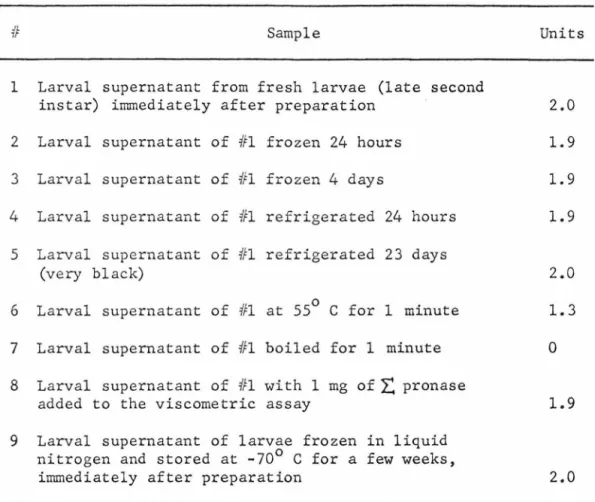
Insects show chitinase activity elsewhere than in the molt; small amounts of activity have been found in the gut, hemolymph, and saliva of cockroaches (11). Stirring the reaction during the 30-minute test process was found to be unnecessary, and Reynolds did so. (NH 4 ) 2 SO 4 protein precipitation was always performed on the soluble fraction of the larval supernatant at pH 5.4.
The chitinase activity of the homogenate is approximately the same as that of the supernatant, so that all activity is in the soluble fraction. Since mg soluble protein/mg wet mass is not constant but varies with life cycle stage (Figure 6), the values. The high background viscosity at low pH, which decreases towards higher pH, is due to the viscous effect of sucrose in the gradient in which the column flows.
The decrease in viscosity with fractional number is due to the effect of increasing salt concentration on the viscosity of chitosan. It is interesting to compare the chitinase activity data with the physical picture of the epidermis at these stages. Ynis seems to suggest that the peak activity is definitely due to the melting enzyme (at least during the second stage).
Chitin synthesis takes place during a good part of the second stage and all of the third (Figure 2), and it is not inconceivable for the synthetase in the presence of a large. Then, the agreement of these data with the second instar electron micrographs (12), to the expected physiological results, and to the results for chitinase distribution in other insects studied by other means (5) is a strong indication that true chitinase activity · is revealed. A significant part of the chitinase can be discarded together with the particulate matter from the larval homogenate.
As mentioned, the properties of the chitinase studied in this paper are similar to those of other chitinases described in