Taxation: current and deferred 12
In this chapter we look briefly at the treatment of current taxation and then, in more depth, at the subject of accounting for deferred taxation. While the former is concerned mainly with the presentation of corporation tax, income tax and overseas taxes in financial statements, the subject of deferred taxation poses a number of conceptual problems and is conse- quently both more difficult to understand and more controversial.
The main issues associated with current taxation concern the presentation of the current tax charge in the financial statements and the treatment of tax credits and withholding taxes. These are addressed in FRS16 Current Taxes, and, in a broadly similar way, in IAS 12 Income Taxes.
In the case of deferred taxation, the issues are whether to account for it at all and, if so, in what way. We look first at the perceived need to account for deferred taxation based on the view that taxation is an expense subject to the accruals or matching concept. The argument is that, if there are timingdifferences, that is differences between the periods in which rev- enues and expenses are recognised in the financial statements and the periods in which they are included when calculating the tax liability, then the tax expense shown in the finan- cial statements should be the notional tax charge based on the revenues and expenses included in the financial statements rather than the tax payable in respect of the period.
We explain that, although SSAP 15 required partial provision for deferred taxation, FRS 19 Deferred Taxation, has now brought UK practice closer to the international standard IAS 12 Income Taxes, by requiring full provision for deferred tax using a liability method.
However, we also examine the substantial differences between the UK and international standards, which will pose considerable difficulties in the attempt to achieve convergence, and cast serious doubt upon whether either method can really be called a full provision method at all.
In this chapter, we draw upon the following UK and international standards:
● SSAP 5 Accounting for Value Added Tax(1974)
● FRS 16 Current Tax(1999)
● FRS 19 Deferred Tax(2000)
● IAS 12 Income Taxes(revised 2000)
Introduction
The treatment of taxation in financial statements in the UK is regulated not only by the Companies Acts but also by three standards: SSAP 5 Accounting for Value Added Tax(April 1974), FRS 16 Current Tax(December 1999) and FRS 19 Deferred Tax(December 2000).
The relevant international standard is IAS12 Income Taxes(revised October 2000).
SSAP 5 is probably the shortest and simplest standard one is likely to see. Its message is that Value Added Tax (VAT) should not be included in turnover nor included in expenses
overview
or as part of the cost of an asset except where the tax is irrecoverable. In other words, the VAT collected from customers on behalf of the government and the VAT paid on inputs do not appear in the financial statements, except to the extent that the balance due to or from the government is shown as a liability or asset respectively. While there are, from time to time, interesting legal disputes about which transactions are subject to VAT, these do not generally touch upon financial accounting concepts and we will not pursue the subject of Value Added Tax any further in this book.
In this chapter, we first deal with the treatment of current taxation, where the issues relate mainly to presentation. FRS 16 sets out standard accounting practice on how current tax should be reflected in financial statements and is especially concerned with the treatment of tax credits and withholding taxes. Its requirements are broadly consistent with the international standard IAS 12 Income Taxes, although, as we shall see later, there are some minor differences.
The main part of the chapter is devoted to deferred taxation, an area in which standard set- ters have found it extremely difficult to follow a consistent path. Deferred taxation becomes relevant when there are different rules for the treatment of income and expenses in financial statements and tax computations. Some differences may be permanent: a good example is busi- ness entertainment expenses where an expense properly charged in a profit and loss account has not been allowed as a tax expense in the UK for the past forty years or so. Permanent dif- ferences do not give rise to deferred taxation: the expense is not allowable for tax purposes, the taxable profit is higher than the accounting profit, and that is the end of the matter.
The perceived need to account for deferred taxation arises when there are timing differ- ences, that is when the same revenue or expense is recognised in different periods in financial statements and tax computations. Where the timing difference reverses in the following period, there would be widespread agreement that it is necessary to account for deferred tax- ation. However, as we shall see, not all timing differences reverse so quickly. In some cases, the reversal of the timing difference may be remote, encouraging arguments that it should therefore be ignored. The previous accounting standard, SSAP 15 Accounting for Deferred Tax, went even further than this by taking the view that a provision for deferred tax was unnecessary where a timing difference expected to reverse in future would itself be replaced by a new originating timing difference in that same future period!
A deferred tax approach that takes account of all timing differences is known as full provi- sionwhile one which takes into account only those timing differences which are expected to reverse in the foreseeable future is known as partial provision. As we shall see, even the so- called full provision methods required by current UK and international standards require important, although different, exclusions.
As with several other topics, relevant UK standards on this subject have not been consis- tent. The first standard, SSAP 11 Accounting for Deferred Taxation, published in 1975, required full provision for deferred taxation but the weight of opposition was such that this standard was withdrawn before its effective date. UK accountants had to wait until 1978 for SSAP 15, a standard that required the use of the partial provision approach. This partial pro- vision method was very much a practical response to a set of circumstances existing in the late 1970s and early 1980s but, to cut a long story short, it had serious conceptual weak- nesses, was open to manipulation by directors and is now completely out of line with international practice. Following earlier publications,1the ASB issued FRS 19 Deferred Taxin December 2000.
1The ASB issued a Discussion Paper Accounting for Tax(March 1995), which dealt with both current taxation and deferred taxation. It subsequently issued an exposure draft of a ‘Proposed Amendment to SSAP 8: Presentation of Dividend Income’ (October 1997). More recently it has dealt with current taxation and deferred taxation sep- arately by the issue of FRED 18 Current Taxation(June 1999) and FRED 19 Deferred Taxation(August 1999).
FRS 19 requires full provision for deferred taxation on timing differences, using what is described as the incremental liabilityapproach but, as we shall see, it exempts certain major timing differences and hence its requirements still fall rather short of full provision.
In the section of the chapter dealing with deferred taxation we explain timing differences and the perceived need for deferred taxation. We then examine the different approaches which could be adopted before we turn to the proposals of FRS 19 and IAS 12 respectively.
Current taxation
Readers are assumed to be aware of the law relating to the taxation of companies and we shall only refer to the system to the extent necessary to provide an understanding of the accounting implications of that system. For simplicity, we shall assume that a company makes up its financial statements for a year, rather than any other period, and that the rate of corporation tax is 30 per cent, the rate applicable to companies with chargeable profits in excess of £1 500 000.2
Corporation tax
The corporation tax of small companies is due in one amount payable nine months and one day after the end of its accounting period. However a large company, that is one which pays corporation tax at the standard rate, must pay corporation tax in instalments. These instal- ments are based on the company’s own estimates of its corporation tax liability for the accounting year and, for a twelve-month accounting period, there are four equal annual instalments due on the 14th day of the seventh, tenth, thirteenth and sixteenth month after the start of the accounting year. So, for an accounting year ended 31 December 20X1, the corporation tax for the year would be due in four equal instalments payable on 14 July 20X1, 14 October 20X1, 14 January 20X2 and 14 April 20X2.
Although the system imposes upon companies the problem of estimating their taxable profits as the year proceeds in order to calculate the instalments payable, accounting for the resulting payments and liability for corporation tax is very straightforward. At the end of an accounting year, the liability will be the corporation tax payable for the full year less the two instalments which have been paid during the year.
Tax credits
When a UK company receives a dividend from a UK resident company or pays a dividend to its shareholders, that dividend carries a tax credit, presently at the rate of one-ninth of the amount received or paid. This reflects the fact that the dividend comes from income which has been subject to corporation tax, although there is no direct relationship between the rate of tax credit and the underlying corporation tax. To a company receiving a dividend with an associated tax credit, the tax credit has no value. However, individual shareholders receiving such a dividend would include the gross amount, that is dividend plus tax credit, as part of their income and then deduct the tax credit from the income tax payable for the year subject
2This is the rate for the financial year 2002, the year from 1 April 2002 to 31 March 2003. There is also a starting rate of 10% as well as a small companies rate of 20%.
to the proviso that an individual with a low taxable income cannot claim repayment of the tax credit. Thus an individual is able to obtain credit for the tax credit but not its repayment.
Withholding tax
Where a company receives interest from or pays interest to another company or individual, the position is somewhat different. Since the Finance Act 2001, UK companies have been able to pay interest and royalties gross to other UK companies.3 However, in most other cases, the paying company must deduct income tax, presently at a rate of 20 per cent, from the gross interest and pay this tax over to the Inland Revenue on a quarterly basis. Such a tax is described as a withholding tax, a tax paid to the Inland Revenue by a company on behalf of the recipient, and is found in various forms around the world.
Overseas taxation
A company resident in the UK is liable to corporation tax on all its profits whether they arise in the UK or overseas. As profits which have arisen overseas are usually subject to taxation in the relevant overseas country, they may therefore be subject to double taxation. Similarly, where a UK company receives dividends from the taxed profits of an overseas subsidiary, such dividends are subject to UK corporation tax.
It is usually possible to obtain relief for such double taxation, although the precise nature of the relief depends upon the terms of any double taxation convention between the UK gov- ernment and the relevant overseas government. Where there is no double tax convention, it is still possible to obtain unilateral relief for double taxation.
In some cases it is possible to obtain relief against UK corporation tax for the whole of the overseas taxation payable but, in other cases, some of the overseas taxation may be unre- lieved. One example of the latter is where the rate of overseas taxation on overseas profits exceeds the rate of UK corporation tax on those same profits. To illustrate, let us suppose that a UK company has taxable profits of £300 000 overseas and an additional £2 000 000 in the UK. The rate of overseas corporation tax is 50 per cent while the rate of UK corporation tax is 30 per cent.
The corporation tax payable overseas is 50 per cent of £300 000, that is £150 000, while the corporation tax payable in the UK is 30 per cent of £(2 000 000 + 300 000), that is
£690 000. As the UK corporation tax payable on overseas income is only £90 000 (30 per cent of
£300000), this is the maximum relief which may be given against the overseas taxation of £150000.
The taxation charge in the profit and loss account would therefore include the following:
£000 Corporation tax on income – 30% of £2 300 000 690
less Relief for overseas taxation 90
––––
600
Overseas taxation 150
––––
––––750 ––––
With this background, let us now turn to the provisions of FRS 16.
3Finance Act 2001, s. 85.
FRS 16 Current Tax
FRS 16 Current Tax, issued in December 1999, is a very short document which is concerned mainly with the way in which dividends and interest received and paid should be treated in the profit and loss account of a company when tax credits and withholding taxes are involved.
Paragraph 2 of the standard provides a number of definitions including the following:
Tax credit
The tax credit given under UK tax legislation to the recipient of a dividend from a UK company.The credit is given to acknowledge that the income out of which the dividend has been paid has already been charged to tax, rather than because any withholding tax has been deducted at source. The tax credit may discharge or reduce the recipient’s liability to tax on the dividend. Non-taxpayers may or may not be able to recover the tax credit.
Withholding tax
Tax on dividends or other income that is deducted by the payer of the income and paid to the tax authorities wholly on behalf of the recipient.
As we have seen above, an example of the former is the tax credit attributable to a dividend received from a UK company. Examples of the latter are income tax deducted at source from patent royalties or interest received from a UK company or foreign tax deducted at source from interest or dividends received from an overseas company.
The main purpose of FRS 16 was to lay down standard practice for the treatment of tax credits and withholding taxes; to be more specific, to rule on whether a relevant income or expense should be shown at the net amount or at a gross amount including the relevant tax.
In the latter case, the relevant tax would have to appear as part of the tax charge in the finan- cial statements. This is essentially a pragmatic question and the outcome favoured by a majority of the Board, as reflected in FRS 16, is to require the grossing up of actual receipts and payments for any withholding tax but to use the net approach for tax credits.4
The standard also stresses the need for consistency in where the taxation consequences of any gain or loss is reported. Thus, where a gain or loss is recognised in the profit and loss account, then the taxation charge or credit should be reported there as well. Where, how- ever, a gain or loss is recognised in the statement of total recognised gains and losses, then the taxation charge or credit should be recognised in that statement too. An example of the latter would be the taxation consequences of an exchange gain or loss on foreign currency borrowing which hedge an equity investment in an overseas company.
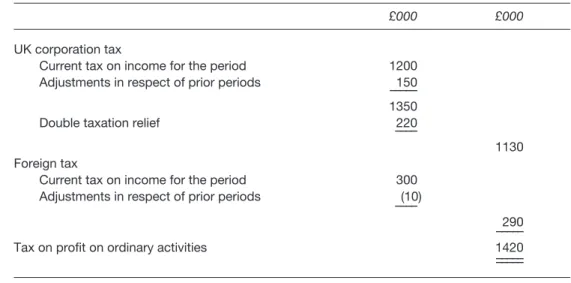
It requires that the current tax expense in the profit and loss account and in the statement of total recognised gains and losses should be analysed into UK tax and foreign tax respec- tively and that each should be analysed to show tax estimated for the current period and any adjustments related to prior periods. Appendix I to the standard provides a possible, but non-mandatory, layout of a note to support the current tax charge shown in a profit and loss account and an example of this is provided in Table 12.1.
Finally FRS 16 provides guidance on what rate of tax should be used to calculate the cor- poration tax liability for a period:
Current tax should be measured at the amounts expected to be paid (or recovered) using the tax rates and laws that have been enacted or substantively enacted by the balance sheet date.
(Para. 14)
4For the arguments considered in reaching this conclusion, see FRS 16, Appendix V, ‘The development of the FRS’, Paras 9 to 20.
A UK tax rate can be regarded as having been substantively enacted if it is included in either:
(a) a Bill that has been passed by the House of Commons and is awaiting only passage through the House of Lords and Royal Assent; or
(b) a resolution having statutory effect that has been passed under the Provisional Collection of Taxes Act 1968. (Para. 15).
FRS 16 is an extremely short standard which provides sensible and uncontroversial solutions to the question of accounting for current tax.
IAS 12 Income Taxes
IAS 12 Income Taxes,revised in 2000, covers both current tax and deferred tax. With regard to current tax, there are only relatively minor differences between the requirements of FRS 16 and those of IAS 12. For example, unlike FRS 16, IAS 12 has nothing to say on the tax treat- ment of dividends receivable and payable. Nor does it mention the recognition of current tax in a statement of total recognised gains and losses, which is not surprising given that most countries do not have a requirement for companies to publish such a statement. Instead, it requires current tax to be charged or credited directly to reserves if it relates to gains or losses, which have been credited or charged directly to equity. The international standard requires the separate disclosure of the current tax liability on the face of the balance sheet, while dis- closure of this may be relegated to a note under UK law, and also requires the disclosure of any current tax expense relating to discontinued operations, on which FRS 16 is silent.
While the differences between FRS 16 and IAS 12 appear to be relatively minor, they could lead to considerable differences in reported profit in particular cases, especially where a company has a large amount of dividend income. As we shall see in a moment, when it comes to accounting for deferred taxation, the differences between FRS 19 and IAS 12 are much more important.
Table 12.1 Example of possible note disclosure relating to the current tax charge shown in a profit and loss account
£000 £000
UK corporation tax
Current tax on income for the period 1200 Adjustments in respect of prior periods 150 –––––
1350
Double taxation relief 220
––––
1130 Foreign tax
Current tax on income for the period 300
Adjustments in respect of prior periods (10) ––––
–––––290
Tax on profit on ordinary activities 1420
–––––
–––––
Deferred taxation
Timing differences
Although accounting profits form the basis for the computation of taxable profits in the UK, for most companies there are substantial differences between the two. Such differences may be divided into two categories: permanent differences and timing differences.
In the case of permanent differences, certain items of revenue or expense properly taken into account in arriving at accounting profit are not included when arriving at taxable profit.
Examples are regional development grants received, amounts spent on entertainment and depreciation of non-industrial buildings.
In the case of timing differences, the same total amount is added or subtracted in arriving at both accounting profits and taxable profits over a period of years, but it is added or sub- tracted in different periods. It is the existence of such timing differences which gives rise to the perceived need to account for deferred taxation.
Although there are fewer differences than formerly, because revenue law has now accepted standard accounting practice for the purposes of taxation in a number of areas,5there are still a number of differences between accounting practice and taxation law which give rise to timing differences. The more important are:
(a) differences which result from the use of the receipts and payments basis in taxation com- putations and the accruals basis in financial statements; these differences often reverse in the subsequent accounting period although they may not always do so. An example of a timing difference which does not usually reverse in the next accounting period is pension contributions payable allowed for tax purposes that differ from the pension cost deter- mined in accordance with the provisions of FRS 17 Retirement Benefits;
(b) availability of capital allowances in taxation computations which are different from the related depreciation charges in financial statements;
(c) interest or development costs capitalised in the financial statements but allowed as an expense for tax purposes when paid;
(d) unrealised revaluation surpluses on fixed assets, recognised in the statement of total recognised gains and losses, for which a taxation charge does not arise until the gain is realised on disposal of the asset;
(e) realised surpluses on the disposal of fixed assets, recognised in a profit and loss account, which are subject to rollover relief for taxation purposes;
(f) tax losses carried forward to be used against taxable profits which arise in the future;
(g) unrealised profits from inter-group trading which are removed in the consolidated financial statements;
(h) unremitted profits of subsidiaries, associates and joint ventures recognised in consoli- dated financial statements but not taxable until remitted.6
One of the four fundamental accounting concepts listed in company law is the ‘accruals’
concept, under which expenses are matched against the revenues recognised in a particular accounting year. While some accountants might argue that taxation is an appropriation of
5Interested readers are referred to Graeme Macdonald, The taxation of business income: Aligning taxable income with accounting income, The Tax Law Review Committee, The Institute for Fiscal Studies, London, April 2002.
6Fair value adjustments applied in a business combination treated as an acquisition are often treated as timing dif- ferences but we shall not deal with such complexities here. Interested readers are referred to the latest edition of UK and International GAAP, Ernst & Young, published by Butterworths Tolley, London.
profit, the vast majority would classify it as an expense. If it is so regarded, then it follows that taxation is subject to the accruals concept and that the taxation charge should be matched against the accounting profit to which it relates.
To illustrate, let us consider an example of a short-term timing difference.
Hongbo plc makes up its financial statements to 31 December each year and has a profit of £2 000 000 in both 20X1 and 20X2, before making any provision for reorganisation costs.
During the year to 31 December 20X1 it made a provision for reorganisation costs amount- ing to £200 000 but these were not paid, and hence allowed for tax purposes, until the following year 20X2. If we assume a 30 per cent rate of corporation tax and make no provi- sion for deferred taxation, the profit and loss accounts for the two years 20X1 and 20X2 would appear as follows:
Profit and loss accounts for the years ended 31 December
20X1 20X2
£000 £000
Profit before provision 2000 2000
lessProvision for reorganisation costs 200 –
––––– –––––
Profit before taxation 1 800 2000
lessCorporation tax:
20X1: 30% ×2 000 000 600
20X2: 30% ×(2 000 000 – 200 000) 540
––––– –––––
Profit after taxation 1200 1460
––––– –––––
––––– –––––
The picture shown by these profit and loss accounts is, arguably, misleading: the payment of
£200 000 for reorganisation costs in 20X2 brings with it a tax reduction of £60 000 (30 per cent of £200 000) but, while the provision is recognised in 20X1, the consequent tax reduc- tion is recognised in 20X2.
If we follow the accruals concept, then the tax reduction should be recognised in the same accounting year as the expense and this is achieved by the use of a deferred taxation account as shown in the profit and loss accounts below:
Profit and loss accounts for the years ended 31 December
20X1 20X2
£000 £000
Profit before provision 2000 2 000
lessProvision for reorganisation costs 200 –
––––– –––––
Profit before taxation 1800 2000
––––– –––––
lessTaxation:
Corporation tax – as above
30% of 2 000 000 600
30% of (2 000 000 – 200 000) 540
Deferred taxation:
On originating timing difference,
30% of 200 000 (60)
On reversing timing difference,
30% of 200 000 60
––––– –––––
540 600
––––– –––––
Profit after tax 1260 1400
––––– –––––
––––– –––––
In 20X1 the accounting profit is £200 000 less than the taxable profit while, in 20X2, the taxable profit is less than the accounting profit by that same amount. As may be seen above, the profit and loss account for 20X1 is credited with deferred tax on the originating timing difference so that the deferred tax account is debited while in 20X2 the deferred tax asset account is credited and the profit and loss account debited with tax on the reversing differ- ence. The end result is that the profit and loss account for 20X1 reflects both the provision for reorganisation costs and the consequent reduction in taxation.
We have implicitly assumed that there are no permanent differences or other timing dif- ferences so that the total tax charge in each year reflects exactly 30 per cent of the reported accounting profit:
20X1 20X2
Total tax charge 540 600
––––––––––––––––– ––––– = 30% ––––– = 30%
Accounting profit 1800 2000
Few would quarrel with the use of a deferred taxation account in such simple circum- stances. However, things are not always so simple, so let us now explore the timing differences which arise where capital allowances exceed depreciation.
FRS 15 Tangible Fixed Assetsrequires that relevant assets should be depreciated as fairly as possible over the lives of those assets, estimated on a realistic basis. Subject to these para- meters and, in particular, the opinions of its auditors, each company may select its own depreciation methods. A long-standing feature of the tax system is that the depreciation charge as shown in the financial statements is not an allowable charge in arriving at taxable profits. Instead, relief for tax purposes is given through capital allowances. The major reason for this has been the wish of governments to prevent companies from delaying the payment of tax by the adoption of unreasonably accelerated methods of depreciation. Conversely, at some times, the government has used the capital allowance system to encourage investment by granting generous capital allowances for expenditure on certain types of fixed asset.
In respect of expenditure on plant and machinery, there is currently a writing-down allowance of 25 per cent applied on a reducing balance basis. Even though this is much less generous than at many times in the past, substantial timing differences still arise and it is instructive to examine the case of an asset with a five-year life.
Let us assume that, as before, Hongbo plc makes up accounts annually to 31 December.
On 1 January 20X1 it purchases a machine for £500 000. The machine has an expected life of five years at the end of which its residual value is expected to be £120 000.7
The company uses the straight-line method so that the annual depreciation charge is
£76 000 ((500 000 – 120 000) ÷ 5).
The depreciation charge and writing-down allowance are therefore as given in columns (ii) and (iii) of Table 12.2. Amounts are rounded to the nearest £1000.
Table 12.2 shows how the deferred tax account is built up. In years 20X1 and 20X2 there are originating timing differences: capital allowances exceed depreciation so that taxable profits are lower than accounting profits. The tax charge in the profit and loss account must be increased and there is a resulting credit balance on the deferred taxation account. In years 20X3 to 20X5 there are reversing timing differences: capital allowances are less than depreci- ation so that taxable profits exceed accounting profits. The tax charge in the profit and loss account is reduced, thus drawing downand finally extinguishing the balance on the deferred taxation account.
7For illustrative purposes, the expected residual value has been assumed to approximate the tax written-down value at the end of five years, namely £500 000(1 – 0.25)5= £118 652 ≅£120 000.
If we assume that the company has a constant profit of £2m before depreciation and taxation and that there are no permanent differences or other timing differences, the con- sequences of accounting for deferred taxation may be seen in the profit and loss accounts:
Profit and loss account for the year to 31 December
20X1 20X2 20X3 20X4 20X5
£000 £000 £000 £000 £000
Profit before depreciation 2000 2000 2000 2000 2 000
Depreciation 76 76 76 76 76
––––– ––––– ––––– ––––– –––––
1924 1924 1924 1924 1924
––––– ––––– ––––– ––––– –––––
Taxation
Corporation tax @ 30%8 562 572 579 584 589
Deferred tax – as per Table 12.2 15 5 (2) (7) (11)
––––– ––––– ––––– ––––– –––––
577 577 577 577 578
––––– ––––– ––––– ––––– –––––
Profit after tax 1347 1347 1347 1347 1346
––––– ––––– ––––– ––––– –––––
––––– ––––– ––––– ––––– –––––
The use of a deferred taxation account in this situation results in a tax charge which is 30 per cent of the accounting profit of each period. It is therefore possible to argue that the use of the deferred taxation account is necessary to comply with the accruals concept and that com- prehensive tax allocation, that is the making of a full provision for deferred taxation, provides useful information. However, it is important to bear in mind the simplifications which have been made.
First, we have assumed that the rate of corporation tax is the same in each of the five years.
Were the rate of tax to change, then it would be necessary to make a choice on whether to apply the deferralmethod or the liabilitymethod of accounting for deferred taxation.
Table 12.2 Calculation of deferred tax account balance
(i) (ii) (iii) (iv) (v) (vi)
Year Depreciation Capital Difference Tax on Balance at
allowances (iii) – (ii) difference year end on at 30% deferred tax a/c
£000 £000 £000 £000 £000
20X1 76 125 49 15 15
20X2 76 94 18 5 20
20X3 76 70 –6 –2 18
20X4 76 53 –23 –7 11
20X5 76 38 –38 –11 –
–––– –––– ––––
380 380 0
–––– –––– ––––
–––– –––– ––––
8Corporation tax payable for each year is calculated as follows (£000):
20X1 (2000 – 125) = 1875 ×30% = 562 20X2 (2000 – 94) = 1906 ×30% = 572 20X3 (2000 – 70) = 1930 ×30% = 579 20X4 (2000 – 53) = 1947 ×30% = 584 20X5 (2000 – 38) = 1962 ×30% = 589
Under the deferral method, all reversing timing differences in respect of an asset are, in principle, reversed at the same rate of tax as that applied to the originating timing difference on that asset. To apply this method to a multi-asset firm strictly involves extensive record keeping and hence, when it is used in practice, it is usual to apply an approximate ‘net change’ method. Thus, where there is a net originating difference for a group of assets in a particular year, it is dealt with at the current rate of tax. If, however, there is a net reversing difference in respect of those assets, it is reversed using some rule of thumb, such as FIFO or the average rate of tax on accumulated timing differences.
Under the liability method, whenever there is a change in the rate of tax, the balance on the deferred taxation account is adjusted to that current rate of tax on accumulated timing differences. The necessary adjustment is charged or credited to the profit and loss account and hence has an immediate impact on the shareholders’ interest. Subsequent reversing dif- ferences are made at the new rate of tax. It follows that, to operate the liability method, it is not necessary to keep such detailed records as those required for the deferral method, as cal- culations may be made in total. To give one example: to calculate the balance on deferred taxation required because of the differences in capital allowances and depreciation on fixed assets, it is merely necessary to know the differences between the net book value and the tax written-down value of the relevant assets and the current rate of tax on the balance sheet date. The liability method is therefore much simpler to apply than the deferral method and has been the more popular of the two methods.
The second simplification we have made is to assume that Hongbo plc purchased one machine in 20X1 but made no further purchases in 20X2–X5. We shall now explore the position where a company makes regular purchases by assuming that Hongbo plc purchases one machine each year at a constant cost of £500 000. The depreciation charges and writing- down allowances for tax purposes are then as shown in columns (ii) and (iii) of Table 12.3.
From Table 12.3 it can be seen that the balance on the deferred tax account gradually builds up and that, eventually, a steady state is reached in 20X5. From 20X5 capital allowances and depreciation are equal and originating timing differences offset reversing timing differences. Thus, if Hongbo plc continues to invest a constant amount each year, there will be no net reversal of timing differences and the balance on the deferred tax account will remain constant at £64 000.
We could develop this theme further by assuming that the cost of the machine increased year by year and, in such a case, we would find again that there would be no net reversing Table 12.3 Calculation of deferred tax account balance
(i) (ii) (iii) (iv) (v) (vi)
Year Depreciation Capital Difference Tax on Balance at
allowances (iii) – (ii) difference year end on at 30% deferred tax a/c
£000 £000 £000 £000 £000
20X1 (1 machine) 76 125 49 15 15
20X2 (2 machines) 152 219 67 20 35
20X3 (3 machines) 228 289 61 18 53
20X4 (4 machines) 304 342 38 11 64
20X5 (5 machines) 380 380 – – 64
20X6 (5 machines) 380 380 – – 64
differences, with the consequence that the balance on the deferred tax account would become larger and larger. Such a deferred taxation balance was normally disclosed as a sep- arate item in the balance sheet of a company and certainly not as part of the shareholders’
equity. If the balance was not part of the shareholders’ equity, then a knowledge of elemen- tary accounting would suggest that it was a liability. However, this may be questioned. As we have seen, for many companies it may well not have been payable in the foreseeable future and, in such cases, its inclusion in the balance sheet may therefore have been regarded as inconsistent with the going concern concept.
The inclusion of a full provision for deferred taxation in the balance sheet of a company undoubtedly posed problems of interpretation. If the amount is not part of the shareholders’
equity, then it must presumably be included as part of other long-term capital in measuring gearing. This resulted in many UK companies appearing to be very highly geared!
As we shall see, problems such as these persuaded the ASC to change from a requirement for companies to make a full provision for deferred taxation to a requirement that they should make a partial provision. We shall also see that, partly in response to subsequent changes in the taxation system but also in response to international developments, the ASB has now moved us back towards the use of a full provision, although it has stopped some way short of the terminus.
Attempts at standardisation: ED 11 to SSAP 15
The Accounting Standards Steering Committee made its first attempt at a standard method of accounting for deferred taxation when it issued ED 11, Accounting for Deferred Taxation, in May 1973. This proposed that companies should provide in full for deferred tax using the deferral method. The ensuing SSAP 11, which was published in August 1975, followed this approach, although it permitted companies to use either the deferral method or the liability method. SSAP 11 came under such heavy criticism from industry that its starting date was postponed indefinitely and it was eventually withdrawn.
ED 19, which was issued in May 1977, adopted a very different approach from SSAP11.
Instead of requiring full provision for deferred tax, it permitted partial provision in certain circumstances. Thus, instead of requiring companies to perform a mechanical calculation to provide for deferred taxation on all timing differences, it recognised that not all timing dif- ferences would reverse in the foreseeable future and consequently permitted a more subjective approach which took into account the circumstances of the particular company.
Even where a company took advantage of this permissive approach, it was still required to provide a note to the balance sheet showing the potential deferred taxation on all timing dif- ferences and this potential deferred taxation was to be calculated using the liability method.
The ensuing SSAP 15, originally issued in 1978 and reissued in a revised form in 1985, required companies to account for timing differences to the extent that it was probable that a liability or asset would crystallise but not to account for timing differences to the extent that it was probable that a liability or asset would not crystallise. The decision on whether deferred tax liabilities or assets would or would not crystallise involved looking into the future, taking into consideration the plans of the company’s management. Under such a par- tial provision approach, only the liability method makes any sense and SSAP 15 required that this be used.
The partial provision approach may be seen as a pragmatic response to circumstances which existed in the UK in the 1970s and 1980s. High rates of price increase had led govern-
ments to introduce extremely generous capital allowances, in some cases 100 per cent in the year of purchase of a fixed asset, as well as allowances to compensate for the rising cost of stocks. These gave rise to enormous timing differences and frequently to ever-growing bal- ances on deferred taxation accounts which, for the reasons we have discussed above, were difficult to interpret. By permitting companies to consider their future plans in estimating whether or not there would be net reversing differences in the foreseeable future, the ASC enabled companies to reduce provisions for deferred taxation and hence increase reported profits to what were considered to be more realistic amounts.
In the opinion of the authors, the partial provision approach lacks any sound conceptual foundation as it permits companies to ignore timing differences which will reverse in future if those reversing differences are expected to be exceeded by future originating differences.
Where else in accounting do we ignore present creditors because they will be replaced by other creditors in future? The ASB found that such a pragmatic, but theoretically unsound, approach sat uncomfortably with its Statement of Principles. In addition, the generous tax incentives, which encourage the adoption of the partial provision approach, had long since disappeared and hence it could be argued that the approach had passed its ‘sell-by date’.
The partial provision approach introduced considerable subjectivity into financial state- ments and resulted in companies in very similar positions often making very different provisions for deferred taxation. It had not found favour around the world and, as we shall see later in the chapter, partial provision is not now permitted by IAS 12.
Given all these factors, it is not surprising that FRED 19 Deferred Tax, published in August 1999, and the ensuing FRS 19, published with the same title in December 2000, rejected this par- tial provision approach in favour of full provision for deferred taxation. As we shall see in the next section, the approach of FRS 19 actually falls somewhat short of full provision!
FRS 19 Deferred Tax
FRS 19 requires that, for accounting periods ending on or after 23 January 2002, deferred tax- ation should be provided in full using what it calls an incremental liabilityapproach. This approach requires the provision of deferred taxation on all timing differences subject to a number of important exceptions.
Thus, deferred taxation should be provided on all of the following timing differences:
● short-term timing differences;
● accruals for pension costs and other post-retirement benefits that will be deductible for tax purposes only when paid;
● accelerated capital allowances;
● elimination of unrealised inter-group profits on consolidation;
● unrelieved tax losses, provided it is more likely than not that there will be suitable tax- able profits in future;
● gains or losses on assets which are continually revalued to fair value, with changes in fair value being taken to profit and loss account. An example would be the gains or losses on current asset investments marked-to-market;
● realised gains or losses on disposal of fixed assets where no rollover relief is available and tax becomes payable;
● unrealised gains or losses on fixed assets where there is a binding commitment to sell with no rollover relief becoming available.
However deferred taxation should notbe provided on the following differences:
● realised gains or losses on disposal of a fixed asset where the gains are rolled over into replacement assets, or likely to be rolled over into replacement assets, such that no tax will become payable until disposal of the replacement asset at some time in the future in the absence of further rollover relief;
● unrealised gains or losses on the revaluation of fixed assets where there is is no binding commitment to sell the asset. In this case no tax will become payable until a sale at some time in the future and, even then, tax would only become payable if there were no rollover relief;
● unremitted earnings of subsidiaries, associates and joint ventures, that is the share of those earnings recognised in the consolidated profit and loss account, where there is no binding commitment to remit those earnings. Binding commitments to make such distri- butions would be extremely rare in practice.
Given the exemption of these timing differences, the FRS 19 approach falls somewhat short of requiring full provision for deferred tax. Its approach is driven by its Statement of Principleswhich, as we have explained in Chapter 1, only permits the recognition in financial statements of items which satisfy the definition of an asset or a liability. Thus the objective of the FRS is stated to be to ensure that:
(a) future tax consequences of past transactions and events are recognised as liabilities or assets in the financial statements; and
(b) the financial statements disclose any other special circumstances that may have an effect on future tax charges. (Para. 1)
Point (a) refers to liabilities or assets and, given that deferred taxation is usually a liability, rather than an asset, let us recall the definition of liability included in Chapter 4 of the Statement of Principles(see Chapters 1 and 7 above):
Liabilities are obligations of an entity to transfer economic benefits as a result of past trans- actions or events.
Many accountants, including the authors, would argue that the only obligation to transfer economic benefits existing at a balance sheet date is the remaining part of the current tax payable for the year. If this is the case, then it would follow that the only conceptually sound method of dealing with deferred tax is to use what is described as the ‘flow through’
approach to accounting for deferred taxation, jargon which means, quite simply, that deferred taxation should be ignored altogether.
The perceived need for deferred taxation rests upon the accruals or matching concept and this sits uneasily with the balance sheet oriented approach of the ASB Statement of Principles and, indeed, the IASB Framework. Hence it is possible to argue that the approach of FRS 19 rests on very shaky foundations, which is why many of the justifications that it uses for its proposed treatment seem somewhat contrived. The exemptions listed above identify situ- ations where there is clearly a timing difference but where no payment or receipt of tax is likely to occur in the near future. The required approach, which requires companies to ignore such timing differences, would sit much more comfortably with the previous partial provision approach to deferred taxation than with the full provision approach that is stated to be the required approach of FRS 19!
For many companies, the change from partial provision to full provision would lead to substantial increases in provisions for deferred taxation but the effects of this would be miti- gated if deferred taxation liabilities were to be discounted. Although not permitted by IAS 12, discounting is permitted, although not required, by FRS 19.
Discounting
For companies which choose to discount deferred taxation, the timing differences eligible for discounting would include those arising from accelerated capital allowances, revaluation gains and tax losses carried forward, to the extent that these have been recognised.
The full reversals of all relevant timing differences should be scheduled on a year-to-year basis. Tax on these reversing differences should then be calculated and discounted back to the balance sheet date using the post-tax yields to maturity on government bonds with maturity dates, and in currencies, similar to those of the deferred tax assets and liabilities.
Let us look at a very simple example of accelerated capital allowances for a company which makes up its financial statements to 31 December each year and which has just one machine. The machine cost £10 000 on 1 January 20X1 when it had an expected life of eight years and an expected residual value of £1000. The company uses the straight-line method of depreciation and the machine is eligible for capital allowances at 25 per cent on a reducing- balance basis.
If all goes according to plan, the annual depreciation will be (10 000 – 1000) ÷ 8 = 1125 p.a. and this is shown in the third column (iii) of Table 12.4. The capital allowances are as shown in the second column (ii).
As will be seen from Table 12.4, there are originating timing differences in the first three years which then reverse completely over the ensuing five years.
Let us suppose we are now at the end of the year 20X3 when the accumulated timing dif- ferences are £2406, that is 1375 + 750 + 281. If the corporation tax rate is 30 per cent, the credit balance on the deferred tax account at that time would be 30 per cent of £2406, which equals £722 to the nearest £1. We can easily schedule the reversals in years 20X4 to 20X8 in Table 12.5, using the relevant figures from Table 12.4.
The second column, (ii), of Table 12.5 shows the reversing timing differences in each future year and the third column, (iii), shows the undiscounted reversals of deferred tax. In order to arrive at the discounted amount, we need to determine the post-tax yield on gov- ernment bonds for one year, two years, three years, four years and five years respectively.
Gross yields for some of these years may be obtained from the yields for Treasury gilts pub- lished in the Financial Timesand, where the particular number of years is not listed, the Table 12.4 Capital allowances, depreciation and timing differences
(i) (ii) (iii) (iv)
Year to 31.12 Capital allowances Depreciation Timing difference
£ £ £
20X1 2500 1125 1375
20X2 1875 1125 750
20X3 1406 1125 281
20X4 1055 1125 (70)
20X5 791 1125 (334)
20X6 593 1125 (532)
20X7 445 1125 (680)
20X8 335 1125 (790)
––––– ––––– ––––
9000 9000 0
––––– ––––– ––––
––––– ––––– ––––
yields must be obtained by interpolation. In either case, tax must be deducted at 30 per cent, the rate which the company pays on its investment income.
If we assume that the relevant rates are as given in the fourth column, (iv) in Table 12.5, then it is easy to arrive at the discounted deferred tax by multiplying each reversal in column (iii) by the formula 1/(1+ i) to the power n, using the relevant discount rate. The discounted amounts are given in the final right-hand column and sum to a total of £607 compared with the undiscounted total of £722.
This is a very simple example to illustrate the principles involved and readers may wish to consult the more realistic example included in Appendix I to FRS 19. There is no doubt that, in practice, all sorts of approximations will have to be used to arrive at any discounted liability.
At the time of writing, it remains to be seen whether many companies will choose to dis- count deferred taxation. If some do but most do not, comparability between UK companies will be reduced. If many choose to discount, then comparability between UK companies and those in other countries, which are prohibited from discounting by the international stan- dard, will be made even more difficult.
Presentation and disclosure
In addition to these fundamental changes in measuring deferred taxation, FRS 19 also requires extensive disclosure.
In the balance sheet, net deferred tax liabilities should be classified as provisions for liabil- ities and charges while net deferred tax assets should be classified as debtors, as a separate sub-category of debtors where material (Para. 55). Deferred tax liabilities and assets should be disclosed separately on the face of the balance sheet if the amounts are so material in the context of the total net current assets or net assets that, in the absence of such disclosure, readers may misinterpret the financial statements (Para. 58).
In the performance statements, deferred tax relating to a gain or loss which is recognised in the statement of total recognised gains and losses should be recognised in that statement (Para. 35). Deferred tax recognised in the profit and loss account should be included within the heading ‘tax on profit or loss on ordinary activities’ (Para. 59). Thus the tax expense for the year will comprise current tax, as explained earlier in the chapter, and deferred tax, including the effect of the unwinding of any discount in respect of any deferred tax which has been discounted.
Table 12.5 Discounting of deferred taxation
(i) (ii) (iii) (iv) (v)
Year to 31.12 Reversing difference Tax @30% Discount rate Deferred tax (discounted to 31.12.20X3)
£ £ % £
20X4 70 21 4.5 20
20X5 334 100 4.4 92
20X6 532 160 4.2 141
20X7 680 204 4.0 174
20X8 790 237 3.9 180
––––– –––– ––––
2406 722 607
––––– –––– ––––
––––– –––– ––––
The standard also requires appropriate analyses of the figures included in the financial statements and a considerable amount of narrative disclosure to enable readers of the finan- cial statements to appreciate what has been done and why. These disclosures are specified in Paras 60 to 65 of FRS 19, to which interested readers are referred.
An important part of these required disclosures is the note reconciling the current tax charge in the profit and loss account with the tax charge which would be expected from applying the relevant standard rate of tax to the reported profit on ordinary activities before tax. Such a note will undoubtedly provide useful information and might take the form shown in Table 12.6.
We shall now turn to the international accounting standard.
The international accounting standard: IAS 12
Whereas the original IAS 12Accounting for Taxes on Income (1979) permitted the use of either full or partial deferred tax accounting, the revised version, Income Taxes(2000),9now requires the use of full deferred tax accounting, using the liability method. It prohibits the discounting of deferred tax.
IAS 12 requires companies to account for deferred taxation not just on timing differences but on what it calls ‘temporary differences’. Like FRS 19, this approach adopts a balance sheet focus and requires deferred taxation to be provided in respect of differences between the carry- ing values of assets and liabilities in the balance sheet and their values for taxation purposes.
Temporary differences form a wider category of differences than timing differences but, because IAS 12 exempts a number of temporary differences from the need for deferred tax, its approach comes much closer to one based upon timing differences, like that of FRS 19.
Table 12.6 Reconciliation of tax charge
20X2 20X1
£000 £000
Profit on ordinary activities
before tax 2200 2000
––––– –––––
––––– –––––
Standard rate of tax of 30%
applied to above profit 660 600
Effects of:
Expenses not deductible for tax purposes, including unwinding of deferred tax
liability 30 33
Capital allowances in excess
of depreciation (125) (116)
Utilisation of tax losses (19) (17)
Changes in deferred tax
discount rate 9 10
––––– –––––
Current tax charge for period 555 510
––––– –––––
––––– –––––
9An earlier revised version of IAS 12 was issued in 1996.
However, this is not to say that there are no differences between the the two standards, for IAS 12 requires the provision of deferred taxation on a wider range of differences than FRS 19. We shall outline three major differences between the standards.
Realised gains on disposal of fixed assets
When a fixed asset is sold, FRS 19 does not require a provision for deferred tax if rollover relief is available or likely to become available. IAS 12 requires provision for deferred tax to be made whether or not rollover relief is available.
Unrealised gains on revaluation of fixed assets
When there are unrealised gains on revaluation of fixed assets, FRS 19 only requires a provi- sion to be made for deferred tax if there is a binding agreement to sell the revalued asset in circumstances where no rollover relief is available. IAS 12 requires a provision for deferred tax to be made whether or not the asset will be sold and whether or not rollover relief is available.
Unremitted earnings
FRS 19 only requires a provision for deferred tax on unremitted earnings of subsidiaries, associates and joint ventures in the unlikely event that there is a binding agreement to dis- tribute those earnings. IAS 12 requires a provision for deferred taxation on unremitted earnings in all circumstances.
It can be seen from these three major differences that IAS 12 requires provision of deferred taxation on more differences than FRS 19 and hence has greater claim to the description ‘full provision’ approach to deferred taxation than the UK standard.
While IAS 12 specifically states that unrealised gains on the revaluation of fixed assets and unremitted earnings are temporary differences rather than timing differences, the authors find this terminology unduly arcane. It would seem to us that all three differences above are timing differences due to the fact that gains that are recognised in one accounting period will be taxed in a future period.
It is, of course, very difficult to reconcile the difference in the two approaches with what are very similar conceptual frameworks. Some accountants would argue that there is only one method of dealing with deferred taxation that is consistent with the conceptual frame- works, the flow through method, which ignores deferred taxation completely. As we have argued elsewhere in the book, the problems that have arisen in connection with deferred tax cast serious doubts on the extent to which existing conceptual frameworks provide suitable guidance to resolve accounting problems.
Given the differences that we have described in this chapter, it is hard to see how it will be possible to achieve convergence between the UK standard and the international accounting standard in the near future. It will perhaps become even more difficult if large numbers of UK companies start to discount their deferred tax liabilities while those in other countries are not permitted to do so. Much talking will have to occur and one or other set of standard setters will have to make some fundamental changes.
Summary
In this chapter, we have looked first at accounting for current tax and then at accounting for deferred taxation.
The treatment of current tax poses few conceptual problems and we have examined the treatment of corporation tax and overseas taxation, as well as tax credits and withholding taxes. FRS 16 requires that amounts receivable and payable should be grossed for withhold- ing taxes but not for tax credits. We have seen that FRS 16 and IAS 12 are broadly similar, except that IAS 12 has nothing to say regarding the treatment of tax credits on dividends.
Deferred taxation is a much more difficult and controversial topic. We have explained how the perceived need to account for deferred taxation rests upon the application of the accruals or matching concept to timing differences and illustrated the full provision approach.
After a number of years in which a partial provision approach to deferred taxation has been applied in the UK, FRS 19 now requires full provision using what the ASB describes as the incremental liabilityapproach. This approach means that deferred taxation should be provided on timing differences but with a number of important exceptions. We have explained how the exceptions result in the approach of FRS 19 falling somewhat short of what most reasonable people would describe as a ‘full provision’ approach to deferred taxation.
IAS 12 also requires a full provision approach to deferred taxation but uses a temporary differences, rather than an incremental liability, approach. Here too, the IASB makes a number of exceptions which effectively result in companies accounting for deferred tax on timing differences but on a wider range of timing differences than that required by FRS 19.
We have explained that FRS 19 permits the discounting of certain deferred tax liabilities while IAS 12 prohibits discounting altogether.
Given these differences, it is difficult to see how convergence will be achieved in the area of deferred taxation. Both FRS 19 and IAS 12 have gone to extraordinary lengths to try to justify how their respective approaches tie in with the relevant conceptual frameworks but, given the differences in the standards and the similarities between these frameworks, the authors are not convinced. If the objective of the standard setters is to ensure that only things which satisfy the framework definitions of assets and liabilities are to appear in bal- ance sheets, then only the flow through approach, that is, to ignore deferred taxation altogether, can be claimed to be conceptually sound.
Recommended reading
A.J. Arnold and B.J. Webb, The Financial Reporting and Policy Effects of Partial Deferred Tax Accounting, ICAEW, London, 1989.
G. Macdonald, The Taxation of Business Income: Aligning taxable income with accounting income, Tax Law Review Committee Discussion Paper No. 2, Institute for Fiscal Studies, London, 2002.
I.P.A. Stitt, Deferred Tax Accounting, ICAEW, London, 1985.
P. Weetman (ed.), SSAP 15 Accounting for Deferred Taxation, ICAS, Edinburgh, 1992.
In addition to the above, readers are referred to the latest edition of UK and International GAAP by Ernst & Young, which provides much greater detailed coverage of this and other topics in this book. At the time of writing, the most recent edition is the 7th edition, edited by A. Wilson, M. Davies, M. Curtis and G. Wilkinson-Riddle, published by Butterworths Tolley in 2001. The relevant chapter is 24.