Review of the Oryzomys couesi Complex (Rodentia: Cricetidae:
Sigmodontinae) in Western Mexico
MICHAEL D. CARLETON1
AND JOAQUIN ARROYO-CABRALES
2ABSTRACT
The status and distribution of eight species-group taxa of the Oryzomys couesi group (Rodentia: Cricetidae: Sigmodontinae) described from western Mexico are evaluated based on morphological and morphometric comparisons. Four of these are recognized as valid species within the region: Oryzomys albiventerMerriam, 1901 (including molestusElliot, 1903), from inland plateau of the Mesa de Ana´ huac;O.couesi mexicanusJ.A. Allen, 1897 (includingbulleri J.A. Allen, 1897;lambiBurt, 1934;rufusMerriam, 1901), from Pacific coastal plain, contiguous lower mountain slopes, and interior valleys along the Rı´os Tepalcatepec–Balsas; O. nelsoni Merriam, 1898, from Isla Marı´a Madre; andO.peninsulaeThomas, 1897, from the southern tip of the Baja California Peninsula. Three other taxa named from uplands in interior Mexico—
aztecusMerriam, 1901;crinitusMerriam; 1901; andregillusGoldman, 1915—are provisionally retained withinO.couesi, but further study of their specific stature and relationships is required.
The recommended taxonomic changes within western Mexico serve to discuss directions for future revisionary research that will refine the definition and distribution of O. couesisensu stricto in Middle America.
INTRODUCTION
North and Middle American populations of the Oryzomys palustris group (sensu Merriam, 1901; Goldman, 1918) have been allocated to as many as 18 species (Merriam, 1901) or to as few as three (Hall, 1981). The systematic contributions of Goldman (1918) and Hall (1960) have played historically influential roles in reversing the early view of specific diversity within the O. palustris group. In his revision of the genus, Goldman (1918), perhaps emulating the revisionary model of Peromyscus as set forth by his colleague Osgood (1909), demoted many of Merriam’s species to intergrading geographic races of the widely ranging, polytypic forms O. couesi and O. palustris. Within the O.
palustris group, Goldman designated two sections, the O. palustris section, which contained the single North American species, and the O. couesi section, which contained
the nominotypical species and six geograph- ically isolated specific allies within Middle America (i.e., O. antillarum, O. cozulmelae, O. fulgens,O. gatunensis, O. nelsoni, andO.
peninsulae). Goldman’s specific classification was essentially maintained through the mid- dle 1900s (Miller and Kellogg, 1955; Hall and Kelson, 1959). Subsequently, Hall (1960) consideredcouesito be synonymous with O.
palustrisbased on perceived intergradation of populations along coastal Texas in certain cranial and chromatic traits. Although ar- gued within a very localized geographic context, Hall swept all of Goldman’s (1918) subspecies of couesi, including those in western Mexico and Central America, under his expansive definition of O. palustris. His action set a broad-brushed precedent for assessing and taxonomically conveying mor- phological variation among populations of the Oryzomys palustris group. Soon
1Department of Vertebrate Zoology, National Museum of Natural History, Smithsonian Institution, Washington, DC 20560- 0111 ([email protected]).
2Laboratorio de Arqueozoologı´a ‘‘M. en C. Ticul A´lvarez Solo´rzano,’’ Subdireccio´n de Laboratorios y Apoyo Acade´mico, INAH, Moneda#16, Col. Centro, 06060 Me´xico, D. F., Me´xico ([email protected]).
94
afterward, other Middle American forms retained as species by Goldman (1918) or Hall and Kelson (1959) were pro forma brought into O. palustris as well (cozumelae by Jones and Lawlor 1965; azuerensis and gatunensisby Handley, 1966;fulgens,nelsoni, and peninsulae by Hershkovitz, 1971; antil- larumby Hall, 1981).
Judged against today’s standards of sys- tematic documentation, presentation of data and analysis to support these sweeping taxonomic changes has been at best perfunc- tory, at worst nonexistent. Reexaminations of the purported zone of intergradation between couesi (aquaticus) and O. palustris (texensis) in Texas tellingly exposed the fragile underpinnings of such an inclusive definition of O.palustris (Benson and Gehl- bach, 1979; Schmidt and Engstrom, 1994).
As a result of these regional studies,O.couesi (Alston) was resurrected as a species distinct from North American O. palustris (Harlan), but most other Middle American taxa have remained as synonyms of a broadly ranging O. couesi(e.g., Honacki et al., 1982; Corbet and Hill, 1991; Musser and Carleton, 1993, 2005), an arrangement based on classificatory inertia rather than on actual documentation of consanguinity.
Herein, we review morphological and morphometric evidence for intergradation among forms of theOryzomys couesicomplex whose distribution lies in western Mexico.
The region encloses striking topographic and biotic diversity and accordingly has proven to be strategic for unraveling specific diversity in other taxonomically problematic rodent gen- era, such as Peromyscus (Carleton, 1977;
Carleton et al., 1982; Bradley et al., 1989, 1996) and Sigmodon (Zimmerman, 1970;
Carleton et al., 1999; Peppers et al., 2002).
Eight type specimens of species-group epi- thets currently allocated to Goldman’s (1918) O.couesisection originate from this area (see fig. 1). In particular, we address the status and relationships of taxonomically recog- nized populations ofOryzomysthat occur at the southernmost tip of Baja California (O.
couesi peninsulae), on the Tres Marı´as Islands (O.nelsoni), along coastal lowlands in Sonora (O. c. lambi) and from Sinaloa through Oaxaca (O.c.mexicanus), and on the inland plateau region of Jalisco (O.c.albiventer). In
addition, we discuss possible systematic af- finities of other taxa named from uplands in interior Mexico—O. c. regillus (Michoaca´ n), O. c. aztecus (Morelos), and O. c. crinitus (Distrito Federal).
MATERIALS AND METHODS
Specimens that form the basis of this report principally consist of skins with their associated skulls and are contained in the following institutional and museum collec- tions (abbreviation in parentheses): American Museum of Natural History, New York (AMNH); Carnegie Museum of Natural History, Pittsburgh (CM); Dickey Collection, University of California, Los Angeles (UCLA); Museum of Natural History, Uni- versity of Kansas, Lawrence (KU); Field Museum of Natural History, Chicago (FMNH); National Museum of Natural History, Smithsonian Institution, Washing- ton, D.C. (USNM, formerly the U.S. Na- tional Museum); the Natural History Muse- um, London (BMNH, formerly the British Museum of Natural History), and the Uni- versity of Michigan Museum of Zoology, Ann Arbor (UMMZ). Type specimens and original series of most taxa described for populations ofOryzomys in western Mexico were examined firsthand, namely those of albiventer Merriam, 1901; aztecus Merriam, 1901; bulleri Allen, 1897; crinitus Merriam, 1901; mexicanus Allen, 1897; nelsoni Mer- riam, 1898;peninsulaeThomas, 1897;regillus Goldman, 1915; and rufus Merriam, 1901.
Original topotypes oflambiBurt, 1934, were consulted, but we did not personally examine the holotype; William T. Stanley examined and measured the FMNH type of molestus Elliot, 1903, for us.
Approximately 600 specimens were exam- ined (see registration numbers and full locality information under Taxonomic Sum- mary) and measured, of which 284 adults were grouped into 11 geographically cohesive samples for univariate and multivariate analyses. According to current taxonomic understanding, these operational taxonomic units (OTUs), their abbreviations as em- ployed in figures, specific localities, and sample sizes are recognized as follows:
2009 CARLETON AND ARROYO-CABRALES:ORYZOMYS COUESICOMPLEX 95
Oryzomys couesi albiventer: (J3) Jalisco, Ameca,N512.
Oryzomys couesi mexicanus: (C1) Colima, vicinity of Santiago,N533; (C2) Colima, 5 mi NW Manzanillo, N 5 20; (J1) Jalisco, localities to the N and E of Barra de Navidad, N 5 60; (J2) Jalisco, Cuitzamala, N520; (N1) Nayarit, 1 mi S Cuautla,N5 62; (N2) Nayarit, San Blas and vicinity,N5 23; (N3) Nayarit, Chacala and Las Varas,N 5 16; (N4) Nayarit, 2 mi E San Pedro Lagunillas,N520.
Oryzomys couesi peninsulae: (BC) Baja California Sur, San Jose´ del Cabo,N514.
Oryzomys nelsoni: (TM) Nayarit, Tres Marı´as Islands, Isla Marı´a Madre,N54.
Four external dimensions were transcribed from skin tags to the nearest whole millimeter (mm): total length (TOTL); tail length (TL);
hindfoot length (HFL); and ear (pinna) length (EL). 17 cranial and three dental variables were measured to 0.01 mm (most are defined and illustrated in Carleton and Musser, 1995, and Musser et al., 1998), using Fig. 1. Type localities of 11 taxa of the Oryzomys couesispecies group described from western and central Mexico and discussed in the present study. Taxa and localities include:albiventerMerriam (1901) from Ameca, Jalisco;aztecusMerriam (1901) from Yautepec, Morelos;bulleriAllen (1897) from Valle de Banderas, Nayarit;crinitusMerriam (1901) from Tlalpan, Distrito Federal;lambiBurt (1934) from San Jose´ de Guaymas, Sonora; mexicanus Allen (1897) from Tonila, Jalisco; molestus Elliot (1903) from Ocotla´ n, Jalisco;nelsoniMerriam (1898) from Isla Marı´a Madre, Nayarit;peninsulaeThomas (1897) from Santa Anita, Baja California;regillusGoldman (1915) from Los Reyes, Michoaca´ n;rufusMerriam (1901) from Santiago, Nayarit. Topography of Mexican sierras is indicated by 1000 m elevational bands.
\. famb/ (^^ / \ ID
\"b
^{ \
\ x^v (^\ ^ L^_ MEXICO
/^^ \ 1 ^KX \ y &. J ^ \ m
r \' % k& \-/
^^-^/ \ ( \^^
\ 1 \ w { iJ
\ ?^p*n/n#wf##
I rufwa /^ ' L/ 7 /^
r fh ^" v *>
nelsoni ®
\ * \ y"^ <L
\
^H > 3000 m
o
•1 2000-3000 m @
e
mexicanus] r-v1000-2000 m %>
I I < 1000 m
handheld digital calipers while viewing crania under a stereomicroscope. These measure- ments, and their abbreviations as used in text and tables, are: occipitonasal length (ONL);
greatest zygomatic breadth (ZB); breadth of braincase (BBC); depth of braincase (DBC);
breadth across occipital condyles (BOC);
interorbital breadth (IOB); length of rostrum (LR); breadth of rostrum (BR); depth of rostrum (DR); length of incisive foramen (LIF); breadth across incisive foramina (BIF); length of diastema (LD); postpalatal length (PPL); length of bony palate (LBP);
breadth of bony palate (BBP); breadth of zygomatic plate (BZP); length of auditory bulla (LAB); coronal length of maxillary tooth row (CLM); width of the upper first molar (WM1); depth of the upper incisor (DI).
Five age classes were defined according to stage of eruption of the upper third molar (M3) and relative wear of the upper molars (M1–3): (1) juvenile—M3 not erupted, or if erupted not reaching the occlusal plane; (2) immature—all molars fully erupted, little wear on M1–2 but no wear on M3; (3) young adult—upper molars, including M3, lightly worn, enamel pattern retaining well defined cusps and ridges, dentinal connections nar- row; (4) full adult—M1–3 moderately to heavily worn with blunt cusps, wide dentinal connections, and enamel pattern variously obscured; (5) old adult—occlusal wear so advanced that the enamel pattern is largely obliterated, dentinal lakes of cusps are broadly continuous, and molars basinlike.
We use the abbreviations M1–3 or m1–3 to individually reference the upper (maxillary) and lower (dentary) molars, respectively.
Standard descriptive statistics (mean, range, standard deviation) were derived for the 11 OTUs using only those specimens judged to be young, full, or old adult.
External data are provided as general guid- ance to identification (table 1) but were not subjected to morphometric comparisons.
Canonical variates (CVs) derived from mul- tigroup discriminant-function classification and principal components (PCs) were com- puted using only the 20 craniodental vari- ables, all of which were first transformed to natural logarithms. With only three speci- mens, the topotypes oflambiwere entered as
unknowns in the discriminant-function anal- ysis and their probabilities of group mem- bership calculated a posteriori, as were the holotypes ofaztecus,bulleri,crinitus,molestus (as measured by W.T. Stanley, FMNH), regillus, and rufus. Principal components were extracted from the variance-covariance matrix, and variable loadings are expressed as Pearson product-moment correlation co- efficients of the extracted components or canonical variates with the original cranial measurements. All analytical procedures were implemented using statistical routines contained in Systat for Windows, Version 10.2 (2002).
RESULTS AND COMPARISONS INTRASAMPLEAGE ANDSEX VARIATION: Superficial perusal of skulls in series of western MexicanOryzomys reveals substan- tial range in size, shape, and pronouncement of cranial ridges, an impression remarked on by others who have worked with examples of Oryzomys (Merriam, 1901; Goldman, 1918;
Paradiso, 1960; Park et al., 1974; Humphrey and Setzer, 1989). Some of this variation plausibly corresponds to the age of individ- uals, as suggested by occlusal wear of molars, but consistent size differences between the sexes are also evident and seemingly vary independently of age. Such casual visual impressions are reinforced by statistical comparisons among age and sex cohorts within our largest OTU of O. couesi mex- icanus(N1,N562).
Many variables display regular, incremen- tal increases in mean size across the three adult age classes defined, producing age- correlated differences that contribute sub- stantially to nongeographic variation within our locality samples (table 1). The magnitude of F values and their significance levels differ according to major anatomical regions of the skull: most measurements taken on the facial region (LR, BR, DR, LIF, BIF, LD), which experiences substantial postweaning growth, disclose clear mean differences with greater age and achieve moderate significance levels, whereas those dimensions measured on the neurocranium (BBC, BOC, DBC, IOB), whose maturation plateaus earlier in postna- tal development, exhibit slight or no increases
2009 CARLETON AND ARROYO-CABRALES:ORYZOMYS COUESICOMPLEX 97
with age and generally insignificant F values.
Dimensions of the molars (CLM, WM1), which decrease in crown height with occlusal abrasion after eruption, do not grow in length and width, unlike osseous components of the skull; in contrast, the incisors substan- tially increase in girth with age (table 1). In nearly all of the age-sensitive variables, the significant differences reside between the young adult and full adult or old adult age classes, but not between the full adult and old adult age classes (according to Bonferroni post hoc multiple comparison tests). Such a pattern is predicated by sample sizes avail- able for the three age groups and corre- sponding mean differences. We suspect that the underrepresentation of the old adult cohort in OTU N1 accounts for the fewer variables that exhibit significant age effects
and the generally smaller F values. The imbalance among age classes and predomi- nance of young adults in OTU N1 typify age representation across all our analytical sam- ples (young adults comprise ca. 70%, full adults 25%, and old adults only 5% of all measured crania, respectively).
Moderate to strong differences between the sexes were derived for most cranial measurements of Oryzomys couesi, males averaging 4%–8% larger than females de- pending upon the variable used as an index of size (table 1). Interestingly, molar dimensions (CLM, WM1) are among those few variables that yielded no significant differences, a finding that indicates that females possess more robust dentitions relative to the head skeleton. Humphrey and Setzer (1989), on the other hand, did obtain significant differ- TABLE 1
Arithmetic Means of External and Craniodental Variables and Results of One-way ANOVAs for Sex and Age Cohorts in AdultOryzomys couesi mexicanusfrom Nayarit
(OTU N1,n562; Y, A, and O5young, full, or old adult age class, respectively; see Materials and Methods for variable abbreviations.)
Sex Age
M F Y A O
Variable (N531) (N531) f(sex) (N545) (N513) (N54) f(age)
TOTL 254.3 235.3 19.2*** 241.7 248.5 268.5 4.1*
TL 129.9 120.3 15.1*** 123.2 128.5 136.0 3.7*
HFL 31.0 30.0 15.5*** 30.5 30.4 31.0 0.4
ONL 30.1 28.8 12.5** 29.2 29.8 31.8 6.9**
ZB 16.0 15.2 17.7*** 15.5 15.7 16.5 2.9
BBC 12.6 12.4 4.4* 12.5 12.4 12.6 0.4
BOC 6.8 6.7 3.8 6.7 6.7 6.8 0.5
DBC 9.5 9.3 7.7** 9.4 9.4 9.6 0.6
IOB 4.8 4.6 18.4*** 4.7 4.7 4.8 0.7
LR 9.5 8.9 11.8** 9.1 9.3 10.3 7.2**
BR 5.8 5.5 11.6** 5.6 5.7 6.2 4.6*
DR 6.6 6.3 9.6** 6.4 6.5 7.1 6.5**
LIF 6.0 5.7 10.2** 5.8 6.0 6.2 3.7*
BIF 2.3 2.3 1.9 2.2 2.3 2.5 7.3**
LD 7.9 7.3 18.5*** 7.5 7.8 8.3 5.6**
PPL 10.0 9.5 11.6** 9.6 9.8 10.7 5.0**
LBP 5.5 5.1 16.7*** 5.3 5.2 5.8 4.5*
BBP 5.5 5.4 3.8 5.5 5.5 5.6 1.5
BZP 3.3 3.1 5.9* 3.1 3.3 3.5 6.8**
LAB 4.1 4.0 1.1 4.0 3.9 4.2 3.8*
CLM 4.56 4.54 0.2 4.55 4.50 4.67 1.6
WM1 1.29 1.30 0.3 1.30 1.29 1.32 0.2
DI 1.85 1.79 3.8 1.77 1.89 1.99 8.7***
*5P#0.05; **5P#0.01; ***5P#0.001.
ences for molar measurements, but their variable definition was an alveolar length that would reflect changes in the bony palate (ANOVAs of LBP were significant for age and sex effects; table 1). Our next largest sample of O. couesi disclosed the same pattern of sexual and age variation, variable differences according to anatomical region, and attained significance levels (J1,N560 or 58; results not tabulated). The larger size of male Oryzomys was qualitatively noted by early researchers (Merriam, 1901; Goldman, 1918; Paradiso, 1960) and quantitatively verified by Humphrey and Setzer (1989) in subspecies of Oryzomys palustris. Further- more, growth studies of laboratoryOryzomys palustrishave demonstrated that well-marked differences in weight and head-and-body length of males and females become apparent by approximately 3–4 weeks in age (Park and Nowosielski-Slepowron, 1972), or shortly after weaning when dispersing subadults are entering the trappable population. The oc- currence of strong sexual dimorphism in Oryzomys contrasts with the pattern of nongeographic variation reported for other oryzomyines, in which conspicuous age- related size differences are demonstrable, but size disparity between the sexes is statistically trivial (e.g.,Microryzomys—Carle- ton and Musser, 1989;Oligoryzomys—Myers and Carleton, 1981, Carleton and Musser, 1995;Zygodontomys—Voss, 1991). On aver- age, there is a slight female bias (56%) among all adult skulls suitable for measurement, but the proportion varies appreciably among individual OTUs (33%–85%females).
Humphrey and Setzer (1989) procedurally circumvented the problematic variation in- troduced by consistent sexual size dimor- phism in O. palustris by confining their analyses to adult males, an approach achiev- able with the large museum series available for a common North American species. Such selectivity proved impractical for several taxa of interest here and would severely limit their sample sizes for morphometric comparisons.
Only four specimens of nelsoni and 21 of peninsulaewill ever be available for study; the 26 examples ofalbiventerthat we managed to assemble exemplify the relative rarity of this taxon in North American collections of Mexican Oryzomys. To explore possible
biases in morphometric comparisons associ- ated with imbalanced sex cohorts, we ran three iterations of discriminant-function analysis (using only females, only males, and both sexes) on three morphologically distinctive subspecies ofO. couesiin western Mexico that vary in proportions of the sexes (albiventer, OTU J3 [4
U
, 8-
]; mexicanus,OTUs C2 [17
U
, 3-
], J2 [5U
, 15-
], N1 [31U
,31
-
]; peninsulae, OTU BC [10U
, 4-
]).Comparable and unambiguous phenetic structure among these five OTUs was dis- closed in bivariate plots of the first two CVs extracted in each iteration (fig. 2), and the percent variation explained by the first two CVs is very similar in all three trials (81.1%–
82.4%). Moreover, the hierarchy of cranio- dental phenetic resemblance among the five OTUs, based on Mahalanobis’ distances between group centroids, is fully congruent.
The exact clustering distances and relative disposition of OTUs on the first two CVs do differ according to the sexual subset ana- lyzed, but such minor departures would be expected as a result of the different numbers of males and females available for each OTU and corresponding effects on covariance matrices.
In summary, we combined the sexes and three adult age classes in the following morphometric comparisons in order to am- plify specimen numbers of the rarer taxa.
Although the contributions of secondary sexual dimorphism and postweaning growth (age) to within-sample variation are statisti- cally appreciable, those sources of variation are typically negligible relative to the extract- ed factors that emerged as taxonomically informative among samples. Indeed, the discriminant-function trials using one or the other or both sexes largely previewed the results we obtained with the full data set.
MORPHOMETRICCOMPARISONS: Pronounced disparity in size and pelage color was especially evident among populations in Jalisco, where key species-group taxa had been named (albiventerMerriam, 1901; mexicanus Allen, 1897), and initially sparked our suspicion about the possible existence of two species.
Two well-defined morphologies were visually apparent in sorting locality samples: large- bodied, brightly colored specimens with broad skulls and robust molar rows versus
2009 CARLETON AND ARROYO-CABRALES:ORYZOMYS COUESICOMPLEX 99
Fig. 2. Three iterations of discriminant-function analysis of select OTUs using only females, only males, and the sexes combined. Left column, projection of specimen scores onto the first two canonical variates extracted; right column, phenograms based on Mahalanobis distances among group centroids. See text for discussion.
Females
CV1
1C0 a: 00 40
Mahalanobis D2 20
Males
eo 40 Mahalanobis D2
J3
J3
CV1
Females + Males
80 40 Mahalanobis D2
J3
CV1
smaller individuals with narrower skulls and more delicate molars (compare measure- ments for OTUs J1 and J3, table 2). Princi- pal component ordination of all Jaliscan adults with intact skulls supplies additional evidence of substantial craniodental differen- tiation over small geographic distances.
Projection of individual scores onto PCs I and II reveals two elliptical densities (fig. 3), one corresponding to specimens from the coastal plain and adjoining foothills in western Jalisco (5 mexicanus, ca. sea level to 1000 m) and the other to those from uplands in central and eastern Jalisco (5 albiventer, ca. 1200–1800 m). Although they marginally overlap, the major axes of these elliptical spreads are phenetically dis- crete (fig. 3), their Y-intercepts being signif- icantly different between taxa (0.46 versus – 1.68; F525.2, P,0.001) while their slopes are comparable (0.65 versus 0.41; F51.4, P 50.245). This covariation pattern among the specimens of albiventer and mexicanus is a familiar one that recalls multivariate con- trasts recovered for other closely related, congeneric species of Muroidea (Voss et al., 1990; Voss and Marcus, 1992; Carleton and Musser, 1995; Carleton et al., 1999). Predict- ably, all variables load positively on the first component and most correlations are mod- erate to large (r 5 0.55–0.98; table 3), indicating a general size factor. Although juveniles were omitted from our analyses, some postweaning growth still accounts for much of the elongate scatter observed within the species samples and for the oblique orientation of the group constellations on the first and second principal components.
Those variables that load heavily on PC II, more or less orthogonal to the major axes of the taxon samples, emphasize the robust molars (CLM, WM1) of albiventer and, to a lesser extent, the relatively broader expanse of the incisive foramina (BIF) of mexicanus (tables 2, 3). The type specimen ofalbiventer (USNM 82236) nests comfortably among other large-bodied specimens from inland Jalisco (fig. 3). That of mexicanus (AMNH 2650/2128) was too damaged to include in the PCA, but its small molars (CLM 5 4.63 mm, WM1 5 1.26 mm) conform to the smaller Oryzomys found commonly
throughout the coastal lowlands of western Jalisco.
We expanded our geographic perspective by including other samples of the broadly ranging mexicanus and two forms with localized distributions in western Mexico, nelsoni from the Tres Marı´as Islands and peninsulaefrom the Baja Peninsula. The only analytically suitable locality series ofalbiven- ter remains Merriam’s (1901) original type series (N 5 12) from Ameca, Jalisco.
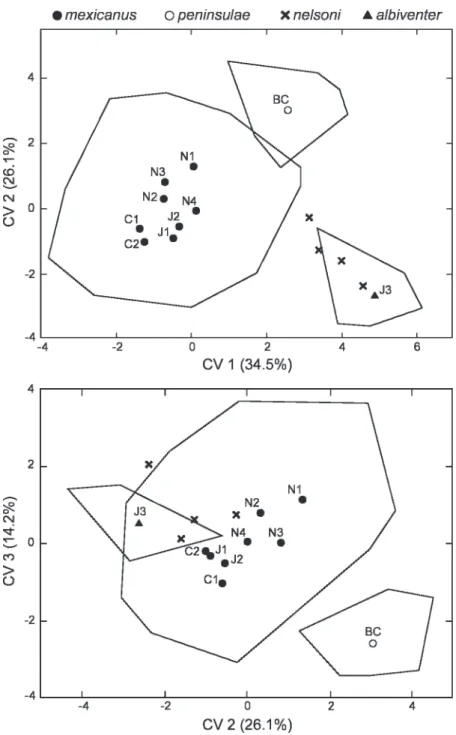
Discriminant-function analysis of the 11 OTUs representing these taxa disclosed three well-defined clusters in the first three canon- ical variates extracted (fig. 4), which collec- tively summarize about 75%of the between- sample variation. The largest cluster consists of the eight samples that representmexicanus.
Their centroids are closely approximate and they broadly overlap one another in canon- ical scores; a posteriori misclassifications among the eight is commonplace (24%–92%
incorrect depending upon the OTU). The mexicanus aggregation is entirely separate from OTU J3 of albiventer along the first canonical variate, a hiatus mainly reflecting the uniformly larger size of the latter (tables 2, 4), a distinction also emphasized in the first component derived from PCA of all Jaliscan specimens.
Although the sample of peninsulae is intermediate to those of mexicanus and albiventer in external size (table 2), cranial size and shape differences contribute to its sharp isolation from the latter OTUs along canonical variates 1–3 (fig. 4). Larger size in nearly all variables sets apartpeninsulaefrom the various OTUs of mexicanus along the first canonical variate (correlations positive, coefficients moderately large; table 4). A subset of dimensions conveys certain shape differences that affect separation ofpeninsu- lae along the next two latent variates, including a deeper braincase (DBC), broader rostrum (BR), and expansive bony palate (LBP, BBP). Noteworthy are the absolutely and relatively broad incisive foramina (BIF) that characterize specimens of peninsulae, features that also contribute to the morpho- metric isolation of the Baja sample, especially on the second canonical variate (table 4). The incisive foramina inpeninsulae even average wider than the large-bodied taxa albiventris 2009 CARLETON AND ARROYO-CABRALES:ORYZOMYS COUESICOMPLEX 101
TABLE 2
External and Craniodental Measurements (in mm) of Samples of theOryzomys couesi Complex in Western Mexico
(Sample statistics include the mean,61SD, and the observed range; variable abbreviations are defined in Materials and Methods; column headings reflect our taxonomic recommendations.)
O.couesi mexicanus O.peninsulae O.albiventer O.nelsoni
Jalisco Nayarit Baja California Jalisco Marı´a Madre
Variable (J1,N558) (N1,N562) (BC,N514) (J3,N512) (TM,N54) TOTL 245.7625.1 244.8619.5 265.6622.3 285.4622.2 322628.8
195–301 210–288 227–305 245–314 282–344
TL 132.3613.2 125.1610.7 136.8610.8 155.4614.3 181.5614.6
102–160 105–150 114–156 129–173 160–191
HBL 113.3612.8 119.7611.0 128.9612.3 130.068.2 140.5614.8
91–141 96–144 113–152 116–142 122–153
HFL 30.261.7 30.561.2 32.061.2 36.161.9 37.361.7
26–34 27–33 29–34 33–40 35–39
ONL 29.461.4 29.561.5 31.561.7 32.961.3 34.862.5
26.4–32.5 26.7–33.2 27.8–34.3 30.0–34.5 31.7–37.8
ZB 15.860.9 15.660.8 17.160.9 17.660.6 18.061.0
13.8–18.0 13.9–17.9 15.1–18.7 16.6–18.3 16.6–18.9
BBC 12.560.4 12.560.4 12.960.2 13.260.3 13.460.3
11.7–13.5 11.7–13.3 12.4–13.3 12.8–13.8 13.0–13.6
BOC 6.760.3 6.760.2 6.860.2 7.160.2 7.260.3
6.1–7.3 6.3–7.2 6.2–7.0 6.9–7.6 6.8–7.6
DBC 9.160.3 9.460.4 9.960.4 9.760.3 10.060.2
8.3–9.8 8.4–10.5 9.4–10.8 9.3–10.1 9.9–10.2
IOB 4.760.2 4.760.2 4.960.2 4.860.2 5.260.3
4.1–5.1 4.3–5.3 4.7–5.3 4.5–5.1 4.8–5.6
LR 9.260.6 9.360.7 10.060.7 10.360.7 11.360.9
8.3–10.7 8.2–11.1 8.4–11.1 9.0–11.4 9.9–11.9
BR 5.860.4 5.660.4 6.460.5 6.160.3 7.060.6
5.0–6.7 4.8–6.9 5.4–7.4 5.4–6.5 6.2–7.5
DR 6.660.4 6.560.4 6.860.5 7.160.5 8.160.7
5.8–7.5 5.7–7.4 5 .7–7.7 6.2–7.7 7.0–8.7
LIF 5.860.3 5.960.4 6.460.5 6.560.4 6.460.3
5.0–6.5 5.0–6.7 5.5–7.3 5.7–6.9 6.1–6.9
BIF 2.260.2 2.360.1 2.660.2 2.460.2 2.560.1
1.9–2.7 2.0–2.7 2.3–3.2 1.9–2.6 2.4–2.6
LD 7.460.5 7.660.6 8.360.7 8.360.7 8.860.7
6.1–8.6 6.4–9.1 7.1–9.7 7.2–9.5 8.0–9.6
PPL 9.860.7 9.760.7 10.361.0 11.060.6 11.561.0
8.0–11.4 8.3–11.3 8.6–12.5 9.5–11.7 10.5–12.7
LBP 5.560.3 5.360.3 5.960.3 6.260.3 6.560.6
4.9–6.2 4.6–6.2 5.2–6.3 5.6–6.7 5.7–7.2
BBP 5.660.2 5.560.2 6.160.2 6.060.2 6.260.2
5.2–5.9 5.1–6.0 5.5–6.6 5.7–6.2 5.9–6.4
BZP 3.160.2 3.260.3 3.360.3 3.760.2 4.260.3
2.6–3.6 2.6–3.8 2.7–3.9 3.5–4.0 3.7–4.5
LAB 4.060.1 4.060.2 4.160.2 4.560.2 4.460.3
3.7–4.4 3.5–4.4 3.9–4.5 4.2–4.8 4.1–4.6
CLM 4.6060.14 4.5660.17 4.7260.11 5.2460.19 4.9260.12
4.23–4.94 4.22–4.91 4.53–4.94 4.74–5.51 4.75–5.00
WM1 1.3560.05 1.3060.07 1.3660.05 1.5360.06 1.5260.04
1.21–1.45 1.04–1.40 1.26–1.44 1.45–1.64 1.47–1.56
DI 1.7560.12 1.8160.14 2.1860.21 2.0660.13 2.3160.18
1.53–1.98 1.54–2.19 1.83–2.59 1.83–2.26 2.06–2.47
and nelsoni (table 2). Clustering (UPGMA) based on Mahalanobis’ distances between centroids does indicate a closer phenetic affinity between peninsulae and OTUs of mexicanus, compared with albiventris and nelsoni, and simultaneously its strong differ- entiation from any one of them (fig. 5). In principal-component and discriminant-func- tion analyses confined to samples ofpeninsu- lae and mexicanus (not illustrated), contrast in incisor girth (DI) emerges as an important variable for separation of the two taxa (table 4), in addition to those already men- tioned. No specimen of peninsulae was mistakenly associated with another OTU according to post hoc probabilities of group membership.
Variable loadings that influence the isola- tion ofalbiventrissimilarly apply to the OTU of nelsoni, insofar as the first three variates extracted are concerned (fig. 4). Compared with examples of mexicanus and peninsulae, specimens ofnelsoniandalbiventrisare large Oryzomys that possess more robust skulls and notably heavier molars (table 2), differ- ences evidenced in the loadings on canonical variates one and two (table 4). Clear-cut circumscription of the four specimens of nelsonifrom those of albiventer, however, is captured on the fourth and fifth variates (not plotted), which principally emphasize the massive development of the rostrum (LR, WR, DR, BZP) and upper incisors (DI) in nelsoni(tables 2, 4). Given the scope of taxa Fig. 3. Projection of specimen scores onto first two axes extracted from principal component (PC) ordination of 20 log-transformed variables as measured on intact skulls (N5108) representingOryzomys couesi albiventerandO.c.mexicanusfrom Jalisco, Mexico. The position of the type specimen (holotype) of albiventer Merriam (USNM 82236) is indicated by ‘‘ht.’’ See table 3 for variable correlations and variance explained.
2009 CARLETON AND ARROYO-CABRALES:ORYZOMYS COUESICOMPLEX 103
A albiventer
• mexicanus
1 -
CO
O
-2 -
Y = 0.65X + 0.456
Y = 0.41X-1.678
-2 0 1
PC I (72.2%)
under consideration, covariation among these variables emerged as minor compared with the overarching patterns of between- group variation summarized by the first three canonical variates. Nonetheless, their unique and consistent expression innelsoniaccounts for its strong differentiation in the pheno- gram generated from Mahalanobis’ distances between OTU centroids (fig. 5). The weak clustering association obtained between nel- soniandalbiventerapproximates that derived forpeninsulaeand OTUs ofmexicanus.
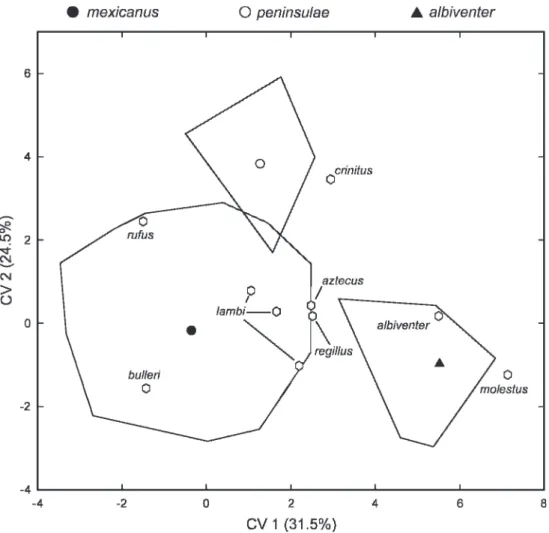
Those type specimens with intact skulls were entered as unknowns in a 10-group discrimi- nant-function analysis for classification ac- cording to a posteriori probabilities of group membership. The OTU of O. nelsoni was excluded as a classificatory option; further- more, DI was omitted in calculating discrim- inant coefficients because the incisors in the
type specimen of aztecus (USNM 51173) could not be measured. Type material of the three species-group taxa that originate within coastal plain were all definitely assigned to mexicanus(fig. 6), including the holotypes of bulleri Allen (AMNH 6663 to N3) andrufus Merriam (USNM 91404 to N2), as well as the three original topotypes of O. couesi lambi Burt (UCLA 51201 to N2, UCLA 51026 to C2, UCLA 51038 to J1); none demonstrated even a low level of affinity for the OTUs of albiventerorpeninsulae. Those taxa described from upland localities in central Mexico were variously affiliated (fig. 6). The specimen of molestusElliot (FMNH 8667), described from Ocotla´ n, Jalisco, was dispersed just peripheral to the type series of albiventer (Ameca, Jalisco) but definitely classified with that OTU (P 5 1.000); the type of albiventer Merriam (USNM 82236) naturally clustered among the original type series. Type speci- mens of aztecus Merriam (USNM 51173, Yautepec, Morelos) and regillus Goldman (USNM 125945, Los Reyes, Michoaca´ n) plotted at the margin of our large represen- tation ofmexicanus, but their canonical scores statistically aligned them with those OTUs (the greatest affinity of both with J2), not with albiventer. Finally, the holotype of crinitus Merriam (USNM 50182, Tlalpan, Distrito Federal) was associated with the series of peninsulae, at an unexpectedly strong level of probability (P 5 0.996). The large values measured for the incisive foramen width (BIF), rostral breadth (BR), and braincase depth (DBC) of this specimen (table 5), variables that importantly contribute to the discrimination of mexicanus and peninsulae (see above), presumably influenced its multi- variate disposition and a posteriori classifica- tion inpeninsulae.
DISCUSSION
TAXONOMIC RECOMMENDATIONS AND
FUTURE STUDY: We recognize four species among our study samples from western Mex- ico: Oryzomys albiventerMerriam, O. couesi mexicanusJ.A. Allen,O.nelsoniMerriam, and O.peninsulaeThomas (figs. 7–9). These forms can be objectively defined by a combination of qualitative morphological traits, demonstrate cohesive patterns of morphometric identity, TABLE 3
Correlations (Loadings) of 20 Log-transformed Craniodental Variables with Derived Principal
Components (PC) Extracted from Ordination Using Intact Specimens (N=108) of Oryzomys couesi albiventerandO.c.mexicanus
in Jalisco, Mexico
(See fig. 3; variable abbreviations are defined in Materials and Methods.)
Variable PC I PC II
ONL 0.98*** 0.03
ZB 0.94*** 20.02
BBC 0.75*** 20.09
BOC 0.71*** 20.05
DBC 0.84*** 20.03
IOB 0.59*** 0.19
LR 0.93*** 0.15
BR 0.87*** 0.28
DR 0.92*** 0.18
LIF 0.87*** 0.12
BIF 0.65*** 0.40**
LD 0.94*** 0.15
PPL 0.93*** 0.18
LBP 0.81*** 20.25
BBP 0.84*** 20.22
BZP 0.91*** 20.18
LAB 0.68*** 20.26
CLM 0.64*** 20.59***
WM1 0.55*** 20.65***
DI 0.87*** 20.11
Eigenvalues 0.069 0.006
%variance 72.2 6.3
*** P#0.001; ** P#0.01.
Fig. 4. Results of 11-group discriminant function analysis based on 20 log-transformed measurements of intact specimens (N 5 246) representing the Oryzomys couesi group from western Mexico: top, projection of specimen scores on canonical variates (CV) 1 and 2;bottom,projection of specimen scores on canonical variates 2 and 3. Individual scores are plotted for the four known specimens ofO. nelsoni;
minimum convex polygons enclose individual scores around the centroid for OTUs of albiventerand peninsulae. To avoid visual clutter only centroids are indicated and a single bounding polygon encloses maximum dispersion for all specimens of mexicanus. See table 4 for variable correlations and variance explained.
2009 CARLETON AND ARROYO-CABRALES:ORYZOMYS COUESICOMPLEX 105
\mexicanus openinsulae xnelsoni Aalbiventer
CV 1 (34.5%)
2 -
CM
c, o
CO
>
O -2 -
I
*/
I I 1
\
J3 N2
\~ X • . 2> N4 N3
C1.
N1 *
-
I I l
BC O
1
CV2(26.1%)
and occupy discrete geographic ranges (see emended diagnoses, distributions, and re- marks under Taxonomic Summary). Such well-marked contrasts stand at odds with the conventional notion of intergrading subspe- cies as conveyed in past studies and influential classifications (Goldman, 1918; Hall, 1981).
The genesis of the widely distributed, polytyp- ic view of O. palustris, encompassingcouesi and most other Middle American taxa, hinged on a geographically and taxonomically limited study (Hall, 1960) that was uncritically expanded in the latter 1900s (Handley, 1966;
Hershkovitz, 1971; Hall, 1981), compelled more by the revisionary habit of the era than by fresh analyses of character data. Consid- ered in this historical context, the sharp differentiation we encountered among western Mexican taxa, unexamined in any systematic detail since Goldman’s (1918) revision, is unsurprising. These taxa have received mini-
mal study since their descriptions; they are not
‘‘cryptic’’ species.
As now understood (i.e., Weksler et al., 2006, plus species recognized herein), Oryz- omys is a moderately speciose genus (8 species to date considered valid). The distri- bution of most species is confined to Neo- tropical environments of Middle America, but one inhabits temperate settings in south- eastern North America (O. palustris) and another occupies the northernmost margin of South America (O. gorgasi). Even so recon- stituted, Oryzomys still contains several species-level uncertainties. The widely rang- ing, polytypic definition of Oryzomys palus- tris, as classically formulated in Hall (1981), reminds us of other Middle American species whose composite nature has been emphati- cally documented by recent researches. For example, Oryzomys rostratus has been sepa- rated fromO. ‘‘melanotis’’ (Engstrom, 1984);
TABLE 4
Correlations (Loadings) of 20 Log-tranformed Craniodental Variables with Derived Canonical Variates (CV)
(Based on 11-group discriminant function analysis of intact specimens,N5246, representingOryzomysin western Mexico; see fig. 4 for scatter plots of CVs 1–3. Variable abbreviations are defined in Materials
and Methods.)
Variable CV 1 CV 2 CV 3 CV 4 CV 5
ONL 0.69*** 20.07 20.09 20.22 0.27**
ZB 0.65*** 20.09 20.22 20.19 0.15
BBC 0.61*** 20.07 20.05 0.09 0.25**
BOC 0.24* 20.11 20.01 0.13 0.20
DBC 0.65*** 0.29*** 0.04 0.05 0.13
IOB 0.46*** 0.17 20.03 20.33*** 0.27**
LR 0.59*** 20.11 20.14 20.16 0.28**
BR 0.46*** 20.05 20.38*** 20.42*** 0.29***
DR 0.55*** 20.16 20.06 20.33*** 0.43***
LIF 0.62*** 0.05 20.15 20.25** 0.01
BIF 0.56* 0.35*** 20.22* 20.23* 0.16
LD 0.62*** 0.05 20.12 20.23* 0.12
PPL 0.51*** 20.11 20.04 20.35*** 0.15
LBP 0.65*** 20.29*** 20.31*** 0.00 0.25**
BBP 0.70*** 20.05 20.37*** 20.28** 0.16
BZP 0.62** 20.08 0.12 20.44*** 0.13
LAB 0.62*** 20.21 0.03 20.21 0.03
CLM 0.76*** 20.40*** 20.09 20.11 20.12
WM1 0.62*** 20.56*** 20.23* 20.07 0.00
DI 0.75*** 0.20 20.15 20.16 0.24**
Eigenvalues 2.19 1.66 0.91 0.73 0.41
Canonical Correlations 0.83 0.79 0.69 0.65 0.54
%variance 34.5 26.1 14.2 12.4 6.4
*** P#0.001; ** P#0.01; * P#0.05.
Sigmodon arizonae, S. hirsutus, S. mascoten- sis, andS.toltecushave been recovered from S. ‘‘hispidus’’ (Zimmerman, 1970; Carleton et al., 1999; Peppers and Bradley, 2000; Peppers et al., 2002; Carroll et al., 2005); and Peromyscus aztecus, P. beatae, P.levipes, P.
madrensis, P. sagax, P. simulus, and P.
spicilegus have been resurrected as valid species, all of them formerly masked under P. ‘‘boylii’’ (Carleton, 1977, 1979; Carleton et al., 1982; Rennert and Kilpatrick, 1987;
Schmidly et al., 1988; Bradley et al., 1989, 1996; Castro-Campillo et al., 1999). In similar fashion, future taxonomic research upon Oryzomys, in particular the O. couesi section, will undoubtedly disclose greater systematic diversity, and some of those research avenues might explore or solidify the following points:
(1) The remoteness of the Oryzomys population that once existed at the tip of Baja California, far removed from the core generic distribution in mainland Mexico, prompted Nelson (1922: 124) to remark that it ‘‘may readily have been introduced in shipments of bananas or other farm products from Mazatlan or elsewhere along the main-
land coast, where a related species [i.e., O.
couesi mexicanus] is plentiful.’’ His conjecture on the nonnative status of the peninsular form may have influenced Hall (1981) to arrange it within a polytypic O. palustris.
However, the morphological distinctiveness and morphometric separation of peninsulae that we observed are substantial and instead portray a species that evolved in situ, isolated appreciably longer from the mainland distri- bution ofOryzomysthan a recent anthropo- genic introduction would suggest.
The phenetic linkage ofO. couesi mexica- nus and O. peninsulae offers a preliminary kinship hypothesis to be tested with other data, and two biogeographic scenarios de- serve consideration in reconstructing the latter’s relict distribution.Oryzomys peninsu- laemay have differentiated from an ancestral stock whose distribution once covered the Baja Peninsula, extreme southwestern United States, and western Mexico. Several rodent species or species complexes today exhibit a similar distributional pattern (e.g., see ranges in Lawlor, 1983: appendix 10), suggesting that Pleistocene climatic changes and subse- quent range contraction could have isolated Fig. 5. Pattern of phenetic similarity among the 11 OTUs ofOryzomysfrom western Mexico based on UPGMA clustering of the squared Mahalanobis distances among group centroids as derived from discriminant-function analysis (see fig. 4). Currently recognized species-group taxa are shown above the appropriate stem subtending terminal OTUs.
2009 CARLETON AND ARROYO-CABRALES:ORYZOMYS COUESICOMPLEX 107
peninsulae
mexicanus
albiventer nelsoni
Baja California Colima 1 Collma 2 Jalisco 1 Jalisco 2 Nayarit 4 Nayarit 1 Nayarit 2 Nayarit 3 Jalisco 3 Tres Marias
60 50 40 30 20 10
Mahalanobis D
an Oryzomys population at the tip of the peninsula. The extension of O. couesi mex- icanus along the coastal plain in western Mexico, as far north as west-central Sonora (fig. 7), further intimates the former continu- ity ofOryzomyspopulations on the mainland surrounding the Sea of Cortez.
Alternatively, O. peninsulae may have originated when the southernmost cape region of the Baja Peninsula was positioned as an island approximate to the Nayarit- Jalisco coast in the late Miocene (Carren˜ o and Helenes, 2002). Geologic and tectonic evidence indicates that northwestward rifting (beginning approximately 5.5 million years
ago) and accelerated seafloor spreading (beginning approximately 3.5 million years ago) eventually brought the insular cape block to its present peninsular terminus, a geological nonconformity demarcated by the Isthmus of La Paz. The biotic legacy of the former juxtaposition of the southern cape block and west-central Mexico is suggested by the current distributions of certain plants and birds (Cody and Velarde, 2002; Cody et al., 2002). Phylogeographic analysis, using ancient DNA, may disclose sufficiently fine-scale genetic affinities to choose among these or other biographic scenarios.
Fig. 6. Dispersion of type specimens ofOryzomysnamed from western Mexico based on a posteriori classification using discriminant coefficients extracted from 10-group discriminant function analysis of albiventer,couesi mexicanus, andpeninsulae. Minimum convex polygons enclose individual scores around the group centroid (or grand centroid in the case ofcouesi mexicanus). See text for discussion.
m 2
CM CM
5
0 molestus
CV1 (31.5%)