7 Teachers as Leaders
Entrepreneurial Thinking in Action for Chapter 7
Communicating, flexibility, leading, make it happen, negotiating, open-minded, proactivity, self-efficacy, strategic thinking, take the initiative, taking responsibility.
Introduction
The idea of teachers as leaders has a long history connecting back to Greek origins in language where the word pedagogy is defined as the leadership of children. Teachers as leaders may be evident where teachers treat students with respect, by listening to and learning from students about their social and cultural values, to connect cur
riculum with enacted learning. With such approaches the teacher as the leader of children can meet students’ learning needs and interests, while also building the agency and leadership of their students. You can see examples of pedagogical lea
ders in action across different career stages in Part IV of this book, and I draw your attention to Case Studies 9.3, 10.3, and 11.5 as examples.
Teachers as leaders has a meaning today that extends beyond the teacher– student relationship because school systems are increasingly complex and con
nected within a broader education ecosystem. A contemporary example of how teachers lead may involve inter-relationships where teachers collaborate and are open to providing and receiving professional feedback. Such activities involve influencing one another in making choices about teaching. In this chapter you will be introduced to some foundational concepts for thinking about yourself as both a teacher and a leader. What leadership could mean in a school context, how we could model leadership, and how we may see leader
ship in everyday practices are some of the big ideas covered in this chapter.
In Theory
What is Leadership?
Leadership may be defined in many ways for different contexts, and in the context of teaching and teachers, a practice-focused form of leadership is DOI: 10.4324/9781003285694-10
described below. In this book, leadership is defined as a collection of learned skills, behaviours, and attributes that enable a person to take action and influ
ence the actions of others. These leadership skills, behaviours, and attributes overlap with entrepreneurial thinking in action as described in Table 1.1 (see Chapter 1). For example, skills such as intuitive decision making, strategic thinking, negotiating, and communicating, or behaviours such as taking the initiative, making it happen, taking responsibility, and networking may be attributed to leadership through entrepreneurial actions. As you start to think about your experiences of leadership, consider how some of these entrepreneurial concepts may connect with the practice of leadership.
The interconnectivity between leadership and organised entrepreneurial activity exists because entrepreneurial activity is a form of management, and leadership is part of management. Put simply, management involves planning, leading, organising, and coordinating in relation to resources and people. The people aspect is where leadership becomes important.
At a fundamental level, people are emotional and social by their nature (Turner, 2007). Most of us like being together in groups with a shared purpose and shared identity, or at the very least feeling like we are part of something that is bigger than us as individuals (Collins, 2004). For this reason, leadership involves interpersonal capabilities to influence social situations. These capabilities include a leader’s self-awareness or knowledge about themselves, as well as an ability to know others and enable the creation of leader–follower relationships.
In organisational settings it is possible for us to be both a leader and a fol
lower at the same time, across different relationships. This is where strategic thinking may be useful because knowing where you fit into an organisation and knowing something about the nature of other people’s relationships above, below, and adjacent to you may help you become a better negotiator in your immediate leader–follower relationships. We will look more closely at this idea in Chapter 8 addressing education ecosystems because organisations have implications for the exercise of power and influence.
Thinking About Leadership in School Systems
In schools and school systems you will often hear language referring to school leaders or the school leadership team, which includes a small number of people in any school and tends to exclude most classroom teachers. Letting teachers teach and school leaders lead is also a common mantra in teacher magazines, along with the label of aspiring leaders for those who want to become school administrators (e.g., Gaynor, 2019). If we take everyday language as an indicator of the way people think about leadership in schools, the teacher who remains in the classroom is typically not considered a leader in their profession within school systems. Put simply, school administrators are regarded as the leaders in a school, there may be teachers who aspire to be school administrators and therefore leaders, and then there are classroom teachers. In the Australian con
text, silence about regard for teachers as leaders is also notable in the way the
A. Teachers as Process Workers Controlled Limits of Discretion
Given Objectives rolled Limits of Discretion
Cont
Expanded Limits of Discretion
national professional standards acknowledge many management capabilities as essential for successful teaching, but the idea of classroom teachers as leaders seems to be missing as an essential category in their list of non-academic capabilities (see Table 1.1, Chapter 1).
In this book I make the distinction between school administrators and class
room teachers as being based on their different management functions, and not their capacity to lead, or their need to be a professional leader. Teachers manage classrooms, and school administrators manage schools, but both should be acknowledged as professional leaders. All teachers are leaders and should be regarded as leaders if their autonomy and agency as professionals is to be established and maintained.
One of the reasons we need greater clarity in the way we think of teachers as leaders is that the power of an effective leader to influence others does not come from their formal positional authority in a school, but from their interpersonal skills.
On occasions you will come across people who rely on their position as a source of authority for exercising influence, which is the weakest form of leadership. It is essential to realise that most people can learn to be leaders and learning to be a leader should be foundational to being a self-regulating professional regardless of one’s formal administrative position in an organisation. A shift in the language within schools would be one step towards improving the professionalisation of teaching by fostering a culture where all teachers are expected to be professional leaders.
Establishing Professional Leadership
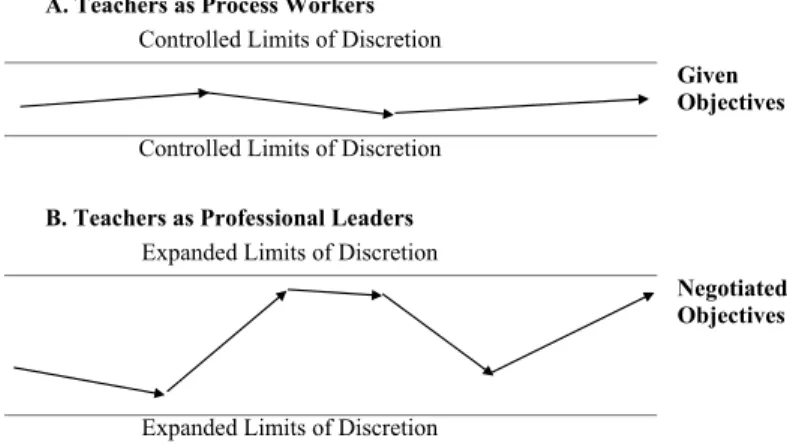
Changing our mindset about classroom teachers as professional leaders has implications for the way teachers may be expected to work and how they may work as their leadership capabilities are developed. Figure 7.1 illustrates the notion of leadership and the limits of discretion (cf. MacDonald et al., 2018) shaping how a teacher’s work may be performed.
s Professional Leaders anded Limits of Discretion
Negotiated Objectives B. Teachers a
Exp
Figure 7.1 Leadership and Limits of Discretion
If teachers are to be regarded as non-leaders in schools, school administrators are more likely to control the limits of discretion by stipulating more precisely the processes teachers should follow in doing the work of classroom teaching. This would lead to school environments driven by standardisation and non-negotiable objectives, a one-size-fits-all approach to teaching and learning, and auditing to ensure rules of teaching practice are followed. Such thinking is currently driven by notions of best practice where school systems adopt a particular way of working as the gold standard. This approach is limited in the way it becomes standardised with little regard for differences across school contexts and changes in context over time.
By thinking of teachers as professional leaders we are establishing a different set of expectations for teachers and administrators that are more likely to lead to better outcomes for students. A teacher as a leader will have expanded limits of discretion and they will be involved in negotiating objectives. This will come naturally within an organisation because people who are trained to be leaders will typically negotiate these limits and objectives. People trained as leaders do not sit back when things go wrong, meaning they are more likely to take corrective action and seek to fix processes that do not work in practice. What this means is that school administrators do not need to control teachers who are leaders. They can situate teachers with negotiable objectives and enable them to explore different pathways for achieving objectives. This enables teachers to shape classroom teaching so that it fits the specific students in their specific classrooms. Thinking of teachers as professional leaders makes possible the notion of next practice (Hannon, 2010), which is a future-focused, innovation- driven approach to improve student outcomes by foregrounding specific school contexts and student needs. Put simply, teachers trained as leaders have a far greater capacity to create value and serve the needs of their students and others.
Creating Value: Leaders Serving Needs
As discussed in Chapters 1 and 3, the creation of value in social and cultural terms is fundamental to entrepreneurial activity. People trained as leaders will naturally become creators of value and values as these are the basis for influ
encing others by having people making choices about how to work towards shared goals. In this sense leaders are people who display various entrepre
neurial skills, behaviours, and attributes as noted earlier.
At a more interpersonal level of thinking, leaders may be regarded as serving the needs of people who they seek to influence. From psychological perspec
tives, models of leadership often connect with different need hierarchies such as those defined by Maslow (see Fisher, 2009). For example, Maslow identifies five levels of needs that are typically satisfied in order, and the level for any individual may vary depending on their specific context. These levels are phy
siological, security, social, ego, and self-actualisation. By understanding the level at which different people’s needs are being satisfied in any situation, a leader would seek to create value by helping to satisfy the next level of needs, thereby motivating people to work with the leader.
A less structured and more social approach to value creation may be to satisfy needs in terms of helping people achieve individual-level human capabilities (Fertig, 2012). For example, Nussbaum’s (2011) central capabilities are viewed as fundamental to human development and include a non-hierarchical list of categories that are regarded as equally important. Human capabilities are fun
damental to the development of societies and provide a more fine-grained and humanistic perspective for understanding why we have governments and the concept of nation States. Societies should not exist to satisfy narrow economic measures of value creation, but instead they should be about the development of every individual citizen’s capability to live a good life. In an entrepreneurial sense this leads to the promotion of social and cultural value as a priority, rather than financial value. Nussbaum’s (2011, pp. 33–34) central capabilities include:
a Life: able to live to normal longevity.
b Health: able to experience good health, reproduction, and shelter.
c Bodily Integrity: able to move freely from place to place.
d Senses, Imagination, and Thought: able to exercise freedom of expression.
e Emotions: able to have attachment and belonging to society, without fear or anxiety.
f Practical Reason: able to conceive of good and be a critical thinker.
g Affiliation: able to live with others in a state of self-respect.
h Other Species: able to live and interact with other animals, plants, and the natural world.
i Play: able to play, laugh, and enjoy recreation.
j Control Over One’s Environment: able to participate in political choice and to own property and goods.
Regardless of the way you choose to think about people’s needs, the leader’s role in creating value by serving such needs is fundamental to influencing people’s choices to join a leader in achieving shared goals. As you consider the following sections addressing a model of leadership and leadership styles, you should also be thinking about the ways in which the needs of others are being served by the leader.
Functional Leadership
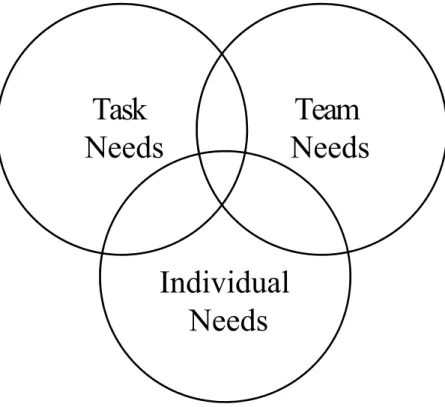
This book adopts a practical, action-centred model known as functional leadership, which focuses on leader–follower relationships for satisfying different people’s needs (Adair, 1973). Functional leadership focuses attention towards addressing the needs of a group of people, by unifying them into a team for achieving a shared focus on common task-related goals. Achieving focus and effort towards shared goals is what distinguishes a team from a group. It is the leader’s role to motivate people individually and collectively by ensuring the various needs of each indivi
dual team member are met, the needs of the team are met, and the needs for achieving their common task are met. We can visualise this in a Venn diagram
Task Needs
Individual Needs
Team Needs
Figure 7.2 Model of Functional Leadership
where the leader seeks to form a team located in the overlapping area of the dia
gram, as shown in Figure 7.2.
In the following example, needs are identified in terms of the functional model of leadership in Vignette 7.1 involving Amelia. Consider the context described and what these various needs may look like in a practical sense. How might these functional needs also be described in terms of Maslow’s hierarchy of needs?
Vignette 7.1: Amelia and Functional Leadership
Amelia illustrates functional leadership when she takes on the challenge of presenting a professional development workshop to her peers on the gamifi cation of mathematics lessons. Task needs are achieved by maintaining focus on the workshop objectives and breaking work tasks into smaller activities with sub-goals to be achieved by teams. Team needs are achieved by ensur
ing each group has adequate resources to complete the task, including laptop computers, internet access, marker pens, and a small whiteboard. Individual needs are achieved by allowing learners to speak and contribute freely to team tasks, to speak to other groups, to move freely around the workshop room, and to leave the room for a break if required.
In terms of Maslow’s hierarchy of needs for Vignette 7.1, individual needs may include the satisfaction of physiological needs such as moving around the room to get a drink of water or partake in morning tea whilst also working on the task. Task needs could be aligned with ego and self-actualisation needs as team members are given opportunities to make creative and individual con
tributions to an overall team achievement. Team needs may satisfy social needs because all team members are given equitable access to resources, meaning that they can contribute to and be part of a well-resourced, socially cohesive team.
In the next example, needs are identified in terms of the functional model of leadership in Vignette 7.2 involving Oliver. Like the above example, consider the context described and what these various needs may look like in a practical sense. This time, consider how these functional needs may also be described in terms of the satisfaction of central capabilities.
Vignette 7.2: Oliver and Functional Leadership
Oliver has fully developed his solution for helping teachers to manage students’ reflective writing. Through his problem validation and build- test-learn processes he has led 50 teachers across 10 schools to adopt his technology in their teaching. By influencing these teachers, he has led them to a solution that satisfies their task needs in optimising student learning outcomes, while also satisfying their team needs in the way he has brought them together around the shared technology as a community of practice. This solidarity has empowered them to make changes to teaching as a collective, across their respective schools. Their individual needs are met by enabling them to gain a sense of satisfaction and per
sonal identity as an innovator in their school communities.
From central capabilities perspectives we may think of the achievement of functional needs in many ways. For example, task needs could be satisfying practical reason, as this capability addresses the conception of a good outcome for students, by enhancing their skills for critical thinking and freedom of expression.
Team needs of the teachers as a collective are satisfied by the production of the final technology solution itself that facilitates student learning as a shared team goal. Individual needs may be aligned with control over one’s environment as each teacher has contributed to the technology as an early adopter and they have developed a sense of ownership over the solution. This may also be related to an affiliation or emotions capability at the same time.
Taken together, both these examples from Amelia and Oliver illustrate how we may achieve functional leadership in different contexts and how we may think of specific needs using different models such as Maslow’s hierarchy or the notion of central capabilities. The different contexts of leadership across these two examples are also of interest. Amelia’s team are likely to be closer together
socially and may have a higher degree of social cohesion because they work together in the same school. In contrast, Oliver’s leadership is across a com
munity of teachers who may have a loose affiliation with each other, but a stronger affiliation individually with Oliver as the community influencer. In both contexts the application of functional leadership is possible. In addition, the different ways we may think about needs or capabilities lends greater flexibility to the way we think of creating value for people as a source of motivation to work together towards common goals.
Leadership Styles
A further way to describe leadership at an individual level of interpersonal practice is in terms of leadership style. To capture a wide array of leadership styles, the three broad categories of laissez-faire, participatory, or authoritarian are quite effective. A participatory leadership style is one most people connect with because it involves working collaboratively with others and influencing the actions of others by giving clear instructions about task objectives, and being fair, inclusive, and respectful. A participatory leader would commonly get involved in doing task-related work alongside team members, helping others directly with individual needs, and keeping the team together by resolving minor conflicts and meeting team needs.
A laissez-faire leadership style is not seen as being effective in everyday con
texts, but it is useful where you may want to give others in your team a little more freedom to explore ideas and exercise greater creativity. It may also be useful when training new leaders by giving them space in which to lead a task and to experience the outcomes of their actions, whatever those outcomes might be. Typically, this would be part of a scaffolded activity where the task outcomes are not high stakes, and where you would give feedback to the trainee leader. In this sense a laissez-faire leadership style can be useful in school settings.
Finally, an authoritarian leadership style is tending to become less common in schools. There are occasions where an authoritarian style is useful such as in emergency situations or situations aimed at ensuring the immediate safety of others. On balance, an effective leader is usually one who can adapt their lea
dership style to different situations as they unfold. Having the flexibility to adapt to changing situations is important if a leader is to maintain the needs of individuals, teams, and the task goals at hand.
Observations from Practice
Diverse teams. The best innovation comes from teams of diverse people. Pre
service teacher Marc Seifert describes the importance of multi-disciplinary teams in Case Study 9.1.
Inclusive teams and safe learning environments. These are essential if we are going to encourage students, colleagues, and stakeholders to take risks and
manage risks through innovation. Jessica Galpin’s thoughts on this topic are described in relation to classroom innovations in Case Study 9.3.
Leading community stakeholders is a further context for teacher leadership as illustrated by Song Huang who established a community-engaged VET pro
gram, as described in Case Study 10.2.
Students as leaders. Consistent with the earlier definition of leadership as a learned interpersonal capability, it is essential that teachers develop the leader
ship skills of their students. This can be achieved in simple ways such as plan
ning learning activities where students are given specific tasks to lead and are supported through the experience with positive feedback from the teacher.
Examples of this is the idea of student-led learning tasks described by Nicholas Teh in Case Study 10.4 and the Year 12 to Year 7 interactions established in learning by Kai-Stefanie Lorimer in Case Study 10.1. Good leaders support new leaders.
Learning Activities
Activity 7.1: Describe a leadership experience. Write a brief paragraph to describe a leadership experience of your own, or one where you have observed another leader, where the experience has involved interpersonal leadership and influence.
Activity 7.2: Appraise a leadership experience. Using your response in Activity 7.1, appraise or evaluate that experience with reference to other past experiences, the concepts introduced through this book, or other readings on leadership you have accessed.
Activity 7.3: Improve future leadership experiences. Based on your responses to Activity 7.1 and 7.2, how does that earlier experience and your appraisal inform your understanding about leadership and how you might practice and/
or teach leadership in the future?
Activity 7.4: Teacher as leader scenarios. Think about the concepts of lea
dership introduced in this chapter and the other innovation concepts illustrated throughout this book. Write some brief paragraphs to describe two or three scenarios about how you may apply leadership strategies to achieve innovation goals in your work as a teacher. Who would you want to influence, how would you influence them, and what would a successful outcome look like?
Principles for Leadership a Know yourself.
b Know your followers.
c Lead by example.
d People like to be led.
e Befirm but fair.
f Develop others as leaders.
g Listen to others.
h Promote diversity and inclusivity.
i Take the initiative.
j Communicate goals and keep people informed.
Conclusion
This chapter defines leadership as a collection of interpersonal skills for influ
encing others by creating value and serving their needs. Functional leadership is described as an action-orientated model focused on the leader serving the needs of others, and this is illustrated with vignettes and connections to case studies in Chapters 9 to 11. In the chapter that follows, leadership concepts will be further illustrated within the context of the broader education ecosystem.
References
Adair, J. E. (1973). Action-centred leadership. McGraw-Hill.
Collins, R. (2004). Interaction ritual chains. Princeton University Press.
Fertig, M. (2012). Educational leadership and the capabilities approach: Evidence from Ghana. Cambridge Journal of Education, 42(3), 391–408. https://doi.org/10.1080/
0305764X.2012.706254
Fisher, E. (2009). Motivation and leadership in social work management: A review of theories and related studies. Administration in Social Work, 33, 347–367. https://doi.
org/10.1080/03643100902769160
Gaynor, B. (2019, December 18). Let teachers teach and principals lead. Education Matters.
www.educationmattersmag.com.au/acppa-let-teachers-teach-and-principals-lead/
Hannon, V. (2010). The search for next practice: A UK approach to innovation in schools. Education Canada, 49(4), 24–27.
MacDonald, I., Burke, C., & Stewart, K. (2018). Systems leadership: Creating positive organisations. Routledge.
Nussbaum, M. C. (2011). Creating capabilities. Harvard University Press.
Turner, J. H. (2007). Human emotions: A sociological theory. Routledge.
8 Leading Through Innovative Ecosystems
Entrepreneurial Thinking in Action for Chapter 8
Leading, networking, innovating, influencing, strategic thinking, communicat
ing, make it happen, manage risk taking, self-efficacy, adaptability, resilience, open-mindedness.
Introduction
Leading in innovative ecosystems situates you as the teacher in the larger edu
cational and community environment where teaching takes place. This chapter aims to help you see the organisations and systems around you as sources of power that you can access and connect with to help you achieve the objectives of your innovative projects (see Case Study 11.1). These ecosystems can be personalised, and you can connect with them in ways that make them meaningful for yourself and the people you need to influence as an innovative teacher who is making change happen (see Case Study 11.4).
In Theory
Education Ecosystems
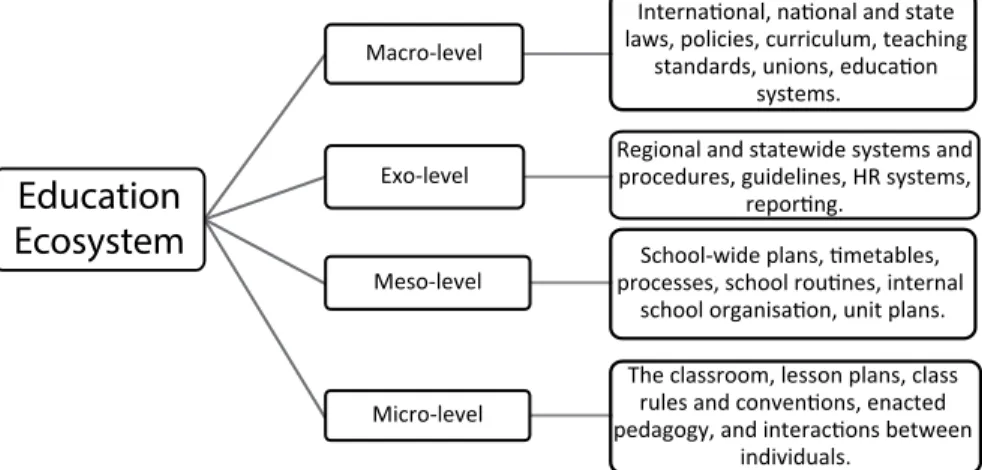
An appreciation of education ecosystems is important if we are to overcome the tendency in school education where teachers commonly perceive barriers to change and doubt their own capacity to make change happen. Figure 8.1 shows the basic features of an education ecosystem (cf. Leonard, 2011). This is a simplistic and conceptual illustration of how there are different levels of an ecosystem from the micro-level in the classroom or interactions between indi
viduals, all the way up to the macro-level where we may identify with inter
national and national laws that impact teaching practices. Within an ecosystem each of these levels interacts with others through our daily practices, and often become embedded as customary ways of working that most people rarely question.
DOI: 10.4324/9781003285694-11
Internatonal, natonal and state laws, policies, curriculum, teaching
standards, unions, educaton systems.
Regional and statewide systems and procedures, guidelines, HR systems,
reportng.
School-wide plans, tmetables, processes, school routnes, internal
school organisaton, unit plans.
The classroom, lesson plans, class rules and conventons, enacted pedagogy, and interactons between
individuals.
Macro-level
Exo-level
Meso-level
Micro-level
Education Ecosystem
Figure 8.1 Education Ecosystems
Throughout this chapter my challenge to you is to think about the different participants in your own education ecosystem, not as barriers, but as potential sources of support for making innovation happen. They may not think of themselves as sources of support, but as an innovator you should think this way.
Each of the institutions we think of in an education ecosystem comprises real living people, with emotions, career goals, and things they value both person
ally and professionally. Understanding the institutions, the people who make up the ecosystem, and how they interact is important if you are to think about innovation in schools by creating value for others within the ecosystem.
Innovative School Ecosystems
It is one idea to think of schools located within a broader education ecosystem, and it is another idea to think of schools located in an ecosystem that is inno
vative. This book is very much future focused and forward thinking where you are challenged to think about innovation, leadership, and the possibilities for innovative school ecosystems. Innovative ecosystems for schools do exist in Australia and internationally, but such ecosystems are still emerging in many places and have significant potential for growth. This is evident in Liz Jackson’s Case Study 11.1 (see Chapter 11) that describes the Australian innovation ecosystem across school years K-12. Liz focuses on the development of entre
preneurial education at national and state policy and curriculum levels, while exploring what is happening all the way to school programs and classroom activities. In Australia, this innovation ecosystem appears sporadically with major challenges being the lack of a clear national strategy and the need to build teacher capabilities, which is the focus of this book.
To be innovative as a teacher it is essential that you are thinking about your specific school context and its culture. To help you think about the school ecosystem you are working in and to get the most out of your specific
ecosystem, we need think about the ecosystem not as a static model, but as a complex collection of interacting parts that you can use to the advantage of innovation. This is possible by thinking of the ecosystem and its organisations as sources of power and influence that you as a teacher can access to achieve your innovation goals.
Organisations as Technologies of Power
One of the ideas that was missing from Chapter 7 on Teachers as Leaders was the concept of power, which is often associated with influence and leadership.
Common understandings of power are that it arises from relationships between people and that certain people have more power than others, and more ability to influence others. For example, teacher–student, policeman–citizen, father– child, business owner–employee are typical relationships where we may regard one person having more power than the other. In contrast, in this book I adopt a view of power proposed by Michel Foucault (1980): that power is carried by all people, and is the cause of relationships, not the outcome of relationships. In this sense people are the vehicles of power, not its point of application.
This form of power can be applied or exercised through technologies, tech
niques, processes, or practices that give rise to everyday knowledge, including knowledge about who we are and how we relate to others. To break this down, a technology of power could be the Australian Professional Standards for Teachers (APSTs: AITSL, 2022). By working with the APSTs and shaping our everyday teaching practices we become known to ourselves, our colleagues and others as being a teacher. Applying the APSTs helps shape our self-concept or our knowledge about ourselves as a teacher. This gives us the power to engage with particular groups of people and enables us to create particular types of professional relationships by exercising power arising from our knowledge about being a teacher, and what a teacher is, should be, and could be.
In Vignette 8.1 Oliver exercises influence as a teacher and achieves one of his innovation goals by submitting a professional development proposal to his Head of Department (HOD).
Vignette 8.1: Oliver Plans for Professional Development At the beginning of the school year Oliver decides he wants to attend an education conference to present a practice-based case study on the development of his reflective writing initiative. His HOD takes the view that attending conferences is not the role of a classroom teacher and he indicates this may not be possible because all professional development must be of benefit to students. Not accepting this as a barrier, Oliver constructs a proposal where he demonstrates how his conference pre
sentation is a way of benefiting students by addressing: APST 1.2, expanding understanding of how students learn using research and workplace knowledge; APST 1.3, supporting colleagues to develop
effective teaching strategies that address the learning strengths and needs of students from diverse linguistic, cultural, and socio-economic back
grounds; and APST 7.4, taking a leadership role in professional and com
munity networks and supporting the involvement of colleagues in external learning opportunities. By showing his HOD how the APSTs connect to his professional development, Oliver illustrates how his work will benefit stu
dents directly and indirectly. He is able to influence his HOD’s decision to achieve his innovation-related, professional development objectives.
In Oliver’s example he is exercising leadership by influencing the decision of his HOD. The example illustrates how leadership is exercised in different directions and does not depend on a formal leadership position. Instead, it depends on interpersonal techniques for shaping the teacher–HOD relationship and changing the way the HOD thinks about the practices of classroom tea
chers. The example also illustrates how Oliver could use a powerful technology such as the APSTs as a source of influence to achieve his objective. Oliver’s alignment with the APSTs becomes difficult for his HOD to make a counter
argument against. By drawing on the APSTs to change the HOD’s under
standing of teaching, Oliver has created a situation that shifts the power rela
tions between him and his HOD. Oliver’s strategy also illustrates how the APSTs are not some abstract compliance document. He brings to life the APSTs by applying them as a technique of influence for achieving his objec
tive. He is both an innovator and a leader of local change.
To explore organisational technologies and processes as a source of power for influencing change and shaping relationships, take some time read and reflect on Leon Furze’s Case Study 11.5 (Chapter 11). As you read Leon’s story and think about the concept of power described above, you could consider some of the techniques and processes he adopts in making change happen.
Revisiting Problem Validation and Solutions
To place in context the above discussions on leading through innovative eco
systems it is important to revisit the ideas explored earlier on the topics of problem validation (Chapter 5) and problem solving (Chapter 6). Take some time to go back and see how Oliver and Amelia expand their networks by getting out of the building and talking to people during the problem validation and solution development stages of innovation. Both these processes involved iterative design thinking and engagement with potential end users or early adopters of the innovation. When we think of these as techniques, practices, or processes it is clear that problem validation and problem solving are productive of new knowledge and new relationships. You were led through these pro
cesses with the view to learning something more about your values, the values
of others, and the ideas at the heart of the problem and solution. You were also encouraged to get out of the building, meet with new people, and engage with others to expand your innovation network. Considering Chapters 7 and 8 it should become clearer how these processes are sources of power for influencing others. As such they may empower you to create new relationships and to influence others in the way you investigate problems and values to produce solutions.
I have used these techniques for the past five years in my teaching with preservice teachers, where my primary goal was to get them out of the class
room and interacting with practising teachers about ideas for innovation. In these brief learning situations over five to six weeks in duration, learners tend to focus on the innovation topics while looking through their processes of collegial engagement. Learners at first tend to take the collaboration and engagement for granted. However, by the end of the project most come back with remarks about how powerful the learning experience was because of the way their collegial engagement processes change the way they think. Typically, it changes the way they think about their innovation ideas, it changes the way they think about themselves as teachers and the possibilities for teaching, and it changes their attitude about being an entrepreneurial teacher.
Thinking Strategically
A further entrepreneurial skill that connects with leadership and the idea of power through organisational technologies is strategic thinking. An effective strategic thinker should keep themselves informed of what is happening across all levels of the education ecosystem from international trends, political issues of the day, through to operational issues higher up in their organisation, as well as the tactical issues of everyday teaching. Understanding what is happening across the ecosystem can be achieved by reading, following news and social media, and thinking about the connections across this ecosystem. This often means thinking beyond your work in its daily routine and thinking beyond your immediate work focus.
By understanding connections across the ecosystem, a strategic thinker can start to appreciate what motivates their school principal and the higher-level managers in the school system. Thinking upwards in an organisation is impor
tant because knowing other people’s objectives is a strength if you are seeking to create value for them by helping them achieve those objectives. At the same time, a strategic thinker will also be thinking about the impact on students when implementing particular objectives. This means thinking up and thinking down the ecosystem hierarchy is a key skill of a strategic thinker.
For an example of strategic thinking in action, consider Case Study 10.2 by Song Huang where he implemented a novel program for context-based lan
guage education in a school. In his case study, Song mentions identifying the problem of low rates of student engagement with learning Asian languages.
This was an issue across most schools in Australia and there was published data
available that Song accessed to illustrate the problem. With this clearly identi
fied problem and his proposed solution, he then commenced stage one of his project, which was to show his principal how this problem could be solved and how the solution would create value by addressing State-level objectives around student learning outcomes. This helped the principal to achieve his school-level objectives. Subsequent stages became possible because Song was able to convince his principal that such a project would be valuable to his school directly and would showcase the school in the future once the project delivered on its objectives.
Song’s example of seeing a problem, visualising a solution, pitching the issue to his principal, and then making it happen is an excellent example of an entrepreneurial teacher leading through an innovative ecosystem.
Building Partnerships
A further foundation to successful innovation is developing a school culture that is open to the external environment. This requires both classroom teachers and tea
chers in school leadership positions to be confident in working with people from outside the school and enabling them to contribute to student learning. Case Study 11.2 by Angela Schumacher provides an overview of a framework she has developed through her many years of experience with school partnerships for her own school and for other schools in her current network. Such partnerships may be developed by individual teachers, for specific projects or at a school-wide level and for ongoing engagement. Importantly, such partnerships should create value for student learning, and for teachers, the school, and partners.
For schools and teachers who are starting out on the partnership journey with limited systems support, a good strategy is to start small and keep it local.
For an idea on how this may work consider one of Amelia’s experiences.
Vignette 8.2: Amelia Builds a Local Partnership
Upon getting a teaching position at a rural school Amelia took some time to look at what she was teaching over the next year, and to do a brief analysis of her local area. She was focused on learning about the town she was working in, to identify potential partners and local resources she might be able to access.
One of these was a government agricultural research station on the edge of town that she thought may be useful when teaching biology. She spoke to some colleagues in her school who had lived in the town for many years and found one who could introduce her to the people at the research station: she did this because a warm introduction through a mutual colleague is always more productive than a cold introduction. Over a six-month period, she vis
ited the station a couple of times and developed a project to support her teaching. Towards the end of her first year, she took her students to visit the station where they conducted their project. This became a regular feature of her students’ learning each year, and the partnership grew from there.
This type of localised partnership starts out small and has a specific focus. The benefit for the students is that they are learning by engaging with an authentic context and with real scientists in the case of Amelia’s example. The partners should also benefit. In Amelia’s case, the translation and communication of science to everyday citizens is often a key performance indicator for govern
ment-funded research centres. Amelia’s initiative is therefore welcomed by the partners as she is creating value for them by helping them achieve one of their strategic objectives. Before approaching a potential partner, it is a good idea to do some research about them. Check their websites and look for a statement of their mission and objectives. Consider who is running the organisation and what they are likely to view as value creation. Reading any annual reports or recent engagement activities they have been involved in will also be useful before making an approach to meet and learn more about each other.
The Possibilities for Innovative School Ecosystems
In the introduction chapter to this book, you were invited to imagine a school system that promotes professional autonomy, imposes low levels of control on staff and students, and operates in a way that is open to community and industry interactivity. The gap between our imagined ideal schools and the reality of the various schools teachers are working in may be attributed to the tension between innovation and the quality agenda. Quality in education has international tentacles, and it drives schools towards standardisation, prescrip
tion, and auditing of practices. In everyday contexts the quality agenda is per
vasive and highly visible, as indicated by Marc Seifert in Case Study 9.1 (Chapter 9), where he describes his first impressions of a school as a preservice teacher. Marc observed high levels of control over teaching practices and very little professional autonomy. Such observations are common for preservice teachers in graduate programs who have come from diverse industry back
grounds where they have more extensive experiences of professional auton
omy. Marc’s case study tells us something about how a new entrant to a school can be a source of innovation because they are not yet socialised. It also tells us something about the diversity and strength of professional experiences graduate teachers can bring into a school, beyond their formal initial teacher education.
Marc’s case study is followed by Viki Rozsa’s deeper experiences described in Case Study 11.3 (Chapter 11), where she explores the complexities of the quality agenda in the early childhood sector and how innovation and leadership may play a role in generating localised change.
When reflecting on these case studies it is important to recognise that both quality management and entrepreneurial management are ideas originating from business, but with different purposes. Quality management is an old idea originating from the mid-twentieth century and is typically concerned with creating low-risk, high-control environments (Peratec, 1994). It involves risk minimisation by controlling processes and measuring production outputs where measurement feeds back into improving the control processes. Quality
Vignette 8.3: Innovation Secondary School
Innovation Secondary School (ISS) is an independent school meaning that it has lower levels of regulation imposed by government than state schools, but it is still fully funded by government contributions at a per student rate. The school is governed by a community board of volunteer directors with a mix of business, social services, educational, and governance skills. It caters for 120 high-needs students who typically have not engaged in learning within larger mainstream schools. ISS focuses on grades 10 to 12 and specialises in a collection of subjects for building student capabilities, for transitioning to employment, and for independent living in the community after leaving school. A small team of social workers support the students, but the school offers limited internal support services. As students require health, social, careers, and other welfare services, they are connected with external agencies in the community who partner with the school. This partnering strategy aims to avoid student dependence on school services, and instead it builds their connections and capacity to connect with services they may need in a post-school life.
management, whether applied in a manufacturing plant or a school, is an engineer-driven, deterministic way of thinking about standardised outcomes.
In contrast, entrepreneurial management is typically concerned with high- risk, low-control environments involving divergent thinking, building new relationships, and producing novel solutions. If you revisit the earlier sections of Chapter 2, you will read about the nature of risk as a form of uncertainty that could be measured or estimated. Examples included the diversity of students and student behaviours. While many people think of schools as low-risk places, many schools are in fact high risk if we consider the complexity of people at the centre of school activity. It is the complexity and uncertainty of working with people that makes entrepreneurial management a far more attractive idea when compared with quality management. Entrepreneurial management puts people first and allows for difference, diversity, freedom, and values, whereas quality management puts processes first and requires that people are controlled to minimise risk and diversity.
The point of contact between quality and entrepreneurial innovation is that innovation asks and addresses the question: What qualities do we want to see in a solution? Once the qualities of a solution are defined, it is then up to the quality managers to reproduce the solution with its standardised outcomes. This has implications for school education, because it raises the question as to who should be determining what qualities we want to see in educational solutions.
In many ways this book answers this question by foregrounding values belonging to members of each school community. To illustrate how this might look, consider Vignette 8.3 that briefly describes the idea of Innovation Secondary School.
ISS operates with a flat hierarchical structure. All staff and students address each other on a first name basis. There are no school uniforms.
Student freedom and autonomy is paramount, and when individual stu
dents are having a bad day, they are given time out from learning if needed and consultation with a social worker. The major requirement of the school is that students make a personal commitment to learning and that they fulfil this commitment through attendance and participation.
The school operates on a philosophy that students will engage with learning when they are ready. Mutual respect, influence, encouragement, and participatory leadership are essential. The concepts of overt discipline, punishment, and control over students or staff do not exist.
The school is led by a highly motivated team of teachers, social workers, and administrative staff who actively lead students and influence the daily operation of the school to achieve its goals. Teachers adopt flexible approaches to differentiate learning and connect with their diverse community of students. All staff are contributors to educational outcomes as a cohesive school community. Teachers are encouraged to seek ongoing professional learning opportunities, and many of the teacher assistant staff are supported to complete their qualifications in initial tea
cher education on a part-time basis. Teachers are significant contributors to innovation at an operational level, and they also interact with the Board on a regular basis throughout the year. Staff and students also par
ticipate in a number of industry and community engagement events throughout the year.
This vignette describing Innovation Secondary School is just one example of the possibilities for this particular type of school serving a particular population of students. The concepts of higher professional autonomy, lower levels of hierarchical control, and increased openness between the school and its com
munity are ideas that can be achieved to differing degrees across different schools. Importantly, teacher capabilities addressed in this book are founda
tional to the transformation of schools where student and teacher autonomy should be promoted.
Observations from Practice
Thinking up and down. Leaders in organisational hierarchies need to be cog
nisant of their impact on others and they also need to be aware of the inten
tions of people above them. Knowing the key objectives of the person above you in an organisation can help you align your innovations with things they value. Knowing the objectives of the people a further step up the organisational hierarchy (i.e., above your principal) can enable you to take your innovation
initiatives to a new level. Thinking up and down in an organisation is about creating value by meeting the needs of people around you.
Seek opportunities, taking the initiative. This is fundamental to being an entrepreneurial teacher. It enables you to create innovation that matters to others.
Expanding the ecosystem. Innovative school ecosystems do not exist unless teachers take the initiative, build relationships, and make them exist. Expanding the ecosystem is about being innovative by growing networks within and outside your school organisation.
Questioning the way things are done. When things don’t work out the way you thought they should, ask yourself why. Questioning the way things are traditionally done in schools is an excellent start point for localised innovations that can improve the way you and your colleagues work together.
Learning Activities
Activity 8.1: What is valued in your school? Make a list the things your school community values. Think about the school you are currently working at, or one from your previous experiences. Explore the school’s website and see if you can access information about school plans, mission, objectives, and philo
sophical approaches. If you are working in the school, consider the things staff talk about when they have issues and what it is they think is important to the smooth running of the school.
Activity 8.2: Aligning values with your innovation goals. Make a list of the things you would like to improve in your teaching or in your school more broadly. How do these align with the list created in Activity 8.1?
Activity 8.3: Reflect on the problem validation activities you did in Chapter 5.
Describe the experience of getting out and talking to people about your ideas in terms of leadership, by thinking about how they influenced you and how you may have influenced them. Also think about the experience in terms of the expansion of your own innovative school ecosystem and how this process could be developed to expand your professional networks
Activity 8.4: Reflect on the problem-solving activities you did in Chapter 6.
Describe the experience of developing a network of colleagues to help build your solution. How much of a sense of ownership do you think they would have with your final solution? Would they be willing to adopt your solution or help you to take it further in your own school? How has this process helped you in terms of leadership, interpersonal influence, and ecosystem building?
Principles for Innovative School Ecosystems a Ecosystems are dynamic and made up of real people.
b Learning to think up and down the ecosystem promotes understanding of others’ values.
c Power creat relationships.
d Power is e institutions.
e School ecosy f Think strateg g Build partner
classroom.
Conclusion
This chapter synthesises many of the ideas from earlier chapters to show you how becoming an entrepreneurial teacher involves a dynamic collection of skills, behaviours, and attributes that can be applied in school ecosystems to make change happen. One of the most important ideas originating from this chapter is a novel conceptualisation of power drawn from the work of Michel Foucault. By adopting this way of thinking about power you will have the potential to shift the way you think about yourself, the way you relate to others, and what you can achieve in your innovation endeavours
References
Australian Institute for Teaching and School Leadership (AITSL) (2022). Australian Pro
fessional Standards for Teachers. www.aitsl.edu.au/standards
Foucault, M. (1980). Power-knowledge: Selected interviews and other writings 1972–1977.
Harvester Press.
Leonard, J. (2011). Using Bronfenbrenner’s ecological theory to understand community partnerships: A historical case study of one urban high school. Urban Education, 46(5), 987–1010. https://doi.org/10.1177/0042085911400337
Peratec (1994). Total quality management: The key to business improvement. Chapman and Hall.
es and shapes relationships; it is not the product of xercised through technologies, techniques, processes, and
stems comprise many techniques and technologies of power.
ically by learning about your ecosystem.
ships and collaborations to bring your community into the