Full Terms & Conditions of access and use can be found at
http://www.tandfonline.com/action/journalInformation?journalCode=tsed20
Download by: [University of Nebraska, Lincoln] Date: 25 December 2015, At: 11:07
International Journal of Science Education
ISSN: 0950-0693 (Print) 1464-5289 (Online) Journal homepage: http://www.tandfonline.com/loi/tsed20
Teachers’ Understanding and Operationalisation of ‘Science Capital’
Heather King, Effrosyni Nomikou, Louise Archer & Elaine Regan
To cite this article: Heather King, Effrosyni Nomikou, Louise Archer & Elaine Regan (2015):
Teachers’ Understanding and Operationalisation of ‘Science Capital’, International Journal of Science Education, DOI: 10.1080/09500693.2015.1119331
To link to this article: http://dx.doi.org/10.1080/09500693.2015.1119331
Published online: 23 Dec 2015.
Submit your article to this journal
View related articles
View Crossmark data
Teachers ’ Understanding and
Operationalisation of ‘ Science Capital ’
Heather King
a∗, Effrosyni Nomikou
a, Louise Archer
aand Elaine Regan
baEducation and Professional Studies, King’s College London, Franklin-Wilkins Building, Waterloo Road, London, UK;bSchool of Education, Nottingham Trent University, Clifton Land, Nottingham, UK
Across the globe, governments, industry and educationalists are in agreement that more needs to be done to increase and broaden participation in post-16 science. Schools, as well as teachers, are seen as key in this effort. Previous research has found that engagement with science, inclination to study science and understanding of the value of science strongly relates to a student’s science capital. This paper reports on findings from the pilot year of a one-year professional development (PD) programme designed to work with secondary-school teachers to build students’ science capital.
The PD programme introduced teachers to the nature and importance of science capital and thereafter supported them to develop ways of implementing science capital-building pedagogy in their practice. The data comprise interviews with the participating teachers (n= 10), observations of classroom practices and analyses of the teachers’ accounts of their practice. Our findings suggest that teachers found the concept of science capital to be compelling and to resonate with their own intuitive understandings and experiences. However, the ways in which the concept was operationalised in terms of the implementation of pedagogical practices varied. The difficulties inherent in the operationalisation are examined and recommendations for future work with teachers around the concept of science capital are developed.
Keywords:Science capital; Teacher professional development; Teacher conceptualisations
Introduction and Background
Increasing and broadening participation in science, technology, engineering and maths (STEM) is a key national policy concern both in the UK (e.g. CBI, 2012;
House of Lords,2012) and elsewhere (e.g. Marginson, Tytler, Freeman, & Roberts, 2013; PCAST,2010). Yet despite decades of interventions, participation in science International Journal of Science Education, 2015
http://dx.doi.org/10.1080/09500693.2015.1119331
∗Corresponding author. Education and Professional Studies, King’s College London, Franklin- Wilkins Building, Waterloo Road, London SE1 9NH, UK. Email: [email protected]
© 2015 Taylor & Francis
Downloaded by [University of Nebraska, Lincoln] at 11:07 25 December 2015
still remains strongly patterned, with working-class, women and some minority ethnic groups remaining under-represented in post-16 science, particularly in the physical sciences and engineering and at higher levels (CBI,2012; Johnson,2011; Lord Sains- bury,2007; Royal Society,2008; Tomei, Dillon, & Dawson,2015). This disparity in participation matters for several reasons. Many commentators have discussed the need for more science graduates and recruits to scientific careers in order to secure econ- omic competitiveness (European Commission,2004; UK Department for Education and Skills,2004). It has also been argued that the production of new scientific knowl- edge should be informed by the insights and experiences of the broad and varied society it seeks to serve (Barton,2003; Millar,2010). In terms of social justice, mean- while, research has shown that science qualifications can ‘open doors’to a range of careers both in and out of science, and that science graduates are likely to earn more in their lifetimes than non-science graduates (de Vries,2014). Perhaps not sur- prisingly, however, recent research which has examined the varied science partici- pation rates among young people have found that some have more opportunities to participate, and receive more support, than others (Carlone, Scott, & Lowder, 2014; Maltese, Melki, & Wiebke, 2014). The study reported in this paper is part of a larger UK-based programme of research aimed at investigating and working with the concept of‘science capital’(see theoretical framework below) as a way of interpret- ing and theorising established patterns of participation and moreover providing a con- ceptual framework for informing initiatives aimed at addressing the disparity, and positively influencing science participation and engagement.
A student’s experience of school science and science teaching is a key factor in influ- encing his or her interest in and attitudes towards science (den Brok, Fisher, & Scott, 2005; Osborne & Collins,2001; Telli, den Brok, & Cakiroglu,2010). In particular, science teachers have been found to play an instrumental role in shaping students’ post-16 science-related choices in education and/or career (Henriksen, Dillon, &
Ryder, 2015; Sjaastad, 2012). This may be particularly the case for young people from under-represented and/or socially disadvantaged groups. For example,findings from surveys conducted with ca. 6,000 school students from‘low participation’back- grounds found that, comparing across a range of variables, the variable of the teacher’s input was most strongly related (i.e. showing the biggest effect size) with their percep- tions of the utility of science (Archer, 2014). However, with the exception of a few studies that explore ways of theorising participation (Nasir & Hand,2008) and extend- ing science engagement beyond the classroom (Mallya, Mensah, Contento, Koch, &
Calabrese Barton,2012), comparatively little is known about the nature and practical implementation of strategies and approaches that teachers might adopt to improve (increase and widen) student participation in science.
As discussed further below, perceptions and dispositions regarding the extrinsic value of science education form one of the eight dimensions of science capital.
Indeed, research by the Understanding Participation Rates in post-16 Mathematics And Physics (UPMAP) project (Mujtaba & Reiss,2014) shows that a student’s per- ception of the extrinsic value of physics or maths is one of the strongest predictors of whether they plan to study the subject post-16. While a compelling case has been
Downloaded by [University of Nebraska, Lincoln] at 11:07 25 December 2015
made for the value of highlighting the relevance and extrinsic value of science to stu- dents in order to increase science engagement and participation (Claussen & Osborne, 2013; Osborne, Simon, & Collins,2003; Schreiner & Sjøberg,2004), much less work has addressed how this might be done in practice. The current paper seeks to helpfill this gap, by exploring how teachers (n= 10), representing a range of inner-city and suburban secondary schools, engaged with the concept of science capital and operatio- nalised it in their practice.
Theorising Science Capital
The concept of science capital was originally developed in the ASPIRESYoung people’s science and career aspirations, age 10–14, research project to explain how a student’s existing resources (notably their family’s understanding of, and relationship to, science) can inform their post-compulsory education and career choices (e.g.
Archer et al.,2012; ASPIRES,2013). For instance, Archer et al. found that science capital has a strong relationship with student science aspirations and post-16 plans.
In particular, a student from a family with medium or high science capital is more likely to plan to pursue science or STEM-related qualifications and/or careers, whereas low science capital is associated with the expression of non-STEM aspirations (e.g. Archer et al., 2012; Archer, Dewitt, & Willis, 2014; Archer, Dawson, Dewitt, Seakins, & Wong,2015). The study reported here sought to further develop and to test the parameters and utility of science capital by studying the ways in which teachers, attending a year-long professional development (PD) programme,firstly made sense of the concept and thereafter operationalised it in their teaching.
The concept of science capital derives from the Bourdieusian conceptualisation of
‘capital’. The French sociologist Pierre Bourdieu (e.g.1977,1984,1986) conceptual- ised capital as economic, cultural and social resources that can be used by those who possess them to produce social advantage within specific contexts. For Bourdieu, capital interacts with habitus (a person’s internal matrix of dispositions, which are acquired through socialisation) withinfields (i.e. across and within different contexts).
Some commentators have likened capital to different types of skill and resource, akin to the‘cards’(and knowledge of the‘rules’) that a player might possess within a par- ticular‘game’(field). The cards that a player has will shape their ability to play and their chances of ‘winning’ or ‘losing’ within a particular ‘game’ (Lareau & Horvat, 1999).
Bourdieu’s conceptualisation of capital has been incredibly influential in sociology and education, but despite some development (e.g. Bennett et al.,2008), it was, and has remained, a predominantly arts-based conceptualisation, focusing for instance, on people’s participation in les beaux-arts. Yet, as various commentators have noted, science qualifications arguably also command a high symbolic value within contem- porary society. For example, research by Savage, Bagnall, and Longhurst (2001) suggests that a person’s chances of being in an elite social class are higher for those with a science degree than those with an arts degree. Hence the concept of science capital was developed to recognise how science-related cultural and social resources Teachers’Understanding of Science Capital 3
Downloaded by [University of Nebraska, Lincoln] at 11:07 25 December 2015
and practices also play a part in the reproduction of social hierarchies of privilege or subordination.
As proposed by Archer et al.(2015), the concept of‘science capital’contains a range of science-related resources, including cultural capital (which includes scientific lit- eracy and scientific dispositions), science-related behaviours and practices, and science-related social capital (social contacts and relationships). It has been explained as:
A conceptual tool for understanding the production of classed patterns in the formation and production of children’s science aspirations. We propose that ‘science capital’ is not a separate‘type’of capital but rather a conceptual device for collating various types of economic, social and cultural capital that specifically relate to science—notably those which have the potential to generate use or exchange value for individuals or groups to support and enhance their attainment, engagement and/or participation in science.
(Archer et al.,2014, p. 5)
This conceptualisation has been developed throughfindings from empirical research.
For instance, the ASPIRES study found that families with higher levels of science- related resources (science capital) are more likely to actively promote, develop and sustain their children’s science interest and aspirations and are more likely to have chil- dren who plan to continue with science post-16 (Archer et al.,2012). These families are more likely to provide children with science kits, watch science-related TV together, spend time discussing science in everyday conversations and engage in science-related leisure activities, such as going to science museums.
The conceptualisation of science capital has since been further elaborated by Archer et al. (2015), to explain how science capital combines three main forms of science- related capital (cultural capital; behaviours/practices; social capital), which can be dis- tinguished into eight dimensions:
Science-related cultural capital
(1) Scientific literacy (conceptualised broadly as scientific knowledge, skills, and an understanding of how science‘works’and the ability to use and apply these capa- bilities in daily life for personal and social benefit);
(2) Scientific-related dispositions/preferences (such as the valuing of science in society);
(3) Symbolic knowledge about the transferability of science in the labour market (knowledge about the extrinsic value and transferability of science qualifications);
Science-related behaviours and practices (4) Consumption of science-related media;
(5) Participation in out-of-school science-learning contexts (e.g. visiting science museums, zoos/ aquaria, going to science clubs);
Science-related forms of social capital
(6) Family/parental scientific knowledge and qualifications;
(7) Knowing people who work in science-related jobs;
Downloaded by [University of Nebraska, Lincoln] at 11:07 25 December 2015
(8) Talking to others (outside school) in everyday life about science.
Although these dimensions are listed separately for presentational clarity, it should be noted that, in theoretical terms, we see them as interacting and overlapping aspects of science capital. The dimensions were formulated from analyses of data collected via a survey conducted in England with over 3,600 students aged 11–15 years (Archer et al.,2015). The analysis indicates that possession of science capital is strongly pat- terned by social background, gender and set in science. Furthermore, students with high levels of science capital are much more likely than those with low science capital to plan to study science post-16 and record higher levels of confidence in their scientific abilities and are more likely to agree that others perceive them as a
‘science person’(Archer et al.,2015).
The Enterprising Science Project
The work reported here is part of a larger programme entitled Enterprising Science.
This programme is a five-year partnership between King’s College London and Science Museum, London funded by BP and involves research-led interventions tar- geted at secondary students (aged 11–16), their teachers and families, with the ulti- mate aim of helping more young people find science engaging and useful. Building on the emergent interest in science capital, the Enterprising Science project offers a timely scoping exercise: a grounded attempt to refine and operationalise the concept by creating a science capital index and appropriate measuring tool (Archer et al., 2015). Crucially, it seeks to forge new understandings about how science capital may best be nurtured and how science-capital-building practices may best be implemented. Our work is founded on the belief that a theoretically and pragmatically developed concept will be useful for education researchers and practitioners (science teachers, educators, communicators and providers) alike.
The Teacher PD Programme
The Teacher Professional Partnership Programme (TP3) is one strand of the Enter- prising Science Project. It was explicitly named as such to acknowledge the expertise of teachers. Many PD programmes are predicated on the notion that teachers are somehow deficient and need developing (Webster-Wright, 2009). In contrast, we were keen to build on the practical expertise and experience of teachers in implement- ing classroom practices and to respond to their particular needs (Lumpe, Czerniak, Haney, & Beltyukova,2012). In addition to conceptualising the programme as a part- nership, we also sought to develop a collaborative approach to the research element.
Thus we hoped that teachers would be able to engage in actively studying their own practice by monitoring and reflecting on the effects of any change. Unfortunately, this ambition for the programme was not fully realised, mostly due to teachers feeling unable to collect the necessary data given conflicting pressures in their schools that limited their commitment.
Teachers’Understanding of Science Capital 5
Downloaded by [University of Nebraska, Lincoln] at 11:07 25 December 2015
As with all learners, teachers participating in a development programme do not arrive as blank slates. Rather, they have an abundance of prior experiences and expec- tations. Teachers also hold personal beliefs about the nature of learning and teaching (Borko & Putman, 1996; Calderhead, 1996), and indeed the efficacy of their own practice (Cantrell & Callaway,2008). Moreover, some teachers may be open to learn- ing new ideas, whilst others may feel that their practice is already sufficient (Haney, Czerniak, & Lumpe, 1996). Glackin’s (2012) work exploring the impact of teacher beliefs upon their behaviour, including their willingness to learn from a PD pro- gramme focusing on learning beyond the classroom, reminds us that the impact of any course will vary between individuals and that the significance of teacher beliefs, values and self-perceptions of efficacy should not be underestimated (see also Hoban,2003; Thomson & Gregory,2013). Munby, Cunningham, and Lock (2000) meanwhile, and more recently Allen and Penuel (2014) have highlighted the role played by wider contextual factors, such as school in-take, examination demands and curricular constraints, in shaping or altering the ways in which a teacher’s expressed beliefs or understandings are enacted in practice.
In planning the programme, we were conscious that theories of cognition and social interaction that apply to efforts directed at student learning should also apply to our endeavour. In particular we recognised the value of collaborative peer-to-peer learning (Brand & Moore, 2011; Loucks-Horsley, Hewson, Love, & Stiles,1998). Thus we scheduled opportunities for teachers to work closely and collaboratively with their peers, with the university researchers and museum educators. Furthermore, we fol- lowed the argument of Nunnery (1998) and accepted that teacher ownership (and therefore application) of a new teaching approach does not necessarily mean that the teachers needed to invent it. Rather an individual may‘own’an approach if they have simply observed it working successfully in a setting [school] similar to their own.
The TP3 course design was also informed by reviews of best practice in teacher PD (Simon, Campbell, Johnson & Stylianidou,2011). Following van Driel, Meirink, van Veen, and Zwart’s (2012) summary of key elements for success based on a review of 44 teacher PD studies, and Penuel, Fishman, Yamaguchi, and Gallagher’s (2007) survey of 454 teachers’implementation of PD, we sought to develop a programme that had a clear focus, was active, involved collaborative learning, was coherent, sus- tainable and was in accord with teachers’own local organisational issues. In partner- ing teachers to address their particular needs and to identify problems in their practice, we recognised the need for reflection (Brand & Moore, 2011). However, we also noted that for reflection to be worthwhile it must, as Cobb, Zhao, and Dean (2009) have argued, be tied to an action. In turn, such an action must be prac- tically achievable in the context of the classroom leading to the solution becoming embedded in everyday practice. Palmer (2011) has suggested that by providing opportunities for teachers to reflect, act and practice, they gain ‘enactive mastery’. By additionally explaining the theoretical underpinnings of a process, teachers gain
‘cognitive mastery’. Thus we included theory-based presentations on the nature of science capital alongside opportunities to experiment with new ideas and resources.
Downloaded by [University of Nebraska, Lincoln] at 11:07 25 December 2015
The TP3 course was hosted by the partner museum over a period of 12 months, from June 2013 to June 2014. It was delivered through one full-day and seven twilight sessions with six to eight weeks between each session. It comprised 22 direct‘contact’ hours—that is hours of PD sessions delivered by university and museum staff. The main focus of the course was ‘careers from’ science, that is, building up awareness of the relevance of science skills in and beyond science, and of the transferability of science qualifications in the labour market. The task of each teacher, or of a pair of tea- chers if they came from the same school, was to develop classroom-based practices, or teaching techniques, that would help students to see both the relevance of science in everyday life and the applicability of science to many varied careers.
To help teachers think more broadly about possible developments to their classroom teaching, Science Museum staff showcased examples of museum-inspired activities.
These activities embodied aspects of museum pedagogy—shorthand for the teaching and communication practices that take place in designed non-school settings that are rich with educationally framed real-world phenomena (Bell, Lewenstein, Shouse, &
Feder, 2009). The museum-inspired activities emphasised the role of both unusual and everyday objects in illustrating the contributions of science to cultural life. In showcasing exhibition techniques meanwhile, we hoped to instil a sense of wonder or excitement for science in participants and, in so doing, connote science as inher- ently interesting and valuable. The course also included presentations from staff of King’s College London outlining research around student [mis]perceptions of science, and student [mis]understandings of career options. These short presentations were embedded in the broader discussions around the theoretical concept of science capital. Teacher reflection was encouraged through the use of one-page reflection prompt sheets and the use of teacher portfolios (Orland-Barak,2005) to document efforts and achievements.
To support teachers outside the PD programme, small groups of three or four tea- chers together with a university or museum member of staff were formed to facilitate ongoing conversations and the sharing of ideas. The aim here was to ensure that the PD provided concrete support on how to develop teaching practices rather than simply provide theoretical input—a criticism commonly levied at PD initiatives (Garet, Porter, Desimone, Birman, & Yoon,2001). In addition, a series of social gath- erings were arranged, including attendance at the Science Museum’s late-opening events, with the aim of maintaining morale and engagement in the project.
It was suggested that participants should spend between 15 and 20 hours of their own time preparing their teaching, implementing new practices in the classroom and reflecting on their effectiveness, although not all teachers committed this time.
Thus, the total number of hours of the course, including direct contact, group mentor- ing, independent and social hours, is hard to quantify and indeed varied from teacher to teacher. Nevertheless, the overall TP3 length accords well with the wider literature that notes that effective teacher PD takes time (Darling-Hammond & Richardson, 2009; Joyce & Showers,2002; Loucks-Horsley et al.,1998; Yoon, Duncan, Lee, Scar- loss, & Shapley,2007). As Blank, de las Alas and Smith (2008) found, more than 50 Teachers’Understanding of Science Capital 7
Downloaded by [University of Nebraska, Lincoln] at 11:07 25 December 2015
hours of PD are commonly reported as a prerequisite for positive impacts on student outcomes.
The Study
Our study sought to examine the experience of secondary science teachers engaged in a museum-hosted pilot PD course, run as part of the wider Enterprising Science project, and aimed at supporting ways of building student science capital. Our research centred on exploring the extent to which teachers make sense of and there- after operationalise the concept of science capital in their teaching. In other words we sought to examine the teachers’ acquisition of both cognitive and enactive mastery (Palmer,2011) with respect to science capital. We framed our investigation around two questions:
(1) How do teachers engaged in the PD programme understand the concept of science capital?
(2) How do these same teachers operationalise science capital in the context of their classroom practice?
This paper reports onfindings from our investigation with a view to informing the ongoing conceptualisation of science capital by incorporating the insights and experi- ence of practitioners working with the concept. In this sense, the paper affords a theor- etical input to science education research and also fulfils a wider aspect of the Enterprising Science project: understanding how the notion of science capital might be applied in practice.
Method
The research reported here comprises a qualitative case study of the TP3 PD pro- gramme run during the academic year 2013/14. Multiple cases of teacher informants contributed to a variety of sources of information (Yin,1993) to provide a collective focus and to corroboratefindings. This approach was chosen to broadly explore a con- textual object/condition (Eisenhardt, 1989; Stake, 1998; Yin, 1993), that is, the phenomenon of TP3 as a means of building science capital. In this way, theory may be developed from the case study as ‘a small step toward grand generalisation’ (Flyvbjerg,2006; Stake,1998, p. 91) and meanwhile the case study allows novel, tes- table and empirically valid research through an analysis of themes (Cohen, Manion, &
Morrison,2000; Creswell,1998; Ehrich,2003).
The research, which received ethical approval from the University’s Research Ethics Committee, aimed to recruit between 15 and 20 teachers using the Science Museum’s established network of teachers in the recruitment process. 17 teachers started the course but only 10 completed the PD in June 2014. All teachers participated volunta- rily, (i.e. the TP3 was not part of compulsory training) and were free to cease their involvement at any time. The applicants represented a range of schools (some
Downloaded by [University of Nebraska, Lincoln] at 11:07 25 December 2015
single-sex, some faith-based, some selective), and their schools reflected their local communities each with a range of socio-economic and ethnic backgrounds. The final purposive sample comprised 10 teachers from across London and the outer suburbs. All participants were teaching with pupils aged between 11 and 14 in at least one of the following subjects: physics, chemistry, biology and geography.
The analysis of teacher conceputalisations of science capital draws mainly on inter- view data andfield notes from the PD sessions. To analyse the operationalisation of the concept of science capital, we assessed the quality of the pedagogical practices employed through a combination of classroom observations, PDfieldnotes, interviews and teacher portfolios. The teachers had neither the time nor the appropriate instru- ments to routinely or explicitly monitor the effects of any change in students as a result of their practice, but many kept anecdotal notes and subsequently shared their planning and examples of their students’ work. Consequently, the research data for this paper primarily draw on semi-structured in-depth interviews and class- room observations but is also complemented with teacher reflections and self-reports.
The semi-structured, open-ended, one-to-one interviews with teachers were con- ducted prior to the course, at the midpoint and at the end of the course (Kvale, 2008). The initial interviews with course participants were conducted in May and early June 2013 prior to the introductory session in June, where they met the team of museum educators and university researchers. The formal sessions commenced in the beginning of the following academic year in October 2013. The interview focused on teachers’ experiences and expectations (of teaching, PD, collaborative work and museums) and teacher beliefs (role as a teacher, science, careers from science) (Borko & Putnam, 1996; Loucks-Horsely et al., 1998). Halfway through the course, in February 2014, the teachers were again interviewed to capture their emerging conceptualisations of science capital. Finally, post-interviews with teachers were conducted at the end of the programme in July 2014 and examined teacher con- ceptualisations of science capital, teacher beliefs about the value of science-capital- building pedagogy and teachers’ self-reports of their operationalisation of science capital. All the pre, mid, post semi-structured interviews lasted between 30 and 60 minutes. All interviews were designed using Kvale’s (1996) three-stage approach of a warm up, main body and cool-off phase
Observationfieldnotes (Emeron, Fretz, & Shaw,2011) were recorded in classroom lessons in which new approaches were implemented, and at all PD sessions. Teacher accounts of their ongoing efforts were elicited at these regular PD sessions and work completed by teachers with their students was shared. As noted above, teachers were also asked to keep a personal record of reflections—‘a portfolio of evidence’—to document their understanding and implementation of PD content (Orland-Barak, 2005; Regan,2013). At the end of the year, the teachers created posters summarising their activities and impressions. The posters were presented at two celebratory events, the first attended by project stakeholders and funders, and the second by fellow teachers at a late-opening evening event at the museum.
All interviews were digitally recorded, transcribed verbatim and anonymised by changing participants’ names and other relevant data to pseudonyms. Analysis of Teachers’Understanding of Science Capital 9
Downloaded by [University of Nebraska, Lincoln] at 11:07 25 December 2015
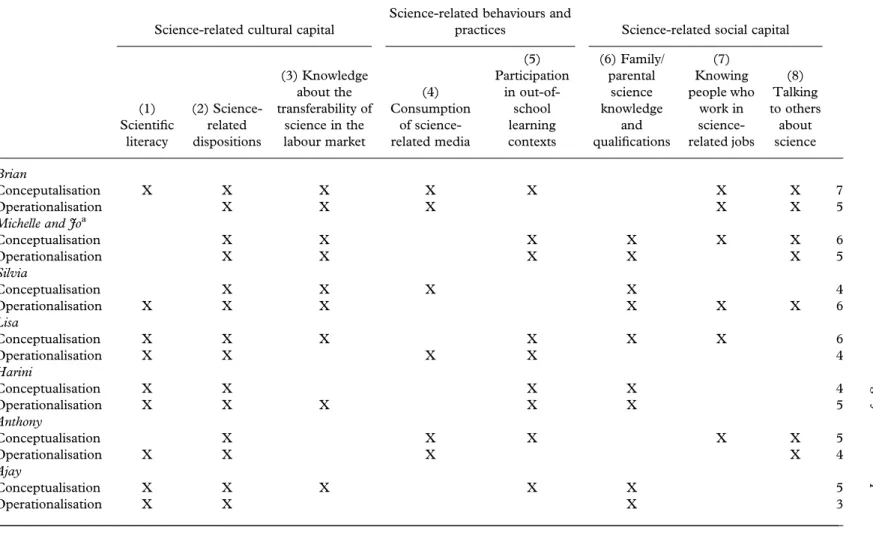
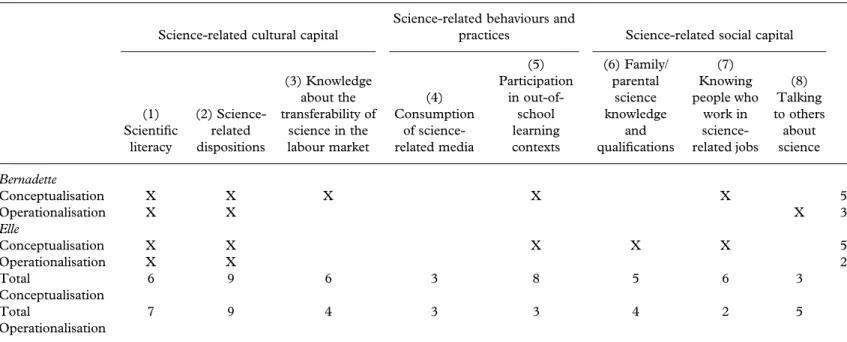
the data comprised qualitative thematic analysis (Braun & Clarke, 2006), of inter- views, fieldnotes and teachers’ own reflections (portfolios and posters). All data were read by at least two researchers who iteratively coded and recoded the responses using Braun and Clarke’s technique. Instances of teacher conceptualisation and teacher operationalisation of science capital were coded against the eight dimensions described above and tabulated (seeTable 1). Disagreements in coding were resolved through discussion between the authors and our wider research group. While we note that the analysis of interviews andfieldnotes from sample lessons may not capture the full extent of the teachers’conceptualisation and operationalisation of science capital, we argue that this process was appropriate for identifying which of our teachers appeared to have developed a stronger, or less strong, understanding of the principles, and the extent to which they had also been able to operationalise them. Our aim, there- fore, was not to highlight deficiencies in teacher practice, but rather gain an insight into the ways that various individuals may make sense of the concept of science capital. Fol- lowing the coding process, we identified three participants as broadly illustrative of the wider cohort’s experience. One teacher—Brian—had a strong conceptualisation of science capital and enacted this understanding in his practice. Lisa, on the other hand, had a clear understanding of the concept, but appeared to experience more dif- ficulties in operationalising the concept in her practice. Lastly, while Bernadette largely understood the concept of science capital, she appeared unable to put it into practice in her teaching. In short, the three teachers variously defined and operationalised science capital as the exemplar quotes demonstrate. Together, however, their accounts serve to create a broad but nuanced picture of teacher learning and practice as facili- tated by the PD course.
Findings
As explained above, the aim of the study was not to evaluate the PD course per se, but rather focus on ways in which teachers made sense of the concepts presented. It is nevertheless worth mentioning, as noted in the pilot year feedback report (King &
Nomikou, 2014), that, overall, the teachers found the course to be enjoyable and worthwhile. In particular, participants acknowledged the extended duration and the opportunity to work with peers as positive elements of the course. They particularly enjoyed meeting in the Science Museum and saw it as an opportunity for learning in a new and inspiring environment, which simultaneously conferred a degree of auth- ority and uniqueness to the proceedings. They also valued the academic input from the university partner noting the added rigour and increased credibility of the learning experience. Participants’rich appreciation of the PD provides a notable context for thefindings presented below. We turn now to a more detailed analysis of the extent to which teachers conceptualised, and thereafter operationalised, science capital.
When asked to give a definition of science capital, teachers were arguably compre- hensive in their accounts as the following quotes exemplify:
Downloaded by [University of Nebraska, Lincoln] at 11:07 25 December 2015
Table 1. Summary mapping of teachers’conceptualisations and operationalisation of the concept of science capital
Science-related cultural capital
Science-related behaviours and
practices Science-related social capital
(1) Scientific
literacy
(2) Science- related dispositions
(3) Knowledge about the transferability of
science in the labour market
(4) Consumption
of science- related media
(5) Participation
in out-of- school learning contexts
(6) Family/
parental science knowledge
and qualifications
(7) Knowing people who
work in science- related jobs
(8) Talking to others
about science Brian
Conceputalisation X X X X X X X 7
Operationalisation X X X X X 5
Michelle and Joa
Conceptualisation X X X X X X 6
Operationalisation X X X X X 5
Silvia
Conceptualisation X X X X 4
Operationalisation X X X X X X 6
Lisa
Conceptualisation X X X X X X 6
Operationalisation X X X X 4
Harini
Conceptualisation X X X X 4
Operationalisation X X X X X 5
Anthony
Conceptualisation X X X X X 5
Operationalisation X X X X 4
Ajay
Conceptualisation X X X X X 5
Operationalisation X X X 3
(Continued)
Teachers’UnderstandingofScienceCapital11
Downloaded by [University of Nebraska, Lincoln] at 11:07 25 December 2015
Table 1. Continued
Science-related cultural capital
Science-related behaviours and
practices Science-related social capital
(1) Scientific
literacy
(2) Science- related dispositions
(3) Knowledge about the transferability of
science in the labour market
(4) Consumption
of science- related media
(5) Participation
in out-of- school learning contexts
(6) Family/
parental science knowledge
and qualifications
(7) Knowing people who
work in science- related jobs
(8) Talking to others
about science Bernadette
Conceptualisation X X X X X 5
Operationalisation X X X 3
Elle
Conceptualisation X X X X X 5
Operationalisation X X 2
Total
Conceptualisation
6 9 6 3 8 5 6 3
Total
Operationalisation
7 9 4 3 3 4 2 5
aTen teachers completed the PD course, but nine are reported in the table. For the purposes of our analysis we regard Michelle’s and Jo’s answers as coming from one teacher: they were from the same school and planned and delivered all activities as a team. Moreover, their individual responses regarding conceptualisation of SC did not differentiate, that is, they both referred to the same SC dimensions.
H.Kingetal.
Downloaded by [University of Nebraska, Lincoln] at 11:07 25 December 2015
It’s their parents, the books they read, you know, if they watch TV programmes, which might be David Attenborough or whatever…you know, all of the different things which might influence their life that might have a scientific background—that’s what I think of as science capital. (Anthony, post-interview)
It’s the amount of science that pupils come into contact with outside of the classroom.
Whether it be the amount of science that their parents have, the amount of talk at the dinner table, the amount that they’re able to relate normal things to science. (Michelle post-interview)
Indeed all the teachers articulated their understanding of science capital by invoking at least four of the eight dimensions.Table 1presents a summary of the teachers’views and practices. All names are pseudonyms.
As can be seen fromTable 1, all teachers conceptualised science capital as compris- ing science-related dispositions and attitudes, and all nine also sought tofind ways to address this in their practice. Most did this by trying to emphasise the relevance of science to everyday life:
[I will seek to be] spreading the discussion about the relevance of science in everyday life beyond a single lesson. In particular, I’d like to run this discussion with Y8 and Y9 stu- dents ahead of their subject choices. (Harini—poster)
I sought to address low engagement with my Y10 bottom set by explicitly linking science concepts with their lives/interests. In this way I was able to highlight the relevance of the lesson content. (Anthony—poster)
Most teachers (8/9) also saw science capital as comprising students’ out-of-school science activities, although only three attempted tofind ways to address or facilitate this through specific techniques. Notably, teachers used the term ‘out of school’ in this instance referring to not necessarily out-of-school time but outside the physical school environment. All three teachers who operationalised ‘out of school’ did so through visits to museums (but still during school time).
Most teachers (6/9) saw science capital as comprising scientific literacy. Seven out of nine (including two who did not include scientific literacy in their SC conceptualis- ation) also sought to build elements of scientific literacy in their activities:
We developed a lesson structure that built on the skills and techniques learnt in TP3 [lesson starters using images]…The format can be applied to standard lesson plans so teachers are able to quickly assess the available resources and more easily engage and enthuse their class. (Ajay—poster)
The same proportions (6/9) of teachers conceptualised science capital in terms of knowledge about the transferability of science skills, science-related social capital (knowing someone who works in a science job) and parental science knowledge/ qua- lifications. However, fewer teachers sought to operationalise these three dimensions in their teaching (4/9, 2/9 and 4/9 respectively). One of the least-cited (n= 3) conceptu- alisation of science capital was the dimension of talking about science with others in everyday life, although interestingly, this dimension was operationalised to a greater degree (n= 5), suggesting that the teachers implicitly recognised its value, but did not appear to explicitly conceptualise it thus.
Teachers’Understanding of Science Capital 13
Downloaded by [University of Nebraska, Lincoln] at 11:07 25 December 2015
We note that in summarising the teachers’conceptualisations and operationalisa- tions in a simple binary approach of present, or not, does not provide any indication of depth of understanding, or quality of practice. Nonetheless, the table provides a useful top-level summary of the experiences of a group of teachers and highlights the general areas in which the understanding and operationalisation of science capital was achieved to either a greater or lesser degree.
The teachers’focus on developing positive attitudes towards science, and enhancing science literacy is perhaps not surprising. After all, such emphases reflect what teachers commonly do and are good at. However, such afinding has important implications for efforts in supporting science capital across all eight dimensions; clearly teachers intui- tivelyfind dimensions 3–8 to be harder to operationalise. In addition, and is clear from the table, the degree of alignment between the teachers’conceptualisation and oper- ationalisation for dimensions 3–8 varies markedly. In the vignettes below we discuss possible reasons teachers’ease or difficulty in conceptualising and operationalising aspects of science capital.
The Case of Brian
Brian has 11 years teaching experience and is now Head of Science in a boys’compre- hensive school in an area of London with relatively high levels of deprivation. Brian is highly committed to raising standards in and uptake of science courses. He regularly communicates with his students’ parents and has recently begun using Twitter to promote the activities of the science department. He notes, however, that parental support of their sons’ science learning is very mixed. He regularly attends PD courses and welcomes opportunities to enhance his practice.
Conceptualisation. In defining science capital, Brian offered a broad depiction that encompassed a number of science-capital dimensions, including knowledge, attitudes, qualifications and everyday practices such as science media consumption. In seeking to capture the impact of this spread of knowledge from across broad experiences, Brian used the metaphor of science capital being one’s‘science baggage’:
Oh gosh…science capital is the background science that a student or a family come to you with. That’s sort of my understanding of it. So it’s their experiences of science…to date almost really…whether it is to do with new television, other media, their qualifications… it’s sort of their science baggage. (Brian post-interview)
Like many of the teachers, Brian felt that the concept of science capital‘made sense’ and resonated with his own instincts and professional experiences. He noted that that the concept served to articulate something that he intuitively felt but was unable to name. Brian may have found the concept to be particularly relevant as it accords well with his ongoing efforts to engage parents in their sons’ education. As Luke and McCreedy (2012) have argued, citing the work of Cox (2005), Christenson and Sheridan (2001) and Fishel and Ramirez (2005), when parents and schools work in
Downloaded by [University of Nebraska, Lincoln] at 11:07 25 December 2015
conjunction, students tend to engage more with the learning focus promoted by school. When this focus involves building capital for students to utilise both in and beyond school, the value of involving parents becomes increasingly apparent.
Operationalisation. Brian’s understanding of science capital as distributed across a student’s life experiences, from home and into school, led him tofind ways to make science part of the student’s everyday life, by prompting everyday science conversa- tions between students and their parents as a means to start integrating science within the daily fabric of family life and interaction (addressing science-capital dimen- sions 8 and 2). Brian’s operationalisation can thus be viewed as an attempt to influence family habitus,‘the collective cognitive matrix of dispositions which produces a family’s sense of“who we are”,“what we value”and“what is normal for us”’(Archer et al., 2012):
What we’re trying to do is get parents to be interested in science so that they have a con- versation with their children about science…or the other way round, that the children can be going and having a conversation with their parents and saying‘Look at this’ …. (Brian, mid-interview)
Brian acknowledged the need to generate interest in order to promote conversations.
Thus he developed a website and series of‘conversation cards’showcasing the science qualifications and achievements of well-known celebrities (actors, sportspeople, TV presenters). His aim was to use the resources to prompt classroom discussions about the value of science for all sorts of future careers. In particular he sought to demonstrate, through what he described as‘celebrity endorsement’, that science is a credible subject.
When reflecting on the success of this approach, Brian noted that the resources on their own were not enough to generate ongoing conversations that would automati- cally spread back to the home. Whilst the students were clearly intrigued by the celeb- rities’varied science histories, without teacher support they lacked the skills to engage in deep or ongoing discussions. In noting this limitation, Brian identified that science capital is not a discrete skill or‘thing’that can be promoted through a single activity, but moreover is an individual’s resource which may be enriched and developed by careful nurturing such as through the facilitation of science teachers.
From a personal perspective, Brian found the PD course to be beneficial in terms of building self-confidence and self-efficacy as a teacher of science. For example, the realisation that there is a concept that encapsulates his feelings about teaching, and moreover one that has been theoretically and empirically substantiated, enabled Brian to legitimate his practice. It gave him the firepower to defend his practices and principles at school (with senior manager/colleagues):
I think it’s legitimised what sometimes I didn’t realise that we should be doing, but felt as though it was the right thing to do. And now actually we’ve got ammunition to be able to say yes it is the right thing to do. (Brian, post-interview)
Teachers’Understanding of Science Capital 15
Downloaded by [University of Nebraska, Lincoln] at 11:07 25 December 2015
However, whilst Brian appeared to understand the value of raising science capital, he doubted whether he would be able to spread this understanding and concomitant approaches more widely:
I think the difficulty is getting the rest of my team to include it as well. Because it’s all well and good saying in their scheme of work on in a lesson‘please talk about this now’but if they haven’t got the knowledge to be able to just talk about it easily, it’s going to be diffi- cult. (Brian, post-interview)
Brian’s admission of the limited extent to which any new practices will be embedded is perturbing given his position of Head of Science and thus his ability to influence his team’s work. However, it should be noted that as with all new ideas and practices, unless the individual colleague understands them and thereafter regards them to be fruitful and more plausible than previously held ideas (Posner, Strike, Hewson, &
Gertzog,1982), they are unlikely to adopt or operationalise them in their practice.
The Case of Lisa
Lisa has been teaching in the UK for 11 years. She is currently in a school where nearly half of the students have free school meals, and the ethnic mix is very broad. Whilst the school has fared well under previous Ofsted1inspections, a recent external review has identified the science department as needing to improve student engagement. Lisa experiences few opportunities to engage with colleagues or to think creatively in her everyday teaching. She enrolled on the PD course as she is keen to strengthen her teaching skills and wants to be reinvigorated in her chosen career.
Conceptualisation. Lisa described science capital as an embodiment of whom you know and what you know. However, she also saw it as a means to an end, rather than a resource that could be utilised. Thus she defines it not so much as a perspective on society wherein one sees and is able to access the inherent value of science, but more as a device or vehicle that teachers could use to encourage more young people to be interested in science:
I would say having immediate links to scientific projects or activities, or people in a scien- tific type career and get information about scientific careers and…yeah, people that they can go to; activities that they could get them interested more into the sciences. (Lisa post- interview)
Throughout the course, Lisa expressed the concern that although she found science capital a compelling concept when someone explained it to her, she had difficulty in
‘fully understanding it’. This may explain her somewhat piecemeal conceptualisation and subsequent operationalisation of the term.
Operationalisation. In developing her practice, Lisa sought to emphasise the relevance of science in everyday life by using images as a regular feature of her lessons:
Downloaded by [University of Nebraska, Lincoln] at 11:07 25 December 2015
I wanted to expose students to a variety of images that could be considered scientific, hoping that over time would begin to see how scientific ideas are part of their everyday life. (Lisa’s poster)
The images included cartoons, adverts and pictures of both strange and everyday objects. The images were introduced at the beginning of every lesson as a ‘starter’ activity and were accompanied with one or two questions that prompted student think- ing and discussion. Over time, Lisa reported that students were questioning the infor- mation in the images more intensely, and that more and more students felt comfortable engaging in debates about the topic, and appeared to recognise the place and relevance of science across all aspects of society (dimension 2).
Whilst clearly effective in generating student interest and understanding of the rel- evance of science, Lisa’s practice did not fully match with her conceptualisation of science capital. The emphasis in her teaching was primarily placed on generating inter- est: it did not extend to discussing the range and variety of jobs that might relate to the images on display (dimension 3), nor did Lisa explicitly seek to build students’science capital by building on parental knowledge and qualifications (dimension 6) or by helping students to meet, or recognise that they already know, somebody in a science-related job (dimension 7). Perhaps the reason for this mismatch was Lisa’s acknowledged lack of confidence in talking about careers from science. When asked how she might help convey to students the transferability of science skills to the wider market (dimension 3), Lisa explained that she did not have the knowledge, and moreover saw this as the responsibility of the school’s‘careers person’:
I dofind it hard. I can relate the skills as long as I know about the career. But it’s like harder for me to tell you beyond doctor, veterinary and all those kinds of like careers, as to what are the other careers beyond that need science. (Lisa post-interview)
Lisa’s comments were echoed by several of the other teachers who similarly saw their roles as simply ‘deliverers’ (of science content) and ‘enthusers’(promoting student interest in science). Whilst they acknowledged the scope of science capital as stretching from home to school, they did not consider it their responsibility to address aspects beyond scientific literacy (dimension 1) and dispositions (dimension 2). Indeed, whilst they saw their roles to comprise teaching students in the classroom and would do that as imaginatively as possible, they did not think that they had any respon- sibility for what happens to students beyond the classroom. This view was exacerbated by the daily pressures that teachers are under to deliver on attainment targets. As Lisa explained:
When the exams are kind of bearing down on us, we kind of forget real life, cos we just don’t have enough time to kind of do extension work. (Lisa post-interview)
For Lisa, the collegial nature of the PD was an extremely positive experience. She had welcomed the chance to learn from and share with other teachers. She noted that in her own school there were few opportunities to work collaboratively with colleagues to develop her teaching. As a consequence, the possibility for Lisa to embed her new practices within her department or school more widely, let alone to continue Teachers’Understanding of Science Capital 17
Downloaded by [University of Nebraska, Lincoln] at 11:07 25 December 2015
developing her personal understanding and operationalisation of science capital, would appear to be limited.
The Case of Bernadette
Bernadette has been teaching for eight years, all in the same school that includes a high number of students with English as an additional language. Furthermore, the school experiences high ‘mobility’ with many students arriving or leaving the school mid- term. The school has only recently come out of‘special measures’2 status following an increase in student attainment scores. Science in the school has not always fared well, with few students achieving well or choosing to continue science post-16. Ber- nadette welcomed the chance to gain new ideas for her teaching, and was drawn to the museum-hosted PD course in particular as she hoped that this would lead to opportunities for her students to experience new environments and thus broaden their horizons.
Conceptualisation. From the outset of the course, Bernadette had acknowledged the value of exposing students to wider experiences. Like Brian, she welcomed the concept of science capital as defining something she had already recognised in her stu- dents. Indeed, Bernadette regularly used the term science capital unprompted, and moreover cited the need to raise science capital amongst her students in herfinal inter- view as the justification for applying to the course. When asked to define science capital, Bernadette offered the following:
Science capital is…as I said, it’s background knowledge and experience, but background knowledge and experience that comes from others, as well as what they experience in their day to day life. It’s related to their home lives as well as their backgrounds, but it’s to do with what other experience…what direct or indirect experience of science they have in terms of their family, in terms of friends and backgrounds, rather than what they get from school…. (Bernadette, post-interview)
This conceptualisation is clearly very broad, and encapsulates the distributed nature of science-related knowledge and experiences a student might have. However, it does not capture the sense of science capital being a resource to be utilised.
Operationalisation. Bernadette appeared to operationalise science capital as an effort to reduce inequity. For example, she spoke at length about the value of providing stu- dents with experiences that might broaden their aspirations/ horizons and encourage social mobility:
I think just, I mean, even in terms of our students, taking the tube to go to the museum, you know, from something as basic as that, to leaving the area and going somewhere else and seeing that these places exist and especially where the Science Museum is, right next to Imperial [College, London]. It kind of starts them questioning and starts them thinking about further education and oh, you know, okay, well, maybe one day I’d like to go to Imperial. (Bernadette, post-interview)
Downloaded by [University of Nebraska, Lincoln] at 11:07 25 December 2015
However, in developing an approach, Bernadette’s initial emphasis on providing life experiences did not materialise. Instead, Bernadette’s recognition of the students’ language difficulties as new migrants, together with her personal passion for support- ing home influences led her to develop an activity in which students were encouraged to explore every day and more unusual objects in lessons and thereafter talk about these objects with their parents for homework. Thus one homework task was set as:
‘with the help of a parent or older family member, how many objects can you list thatfit into your pocket today, but would not have done 20 years ago?’In this way, Bernadette’s approach promoted science literacy skills (dimension 1) and positive dis- positions towards science (dimension 2), and also encouraged students to talk about science outside the school context (dimension 8).
When asked about plans for sharing her understanding of the concept of science capital more widely with colleagues, Bernadette noted that the colleagues were already engaged in efforts to bridge the gap between those students that have and those that do not have science capital:
What we’re trying to do is to build on that to kind of bridge the gap between those people who don’t have input from home and background capital, so that we can kind of catch them up to the other people who do have the science capital background. (Bernadette post-interview)
However, Bernadette also commented that it would be difficult to substantively change any practice in the school that might be perceived to detract from the school-wide focus on attainment. In this regard, Bernadette’s experience resembled several of the teachers who cited similar constraints in embedding science-capital approaches more broadly within their departments/ schools.
Discussion and Implications
Ourfindings suggest that the concept of science capital resonated with the teachers involved in the PD course, although there was considerable variability in the ways in which they conceptualised and operationalised science capital in their practice.
Indeed, we found that a teacher’s conceptualisation of science capital did not necess- arily concur with the extent of their subsequent operationalisation. In other words, whilst teachers may have gained cognitive mastery in understanding the concept, and felt that it resonated with their own experiences, this did not mean that they necessarily gained enactive mastery and thus became able to fully realise the concept in their pedagogical practice (Palmer, 2011). In some instances, for example for Elle, this may be due to her ardent belief that her practice was already suf- ficient (Haney et al.,1996). For others, for example Bernadette, the wider contextual pressures of the school’s recent Ofsted rating and subsequent pressures to increase examination scores may have adversely impacted her ability to fully enact her under- standing (Allen & Penuel,2014; Munby et al.,2000).
We found that science-related dispositions (dimension 2) and scientific literacy (dimension 1) were the most commonly conceptualised and addressed aspects of science capital. For many of our teachers, the dimension of science-related Teachers’Understanding of Science Capital 19
Downloaded by [University of Nebraska, Lincoln] at 11:07 25 December 2015
dispositions was almost synonymous with the notion of relevance of science in (stu- dents’) everyday life, while our academic conceptualisation of dimension 2 is more nuanced and includes attitudes to science and scientists, views of school science and a supportive (family) environment towards science education (Archer et al., 2015). It was also notable that teachers felt generally less confident addressing areas such as students’consumption of science-related media (dimension 4), participation in out-of-school learning contexts (dimension 5) and knowing someone in a science-related job (dimension 7).
Thesefindings provide some useful pointers regarding how we might improve the ways in which we work with teachers in PD courses and elsewhere to communicate the concept of science capital, with respect to both the breadth of the concept, and also in terms of developing approaches that might address a wider range of science- capital dimensions. These insights may also be particularly useful in terms of develop- ing and honing public engagement and communication activities to support partici- pation in science from young people of all backgrounds. Indeed, we have noted that, beyond academia, the concept of science capital seems to be gaining traction within the policy and STEM education delivery sphere, and is becoming prominent within the discourse and activities of a range of STEM organisations in UK and beyond.3 In particular, the findings discussed in this paper suggest that more thought might be usefully given to‘translating’the breadth of the concept to ensure that it is not reduced to one or two dimensions within policy enactment.
The variance in terms of how teachers conceptualised science capital versus the extent to which they were able to operationalise it is, perhaps, to be expected. The PD programme was after all in its pilot year and as a result, the course may not have included enough opportunities for teachers to fully understand the breadth and nature of science capital as a resource, and thereafter consciously translate their understandings into concrete actions. Indeed, as Rokeach (1968) noted, beliefs that are held as core—for example, one’s perception of what constitutes effective teaching practice—are hard to change. As a consequence, behaviours will also remain fixed.
The aim here, then, becomes one of supporting teachers to embrace science capital as a concept and to see the ways in which it aligns with and enriches their current prac- tice. Furthermore, if science capital is more confidently articulated by teachers, it will become part of their everyday vocabulary and as such will become a useful common denominator term for teachers to describe the important aspects of the work that they do, and share this with colleagues across school. In addition, by sharing their con- ceptualisations of science capital, teachers are afforded with the opportunities to reflect on their beliefs about the purpose of science teaching and in turn improve their prac- tice (Bell & Gilbert,1994; Darling-Hammond & Richardson,2009). However, whilst a full articulation is ideal, more pragmatically, and in terms of designing future PD programmes, it may be more appropriate to focus on changing practice across just one or two dimensions. Indeed, the focus for the PD programme for 2015 was centred on approaches that link home and school by building on family ‘funds of knowledge’ (Moll, Amanti, Neff, & Gonzalez, 1992) and extending science
Downloaded by [University of Nebraska, Lincoln] at 11:07 25 December 2015
participation activities into the home or community. A second study documenting the efficacy of this approach is ongoing.
In line with otherfindings examining the effect of PD programmes (Garet et al., 2001; Penuel et al., 2007), our analyses suggest that there are a number of factors affecting the operationalisation of science capital in the classroom context. Firstly, science capital is a somewhat complex concept and some of the nuance may, inevita- bly, get‘lost in translation’. For instance, we proposed the concept as requiring a shift in pedagogy, rather than being deliverable through a single, simple activity or resource (hence the desire to work with teachers through an extended PD course). This inevi- tably requires an investment of time and resource by both deliverers and participants— and may be inherently less appealing to many hard-pressed teachers as compared to some existing ‘one size fits all’, single/discrete activity approaches for increasing student engagement with science. No teacher reduced the concept to a single dimen- sion, but several (e.g. Elle) limited their approaches (particularly in terms of operatio- nalising the concept) to focusing primarily on scientific literacy and dispositions.
Secondly, and relatedly, implementation of science-capital-building approaches may be hampered in practice by the constraining context within which many teachers work (Allen & Penuel,2014; Munby, et al.,2000). For example, the demands of the current teaching context may have played a part, in shaping teachers’expectations and motivations, constraining their available time, and raising the‘risk’of trying something
‘different’. As Lisa explained in her earlier quote, the pressure of ‘exams’ (and the pressure to achieve attainment targets) can mean little time or justification for enga- ging in (anything defined as being) non-core (‘extension’) activities. In this respect, we suggest that efforts to build student science capital through science teaching will need to recognise that implementation will not be straightforward and that teachers will need considerable support to engage with the concept if they are to also change their beliefs and practice to better promote and build science capital among their stu- dents. The task for proponents of a science-capital approach (including designers of PD courses) will be to develop more accessible and tangible ways for teachers to firstly grasp the concept and then to review their personal beliefs about the purpose of science teaching.
Thirdly, and further relating to the strength of existing beliefs, some teachers appear to see particular dimensions of science capital as being‘beyond their remit’as science teachers. Ourfindings suggest that dimension 3 (symbolic knowledge about the trans- ferability of science) may need particular care in this respect. As research by the ASPIRES and UPMAP projects shows, and as forcibly argued by Claussen and Osborne (2013), this is a particularly important and influential dimension within science capital which schools could (and should) usefully convey. Yet, as our data suggests, generally teachers do not feel well equipped or well placed to address this dimension within their everyday teaching. As Lisa put it earlier, for her, this would be the responsibility of the school’s ‘careers person’. In other words, some teachers may not necessarily believe it to be their responsibility to build science capital for the student’s benefit beyond the classroom. We thus suggest that advocacy work and further research may be necessary to build and strengthen the case as to why Teachers’Understanding of Science Capital 21
Downloaded by [University of Nebraska, Lincoln] at 11:07 25 December 2015