i
TEACHING VOCABULARY IN THE THEME OF ANIMALS BY USING WORD WALL TO FOURTH GRADE STUDENTS OF SD MI AL-HIKMAH
TALANG KELAPA PALEMBANG
THESIS
BY
VERA SUPERZA AS NIM 372016028
UNIVERSITAS MUHAMMADIYAH PALEMBANG FACULTY OF TEACHER TRAINING AND EDUCATION
ENGLISH EDUCATION STUDY PROGRAM AUGUST 2020
i
TEACHING VOCABULARY IN THE THEME OF ANIMALS BY USING WORD WALL TO FOURTH GRADE STUDENTS OF SD MI AL-HIKMAH
TALANG KELAPA PALEMBANG
THESIS
Presented to
Universitas Muhammadiyah Palembang In Partial Fulfilment of The Requirement
For the degree of Sarjana in English Language Education
By
Vera Superza AS NIM 372016028
UNIVERSITAS MUHAMMADIYAH PALEMBANG FACULTY OF TEACHER TRAINING AND EDUCATION
ENGLISH EDUCATION STUDY PROGRAM August 2020
ii
iii
iv
v
MOTTO AND DEDICATIONS
Motto:
Success is when preparation and opportunity meet.
This Thesis is Dedication to:
Allah SWT, thank you for your life and your blessing that have been given for me.
My beloved parents; My lovely father, Muhammad Akip S.Pd and my lovely mother, Sudainah. You are the angel of my life. Thank you for your love, pray, and financial support. Thank you for everything that you have given to me. I will do the best for make all of you to be happy. I love you very much.
My beloved oldest sister, Susi Mei Verianti, S.Pd and her husband, Andi Hajaka. Thank you for you love, support, motivation and help that you have given to me. I love you both.
My beloved youngest brother, Muhammad Ade Ilham. Thank you for always give me support and motivation. I love you.
My big family (Zainuri’s family). Thank you your for support, pray and help.
vi
My great advisors Sherly Marliasari, S.Pd., M.Pd and Finza Larasati, S.Pd., M.Pd. Thank for your guide, advice and thank you for your help to finish this thesis.
My beloved friends, Ayu Intan Permatasari, Anisha Fitriani, Lia Juni Astuti, Ninda Octalia, Pania, Rati Fainna and Vicca Lesti Kartika Putri) thank you for your support, advice, togetherness and also your pray.
All of my friends in English Department especially in academic year 2016. “I will miss you all”
My friends who helped me (Haris Abdillah, Ika Eviolina, Sri Ariski, Rati Fainna).
My beloved KKN friends in Sangkhom Islam Wittaya School Songkhla Thailand. (Putri Marchella, Rati Fainna, Riana Yuliansari).
All of lecturers in Faculty of Teacher Training and Education, especially in English Education Study Program.
Thank you for almamater, Universitas Muhammadiyah Palembang.
vii ABSTRACT
Superza, Vera. 2020. Teaching Vocabulary in the Theme of Animals by Using Word Wall (to Fourth Grade Students of SD MI AL-Hikmah Talang Kelapa Palembang).
Thesis by English Education Study Program, Sarjana Degree (S1), Faculty of Teacher Training and Education of Universitas Muhammadiyah Palembang. Advisor: (1) Sherly Marliasari, M.Pd. and (II) Finza Larasati, S.Pd., M.Pd.
Keywords: Teaching Vocabulary in the Theme of Animals by Using Word Wall.
This thesis is entitled “Teaching vocabulary in theme of animals by using word wall to fourth grade students of SD MI AL-Hikmah Talang Kelapa Palembang”. The problem of this study was whether or not there was effective to teach English vocabulary in the theme of animals by using word wall to the fourth grade students of SD MI AL-Hikmah Talang Kelapa Palembang. The objective of this study was to find out whether or not there was effective to teach vocabulary in theme of animals by using word wall to fourth grade students of SD MI AL-Hikmah Talang Kelapa Palembang. This study used quasi experimental design the population of this study was fourth grade students of SD MI AL-Hikmah Talang Kelapa Palembang, with the total number 50 students. The sample of this study was 50 students that were taken selected through purposive sampling. The data obtained were analyzed by using Independent simple t-test in SPSS (Stastictical Package for the Social Science) 2.010.
The result of t-test obtained was 4.644 and it was higher than the critical value of t- table was 2.010 with (df) n= 48 at the level of significance 0.05 (5%) for two –tailed test. It could be concluded that the alternative hypothesis (Ha) was accepted and the null hypothesis (Ho) was rejected, because t-obtained was higher than the value of t- table. It means that it was effective to teach English vocabulary in the theme of animals by using word wall to the fourth grade students of SD MI AL-Hikmah Talang Kelapa Palembang
viii
ACKNOWLEDGMENT
ِمْيِحَّرلا ِنَمْحَّرلا ِالله ِمــــــــــــــــــْسِب
“In the Name of Allah the Most Gracious and the Most Merciful”
The Writer expresses her highest gratitude to Allah SWT for blessing, opportunity, health, and mercy to complete this thesis on time. The thesis entitled
“Teaching Vocabulari in the Theme of Animals by Using Word Wall. (to Fourth Grade Students of SD MI AL-Hikmah Talang Kelapa Palembang)”. Sholawat and Salam are also delivered to prophet Muhammad SAW.
It is a pleasure to acnowledge the help and contributions to all of the lecturers, institutions, family and friends who have contributed in the different ways, hence this skripsi is processed until it becomes a complete writing.
The writer would like to express appreciation and gratitude to Dr. H. Abid Djazuli, SE., M.M as a Rector Universitas Muhammadiyah Palembang. Dr. H, Rusdy A. Siroj, M.Pd as Dean of Teacher Training and Education Universitas Muhammadiyah Palembang. Sri Yuliani, S.Pd., M.Pd as Head of English Education Study Program. Sherly Marliasary, M.Pd as advisor 1 and Finza Larasati, S.Pd., M.Pd as advisor II. Thank you for guidance, advice, help, suggestion, correction and encouragment. All students that helped to do this thesis, to Fourth Grade Students of Elementary School at MI AL-Hikmah Talang Kelapa Palembang.
The writer realizes that the thesis is really far being perfect. Therefore, any comments, suggestion, critiscm, and contructive criticts are very much welcome. The last, she hopes that thesis will be usefull for the people who read it.
Palembang, August 2020 The writer
Vs
ix CONTENTS
Pages
TITLE... i
AGREEMENTS ... ii
APPROVEMENT ... iii
SURAT PERNYATAAN PLAGIAT ... iv
MOTTO AND DEDICATIONS... v
ABSTRACT ... vii
ACKNOWLEDGEMENTS ... viii
CONTENTS ... ix
LIST OF TABLE... xii
APPENDICES ... xiii
LIST OF FIGURE... xiv
CHAPTER I INTRODUCTION ... 1
1.1.Background of the Study ... 1
1.2Problem of the Study ... 4
1.2.1. Limitation of the Study ... 4
1.2.2. Formulatition of the Study ... 4
1.3. Objective of the Study ... 5
1.4. Significance of the Study ... 5
1.5.Hypothesis ... 5
1.6. Criteria of Testing the Hypothesis ... 6
CHAPTER II LITERATURE REVIEW ... 7
2.1. Vocabulary ... 7
2.1.2. Vocabulary Development... 8
x
2.1.3. Kinds of Vocabulary ... 9
2.1.4. Types of Vocabulary ... 11
2.1.5. Principles of Vocabulary ... 12
2.1.6. How to Build Vocabulary ... 12
2.6.7. Teaching Vocabulary ... 13
2.2. Word Wall ... 14
2.3. Teaching Vocabulary by Using Word Wall Strategy ... 14
2.4. Teaching and Learning og Activities ... 16
2.5. Previous Related Study ... 17
CHAPTER III RESEARCH METHEDOLOGY ... 19
3.1. Method of Research ... 19
3.2. Research Variable ... 20
3.3. Operational Defination ... 20
3.3.1. Teaching ... 20
3.3.2. Vocabulary ... 20
3.3.3. Animal Theme ... 20
3.3.4. Word Wall ... 21
3.3.5. Fourth Grade Students of Elementary school at MI AL-Hikmah Talang Kelapa Palembang... 21
3.4. Population and Sample ... 21
3.4.1. Population ... 21
3.4.2. Sample ... 22
3.5. Techniques for Collecting the Data... 22
3.5.1. Prestest ... 23
3.5.2. Posttest ... 23
3.6. Research instruments analysis... 23
3.6.1. Validity ... 23
3.6.2. Reability ... 24
3.7. Technique for Analyzing the Data ... 25
3.7.1 Paired t-test... 25
3.7.2. Independent sample t-tes ... 25
3.7.3 The Score Range ... 26
CHAPTER IV FINDINGS AND INTERPRETATION ... 27
4.1. Findings ... 27
4.1.1. The Students Individual Score ... 27
4.1.2. Students Individual Score in Control Group ... 27
xi
4.1.3. The Students Frequency in the Posttest of the Control
Group ... ...29
4.1.4. Students Individual Post-test Scores in Control Grup... 30
4.1.5. The Students Frequency in the Posttest of the Control Group ... 31
4.1.6. Students Individual Pretest Scores in Experimental Group ... 32
4.1.7. The students Frequency in the Pretest of the Experimental Group... 34
4.1.8. Students Individual Posttest Scores in Experimental Group ... 35
4.1.9. The Students Frequency in the pretest of the Experimental Group... 36
4.2. The differences Between Pretest and Posttest Score in Experimental Group ... 37
4.2.1. The Result of Paired-Sample T-test of Pretest and Posttest of Experimental Group ... 38
4.3. The differences Between Pretest and Posttest Score in Control Group ... 39
4.3.1. The result of Paired-Sample T-test of Pretest and Posttest of Control Group ... 40
4.3.2. The Result of Independent Sample T-test Posttest of Experimental Group and Posttest Control Group ... 40
4.3. Interpretation ... 41
CHAPTER V CONCLUSION AND SUGGESTIONS ... 44
5.1. Conclusion ... 44
5.2. Sugestion ... 45
REFFERENCES ... 46
TABLE OF CHART ... 48
APPENDDICES ... 49
xii
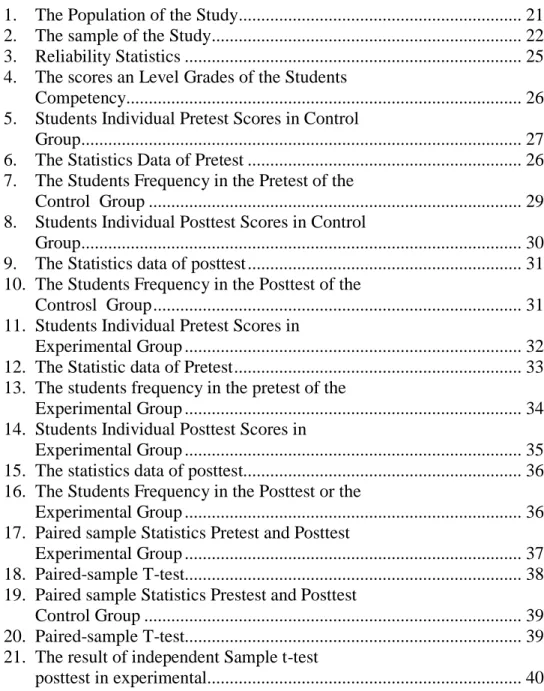
LIST OF TABLE
Table Page 1. The Population of the Study ... 21 2. The sample of the Study ... 22 3. Reliability Statistics ... 25 4. The scores an Level Grades of the Students
Competency... 26 5. Students Individual Pretest Scores in Control
Group... 27 6. The Statistics Data of Pretest ... 26 7. The Students Frequency in the Pretest of the
Control Group ... 29 8. Students Individual Posttest Scores in Control
Group... 30 9. The Statistics data of posttest ... 31 10. The Students Frequency in the Posttest of the
Controsl Group ... 31 11. Students Individual Pretest Scores in
Experimental Group ... 32 12. The Statistic data of Pretest ... 33 13. The students frequency in the pretest of the
Experimental Group ... 34 14. Students Individual Posttest Scores in
Experimental Group ... 35 15. The statistics data of posttest... 36 16. The Students Frequency in the Posttest or the
Experimental Group ... 36 17. Paired sample Statistics Pretest and Posttest
Experimental Group ... 37 18. Paired-sample T-test... 38 19. Paired sample Statistics Prestest and Posttest
Control Group ... 39 20. Paired-sample T-test... 39 21. The result of independent Sample t-test
posttest in experimental... 40
xiii
LIST OF APPENDICES
Appendix Page
1. Surat keputusan Dekan FKIP UMP ... 50
2. Usul judul dan pembimbing skripsi ... 51
3. Undangan ujian seminar proposal ... 52
4. Daftar hadir mahasiswa seminar proposal ... 53
5. Table distribution critical value ... 54
6. Surat permohanan riset dari fakultas ... 55
7. Surat keterangan penelitian dari MI AL-Hikmah Talang Kelapa Palembang ... 56
8. Laporan kemajuan bimbingan skripsi ... 57
9. Bukti telah perbaikan skripsi ... 58
10. Surat Keterangan Validasi... 59
11. Test instruments ... 60
12. Key answer ... 61
13. Curiculum vitae ... 62
14. Documentations... 63
xiv
LIST OF FIGURE
Figure Page
1. Figure one ...16
1
CHAPTER I INTRODUCTION
This chapter presents; (1) Background (2) Problem, (3) Objective, (4) Significance of study, and (5) Hypotheses
1.1 Background of the Study
Wilsana, Marhum and Kamaruddin (2015), English is an important subject in school. It plays a vital role for students when they want to continue their education to a higher level. In the process of English learning, the most important components are teacher’s performance, learning facilities, and students’ attitudes towards English learning. A teacher’s performance can be seen in his/her behavior towards his/her work of teaching. The factors affecting the performance of teachers are attitude, method of teaching, classroom management, and motivation. (p.23)
Sulaiman (2017) stated that teaching is a such a verbal interaction among the teacher and the students in a good learning sequence or atmosphere. (p.1). According to Schlitz (2004 as cited in Ababio 2013), teaching is as an art of inducing students to behave in ways that are assumed to lead to learning, including an attempt to induce students to so behave. (p.38). It means that teaching is a learning process interaction to encourage students to behave well.
Manik and Christiani (2016), vocabulary is a total number of words which with rules for combining them make up a language. In the world of education, students are
2
expected to master enough vocabulary to support their English skill. When the students have known enough vocabulary, it will help them to make their learning process go easier with the maximum result. (p.2).
According to Rahmasari (2016), vocabulary is a list of words that have the meaning, glossaries and some words used in language, those words has meaning and convey some messages. (p.3). According to Lelawati, Dhiya and Mailani (2018), vocabulary is the stock of words which are at disposal of speaker of writer. The term of vocabulary may refer to all words in the whole language, at the words or phrase used in particular varieties such as dialect, register and terminology. (p.96).
Agdogan (2017) stated that vocabulary is the important part of English language teaching and learning because without enough vocabulary students cannot understand others or communicate their own ideas. It is repeatedly understood that learning many words is only useful for writers and speakers, but the reality is that everyone benefits from it, both personally and professionally. Substantially developing a great vocabulary is one of the most unnoticed ways to improve our lives. There is the relationship between an English vocabulary and the teaching of it to students learning English as a second language. (p.33). It means that vocabulary is a word use make a sentence, paragraph and the more writer master the vocabulary, the easier it will be for us to communicate with stranger, also make it easier for us to go abroad.
Burden (2011) as cited in Wilsana,. et al 2015) state that a word wall is a literacy tool composed of an organized collection of words which are displayed in
3
large visible letters on a wall, bulletin board, or another display surface in a classroom. It helps to facilitate students to improve their vocabulary. It is definitely adaptable to any subject and any grade level and has been proven to be extremely effective learning and teaching tools. If teachers have their own classrooms, they can create word walls. Word wall come in many varieties. They are most often arranged alphabetically, but can just as easily be arranged by topic or classes of word. Pictures can also be included next to words. This media can be designed to improve individual or group activities that can involve students in making process. By using word wall method is expected that students could increase understanding of the English vocabulary without depend on the use of a dictionary or even the meaning of the word given by the teacher. The use of the Word Wall strategy in teaching vocabulary can lead the students to actually use the language. As they improve their knowledge of words and their meanings in different contexts, they build confidence and become more active learners. (p.25).
The reason why the writer chose this tittle is to make students interested and excited in learning vocabulary, for easier about learning vocabulary, and for easier remembering little by little vocabulary, because this strategy helps learners to add new vocabulary in an interesting way entitle Teaching vocabulary in the theme of animals by using word wall to fourth grade students of SD at MI AL- Hikmah Talang Kelapa Palembang.
Besides that, the reason why the writer conducted this research in SD MI AL- Hikmah Talang Kelapa Palembang because from that observation and the writer
4
found that the students in this school has lack of English vocabulary when the writer conducted the observation, it was found that from 25 students there were only seven students knew about the English vocabulary.
Based on the writer conducted the observation by asking to teacher of English at SD MI AL-Hikmah Talang Kelapa Palembang, the writers looked at the average value of students at MI-AL-Hikmah Talang Kelapa Palembang English Lessons with a score was 65.
1.2 Problem of the study
The problem of the study was whether or not there was effective to teach English vocabulary in the theme of animals by using word wall to the fourth grade students of SD MI AL-Hikmah Talang Kelapa Palembang.
1.2.1 Limitation of the problem
The problem in this study limited in investigating of teaching English vocabulary in the theme of “animals” by using word wall to the fourth grade students of SD MI AL-Hikmah Talang Kelapa Palembang.
1.2.2 Formulation of the problem
The problem in this study was formulated in the following question : “was it effective to teach English vocabulary in the theme of animals by using word wall to the fourth grade students of SD MI AL-Hikmah Talang Kelapa Palembang?.
5 1.3 Objective of the study
In keeping with the problem, the objective of the study was to find out whether or not there was effective to teach English vocabulary in the theme of animals by using word wall to the fourth grade students of SD MI AL-Hikmah Talang Kelapa Palembang.
1.4 Significance of the study
Teaching vocabulary in theme of animals by using word wall, hopefully, this study would be useful to
a. Students
The students could have the information about improving vocabulary achievment.
b. Teachers of English
Hopefully this research could help the teacher to know more about tecnique of teaching vocabulary.
1.5 Hypothesis
(Ha) : It was effective to teach vocabulary in the theme of animals by using word wall to the fourth grade students of SD MI AL-Hikmah Talang Kelapa Palembang.
(Ho) : It was not effective toteach vocabulary in the theme of animals by using word wall to the fourth grade students of SD MI AL-Hikmah Talang Kelapa Palembang.
6 1.6 Criteria of Testing The Hypothesis
In this research, to test hypothesis means to accept or reject the hypothesis. The researcher used t-test. If the t-obtained was equal to or higher than t-able, the research hypothesis (Ha) could be accepted then the null hypothesis (Ho) could be rejected. In other words, if the t-able was higher than t-observed, it means that null hypothesis can be acceptable and the research hypothesis should be rejected.
46
REFERENCES
Ababio Bethel T (2013). Nature of Teaching: What Teachers Need to Know and Do.
International Journal for Innovation Education and Research, vol. 1-03 Agdogan, E (2017). Developing Vocabulary in game activities and game materials.
Jurnal of Teaching and Education, CD-ROM. ISSN: 2165-6266 ::
07(01):311-66
Children Literacy Initiative (2020). Creating successful Word Wall – childrens literacy initiative. Retrieved from: https://cli.org/2016/09/29/4293/ on September, 2nd 2020
Creswell, J, W. (2005). Educational research: planning, conducting, and ecvaluating quantative and qualitative research secondedition. newjersey:pearson Educational, inc.
Hernawati (2015). Building up the students english vocabulary through fanny stories at SMP Negeri 2 Duampanua Kab. Pinrang, vol. 1 no. 2
Lelawati, S., Dhiya, S., & Mailani, P. N (2018) The Teaching English vocabulary to young learners, Proffesional Journal of English Education ( PROJECT), vol.
1 No.2. e- ISSN 2614-6258
Manik, S., & christiani, M (2016). Teaching vocabulary using matching word on computer assisted, language learning. International Juornal of English Language Teaching, vol. 4 No.7, pp.1-26
Mawar, S., Sustri, E.H., & Siregar, F. R (2017) Improving Students vocabulary mastery through word square modeling at grade VII SMP Negeri 5 Padangsidimpuan, Jurnal Penelitian Ilmu-ilmu Sosial dan Keislaman, vol.
03 No. 2. ISSN : 2460-6099x
Rahmasari, B.S (2016). The use of flahcards in teaching vocabulary at fourth grade students of sdn sukosari 02 dagangan madiun, Jurnal Edutama. vol. 3 No,1
Sahwari (2013). The effectiveness of mind mapping for teaching vocabulary to the eighth grade students of SMP Negeri 3 Sungai Kakap in academic year 2012/2013, Jurnal Pendidikan Bahasa, vol. 2 N0, 2
47
Sulaiman, M (2017). TEACH The Students Not The Books (A Handbook of TEFL,.
(1st ed). Palembang
Sugiono (2011) Metode Penelitian Pendidikan (Pendekatan Kuantitatif, Kualitatif dan R&D). ALFABETA, cv
Syahri, I., Sulaiman, M., & Susanti, R (2016) Metodology Penelitian Pendidikan Bahasa, Roemah sufie
Wilsana, A., Marhum, M., & Kamaruddin,A (2015). Teaching vocabulary to grade VIII students at SMP Negeri 9 Palu by using word wall stategy. e-Jurnal Bahasantodea, vol. 3 No. 2. ISSN 2302-2000
Zawil, R (2016). Using make a match technique to teach vocabulary, English Education Journal (EEJ), vol. 7 No. 3, pp : 311-328