THE RELIGION-DEVELOPMENT DOMAIN OF WAHANA VISI INDONESIA CONCERNING CHILD EDUCATION IN ALOR – EAST NUSA TENGGARA
Petsy Jessy Ismoyo
Indonesian Consortium for Religious Studies, UGM Graduate School Email: [email protected]
ABSTRACT
This study tries to explain the role of faith-based organizations in achieving Sustainable Development Goals (SDGs) in Indonesia by showing the role of Wahana Visi Indonesia (WVI) in education. Claiming themselves as a Christian Faith-Based Organization that works according to the Christian Faith (Iman Kristen), WVI has huge impact on sustainable development in Indonesia, including the education. By focusing this study on the case of Wahana Visi Indonesia (WVI), the author aims to explain profoundly the effect religious actors have in development, particularly child education in Alor – East Nusa Tenggara. This study uses qualitative methods and a literature review. The author conducted one-on-one interviews and examine the data using critical analysis to develop an initial understanding in specified areas: religion and development and education. On the ground of major role of WVI as faith-based organization in the issue of SDGs, the author will discuss it accordingly in two main analysis as follows, the nexus of faith and the development in Wahana Visi Indonesia in education field. Secondly, the author will examine the encounter and engagement that happened between religious actors (national and international), International Organizations, religious-affiliated schools and churches to understand how Faith-Based Organizations (FBO) operate in international development to achieve more effective and efficient advocacy within religious-civil-society in Indonesia. The Final results showed that religion is transformational, seen from the dynamic on three levels (macro- level, meso-level, micro-level) which outlined the progress of Wahana Visi Indonesia in intensifying child education in Alor – East Nusa Tenggara. The study concludes that Wahana Visi Indonesia as a Faith-Based Organizations has successfully become a catalyst of development for which it has influenced people-centered development regarding child education. It is an evidence of how ‘faith’, ‘dialogue’ and ‘networks in the religion-development domain’ has successfully made a significant contribution in improving child education.
Keywords: Wahana Visi Indonesia, religion and development, child education, East Nusa Tenggara
East Nusa Tenggara
INTRODUCTION
Over the past 60 years, according to Lunn, religion has been underrepresented in development. In line with Lunn’s opinion, Ver Beek (2000) showed in his study that spirituality and religion rarely discussed in development discourse in 1982 to 1998. During that time, not even indigenous knowledge was discussed in research on rural development. It emerged because of the neo- Marxist concepts that had big effect in the period of modernism. Marx’s ideas were nourished as secularism (religion is an opium of the people) and falsely taken as to exhibit many characteristics of religions. In that perspective, religion was seen as irrelevant for modern times, and a hindrance to the advancement of economic (what?). This hypothesis influenced the absence of religion in development discourse (Lunn 2009, pp. 66-67).
In the 20th century, academic discussion was dominated by positivist social scientists who point to the emergence of secularism as the church is divided from the state. This marks the moment when religion shifted from the public sphere to the private sphere. As a results religion has often been sidelined in ‘secular matters’ of the state, even if religious perspectives brought insightful critiques. In the 21st century, this view shifted/changed, with scholars naming it the post- secular era, it marking the rise of non-Western scholars who offered different perspective from those of secular and Western scholars. As an example, the Indonesian scholar KC Soedjatmoko, in his book entitled
Development and Freedom
also argued the importance of spirituality and religion to enhance development process. Along with other emerging non-Western scholars like Rana PB Singh, AT Ariyaratne, Sulak Sivaraksa, and Ziauddin Sardar, they established new perspectives on related issues. Lunn stated that this shift happened because of the influence of poststructuralism, postcolonialism, and postmodernism in which the critical period of anti-developmentalist arose in 1990s; these alternative frameworks revealed new understandings on religion and development.Development issues have expanded beyond the economic only, into multidimensional facets including taking cultural contexts as well as religion into consideration (Lunn 2009, pp. 939-940).
Arguing that religion plays a part in development, especially highlighting that it is sustainable, this paper presents evidence to demonstrate how religious actors are successful as development actors as well. This acknowledgement can enrich the discourse about religion and development in academic research and study. This paper is divided into four sections, namely: Introduction,
Religion and
Development – A Conceptual Frameworks, ‘The Kids Are All Right’: Child
Education in Alor – East Nusa Tenggara,
and Conclusion.
RELIGION AND DEVELOPMENT: A THEORETICAL FRAMEWORKS
By acknowledging how religion plays an important role in the socio- political context, including in development issues, this section discusses further the theoretical and conceptual frameworks that connect religion and development in a constructive relationship. This is necessary as I argue that religion can be a catalyst for development. This section is divided into two parts:
The Return of ‘Faith’: The Importance of Faith in Development
andDefining Faith-Based Organizations in Development: In Between Values and Missions.
The first part explains theoretically how ‘Christian faith’ works as a catalyst and continues with theoretical explanation that underlies the analysis in this paper.In global narrative, global political constellation was heating up with the issue of religious identity since the 9/11 attack on the twin towers in 2001 which became the excuse for launching a ‘war on terror’ against ‘terrorism’. In Indonesia, for instance, it was followed by the Bali Bombing in 2002 and the rising level of religious extremism that placed religion as the
‘Black Sheep’
(Kambing Hitam) in the society. Religion suddenly becomes something that affected the social, political, and cultural aspects. This was also written by Samuel Huntington. He argues that the Clash of Civilizations places religion (mainly Judeo-Christian values) as a cause of conflict in the global political sphere. He stated that the direction of global politics would be largely determined by the vortex of identity – one of which is religion. By looking at this phenomenon, the UN and World Bank realized to the other side of global discourse contestation on religion. For this reason, religion is included in development agendas. This causes shifting in the global political constellation with the emergence of religious actors as a key development actors – as explained by Tomalin (2014), religious actors brought a range of benefits to development, including the ability to tap into different resources and their relationship with local communities.Religion is a ‘panacea’ which is an essential element in ‘everyday life’ for many people. Therefore, organizations that present religious elements can cross public and private boundaries – religion in development is omnipresent (Alkire 2006, p. 233). Thus, it was a renaissance era for FBOs – judging from the key role of religious values amidst the issue of international development since the Cold War and Post-Colonialism era (Lunn 2009: p. 938). To support this argument, I refer to Gallup polling to prove that religion still plays an important role in aspects of individual life as shown below:
East Nusa Tenggara
The results showed, from 1993 to 2019, the percentage of people who chose that religion was a very important thing in their lives moved in the range of 49- 61%, 50-59% believe that religion was the answer to the problems of daily life (2010-2019), and 13-19% were very satisfied – 38-41% were satisfied with the influence with religious labels (Gallup News Poll 2019). To explain why religion still holds central part, Putnam explained that religion is the identity of a group or a community. At the local level, they respect religious leader who is considered as decision maker, role model, and respected person. For instance, religion can be understood as a form of social capital in which an interaction can form a social network and established trust and reciprocal norms. It explained how international networks connected and became donors to various FBOs in many development projects throughout the world where they believed that religion can make ‘change’ applied in a society (Putnam 2000, p. 19).
In terms of theoretical frameworks, the author emphasizes that this study was conducted using qualitative methods. It was based on a constructivist approach which identifies and classifies data based on a social phenomenon or a concept.
This study used case study as strategy of inquiry, mainly using interviews and documents as data collection techniques with Wahana Visi Indonesia as the case study. Data analysis was based on validating the accuracy of the information that placed the author to organizing and preparing data for reading, identifying, and classifying, and analysing through each theme and description, after that the author interrelating each themes/description and interpreting the meaning of each (Shahiza, 2012). On a side note, due to the pandemic COVID-19, this study has limitations in terms of collecting data, so the author tried to underline more on the relation between religion and development in Wahana Visi Indonesia, particularly in the Faith and Development Department, focusing on its program of education in Alor – East Nusa Tenggara.
Fig. 1 The Importance of Religion in Daily Life (Gallup Polling)
The Rise of Faith’
: The Importance of Faith in DevelopmentIn this subchapter, I explain more the relationship between religion and development. Indeed, the ‘trust’ that has been the foundation of religion which is the basis of movement in every Faith-Based Organizations (FBOs). I argue that faith is the groundwork of the interest of religion in development, so this section discusses the importance of faith in development. I want to note that, in this study, I made no distinguish point between Catholic and Christian because the teachings of both are the same. Alkire (2005) stated, Catholic social teachings since
Populorum Progressio
(1967) by Paul Pope VI give emphasis to the contributions of spiritual disciplines and ethical action to one’s vocation to human fulfillment alongside contributions made through poverty reduction, and public policy, as followed byCentesimus Annus, Solicitudo Rei Socialis, Veritalis Splendor and Laudato Sì
that accentuates faith perspective to the vision of development (p.2).Those encyclical-letters highlight the importance of faith in development, but most of all, I want to stress on
Laudato Sì
which designates ‘The Rise of the Faith’in the context of time that later explained when the liberation theology arises.
The engagement exercise between religion and development can be seen from Pope Francis’ (205) encyclical-letter
Laudato Sì: On Care of Our Common Home
(LS). This encyclical-letter showed that the engagement between religious teachings and initiatives in integral way and not limited in particular development area. In Chapter 1 (What is Happening to Our Common Home?
), Pope Francis spoke about the environmental degradation that intertwined with social degradation thus social and spiritual change were needed. Highlighting the spiritual change, the encyclical-letter likely illustrated the Christian Social Teaching on how to see the ‘reality of current development’. To be present in such a situation, a certain model of education is needed – in which a holistic approach based on dialogue and participation is required. It aims to promote ‘action’ in the real example of the role of religion (Deneulin and Zampini-Davies 2017, p. 112).Chapter Six, discusses in more specifically the topic on Education and Spirituality and points to the actual need for education to bring about change.
Pope Francis clearly emphasised the role of education in development. It is not only to expand scientific knowledge or raise consciousness, but also suggesting that people make ‘selfless ecological commitments (LS 211) and be critical of the
‘misleading concept of modernity that is rooted in a utilitarian mindset’ – individualism, unlimited progress, competition, consumerism and the unregulated market. This is where education holds a central role in promoting a new way of ‘sacred life’ that is concerned with the needs of the poor and the environment. As mentioned above, “
Laudato Sì” underlines the contribution that
Christian spirituality offers to inspire the needed changes in lifestyles and
East Nusa Tenggara
consumer habits.
In other words, the encyclical-letter emphasizes how education should encompass and be in line with God’s love and goodness of creation, in order to be able to “Love thy neighbor” (Deneulin and Zampini-Davies 2017, pp.113-114)
.
Referencing toLaudato Sì,
religious actors are required to get more involved in development work by focusing on the importance of ‘dialogue’ and‘participation’ in each initiative.
It appeared from the rise of liberation theology how religion develops to grow not just become a mere ‘teaching’ – Alkire stated that religion should have a real impact on humanity. It is not limited to the Christian faith, but also in all religions. For example, Gustavo Gutierrez argued that Bernardo Kliksberg wrote about Jewish perspectives on social justice, while Sulat Sivaraksa and Amartya Sen tried to see it from Buddhist perspective.In Christian teachings, Christians should help one another. Nonetheless, religion is often associated with proselytization.
To define a clear boundary between development work and proselytization, I refer to
Missio Dei Holistic which stated “Doing good deeds itself can be
divided into two, i.e social services and evangelism.” Thus, religious actors’ values are based on the first, not the latter – hence it is not accurate for proselytization to be associated with their works (2006, p. 3).According to UNFPA, there are two responses regarding the issue of conversion that often attached in religious actors – it is whether those who accept that religion is good and they give money or those are suspicious about the motives of religious-affiliated actors. Heist and Cnaan also argued that
“all organizations aim to transform the way people in developing countries think and operate”
(2016, p. 12). It needs to be emphasized that, according to numerous sources (Barr, Fafchamps or Owens), FBOs offered developmental services, rather than proselytization. Berger in Heist and Cnaan supported this argument by stating that the Golden Rule of FBOs underpinned all religious traditions, exhort believers to be concerned with condition of others, thus it brings religious practices into the public sphere. That is why developmental works by FBOs derived from Christian responsibility to “Love Thy Neighbour”, instead of evangelization (2016: 12).In the case of Wahana Visi Indonesia, Richard Stearns, the President of World Vision stated:
“Well, for World Vision, it's our faith. You know, Matthew
25 - that famous passage - I was hungry, and you gave me food to eat. I was thirsty,
and you gave me water to drink. Jesus said, whatever you have done for the least
of these brothers and sisters of mine, you’ve done it to me. Mother Teresa claimed
that first. And she said when she worked among the poor in Calcutta, she said I
saw the face of Jesus in his most distressing disguise.” This
can be understood as‘Christian Faith’ and hence my argument for classifying World Vision as a FBO (NPR 2018).
To attain its goals, World Vision’s strategic imperatives involve five elements, i.e deepening their commitment, focusing their ministry, collaborating and advocating, aiming for high quality and sustainable funding, and applying Christian faith with boldness and humility. They highlight this engagement in their component Faith and Development Programming using 5 (five) point indicators as follows: Faith and calling as a strategic driver, Christian formation and spiritual nurture of staff, Integrate faith and community development, partnering with churches and FBOs, promoting interfaith/denominational relations and the spiritual nurture of the children. In Wahana Visi Indonesia, in particular, the importance of faith is evident in how the organization can conduct transformative development through community development programs in education (and other aspects). Further WVI does not discriminate community by tribe, religion, gender, and race (Wahana Visi Indonesia 2017, p. 2).
Defining Faith-Based Organizations in Development: In Between Values and Missions
I need to emphasize here how I describe Faith-Based Organizations as the question often arises of whether an organization is classified as a FBOs or an NGOs. In this study, according to an interview with Anil Dawan in
Faith and Development Department
in Wahana Visi Indonesia, the organization is included as a Faith-NGO (FNGO) with ‘Iman Kristen’ (Christian Faith) as its root (Dawan, 2020, interview in May 18). However, in this study, I classify it as a FBO based on the consideration that the definition of faith-based infrastructure is included as religious institutions, religious non-profit institutions, religious leaders, faith- affiliated and faith-inspired service delivery mechanisms, government-sponsored faith-based service partners, government-affiliated faith-based advocates and international FBOs with local offices. Stearns, the President of World Vision clearly stated in his interview, “We’re faith-based organization. We’re a community of people with faith values that we hold deeply, and we’re a multi- denominational organization”. Because of the uniqueness of Wahana Visi Indonesia it has qualities of both FBOs and NGOs, but speaking of ‘post-secular’statement that I stated before, in my opinion, the role of Wahana Visi Indonesia is more towards FBOs, yet according to the scheme of development objectives, it is classified as holding the qualities of NGO (Dawan 2017, p. 7).
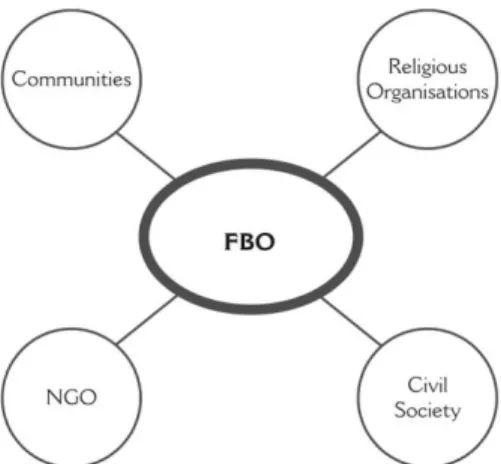
First, FBOs are seen as constitutive of a number of bodies that are involved in development activities. Clark & Ware (2015) called it
a ‘Frankenstein’ type
organization because the heritage and relationship between FBOs and NGOs,East Nusa Tenggara
religious organizations, civil society organizations and communities is distinctive yet existing together towards the same mission. The explanation is illustrated below:
Fig. 2 Constitutive Relation of FBOs (Clark & Ware 2015: p. 5)
According to the study, the characteristics of FBOs are varied based on size, location, geo-political positions (local, regional, and national activities), areas of interest and positions on diverse development-related issues and priorities, etc.
The capability of FBOs cannot be underestimated. In 2012, the total revenue of World Vision International was (US?)$2.67 billion, while the Lutheran World Relief’s total support and revenue was $38,529,000. Further, the Catholic Church’s diverse assets are far greater than these organizations (UN 2014).
In development practice, faith-based organization frequently gains recognition from religious leaders in charitable assistance, relief and social services that occurred before the concept of development. For example, Christians missions have existed worldwide for centuries, especially in the field of education, health and humanitarian aid. Nevertheless, missionary works were intertwined with imperialism, thus faith-based organizations were often mistaken as an act of proselytization (Lunn 2009: p.943). Tomalin explained it furthermore by dividing it to three phases as follows: phase one, the ‘pre-secular’ or ‘integrated phase’ that happened during the colonial era in which Protestanism was associated with imperialism and proselytization; the second phase is the ‘secular’ or the
‘fragmented’ phase that happened during the modernization phase the third one is characterized by the ‘turn to religion’, or that Clark and Ledger-Lomas refer to as ‘Post-Secular’ phase that started from the early 2000s (2018, pp. 2-3).
Elena Fiddian-Qasmiyeh, CEO of Christian Aid in the 5th Westminster Faith Debate on the theme of global religious trends. She stated, there are three phases
in a kind of pendulum swing between religion and development. First, the mission to spread Christianity and create Christian civilization put together religion and western imperalism – bringing benefits to the West. Second, there was the shift as the world has been changing to postwar and postcolonial period. There was strong reaction against religious-affiliated organizations, as it counted as
‘paternalistic model of doing good to others’. Religion was seen as an obstacle to the development, compared to the secular model of development. To overcome that perception and restoring trust to ‘religion’, FBOs are doing advocacy with
‘post-paternalistic models’ or ‘post-charitable models’ whereby faith is itself a means for people’s sense of self-improvement for better well-being (Lancaster University, 2014).
The wrong perception about religion derived from the long history of Protestanism that associated with Christian imperialism in the alteration of world order. Clark and Ledger-Lomas (2018) in their article entitled ‘
The Protestant International’
stated that internationalism and Protestantism went hand in hand.It happened because of evangelical revival that that relied on an evangelical obsession with conversion. It was supported by the influx of missionaries which was associated with imperial nation-states. Nonetheless, the reformation in Protestanism brought a slight change in missionary works. The involvement of religion organizations with the issue of colonialism, abolition of slavery and women’s rights proved the emergence of FBOs to safeguard civil rights. For instance, World Vision International, Religion for Peace (RfP), Islamic Relief Worldwide, Jesuit Refugee Service (JRS), CO.RE.IS (Comunità Religiosa Islamica) who identify advocacy strategies on how to make children more inclusive to improve children on the move access to service e.g., health and education (2012:
pp. 23-35).
Furthermore, Trihadi Saptoadi, Director of World Vision Indonesia in 2009 gave statement about the issue of proselytization – he stated, WVI never hide the Christian identity, it is important to let others know the clear position and policy.
WVI also rejected to work with organizations and individuals that do proselytizing – nor use the resources to proselytize people with whom the organization works. The mission has been spoken to itself that WVI are motivated by Christian values and calling – to follow Jesus Christ’s message to love and care for everyone, not only among Christians, but with other faiths as well (Georgetown University, 2009).
Next, according to Dawan, as shown the figure below, I want to put an emphasize on the three values of Wahana Visi Indonesia, that is in line with my previous arguments. In the context of Wahana Visi Indonesia, the organization has 6 (six) core values in which 3 (three) of those strongly illustrated Christian
East Nusa Tenggara
faith, i.e “We are Christians in the context of religious and cultural pluralism,”
“We commit to the poor for the context of poverty or the gap between the rich and poor,” and “We are stewardship for a severe context of corruption” (2017, p.
3). Those three values are the engagement between religion and development that directs Wahana Visi Indonesia to transformational change in development process.
Table 1Faith and Development is Intertwined in Wahana Visi Indonesia’s Core Values (Dawan 2017, pp. 1-12)
Core Values Religious Values Development Mission We are Christian • Doctrine of Trinity (Father,
Son, and Holy Spirit);
• Love thy Neighbour (The Book of Leviticus and Golden Rule)
WVI’s missions work aligned with the justice and to help the poor, weak and oppressed.
We Serve the Poor • Imitating Jesus in caring for the poor (Matthew 9: 35- 36)
WVI has been bridging and will always try to bridge ‘the disharmony’ between ‘the poor’ and ‘non-poor, as it velieves that poverty happened because of the
‘dissonance’ or the oppressive and non-functioning relationship in society, hence it needs to be restored hollistically.
We are Stewardship • As Jesus followers, we employ it in serving one another as good stewards (1 Peter 4: 10, 11)
In line with two core values, WVI attempts to engage the Christian faith into their projects by applying this core value as principal – ‘ to be servants of one another.
Speaking of integrating faith and development in FBOs, based on the interview with Faith and Development Manager in WVI, to be able to put the values into mission, WVI applied the transformational leadership that lies in the context of the organization itself, “Our Vision for Every Child, Life in All Its Fullness: Our Prayer for Every Heart, The Will to Make it So.” Dawan explained, transformational leadership in WVI can be achived to four aspects, namely:
influence of idealizing leaders, inspirrational motivation, intellectual stimulation, and giving attention as subject to each individuals.
Then specifically, World Vision (International) intends to work alongside the poor and oppress as they pursue their transformational development, in partnership with the sponsor, government, churches, and other NGOs. It has five areas of desired change and each has detail explanation regarding its scope of changes from well-being of the children, put children as agents of transformation, to have transformed relationship, and enhance interdependent and empowered churches and communities as well as having transformed systems and structures (Wahana Visi Indonesia 2014, p. 6).
Next, depart from the fact that current global development discourse placed development int post-secular praxis, Tomalin also stated how Peter Berger revised his position from the unavoidable effect of secularization to how he called as
‘desecularization of the world’; although, Tomalin pointed that there is nuance to the term ‘desecularization’ as it is different to Global North and Global South. I agreed with the arguments she presented, that in Global South, the term of
‘desecularization’ or ‘the resurgence of religion’ might less incorrect because it was never in decline in such settings (2018: 6).
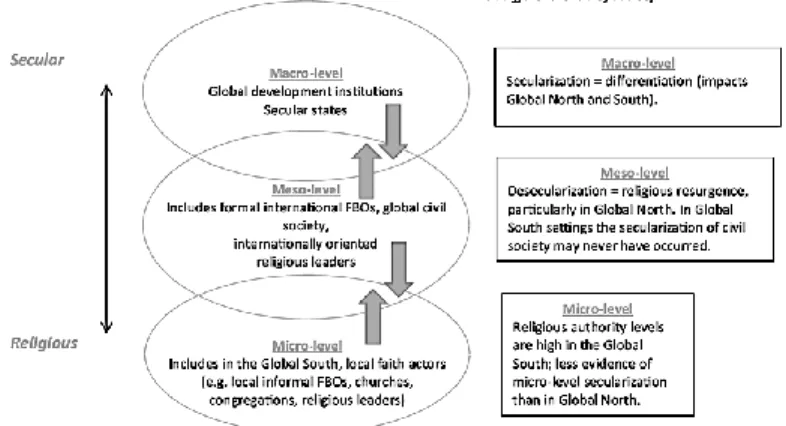
Therefore, Tomalin tried to analyze further the engagement between a religion and development. Author argued that there is different types of religious dynamic at different levels of society and it dependens on whether and which type of secularization might be occurred at certain interrelated levels of society.
Findings showed that secular actors work at the macro-level, although secularization might be taken as differentiation that has impacted Global South and North. Moreover, meso-level showed that there is religious resurgence in Global North and the fact that secularization never occurred in Global South, although religious actors may have appeared as representative of formal international FBOs or internationally oriented religious leaders; while in micro- level showed religious authority level are high in the Global South and found less evidence of secularization than the Global North – as local faith actors who play big roles in this level. Further details can be seen in figure below:
East Nusa Tenggara
Using Tomalin’s analysis, the author aims to explain how FBOs’ values and missions are intertwined based on the figure above. The analysis in the next section tried to map on how Wahana Visi Indonesia has been working in different levels of society with a special focus on the child education. As in the next section, I would like to explain further the concept of each level of society. The macro- level refers to national and global systems which includes states and multilateral organizations; the meso-level refers to national, regional and international associations, organizations and movements where each part influences and delivers outcomes in child education in Indonesia particularly; lastly, the interaction that happened in micro-level.
‘THE KIDS ARE ALL RIGHT’:
CHILD EDUCATION IN ALOR – EAST NUSA TENGGARAThis section will discuss in further detail FBOs and child education sector.
It explains what work WVI has been doing in children’s rights, particularly in child education. WVI works with Kota/Kabupaten Layak Anak, a program initiated by the Ministry of Female Empowerment and Child Protection (KEMENPPA) to attain SDGs Goal 4 (Education). Six aims have been designed, with one entitled “Pendidikan, Pemanfaatan Waktu Luang dan Kegiatan”
(Education, Utilization of Free Time and Activities) which regulates the different education levels of Indonesian school children including PAUD-HI (Pengembangan Anak Usia Dini Holistik-Integratif/Early Childhood Development Holistic-Integrative, Wajar 12 Tahun (12 Years of Compulsary Education), SRA (Sekolah Ramah Anak/Child-Friendly School), and PKA (Pusat Kreativitas Anak/Center of Children’s Creativity). Further, this section provides a picture of how FBOs achieve Goal 4 (Four) of the SDGs (education). It is divided
Fig. 3 Religion-Development Domain Analysis (Tomalin 2018, pp. 7-8)
into two parts, that is, Good Education is a Child’s Right and Cultural Revitalization as an Outlet for Better Education in Alor – East Nusa Tenggara.
Good Education is Child’s Rights
In international settings, the protection of children’s rights was codified in 1923 in the Geneva Declaration of the Rights of the Child. This code was drafted by Eglantyne Jebb, a British social reform figure and founder of Save The Children.1 This declaration contains five important points in regards to the basic rights of children. These include that a child must be given the means needed for its normal development, both materially and spiritually, thus a hungry child should be fed; a sick child should be helped; an errant child should be redeemed;
the orphan or homeless child should be sheltered and comforted, a child must receive relief in times of distress, a child must not be put in a position to earn a livelihood and must be protected against every form of exploitation, and a child must be brought up in the consciousness that its best qualities are to be used in the service of its fellow men. Later in 1924, the League of Nations adopted the Geneva Declaration and changed it into the World Child Welfare Charter.2 This marked the separation of children’s rights from adults – and it began the process that would lead to the UN Convention on the Rights of Child that adopted later by UN Convention on the Rights of the Child (Wahana Visi Indonesia 2017, p.
3).
In 1959, A Declaration of the Rights of the Children was issued. It was based on the structure and content of the 1924’s Charter while adding ten new rules.
After this November 20 was set as World’s Children Day. Looking back at history we see that protecting children’s rights is fundamental and that a child’s right to education is part of this. The WVI, is a humanitarian organization that makes efforts to achieve the fulfillment of children’s right, including child education. In
1 Save The Children is a humanitarian organization for children. It was established in the United Kingdom in 1919 to improve the lives of children through better education, healthcare, and economic opportunities – it also proves emergency aid in natural disasters, war, and other conflicts.
By enforcing the UN Declaration of the Rights of the Child, this organization promotes changes to gain more rights for young people. So, Save The Children has a general consultative status in United Nations Economic and Social Council (www.savethechildren.net/about_us).
2 Five points in an initial draft that would become the UN Declaration of the Rights of the Child in 1923 contained this following five criteria: (1) The child must be given the means requisite for its normal development, both materially and spiritually; (2) The child that is hungry must be fed, the child that is sick must be nursed, the child that is backward must be helped, the deliquent child must be reclaimed, and the orphan and the waif must be sheltered and succored; (3) The child must be the first to receive relief in times of distress; (4) The child must not be put in a position to earn a livelihood and must be protected against every form of exploitation; (5) The child must be brought up in the consciousness that its talents must be devoted to the service of its fellow men (www.savethechildren.net/about_us).
East Nusa Tenggara
2016, UNICEF marked 70 years as an international organization that fights for children’s rights including cooperating with World Vision and being partnered with WVI. WVI focuses on fulfilling the basic rights of children as outlined in the Convention on the Rights of the Child reported by UNICEF in 1989, including:
the right to a name (identity), the right to citizenship, the right to play, the right to attain an education, the right to obtain protection, the right to obtain food, the right to access to health, the right to be creative, the right to equality, and the right to play a role in development (Wahana Visi Indonesia 2016, p. 6).
Children’s rights in Indonesia are legally protected by law. It is written in the 1945 Constitution of the Republic of Indonesia as follows “Every child shall have the right to live, to grow, to develop and shall have the right to protection from violence and discrimination,” but not until 2002 Indonesia has established the National Commission of Child Protection (KPAI) with considerable support from UNICEF. This independent institution was formed to improve the monitoring system for the implementation of the Protection and Fulfillment of National Children’s Rights and to increase institutional capacity in supervising the implementation of child protection development.3 In the matter of Child Protection Rights, World Vision and WVI along with partners, support efforts to ensure: the prevention of exploitation, harmful traditional practices, violence against children in the family and community, protection of children who live in a vulnerable situation, and restoring the condition of children who have been mistreated, ignored or exploited. This is the beginning to focus on the Children’s Participation Rights which aims to create a sustainable child welfare and a democratic society (Wahana Visi Indonesia 2018b, p. 2).
The next important thing to note is the National Medium-Term Development Plan (Rencana Pembangunan Jangka Menengah Nasional 2015- 2019 – RPJMN) which included the implementation of the National Action Plan for Child Protection (Rencana Aksi Nasional Perlindungan Anak – RAN-PA) to achieve its global commitments including Goal 4 (education) of the SDGs. This is stipulated in Presidential Regulation No. 2/2015 about the RPJMN. In the RPJMN 2015-2019, government is committed to protecting children’s rights as part of an investment in human resource development – as it is in line with NAWACITA (National Development Agenda). Moreover, fulfillment of children’s rights leads
3 According to Art. 76 explained that The Indonesian Child Protection Commission’s tasks as follows, (1) To supervise the implementation of the protection and fulfillment of children’s rights;
(2) To provide input and suggestions in the formulation of policies regarding the implementation of Child Protection; (3) To collect data and information regarding violations of children’s rights; (4) To mediate disputes over violations of the Rights of the Child; (5) To report to the authorities regarding the alleged violation of this Law” (https://www.kpai.go.id/profil).
to qualified. Based on this document, the main target of National Action Plan for Child Protection (RAN-PA) is children, which according to Law No. 35/2014 concerning Amendments to Law No. 22/2003 concerning Child Protection which explains that children refers to individuals aged 0 to before 18 years old including children in the womb (BAPPENAS 2015).
Furthermore, WVI established six priorities that colored all of its programs in an effort to achieve child welfare in 2012-2015. One of these goals is “The creation of loving and safe family and community.” The approaches used by WVI are children’s forums,
‘Kota/Desa Layak Anak’,
and child protection mechanism and advocacy. According to Regina Veronica at Communication Department at WVI, the organization supports to a dialogue between children and adults to exchange ideas and work together. This effort was made in accordance to WVI’s core values that stress in the dialogue, as well to improve the welfare of the community (Wahana Visi Indonesia 2016, p. 7).For example, PAUD Betel Retta in Alor – East Nusa Tenggara is one of the programs in assisted area of ‘Program PAUD Holistiok’ or Early Childhood Care for Development in WVI. In my perspective, this is exemplary as it is potrayed the fulfillment of WVI’s aims in child education which also illustrates the faith as
‘core values’ of the organization. In 2016, the early childhood program involved the siblings, Menahem Basituba and Hanna Besituba, who graduated high school and aim to edify early childhood education in Alor. As Menamem said,
“I feel that early childhood is important for future generations. Finally, from my deepest heart, it becomes one of my dreams – to build my nationess from my village (membangun bangsa dari desa). In this case, I want to take part in education the child of the nation – to devote myself to education.”
It took years for the Menahems for finally established steady system for PAUD Betel Retta, WVI has been recording their journey to raise the people’s awareness in village to go to school. Hanna stated, most of the parents prefer their kids to help them working instead making them go to school. In 2016, WVI helped in holistic way PAUD Betel Retta by giving the training for everyone involved with the PAUD Betel Retta (Wahana Visi Indonesia, 2016).This program is handed out in three steps: Center Base, Home Base, and Parenting Education. First step aims to advance the quality of teaching in early development childhood education such as module-making, curriculum-making (daily, weekly and semester activity unit). Next step heads to develop the quality of parents whereas stimulates the aptitude of the children. Last step intends to hone parenting skills, not only about education but also nutritional knowledge as nutritious food intake for maximizing child growth, also bring around parent’s
East Nusa Tenggara
consciousness of the importance of the education for children and learning with the society (Wahana Visi Indonesia, 2016).
Religion-Development Domain Analysis on Cultural Revitalization as an Outlet for Better Education in Alor – East Nusa Tenggara
Here above is the mindmap of religion-development analysis of the child education program. According to the theoretical frameworks, author explains this section by drawing the nexus of Wahana Visi Indonesia in Religion-Development into three parts as Tomalin’s concept: macro, meso, and micro-levels. In fact, World Vision utilizes this method in Development and Program Effectiveness Team (2014) – the material presented to build on the experience of World Vision’s partnering practitioners as well as that of technical teams and national, regional and support offices across World Vision, including WVI. In this section, it will be shown how WVI undertakes the core values that emphasizes on ‘Love thy neighbor, ’be servant’, and ‘help the poor’ through ‘dialogue’ – it becomes principles of monitioring and evaluation needed within coalitions, as follows equity, mutual benefit, and transparency. That is to say, all partners will contribute meaningfully to planning, doing, analysis and using the findings from agreed evaluations; engaged parties need to gain benefits that must be shared in order to strengthen the collaboration; and transparency in which data and analysis regarding the education projects and partner contributions must be open to all partners. In learning to partnering in practices – WVI is also familiar with Tomalin’s conceptual framework. To understand a partner in macro-meso-micro levels, WVI divides three different types of collaboration based on the motivations, benefits, drivers and opportunities as follows, from networks, coalitions (coordination and cooperation), and partnership and WVI’s role. For instance, all parties that work together is network, but related party does not mean necessarily a part of coalition or partnership. The major difference between those two is the length of engagement in WVI’s program for each party, for instance a coalition must commit in long term through coordination and cooperation – whilst a partnership is likely to be shorter-term.
Fig. 6 Tomalin's frameworks on the study case of Child Education in Alor - East Nusa Tenggara
Below is explanation on religion-development domain analysis of Alor’s case of cultural revitalization. In macro-level, there are two categories, i.e Government and Institutional Donors (CIDA, DFAT, USAID, GHA, HACP, and UKAID) and Humanitarian Agencies (WFP, UNHCR, UNICEF, World Bank, UNDP, ICRC). In 2014, top five single grants were received from WFP ($179 million), USAID ($85 million), AUSAID ($27 million), and UKAID ($21 million) – in total approximately $347 million. Moreover, 86% World Vision Aid went to aid Indonesia in 2018, it is approximately $20 millions from donors and sponsors.
Recently, $24 million has been given to WVI to establish programs that benefited children, families and communities in poverty – 40% of the aid went to education (NGO Monitor, 2018).
In the figure, there are six organizations, all is involved with education program but ICRC. Look further on Humanitarian Agencies, mostly it focuses on the relationship between UN and FBOs in general. UN has many track records in its collaborations with FBOs and religious leaders. Since 1970, UNFPA has ensured that ‘the language of UN advocacy’ must be accompanied by contextual understanding of religion – other institutions such as UNICEF, World Bank, UNHCR, UNDP and WFP started working together in the 1990s and 2000s, both in advocacy, care, and service delivery. In this case, UNFPA played a major role in ‘raising the role of FBOs to the surface in the UN system – from the purposes, objectives, methods, lessons learned and ‘pros and cons’ of FBOs engagement. In addition, UNFPA was the first who is mapping the engagement of FBOs with donors from Norwegian Agency for Development Cooperation (NORAD) in
East Nusa Tenggara
2000-2008. After that, UNFPA organized Global Forum on Faith-Based Organizations for Population and Development in Istanbul and launched the first Interfaith Network on population and development issues in 2008. In 2009, United Nations Development Group (UNDG) formed the “United Nations Inter- Agency Task Force on Engaging Faith-Based Organizations for discussion between FBOs, academics, think tanks, and UN agencies related to the issue of development, religion and politics (UN, 2014).
In meso-level, there were CRS, CWS, LWR as IFBOs that has been partnered with WVI. They worked as partners that internationally and religiously oriented. They also have a role as third sector whereas they became beneficiaries to WVI and cooperating to wider stakeholder engagement and enhancing reach and impact in regional area – contextually in Southeast Asia. Not to mention there three FBOs help WVI to build community self-reliance and resource leverage – though their role is not visible, but Church World Service specifically served through Communion of Churches in Indonesia since 1950s, they also partnered with US Government through USDA and USAID which explained before in macro-level – this organization focused on child nutrition that somehow related (in holistic perspective) to education (CWS Asia, 2020). As for the central governments, Ministry of Education and Culture and Ministry of Social Affairs worked hand-in-hand with WVI in child education. Ministry of Social Affairs has been working with WVI since 1980s and followed by Ministry of Education and Culture – they were coordinating to established social order, implement regulations, search for innovative solutions that can improve good government as being responsive to local need and be able to deliver effectiveness and reach (Wahana Visi Indonesia, 2014).
In micro-level, there is 14 institutions involved varied from CCI, Churches (GMIT, Kantor Klasis Alor Barat Daya, and GKII), LPMP, Puskesmas, UPTD, BPMD, District Government and Regency, Regional House of People’s Representatives, Religious Figure, Customary Figure, as well as Head of Village.
As Tomalin mentioned in her theory that micro-level showed evidence that religious authority levels are high in Global South, it is proven in some degree from cultural revitalization in Alor. By seeing that the most part of engagement to develop child education in Alor happened in micro-level – it can be said that religion plays central role of the work of development, especially to attain SDGs Goal 4 in Global South, particularly in Indonesia by taking the case of Alor, we can see how in religion-development domain ‘the interfaces’ of global development institution as mentioned in macro-meso levels intersect with local faith actors very effectively. In this fashion, this analysis showed the differentiation in Global South in which religion was never out of ‘figure’ in the
first place – it is proven by actors that has been playing along from meso-level in which three of them was a IFBOs.
According to Dawan in his interview – This program was designed to improve child education for 15 years, but it did not run smoothly – the HDI in Alor was still low and the education system was failed to improve. Not until the 7th year of the program, the problem was discovered and that happened because of the price of ‘Belis’ is expensive and WVI realized intervention in education without
‘a cultural approach’
would not be working – thus, WVI has been working on cultural revitalization ever since (Dawan, 2020, interview May 18).In Alor, there are approximately 56 mother languages which are grouped in 13 languages which are very different from one another. Alor is inhabited by dozens of tribes and has dozens of diverse regional languages and has extraordinary cultural richness. he diversity of native tribes and
‘pendatang’
is inseparable from the vary of mother tongues used there. Cultural and customary values are highly respected in Alor to such degree the existence of customary institution is presented in each‘satuan kerja adat’
or‘rumpun adat’
or adat groups and at the district level – they are acknowledged and involved in Musrembang Desa (Village Development Planning Meeting). With such cultural richness, customary figures, religious figures, and local government witnessed how‘belis’
caused degradation of child education and marginalization to children – thusly they decided to review and renew the ‘meaning’ of the culture of
‘belis’
. (Dawan 2019: p. 31).After that, WVI efforts from 2012 was to mobilize customary figures or
‘Orang-orang Tua Adat’ who wanted to be involved in the cultural revitalization in order to decrease the excessive ‘cultural practices of marriage and belis’ – and it has succeeded. WVI found the challenge was lied in cultural issue of ‘belis’.
Concerning the situation, according to Marthen Beda, Chair of the Customary Institution of Kulligang Traditional Family ‘Rumpun Adat Kulligang’, child education was neglected because parents focused on financial customary issue (
belis
), thus they invited their children in helping them to work and focusing to raise family income from agriculture or livestock products such as goats, pigs and chickens for ‘belis’, instead of telling them to go to school (Wahana Visi Indonesia 2018a).This argument supported with the statement of Bapak Yusuf Tangpeni, KII in Moraram Village, in his interview with Anil Dawan from WVI thusly:
“Are
customs and culture for humans or humans for customs and culture? The process
of unification of ‘adat’ seems to lack of understanding of education. It is based on
high price of ‘belis’ – I become a pioneer to reduce the price of belis, around 70-
East Nusa Tenggara
80 moko and it can be negotiated to 60 moko. It could not be any less from that.
In such matter of education, no one went to university anymore, not even high school.”
Bapak Salmun, KII in Moraman Village, also said the same thing – he stated that education is not taken care of, in this way development cannot be regulated – thusly we have low human resources, we face cases of pregnancy out of wedlock and the children are forced to pay the belis. Dawan specifically argued that cultural intervention can help child education to such degree WVI helps to strengthen family resilience from the understanding that ‘belis’ is not a shackle or‘hutang adat’ (Dawan 2019: pp. 32-33).
WVI worked alongside 12 traditional families and BPMD in Alor – all these customary figures (Elders involved), and religious figures carry their policies and wisdoms to initiate the change and cultural revitalization of ‘belis’. Dawan argued in his ethnography research that the change showed firstly from Bapak Yusuf Tangpeni, Bapak Salmun, Bapak Sem Bangkay, Bapak Immanuel Yopa, Bapak Asshorudin Songkay as cultural and customary representatives, both from Christian and Islam in Abui Tribe in Alor that discussed together how cultural revitalization brought positive impacts to their communities. Bapak Yusuf Tangpeni specifically said: “I am a hard person whom hard to deal with in Alor – but from pastors, I think the way of kindness and it made me realized what is sought in customary law, the changes seem extraordinary in the last 2-3 years.
Nothing is tied us from such change.”
In addition, since Early Childhood Education implemented as basic education, children can grow and develop furthermore to have access to basic education. A mother named Aneas Dakadjo (Mother of a child named Jerry) stated that her home became a friendly space for learning comfortably also for playing.
As a mother, she agreed that through education she can attain family resilience because she is now able to provide healthy food and teach her children at home better – as before she told that her child was often sick (Dawan 2019: p. 37).
Moreover, as Marthen Beda stated to WVI, in 2014 up to 2016-2017, the problem of marriage certificates and birth certificates of each family was slowly resolved this affects the number of children attending school because before they could not attend school because they did not have birth certificate. Ismail Kawa, Head of Lamma Village, justified the condition. He explained, children can return to school with the guarantee system. To help the process, before parents get their marriage certificate in order to have birth certificate, churches helped them with a Baptist Letter as a guarantee for children to be able to go to school. WVI showed data that, after cultural revitalization, children’s education has successfully increased. Now, children’s education in Tulleng Village has reached bachelor’s
level, even in 2017, there have been eight people who graduated from university and 12 people who are still in college (Wahana Visi Indonesia 2018a).
WVI’s work in child education in Alor brought so many positive impacts as stated in Figure 4 above in which scope of changes covered all five aspects that can be listed as follows: new cultural meaning of ‘belis’, improvement of child education and decreasing number of ‘structural violence of adat’, advancement of family resilience in fashion of family welfare and education as well as household economy, churches and congregations helped in holy marriage to attain marriage certificates and birth certificates, and improving religious relations, traditional leaders with the government – in other words, faith and dialogue flourished the development work in holistic way and in line with root values through transformational development.
CONCLUSION
This study concludes three main points as follows, ‘faith’ is cornerstone of religion in development, Wahana Visi Indonesia (WVI) is a catalyst in development, education is effective if regulated with multidimensional facets as the study case in Alor – East Nusa Tenggara proves all the arguments in the sudy are relevant. Firstly, ‘faith’ is the bridge of religion and development. For instance, encyclical letters from
Populorum Progressio
toLaudato Sì
that consisted of two main points namely dialogue and participation. It confines education to be in line with Christian values and missions that emphasizes in ‘Matthew 22 – Love Thy Neighbors’. Put differently, faith is generator that moves Christianity to face‘reality of current development’ as the practice of having ‘Sacred Life’, hence faith shall criticize structural injustice and have concerned of the poor and the oppressed.
It leads to second point whereby WVI becomes constitutive and work with all social elements and applied
‘postpaternalistic’
and‘postcharitable’
model that highlight faith as a means of enhancement of oneself – simply put, Christianity has been changed from evangelical revival that obsessed to conversion, to reformation for missionary works that captivated religion with social issues in which WVI serves as development actor and becomes a resource of social cohesion as well as proving social service whereas state is absence – it has to be done without the intention to conversing. On a side note, WVIs work is taken as a social work, rather a proselytization. It is because they never hide their faith as identity, have clear position and policy and not work with whom support‘conversion to certain belief or religion’ as explained in their core religious values and developmental missions.
East Nusa Tenggara
Thirdly, in Indonesia, as Global South, religion can make social transformation easily permeated. Simply put, by taking cultural and religion context into consideration, holistic change can be brought in Alor – East Nusa Tenggara. WVI works in multidimensional facets that required cultural and religious context as described in five domain areas in education and focusing to detailed scope of changes – that is to say WVI transformational change in its process. For instance, analysis of WVI’s work in Alor – East Nusa Tenggara from Tomalin’s frameworks showed that Indonesia is ‘religious’ type of dynamic at level of society. In other quarters, it is in accordance with Tomalin’s argument in which religious authority is high. This is proven by the number of actors involved in micro-level – there is 14 and the key persons are religious and customary figures.
Furthermore, in meso-level, three out of six is IFBOs in which their groundworks are lied upon the ‘harmony’, ‘dialogue’ and participation as mentioned in encyclical letters – same principal goes for all actors involved in macro-level.
From the interface from macro-meso-micro levels, the study case showed transformational development with cultural and religious perspective is needed in Indonesia particular. By focusing in the smallest unit of society or family resillience and put forward in ‘constitutive’ way along with WVI, the change can happen and child education can be improved.
REFERENCES
Ahmad Zainuddin, Shahiza 2012, “Language Needs of ICT Students in Malaysian Polytechnics,” Advances in Language and Literary Studies. Vol. 3, no 23-40.
https://doi.org/10.7575/aiac.alls.v.3n.2p.23.
Alkire, S 2005, “Religion and development,” Culture and Global Change, pp. 232–239.
https://doi.org/10.4337/9781783479825.00039
Anak, K. P. P. dan P 2015, Strategi Nasional Penghapusan Kekerasan Terhadap Anak (2016-2020), Vol. 45. https://doi.org/10.1017/CBO9781107415324.004
Dawan, A 2019, “Perempuan Alor di Pusaran Budaya Belis: Sebuah Pendekatan Etnografis Melalui Revitalisasi Budaya,” Inada, 2(1), 25–41.
https://doi.org/http://dx.doi.org/10.33541/ji.v2i1.1037
Dawan , Irianto, J., & Suaedi, F 2017, “Transformational Leadership Model in Core Values Learning of Faith Based Humanitarian Organizations Wahana Visi Indonesia,”
Global Journal of Human Resource Management, Vol. 5(8), pp. 1-12.
Bäckström, K 1989, “Convention on the rights of the child,” International Journal of Early Childhood, 21(2), pp. 35–44. https://doi.org/10.1007/BF03174582
Berger, P. L 2009, “Faith and development,” Society (Vol. 46, Issue 1, pp. 69–75).
https://doi.org/10.1007/s12115-008-9166-5
Byrne, M., Erb Leon-Cavallo, A., Saadallah, S., Begg, A., Ross, A., Matarazzo, J., Sheikh, M., Kadir, A., & Fischer, N 2009, “Global Forum of Faith-based Organisations for Population and Development,” United Nations Population Fund, 3–112, accessed on May 20 2020, https://www.unfpa.org/sites/default/files/pub- pdf/global_forums_fbo.pdf
Carbonnier, G 2013, “Religion and Development: Reconsidering Secularism as the Norm,” Revue Internationale de Politique de Développement, 4(1), 1–5.
https://doi.org/10.4000/poldev.1351
Casey, K., & Lorey, M 2011, The Handbook for Development Programmes.
https://www.wvi.org/sites/default/files/Handbook_for_Development_Program mes.pdf
Clarke, M., & Ware, V 2015, “International Development Literature,” Progress in Development Studies, 15(1), 37–48.
CWS Asia 2020 “CWS Asia Introduction: Indonesia,” Church World Service, – Accessed on May 21, 2020, https://cws-asia.org/where-we-work/indonesia/
Deneulin, S., & Zampini-Davies, A 2017, “Engaging Development and Religion:
Methodological Groundings,” World Development, 99, 110–121.
https://doi.org/10.1016/j.worlddev.2017.07.014
Diop, G., & Ph, D 2017, “A theological foundation and framework for partnering for and with Children,” Move: A Christian perspective. September 2016, 1–4.
Engagement, F. B. O., & Entities, U. N. 2015, Un Inter-Agency Task Force on Engaging Faith- Based Actors for Sustainable Development and the UN on Religion and Development .
Heist, D., & Cnaan, R. A 2016, “Faith-based international development work: A review,”
Religions, 7(3), 1–17. https://doi.org/10.3390/rel7030019
Gallup News Poll 2019, In-Depth Topics A-Z: Religion, accessed on May 13, 2020, https://news.gallup.com/poll/1690/religion.aspx
Georgetown University 2009, “A Discussion with Trihadi Saptohadi, Director of World Vision Indonesia,” Berkley Center for Religion, Peace & World Affairs, accsessed in May 1, 2020, https://berkleycenter.georgetown.edu/interviews/a-discussion- with-trihadi-saptoadi-director-world-vision-indonesia
Lunn, J 2009, “The role of religion, spirituality and faith in development: A critical theory approach,” Third World Quarterly, 30(5), 937–951.
https://doi.org/10.1080/01436590902959180
Of, R., Among, A. C., Organizations, D., Nations, U., & Agencies, D 2015, Religion and Post-2015, USA.
East Nusa Tenggara
Lancaster University 2014 “Do the Benefits of Engaging Religion for Development Outweigh The Dangers?”, 5th Westminster Faith Debate on the theme of Global Religious Trends in, accessed on May 20, 2020, https://www.youtube.com/watch?v=abzkKXmzRrc
NPR 2018, A Conversation with World Vision President Richard Stearns, accessed on May 21, 2020, https://www.npr.org/2018/05/06/608942129/a-conversation- with-world-vision-president-richard-stearns
Redaksi, D., Veronica, R., Rena, E., Hutomo, A., Ciputra, M., Runtuwene, Y., Thomas, G., & Yuventa, N. R 2017, Mimpiku Untuk Papua. Kasih Peduli, 3 7(Kemitraan Global Wujudkan Kesejahteraan Anak Indonesia, Jakarta.
REYES GUZMÁN, G 2009, “Amartya Sen Development as Freedom,” Problemas Del Desarrollo. Revista Latinoamericana de Economía, 32(126).
https://doi.org/10.22201/iiec.20078951e.2001.126.7398
Robert D. Putnam 2000, Bowling Alone: The Collapse and Revival of American Community, New York: Simon & Schuster.
Tomalin, E 2018, “Religions, poverty reduction and global development institutions,”
Palgrave Communications, 4(1). https://doi.org/10.1057/s41599-018-0167-8 UNFPA 2016, Realizing the Faith Dividend: Religion, Gender, Peace and Security in
Agenda 2030, USA.
NGO Monitor 2020, “Funding: World Vision” – NGO Monitor Making NGOs Accountable, accessed on May 21, 2020, https://www.ngo- monitor.org/ngos/world_vision_international.
Wahana Visi Indonesia 2014, “Local Partnering in Practice,” World Vision International
2014, Accessed on May 20, 2020,
https://www.wvi.org/sites/default/files/Local%20Partnering%20in%20Practice.
Wahana Visi Indonesia 2016, “Pendidikan Anak Usia Dini Alor” dalam Program Pendidikan Usia Dini dampingan Wahana Visi Indonesia in Alor, NTT, accessed on May 20, 2020, https://www.youtube.com/watch?v=Wxy4ZSS9Csc
Wahana Visi Indonesia 2017, Kasih Peduli. 36 (Penghapusan Kekerasan Terhadap Anak), Jakarta.
Wahana Visi Indonesia 2018a, “Pendidikan Anak Alor Tidak Lagi Diabaikan,” Berita &
Cerita Wahana Visi Indonesia, Accessed on May 21, 2020, https://wahanavisi.org/id/fromfield/detail/pendidikan-anak-alor-tidak-lagi- diabaikan
Wahana Visi Indonesia 2018b, Laporan Wahana Visi Indonesia Tahun 2018, Jakarta.