Volume 13 • Number 1 • 2023
OTORITAS : Jurnal Ilmu Pemerintahan
Published by the Department of Government Studies,
Faculty of Social and Political Sciences, Muhammadiyah University of Makassar For further information, please visit: https://journal.unismuh.ac.id/otoritas
ISSN: 2088-3706 (Print) | 2502-9320 (Online) | DOI : 10.26618
Firstpublished in April 2011
Please send all articles, essays, reviews, and documents to:
Regular Mail:
Department of Government Studies Faculty of Social and Political Sciences
5th Floor of Menara Iqra, Muhammadiyah University of Makassar Jl. Sultan Alauddin No.259 Makassar, 90221
South Sulawesi, Indonesia E-Mail:
OTORITAS : Jurnal Ilmu Pemerintahan is an internationally peer-reviewed open access journal published triannual in April, August and December, aims to publishes significant
and cutting-edge research drawn from all areas of politics and governmental studies and promotes scholarly, theoretical, pragmatic, and contemporary research, which makes a clear conceptual and methodological contribution to existing international
literature.
OTORITAS : Jurnal Ilmu Pemerintahan indexed by :
OTORITAS : Jurnal Ilmu Pemerintahan have been double blind-reviewed by international peer reviewers. The decision on whether the scientific article is accepted
or not in this journal will be the Editorial Board’s right based on peer reviewer's recommendation.
About the Journal
OTORITAS : Jurnal Ilmu Pemerintahan, with registered number ISSN 2088-
3706 (Print), ISSN 2502-9320 (Online), is an internationally peer-reviewed open access journal published triannual in April, August and December by Department of Government Studies, Faculty of Social and Political Sciences, Universitas Muhammadiyah Makassar in collaboration with Muhammadiyah’s College Association of Government Studies (AIPPTM) and Asia Pacific Society for Public Affairs (APSPA).
OTORITAS : Jurnal Ilmu Pemerintahan aims to publishes significant and
cutting-edge research drawn from all areas of politics and governmental studies and promotes scholarly, theoretical, pragmatic, and contemporary research, which makes a clear conceptual and methodological contribution to existing international literature.
OTORITAS : Jurnal Ilmu Pemerintahan Starting from 2015 it is available in e-
journal version and has been currently indexed by both national and international indexer institutions such as: ESCI Web of Science (International), DOAJ (International), ASEAN Citation Index (International), Dimensions (International), Garba Rujukan Digital (National), Google Scholar (International), Crossref (International), BASE (International), SINTA (National), and Indonesia One Search (National).
OTORITAS : Jurnal Ilmu Pemerintahan Starting from 2016 and for the
upcoming years, the process of manuscript submission and other management processes will be conducted online through Otoritas : Jurnal Ilmu Pemerintahan website and for the betterment of the quality and quantity of Otoritas : Jurnal Ilmu Pemerintahan qualified reviewers and editors are recruited. Besides that in the same year we collaborated with Muhammadiyah's College Association of Government Studies (AIPPTM) on the publication of this journal.
OTORITAS : Jurnal Ilmu Pemerintahan Starting from 2018, we collaborated
with Asia Pacific Society for Public Affairs (APSPA) on the publication and has
been accredited by National Journal Accreditation (ARJUNA) Managed by Ministry
of Research, Technology, and Higher Education of Republic Indonesia.
Focus and Scope
Otoritas: Jurnal Ilmu Pemerintahan (Journal of Political Science and
Government) promotes scholarly, theoretical, pragmatic, and contemporary research, making a clear conceptual and methodological contribution to existing international literature. Its spesific aim is to enhance the broad scholarly understanding of governance, public administration, public law, religion and politics, comparative politics, international studies, and democratic institutions in emerging countries.
Otoritas : Jurnal Ilmu Pemerintahan (Journal of Political Science and
Government) is committed to disseminating rigorous, high-quality research and
debate with a scientific influence on the international society. To that purpose,
the Editorial team follows a meticulous editorial procedure, bringing the most
sophisticated research on modern politics and governance to the academic
community and policymakers. The journal is online and has open access, and its
internal publication procedure enables it to distribute its research findings
internationally promptly.
Editorial Board
EDITOR-IN-CHIEF
Andi Luhur Prianto, Scopus ID: 57208214401, Universitas Muhammadiyah Makassar, Indonesia
MANAGING EDITORS
Nur Khaerah, Scopus ID: 57708938300, Universitas Muhammadiyah Makassar, Indonesia
ACCOCIATE EDITORS
Abel Kinyondo, Scopus ID: 55293738000, University of Dar Es Salaam, Tanzania Abel Polese, Scopus ID: 57201804952, Dublin City University, Ireland
Ilyas Mohammed, Scopus ID: 57221933986, University of Liverpool, United Kingdom Michael Hatherell, Scopus ID: 56433408300, Deakin University, Australia
Nursaleh Hartaman, Scopus ID: 57395318100, Universitas Muhammadiyah Makassar, Indonesia Riccardo Pelizzo, Scopus ID: 6507727385, Nazarbayev University, Kazakhstan
INTERNATIONAL EDITORIAL
Adam Tyson, Scopus ID: 35337925000, University of Leeds, United Kingdom
AKM Ahsan Ullah, Scopus ID: 10043791400, Universiti Brunei Darussalam, Brunei Darussalam Ahmad Harakan, Scopus ID: 57203222670, Universitas Muhammadiyah Makassar, Indonesia Andreas Ufen, Scopus ID: 24280605600, German Institute of Global and Area Studies, Germany
Farida Tadjine, Scopus ID: 57678049100, University of Kasdi Merbah Ouargla, Algeria Mergen Dyussenov, Scopus ID: 57190342068, National University of Singapore, Singapore
Mohd Afandi Salleh, Scopus ID: 55582821500, Universiti Sultan Zainal Abidin, Malaysia Mubashar Hasan, Scopus ID: 45861188500, Oslo University, Norway
Muh Firyal Akbar, Scopus ID: 57210750267, Universitas Muhammadiyah Gorontalo, Indonesia Ni Putu Tirka Widanti, Scopus ID: 57970637000, Universitas Ngurah Rai, Indonesia Nuryanti Mustari, Scopus ID: 57395318000, Universitas Muhammadiyah Makassar, Indonesia
Önder KUTLU, Necmettin Erbakan Universitesi, Turkey
Rudi Hardi, Scopus ID: 57395626900, Universitas Muhammadiyah Makassar, Indonesia Wolfgang Drechsler, Scopus ID: 36840148600, University College London, United Kingdom
EDITORIAL ASSISTANTS
Abdillah Abdillah, Scopus ID: 57697035900, Universitas Muhammadiyah Makassar, Indonesia Hamrun Hamrun, Scopus ID: 57395116400, Universitas Muhammadiyah Makassar, Indonesia
Table of Contents
The excellence scholarships program: Analysis of implementation aspects and societal impact
Achmad Kosasih1, Nurzela Eka Juniarfa2, Yusuf Fadli3, Adie Dwiyanto Nurlukman4, Abdul Basit5
1,2,3,4 Department of Government Science, Faculty of Social and Political Sciences, Universitas Muhammadiyah
Tangerang, Indonesia
5 Department of Communication Science, Faculty of Social and Political Sciences, Universitas Muhammadiyah Tangerang, Indonesia
1-15
How to deal with children’s violence? Implementation of child protection policies in Bekasi Regency, Indonesia
Aos Kuswandi1, Ainur Rofieq2, Siti Nuraini3, Noer Kholis4
1, 3, 4 Department of Government Science, Graduate School, Universitas Islam 45, Indonesia
2 Department of Government Science, Faculty of Social and Political Sciences, Universitas Islam 45, Indonesia
16-29
Unfolding women’s role in small-scale fishing community in The Philippines toward formulating a gender-sensitive local government policy
Joy Tricia Mae Corpuz1, Reynald Cacho2, Brenda Villamor3, Maria Gracia Samson4, Ma.
Sheila Simat5
12345 Philippine Normal University - South Luzon, Philippines
30-43
Regional head elections, high-cost politics, and corruption in Indonesia
Leo Agustino1, M Dian Hikmawan2, Jonah Silas3
1 Department of Public Administration, Faculty of Social and Political Science Universitas Sultan Ageng Tirtayasa, Indonesia
2 Department of Government Science, Faculty of Social and Political Sciences, Universitas Sultan Ageng Tirtayasa, Indonesia
3 Indonesian Politics Research & Consulting (IPRC), Indonesia
44-59
Territorial reform of areas with concentrated residence of minorities within decentralization policy under polyethnicity in Ukraine
Sierhiei Sakhanienko1, Natalia Kolisnichenko2*), Oleg Dolzhenkov3
1 Public Administration and Regional Studies Chair, Odessa Regional Institute for Public Administration of the National Academy for Public Administration under the President of Ukraine
2 Odessa Regional Institute for Public Administration of the National Academy for Public Administration under the President of Ukraine
3 Educational Management and Civil Service Chair, South Ukrainian National Pedagogical University named after K.D. Ushynsky.
60-79
The implementation of Sewakadharma work culture to improve public service quality in Denpasar City, Indonesia
Ni Putu Tirka Widanti
Departement of Public Administration
Postgraduate Program, Universitas Ngurah Rai, Indonesia
80-91
Mainstreaming state auxiliary agency to handling revenge porn victims in Indonesia, 2020-2021
Pamela Setya Miliasari1, Dede Sri Kartini2, Nandang Alamsah Delianoor3
123 Department of Government Studies, Postgraduate Program, Faculty of Social and Political Sciences, Universitas Padjajaran, Indonesia
92-110
Public service transformation trough digital-based services during Covid-19 pandemic in Riau Province, Indonesia
Panca Setyo Prihatin1, Pahmi Amri2, Agung Wicaksono3
1,2 Department of Government Studies, Faculty of Social and Political Sciences, Universitas Islam Riau, Indonesia
3School of International Relations and Political Science, Corvinus University of Budapest, Hungary
111-124
Islamophobia as a religious-based horizontal conflict and its resolution
Rodon Pedrason1*), Waluyo Handoko2, Paulus Israwan Setyoko3, Denok Kurniasih4
1 Departement of Defense Diplomacy, Faculty of Social and Political Science Universitas Pertahanan Indonesia, Kawasan - Indonesia Peace and Security Center (IPSC), Indonesia
2 Departement of Political Science, Faculty of Social and Political Science, Universitas Jenderal Soedirman, Indonesia
3,4 Department of Public Administration, Faculty of Social and Political Sciences, Universitas Jenderal Soedirman, Indonesia
125-140
Social capital as a political strategy: evidence from Nasdem Party in Makassar City, Indonesia
Suhardiman Syamsu1, Andi Muhammad Rusli2, Miranda Malinda Hamka3
1,2 Department of Government Studies, Faculty of Social and Political Sciences, Universitas Hasanuddin, Indonesia
3 Department of Social Anthropology, Faculty of Social and Political Sciences, Universitas Hasanuddin, Indonesia
141-155
Local development and enviromental governance: Experienced from extractive industry in East Luwu, Indonesia
Umar Congge1, Srirath Gohwong2
1 Departement of Public Administration, Faculty of Social and Political Sciences, Universitas Muhammadiyah Sinjai, Indonesia
2 Department of Political Science and Public Administration, Faculty of Social Sciences, Kasetsart University, Thailand
156-168
Policy model for development of tourism villages based on local wisdom towards self-reliant village in Pangandaran Regency, Indonesia
Yaya Mulyana1, Abu Huraerah2, M. Budiana3,Regan Vaughan4
1 Departement of Administration and Public Policy, Graduate Program, Universitas Pasundan, Indonesia
2 Departement of Social Welfare, Faculty of Social and Political Science, Universitas Pasundan, Indonesia
3 Departement of International Relations, Faculty of Social and Political Science, Universitas Pasundan, Indoenesia
4 Departement of Public Administration, Faculty of Social and Political Science, Universitas Pasundan, Indonesia
169-181
Article Guidelines
Article Title: Segoe UI, 14pt Bold, alignment centered, single-line spacing and All Caps. Article title should be written briefly and clearly. It shows exactly the issue to be discussed and should not create misinterpretations. Article title is written in capital letters symmetrically and does not contain unusual abbreviations. Express the main idea of a new article and followed by another explanation.
Author Details: Segoe UI, alignment centered, Article title, author's name (without academic degree(s)), and author's affiliate address are written in the center on the first page under the article title. The distance between title and author's name is double-spacing; meanwhile the distance between author's affiliate address and abstract title is single-spacing. Keywords should be written under abstract for each language. It is arranged alphabetically and separated by a semicolon consisted of 3-5 words. For Indonesian article, the title is translated into English at the beginning of English abstract (see the example above).
Corresponding Author should be marked with an asterisk and followed by a comma "*)" as the example above. At the bottom of the left column on the first page/abstract, it is written the Corresponding Author’s mark and his/her email address (see example). Article revisions and final decisions will only be communicated through the Corresponding Author’s email.
If there is more than one author, write the authors’ names separated by a comma (,). If the author's name consists of two words, the first name should not be abbreviated. If the author’s name consists of only one word, write his/her actual name in one word. However, the online version (HTML) will be written in two words consisting of the same name (repeatedly) for metadata indexation purpose (Camdali & Tunc, 2006; Fridman, 2008).
Introduction: Introduction consists of (in sequence) general background, state of the art as the basis for the scientific novelty statement of the article, scientific novelty statement, and research problem or hypothesis. In the end, introduction should mention the purpose of article review.
Literature review is not allowed in the scientific article format, so it is replaced by the state of the art to prove the novelty of the article.
Research Methods: Method is implemented to solve problems, including analytical method.
The method used to solve the research problems is described in this section.
Results and Discussion: This section consists of results and discussion. Every result should be supported by sufficient data. Then, result should be able to answer the research question or hypothesis stated earlier in the introduction.
Conclusion: Conclusion states the answer of the hypothesis and/or research objective or scientific finding. Conclusion is not the repetition of findings and discussion, but it is the summary of findings as expected in the objective or hypothesis. If necessary, conclusion can also be ended with the next idea to be implemented to the study.
Acknowledgment: Acknowledgment are primarily addressed to research funders or donors.
Acknowledgment can also be dedicated to people who contribute in the study.
References: All references used in the article should be listed in the References section.
References should contain reference literature originating from primary sources (scientific journals at least 80% of the entire references) published in the last 10 (ten) years. Each article contains at least 10 (ten) references. It is better to write the reference system in the article and in the references section using the reference management programs such as Mendeley, EndNote, Zotero, or others.
Publication Ethics
Otoritas : Jurnal Ilmu Pemerintahan, with registered number ISSN 2088-3706 (Print), ISSN 2502-9320 (Online) is a peer-reviewed journal, available in print and online and published tri-annual. This statement clarifies ethical behaviour of all parties involved in the act of publishing an article in this journal, including the author, the chief editor, the Editorial Board, the peer-reviewer and the publisher (Department of Government Studies, Faculty of Social and Political Sciences, Universitas Muhammadiyah Makassar in collaboration with Muhammadiyah’s College Association of Government Studies (AIPPTM) and Asia Pacific Society for Public Affairs).
This statement is based on COPE’s Best Practice Guidelines for Journal Editors.
ETHICAL GUIDELINE FOR JOURNAL PUBLICATION
The publication of an article in a peer-reviewed Otoritas : Jurnal Ilmu Pemerintahan is an essential building block in the development of a coherent and respected network of knowledge.
It is a direct reflection of the quality of the work of the authors and the institutions that support them. Peer-reviewed articles support and embody the scientific method. It is therefore important to agree upon standards of expected ethical behaviour for all parties involved in the act of publishing: the author, the journal editor, the peer reviewer, the publisher and the society.
Department of Government Studies, Faculty of Social and Political Sciences, Universitas Muhammadiyah Makassar in collaboration with Muhammadiyah’s College Association of Government Studies (AIPPTM) and Asia Pacific Society for Public Affairs as publisher of Otoritas : Jurnal Ilmu Pemerintahan takes its duties of guardianship over all stages of publishing seriously and we recognize our ethical and other responsibilities. We are committed to ensuring that advertising, reprint or other commercial revenue has no impact or influence on editorial decisions.
PUBLICATION DECISIONS
The editor of the Otoritas : Jurnal Ilmu Pemerintahan is responsible for deciding which of the articles submitted to the journal should be published. The validation of the work in question and its importance to researchers and readers must always drive such decisions. The editors may be guided by the policies of the journal's editorial board and constrained by such legal requirements as shall then be in force regarding libel, copyright infringement and plagiarism.
The editors may confer with other editors or reviewers in making this decision.
FAIR PLAY
An editor at any time evaluate manuscripts for their intellectual content without regard to race, gender, sexual orientation, religious belief, ethnic origin, citizenship, or political philosophy of the authors.
CONFIDENTIALITY
The editor and any editorial staff must not disclose any information about a submitted manuscript to anyone other than the corresponding author, reviewers, potential reviewers, other editorial advisers, and the publisher, as appropriate.
DISCLOSURE AND CONFLICTS OF INTEREST
Unpublished materials disclosed in a submitted manuscript must not be used in an editor's own research without the express written consent of the author.
DUTIES OF REVIEWERS:
Contribution to Editorial Decisions
Peer review assists the editor in making editorial decisions and through the editorial communications with the author may also assist the author in improving the paper.
Promptness
Any selected referee who feels unqualified to review the research reported in a manuscript or knows that its prompt review will be impossible should notify the editor and excuse himself from the review process.
Confidentiality
Any manuscripts received for review must be treated as confidential documents. They must not be shown to or discussed with others except as authorized by the editor.
Standards of Objectivity
Reviews should be conducted objectively. Personal criticism of the author is inappropriate.
Referees should express their views clearly with supporting arguments.
Acknowledgement of Sources
Reviewers should identify relevant published work that has not been cited by the authors. Any statement that an observation, derivation, or argument had been previously reported should be accompanied by the relevant citation. A reviewer should also call to the editor's attention any substantial similarity or overlap between the manuscript under consideration and any other published paper of which they have personal knowledge.
Disclosure and Conflict of Interest
Privileged information or ideas obtained through peer review must be kept confidential and not used for personal advantage. Reviewers should not consider manuscripts in which they have conflicts of interest resulting from competitive, collaborative, or other relationships or connections with any of the authors, companies, or institutions connected to the papers.
DUTIES OF AUTHORS Reporting standards
Authors of reports of original research should present an accurate account of the work performed as well as an objective discussion of its significance. Underlying data should be represented accurately in the paper. A paper should contain sufficient detail and references to permit others to replicate the work. Fraudulent or knowingly inaccurate statements constitute unethical behaviour and are unacceptable.
Originality and Plagiarism
The authors should ensure that they have written entirely original works, and if the authors have used the work and/or words of others that this has been appropriately cited or quoted.
Multiple, Redundant or Concurrent Publication
An author should not in general publish manuscripts describing essentially the same research in more than one journal or primary publication. Submitting the same manuscript to more than one journal concurrently constitutes unethical publishing behaviour and is unacceptable.
Acknowledgment of Sources
Proper acknowledgment of the work of others must always be given. Authors should cite publications that have been influential in determining the nature of the reported work.
Authorship of the Paper
Authorship should be limited to those who have made a significant contribution to the conception, design, execution, or interpretation of the reported study. All those who have made significant contributions should be listed as co-authors. Where there are others who have participated in certain substantive aspects of the research project, they should be acknowledged or listed as contributors. The corresponding author should ensure that all appropriate co- authors and no inappropriate co-authors are included on the paper, and that all co-authors have seen and approved the final version of the paper and have agreed to its submission for publication.
Disclosure and Conflicts of Interest
All authors should disclose in their manuscript any financial or other substantive conflict of interest that might be construed to influence the results or interpretation of their manuscript. All sources of financial support for the project should be disclosed.
Fundamental errors in published works
When an author discovers a significant error or inaccuracy in his/her own published work, it is the author’s obligation to promptly notify the journal editor or publisher and cooperate with the editor to retract or correct the paper.
60 Otoritas : Jurnal Ilmu Pemerintahan Vol. 13, No.1, 2023
DOI: https://doi.org/10.26618/ojip.v13i1.6274
Territorial reform of areas with concentrated residence of
minorities within decentralization policy under polyethnicity in Ukraine
Sierhiei Sakhanienko1, Natalia Kolisnichenko2*), Oleg Dolzhenkov3
1 Public Administration and Regional Studies Chair, Odessa Regional Institute for Public Administration of the National Academy for Public Administration under the President of Ukraine
2 Odessa Regional Institute for Public Administration of the National Academy for Public Administration under the President of Ukraine
3 Educational Management and Civil Service Chair, South Ukrainian National Pedagogical University named after K.D. Ushynsky.
Abstract
Keywords: decentralization, ethnic policy, ethnic group, ethno-territorial structure
*) Corresponding Author E-mail : [email protected] Introduction
After declaring independence in 1991, Ukraine was perhaps the only part of the former USSR that managed to avoid ethnic conflicts. This is especially surprising as Ukraine is a Plural Society. Lijphart (1977) defines a Plural Society as a multi-component society consisting of a combination of organized and unorganized groups that differ in linguistic, religious, ethnic, etc. Features. Speaking about such groups, Murphy (1989) makes a remark that to create an area with legal or administrative significance is to bring into being a functional spatial unit that can profoundly alter ideas about social The ethnic problem is of particular importance with neighboring states, which, as kin-states, seek to protect their diaspora in Ukraine. The purpose of the article is to analyze the results of territorial transformations in the areas of concentrared residence of ethnic minorities in Ukraine and their impact on the current ethno-political balance. To examine the territorial transformations in Ukraine various methods were used - statistical analysis and survey method to generalize the attitude of the population to territorial transformations in the areas of ethnic groups settlements; documentary method to analyse international and Ukraine documents on territorial forming; observation to reveal the minorities moods; content analysis of local governments documents etc. Being based on situational and comparative approaches, on statistical data, the peculiarities of the settlement and administrative structure in areas of concentrated residence of minorities in Ukraine were examined both before the reform of the territorial structure and after the corresponding changes in 2020. On the basis of a wide expert survey, the problematic issues of territorial reform in areas of concentrated residence of minorities were identified, and ways of their solution were proposed. After the analysis of the index of ethnic tolerance in areas of concentrated residence of minorities, a forecast was made about the stability of the territorial structure in areas of concentrated residence of minorities (Romanians and Moldovans), including the mixed (multi-ethnic) municipalities and raions (territorial districts).
61 groupings. And since ethnic-group identity is grounded in a historical association between people and place, ethnicity is inherently territorial.
The multi-component nature of the Ukrainian society is due to the fact that modern Ukraine - within its existing borders - was formed in the 20th century within the USSR. It was formed through both natural and artificial unification of most Ukrainian ethnic territories that were previously within the Russian and Austro- Hungarian empires, and after their collapse also within the borders of Czechoslovakia, Hungary, Poland, Romania. However, the process of unification of Ukrainian lands in the USSR also led to the fact that within the boundaries of Ukraine there were ethnic areas of Russians, Hungarians, Romanians, Poles, Crimean Tatars, Bulgarians, Gagauzes, Moldovans. In general, more than 20% of Ukrainian citizens belong to ethnic minorities.
The multi-component nature of Ukrainian society is also manifested in the mismatch of ethnic and linguistic self-identification. In particular, for about 50% of Ukraine citizens, the Russian language is the main language of communication. The languages of national minorities were recognized as official regional languages in the places of their concentrated residence. This was also reflected in the media, in the education system, and in the system of public administration.
However, the remaining ethno-political balance was largely „destroyed‟ after the political events of 2004 (the so-called “Orange Revolution”) and especially in 2014 (the so-called “Revolution of Dignity”). Together with a number of positive reforms, as a result of these events in Ukraine, the rights of national minorities and language groups were significantly limited. The Ukrainian language has become the only one recognized in the media, education, public administration, as well as in other public spheres.
Despite the declared desire to access the European Union, Ukraine, nevertheless, did not follow the recommendations of the European institutions in the sphere of minorities, which caused significant tensions with the neighboring states. In particular, before resolving the issue of the rights of the Hungarian minority, Hungary actually vetoed Ukraine's efforts to join NATO and the EU. The Russian annexation of Crimea, separatism in the Donbas, and Russia's invasion of the eastern and southern regions of Ukraine where a vast number of Russian ethnic groups live and where there is a preferably Russian-speaking population, largely contain an ethnic component.
Following the political shift in 2014, Ukraine launched a policy of decentralization, which is reposed on the use of instruments of delegation, deconcentration, devolution and divestment on the basis of subsidiarity. The general direction of decentralization policy in Ukraine is to form a self-government system, which is territorially, socially, financially and economically capable. Such a system will solve effectively most of the local problems faced by the Ukrainian citizens. The relevant changes primarily concern: the sharing of functions from the State to local self- government; strengthening the financial fundamentals of local self-government;
reorganization of administrative structures of both state and local self-government;
improving administrative procedures.
One of the key issues in the implementation of decentralization policy as Table 1 indicates has been the territorial transformation aiming to reduce the number of municipalities (communities) radically. The formation of new communities took place in 2015-2019 within a voluntary amalgamation (about 25% of communities were amalgamated). In June-July 2020, the Government of Ukraine through its centralized decision provided a radical consolidation of communities and raions.
62 Table 1. Changes in the system of territorial arrangement of Ukraine – developed by the authors
Territorial units 2015 2020
Upper level
Autonomous Republic of Crimea 1 1
Oblasts 24 24
Cities with special status (Kyiv, Sevastopol*) 2 2
Middle level
Raions 490 136**
Average area 1,2 thousand sq. km. 4,5 thousand sq. km Average population 40 thousand people 340 thousand people
Cities with the status of a raion 178 -
Basic level
Communities (hromadas) 11520 1469***
Average area 50 sq. km. 400 sq. km.
Average population 2 thousand people 29 thousand people Source: processed by the authors
* the city of Sevastopol is not controlled by the government of Ukraine
** incl. 17 raions on the territory of the Autonomous Republic of Crimea and some territories of Donetsk and Luhansk oblasts that are not controlled by the Government of Ukraine
*** incl. 33 communities in some territories of Donetsk and Luhansk oblasts that are not controlled by the Government of Ukraine. In the Autonomous Republic of Crimea, which is not controlled by the government of Ukraine, the division into communities was not carried out.
One of the challenges of decentralization policy in Ukraine is the implementation of territorial transformations in the areas of concentrated residence of ethnic minorities (Smith and Semenyshyn 2016). It is associated with the residents‟ fears of reducing their rights‟ protection as a result of the territorial reform. As some experts consider, that can strengthen inter-ethnic contradictions leading to conflicts (Henke 2020). Nadolishniy (1998) also emphasizes this threat. The other well-known Ukrainian expert on decentralization, Kuchabsky (2010) argues that in the context of territorial reform, the expediency to preserve the integrity of microsocial systems formed on the basis of few ethnonational minorities in Ukraine is to be relevant. Generally, as A.
Murphy considers, a formally sanctioned ethnic territory is unlikely to fulfill the kinds of functional or symbolic roles that sustain or promote ethnic identity unless most group members already feel a bond with the area. Territorial policies that have undermined or have had little effect on ethnic identity suggest the importance of at least three overlapping factors: 1) the relative power of the dominant ethnic group controlling the governmental institutions within the state, and the ability and willingness of this group to exercise that power; 2) the spatial relationship between the territory that is accorded some special status on the basis of ethnic considerations and the distribution of the group in question; 3) the extent to which the group in question already has a well- developed sense of ethnic identity (Murphy 1989).
In Ukraine, more than 1,000 “old” communities were characterized by the concentrated living of ethnic minorities (Solonenko 2017). It is no coincidence that the voluntary consolidation of communities в 2015-2020 has hardly affected them.
Speaking about such groups, A. Murphy makes a remark that to create an area with legal or administrative significance is to bring into being a functional spatial unit that can profoundly alter ideas about social groupings. And since ethnic-group identity is grounded in a historical association between people and place, ethnicity is inherently territorial (Murphy 1989).
63 According to Art. 16 of Framework Convention for the Protection of National Minorities the Parties shall refrain from measures which alter the proportions of the population in areas inhabited by persons belonging to national minorities and are aimed at restricting the rights and freedoms flowing from the principles enshrined in the Framework Convention. This article provides, in particular, taking into account the ethnic factor in the implementation of territorial transformations, changes in the boundaries of constituencies, as well as districts of the judiciary and other structures.
Under the protection of the European Charter for Regional or Minority Languages, there are languages that are traditionally used within a given territory of a State by nationals of that State who form a group numerically smaller than the rest of the State's population and different from the official language(s) of that State.
Moreover, "territory in which the regional or minority language is used" means the geographical area in which the said language is the mode of expression of a number of people justifying the adoption of the various protective and promotional measures provided for in this Charter. In addition to the right to use the language, the European Charter for Regional or Minority languages emphasizes the need to respect the geographical area of each regional or minority language in order to ensure that the existing or new administrative divisions do not constitute an obstacle to the promotion of regional or minority language in question.
The Framework Convention for the Protection of National Minorities and the European Charter for Regional or Minority Languages must comply with Article 5 of the European Charter of Local Self-Government, according to which changes in local authority boundaries shall not be made without prior consultation of the local communities concerned, possibly by means of a referendum where this is permitted by statute. Due to the above, in areas of concentrated residence of ethnic minorities, the ethnic principle will be the basis for clarifying the opinion of local communities.
The attempts to adhere to these principles have (in some way) influenced the legal regulation of the amalgamation of local communities in areas of concentrated residence of ethnic minorities in Ukraine. In the Constitution of Ukraine (Article 132) the principles of the territorial structure of Ukraine take into account the historical and demographic characteristics, ethnic and cultural traditions. The Law of Ukraine “On Voluntary Amalgamation of Local Communities” stipulates that historical, natural, ethnic, cultural and other factors influencing the socio-economic development of a community are taken into account while making decisions on the voluntary consolidation of communities.
It is no coincidence that PACE Resolution № 2145 of January 25, 2017 on the functioning of democratic institutions in Ukraine (paragraph 5.1.) proclaims that “the decentralization process is important for the stability and democratic consolidation of the country as a whole, also taking into account the ethnic composition of the regions”.
According to the Fourth Opinion on Ukraine of the Council of Europe Advisory Committee on the Framework Convention for the Protection of National Minorities,
“The Advisory Committee urges the authorities to ensure that, when redrawing administrative boundaries, the rights and freedoms which flow from the Framework Convention are not restricted and that effective participation of persons belonging to national minorities in the discussions at local level is guaranteed”.
The Treaty on Good Neighbourghhood and Cooperation between Ukraine and Romania stipulates that the parties shall refrain from taking measures that change the proportional composition of the population in areas inhabited by persons belonging to
64 ethnic minorities, aimed at restricting the rights and freedoms of those persons arising from international norms and standards.
The relation of ethnic groups to territory is thus an important point in explaining the phenomenon of multinational states. Among the scholars, the thesis about the conditionality of the connection between ethnicity and territory is widespread (Anderson, 2017; Anderson, 2006; Blanton, 2015; Connor, 1994; Murphy, 1989; Quer, 2013; Safran, 1999). The corresponding territory which is filled in the imagination of people with cultural meaning becomes meaningful (Murphy 1989). The meaning of territory or space is usually described in terms of "homeland", "native home".
Homeland in most cases is perceived as something “given", "unchosen"; something that cannot be changed (Anderson 2017). If any ethnic community is associated with a certain geographical territory, which is filled with ethnic meaning, there is a coincidence of two identities - ethnic and territorial, and together they can form the ethno- territorial identity. Such a coincidence is one of the prerequisites for the emergence of intercommunal conflicts and the growth of separatist tendencies.
It is under ethno-territorial fragmentation that regional ethno-nationalism develops - an ideology that forms the idea about an ethnic community as a nation with its own political traditions and institutions, and therefore entitled to its own nation-state.
Besides, in many states a phenomenon which was identified in Western science as
“internal nations”, “stateless (“sub-state”) nations” or “side nations” has appeared (Tiryakian and Connor 1995). The revision of last publication on the topic allows us to formulate two statements. First, the state always develops as a national (or mono- national) when it does not experience an organized internal ethno-nationalism.
Secondly, when internal ethno-nationalism and territorial claims put forward on behalf of one or more ethno-territorial communities, the chosen form of governance will be the result of a “deal” between political elites representing the state as a whole and individual ethnic communities. According to Safran (1999), only a strong state can afford to decide whether to grant territorial autonomy to the region or not. Weak states are most often forced to make concessions in favor of ethnocratic elites. As Hoffmann (2021) considers, administrative maps are often objects of intense political struggles, especially in post-colonial context where they have been imposed on ambiguous and highly heterogeneous cultural and political landscapes. Thus, the ethnic factor in the territorial structure of the state has largely turned out to be a product of the modern system of the world order, the main unit of which is nation-states.
The purpose of this article is to analyze the impact of territorial reform in Ukraine on communities in areas of concentrated settlements of one of the largest ethnic minorities in Ukraine – Romanians, and Moldovans. The article is based on the outcomes of a wide inter-regional study of the processes of territorial reform in areas of concentrated residence of national minorities in Ukraine, carried out in 2017-2020 by the NGO “Association of Public Administration Researchers” with the support of the International Renaissance Foundation.
Despite the existing works devoted to the territorial aspects of ethnicity (ethnic territory, ethnic areas, ethnic enclaves), there are practically no studies aimed at examining the impact of territorial reforms on national minorities. The case of Ukraine is perhaps the only one when territorial reorganization in the XXI century was carried out in the areas of concentrated settlement of ethnic groups, which makes our study actually relevant and unique. An additional novelty to the study is added by an analysis based on the developed methodology for the perception by national minorities of a change in the administrative affiliation of their ethnic territories.
65 Research Methods
The research algorithm of the research is in obtaining and processing data through the following sequentially implemented research techniques: collection and processing of statistical data on the ethnic composition of territorial units, both before and after the territorial reform in places where Romanians and Moldovans are concentrated; a survey of persons actively involved in the processes of territorial reform as consultants and decision-makers at the political and administrative level to obtain an expert's vision on the tasks of territorial transformation in areas of concentrated residence of Romanians and Moldovans; content analysis of the local media to summarize public opinion on the results of territorial transformations in areas of concentrated residence of Romanians and Moldovans; study of ethnic tolerance in areas of concentrated residence of Romanians and Moldovans in order to reveal the possibilities of non-conflict existence of new territorial units with a mixed ethnic composition of the population.
The study is based on a situational approach which allowed to consider the peculiarities of territorial transformations in the areas with the residence of Romanians and Moldovans (Farr 1985). As the data on the ethnic composition of the population, its linguistic features, distribution by country, region, each territorial unit are collected only during the Censuses, the other objective sources of such data do not exist. The recommendations of the Conference of European Statisticians on censuses and housing identify the issues of ethnic origin and language as optional ones. However, for countries with a large share of national minorities, census data on ethnic and linguistic composition (in combination with other issues) provide unique information for studying ethnic processes in the country. The importance of such information is valued by the Law of Ukraine "On the All-Ukrainian Census" which addresses the issue of ethnic origin and language pecularities of the population taking data of the census.
While conducting this research, we were forced to use the outdated data from the first All-Ukrainian Population Census of 2001. The scholars also make remarks on the representativeness of the first All-Ukrainian census of 2001 in terms of ethnic and linguistic characteristics of the population (Kolodiy 2003).
Within the newly created communities (as a result of the territorial reform of 2020), there are still no practices of statistical observation of the processes taking place in the respective territory.
Under such conditions, expert surveys are a significant source of information. In 2017 we conducted a pilot expert study on the ethno-territorial processes in the Odessa region (Ukraine), which examined the mechanisms for selecting experts and methods in processing the relevant information (Serhiey, Petro, and Natalia 2017).
Using its findings in 2020 an expert survey was conducted on the implementation of decentralization policies under conditions of concentrated residence of the Romanian and Moldovan population. Nine groups of experts were selected. They are:
representatives of organizations that have implemented projects on an amalgamation of local communities, primarily employees of regional Centers for Local Self- Government Development, created under Ukraine – Local Empowerment, Accountability and Development Programme "U-LEAD with Europe", funded by the European Union; representatives of all-Ukrainian and regional associations of Romanians and Moldovans; councilors of local self-government bodies representing the areas of concentrated residence of Romanians and Moldovans; officials of executive public bodies in the areas of concentrated residence of Romanians and Moldovans.
66 The expert survey was conducted by “distance questionnaire”. To select the questionnaires, the criterion of experts‟ awareness of the main regulations on ethnic politics and territorial reform was used. In particular, the questionnaires in which the experts were unaware of the provisions of the European Charter for Regional or Minority Languages, the Framework Convention for the Protection of National Minorities of the Council of Europe, the laws of Ukraine “On National Minorities in Ukraine”, “On Voluntary Amalgamation of Local Communities” were not taken into account. As a result, the total number of experts‟ questionnaires (which were processed in this research) was 86.
In order to determine the prospects for the functioning of communities on a multiethnic basis, in 2020 we also conducted a study on ethnic tolerance in communities with the concentrated residence of Romanian-Moldovan settlement areas, according to the adapted methods used in ethnopolitical research of the 90s (Hodson, Sekulic, and Massey 1994; Mc Intosh et al. 1995).
An additional tool was the content-analysis materials of local self-government decisions on territorial reform and the media in the Romanian-Moldovan settlement area.
Results and Discussion
Romanians and Moldovans in Ukraine are considered to be different ethnic groups, although they are united by one language, features of national traditions and way of life. In Ukraine there are about 250 thousand Moldovans and about 150 thousand Romanians. As it is seen from Figure 1 some areas in the south of Odessa region, south of Zakarpattia (Transcarpathia) region and Chernivtsi region can be considered as ethnic territories of Romanians and Moldovans.
Figure 1. The share of Moldovans and Romanians in the regions of Ukraine, 2015 – developed by the authors using the data of the State Staistic Service
Source: State Statistic Service, 2001
The peculiarity of Romanians and Moldavians‟ residence in Ukraine is mainly the rural form of settlement. The residence of Romanians and Moldovans in cities is mainly in the administrative centers of the areas of their concentrated residence. As it is indicated in Figures 2-4, prior to the 2020 territorial reform, Moldovans were the largest
67 ethnic group in the Reni raion of Odessa oblast and Novoselytsia raion in Chernivtsi oblast, with the Romanian population predominating in Hertsa raion of Chernivtsi oblast. Romanians and Moldovans were the second largest ethnic group in the 16 “old”
raions. Moldovans are the dominant ethnic group in 64 rural settlements, Romanians dominated at the level of 58 rural settlements, as well as in one city (Hertsa) and 2 villages (Solotvine and Krasnoyil‟s‟k). The Table 2 shows that the total number of communities in the Romanian and Moldavian settlement areas was 87 communities before the 2020 territorial reform.
Table 2. Settlements and communities in areas of concentrated residence of Romanians and Moldovans, 2015 and 2020
Oblasts of
Ukraine Romanians Моdovans
Communities Settlements Communities Settlements
2015 2020 2015 2020
Zakarpattia
oblast 6 1 10 - - -
Chernivtsi oblast 35 13 51 20 7 29
Odessa oblast - - - 26 13 35
Totally 41 14 61 46 20 64
Source: processed by the authors
Ukrainians
Hungarians
Romanians and Moldovans Figure 2. Location of ethnic groups by
communities in Chernivtsi oblast, 2015 – developed by the authors using the data of the
Source: State Statistic Service, 2001
Figure 3. Location of ethnic groups by communities in Zakarpattia oblast, 2015 – developed by the authors using the data of the
Source: State Statistic Service, 2001
68
Ukrainians Russians Gagauz Moldovans Albanians Bulgarians
Figure 4. Location of ethnic groups by communities of the southern raions of Odessa oblast, 2015 – developed by the authors using the data of the State Staistic Service
Source: State Staistic Service, 2001
A sign of the high level of ethnic consolidation of Romanians and Moldovans is their high level of proficiency in Romanian language, which, in particular, in 2012-2018 was recognized as official language in 24 communities of Chernivtsi and Zakarpattia oblasts. This was also facilitated by the availability of school education in Romanian language (73 preschools and 78 secondary schools); media in Romanian language (11 publication issues); worship in Romanian language in the areas of concentrated residence of Romanians and Moldovans; the activity of All-Ukrainian, regional and local associations of Romanians and Moldovans; established ties with Romania and Moldova as kin-states. It should be noted that due to the repeal of the Law of Ukraine "On the Principles of State Language Policy", the regional status of the Romanian language in the respective communities and raions was abolished. Also, in accordance with the amendments to the educational legislation of Ukraine, beginning from 2023, the provision of school education in the languages of ethnic minorities will be stopped (Maksimovtsova 2017).
As a result of territorial reform in 2015-2020 in areas of concentrated residence of Romanians and Moldovans, there are significant changes in the territorial division. At the beginning of 2020, the existing 87 communities with a dominant Romanian and Moldovan population were included in 34 new communities. As a result, the communities of several types were formed in terms of ethnic composition: 9 monoethnic communities, in which the percentage of Romanian and Moldovan population exceeds 90%, and in their structure there are no settlements with other ethnic groups: Solotvyno community of Zakarpattia oblast (Romanians), Hertsa,
69 Ostrytsia, Volokiv, Karapchiv, Tereblev, Petrovets, Chudey (Romanians), Boyany (Romanians and Moldovans) communities of Chernivtsi oblast; 7 bi-ethnic communities with the relative dominance of Romanians or Moldovans, which include some non- Roman settlements: Sucheveny, Krasnoyil‟s‟k (Romanians), Magal‟s‟k, Mamalygivska, Vanchikivtsi, Novoselytsya communities of Chernivtsi oblast, Petropalivs‟k community of Odessa region (Moldovans); 5 bi-ethnic communities which include Romanian and Moldovan settlements, but their percentage exceeds 20%: Vashkivtsi, Toporivka, (Moldovans), Tarashany, Hlybotska (Romanians) communities of Chernivtsi oblast;
Novoselivka community (Moldovans) of Odessa oblast; 9 communities, which include settlements with Romanian and Moldovan population, but their percentage is less than 20%: Starozhynets, Kamianka (Romanians) communities of Chernivtsi oblast; Kuyalnyk, Ananyiv, Podil‟s‟k, Tatarbunary, Tarutyne, Borodino, Starokozache (Moldovans) communities of Odessa oblast; 4 multiethnic communities, which include settlements with various ethnic composition and each of the ethnic groups does not constitute an absolute majority: Reni (Moldovans, Russians, Bulgarians, Gagauz), Safyanivka (Ukrainians, Russians, Bulgarians, Moldovans), Suvorove (Bulgarians, Russians), Moldovans), Kiliya (Ukrainians, Russians, Moldovans) communities of Odessa oblast.
Due to a significant increase of raions in the average level of territorial division, the percentage of Romanian and Moldovan population in areas of their traditional residence has decreased significantly and only in Chernivtsi raion it succeeds 25%.
One of the most fundamental issues in the process of amalgamation of communities and raions was compliance with the Law of Ukraine “On Voluntary Amalgamation of Local Communities” in terms of historical, natural, ethnic, cultural and other factors affecting socio-economic development of the amalgamated local community. The majority of the interviewed experts considered that these criteria were mostly met. However, about 15% of experts, primarily those representing ethnic associations and members of local councils, confirmed that these criteria were not always met. It was noted that while providing the reform process, the views of ethnic associations, the linguistic characteristics of the communities, their religious affiliation were not taken into account. That resulted in the amalgamation of communities with different ethnic composition. The vast majority of experts were rather skeptical about the effectiveness of the public discussion of plans on an amalgamation of communities and raions. It was noted that the citizens' meetings were formal, nobody knew about them, there was a conspiracy between community leaders, and there was pressure from authorities.
When asked “What should the process of territorial division arrangement be, if the creation of an economically and financially capable community is done through the amalgamation of neighboring communities, which are dominated by various ethnic groups?”, most experts, as Figure 5 demonstrates, favored such amalgamation.
70 Figure 5. What should the process of territorial division arrangement be, if the creation of an economically and financially capable community is done through the amalgamation of neighboring
communities, which are dominated by various ethnic groups?
Source: processed by the authors
On the contrary, the representatives of ethnic associations and community leaders insisted on the inexpediency of such amalgamation. They named the following reasons for inexpediency: the possibility of ethnic contradictions and tensions; the impossibility to form a system of native language upbringing and education; the impossibility to conduct local council meetings when deputies speak different languages; at the elections of the community mayor and councilors, the voters will mostly elect the representative of their ethnic group, contrary to his/her business qualities; ties with the kin-state will be weakened; land, financial, etc. contradictions will acquire ethnic character.
Against this background, the overwhelming majority of experts, as it is shown in Figure 6, supported the position on the expediency of amalgamation of several neighboring communities into one community with only one dominating ethnic group.
Figure 6. Is it expedient to amalgamate into one territorial community several adjacent territorial communities in which one national minority dominates even under the condition of
the remoteness of the administrative center of the community?
Source : developed by the authors 27%
54%
19% amalgamation is
inappropriate amalgamation is appropriate difficult to answer
16%
70%
14%
amalgamation is inappropriate amalgamation is appropriate difficult to answer
71 The experts named the following reasons for inexpediency: restricted access to the community center and worse quality of public services provided; a threat of an ethnic enclave, which will lead to separatism. At the same time, the experts generally agreed that if communities with different dominant ethnic groups were united, interethnic relations would remain unchanged.
Among the convincing arguments in favor of amalgamated communities with different ethnic groups, the experts noted: that nothing will prevent an amalgamated community to support ethnic traditions; the ethnic composition of the population will not in any way affect the quality of services to be provided by local self-government;
additional funds will appear in the community, which will be directed, also on the development of culture and traditions of ethnic groups; there will be large schools in the communities, which will allow forming “ethnic” classes (in case of their need), which is impossible in small communities; communities will have more opportunities to gain experience in interethnic interaction, which will lead to harmonization of interethnic relations.
There were questions on the reform of the raion level of territorial division. The experts mostly repeated the positive and negative consequences (similar to those concerning communities).
Regarding the question on an amalgamation of adjacent raions or their territorial parts into one raion (which will result in the creation of one raion) dominated by one ethnic group, the opinions of the experts were split almost in half. The experts mentioned the following reasons for inexpediency: an ethnic enclave will be created, which will lead to manifestations of separatism and inhibition in the formation of a single Ukrainian nation; such an area will become a base for individual politicians and political forces who use the “ethnic map”.
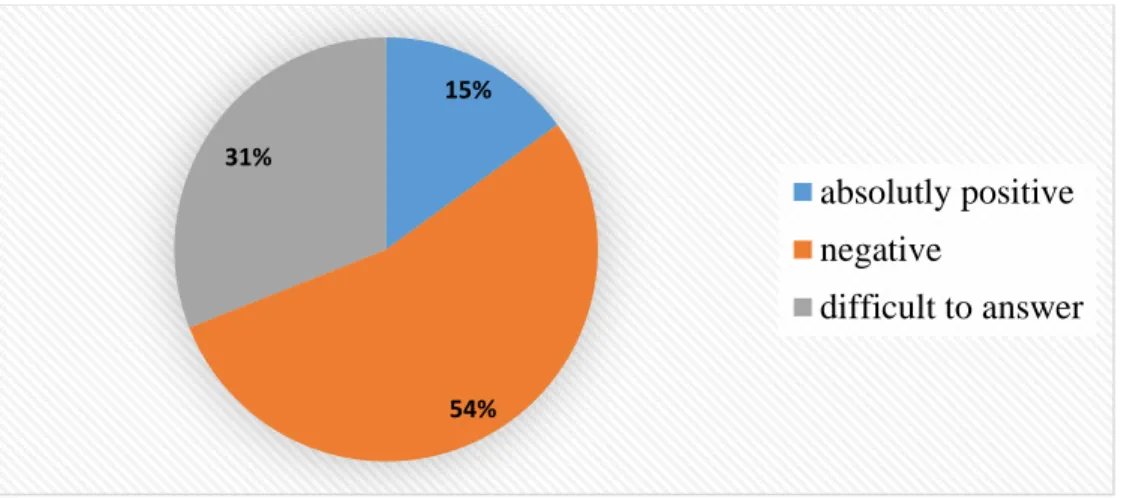
The experts also had a rather negative attitude towards national-cultural (as Figure 7 indicates) and national-territorial (as it is shown in Figure 8) autonomy as forms of solving ethnic problems. At the same time, in Ukraine, in the public consciousness (traumatized by the events in Crimea and eastern Ukraine), the concept of “autonomy” has a mostly negative connotation and is identified with separatism and violation of territorial integrity. That, in our opinion, affected the results of the survey.
Figure 7. Attitude to cultural autonomy (in solving the problems of national development through national associations to which the relevant powers are delegated) in
modern Ukraine
Source : developed by the authors 15%
54%
31%
absolutly positive negative
difficult to answer
72 Figure 8. Attitude to territorial autonomy (solving problems of national development
through national territorial units) in the conditions of modern Ukraine Source : developed by the authors
Among the legal and organizational mechanisms that can ensure the coordination and implementation of the specific interests of ethnic groups within the communities (as well as within a raion and an oblast) in the process of territorial reform, the experts point out the necessity: to create a neighbourhood council and/or a starosta (a head of the settlement) with delegation of authorities on cultural development in the settlements of the community, which differ in their ethnic characteristics from the administrative center of the community; to fix quotas for ethnic minorities in the electoral lists of political parties (by analogy with quotas for women); to create constituencies for elections to local councils, taking into account the concentrated residence of ethnic groups; to delegate to ethnocultural associations some competencies in the field of culture and education; to include in the executive bodies of the communities a representative of ethnic associations; to give the official status to minority languages in the areas of concentrated residence of ethnic minorities;
to develop specific curricula on the culture of ethnic minorities at schools; to promote an active policy on cooperation with kin-states; to create advisory bodies of ethnic minorities at the governmental authorities; to provide an additional subvention from the State budget to communities which have ethnic composition; to intensify inter- community cooperation between neighboring communities on the development of ethnic minority culture in order to maintain national folklore groups by several communities and the possibility of forming schools with teaching in languages of ethnic minorities.
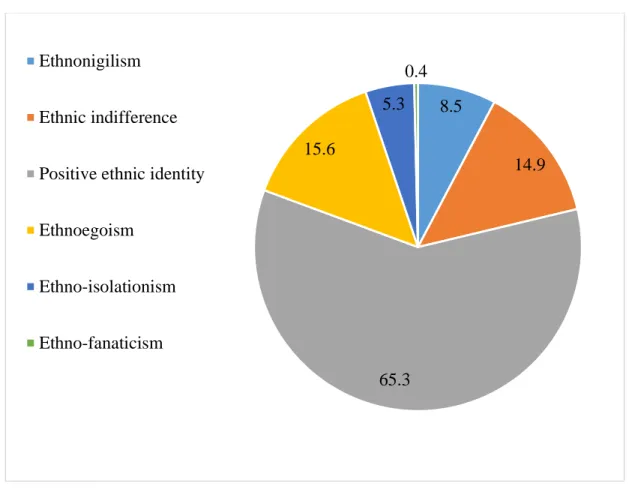
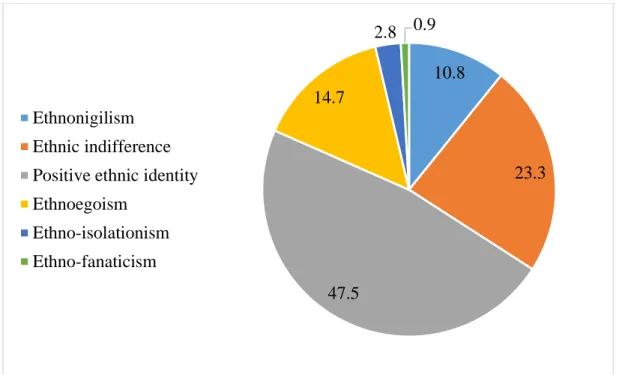
In order to determine the sustainability of community development in the area of Romanians and Moldovans settlements and the prospects for their preservation, a study on ethnic tolerance of these ethnic groups was conducted. The study included communities consisting of several settlements dominated by different ethnic groups (the first ethnic group in the community indicates its dominance), including: Ukrainian- Romanian - 1 (Tarashaniv community, Chernivtsi oblast); Romanian-Ukrainian - 1 (Sucheva community, Chernivtsi oblast); Ukrainian-Moldovan - 1 (Vashkovets community, Chernivtsi oblast); Moldovan-Ukrainian - 1 (Petropavlivs‟k community, Odessa oblast); multiethnic - Rheni community (Moldovans, Russians, Bulgarians,
22%
65%
13%
absolutly positive negative
difficult to answer
73 Gagauz); Safyany community (Russians, Moldovans, Bulgarians, Ukrainians) Odessa oblast.
The communities where all settlements within the community are Romanian and Moldovan were also taken for comparison: Volokiv community (Chernivtsi oblast) and Solotvyne community (Transcarpathian oblast).
Totally 30-50 people were interviewed in each community (436 in total). The sample is representative by age, gender, ethnicity. The error of representativeness with a confidence level of 0.95: not more than 1.4%.
Ethnic tolerance means tolerance to “otherness”, to other values, other people's way of life, traditions, culture, customs, thoughts; readiness to constructive interaction;
respect to members of other ethnic groups; ability to show patience; positive attitude to one's own and other peoples; active position in establishing mutual understanding and mutual respect; positive interaction with other ethnic groups.
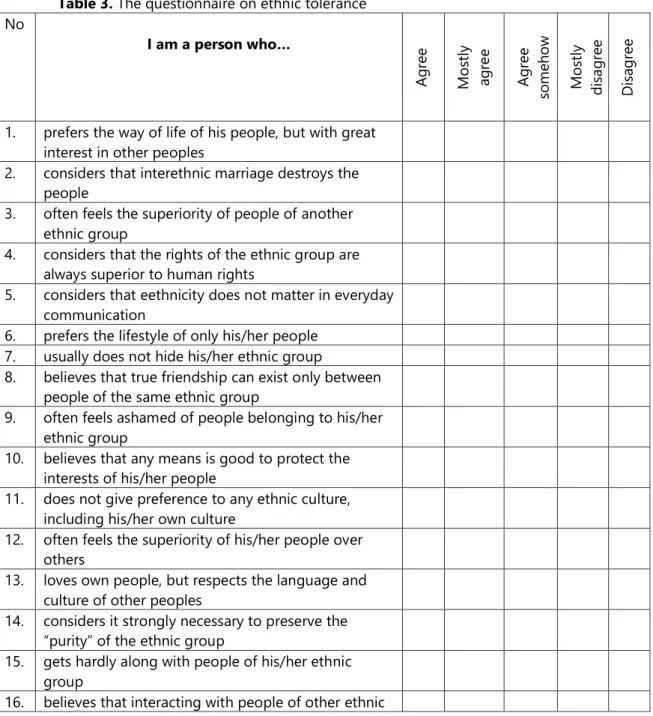
The questions of the questionnaire were traditional in terms of studying the ethnic situation (see Table 3).
Table 3. The questionnaire on ethnic tolerance No
I am a person who…
Agree Mostly agree Agree somehow Mostly disagree Disagree
1. prefers the way of life of his people, but with great interest in other peoples
2. considers that interethnic marriage destroys the people
3. often feels the superiority of people of another ethnic group
4. considers that the rights of the ethnic group are always superior to human rights
5. considers that eethnicity does not matter in everyday communication
6. prefers the lifestyle of only his/her people 7. usually does not hide his/her ethnic group
8. believes that true friendship can exist only between people of the same ethnic group
9. often feels ashamed of people belonging to his/her ethnic group
10. believes that any means is good to protect the interests of his/her people
11. does not give preference to any ethnic culture, including his/her own culture
12. often feels the superiority of his/her people over others
13. loves own people, but respects the language and culture of other peoples
14. considers it strongly necessary to preserve the
“purity” of the ethnic group
15. gets hardly along with people of his/her ethnic group
16. believes that interacting with people of other ethnic