17 he was taken out to become a watchmaker with the master, Johann GeorgButzjagerof Neulengbach, a small village on the edge of the great forests of Vienna. I know how many and how many great calculations and to systematize the complexity of the rotations of the heavenly bodies; however, all, as usual.
EPHEMERIS
AUTHOMATICA
FRANCISCO BURGHESIO,-
ANNANIENSI,
MUM*
The first clock, which should have easily been completed in less than a year, was not completed until three full years later. But when the priest stood and the watchmaker put the finishing touches on their beautiful watch, the result exceeded the greatest possible expectations, because it was truly a masterpiece.
PUBLISHED DESCRIPTION' OF THE FIRST CLOCK Father Borghesi soon came to the conclusion that
Extensive research has not revealed what happened to the first watch, although several sources state lli.it that both timepieces were presented to the Empress Maria Theresa sometime between 1764 and 1780. After all, they gained invaluable experience in the production of the first watch, in addition, , has already completed its design.
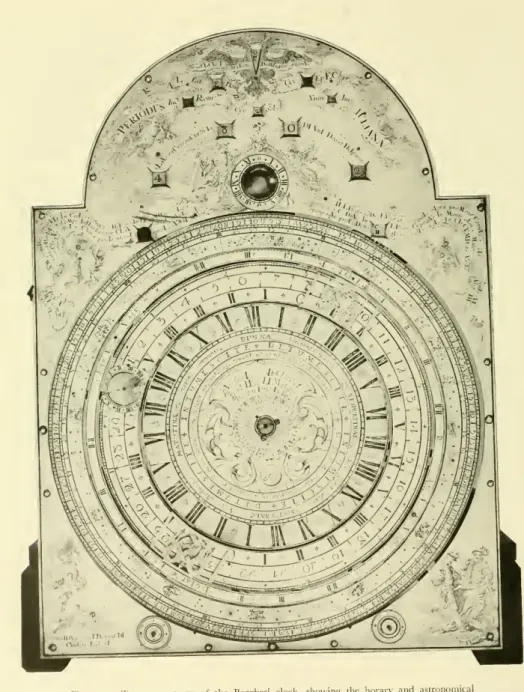
THE DIAL-PLATE ENGRAVINGS
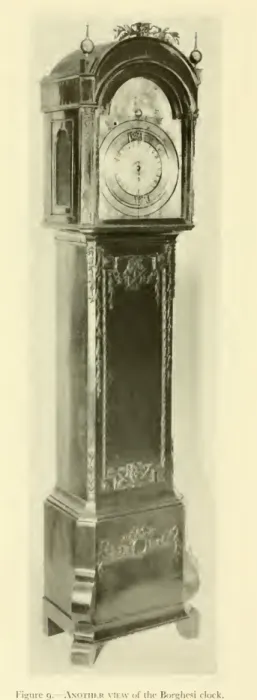
Gilt brass trim surrounds the front of the hood, which is topped by three gilt brass ball finials. Instead of hands, the dial uses three concentric rings that move around a central disk, the markings of which are read on two incised gilt lines inscribed in the glass face.
THE INSCRIPTIONS
The lower right corner shows the figures of two noblemen apparently examining and discussing a or bupona table, the meaning of which is not clear. The lower right corner of the dial plate showing two noblemen contemplating a sphere, with the last inscription "DiligitAvdaces rrepidosFortvnaRepellet.". 34;Tempe indesinenter clausa s< tturigo signata" i^ literally translated"Tempealwaysclosed,Afount<>lwatersealedup". or.freelytranslated,a-"Agarden inclosed,fountain sealed up.". uai Iedai in1.elian.pii,.
In the bottom left corner, below the figure of Atlas holding up the world, is the phrase Assidvo rorii/>. The favorable gods willingly allow the diligent worker. DiligitavdaeesIrepidosfortvnarepellet.<\orttine favors the brave and rejects the timid.).
CENTER DIM. [NSCRIPTIONS
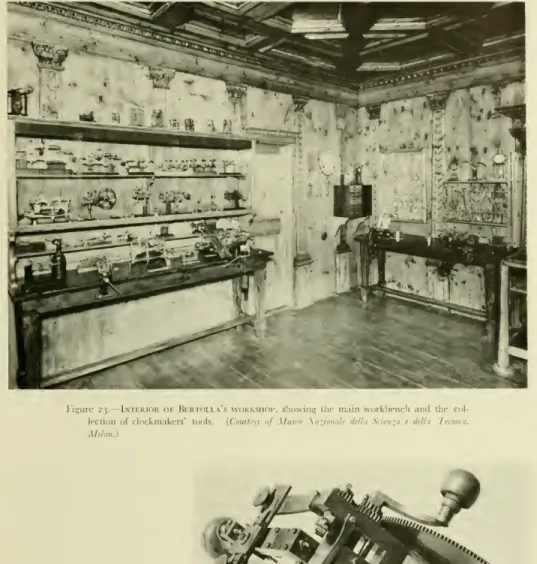
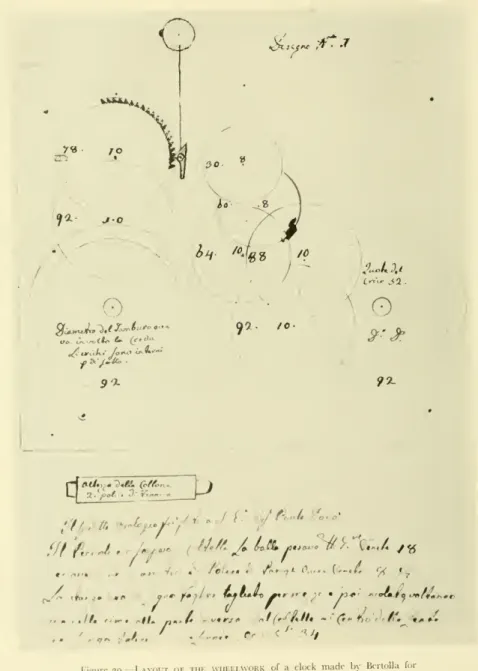
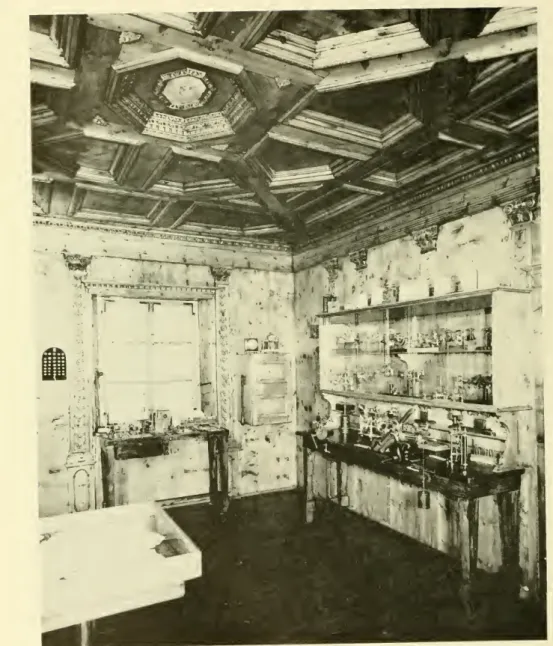
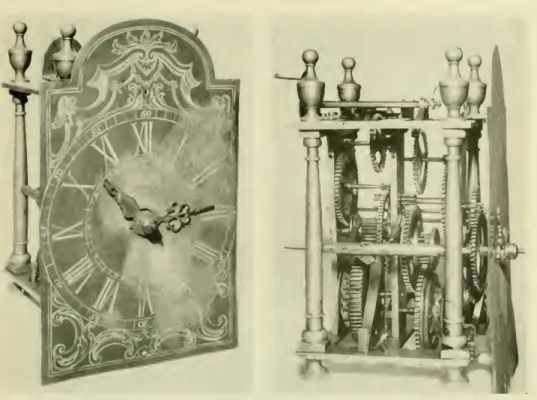
-Iitmes Mounts Diurnae (day hours) and Vespertinat (evening hours). The next part of the central dial is inscribed Intumescite Detun ris< md fall of the tide), repeating at intervals of about e\er) six km. When Phoebus and Diana agreed in their commands, the waters moved; when they disagree, they lead. INDICATORS IN THE FRONTISPIECE THE CHAPTER-RING ASSEMBLY Meton, an astronomer from Athens, discovered in 432 BC. that after a period of 19 years the new and full moons returned on the same days of the month. as they had before, and this is called the cycle of the moon. What does the sun and moon, any fixed star, hold the head and tail? Is the sea swelling with periodic heat [a) high tide?]. Which sign of the zodiac occupies the sun, the moon, the head and tail of the dragon. Isthesunor themoon, inapogee or perigee, waxing or waning.' What is the apparent speed of the sun and moon. What is the apparent size of the solar and lunar diameter, and the horizontal parallax of theumbra and penumbra of the earth. If they desire to construct a similar mechanism, they will follow the aforesaid movements of the heavens, etc., not in one way only, but in many, more quickly by thoughtful study than by any kind of instruction. 50 BULLETIN 240: CONTRIBUTIONS FROM THE MUSEUM OF HISTORY AND TECHNOLOGY THE BELLS LV C CI DIVI D DI In addition, I went a little from the lifelike pattern to the mechanical order, so that I could transfer all the movements of the sky, etc., which I enjoyed thinking more about), to the plane of the dial. In this way the ecliptic spectacles of the stars, etc., would appear their proper times distinctly before the eyes of the beholder. I could also avoid many difficulties which otherwise, perhaps, even the hands of the most skilled craftsmen could never solve.. nocturnal meditations, I have, after much consideration, rejected all explanations of the universe that have hitherto been published.. up of the universe, how admirable, and how many are uncut and how many of the annual movements are. So, Philolaus was the first to .. it through the void; then Aristarchus of Samos and then Copernicus moved the earth with the moon. IheF.gyptians. as well as Pythagoras, Ptolemy, Tycho, Riciolus, Longomontanus, etc., thought that the sun passed through the degree of the ecliptic every year. I have not in vain the annual equilibrium in all astronomical observations naI"-of the daily paper) movement of the same as it moves the poles of the heavens. ASTKONOMICUM AUTHOMA A hemisphere if part IS, proceeding in ordei from west] to east [ascending] should be assigned the corresponding signs of the zodiac; Thai is. The income of the parish priest in a small mountain village could not be equal to the relatively large costs of the projects that had been completed. It was L'iJpage in length, written in Latin, in. in the form of an answer to the writer's brother, on the subject of the watch invented by Borghesi. The anonymous letter is without date, place or note 11), p. signature, ["his scribe claimed that Thai Father Borghesi .. wrote his book, probably in .. description of the functions of the clock and in the basic theories on which the priest based his research. The ingenuity displayed in the Borghesi clock b) her the constructor, BartolomeoAntonioBertolla, calls for an examination of other examples of his work that have survived. He used all kinds of striking parts, including a music box cylinder, common in Black Forest clocks, and a stand and auger. To achieve the necessary axis of rotation of the hammer, which is perpendicular to the plate. when the clock strikes, it moves to an inclined position and moves one of the two long pins in the oblong opening. The arms were well made of steel or perforated bronze and occasionally of repussecpra; gilding was applied to the crafted hands. forged steel. Over time, Bertoll's home workshop was passed down from generation to generation within the family. In recent years, the workshop space, complete with contents, has been taken over from Bertolla's. descendants, and installed in the Museo Nazionale della Scienza edella Tccnica in Milan as an exhibition of a typical 18th century clockmaking workshop. The original workshop was dismantled in Mocenigo di Rumo and completely rebuilt in the museum, including the walls, ceiling and floor. The paneling and woodwork of the walls and ceiling, which remain intact, are hand-carved, with hand-carved columns, moldings and moldings in the center of the coffered ceiling. THE BORGHESI ASTRONOMICAL CLOCK THE BORGH1 SI ASTRONOMICAL CLOCK Clockwork of a copper lantern clock produced by Bertolla at the age of 80, with details of the movement and double bell. The chapter ring, which is soldered to the dial, is. marked for the minutes on the outer edge and for the four quarters within. Above its center there is a semicircular opening in the dial, through which. visible is a rotating disk mounted behind the dial. This disk is marked with the hours and rotates from right to left, with the current hour indicated by a projection of the minute ring. brass dial plate engraved with simple floral motifs. in the corners and around the broken arch. There is no comparison between this rough and simple decoration and the extremely fine quality of the engraving on the dial of, for example, the Borghesi clock. Three circles are assigned to the lowest index, of which 30 degrees of the moon's distance from its nodes constitute the largest. Lying between these circles, there is another eccentric circle (black with a dot) showing the shadow of the earth, into which the small moon sinks itself, carried with the lowest index. In the first case, the equation is subtracted from the mean longitude of the moon, descending from apogee to perigee; in this second case, with beads in the longitude of the moon ascending from perigee to apogee; and, in the third semicircle of the index, as the rubric directs, common to the equations, added around the center. Each of these parts is again, in the outer periphery, divided further into 30 parts, which are the 12 signs of the zodiac and the individual degrees of the signs of the distance between the sun and the sun. Finally, on the fourth largest circle, several primary minutes of the circle are seen to reduce the moon's orbit to the ecliptic. In order to obtain the true longitude of the moon more accurately, these must be subtracted from the longitude of the moon. Here then [you] have, as at last completed, the delineation of the great index partially described before in this book. Between two points of that index corresponding perpendicularly to the center of the circles, a pair of compasses, through an unchanged opening to the circumference! the first larger circle, marked oil lour. Both segments of division, like a small wing of the index, extend to the measure of the degree of distance of the moon from .. its nodes, and to which that particular degree of latitude corresponds. On the one hand, that latitude is exactly equal to the radii of the earth, the sun. and the moon. . as the endpoints of solar eclipses; and on the other side are exactly equal to the radii of the earth's shadow and of the moon, as the limits of lunar eclipses. Lastly, as indicated by the epact and the dominant letter in a fixed table added outside, are the iys, ni Since lunar eclipses appear to sick people to be of the same magnitude and duration, and begin and disappear at the same absolute instant, I. Heir, as long as the true ecliptic is full, you can determine the pointer of the third minor index. hours, etc., duration, and the centimeters of the greatest eclipse. I made sure the wheel communicated immediately'; movement to the index of the synodic moon should be internally assigned to the mechanism that... l.\ the reversal of an) external index, the wheel would be removed from its proper position; if desired, it could be restored to the right place quickly and extremely accurately. You only need to guide the index of the synodic moon in circles with your hand, always seeing if, in the passage that this index places on the small index, both pointers of the small index are hidden by the segments of the circle. The second month as well as the day of the month will be indicated by the small, historical index indicator on the right side of the watch. Although the machine repeats hours and quarter hours at will and. Consequently, the number wheels and the rest of the apparatus necessary for these functions increase, it is not increased to an unwieldy size, however much one might wrongly imagine it to be. BIBLIOGRAPHY46 BULLETIN 240: CONTRIBUTIONS FROM THE MUSEUM OF HISTORY AND TECHNOLOGY
ATTACHMENTS FOR ADJUSTMENT
PUBLISHED DESCRIPTION OF THE SECOND CLOCK When the clock had been completed and proved to
MUNDI SYSTEMA
62 BULLETIN 240: CONTRIBUTIONS FROM THE MUSEUM OF HISTORY AND TECHNOLOGY
64 BULLETIN 240: CONTRIBUTIONS FROM THE MUSEUM OF HISTORY AND TECHNOLOGY
BULLETIN 240: CONTRIBUTIONS FROM THE MUSEUM OF HISTORY AND TECHNOLOGY
68 BULLETIN 240: CONTRIBUTIONS FROM THE MUSEUM OF HISTORY AND TECHNOLOGY
SYNOPSIS OF THE COMPLETE MECHANICAL WORKS OF THE FIRST CLOCK
VIII