
The Minimum Equivalent Expression problem is a natural optimization problem at the second level of the Polynomial-Time Hierarchy. Circuit minimization problems are natural optimization problems located at the second level of the polynomial time hierarchy (PH).
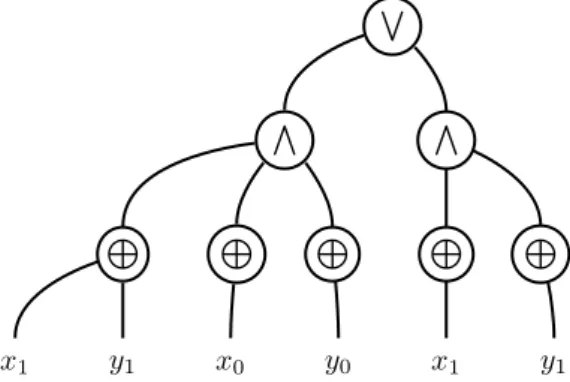
Description of the reduction
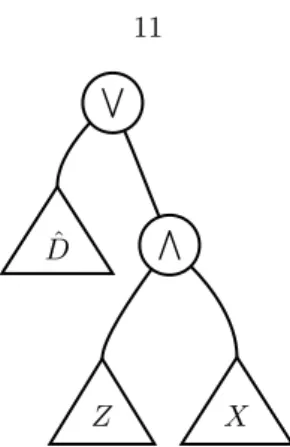
We can then determine whether there is coverage of size k or not by asking whether (2.1) has an equivalent formula of size at most k that is greater than the size of the subformula D and the variable z. For example, since the sets in the original instance cover all points in the domain, D∨z is already a small equivalent formula that does not depend at all on whether the instance of the concise set coverage was a positive instance or not.
Outline
Preliminaries
But the formula Fbρ0 is clearly equivalent to F, so the w-weighted size is an upper bound on the minimum w-weighted size of a formula equivalent to F.
The problems
Given a depth-of-Boolean formula F and integers, is there an equivalent depth-of-fit formula of size at most k. Although the distribution of NOT gates per variable level obviously does not affect the size of the formula, it is not so clear that finding a formula for minimum depth d is equivalent to finding a formula for minimum depth d with an OR gate in the root.
Main results
Top OR gate vs. unrestricted top gate
When discussing constant depth formulas, as usual, we allow arbitrary AND and OR gates and use the convention that all NOT gates appear at the variable level. Otherwise, there exists a formula F∗ such that F∗ has a smaller equivalent depth-d formula with an AND at the root than the smallest equivalent depth-d formula with an OR at the root. Equivalently, F∗ has a smaller equivalent depth-d formula with an OR at the root than the smallest equivalent depth-d formula with an AND at the root.
If F has an equivalent formula of depth d with OR in the root of size at most k, then it is clear that F0 has an equivalent formula of depth d of size at most k0. If F does not have an equivalent depth dformula with an OR gate on the root of size at most k≥0, we consider that it cannot be a constant function. Thus there must be an equivalent formula for F with an OR gate at the root of size at most k (and this formula can be obtained by restricting the variables belonging to Gi in Fb0 so that each Gi becomes 0).
So we conclude that F has an equivalent formula of depth d with an OR gate in the root of size at most k, which is a contradiction.
Main reduction
- The z variable
- Properties of F b ρ
- The X sub-formula
- Position of the z variable
- Finishing up
We make at most log|D0|calls to the oracle to find the size of the smallest equivalent depth-d formula with the upper OR gate for D0, using binary search. Let Db be a d-depth upper-gate formula equivalent to D0 of size, and let I⊆ {1,2,. n} be a set of size in mostk for which. such a set exists because the MSSC instance is a positive instance). In the other direction, we assume that the MSSC example is a negative example, and we wish to show that there is a nodepth-d formula with the upper OR gate equivalent to the size of Fof at most 4u+2k+2n+1.
From Fb we will derive a minimum depth-d formula for F that has the form shown in Figure 2.1. Note that the transformation in Lemma 2.5.11 does not increase the size of the formula, nor its depth if Gal already has an upper OR gate. There are four cases depending on where zi occurs in Fbρ: under the OR gate at the top level, under an AND gate below the second level, under an OR gate below the third level, or under an OR gate at the third level.
Thus, since (zi∨B)∧ALLT RU EimpliesFbρ, by Lemma 2.5.12 we know that Fbρ is not minimal, which contradicts the lemma, or there is an equivalent top-door depth-d formula OR with size |Fbρ| and in which this subformula appears directly under the AND gate of the second level, thus placing zi directly under the OR gate of the third level. There is a formula for minimum depth d with an upper OR gate equivalent to F in the form shown in Figure 2.6. By the lemma, this quantity is a lower bound on the size of the minimal depth dformula with an upper OR gate equal to F, so it must be minimal.
The unbounded depth case
On the other hand, when Z is set to true, the formula must accept every assignment in which at least one variable is set to false. By Lemma 2.5.9, we know that we can assume that B is a disjunction of negated variables, and that it must have size at least u+n+k+ 1 (because the original MSSC instance was a negative instance).
Conclusions and open problems
These are form problems: given a Boolean circuit (of a specified form), is it a minimal circuit (of the specified form). This section contains a high-level description of the reduction used to show that Problem 1.0.1 is ΣP2-complete under Turing reductions, in order to facilitate understanding of a more technical description later. To reduce MSSC to MSF, we try to split the SPP formula of the MSF instance into a part that calculates D and another that accepts W .
To achieve this, we add a variable z, whose value determines whether the formula calculates D for the rest of the variables, or D∨W. The difficult direction of the reduction shows that if the MSSC instance is negative, so is the MSF instance. To avoid confusion, we do not call this a weighting in the more technical description of the reduction, but simply mention the reduction with variablesz1.
This is a big change, and the mere existence of multiple copies of variables completely destroyed many of the proof techniques used in Chapter 2.
Outline
Such an XOR cannot accept both a= false, b= false and ena= true, b= false, since these assignments differ in parity. We therefore need multiple copies of this variable in any reduction from MSSC to MSF using the same general approach as in Chapter 2. In a depth-3 Boolean formula such as that considered in the earlier reduction of MSSC to MEE3, the subformula that is thez-variable contains a DNF, and is therefore not limited in computational power like a pseudoproduct.
Because the z-variable cannot appear only once, the relative weights must be completely different from those used in the MEE reduction, to allow for an unknown number of z-variables. Instead of a single z variable having more weight than the rest of the formula combined, all the z variables combined have less weight than any other single variable. We can get a handle on the structure of the pseudoproducts containing the z-variables by developing new proof techniques.
Results
Complexity of Related Problems
An important implicant of a DNF D is a term that implies D, and does not imply any other term that implies D. We show that SPP-PP is DP-hard, using the same reduction as in [GHM08] to prove that IS-PRIMI is DP-hard. We use the same reduction as in [GHM08] to show that IS-PRIMI is DP-hard.
Setting f =¬α∨(¬β∧y), we see that SPP-PP is DP-hard and show that IS-PRIMI is DP-hard. One might also hope that the proof that the DNF formula minimization is ΣP2-complete would transfer directly to a proof that the SPP formula minimization is ΣP2-complete, while the proof that IS-PRIMI is DP-hard would transfer directly to a proof of SPP -PP is DP-hard. However, the proof of DP hardness for primary implicants had the convenient feature that the DNF term y is a primary implicant if it is a primary pseudoproduct.
However, proving that a DNF minimization is ΣP2-complete does not have the similar property that the produced DNF is a minimal DNF if it is minimal SPP.
Weighted variables
In general, the problems in formula minimization differ in that the problem instance is compared against all formulas with size less than k, requiring a different reduction when the type of formula being considered changes. Given an SPP formula F with associated weight function w(v), we call F the weighted version of the formula. Our strategy has the advantages of dealing with negation without the need for a possible increase in the depth of the formula, and can be easily applied to SPP formulas.
Given an SPP formulaS, a list of weights wfor each variable in unary, and an integer k, there is a formula S0 corresponding to S for which|S0|w6k. If F is aw-minimum formula forf and F0 is a minimum formula corresponding to the extended version of F, then|F|w=|F0|. Furthermore, by Lemma 3.3.4, the w-minimum formula corresponding to S is at most of size k iff if the minimum formula corresponding to S0 is at most of size, which proves the theorem.
Since these two problems are polynomial-time equivalent, we only need to prove under Turing reductions that one of them is ΣP2-complete to see that they both are.
Main Result
We will show that if the MSSC instance is negative, the W-MSF instance is also negative, by first restricting ourselves to the part of the formula that calculates D via Claim 3.3.7.1 to obtain a lower bound on τ. We then show that the part of the formula removed by the constraint is greater than thank(k+ 1)` by Proposition 3.3.7.2. By Lemma 2.5.8, the minimal formula that accepts everything that is not accepted by D and rejects all true assignments to the variables thexi is of the form W .
The magnitude contribution ofxi variables inU is therefore at least k(k+ 1)`, which completes the proof of the statement. Most importantly, we have solved the complexity of the MSF problem and provided a critical theoretical background for an important area of research in logical synthesis. The complexity of k-SPP minimization remains unresolved because the weighting scheme used in this chapter requires polynomial fan-out of the XOR gates.
Finally, we note that the full characterization of the complexity of SPP-PP remains unsolved, as we have proven that SPP-PP is DP-hard, but not that SPP-PP∈DP.