
I would also like to thank Williams lab members past and present, Digna Velez and Jackie Bartlett for their friendship and support, as well as all the students in the Human Genetics Program and members of the Center for Human Genetics Research. Part C determines whether SNPs in toll-like receptor 2 (TLR2) and toll-like receptor 4 (TLR4) are associated with pro- and anti-inflammatory cytokine concentrations.
Introduction and Background
Five million infants are born each year, of which approximately 12% are born preterm (defined as less than 37 weeks' gestation) (Martin et al., 2005). When found, it may indicate microrupture of the fetal membranes or disruption of the choriodecidual interface (Lockwood et al., 1991).
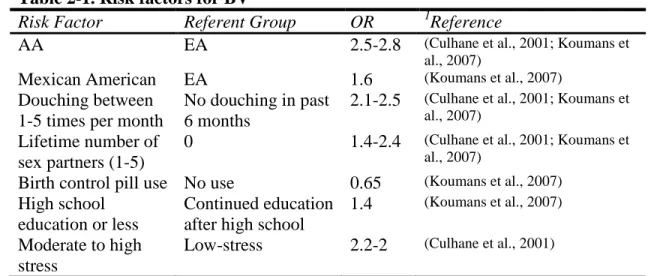
Hypotheses and Specific Aims
The Magee Womens cohort will be used to identify SNPs associated with cervical cytokine concentrations in EA and AA women separately. These SNPs will be tested for association with logistic regression in the Cenn and MoBa samples combined to determine effect size.
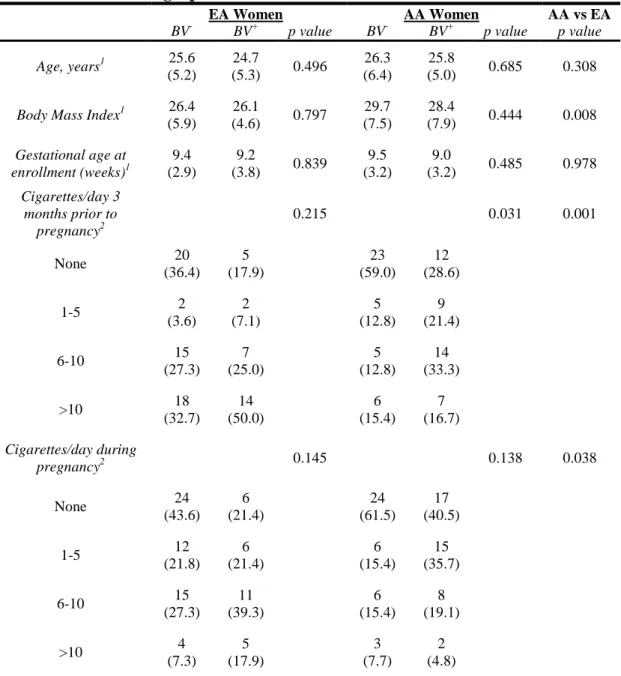
Cervical Cytokine Concentrations Differ by BV Status and Race
There were still no significant differences in cytokine concentrations between EA and AA BV+ women. Our findings support the idea that the nature of the inflammatory milieu in the cervix is different in BV+ and BV- women.
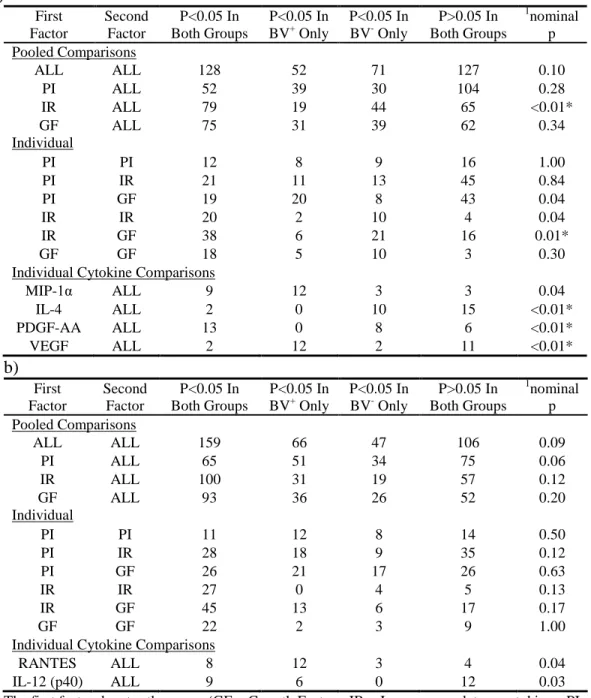
Patterns of Cervical Cytokine Concentrations Differ by BV Status and Race
In EA, there were 180 significant correlations in BV+ and 199 in BV- women (Appendix Figure 1a and b). Also, only 13 of the 23 heterogeneous correlations between BV+ and BV- women were more highly correlated in BV+ women (Figure 3-1b, Appendix Table 3).
Genetic Associations of Cervical Anti-inflammatory Cytokines Differs by BV Status and Race Status and Race
Our data demonstrate a significant relationship between cervical concentrations of IL-10 and common polymorphic variation in the gene encoding this cytokine receptor (IL-10RA), especially in EA. Importantly, the contribution of genotype to IL-10 concentration is significant even when considered in the context of BV. There is previous literature supporting a contribution of genetic variation to the production of inflammatory molecules, including IL-10.
Recently, peritoneal fluid concentrations of IL-10 in women with endometriosis were found to differ by IL-10 genotype (Zhang et al., 2007). Genetic regulation of IL-10 may also be associated with disorders of an infection-mediated or inflammatory nature. Maternal carriage of the IL-10-1082 G allele in the presence of chorioamnionitis was associated with early sPTB (Kerk et al., 2006).
Therefore, it is possible that these changes, especially rs2229113, are directly involved in influencing IL-10 concentration. It is interesting to note that in our study, the polymorphisms most associated with IL-10 levels are in the genes encoding the IL-10 receptor, not in the IL-10 gene itself.

Genetic Associations of Cervical Pro-inflammatory Cytokines Differ by BV Status and Race
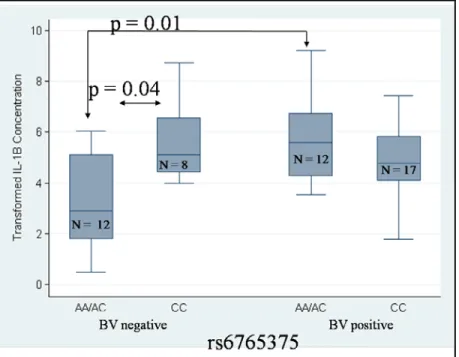
Furthermore, BV- women with the AA/AC genotypes had significantly lower cervical IL-1β levels compared to BV+ women with the same genotypes (median 17.5 ng/ml vs. 264.3 ng/ml, p = 0.013). Furthermore, BV+ women with the CT/TT genotypes had significantly higher cervical TNF-α levels than BV- women with the same genotypes (median 48.5 ng/ml versus 5.0 ng/ml, p = 0.003). Furthermore, BV+ women with the TT genotype had significantly lower cervical IL-6 concentrations than BV- women with the same genotype (median 147.0 ng/ml vs. 3444.5 ng/ml, p = 0.033).
To determine whether significant associations with cytokine levels were influenced by race, main effects of race and interactions between race and SNP were examined for each cytokine in BV+ and BV- women separately (Table 4-3). It remains unclear why some women with BV have adverse pregnancy outcomes such as PTB and others do not. In our study, two intronic SNPs in IL-1AP were associated with higher cervical IL-1β concentrations in AA BV+ women with a particular genotype compared to BV- women with the same genotype.
While EA and AA women differed significantly in allele and genotype frequencies at rs6765375, there were no main effects of race or race/SNP interactions with IL-1β levels in BV+ or BV- women. Our study supports this finding and shows that genetic associations with proinflammatory cytokine concentrations were more pronounced in AA and race-SNP interactions were absent in women with BV.
Genetic Association of Cervical Pro- and Anti-inflammatory Cytokines by Toll- like Receptors
A previous study identified a variant in TLR4 associated with BV-related bacteria and increased concentrations of vaginal IL-1β. Although not significant after initial correction for multiple testing with FDR, rs1927911 and rs2149356, both in TLR4, were the only polymorphisms associated with five or more cytokine levels in EA women (Table 4-4). In BV+ women with the CT/TT genotype, TNF-α concentration was significantly higher than in women with the CC genotype (median 5.0 ng/ml versus 28.5 ng/ml) (Figure 4-7c) .
Previous studies in this chapter identified IL-1RAP, IL-8RA, and TNFR2 variants associated with cervical anti-inflammatory IL-1β, IL-8, and TNF-α concentrations in AA but not in EA. Furthermore, in EA, the SNP in IL-6R was associated with levels of IL-6, which is classically defined as an anti-inflammatory cytokine but has many anti-inflammatory properties. A polymorphism in TLR4 (rs4986790) was previously found to be associated with an increase in vaginal pH, G.
A similar trend in BV+ women, albeit not significant after correction for multiple testing, was observed with the TT genotype being associated with higher cervical IL-1β concentrations than the AG/GG genotypes. Furthermore, we found several SNPs in TLR4 that were associated with multiple proinflammatory cytokine concentrations in EA, but not in AA.

Maternal and Fetal Single Locus Associations with PTB
Thirty-four SNPs in COL1A2 were examined for association with PTB in maternal and fetal samples and ten of these associated with PTB (Figure 5-3a and Appendix Table 10). Seven SNPs were only associated with PTB in fetal samples, one SNP was only associated in maternal samples and two SNPs were associated in both maternal and fetal samples. In fetal samples, there were significant haplotype associations spanning two regions of the gene (Figure 5-3a).
Seventeen SNPs in TFPI were examined for association with PTB in maternal and fetal samples and nine of them associated with PTB (Figure 5-3b and Appendix Table 11). Eight SNPs were significantly associated with PTB in both maternal and fetal samples, and one SNP (rs6434222) was associated only in fetal samples. In the fetal samples there was significant haplotypic association involving two regions of the gene (Figure 5-3b).
Of the five collagen genes examined, all were associated with PTB in maternal or fetal samples. Intronic SNPs in TFPI had the strongest associations in fetal samples and several SNPs in TFPI associated with PTB in both maternal and fetal samples.
Corroboration of Maternal and Fetal Single Locus Associations with PTB
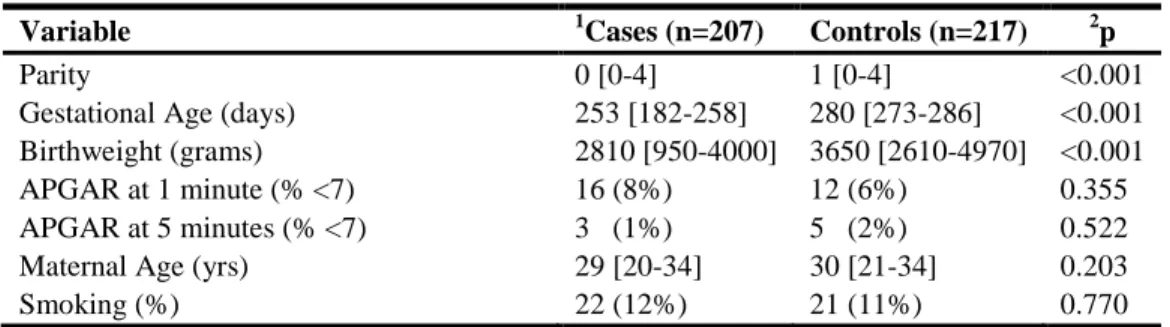
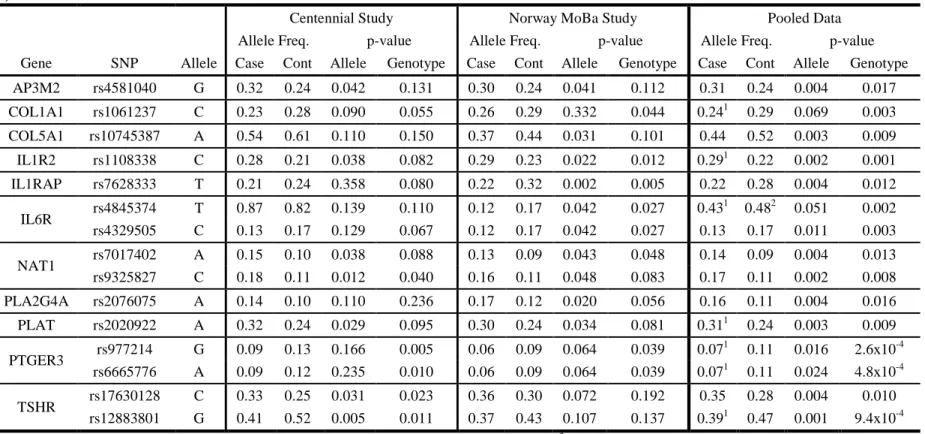
The control group was defined as a gestational age ≥ 390/7 weeks in the Moba study and ≥ 370/7 weeks in the Cenn study. The most significant single-locus result in the pooled sample was in prostaglandin E receptor 3 (PTGER3). There were six SNPs in this gene that met the criteria for pooled analysis and three of these (rs2072947, rs977214 and rs6665776) had significant allelic or genotypic results in the pooled samples.
Haplotype associations spanned three general regions of the gene; two of these regions were significant only in the Cenn study, and one of these regions was significant only in the Moba study (Figures 5–6). PTGER3, Asterisks to the right of a SNP indicate significant single locus allelic associations with PTB, blue indicates significance in pooled samples, red indicates significance in the MoBa study and black indicates significance in the Cenn study. Previous studies in Part A of this chapter identified significant maternal and fetal associations with PTB in COL1A2 in the MoBa study.
In addition, the most significant associations in the pooled samples were from two main PTB pathways:. In addition, three of the six SNPs examined in the pooled sample were associated with PTB.
Summary
IL-6R, IL-10RA and TLR4, all associated with cervical cytokine concentrations in EA but not AA, act through the JAK/STAT signaling pathway to either inhibit (IL-10RA) or pro-. IL-1RAP and TNFR2, both associated with cervical cytokine concentrations in AA but not EA, signal through the MAPK/NF-kB signaling pathway to induce production and release of proinflammatory cytokines. Our studies identified genes associated with PTB involved in the previously mentioned pathways (Figure 6-2).
Several studies have identified SNPs in the inflammation/infection pathway associated with PTB; however, these studies often fail to replicate (Velez et al., 2007; . Velez et al., 2008b). In this study, we identified many SNPs in inflammation/infection-related genes such as IL-1R2, IL-1RAP, and IL-6R that are consistently associated with PTB (Figure 6-2). Studies in part B of chapter IV showed that in a separate EA population, a SNP in IL-6R was significantly associated with cervical IL-6 concentrations.
Another important pathway consistently associated with PTB is the decidual hemorrhage pathway that activates ECM degradation. Collagen, in particular type I and type III, plays a vital role in changes in tissue consistency associated with cervical ripening (Word et al., 2007).

Future Directions
Tumor necrosis factor-alpha promoter variant 2 (TNF2) is associated with preterm delivery, infant mortality and malaria morbidity in western Kenya: Asembo Bay Cohort Project IX. 2004) Vaginal lactobacilli in adolescents: presence and relationship to local and systemic immunity, and to bacterial vaginosis. 2002). The recurrence of spontaneous preterm labor. 2007) Modulation of vaginal immune response among pregnant women with bacterial vaginosis by Trichomonas vaginalis, Chlamydia trachomatis, Neisseria gonorrhoeae and yeast. 2007) Association of interleukin-1beta and interleukin-1 receptor antagonist polymorphisms with bacterial vaginosis in non-pregnant Italian women. 2003) Relationships of interleukin-8 with interleukin-1beta and neutrophils in vaginal fluid of healthy and bacterial vaginosis-positive women.
Beijing Da Xue Xue Bao. 2004b) Maternal and child methylenetetrahydrofolate reductase C677T polymorphism is associated with preterm birth and low birth weight. Beijing Da Xue Xue Bao. 2007) Hormonal contraceptive use modulates the local inflammatory response to bacterial vaginosis. Does pre-pregnancy bacterial vaginosis increase a mother's risk of having a premature baby with cerebral palsy? 2005) Heritability estimates of innate immunity: an extended twin study.
A promoter mutation that increases transcription of the tumor necrosis factor-alpha gene is not associated with preterm birth. Factor V Leiden mutation carriers are prone to miscarriage and placental infarction. Amniotic fluid interleukin-6 and preterm birth: a review. 2005) Risk of spontaneous preterm birth is associated with common proinflammatory cytokine polymorphisms. Matrix metalloproteinase-9 promoter polymorphism is associated with increased risk of premature rupture of membranes in African Americans.
2004b) Relationship between a toll-like receptor-4 gene polymorphism, bacterial vaginosis-related flora and vaginal cytokine responses in pregnant women.