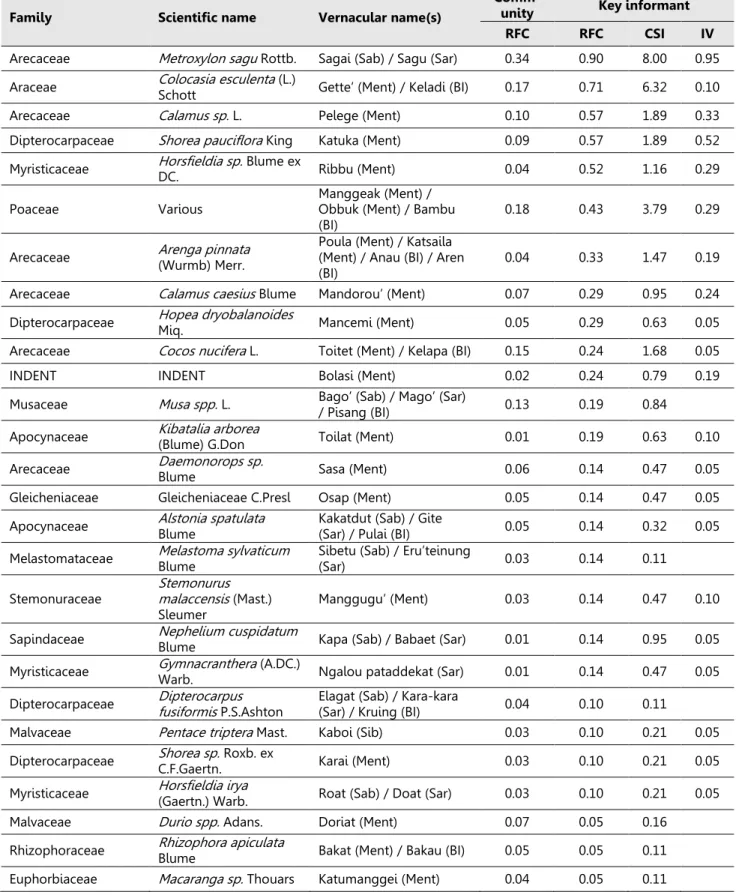
Climber L, R Used in many medicines, especially for kisei medicine, Used in laggek sasaggoi and laggek lango' preparations. Category Family Scientific name Language name(s) Plant habit Part. Sar) Grass L Used in laggek lango' sikebukat preparations. Simuinek (Sar) Wood L, St Used in laggek pakop sagu, laggek lango', laggek besit ute' and laggek sasaggoi preparations.

Discussion
During the observation period it was also noted that fields are often fenced with coppice ngirip/irip (Barringtonia racemosa (L.) Spreng. Lecythidaceae)), a practice shown to improve biodiversity in agricultural landscapes (León & Harvey 2006). Fertilizers, herbicides and pesticides are generally not used, although during the study period there were observations of farmers spraying poisons to control ferns and grasses along garden paths in resettlement communities. It was also observed that where customary land tenure is no longer observed, deforestation, sediment run-off and pollution are more evident (although this requires further research to validate these initial observations).
Collaboration with Mentawai researchers was central to the implementation of the research activities and analysis, and is the first of its kind to emerge from Mentawai. When participants were informed that data collected during the research period would be returned to the community for their own use, and to develop knowledge-sharing resources for their children, participants were observed to be more motivated to provide in-depth and accurate to offer answers. Furthermore, as native speakers of the Sabirut and Rereiket dialects, the inclusion of Mentawai people as researchers, not just informants, is believed to have greatly reduced the likelihood of errors in listening or spelling of words and meanings in the Mentawai language .
Additional perceived benefits of the project include: contributors' increased sense of ownership and empowerment in the conservation of Mentawai TEK; colleague and community increased awareness of Siberut's unique biosphere; and increased awareness of the international conservation agenda and protocol. I knew that our forest was important, but I did not realize how many important plants - especially medicinal ones - are in such a small part of the forest. Given the significant impact of industrial agriculture on biodiversity (Laurance et al. 2014, Lin et al. 2011), practices such as those traditionally used by the Mentawai people contribute significantly to supporting Siberuta's biodiversity (Kumar & Nair 2004).
If so, there is a possibility that native or endemic plant species may become extinct, thereby causing a decline in the well-being of the Mentawai and their biome (WWF 1980). Furthermore, by not practicing slash and burn farming methods, a lack of fire across Siberut's landscapes ensures that the soil is never exposed, preventing significant erosion, runoff and sedimentation of streams – an important practice given that Siberut's fragile soils originate from hardened mud sediments and that marginal zones are exposed to extreme erosion (Suhandi et al. 2002; WWF 1980). Biological and Cultural Significance of Sague Previous reforms enforced throughout Siberut and greater Mentawai sought to replace sagus swamps with rice cultivation programs (Pradipta 2019) and the Mentawai people were forced to replace sagu with.
Saguen despondency also failed to recognize the ecological efficiency of the palm for staple food production (WWF 1980; Pradipta 2019). Given observations of changes in rice season and harvest yield due to climate-related effects (Li et al. 2017), existing ecosystems that already achieve efficient staple food production such as Siberut's sago swamp and pumonean are essential to ensure food security for a growing population, and have significant value in relation to current efforts to conserve biodiversity (World Resources Institute 2019). Given the interconnectedness of culture and biodiversity (Posey 1999, Pretty et al. 2009), the plants most valuable to a community and the cultural traditions that result from them are fundamental to biodiversity conservation and ecosystem regeneration.
Conclusions
Traditional Mentawai practices have the potential to ensure local food security, maintain long-term sustainability and regenerate human-degraded ecosystems (Garrity 2004, Kumar & Nair 2004, McNeely & Schroth 2006, Retnowati 2003). This substitution not only ignored the cultural significance of sago and displaced a crucial food, building, and medicinal resource (Pradipta 2019), but labeled a nutritious food source as primitive and only for the poor—decreasing its status in the eyes of consumers decreased. Failure to consider Mentawai TEK in resource conservation and management could drive Siberut's unique biodiversity and culture to extinction.
The global ecological crisis is too urgent to ignore the contributions of Mentawai TEK and the input of local researchers to advance the understanding of Indonesia's ecosystems and species.
Declarations
Before participating in any research activities, participants read (or were read to in their preferred language) and signed an informed consent document, which outlined the research objectives, risks, benefits, and confidentiality agreements. All participants were informed that they had the right to refuse participation at any time throughout the research activities, and were under no obligation to reveal any knowledge they did not want to share, or felt was confidential. Consent for publication: Before participating in any research activities, participants read (or were read to by a trusted witness) and signed an informed consent document, which outlined the research objectives, risks, benefits, confidentiality agreements and permission for publication.
All participants were informed that they had the right to refuse participation at any time during the research activities and were not obliged to reveal any knowledge they did not want to share or considered private knowledge. Availability of data and materials: The data have not been deposited in a public repository, but have been made available to the Mentawai community through Yayasan Pendidikan Budaya Mentawai. Funding: Fieldwork activities associated with this project were funded by a National Geographic Society Early Career Research Grant (EC-53693R-19) and supported by the Australian Government Department of Foreign Affairs and Trade through the Colombo New Plan Scholarships.
These agencies were not involved in any aspect of the study preparation, data collection, or preparation of this publication. Author contributions: SML conceptualized the initial fieldwork plan and was the primary author of the manuscript, with suggestions for improvements from JDN and DL. SML and SS were involved in the design and implementation of the methodology and performed the data analysis.
FS participated in fieldwork and improved accuracy of Mentawai plant names and variations between dialects.
Acknowledgements
Literature cited
Quantifying the contribution to biodiversity conservation of protected areas governed by indigenous peoples and local communities. Capacity building and knowledge sharing on Indigenous Peoples and Community Territories and Conservation Areas (ICCAs). Between the Spice of Life and the Melting Pot: Biodiversity Conservation and its Impact on Indigenous Peoples.
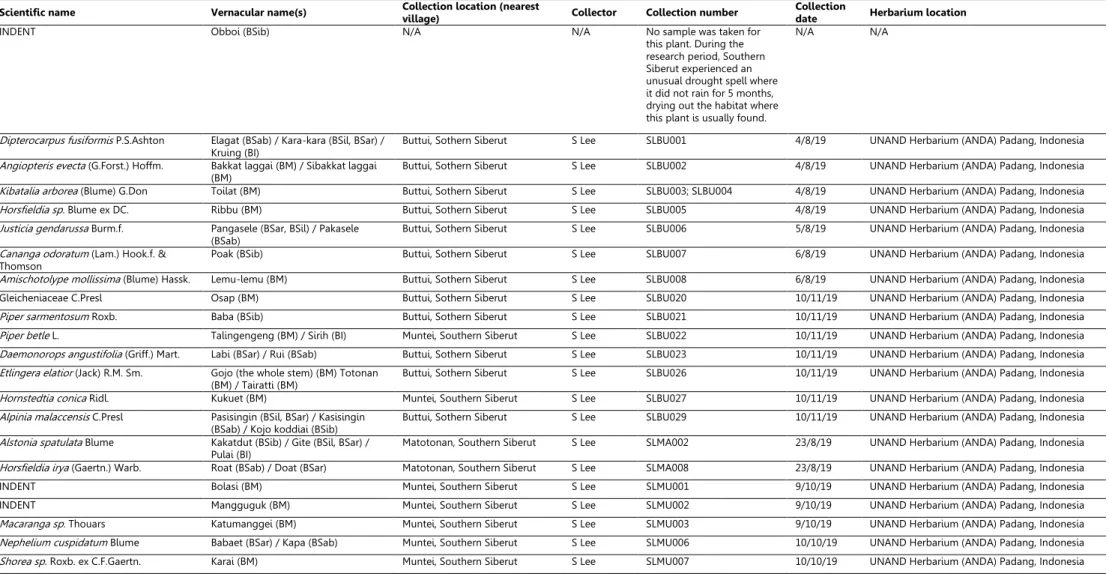
Summary for policymakers of the Global Assessment of Biodiversity and Ecosystem Services Report of the Intergovernmental Science-Policy Platform on Biodiversity and Ecosystem Services. Report of the Center for Tropical Native Ethnobotany Workshop on Cultural Use of Plants, Cairns, 19 November 2010. Bakkat laggai (BM) / Sibakkat laggai. BM) Buttui, South Siberut S Lee SLBU002 4/8/19 Herbarium UNAND (ANDA) Padang, Indonesia.
Kibatalia arborea (Blume) G.Don Toilat (BM) Buttui, sydlige Siberut S Lee SLBU003; SLBU004 4/8/19 UNAND Herbarium (ANDA) Padang, Indonesien. Nephelium cuspidatum Blume Babaet (BSar) / Kapa (BSab) Muntei, det sydlige Siberut S Lee SLMU UNAND Herbarium (ANDA) Padang, Indonesien. Mancuat (BM) / Matcuat (BM) Muntei, det sydlige Siberut S Lee SLMU UNAND Herbarium (ANDA) Padang, Indonesien Ludwigia linifolia Poir.
Bekeu (BM) / Hibiscus (BI) Muntei, Suidelike Siberut S Lee SLMU UNAND Herbarium (ANDA) Padang, Indonesië Nephelium lappaceum L. Bamboestipes Manggeak (BM) / Bambu (BI) Muntei, Suidelike Siberut S Lee SLMU019 4/8 / 19 UNAND Herbarium (ANDA) Padang, Indonesië. Oroket (BSab) / Palakkokoai (BSar) Muntei, Suidelike Siberut S Lee SLMU023; SLMU UNAND Herbarium (ANDA) Padang, Indonesië Kaempferia galangal L.
Ottot (BM) / Pari-pari (BSib) Muntei, Južni Siberut S Lee SLMU UNAND Herbarij (ANDA) Padang, Indonezija Colocasia esculenta (L.) Schott Gettek (BM) / Talas (BI) / Keladi (BI) Muntei, Južni Siberut S Lee SLMU UNAND Herbarium (ANDA) Padang, Indonezija Curcuma zanthorrhiza Roxb.