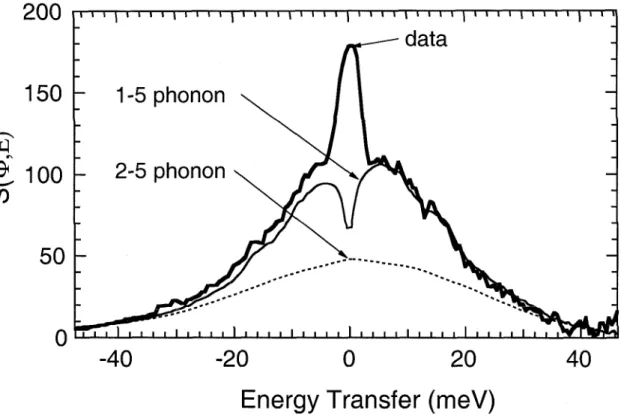
The vibrational entropy of the NiTi-nartensitic transition was measured using low-temperature calorimetry and inelastic neutron scattering. The difference in vibrational entropy accounts for the total entropy of the austenitic-martensitic phase transition. Ironically, vibrational entropy makes up most of the entropy of a solid, but it is historically the least well understood.
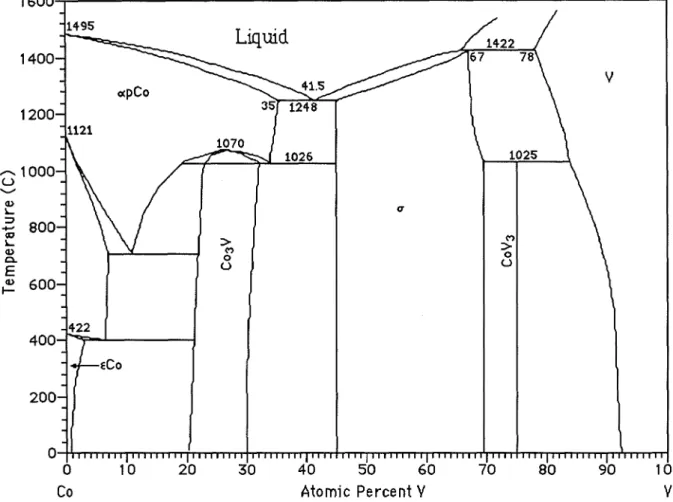
A clear example of the effects of vibrational entropy are the allotropes of elemental Co. Inelastic neutron scattering provides us with the most direct measurement of the lattice entropy of a solid. This neutron weighting of the phonon spectrum, or density of states (DOS), prevents correct derivation of the vibrational entropy.
The drawback of this method is that the phonon DOS of the disordered material is never calculated, only the vibrational entropy and free energy. We report a good correlation of the vibrational entropy of formation change in the metallic radii of the two species.
Methods and Results
Most of the phonon DOS curves were obtained from coherent inelastic neutron scattering measurements of phonon dispersion curves of single crystals. Exceptions were the DOS curves for the A15 intermetallic compounds, bcc alloys and the MgZn2 Laves compound, which were obtained by neutron scattering from polycrystalline samples. For these polycrystalline samples, the neutron data were interpreted in the incoherent approach [ 60 , 611 , but without correction for the different constituent scattering lengths.
The results for intermetallic compounds A15, bcc alloys and the MgZn2 Laves compound should therefore be treated with caution. In the second method, published graphs of phonon DOS curves were converted into digital format using the Datathief 2.0b software package. Although the number of original points in the data was not preserved, the shape of the DOS curve was faithfully reproduced after digitization.
The digitization process provided essentially the same phonon DOS curves that we calculated from the force constants and almost the same values of AS$;m that we calculated directly with the Born-von KLrmAn model for L12 Cu3Au, Fe3Ni, Ni3A1, Ni3Fe, PtsFe , and their elementary components. All digitized DOS curves were normalized to unity, which typically required corrections of less than one part per thousand.
Correlations
Vibrational Entropy of Formation
The phonon DOS structure at higher energies is expected to depend more sensitively on the local alloy structure [72]. Of the correlations made with other thermochemical parameters, the most successful involved the difference in metallic radium [73] between the majority and minority species. The success of the correlation with differences in metallic radius appears to be consistent with interatomic force constants determined from coherent inelastic neutron scattering.
This suggests an intuitive picture of the lattice dynamics involving spheres interacting with tight first-neighbor central forces. When the larger B atoms are pushed onto the A lattice without causing much change in lattice parameter, it is expected that the amplitudes of the atomic vibrations will be limited, and the vibrational frequencies will increase. This effect corresponds to the large slope of the curve of A S z m versus Ar at increasingly negative Ar.
This is consistent with the flattening of the curve in Figure 2.2 for small and positive values of Ar. As a corollary, we suggest that when the B atoms are smaller than the A atoms, the phonon DOS of the L12 alloy is less sensitive should be for the state of chemical order in the alloy.

Vibrational Entropy of Alloying
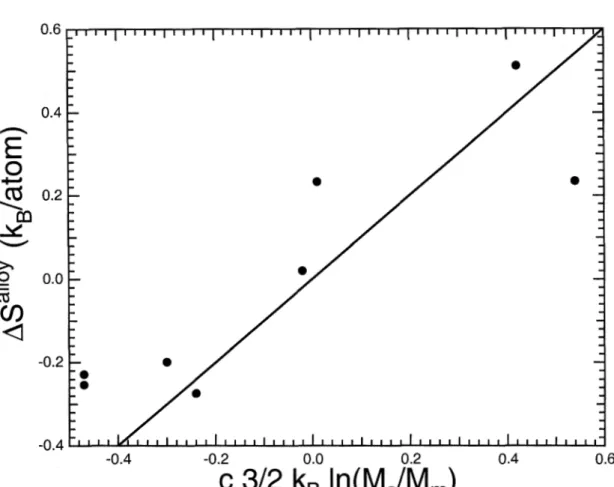
The emphasis of the Debye temperature on low energy phonons makes it less relevant for most phonon DOS. However, atomic mass and atomic volume are correlated, and examination of the data in Figure 2.6 shows that the correlation shown is largely similar to that of Figure 2.3. Although the R values of the mass and volume correlations are similar, the mass correlation is more impressive because no adjustable parameters were involved.
Using the slope of the best fit line and a value of 13 A3/atom for V,tri, the Griineisen constant for figure 3.6 was determined to be 1.2. The variables MI, and M2, are the atomic masses of the minority constituents of the final and initial states, respectively. Some comparisons of the success of the different correlations for the entropy of alloying are presented in Table 2.2.
It is important to note some limitations of the experimental measurements of the phonon DOS curves. The phonon DOS curves for the A15 compounds (Fawcett, et al. 1983) were determined in the incoherent scattering approach, but no attempt was made to correct the experimental DOS curve for differences in neutron scattering cross sections and masses of the elements.
Summary
Calorimetric methods have been used in several previous investigations of martensitic transformation in NiTi. Using the temperature dependence of the transformation stress, McCormick and Liu [77] measured an entropy increase of 0.41 ks/atom in the transformation to austenite. Calorimetry can provide useful numbers but does not address the atomistic origin of transformation entropy.
The emphasis of this work was on how differences in vibrational entropy arise from differences in the phonon density of states (DOS) of the different phases. We have carried out measurements of the phonon DOS, heat capacity, transformation graft enthalpy, thermal expansion, and calculations of Born-von KBrmAn lattice dynamics to investigate the vibrational entropy of the martensitic transformation. The heat capacity measurements and lattice dynamics simulations were used to check the reliability of the phonon DOS measured by neutron scattering.
The phonons implicated in the mechanism of the martensitic transformation, the k r/a transverse acoustic phonons, are not sufficient in number to account for the entropy of the transformation. On the other hand, the softness of the acoustic branches in the B2 austenite phase is shown to be responsible for most of the vibrational entropy of the phase transformation.
Experimental Methods
Low-temperature heat capacity measurements were performed with a Perkin-Elmer DSC-4 differential scanning calorimeter modified by placing the sample head in a liquid helium dewar. Using the same samples and calorimeter, the differential low-temperature heat capacity of martensitic NiTi with respect to Ni was measured. Liquid nitrogen was used as a cryogen, which enabled differential heat capacity measurements from -170 to -50 "C.
The difference between the data pairs with swapped samples is equal to twice the differential heat flow, from which the differential heat capacity was found. The differential heat capacity was added to the heat capacity of Ni [85] to obtain the absolute heat capacity for martensitic NiTi. The long dotted line is the linear expansion in the direction perpendicular to the plane of the plate.
Background spectra were measured from the empty can both in the oven and in the refrigerator at 300 K. Calorimetric error limits were obtained from the statistical variation of the repeated measurements for both heating and cooling.

Results
Calorimetry
The sum of the corrected intensities from the top 6 angle banks was used to obtain the phonon DOS. The vibrational entropy of the martensite-austenite phase transformation can be calculated from the respective DOS curves as. This anharmonic contribution to the entropy of the austenite is smaller than that obtained from the phonon DOS.
This Shar originates from the part of the phonon DOS that is unchanged with temperature. This volume dependence of the phonon DOS significantly overestimates the observed thermal softening of the DOS. A conventional textbook analysis of anharmonic behavior reconciles the observed softening of the phonon DOS with the thermal expansion.
A difference between S ~ ( T ) and s T ) requires an explicit temperature dependence of the phonon DOS, which counteracts the general. There has been no study focused solely on the vibrational entropy of the chemically disordered phase. The phonon DOS results are of low confidence due to the use of the ordered phase lattice dynamics to correct the neutron-weighted DOS of the disordered phase.
The vibrational entropy of disorder at T can be different, depending on how the phonon DOS of the two phases changes between 300 and 663 K. This method allows direct measurement of the phonon DOS, without approximation to data analysis. This method allows direct measurement of the phonon DOS, with significant approximations in data analysis.
The measurement of the phonon DOS of elemental copper in Chapter 5 is a good example of this method. The temperature dependence (at constant volume) of the phonon DOS must be caused by either electron-phonon scattering or phonon-phonon scattering. The temperature dependence of the phonon DOS elements has generally not been measured.
Although this area has attracted lattice dynamics interest from the theoretical community (see Sections 5.3.3 and 5.4.1), its thermodynamic importance has remained unexplored both theoretically and experimentally. The vibrational entropy of a solid can be deduced solely from knowledge of the density of states of phonons. Alternatively, one can fit measurements of the neutron-weighted phonon DOS (measured using Methods 1, 2 or 3) to a Born-von KArmAn lattice dynamics model.
A common task is the measurement of the vibrational entropy by time-of-flight (TOF) inelastic neutron scattering.