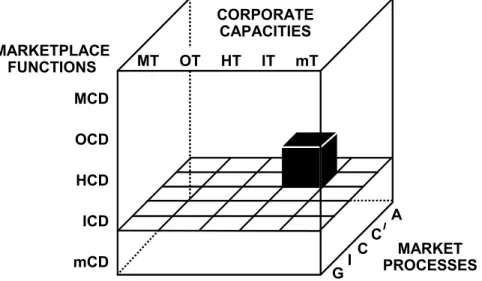
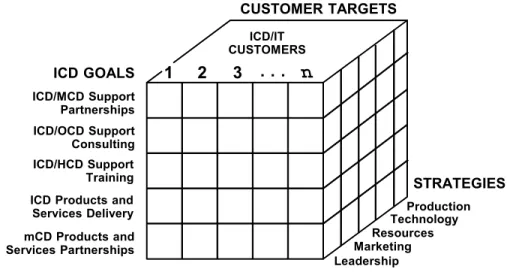
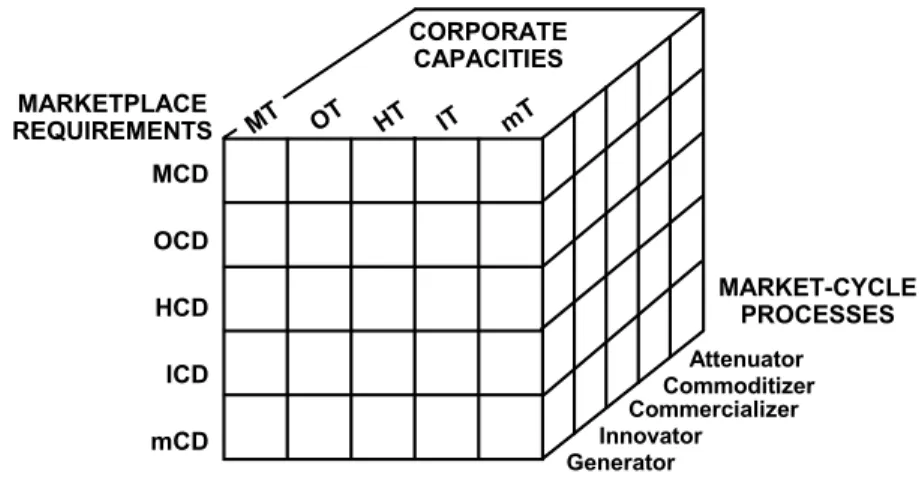
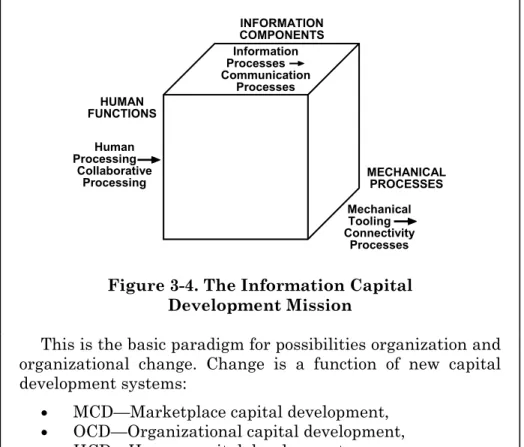
Organization—The New Science of Possibilities
Management
Robert R. Carkhuff, Ph.D.
Bernard G. Berenson, Ph.D.
The Possibilities Organization—
The New Science of Possibilities Management
Robert R. Carkhuff, Ph.D.
and
Bernard G. Berenson, Ph.D.
Contributors:
Don Benoit, M.A.
Christopher Carkhuff, M.A. Cert.
Copyright © 2000 by Robert R. Carkhuff
Published by Possibilities Publishing 22 Amherst Road
Amherst, MA 01002 413-253-3488
1-800-822-2801 413-253-3490 (fax)
www.possibilitiespublisher.com
ISBN 0-87425-577-5
All rights reserved. Any reproduction of this material in any media without written permission of the publisher is a violation of international copyright law.
Editorial services by Mary George Production services by Jean Miller Cover design by Donna Thibault-Wong
This book is dedicated to John T. Kelly, Manager, IBM’s Office of the Future, who conducted the first private-sector research on the interdependent organizational
relationships of Human, Information, and Organizational Capital Development.
This page intentionally left blank
The New Science of Possibilities Management
CONTENTS
About the Authors... ix
About the Contributors... xi
Foreword by Barry Cohen, Ph.D.... xiii
Preface: “The Requirements of the Twenty-First Century”... xix
Welcome to a Special Kind of Book!... xxix
I. INTRODUCTION AND OVERVIEW... 1
1. The Possibilities Economics... 3
“It Was a Great Run…” – A Case for Thought ... 7
Mechanical Technologies ... 10
Information Technologies ... 13
Human Technologies... 15
Organizational Technologies ... 18
Marketplace Technologies ... 21
NCD Equation for Wealth Generation... 24
II. NEW CAPITAL DEVELOPMENT—THE POSSIBILITIES MANAGEMENT SYSTEM... 27
2. Managing Marketplace Capital Development.... 29
“A Contrast of Extremes…” – The Power of Positioning ... 33
Modeling Marketplace Positioning ... 40
Scaling Marketplace Requirements... 41
Scaling Corporate Capacities ... 43
Marketplace Capital Matrix... 45
Scaling the Market Life-Cycle... 46
Dimensionalizing the MCD Model... 48
Processes for Marketplace Positioning ... 49
Phase 1 – Requiring... 50
Phase 2 – Valuing ... 51
Phase 3 – Visioning ... 52
Phase 4 – External Missioning ... 54
Phase 5 – Internal Modeling ... 55
In Transition ... 60
3. Managing Organizational Capital Development... 63
“The Team of Teams…” – Modeling for Alignment... 67
Modeling Organizational Alignment ... 75
Scaling Marketplace Functions ... 76
Scaling Organizational Components... 77
Organizational Capital Matrix... 79
Scaling Human Processes... 79
OCD Model ... 80
Processes for Organizational Alignment ... 81
Phase 1 – Goal Alignment ... 82
Phase 2 – Resource Alignment ... 83
Phase 3 – Process Alignment ... 85
Phase 4 – Customer Alignment... 86
Phase 5 – Performance Alignment... 88
Aligning New Capital Development ... 89
Aligning MCD... 90
Aligning OCD ... 91
Aligning HCD ... 92
Aligning ICD... 94
Aligning mCD... 95
Aligning Delivery Systems ... 96
Aligning Internal Delivery Systems... 96
Aligning External Delivery Systems... 99
In Transition ... 102
4. Managing Human Capital Development... 105
“The Monolithic Idea” – A Model of Human Processing ... 109
Modeling Human Processing... 113
Scaling Organizational Functions... 115
Scaling Human Components ... 116
Human Capital Matrix ... 117
Scaling Information Processes ... 118
HCD Model ... 119
I1 – Information Relating Systems... 122
I2 – Information Representing Systems... 126
I3 – Individual Processing Skills ... 129
I4 – Interpersonal Processing Systems ... 132
I5 – Interdependent Processing Systems Skills ... 136
Managing HCD ... 139
In Transition ... 144
5. Managing Information Capital Development... 147
“What Now?” – The Power of ICD ... 151
ICD Mining... 152
ICD Aligning... 153
ICD Linking... 153
ICD Management ... 154
Modeling Information ... 157
Scaling Human Functions ... 158
Scaling Information Components... 159
Information Capital Matrix ... 160
Scaling Mechanical Processes ... 161
ICD Model... 162
Processes for Information Modeling ... 163
Conceptual Information ... 164
Operational Information... 165
Dimensional Information... 170
Vectorial Information... 172
Phenomenal Information ... 176
Managing ICD ... 179
In Transition ... 182
6. Managing Mechanical Capital Development... 185
“Information-Driven mCD” – Continuous Tooling ... 189
CAI – Computer-Assisted Innovation ... 193
CAO – Computer-Assisted Organization ... 194
CAP – Computer-Assisted Positioning ... 195
Modeling Mechanical Tooling... 198
Scaling Information Functions... 200
Scaling Mechanical Components... 201
Mechanical Capital Matrix... 203
mCD Model ... 205
Processes for Mechanical Tooling... 206
In Transition ... 210
III. SUMMARY AND TRANSITION... 217
7. The Possibilities Management... 219
Managing NCD... 227
In Transition ... 234
Selected Publications by Authors ... 241
Acknowledgments ... 243
About the Authors
DR. ROBERT R. CARKHUFF is Founder and Chairperson, The Carkhuff Group: Human Technology, Inc., Human Resource
Development Press, Inc., and Carkhuff Thinking Systems, Inc. One of the most frequently referenced writers in the social sciences, Dr.
Carkhuff has authored many major works, including The Age of the New Capitalism, and The Possibilities Schools.
DR. BERNARD G. BERENSON is Executive Director, Carkhuff Institute of Applied Science and Human Technology. A professor at the state universities of Maryland, Massachusetts, and New York, Dr. Berenson was co-founder of the original Center for Human Resource Development and chairperson of its graduate training program at American International College. He is the author of The Possibilities Mind and many other books.
Together, Carkhuff and Berenson have introduced several market revolutions over the past four decades. They brought us the first interpersonal skills system in the ’60s and ’70s. They introduced the first individual models of human resource development in the
’70s and ’80s. Their combined efforts also initiated us into twenty- first-century thinking in the ’80s with the first models of new lead- ership and organizational capital development. Now, as creators of The New Science of Possibilities, Carkhuff and Berenson are the first scientists to address the area of management. The Possi- bilities Organization is their contribution to all possibilities managers and leaders.
About the Contributors
DON BENOIT is Director, Educational Projects, Carkhuff Thinking Systems, Inc., and contributor to Chapter 5, Managing Information Capital Development, and Chapter 6, Managing Mechanical
Capital Development.
CHRISTOPHER CARKHUFF is Director, Research and Development, Carkhuff Thinking Systems, Inc., and contributor to Chapter 3, Managing Organizational Capital Development.
Foreword
by Barry Cohen, Ph.D.
Vice President, Marketing
Parametric Technology Corporation
In The Possibilities Leader, Carkhuff and Berenson
introduced us to the universal language of processing. They taught us how to process interdependently so that we can generate new and powerful images of phenomena and innovate within phenom- ena. They labeled their interdependent processing system “I5” to represent the different human and information processing systems involved, and showed how “I5” systems empower us to generate new images of any phenomena—people, data, or things. The authors also demonstrated how we can live inside of these phenomena and generate totally new phenomenal operations.
Now, in The Possibilities Organization, Carkhuff and Berenson demonstrate how they live, learn, and work within, between, and among organizations. They “I5” with organizations, becoming “one” with them in order to generate new and powerful images of organizational possibilities. In so doing, they deliver to us the first systematic approach to birthing and growing organizations with infinite possibilities. Organizations will never be the same!
The Possibilities Organization is a book about a “paradigm shift” in management from probabilities science to possibilities science—although, in truth, current management practices hardly qualify as a paradigm, let alone a science! Scientific management, the platform upon which twentieth-century probabilities manage- ment was based, is no more than a euphemism for totalitarian rule:
command and control policy, classist organizations, conditioned personnel, and the rest. Possibilities management, then, is more than a paradigm shift: it is the first authentic management para- digm, the first model that actually defines all of the processing systems required by the twenty-first-century manager, and all of the new capital development functions to which those systems are dedicated.
I1 Information relating systems to define phenomenal operations;
I2 Information representing systems to dimensionalize images of phenomena;
I3 Individual processing systems to generate new images of phenomena;
I4 Interpersonal processing systems to generate more powerful images of phenomena;
I5 Interdependent processing systems to generate the most powerful images of phenomena.
Interdependently and synergistically related, these processing systems define the core of the manager’s contribution to any phenomena, especially tasks-in-mind.
Next, let us view the organizational functions to which the processing is dedicated. They are labeled “new capital development systems” to represent their contributions in the equation for
generating wealth. There are five functions in all:
MCD Marketplace capital development, or continuous marketplace positioning;
OCD Organizational capital development, or continuous organizational alignment;
HCD Human capital development, or continuous human processing;
ICD Information capital development, or continuous information modeling;
mCD Mechanical capital development, or continuous mechanical tooling.
they are doing and where they are going. We have a real paradigm to guide us!
builds a bridge that spans not only probabilities and possibilities science, but also probabilities and possibilities culture. The authors empower us to actualize a culture of true freedom: genuine free- enterprise-driven economies, truly free and direct democratic governance, all empowered by free scientific processing systems—
by, in a word, “process-centricity.”
In a process-centric culture, everything is processing. There is no enduring content. One processor’s outputs are another’s inputs.
All processors’ interdependent processing is spiraling and chang- ing, as are the phenomena that they process. In short, processing is an accelerator of evolution wherein we can continuously influence our continuously changing destinies.
In a process-centric culture, all models of processing are powerful and elegant. As the authors demonstrate, even the formula for generating wealth can be reduced to simple yet potent terms:
I 5 N CD
I5 represents the interdependent processing systems of possibilities management. NCD represents the organization’s new capital development systems, which generate wealth. I5 and NCD are related interdependently and synergistically: each contributes to the other’s growth. We managers may now become process-centric in a wealth-generating culture!
Possibilities leaders generate
possibilities organizations.
This page intentionally left blank
Preface
The Requirements of the Twenty-First Century
At least twice in the last decade, the clarion cries of false prophets have been trumpeted. Ten years ago, the Soviet Union was still planning to bury Western capitalism. Indeed, the Soviets pitted their planning systems against our processing systems. The rest is history.
Up until a few years ago, the Japanese were claiming that the twenty-first century would be the Asian century, led by them, of course. We know this personally because they adopted our platform on “The New Capitalism,” believing that they had the superior brainpower needed to dominate the new century. To be sure, they posed their imitative systems against our generative and innova- tive systems. And lost!
Now many in the unfree world are saying that the free market has failed. Wrong! The unfree nations have failed. They have failed because their cultures have failed. Their cultures have failed because they have been bound by past traditions—dysfunctional traditions. They cannot participate in a free, global market with command and control economies. They cannot generate free- enterprise-driven economies with authoritarian governance. They cannot implement free democratic governance without new sources of generating wealth—what we label “new capital development.”
Sometime in the last decade of the twentieth century, civiliza- tion crossed a momentous threshold. It moved from shaping cultures based upon past traditions to generating cultures to meet future requirements. Because of spiraling changes in technology- driven economies, the historic traditions no longer suffice. Scientific and technological “breakthroughs” have generated robust, new socioeconomic requirements that must be met in order to partici- pate in the marketplace. Our traditional responses, no matter how enduring, are rendered impotent. The requirements that define our new century’s culture are prepotent.
century are already defined. They were defined by the Western economies in the last decade as:
1. Free-Market Economies, 2. Free Democratic Governance, 3. New Capital Development Systems.
Let us state this in the form of a principle:
Free-market economies are accomplished by free democratic governance empowered by new capital development systems.
It is the Western mission to define these growthful socioeconomic standards for the global economy in the twenty-first century. Let us elaborate.
By “free-market economies,” we do not simply mean capitalism as it has been practiced historically. Here in the United States, for example, we continue to practice a mixed form of capitalism and socialism. We seek deregulation when that pleases us and govern- ment subsidies when that supports us. By “free market,” we mean entrepreneurial- and intrapreneurial-driven capitalistic economies.
We mean economies driven by the generative and innovative proc- essing of free people. We mean risk-taking entrepreneurs rather than note-taking bureaucrats.
There must be some good reason for the sources of spiraling change in the last decade. Ninety percent of the breakthroughs in science and technology have occurred in the last decade. Yes, 90 percent of the breakthroughs in the history of humankind! And 90 percent of these breakthroughs have been generated by Western science and enterprise!
These free-market economic systems are enabled by the truly free and enlightened citizenry of free democratic governance. By
“free democratic governance,” we do not simply mean democracy as it has been practiced historically. In the United States, for example, we continue to practice representative democracy—meaning that every politician is in business for himself or herself. Politi-
monies that support them. However, we now have the electronic means to become a direct democracy: everyone can be educated to vote directly on every issue. It is thus time to stop the circus in Washington as well as within our corporations. By “free democratic governance,” we mean true democracy within both the professional political arena and the corporation.
The free-market economic systems, then, are accomplished by free democratic governance. This entire freeing system is enabled by new capital development systems. By “new capital develop- ment,” we mean new wealth-generating sources. “Capital” merely means what is “most important.” There are new capital sources of wealth. To be sure, financial capital plays an important, catalytic role in generating wealth. It accounts for about 10 percent to 15 percent of the variability in economic productivity growth. It is necessary but not sufficient for wealth generation. What we would like to present in this book are other sources of wealth, the new capital development systems.
The first of these new capital development systems is mar- ketplace capital development. Marketplace capital is the impact of the positioning of our corporation in the marketplace. In other words, we position our corporations for differentiation in the marketplace. This positioning is the source of our comparative advantage or competitive edge. Now let us ask:
How many of you believe that your corporations’
marketplace positioning is the most critical source of corporate success?
We have challenged many executives on this issue of market- place positioning. To a person, they have agreed that 99 percent of the success of their companies is attributable to marketplace posi- tioning. If you agree that marketplace capital is most important and you acknowledge that you do not have it, then you are directed to your course: “You’ve got to get it!”
tional capital development is most critical among them.
Organization capital is accomplished by the capacity to systemati- cally and continuously align resources in your corporations with your marketplace positioning. Now let us ask:
How many of you believe that your corporations are continuously aligned with continuously changing marketplace positioning?
None? Your organizations grew like Topsy? You are stuck with a legacy of unchanging entities? Then you already know the answer to your projections of success. Organizational capital development is about continuously “rearchitecting” the organization. Either you have it or you don’t!
What about human capital development? Do you use the adjectival modifiers “human capital” as seriously as they are intended? They are not just another set of terms for personnel or human resources! They mean empowering people to think genera- tively or innovatively to meet the requirements of organizational alignment. So we ask:
How many of you believe that your corporations are continuously empowering real human capital in interdependency with organizational capital?
Well, you tried to teach your people to relate interpersonally (soft skills) and perform technically (hard skills). You get an “E” for effort—not an “I” for intellect. Human capital development is about
“brainpower” development. If you don’t get it, you don’t get it!
Now let us turn to an area that most people believe they know something about—information capital development. Informa- tion capital development is the information modeling required for
els that bring the phenomena that we are processing to life. Here we ask:
How many of you believe that your corporations are continuously developing information capital in interdependency with human capital?
Sure, you have connectivity with your information systems.
And you have communication due to this connectivity! But what do you communicate? The lowest levels of information capital—data and concepts about the relationships between data! While concep- tual information does not prohibit human processing, it does retard it. So let us think of our current communication and knowledge management systems as “depressor variables” in the equation for enabling generative human processing. Information capital devel- opment is about information modeling. It involves pictures—lots of pictures! If you can’t produce pictures, don’t bother pretending to process generatively.
Finally, we turn to mechanical capital development, the continuous tooling and retooling of machine systems to be driven by information systems—the same systems that gave us the semi- conductor chip and that now generate a spiraling array of products on land and sea and in the sky. So we ask:
How many of you believe that your corporations are continuously developing mechanical capital in interdependency with information capital?
Well, you certainly have provided the mechanical underpin- nings for our information connectivity. You also have produced an incredible array of mechanical products and services. Is it enough to muddle through to meet the spiraling requirements of the global marketplace? You already know the answer. It is no longer in con- trol! Mechanical capital development is about continuous mechani-
ment systems. Then it can, in turn, contribute to new directions.
Now we would like to ask:
If all of these new capital development systems are so critical to the success of your organiza- tions, then how come no one ever taught you about them?
Let us put that question in another way:
• Were you taught to systematically and continuously reposi- tion your corporation so that you could co-orchestrate all of your partnered entities in a changing marketplace?
• Were you taught to systematically and continuously align your organization with continuously changing marketplace positioning so that you could generate interdependent cooperation within all of the units in a changing organiza- tion?
• Were you taught to systematically and continuously empower your people in thinking skills to implement changing organizational alignment, so that you could generate interdependent collaboration between all of the people?
• Were you taught to systematically and continuously model information in multidimensional forms to meet changing human-processing requirements, so that you could generate interdependent communication between all entities—people, units, organizations, markets?
• Were you taught to systematically and continuously tool and retool your machine systems as driven by information- systems requirements, so that you could provide the basic connectivity between all entities?
know what you need to do. If your answer to all of these questions is “Yes,” then please contact us, for we have discovered a “possibili- ties leader” who can teach us a thing or two.
The possibilities leader is a person who can process interde- pendently and continuously with all phenomena—people, data, things. Such processing is achieved by:
• Utilizing information relating systems to transform conceptual information into operational information about phenomena;
• Utilizing information representing systems to trans- form operational information into dimensional information about phenomena;
• Utilizing individual processing systems to generate new images of phenomenal information;
• Utilizing interpersonal processing systems to generate more powerful images of phenomenal information;
• Utilizing interdependent processing systems to gener- ate the most powerful images of phenomenal information.
The possibilities leader has an ever-expanding domain of influ- ence. This influence proceeds, first and foremost, from his or her dedication to generating a “possibilities organization” through new capital development:
• Marketplace capital development for the co- orchestration of partners;
• Organizational capital development for the cooperation of units;
• Human capital development for the collaboration of people;
• Information capital development for the communication of models;
• Mechanical capital development for the connectivity of machines.
I 5 NCD
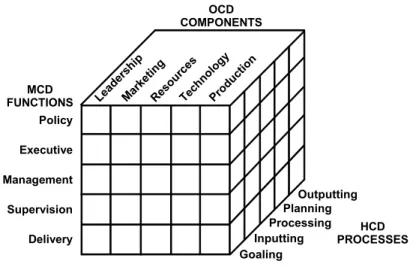
organizational dimensions in Figure 1. As shown, the leadership systems culminate in interdependent processing: I1, I2, I3, I4, I5. In turn, the organization systems are nested in marketplace capital development: MCD, OCD, HCD, ICD, mCD. Potentially all areas of leadership processing relate to all levels of new capital develop- ment (NCD), and vice versa. This means that I5 generates NCD. In turn, NCD generates I5. This means that I5 leadership and NCD organization have an interdependent and synergistic, or growth- producing, relationship:
POSSIBILITIES ORGANIZATIONAL
FUNCTIONS
I
1111I
2222I
3333I
4444I
5555POSSIBILITIES LEADERSHIP
SYSTEMS
MCD OCD HCD ICD mCD
Figure 1. The Possibilities Management Paradigm You can readily see that changes are indeed spiraling. Changes in the marketplace! In organizations! In people! In information! In tools! Indeed, you may conclude that all phenomena are inherently changeable.
changes:
• Relating to them to discover their potential,
• Empowering them to enhance their potential,
• Freeing them to release their potential.
To accomplish this, you must acquire, apply, and transfer interde- pendent processing systems, thus generating new capital develop- ment in your organizations.
In summary:
Possibilities leaders are about generating possibilities organizations, and vice versa:
possibilities organizations generate possibilities leadership.
Culture change is clearly the issue of our time. Because we are not burdened by dysfunctional traditions, we can be shaped by future requirements—in this case, by the requirements of new capital development. In turn, we can shape the requirements for the global marketplace and the global community. The twenty-first century will yield a global marketplace and community that are interde- pendently related and interdependently generated by possibilities leaders and possibilities organizations.
Welcome To
A Special Kind of Book!
This is a book of pictures. We call the pictures information models. Information models are the universal language of processing in the twenty-first century. They are the interdependent and synergistic processing partners with human proc- essors or human capital. We relate to phenomena, represent them, and then generate increasingly more powerful information models of the phenom- ena. That is the thesis of this book: interdependent processing generates prepotent models of phenom- ena. The reader need not conquer the processing operations involved: there is time for that later with different experiences and materials. The reader need only experience the magical images of any and all phenomena; to be introduced to the generation of powerful possibilities; to realize the accomplishments of generations of work in an afternoon of processing.
RRC and BGB
The equation for wealth is an evolving one. As marketplace requirements
change, the capital ingredients change.
Conventional wisdom aside, “capital”
simply means what is “most important.”
Superstitious behavior to the contrary, financial capital is no longer “most important.” Today, finances account for less than 15 percent of the variance in economic productivity growth. The emerging ingredients of new capital development account for more than 85 percent of growth.
This page intentionally left blank
I
Introduction and Overview
OCD
HCD
ICD
mCD
1 The Possibilities
Economics
This page intentionally left blank
New capital development defines five new sources of
wealth that define our
organizations’ requirements.
“It Was a Great Run . . .”
— A Case for Thought
The information-technology corporation was a very suc- cessful corporation. It had a 10-year track record of incessant growth in gross and profit. That growth was a direct outcome of the corporation’s simple business formula, which looked like this:
●●
●●
●
●
●
●
●
●
●
●
●
●
●
●
●
●
●
●
High-quality, low-cost positioning Sales-driven organization Aggressive sales force Credible information support Standardized product-line
+ $
GrowthThe formula, or equation, was put into practice as follows:
• First, the policymakers established “high-quality, low- cost” positioning to provide customers with “big bang for the buck.” Competing in a marketplace with much costlier customized and even tailored software, it delivered maximum benefits for minimum price.
• Second, the organization was aligned with this posi- tioning. This was a relatively flat, sales-driven organization. Basically, after initial product-devel- opment efforts, the organization was defined by two levels: a sales level, and a management level that supported the sales. The success of this organizational scheme led to unquestioned “functional autonomy” for the sales reps enabled by meeting sales quotas.
• Third, the sales force was composed of highly motivated salespeople. Aggressiveness was reinforced by two things: the company’s unwritten sales credo—
“The optimum sale is one that the customer does not need and cannot use”—and an extraordinary commission system that made the retained salespeople well-to-do.
• Fourth, the organization did not require great technical expertise of its salespeople since it did not emphasize service. Instead, it supported them with credible “sales”
information that created the illusion of expertise.
• Fifth and finally, the organization delivered a highly leveraged product-line. The line was technically power- ful, including all of the innovations that could be found in the industry. While it developed some unique fea- tures, generally it was a more commercial version of the competition’s research-and-development outputs.
For this reason, the product-line could be priced as
“relatively inexpensive” for its customers.
This was a great success story. It was a great run. Then, while everyone in the company was counting their earnings in cash and stock ownership, the world began to change. The market was being saturated with competitor products that cloned the company’s capabilities. As prices were being driven downwards, the high-quality, low-cost market space was filling up with competition. Soon, the sales-driven organization began to look untenable. Sales quotas were getting too difficult to reach, and there was a hemorrhaging of salespeople to other companies. The remaining sales force, though aggressive, was now addressing customer requirements that were equally, if not more, aggressive. Customers who were not buying from the lowest-price providers were making their demands known:
“Our purchases are not based on ‘best price’ or ‘best technology’
anymore; they’re based on ‘culture change requirements.’ We won’t buy from you unless you can help us change our corporate cultures to adopt your products.” Frankly, the “credible”
information that once had helped to make a sale was not good enough to service corporate culture change. Now, in light of
these changing requirements, the product-lines looked awfully complicated for the benefits they delivered.
The company that had been positioned at the “razor’s edge”
of commerciality for so long was now falling, leaning headlong into commoditization and attenuation. What was going wrong?
Could it save itself ? Was its future, in all probability, already written? Could it be renewed, with new possibilities?
Today we are all participants in “probabilities economics.”
We participate in probabilities economics when we build our organizations to exploit the discoveries of the past, thinking that what worked yesterday will probably work today and tomorrow.
The economics of probabilities, however, are the economics of time- limited commerciality followed by product and service commoditi- zation and eventual attenuation. All organizations operate with the same available machinery, the same information, the same “best practices,” and the same strategies for organizational networking;
consequently, products and services become more and more undif- ferentiated.
The economic theories of probabilities do not adequately describe our changing present or future economic landscapes. To stay in business, we must proactively build our organizations to develop the evolving forces of our economy. We call our approach to these evolving forces “possibilities economics.”
Possibilities economics builds upon historical sources of wealth generation and projects evolving and future sources. We begin con- structing our model of such economics by tracing the evolutionary march of “technological breakthroughs” that have driven our econ- omy. From the broadest perspective, economic growth in the mar- ketplace and comparative advantage for organizations are driven by “breakthroughs in technology development.” Agrarian technolo- gies of seeding and herding were early “breakthroughs,” with agrarian methods and tools operating as sources of economic growth and comparative advantage. These technologies trans- formed the nomadic tribes of our hunter-gatherer ancestors into
farming communities of agricultural people. In a similar manner, industrial machinery and systems transformed farming communi- ties into industrial organizations. As we will see in this book, new technologies are now changing our industrial organizations.
Relatedly, it is not until new “breakthrough technologies” are developed that the contributions of earlier technologies to wealth creation are fully realized, or “capitalized.” For example, we did not actualize, or “capitalize,” the benefits of our agrarian technologies until we developed mechanical technologies to mechanize our agri- cultural practices. Similarly, we did not “capitalize” the productiv- ity of our mechanical technologies until we developed information technologies to drive our machines. Likewise, we will not “capital- ize” the potential of our information technologies until we develop human technologies to empower and free innovation. Moreover, we will not “capitalize” our human technologies until we develop organizational technologies to align our organizations. Finally, we will not “capitalize” the impact of organizational technologies until we have developed marketplace technologies to help us position our organizations in the marketplace.
M ECHANICAL T ECHNOLOGIES
The mechanical-technology marketplace is the market of machinery and the products and services delivered by machines.
The comparative benefits of mechanical technologies peaked at the height of the Industrial Age, and have all but disappeared due to the standardization of mechanical operations. From this perspec- tive, we may view the decline of mechanical technologies (mT) as a source of comparative advantage, or “competitive edge,” for organi- zations (see Figure 1-1).
Manufacturing processes typically rely on some form of the mechanical assembly line. All companies automate their machinery to the maximum. All install statistical process controls to maximize the quality of machine outputs. In short, everyone who is dedicated to being equal is becoming equal in the mechanical production of off-the-shelf products for customers.
Figure 1-1. Market Impact of Mechanical Technologies (mT)
By choosing to offer our customers products and services through manufacturing processes, we are choosing to position our- selves in an attenuating market. Without breakthroughs, mechani- cal technologies will continue to decline as a source of comparative advantage. Basically, this means a level playing field for everyone:
if we are willing to make the investment in machinery and infor- mation systems to drive our machines, we can compete for declin- ing profits. This is not to say that the market for mechanical and even agricultural products and services is not huge: it represents several trillion dollars globally, and there is still much money to be made. It is to say that many mechanical technologies have been around since the Industrial Age and simply yield the least competi- tive edge.
Whether or not we choose to define our organizations as
mechanical operations, every organization is impacted by its ability to manage mechanical technologies. At the production or delivery levels, in particular, there is a great need to understand mechani- cal technologies and their applications.
An expanded vision of mechanical technologies will be intro- duced later in this book, in Chapter 6, Managing Mechanical Capital Development. There you will learn how to construct a model of mechanical capital development (mCD), one that
1960 1970 1980 1990 2000 2010 2020 SOURCES OF
COMPARATIVE ADVANTAGE (Technologies)
TIME mT
describes the processes used by mechanical capital to accomplish its goals or intentions. You will also learn about the following:
• The components, or parts, of mechanical capital and their definitions;
• How the components are related to machinery functions;
• The vectors, or forces, that act upon mechanical capital;
• How the vectors direct us to discover and apply new machinery by identifying what is needed and why it is needed;
• The managerial practices that are necessary for meeting mCD responsibilities.
The mCD process is one of the five sources of wealth generation that we have identified as critical for every organization to manage.
The process allows us to start building our New Capital
Development (NCD) Equation for Wealth Generation, a for- mula that is valid for the twenty-first century and beyond. With breakthroughs in mCD, the equation for wealth becomes redefined (see Figure 1-2).
+ $ WEALTH
mCD
Figure 1-2. Wealth Driven by Mechanical Capital
Mechanical capital development is its own source of wealth. In an economy empowered by mCD technologies, it is mechanical capital that drives the production of products and services in the marketplace.
I NFORMATION T ECHNOLOGIES
The information-technology marketplace is the market of information products and services. Themselves products of break- throughs in electronics, information technologies (IT) climaxed as sources of comparative advantage in the 1980s. While driving our mechanical technologies to actualize their contributions, today’s information technologies are also diminishing as a source of com- parative advantage (see Figure 1-3). While their innovation poten- tial remains infinite, their current comparative advantage is
receding as the marketplace experiences the “leveling” effects of the near-instantaneous dissemination of information. Although the total size of the IT marketplace continues to grow, this dissemina- tion has limited the competitive advantage of information tech- nologies, since most companies now have access to reasonably priced, off-the-shelf and customized hardware and software, as well as a wide circulation of information.
Figure 1-3. Market Impact of Information Technologies
1960 1970 1980 1990 2000 2010 2020
SOURCES OF COMPARATIVE
ADVANTAGE (Technologies)
TIME IT
By choosing to define our organizations as IT businesses, such as computer hardware, software, or publishing, we are choosing to position ourselves in a commoditizing market curve.
Current corporate interest in “intellectual capital” and “knowl- edge management” reflects a growing concern about identifying and exploiting information as a source of wealth creation and compara- tive advantage. Groupware connectivity, database mining, and report-generation software are examples of current efforts in this market for “information capital.” However, these efforts focus upon information access, not information capital development. In other words, it is assumed that the present information in our systems is of “capital” value and that we just need to access it. In reality, the marketplace has a great void in its current understanding of how to define and create valuable “information capital.”
More managers and employees are responsible for creating and managing more and better information today than at any other time in history. This is a trend that is here to stay. Whether or not we choose to define our organizations as providers of information products or services, every organization is impacted by its ability to manage the use of information technologies. More important, every organization is impacted by its ability to manage the development of new and valuable information capital.
Future mechanical breakthroughs in micro-electronics aside, IT companies will contribute to “growing” the trillion-dollar market only by more broadly and deeply defining and addressing the information-capital requirements of the marketplace.
Information capital development (ICD) methods and technolo- gies will be introduced in Chapter 5, Managing Information Capital Development. In that chapter, you will learn the basics of ICD, including the following:
• Useful new ways to define and develop information capital (you will probably never look at a nugget of information in the same way again!);
• New methods for modeling ideas— ones that will help to accelerate our ideational processes;
• Managerial practices necessary for handling ICD processes.
Information capital development, a critical source of wealth generation for every organization, allows us to continue building our NCD Equation for Wealth Generation. As the computer and telecommunication industries further converge upon a common mission— “the unimpeded flow of global information”—the equa- tion for wealth generation is continually redefined (see Figure 1-4).
ICD
mCD
+ $ WEALTH
Figure 1-4. Wealth Driven by Information Capital
In the evolving Age of Ideation, the generation of information capi- tal development replaces information resources as a source of wealth and competitive advantage. Together, information capital development and mechanical capital development become interde- pendent and synergistic, with each continuously redefined by its contributions to generating wealth. In an economic system powered by ICD technologies, information capital emerges as a driving ingredient in the generation of wealth.
H UMAN T ECHNOLOGIES
The human-technology marketplace is the market of products and services that support and enable human capital development (HCD). Thus far, our economies have focused upon mechanical and information technologies, and have grown in imbalance with our efforts to develop our human resources. Human technologies (HT) are an emerging source of growth and comparative advantage (see Figure 1-5).
1960 1970 1980 1990 2000 2010 2020 SOURCES OF
COMPARATIVE ADVANTAGE (Technologies)
TIME HT
Figure 1-5. Market Impact of Human Technologies (HT)
The markets of human resource development, or education and training, represent more than one-half trillion dollars in the United States and are growing at the rate of nearly 10 percent per year.
Although these huge markets are half the size of the trillion-dollar IT marketplace, we must remember one thing: it is human per- formance that develops information and mechanical products and services. Until we actualize the generative and innovative capabili- ties of our human capital, we will not actualize the potential con- tributions of information or machinery for wealth creation.
The business sector’s growing interest in “human capital” and
“core competencies” testifies to an increasing need to understand the ingredients of effective human performance. For businesses today, the HCD marketplace strategies are a mix of technical training and “soft-skills” training. “Soft skills” are identifiable as multiple variations of basic interpersonal-communication skills.
Generally, these skills are considered today’s current “human tech- nologies.” However, the future skills requirements for human capi- tal development are primarily intellectual skills that empower generativity and innovativeness.
By choosing to define our organizations as human-technology businesses, and offering education, training, consulting services, or
related software or media products, we are choosing to position ourselves in a now-accelerating commercial market curve.
Requirements to elevate human performance have created a growth market. With an increased understanding of the factors that leverage human performance, companies will grow this HCD marketplace, empowering more and more people as sources of comparative advantage. It is critical that we understand and apply a new set of human technologies — methods to develop generative and innovative human performers.
Whether or not we choose to define our organizations as pro- viders of HCD products or services, every organization is impacted by its ability to define and apply human technologies. Most impor- tant, every organization is impacted by its ability to empower and support innovative human performance. Employees who can think are of growing value. Managers and employees at every organiza- tional level have a great need to understand and apply human technologies for human capital development.
New human technologies to empower innovation will be intro- duced in Chapter 4, Managing Human Capital Development.
There we will focus on how to model the critical operations of HCD:
the skills that thinking people need, the organizational responsi- bilities involved, and the critical information processes required to service these organizational functions. We will also take a look at the following:
• New ways to measure human performance—ways that will make an impact on how we view employee selection, per- formance management, and education and training;
• Identifying new areas of performance that are personally interesting;
• Managerial practices necessary for managing HCD effec- tively.
HCD technologies and methods are a crucial source of wealth generation for us and our organizations. With them, we may further build our NCD Equation for Wealth Generation. As breakthroughs in human technologies occur, the equation continues to be redefined (see Figure 1-6).
+ $ WEALTH
ICD
mCD HCD
Figure 1-6. Wealth Driven by Human Capital
In the evolving Age of Ideation, human resources are redefined as innovative human processors, or human capital. Together, human capital development, information capital development, and mechanical capital development become interdependent and syner- gistic: each is continuously redefined by its contributions to gener- ating wealth.
In an economic system powered by HCD technologies, human capital emerges as a driving economic ingredient. In synergistic relationship with information capital, human capital is capable of creating entirely new ingredients of wealth generation.
O RGANIZATIONAL T ECHNOLOGIES
The organizational-technology marketplace is the market for organizational architecture and alignment services and support products. Organizational technologies (OT) are another emerging source of growth and comparative advantage, as we can clearly see in Figure 1-7.
1960 1970 1980 1990 2000 2010 2020 SOURCES OF
COMPARATIVE ADVANTAGE (Technologies)
TIME
OT
Figure 1-7. Market Impact of Organizational Technologies (OT)
With the “information overload” produced by information tech- nologies, we decentralized our corporate operations. The effects were two-edged. On the one hand, decentralization allowed new sources of growth to emerge naturalistically—primary among them, human and information sources. On the other hand, decen-
tralization dismantled the organization as a powerful source of effect in its own right.
We may realize that all of our resources — including machines, information, and people — operate within the contexts of our organizations; yet, until we actualize the functional alignment of our organizations’ operations, we will not actualize these wealth- generating resources.
The need for continuous organizational alignment, within and between organizations, is ubiquitous. It is estimated that we are already spending 5 percent of GDP on internal restructuring annu- ally: this would put the market estimate in the United States at over one-quarter trillion dollars and growing. In a changeable marketplace, every viable organization will engage in continuous organizational alignment throughout the twenty-first century. The commercial market for organizational alignment services and support products is a growth market.
Recent corporate interest in the “reengineering” of processes and the “quality function deployment” (QFD) of resources — as well as in “self-organizing systems” and “flat,” “matrixed,” “virtual,” and
“learning” organizations — reflects a recognition that the organiza- tion itself requires attention as a valuable source of effect. The idea of the organization as a “productive agency” has reemerged. How- ever, the aforementioned strategies of organizational architecture have already “played out.” Corporate consultants and executives are now asking, “What’s next?”
The market requires that organizational technologies serve both internal and external alignment. Organizational methodolo- gies are needed for the internal alignment of all of the organiza- tion’s critical operations: its goals or intentions, its resources, and its processes. Organizational technologies also need to deliver operational processes for external alignment with suppliers, vendors, and customer organizations.
New organizational-alignment technologies will be introduced in Chapter 3, Managing Organizational Capital Develop- ment. There you will learn about all of the following:
• Effective ways to use multidimensional modeling systems to describe how organizations work;
• How to diagnose organizational operations by measuring the presence or absence of critical operations;
• The importance of organizational information flows — deductive, inductive, and idiosyncratic;
• New ways to measure organizational performance — ways that will make an impact on your view of reengineering, restructuring, and realigning organizations;
• Managerial practices necessary for managing organiza- tional capital development (OCD).
OCD, a critical source of wealth for every organization, allows us to build on our NCD Equation for Wealth Generation for the twenty-first century. With breakthroughs in organizational tech- nologies, our equation is further refined to include the impact of OCD technologies (see Figure 1-8).
+ $ WEALTH
ICD
mCD HCD OCD
Figure 1-8. Wealth Driven by Organizational Capital
OCD technologies revitalize the organization by aligning the organization internally: its goals, resources, and processes. OCD technologies revitalize the organization with external-alignment strategies to align with suppliers and vendors as well as customers.
This alignment defines organizational capital and results in the increased efficiency and effectiveness of what we call a “possibilities organization.”
M ARKETPLACE T ECHNOLOGIES
Every organization is involved in making decisions about marketplace positioning and partnering. The market for position- ing services to assist in these responsibilities is the market for marketplace technologies. Marketplace-positioning and -partnering methodologies enable producer organizations to strategically ana- lyze and address their own marketplace requirements and values.
These same technologies are also used to analyze the requirements and values of customers and competitors. Marketplace technologies (MT) are the most powerful source of continuous growth and com- parative advantage (see Figure 1-9).
1960 1970 1980 1990 2000 2010 2020 SOURCES OF
COMPARATIVE ADVANTAGE (Technologies)
TIME
MT
Figure 1-9. Market Impact of Marketplace Technologies (MT)
Most of us have already conceded that marketplace positioning is the prepotent source of corporate success. This, our greatest and most urgent corporate need, makes the marketplace-technology market a growth market.
Marketplace positioning is about positioning an organization in relation to other businesses in the marketplace. It implies aligning organizational divisions and units, positioning the talents of employees, positioning technologies, machinery, processes, and products and services, all in relation to counterparts in the eco- nomic marketplace.
Today, marketplace-positioning practices revolve around a few simple yet profound interrogatives:
• “What business are you in?”
• “What business would you like to be in?”
• “How do you think you can make the transition?”
• “What are the obstacles?”
Our current tools for marketplace positioning include market research, trend analysis, “what-if ” scenario development, financial analyses, and industry best-practices benchmarking.
Requirements are imposed upon marketplace-positioning methods and practices: they must serve the policymaker’s respon- sibilities regarding strategic decision-making and mergers and acquisitions; they must assist in making decisions about whether to enter a new market niche and whether to sell off a business line.
Marketplace-positioning technologies can be defined as the “how-to”
processes of marketplace positioning. Specifically, these tech- nologies must help policymakers represent the values and capabili- ties of organizations and relate them to the requirements and opportunities of the marketplace. These technologies must walk policymakers through processes for positioning their organizations.
With this in mind, we must ask ourselves whether our current marketplace-positioning strategies are adequate for the require- ments of positioning our businesses for the next century.
New marketplace-positioning technologies will be introduced in Chapter 2, Managing Marketplace Capital Development.
There we will focus on the following:
• New, useful ways to analyze the marketplace positioning of an organization;
• Methods for measuring the requirements of the market- place;
• Methods for measuring the values and capabilities of the marketplace of organizations in response to those require- ments;
• How to position organizations in the marketplace of organizations;
• Managerial practices necessary for managing marketplace capital development (MCD).
By the time you finish reading Chapter 2, you will look at your organization’s marketplace positioning quite differently than you did before! You will have learned new ways to measure market- place positioning, and this will surely make an impact on how you view partnering and future mergers and acquisitions.
MCD is a critical source of wealth for every organization. With the inclusion of MCD and marketplace technologies, our NCD
Equation for Wealth Generation assumes a comprehensive form. The equation is further expanded to incorporate MCD tech- nologies (see Figure 1-10).
+ $ WEALTH
ICD
mCD HCD OCD MCD
Figure 1-10. Wealth Driven by Marketplace Capital
Policymakers are continuously processing the positioning of their organizations to maximize meeting and exceeding both current and future marketplace requirements.
NCD E QUATION FOR
W EALTH G ENERATION
In our NCD Equation for Wealth Generation (shown in Figure 1-11), financial capital is reduced to a catalytic ingredient—
necessary but not sufficient for capital development.
WEALTH
ICD
mCD HCD OCD MCD
Figure 1-11. NCD Equation for Wealth Generation
As accounting procedures for keeping score, finances may appear on either side of the equation. Finances are used to invest in capital resource development and are used to measure the value of the many criteria of wealth. The new reality of ever-expanding wealth is generated by the ingredients of new capital development.
This page intentionally left blank
II
New Capital Development—
The Possibilities
Management System
2 Managing Marketplace
Capital Development
This page intentionally left blank
Positioning in the marketplace is the
context for wealth
generation.
“A Contrast of Extremes . . .”
—The Power of Positioning
Attempting to anticipate future requirements in their marketplace, Companies A and B met for a series of discus- sions. These discussions between the two competitors centered on joint venturing to build the world’s “cutting-edge” product.
Utilizing the exact same market data, the companies posi- tioned themselves differentially in the marketplace: Company A decided to continue on its current course and customize its standard product-line; Company B decided to “go it alone” in an attempt to tailor future product-lines to marketplace requirements. The implications of this differential positioning would be profound.
First of all, differential positioning in relation to the exact same market requirements means differences in values:
differential positioning is a function of the interaction of values with requirements; power-positioning is an attempt to maximize meeting both values and requirements.
In this context, Company A’s value system revolves around conservative, probabilistic principles: stick to what we do best and avoid taking risks.
In turn, Company B’s value system revolves around pro- gressive, possibilistic principles: reach for what we can do best and take the risks.
Moreover, both companies are differentiated in their corpo- rate capacities, reflecting their values:
• Company A is committed to maximizing the contribu- tions of its powerful, existing technologies—mechanical and information technologies.
• Company B is committed to developing new corporate capacities to accomplish its initiative positioning—
human, organizational, and marketplace technologies to drive its information and mechanical technologies.
Their marketplace positioning established, the leaders of Company A have spelled out a policy of incrementalism to deal with production bottlenecks and declining profits. The broad outlines of the plan include modernizing the computer sys- tems, trimming thousands of jobs, and remaking relationships with the company’s huge supply chain.
A redesign of assembly operations has actually been under- way for several years. However, at one point it got detoured by a big production push to compete with arch-rival, Company B.
Company A won the competition, but the effort sent costs spi- raling and profits down. In addition, global economic problems have had an impact on Company A, leaving many orders unfilled.
However, Company A has a lot more going for it than meets the eye on the profit sheet. It has historic positioning as the premier builder of products. Moreover, it has futuristic posi- tioning as the exclusive builder of some products, for example, those from its defense division. Company A has already acquired companies that enable it to have proprietary tech- nologies; these give it a competitive edge in bidding on large defense contracts.
Company B, in turn, is positioned to become the standard- setter in the marketplace. This means that it must bring to bear not only “cutting-edge” mechanical and information tech- nologies, but also “state-of-the-art” human, organizational, and mechanical technologies; moreover, it must integrate the applications of all of these technologies.
Here we have a direct contrast of the extremes of market- place positioning: one company dedicated historically to the potentially infinite variations of legacy learning; the other company dedicated futuristically to the potentially infinite
variations of generative and innovative processing. Both com- pete on the same playing field: one with a conservative and stable game plan; the other with a continuous interdependent processing system.
The management of marketplace positioning projects the business and its enterprise networks in the marketplace. Posi- tioning is futuristic in orientation. Managing marketplace positioning emphasizes preparing as-yet-unborn generations of business opportunities for continuous repositioning in the marketplace. We label the process of continuous marketplace positioning “marketplace capital development,” or “MCD.”
Of course, many other forms of new capital development are directed by this positioning.
• When Company A and its new acquisitions integrate and elevate organizational relationships aligned with marketplace positioning, we say that they have devel- oped organizational capital.
• When the people of both organizations are related and empowered to generate business innovations and solu- tions, we say that they have developed human capital.
• When they incorporate new information-modeling tech- nologies and concurrent planning for prototyping new designs, we say that they have developed information capital.
• Finally, when they incorporate new information- systems-driven mechanical technologies, such as “aug- mented reality” tools to track continuously changing wiring diagrams and parts lists, we say that they have developed mechanical capital.
All forms of new capital development flow deductively from marketplace capital. The organizational capital is aligned with position