By
Matthew D. Owen
Dissertation
Submitted to the Faculty of the Graduate School of Vanderbilt University
in partial fulfillment of the requirements for the degree of
DOCTOR OF PHILOSOPHY in
History December, 2014 Nashville, Tennessee
Approved:
Gary Gerstle, Ph.D.
Sarah E. Igo, Ph.D.
Michael Bess, Ph.D.
Ole Molvig, Ph.D.
Dana D. Nelson, Ph.D.
ii
Copyright © 2014 by Matthew D. Owen All Rights Reserved
iii
This project would not have been possible without the generous financial support of Vanderbilt University. The funding I received from the Graduate School and the History
Department enabled me to conduct research in twenty-five collections housed in twelve different archives, libraries, and organizations throughout the southeast. I am also indebted to the Harry S. Truman Library Institute for National and International Affairs for providing me with a year- long service-free fellowship that allowed me to finish writing and revising my dissertation.
I would like thank the faculty in the History Department for their guidance and support during my graduate studies. In particular, I would like to thank my advisor, Gary Gerstle, for nurturing my love of history and politics by allowing me to explore my own interests and for helping me along my odyssey with the Tennessee Valley Authority. His ability to ask probing questions and provide a much-needed nudge in the right direction has made me a better historian.
Moreover, I owe my progress as writer to his willingness to offer constructive comments on an endless supply of seminar papers and dissertation drafts. I would like to thank Professor Sarah Igo for her kindness and support. Both her enthusiasm for my project and her sage advice have been inordinately helpful for me as I completed this dissertation. Her willingness to go out of her way to aid me and my fellow graduate students is greatly appreciated if seldom articulated. I am very grateful for my relationship with Professor Michael Bess, and I owe my introduction to environmental history to him. His suggestion that I read Richard White’s Organic Machine changed my career trajectory and opened an entirely new field of scholarship to me. I would like to thank Professor Ole Molvig for sharpening my understanding of the relationship between politics, culture, and technology. I would also like to thank Professor Dana Nelson in the
iv
participate in her graduate seminar on resource regulation and the concept of the commons.
I am very grateful for my friends and fellow graduate students in the History Department.
Nick Villanueva, Adam Wilsman, Will Bishop, Erin Stone, Steve Harrison, Miriam Martin Erickson, Jessica Burch, Tizoc Chavez, and Erica Hayden have read far too many drafts of my work and provided camaraderie over the last six years. I am forever indebted to Frances Kolb and Ansley Quiros for their unwavering friendship and advice; I will miss our weekly lunches.
I am also grateful for the help I received from the archivists and librarians with whom I have had the pleasure to work on this project. I would especially like to thank Maureen Hill at the National Archives in Atlanta, Georgia, for guiding me through the TVA’s collections. I would like to thank Jason Wright of the North Alabama Industrial Development Association and Leonard Leech of the Nashville Electric Service for opening their organizations’ files to me.
Finally, I would like to thank my family. I am eternally grateful for the love of my mother and father and the values they instilled in me as a child. Their support for my endeavors has propelled my intellectual curiosity and helped me develop the self-confidence I needed to achieve my goals. My father, in particular, was a rock for me after my mother’s passing, performing the task of two parents with dignity and grace. He has always been my role model, and I hope only that he knows I love him. Amy, my wife and soul mate, words cannot fully express my love for you and the many ways in which you have made me a better person. Your emotional support has made this dissertation possible. You are and always will be my editor-in- chief, my sounding board, my one true love. I cannot thank you enough for sharing your life with me. And, for my Teddy, know that you brighten up my life every day. You are the one thing I am most proud of in the world.
v
Acknowledgements ... iii
List of Figures ... vii
Chapter Introduction ...1
Historiographical and Conceptual Frames ... 6
Tennessee Valley Region ... 19
Chapters ... 21
For the Progress of Man ... 24
1. Protecting a Public Good: Conservation and the Origins of the TVA’s Power Program ...25
Muscle Shoals, the Conservation Movement, and Hydroelectricity before 1920 ... 29
Fits and Starts: the Ford Plan and George Norris ... 34
The TVA Act and the Balance between Public Power and Regional Planning ... 35
The Uneasy Triumvirate: A. E. Morgan, H. A. Morgan, and David Lilienthal ... 47
Echoes of Giant Power: Lilienthal’s Vision for the TVA and its Power Program ... 53
A Countervailing Vision: Arthur Morgan and Planning... 61
The Triumph of Lilienthal and Public Power ... 63
Conclusion ... 67
2. Building the Tools of Progress: The Technopolitics of Coal-Fired Expansion in the TVA’s Dynamic Decade ...71
The Power Program Goes to War ... 76
The Johnsonville Steam Plant and the TVA’s New Coal-Fired Network ... 81
The TVA’s Consumption-Centric Ideology in the Postwar Era ... 92
Kilowatts-For-Defense ... 105
Technology for the People ... 111
Conclusion – The Bond Revenue Act of 1959 ... 122
3. Better Living in The Electrical Center of America: Nashville Electric Service, Public Power, and Residential Consumption ...126
From Private to Public ... 130
Low Rates: Power for All ... 141
Production, Transmission, and Wiring: Infrastructure at the Local Level ... 146
The Promotion of Progress ... 157
A Vision of Better Living ... 166
Nashville’s Progressive Electric Mindedness ... 173
The Limits of Better Living ... 180
Conclusion ... 182
vi
Region ...187
Cotton and Textiles in the Huntsville-Decatur Corridor ... 190
Electric Power, World War II, and the Huntsville Arsenal ... 194
Wolverine Tube: Electricity and Private Development ... 197
Business Progressives, Distributors, and the Maturation of a Growth Strategy ... 201
Rocket City U.S.A. ... 209
Environment and the Energy-Intensive Industrial Economy ... 217
Conclusion ... 227
5. The Balance of Power: Low Rates, Public Health, and Air Pollution in the 1950s ...231
For the Dwellers of Industrial Cities: Electricity and Clean Air ... 234
Overwhelmed with Concern: Project Authorization 594 ... 244
Sulfur Dioxide and Environmental Science ... 255
Pollution Control in Practice: The Kingston Steam Plant and Public Health ... 259
Conclusion ... 274
6. Where Paradise Lay: Coal-Fired Power in Muhlenberg County, Kentucky ...278
Paradise and Muhlenberg County ... 281
The Green River Valley Citizens League: Building the Environment for Public Power 286 The Paradise Steam Plant... 294
A Bonanza for Western Kentucky ... 300
Paradise Lost ... 304
The Blackened Desert ... 318
Conclusion ... 333
Conclusion: The Use of the Earth for the Good of Man ...336
References ...345
vii
Figure 1.1: The TVA’s Service Area ... 26
Figure 1.2: Map of the Tennessee River Valley ... 30
Figure 1.3: Eroded Hillside ... 56
Figure 2.1: TVA Cornucopia ... 96
Figure 2.2: Residential Electricity Use, 1945-1955 ... 99
Figure 2.3: Johnsonville Steam Plant circa 1950s (a) ... 114
Figure 2.4: Johnsonville Steam Plant circa 1950s (b) ... 117
Figure 2.5: Kingston Steam Plant circa Late 1950s ... 119
Figure 2.6: Paradise Steam Plant circa 1964 ... 121
Figure 3.1: “The Magic Pen” ... 135
Figure 3.2: “At Our Door” ... 136
Figure 3.3: “Over Our Land” ... 137
Figure 3.4: “More Than a Mere Building” ... 176
Figure 3.5: Suburban Tract Housing ... 179
Figure 4.1: Chemstrand Site ... 219
Figure 4.2: Josiah Gorgas Laboratory ... 220
Figure 6.1: Western Kentucky Coal Basin ... 283
Figure 6.2: KY-176 ... 284
Figure 6.3: The Green River Watershed ... 293
Figure 6.4a: Paradise Steam Plant ... 298
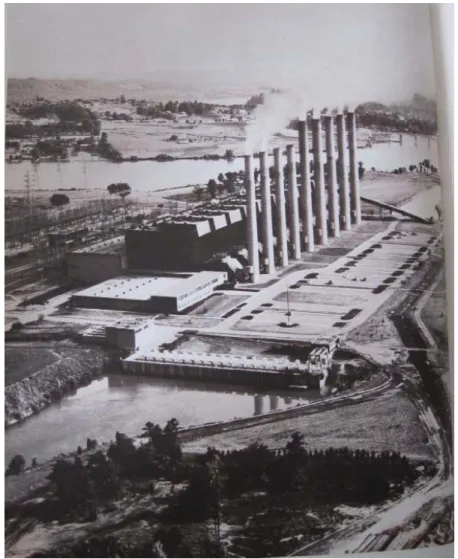
Figure 6.4b: Paradise Steam Plant (aerial) ... 300
viii
Figure 6.6: Peabody’s Big Hog ... 320
Figure 6.7: Diagram of Area Stripping ... 323
Figure 6.8: The Ravage ... 325
Figure 6.9: Strip Mining in Western Kentucky ... 327
Figure 6.10: Big Hog in Sinclair Mine ... 330
1
Speaking at the University of Chicago in 1954, Gordon R. Clapp, the chairman of the Tennessee Valley Authority’s board of directors, remarked, “Electricity, unlike butter, has no substitute.”1 In one sentence, Clapp captured the importance of electric power as a tool of social change for an entire generation of reformers and policymakers. The public power movement of the 1920s first linked the increased consumption of electricity with the rise of a healthy,
industrialized economy, the modern, appliance-filled home, and a clean environment. Beginning in the 1930s, the TVA’s emphasis on using an abundant supply of inexpensive kilowatts to facilitate economic growth and improve the quality of life in its service area formed the
foundation of an energy regime that made access to electric power an indispensable part of the social citizenship package coming out of the New Deal.2 In the post-World War II period, the consumption of electricity by businesses and individuals served as both a marker of progress and a means of achieving a modern, American standard of living through a more efficient use of natural resources.
Three core arguments drive this dissertation. First, public power represented a profoundly idealistic and influential approach to resource development that defined energy policy in the United States after the New Deal. The advocates of public power focused on democratizing access to electricity by expanding service and reducing rates in an effort to better
1 Gordon R. Clapp, “National Power Policy” (lecture 6 of 6 presented at the University of Chicago for the Charles R.
Walgreen Foundation, Chicago, Illinois, February 26, 1954), 4, University of Tennessee at Knoxville, John C.
Hodges Library, Special Collections [hereafter: UTK: Hodges], TVA Pamphlet Collection 1934-1960 [hereafter:
TVA PC], Box 1, Folder 1.
2 I will explain the term “energy regime,” its use in this dissertation, and its importance as a tool of critical analysis below; also see Gabrielle Hecht, The Radiance of France: Nuclear Power and National Identity after World War II (Cambridge: MIT Press, 1998), 14-7. On the concept of social citizenship and its relationship to the New Deal state, see discussion below and Suzanne Mettler, Dividing Citizens: Gender and Federalism in New Deal Policy (Ithaca:
Cornell University Press, 1998); and Meg Jacobs, Pocketbook Politics: Economic Citizenship in Twentieth Century America (Princeton: Princeton University Press, 2007).
2
the lives of all Americans. Cheap energy became a key component of the liberal state and its goal of achieving social welfare through economic growth and mass consumption. It was also an important bulwark for national security during the Cold War. Together, the state and the public power movement created an energy infrastructure and culture premised on low cost and high use that functioned as a critical support both for the era of material abundance and the military industrial complex.
Second, The Tennessee Valley Authority’s power program was the boldest experiment in public power in the nation’s history and the apotheosis of federal efforts to promote the
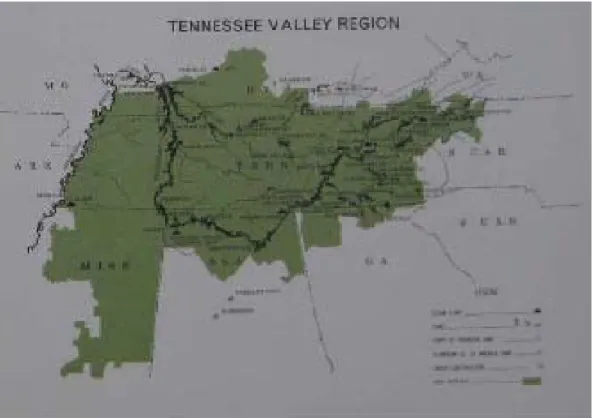
widespread adoption of an energy-intensive lifestyle. The agency’s emphasis on maintaining an abundant supply of inexpensive kilowatts formed the foundation of a consumption-centric energy regime that shaped the TVA’s generating system, encouraged residential use, and transformed the economy of its service area. The Authority relied on the cooperation of local boosters, including businessmen and politicians who embraced cheap electricity as a pathway to progress, and on the municipal utilities and rural coops that distributed TVA power. Particularly in the 1950s and 1960s, the Authority’s consumption-centric regime revolutionized patterns of energy use and resource development in the Tennessee Valley Region—an 80,000 square mile expanse that included parts of nine states.3 [Fig. 1.1]
Third, the successes and failures of the TVA’s regime highlight the strengths and weaknesses of the liberal state after World War II. They underscore both the state’s ability to project its influence by promoting widespread energy use and the limitations of consumption as a
3 The label “Tennessee Valley Region” refers to the communities included in the TVA’s service area as well as those directly involved in the production of electricity for the Authority. Admittedly the term has greater meaning when used to describe the immediate postwar period when one could argue that it referred to a roughly contiguous area. The TVA now receives much of its coal from mines in the western United States, including the Powder River Basin in Wyoming. It is also something of an artificial descriptor in the sense that the TVA’s system has always been connected to adjacent networks in the southeast and now is part of the national power grid receiving and sending electricity as needed.
3
social, economic, and environmental policy. Although the Authority succeeded in making inexpensive electric power ubiquitous in its service area, the agency’s policies reinforced a political economy that favored an emerging commercial elite and upper- and middle-class white consumers to the detriment of minorities and the poor. The focus on improving the purchasing power of all Americans to raise standards of living did little to reduce social and economic inequality, falling short of the rhetoric of public power’s early proponents. Furthermore, the process of generating large volumes of cheap kilowatts had serious consequences for the
environment. The TVA’s coal-buying policies encouraged the adoption of strip mining practices that destroyed the land and ruined streams in the region’s coalfields, and the agency’s coal-fired power plants released harmful pollutants that rendered neighboring communities uninhabitable.
Despite the destruction that its power program caused, the Authority continued to tout electricity as clean energy for homes and businesses. The TVA’s claim rested on the physical separation of energy consumers from the sites of energy production. To Nashville residents, electricity did in fact seem remarkably clean. Gone were the smog and soot that engulfed the city and other urban areas in the 1920s and 1930s. But the pollution problems of coal-fired power had not been solved. Rather, they had been moved to places “invisible” to most electrical customers. Not surprisingly, the environmental costs of the Authority’s energy regime fell most heavily on the rural poor.
In 1930s, the public power and regional planning movements shaped the early history of the TVA. The movements formed two parallel branches of conservationist thought, and both supported multipurpose resource development. The advocates of public power believed that government ownership of utilities was necessary to ensure that all consumers had access to electricity, which they argued was a vital resource of modern life. In contrast, the devotees of
4
regional planning favored cooperation with private electric companies whenever possible. The TVA’s first board of directors was split between David Lilienthal, a supporter of public power, and Arthur E. Morgan, a regionalist. Lilienthal pushed for the expansion of the Authority’s power program and the expulsion of private providers from the Tennessee Valley Region.
Morgan opposed this approach, preferring to rely on private utilities rather than increase the scope of the TVA’s power operations. The two men clashed repeatedly until Lilienthal ousted Morgan in 1938. As a result, the tenets of public power became the guiding principles of the Authority’s energy regime.
The history of the TVA’s power program in the 1950s and 1960s demonstrates the
centrality of the public power movement and inexpensive electricity to the making of the modern United States. It is a story of the state’s role in promoting a vision of social welfare predicated on the consumption of cheap energy, a vision that favored economic development over the preservation of natural resources and increasing the purchasing power of ordinary Americans over the direct redistribution of wealth. The widespread availability of affordable electric power underpinned much of the United States’ prosperity after World War II, facilitating
suburbanization and encouraging economic growth. Electricity was also a critical resource for the Army during the Cold War, providing the energy needed to produce the nation’s stockpile of nuclear weapons.
The Authority became the biggest producer and wholesale distributor of electricity in the United States in the middle decades of the twentieth century. In the 1950s alone, the agency oversaw a 320 percent increase in its sales of electric power and more than quadrupled its overall generating capacity.4 By the 1960s, residents in the Tennessee Valley Region used more
4 See TVA, Annual Report, 1949 (Washington, D.C.: Government Printing Office, 1949), 50; and TVA, Annual Report, 1959 (Washington, D.C.: Government Printing Office, 1959), 2. In the fiscal year ending in the summer of
5
electricity per household than any other part of the country, and homes in Nashville consumed electric power at twice the national average.5 The Authority’s energy regime made the agency’s service area attractive to manufacturers and federal defense projects. Electrochemical and metallurgical companies opened new factories in communities like Decatur, Alabama and Calvert City, Kentucky. The Atomic Energy Commission operated laboratories and production centers at Oak Ridge, Tennessee and Paducah, Kentucky, and the Army moved its rocket and guided missile research program to Huntsville, Alabama. Together, these industries and
installations fundamentally altered the economy of the region while relying on TVA electricity to meet their energy needs.6
Although the Authority made electric power more accessible and affordable for in-home and commercial use, its energy regime bolstered the interests of affluent white residents and did little to redistribute political or economic power to minorities and the poor. The TVA’s policies abetted mass movement to economically stratified, racially segregated suburban communities by expanding service on the metropolitan fringe. The manufacturers, research laboratories, and defense projects that used the Authority’s cheap kilowatts to transform the region provided few high-paying jobs for African Americans and empowered a new class of business progressives and white collar workers who dominated the region’s politics in the post-World War II period.7
1950 the TVA reported a generating capacity of approximately 2.74 million kilowatts. Ten years later the figure had risen to nearly 11.5 million kilowatts. See TVA, “TVA Power, 1959-1960,” informational pamphlet, January, 1960, 2, UTK: Hodges, TVA PC, Box 4, Folder 8; and TVA, “TVA Power, 1949,” undated informational pamphlet, 3, National Archives and Records Administration Southeast Branch, Morrow, GA [hereafter: NARA-SE], Record Group 142 [hereafter: RG 142], Power Manager’s File [hereafter: PMF], Box 17.
5 For statistics on electricity use in the Tennessee Valley Region and Nashville, see Chapter Three.
6 For a discussion of industrial growth and the rise of a postindustrial sector of research and development firms, see Chapter Four.
7 The term business progressives refers to the new commercial elite that finally overtook the older planter class in southern politics in the twentieth century and especially after World War II. The term’s application in the South can be attributed to George B. Tindall; see George B. Tindall, The Emergence of the New South, 1913-1945 (Baton Rouge: Louisiana State University Press, 1967); also see, Bruce J. Schulman, From Cotton Belt to Sunbelt: Federal Policy, Economic Development, and the Transformation of the South, 1938-1980 (Oxford: Oxford University Press, 1991), ix and 8-15.
6
The agency cultivated the support of these groups, and they became integral to the success of the TVA’s energy regime. While the Authority touted inexpensive electricity as a democratizing force in the Tennessee Valley, the energy-intensive lifestyle that the TVA promoted served as an important bulwark for a political economy of white middle- and upper-class privilege.8
The Authority also became one of the worst polluters in the United States. The agency’s commitment to increasing the capacity of its system ahead of demand resulted in its transition from hydroelectric to coal-fired power following World War II. Rather than install expensive pollution controls at its massive facilities, the TVA chose to locate them in remote areas in an effort to separate the vast majority of consumers from the byproducts of generating electricity from coal. In the process, the agency sacrificed environmental quality in the small, rural
communities that hosted its plants. Additionally, the Authority’s insistence on reducing the cost of procuring coal incentivized the expansion of strip mining in the Tennessee Valley Region.
Stripping operations denuded the landscape, ravaged the soil, and poisoned streams in the
coalfields that fed the agency’s steam plants. The consequences of the TVA’s approach to power production raised internal questions about the agency’s responsibilities as a public utility and fostered external criticism from individuals who believed the Authority ought to do more to mitigate the damage that its power program caused.9
Historiographical and Conceptual Frames
This dissertation’s conceptual focus on technopolitical regimes integrates four different historiographies: the history of energy, American political development and political economy, environmental history, and the history of the TVA. Few scholars have analyzed the relationship
8 See Chapter Three and Chapter Four.
9 See Chapter Five and Chapter Six.
7
between the public power movement, postwar social and economic policy, and the environment.
Furthermore, the literature on the Tennessee Valley Authority remains narrowly focused on the institution and its internal politics. Connecting these historiographies by framing the TVA’s power program as a technopolitical regime demonstrates how the ideals of public power shaped both the political economy and environmental history of the United States in the decades after World War II.
Energy, Electricity, and Technopolitical Regimes
This dissertation makes its greatest contribution to the field of energy history, specifically the history of electricity. It builds on the work of Thomas Parke Hughes and Gabrielle Hecht by framing the TVA’s power program as a technopolitical regime that embodied the ideals and contradictions of public power and defined energy policy in the United States after World War II. In Networks of Power, a foundational text on the development of electricity, Hughes argues that technological systems are integrated within political, social, and economic contexts, creating a seamless web. His analysis avoids the methodological deficiencies inherent in older
approaches to studying the history of technology. Rather than technological determinism, Hughes claims that the interactions between nominally internal and external factors both influence and are influenced by the creation of new technologies.10
Gabrielle Hecht uses the concept of technopolitical regimes to adapt Hughes’ “seamless web” to the study of nuclear energy in France. Hecht defines a technopolitical regime as the
10 Thomas P. Hughes, Networks of Power: Electrification in Western Society, 1880-1930 (Baltimore: Johns Hopkins University Press, 1983). Also see Thomas P. Hughes, “The Seamless Web: Technology, Science, Etcetera,
Etcetera,” Social Studies of Science 16 (1986): 281-92; Thomas P. Hughes, “The Evolution of Large Technological Systems,” in Social Construction of Technological Systems: New Directions in the Sociology and History of Technology, eds. Wiebe E. Bijker, Thomas P. Hughes, and Trevor J. Pinch (Cambridge: MIT Press, 2012[1987]), 45-76 (in the same volume, also see “Common Themes in Sociological and Historical Studies of Technology:
Introduction,” and the accompanying essays by Michel Callon and Trevor Pinch and Wiebe Bijker); and Hecht, The Radiance of France, 15.
8
institutions, individuals, engineering practices, and policies that “act together to govern
technological development and pursue technopolitics,” a term she uses to refer to “the strategic practice of designing or using technology to constitute, embody, or enact political goals.”11 Hecht demonstrates how French national identity became intertwined with the construction of nuclear power plants in the postwar period. The decision to pursue nuclear power, the design of the reactors, and the public reception that the new facilities received reflected the complex,
“mutually constitutive” relationship between technology, politics, and culture.12 Although scholars like Timothy Mitchell suggest that Hecht’s focus on technopolitical regimes reproduces assumptions about agency that privilege human over nonhuman actors, I find her work highly applicable to the TVA.13 The regime metaphor captures the way in which individuals,
institutions, ideologies, and environments both shaped and were shaped by the formation and implementation of the Authority’s energy policies.14
11 Hecht, The Radiance of France, 14-7 (for quotes see 15 for latter and 16 for former).
12 In part, Hecht grounds her framework in the scholarly argument over technological determinism that animated the field of science and technology studies in the 1980s and 1990s. Hecht stakes out a middle ground in the debates.
Although she explicitly rejects technological determinism, she also acknowledges that politics and culture are constructed concepts and that real limits of engineering affect the development of energy systems. Hecht, The Radiance of France, 8-14 (mutually constitutive is Hecht’s verbiage, see page 9).
13 Timothy Mitchell’s understanding of agency is similar to that of Bruno Latour in his work Reassembling the Social. As suggested in the previous note, Hecht does well to chart a middle course that acknowledges that human agency is not absolute, i.e. that there were real constraints of engineering that affected the development of nuclear technology in France, without reverting to technological determinism or contorting her framework to develop an entirely new conception of agency. It is not my goal in this dissertation to enter into this battle in great depth. I find that Hecht’s framework produces a commonsensical approach to balancing human agency with technological and environmental constraint. To the extent that my use of technopolitics reifies a false separation between the human and the nonhuman I hope that it does not detract from my larger argument regarding energy, political economy, and the environment in the United States. In fact, the assumption that human actors could separate themselves from environmental constraints was a central tenet of the public power movement. For Mitchell, see Timothy Mitchell, Rule of Experts: Egypt, Techno-Politics, Modernity (Berkeley: University of California Press, 2002); for Latour, see Bruno Latour, Reassembling the Social: An Introduction to Actor-Network-Theory (Oxford: Oxford University Press, 2005); for a recent critique of Latour’s and Mitchell’s articulation of agency, see Christopher Pearson, Scarred Landscapes: War and Nature in Vichy France (London: Palgrave MacMillan, 2008), 6-9.
14 Hecht’s investigation of the link between national identity and electric power makes her work particularly relevant for a study of the TVA and the liberal state’s role in promoting the use of electricity after the New Deal. For more on the relationship between the development of generating systems, national identity, and politics, also see James Jasper, Nuclear Politics: Energy and the State in the United States, Sweden, and France (Princeton: Princeton University Press, 1990) 3-20; and Brian Balogh, Chain Reaction: Expert Debate and Public Participation in American Commercial Nuclear Power, 1945-1975 (Cambridge: Cambridge University Press, 1991).
9
In the tradition of Hughes and Hecht, this dissertation examines the connections between the Tennessee Valley Authority’s power program and the politics of social, economic, and environmental change. It treats the ideals of the public power movement as the driving force behind a consumption-centric energy regime that included TVA leaders and staff, civic boosters, power distributors, development agencies, and politicians at the national, state, and local levels.15 These individuals and groups collaborated to ensure the successful operation of the Authority’s power program in the post-World War II period. Increasing residential and commercial
electricity use in an effort to raise standards of living served as the primary vision for the public power movement and the ultimate policy objective of the TVA and its supporters. The agency’s preference for building massive, rurally located coal-fired steam plants while eschewing the installation of costly devices for controlling emissions reflected its emphasis on maintaining an abundant supply of cheap electric power. During this period, municipal utilities and rural cooperatives also improved the capacity and coverage of the power grids in their communities.
Framing the TVA’s power program as a technopolitical regime highlights the way in which the agency cooperated with outside groups to make the presumed benefits of an energy-intensive lifestyle available throughout the Tennessee Valley Region. Additionally, the regime metaphor facilitates my discussion of the internal and external opposition to the Authority’s policies because it acknowledges the “contested nature” of energy systems and their development.16
This dissertation also heeds David Nye’s call for historians to analyze the social meanings of energy. In Consuming Power, Nye laments the extent to which scholars of electricity have concentrated their research on the construction of networks and specific
15 By way of clarification, I am referring to this technopolitical regime throughout the dissertation when I discuss the TVA’s consumption-centric energy regime, its consumption-centric regime, its energy regime, or, simply, its regime.
16 Hecht, The Radiance of France, 17.
10
technologies. He argues that this narrow focus detracts from the important role that energy plays in shaping social life.17 Recent work on energy and electricity in the United States addresses Nye’s concern without abandoning the discussion of systems. In his dissertation on energy use in the Mid-Atlantic region, Christopher Jones demonstrates how the development of new transmission technology altered local landscapes and improved access to electric power in the early twentieth century. By analyzing the intersection of technological innovation, economic development, and the environment, Jones illustrates the important effect that the expansion of service had on the history of the urban fringe.18 Similarly, Andrew Todd Needham investigates the cooperation of utilities and civic boosters in Phoenix, Arizona, during the 1960s in his book, Power Lines. He shows how a combination of private enterprise and public purpose transformed the American southwest after World War II. Increasing regional generating capacity and
extending the electric grid were both integral to Phoenix’s evolution into a sprawling, modern metropolis, though the former had severe consequences for the environment.19 Neither Jones nor Needham, however, addresses the influence of the public power movement or the liberal state in the postwar period.20 This dissertation highlights the connections between the Authority’s energy regime and the political economy of the1950s and 1960s. Cheap electricity wove itself into the social fabric of the nation. In the Tennessee Valley Region, the TVA’s power policies
17 David E. Nye, Consuming Power: A Social History of American Energies (Cambridge: MIT Press, 1998), 8-10.
18 Christopher F. Jones, “Energy Landscapes: Coal Canals, Oil Pipelines, Electricity Transmission Wires in the Mid- Atlantic, 1820-1930” (PhD diss., University of Pennsylvania, 2009), 1-31 and 325-65.
19 Todd Andrew Needham, Power Lines: Phoenix and the Making of the Modern Southwest (Princeton: Princeton University Press, forthcoming 2014).
20 Needham, in particular, appears to ignore the resemblance between the consumption-centric promotional campaigns and the construction of mine-mouth power plants in the southwest during the 1960s and 1970s and the campaigns and construction projects that the advocates of public power and the TVA championed only a decade earlier. Jones mentions Gifford Pinchot and Giant Power but does not follow their influence beyond the 1920s. In general, scholarship that discusses public power focuses on the movement prior to World War II; see Ronald C.
Tobey, Technology as Freedom: The New Deal and the Electrical Modernization of the American Home (Berkeley:
University of California Press, 1996), 40-61; Sarah T. Phillips, This Land, This Nation: Conservation, Rural America, and the New Deal (Cambridge: Cambridge University Press, 2007), 21-36; and Jay Brigham, Empowering the West: Electrical Politics Before FDR (Lawrence: University of Kansas Press, 1998).
11
helped promote suburbanization, consumerism, and economic growth. Emphasizing consumption and the state underscores the link between the public power movement and American political development in the twentieth century.
Political Economy, Social Citizenship, and the State
The growing literature on the state in American politics helps frame my analysis of the TVA and its technopolitical regime. Contrary to scholars like Philip Funigiello and Craufurd Goodwin, who claim that the United States lacked any discernible energy policy in the post- World War II period, this dissertation argues that the federal government endeavored to create a culture and infrastructure that encouraged the widespread adoption of an energy-intensive
lifestyle. The Authority’s regime represented one iteration of this larger effort. While Funigiello and Goodwin focus on the federal government’s failure to establish a nationwide regulatory apparatus and its inability to nationalize the utility industry, they rely on a conceptualization of state action that is too narrow.21
In the last three decades, scholars of history and the social sciences have begun treating the state as an important actor and a vital unit for academic discourse rather than a passive entity, derivative of the conflicts and desires of individual policy makers and social groups.22 Stephen Skowronek and Theda Skocpol have both greatly influenced the field of American political
21 For scholarship that claims the United States did not develop an energy policy, see Philip J. Funigiello, Toward a National Power Policy: The New Deal and the Electric Utility Industry, 1933-1941 (Pittsburgh: University of Pittsburgh Press, 1973), xi-xvi; and Craufurd D. Goodwin, “The Lessons of History,” in Energy Policy in
Perspective: Today’s Problems, Yesterday’s Solutions, ed. Craufurd D. Goodwin (Washington, D.C.: The Brookings Institution, 1981), 665-84.
22 Theda Skocpol, “Bringing the State Back in: Strategies of Analysis in Current Research,” in Bringing the State Back In, eds. Peter B. Evans, Dietrich Rueschemeyer, and Theda Skopol (Cambridge: Cambridge University Press, 1985), 3-44.
12
development.23 In his examination of the federal bureaucracy’s expansion after the Civil War, Skowronek argues that the American state experienced a period of reform and reorganization in response to the challenges of industrialization. This led to the creation of a modern
administrative apparatus that the nation had previously lacked.24 His work supports the traditional narrative in United States history that emphasizes the growing power of the federal government in the twentieth century—especially after the New Deal.25 Skocpol criticizes this teleological approach to American political development. In her study of the origins of federal welfare programs, she suggests that the state played a significant role in the creation of social policy well before the 1930s.26
Increasingly, other scholars, including William Novak and Brian Balogh, have also rejected the myth of the weak American state. Balogh, in particular, relies on an associational conceptualization of state power that dismisses the traditional Weberian focus on size and visibility. Instead, he builds on the work of Ellis Hawley, emphasizing the importance of public- private cooperation in American political development. In this way, Balogh assesses the ability of government institutions to influence the creation and implementation of policy through
23 In the last two decades numerous scholars have followed their lead, bringing the state back in to academic discourse on American politics, culture, and society. See Stephen Skowronek, Building a New American State: The Expansion of National Administrative Capacities, 1877-1920 (Cambridge: Cambridge University Press, 1982);
Theda Skocpol, Protecting Soldiers and Mothers: The Political Origins of Social Policy in the United States
(Cambridge: The Belknap Press of Harvard University Press, 1992); Richard Bensel, Yankee Leviathan: The Origins of Central State Authority in America, 1859-1877 (Cambridge: Cambridge University Press, 1990); and Karen Orren and Stephen Skowronek, The Search for American Political Development (Cambridge: Cambridge University Press, 2004).
24 Skowronek, Building a New American State, vii-ix and 3-18.
25 For examples of the traditional growth thesis, see Roy Lubove, The Struggle for Social Security, 1900-1935 (Cambridge: Harvard University Press, 1968); James T. Patterson, America’s Struggle Against Poverty, 1900-1980 (Cambridge: Harvard University Press, 1981); Michael B. Katz, In the Shadow of the Poorhouse: A Social History of Welfare in America (New York: Basic Books, 1986); Daniel Levine, Poverty and Society: The Growth of the American Welfare State in International Comparison (New Brunswick: Rutgers University Press, 1988); Bensel, Yankee Leviathan; Mettler, Dividing Citizens; Ira Katznelson, When Affirmative Action was White: An Untold Story of Racial Inequality in Twentieth Century America (New York: W. W. Norton & Company, 2005); Gareth Davies, See Government Grow: Education Politics from Johnson to Reagan (Lawrence: Kansas University Press, 2007); and Jacobs, Pocketbook Politics.
26 Skocpol, Protecting Soldiers and Mothers, 1-62.
13
partnerships with private actors to highlight the relative strength of the American state during the nineteenth century.27
This dissertation uses the associational model of state power to analyze the Authority and its energy regime. Although the TVA was a product of the New Deal and although it displaced existing private utilities, traditional models of state power do not fully capture the extent to which Authority, as a regional agency, relied on the support of local actors to implement its consumption-centric policies. The TVA mandated rate reductions and required its distributors to pay down their debts and invest in infrastructure. Much of the Authority’s success, however, resulted from collaboration with civic leaders who embraced the vision of the broader public power movement. Municipal utilities and rural cooperatives engaged in promotional campaigns to encourage domestic consumption, and local development organizations worked to attract private investment by electrochemical and metallurgical companies. The strength of the TVA’s regime stemmed less from the agency’s ability to centralize authority than from its relationship with powerbrokers in the region, demonstrating one of the important ways in which the liberal state projected its influence both during and after the New Deal.
27 Brian Balogh, A Government Out of Sight (Cambridge: Cambridge University Press, 2009). While Balogh discusses the nineteenth century, his work has applications for the post-New Deal period as well. As noted above, I believe that the study of technopolitical regimes provides an avenue for understanding and analyzing how the New Deal state projected power in the post-World War II era. Also see Ellis W. Hawley, The Great War and the Search for a Modern Order: A History of the American People and their Institutions, 1917-1933, second edition (New York: St. Martin’s Press, 1992). For a sample of other scholarship that utilizes the associational framework to analyze the American state, see Michael Fein, Paving the Way: New York Road Building and the American State, 1880-1956 (Lawrence: Kansas University Press, 2008); and for an analysis of the development of modern bureaucracies in the late nineteenth and early twentieth century, Olivier Zunz, Making America Corporate, 1870- 1920 (Chicago: University of Chicago Press, 1990). William Novak focuses more on the history of regulation at the local level and the importance of police powers to understanding the strength of the nineteenth century state; see William Novak, “The Myth of the ‘Weak’ American State,” American Historical Review 113 (June 2008): 752-72;
and William Novak, The People’s Welfare: Law & Regulation in Nineteenth-Century America (Chapel Hill:
University of North Carolina Press, 1996). For Weber, see Max Weber, “The Three Types of Legitimate Domination,” in Essays in Economic Sociology, ed. Richard Swedberg (Princeton: Princeton University Press, 1999), 99-108; Max Weber, “The Bureaucratization of Politics and the Economy,” in Essays in Economic Sociology, ed. Richard Swedberg (Princeton: Princeton University Press, 1999), 109-15; and Max Weber, “The Rational State and Its Legal System,” in Essays in Economic Sociology, ed. Richard Swedberg (Princeton: Princeton University Press, 1999), 116-9. For another critique of the Weberian definition of the state and state power, see John Brewer, The Sinews of Power: War, Money and the English State, 1688-1783 (New York: Alfred A. Knopf, 1989).
14
Framing the Tennessee Valley Authority in this way also underscores the extent to which consumption became a central component of social policy in the United States. Liz Cohen, Suzanne Mettler, and Meg Jacobs all show how the New Deal’s Keynesian turn linked access to goods and services with national identity.28 Cohen analyzes the growth of consumer culture after World War II in her book, Consumer’s Republic. She argues that the United States built “an economy, culture, and politics…around the promises of mass consumption, both in terms of material life and the more idealistic goals of greater freedom, democracy, and equality” in the 1950s and 1960s.29 Similarly, Mettler and Jacobs use the concept of social citizenship, which they define as an individual’s “entitlement…to the basic necessities of economic security and social well-being,” to examine the state’s role in facilitating the rise of Cohen’s consumer’s republic.30 In Dividing Citizens, Mettler focuses on welfare programs such as unemployment insurance and old age insurance that provided supplemental income to those who were either out of work or had retired. She claims that the ability to take part in these programs became a marker of civic membership following the New Deal, and she describes how the federal government excluded many African Americans and women from participating in them.31 In
28 Lizabeth Cohen, A Consumer’s Republic: The Politics of Mass Consumption in Postwar America (New York:
Alfred A. Knopf, 2003); Mettler, Dividing Citizens; and Jacobs, Pocketbook Politics. The literature on consumption and consumerism and their relationship to political and social history in the United States is long and detailed; some examples of scholarship that address the topic either from a contemporary or historical lens include Thorstein Veblen, The Theory of the Leisure Class: An Economic Study of Institutions (New York: Macmillan, 1899); Daniel Horowitz, “Consumption and Its Discontents: Simon N. Patten, Thorstein Veblen, and George Gunton,” Journal of American History 67(September 1980): 301-17; David M. Potter, People of Plenty: Economic Abundance and the American Character (Chicago: University of Chicago Press, 1954); E. Franklin Frazier, Black Bourgeoisie (Glencoe, IL: Free Press, 1957); John Kenneth Galbraith, The Affluent Society (Boston: Houghton Mifflin, 1958);
Lynn Dumenil, Modern Temper: American Culture and Society in the 1920s (New York: Hill and Wang, 1995); and Alan Brinkley, The End of Reform: New Deal Liberalism in Recession and War (New York: Alfred A. Knopf, 1995).
29 Cohen, A Consumer’s Republic, 9.
30 Mettler, Dividing Citizens, 9. Jacobs uses the term “economic citizenship” to describe the ability to participate in the “mass consumer economy”; see Jacobs, Pocketbook Politics, 2. Both scholars link civic membership with consumption.
31 Mettler, Dividing Citizens. For more on the extent to which the liberal state’s social policies benefited
heterosexual, white, men, see Katznelson, When Affirmative Action was White; and Kathleen J. Frydl, The GI Bill (Cambridge: Cambridge University Press, 2009).
15
Pocketbook Politics, Jacobs suggests that the ability to consume has functioned as the
“foundation of American identity” and that the liberal state adopted the high-wage, low-price economy as a mechanism for improving the purchasing power of individuals during the 1930s.32 This dissertation draws on the work of these three scholars to frame the TVA’s energy regime within the context of federal efforts to foster a political economy predicated on mass-
consumption that treated access to goods and services like electricity as one of the basic rights of American citizenship.
Furthermore, the Authority’s regime helped transform the economy of the agency’s service area by creating the infrastructure necessary to support energy-intensive manufacturing and research. The literature on economic development in the American South after World War II emphasizes the importance of the military industrial complex and a new commercial elite in breaking agriculture’s hold on the region. It does not discuss cheap electricity in great detail.
Bruce Schulman, for example, acknowledges the TVA’s power program in his book, From Cotton Belt to Sunbelt, but he does not count the agency among the major factors that attracted defense spending and private capital to the South.33 This dissertation integrates the Authority’s energy regime more fully into a history of the South’s rise after 1945. The TVA’s inexpensive kilowatts did influence the Army’s decision to locate certain projects in the Tennessee Valley and made possible the rapid expansion of electrochemical and metallurgical industries in the
32 Jacobs, Pocketbook Politics, 2.
33 Schulman’s work is most relevant for Chapter Four on the Huntsville-Decatur corridor in Alabama. Schulman’s study is substantially broader geographically than mine, and he does not focus exclusively on the importance of the TVA because of this. As a result, Schulman deemphasizes the importance of cheap energy to development in the South. It is true that energy, and specifically electricity, represented only one factor that affected economic growth in the region; nevertheless, it has received little attention from scholars. See Schulman, From Cotton Belt to Sunbelt. For a sample of other works that discuss the changing politics and economy of the New South, see V. O.
Key, Southern Politics In State and Nation (New York: Knopf, 1949); C. Vann Woodward, Origins of the New South, 1877-1913 (Baton Rouge: Louisiana State University Press, 1951); Tindall, Emergence of the New South;
Dwight B. Billings, Jr., Planters and the Making of the “New South” (Chapel Hill: University of North Carolina Press, 1979); and James C. Cobb, Industrialization and Southern Society, 1877-1984 (Lexington: University of Kentucky Press, 1984).
16
region. The growth of cities like Huntsville, which became a center for aeronautical research in the 1950s and 1960s, would not have occurred if not for the Authority. Affordable electricity in large volumes was critical to the emergence of the new Sunbelt economy.
Environmental History
This dissertation also adds to recent scholarship on the relationship between the New Deal and the environment. Sarah Phillips and Neil Maher both demonstrate how conservationist thought influenced the environmental policies of the Roosevelt administration in the 1930s.
Phillips, in particular, connects the TVA’s early history with the conservation movement and public power, though she does not explore the agency’s power program in the period after World War II.34 This dissertation expands her analysis of the Authority by investigating the long-term environmental consequences that resulted from the liberal state’s embrace of public power and conservation. The TVA’s decision to construct its power plants in sparsely populated areas protected the majority of its customers from the noxious byproducts of generating energy from coal. As William Cronon argues in his study of late nineteenth century commodity flows, the separation of consumption from the site of production is a defining feature of modernity that insulates most Americans from the side effects of development.35 It also concentrates pollution in communities inhabited by minorities and the poor.36 In the Tennessee Valley Region, the
34 Phillips and Maher represent a new thrust in environmental scholarship on the New Deal. Earlier works tend to focus on the dust bowl or technical aspects of programs like the Civilian Conservation Corps. Phillips and Maher advance this literature by framing the New Deal’s environmental programs within conservationist thought. See Phillips, This Land, This Nation; and Neil M. Maher, Nature’s New Deal: The Civilian Conservation Corps and the Roots of the American Environmental Movement (Oxford: Oxford University Press, 2008). Earlier works include, Donald Worster, Dust Bowl: The Southern Plains in the 1930s (Oxford: Oxford University Press, 1982); and John Salmond, The Civilian Conservation Corps, 1933-1942: A New Deal Case Study (Durham, Duke University Press, 1967).
35 William Cronon, Nature’s Metropolis: Chicago and the Great West (New York: W. W. Norton & Co., 1991).
36 Several scholars have commented on the tendency of the poor and minorities to bear the brunt of
industrialization’s environmental consequences in the United States; see Robert D. Bullard, Dumping in Dixie:
17
TVA’s coal-fired power plants inundated small rural towns with ash and gaseous emissions, and the agency’s coal buying policies promoted strip mining that destroyed local landscapes and streams throughout the Kentucky and Tennessee coalfields. The “use of the earth for the good of man” privileged upper- and middle-class urban and suburban consumers to the detriment of the rural poor.37 In this way, the Authority’s energy regime underscores the weaknesses inherent in the New Deal’s approach to resource management.
Contextualizing the TVA
By contextualizing the Tennessee Valley Authority within the politics of public power and the post-World War II period, this dissertation also contributes to the historiography of the TVA. Erwin C. Hargrove’s exhaustive study, Prisoners of Myth, remains the definitive work on the Authority’s power program. Hargrove notes the role of the agency’s leadership in both creating and perpetuating founding narratives that have shaped the culture of the TVA and affected its approach to designing and maintaining its generating system. Nevertheless,
Prisoners of Myth focuses almost exclusively on the Authority’s inner-workings.38 Much of the scholarship on the TVA maintains a similarly narrow focus. Early works on the Authority provide a narrative of the agency’s success. Often written by former TVA staffers and board members, these accounts offer laudatory assessments of the Authority that lack critical
Race, Class, and Environmental Quality (Boulder: Westview Press, 1990); Andrew Hurley, Environmental Inequalities: Race, Class, and Industrial Pollution in Gary, Indiana, 1945-1980 (Chapel Hill: University of North Carolina Press, 1995); and Steve Lerner, Diamond: A Struggle for Environmental Justice in Louisiana’s Chemical Corridor (Cambridge: MIT Press, 2005).
37 The phrase “use of the earth for the good of man” is in reference to a Gifford Pinchot who often used it to describe the philosophy of the conservation movement and public power. The TVA quoted it in its annual reports, see TVA, Annual Report, 1953 (Washington, D.C.: Government Printing Office, 1953), 52; also see Erwin C. Hargrove, Prisoners of Myth: The Leadership of the Tennessee Valley Authority, 1933-1990 (Knoxville: University of Tennessee Press, 1994), 181.
38 Hargrove, Prisoners of Myth.
18
analysis.39 Other historians and political scientists have probed the TVA’s shortcomings, emphasizing its paternalistic approach to development and the extent to which the agency’s policies reinforced existing social hierarchies in its service area.40 Few of the authors in either of these groups have made an attempt to locate the Authority within the broader forces of United States history.
This dissertation connects Hargrove’s detailed institutional history to the work of another set of scholars who link the TVA with the rise of conservationist thought in the early twentieth century. As noted above, Sarah Phillips analyzes how the principles of conservation and public power shaped the development of the Authority’s agricultural programs and its power policies.41 While Phillips focuses on the 1930s, this dissertation demonstrates that the principles of public
39 For example, in Democracy on the March, David Lilienthal, one of the TVA’s original board members, describes the Authority as a federal agency that encouraged grassroots participation in the management of resources,
empowering local communities rather than becoming an insulated bureaucracy. He emphasizes the Authority’s protracted battle with private utility companies as a conflict in which the TVA ultimately proved victorious. Having vanquished its competitors by 1940, the TVA stands alone at the conclusion of Democracy on the March as a triumphant yet benevolent institution. David Lilienthal, TVA: Democracy on the March (New York: Harper & Row, 1944); for other examples of work written by former administrators and employees see Gordon Clapp, The TVA: An Approach to the Development of a Region (Chicago: Chicago University Press, 1955); Wilmon Henry Droze, High Dams and Slack Waters: TVA Rebuilds a River (Baton Rouge: Louisiana State University Press, 1965); Arthur Morgan, The Making of the TVA (Buffalo: Prometheus Books, 1974); and Marguerite Owen, The Tennessee Valley Authority (New York: Praeger, 1973); and for a slightly more even handed treatment see, Thomas K. McCraw, TVA and the Power Fight, 1933-1939 (Philadelphia: J.B. Lippincott Company, 1971).
40 For examples, see Philip Selznick, TVA and the Grass Roots: A Study in the Sociology of Formal Organization, second edition (New York: Harper & Row, Publishers, 1966), ix-xvi and 3-16; Victor C. Hobday, Sparks at the Grassroots: Municipal Distribution of TVA Electricity in Tennessee (Knoxville: University of Tennessee Press, 1969); Michael J. McDonald and John Muldowny, TVA and the Dispossessed: The Resettlement of Population in the Norris Dam Area (Knoxville: University of Tennessee Press, 1982); William U. Chandler, The Myth of TVA:
Conservation and Development in the Tennessee Valley, 1933-1983 (Cambridge: Ballinger Publishing Company, 1984); William Bruce Wheeler and Michael J. McDonald, TVA and the Tellico Dam, 1936-1979: A Bureaucratic Crisis in Post-Industrial America (Knoxville: University of Tennessee Press, 1986); and Nancy L. Grant, TVA and Black Americans: Planning for the Status Quo (Philadelphia: Temple University Press, 1990). Also see Walter L.
Creese, TVA’s Public Planning: The Vision, the Reality (Knoxville: The University of Tennessee Press, 1990).
Creese acknowledges that the Authority has attained some level of success in the area of farming.
41 Phillips, This Land, This Nation, 1-148. For two earlier accounts that discuss the connections between the TVA, conservation, and public power in the pre-World War II era, see Judson King, The Conservation Fight: From Theodore Roosevelt to the Tennessee Valley Authority (Washington, DC: Public Affairs Press, 1959); and Preston J.
Hubbard, Origins of the TVA: The Muscle Shoals Controversy, 1920-1932 (Nashville: Vanderbilt University Press, 1961). King, in particular, traces the role of politicians like George Norris in fighting for the creation of a
government agency that would manage the resources of the Tennessee Valley in the 1920s and in guiding the TVA Act through Congress in the 1930s.
19
power and a definition of conservation that privileged development over preservation continued to drive the TVA’s energy regime after World War II. In doing so, it locates the Authority within the political economy of the postwar era.
Tennessee Valley Region
Regional history presents certain challenges. In particular, one must define the area under study and demonstrate that it represents a useful unit for analysis. A variety of methods exist for identifying and demarcating regions, including political borders, cultural and ethnic divisions, and river systems.42 The multiplicity of frameworks causes disagreements among scholars. Historians and social scientists who study the United States, for example, often quarrel over the relative importance of politics, culture, economics, and geography when discussing the boundaries of the American South.43 None of these approaches, however, best describes the Tennessee Valley Region.
42 Christopher Jones makes this observation in his recent dissertation on energy systems in the Mid-Atlantic; see Jones, “Energy Landscapes,” 22-4 and 22n.36. Environmental historians, in particular, have focused on rivers and watersheds to frame regional studies; for an example, see Richard White, The Organic Machine (New York: Hill and Wang, 1995).
43 A voluminous literature exists on the South. For debate over the region’s boundaries, see Schulman, From Cotton Belt to Sunbelt, x and 232n.7; Cobb, Industrialization and Southern Society; Michael O’Brien, The Idea of the American South, 1920-1941 (Baltimore: Johns Hopkins University Press, 1979); Timothy G. O’Rourke, “The Demographic and Economic Setting of Southern Politics,” in Contemporary Southern Politics, ed. James F. Lea (Baton Rouge: Louisiana State University Press, 1988); and Carl Abbott, “The American Sunbelt: Idea and Reality,”
Journal of the West 18 (July 1979): 5-18. More generally, Howard W. Odum’s work, Southern Regions of the United States, stands out as the first piece of social science that had a an effect on social policy at the federal level.
It was quickly followed by a report from the National Emergency Council in which Franklin Roosevelt labeled the South as the greatest economic problem in the United States; see Howard W. Odum, Southern Regions of the United States (Chapel Hill: University of North Carolina Press, 1936) and United States National Emergency Council, Report on Economic Conditions of the South (Washington, D.C.: Government Printing Office, 1938). For a sampling of the vast historiography on the New South, see Woodward, Origins of the New South; C. Vann Woodward, The Strange Career of Jim Crow (Oxford: Oxford University Press, 1955); Billings, Jr., Planters and the Making of the “New South”; and Tindall, Emergence of the New South. For an example of work on the New South that focuses more on cultural and social history than economic history, see Glenda E. Gilmore, Gender & Jim Crow: Women and the Politics of White Supremacy in North Carolina, 1896-1920 (Chapel Hill: University of North Carolina Press, 1996).
20
This dissertation adopts William Cronon’s focus on commodity flows from Nature’s Metropolis, in which Cronon argues that the movement of grain and livestock connected Chicago with a vast hinterland of producers and consumers in the late nineteenth century.44 Recently, Christopher Jones and Todd Andrew Needham have utilized frameworks similar to Cronon’s to examine the development of energy systems in the Mid-Atlantic and the Southwest. Both Jones and Needham show how the production, distribution, and consumption of electricity linked far flung communities. Although individuals are not always conscious of the relationship between their use of electric power and the consequences of surface mining or coal-fired emissions, the very act of turning on a light renders them part of a larger system.45
This dissertation treats the TVA’s consumption-centric energy regime as the sinew that makes the Tennessee Valley Region a useful unit for analysis. Rather than the Tennessee River Valley proper, I use the term Tennessee Valley Region to refer to the communities included in the Authority’s service area and those directly involved in the production of electricity for the agency.46 [Fig. 1.1] The TVA distributed electric power to municipal utilities, rural
cooperatives, large industries, and federal defense installations in Tennessee, northern Alabama, northern and eastern Mississippi, western Kentucky, western North Carolina, southwestern Virginia, and northern Georgia. Outside of its service area, the Authority purchased coal from mines in Alabama, eastern and western Kentucky, Virginia, Illinois, and Indiana in the 1950s and
44 Cronon focuses on Chicago and the development of its hinterland during the late nineteenth century. Although my project does not focus on a single node, it does treat the production and consumption of electricity as a commodity flow that connects different communities to create a region. See Cronon, Nature’s Metropolis.
45 Jones, “Energy Landscapes”; and Needham, Power Lines.
46 As I discuss in a footnote above, the term Tennessee Valley Region is probably most accurate when used to describe the three decades following World War II. During this period my regional schema refers to a roughly contiguous area. The TVA now purchases coal from mines in Wyoming and other western states. The label is also artificial to the extent that the Authority has always shared connections with surrounding networks and now is part of a national power grid that shares electricity across the nation.