The effect of the existence of an in-plane pole of angular momentum near J = 1 on the scattering amplitude in the vacuum quantum number channel is calculated. Suppose, for example, that many of the experimental consequences of the Regge pole hypothesis (6) for strong interactions were actually verified. Using the optical theorem, we would also find for the entire cross section in the high energy limit.
We calculate the scattering amplitude in two ways, once with Feynman's rules and again by introducing our conjectures about the vacuum singularity of the partial wave amplitudes in . Some details of the field theory used in the main body of the text · are included in Appendix A along with notation conventions. The first task is to see what modifications occur in the partial wave expansion as a result of the symmetrization of the states.
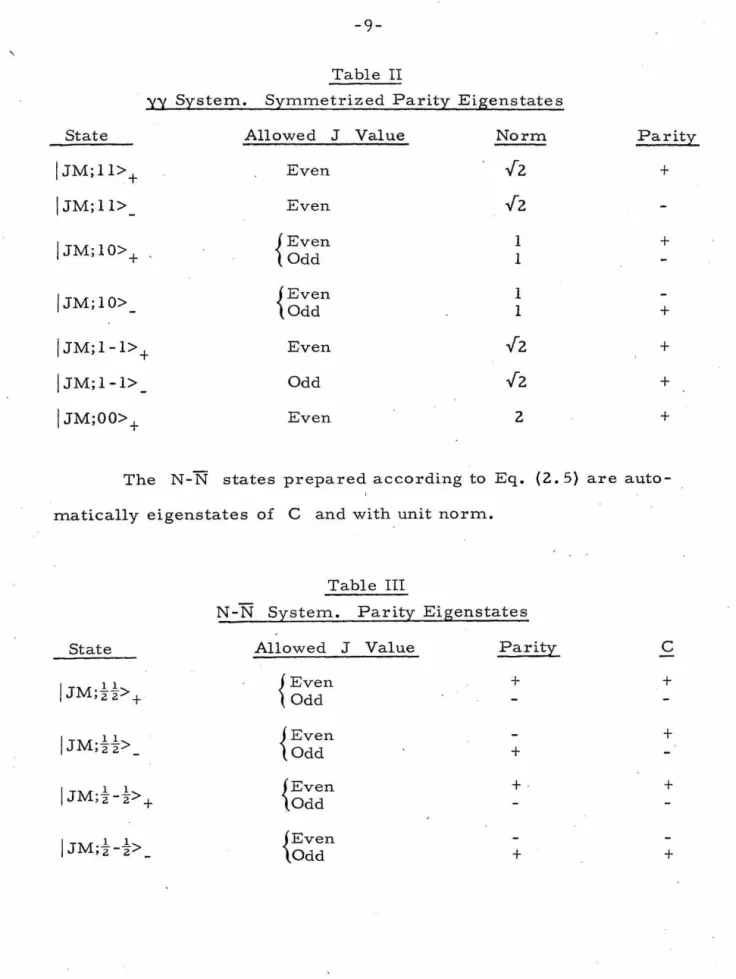
Introduce additional new scattering amplitudes. so that the partial wave expansions of the ;J's become, from Eq. The final step is the construction of the parity-preserving amplitudes to match the parity eigenstates.
THE BASIC PROGRAM
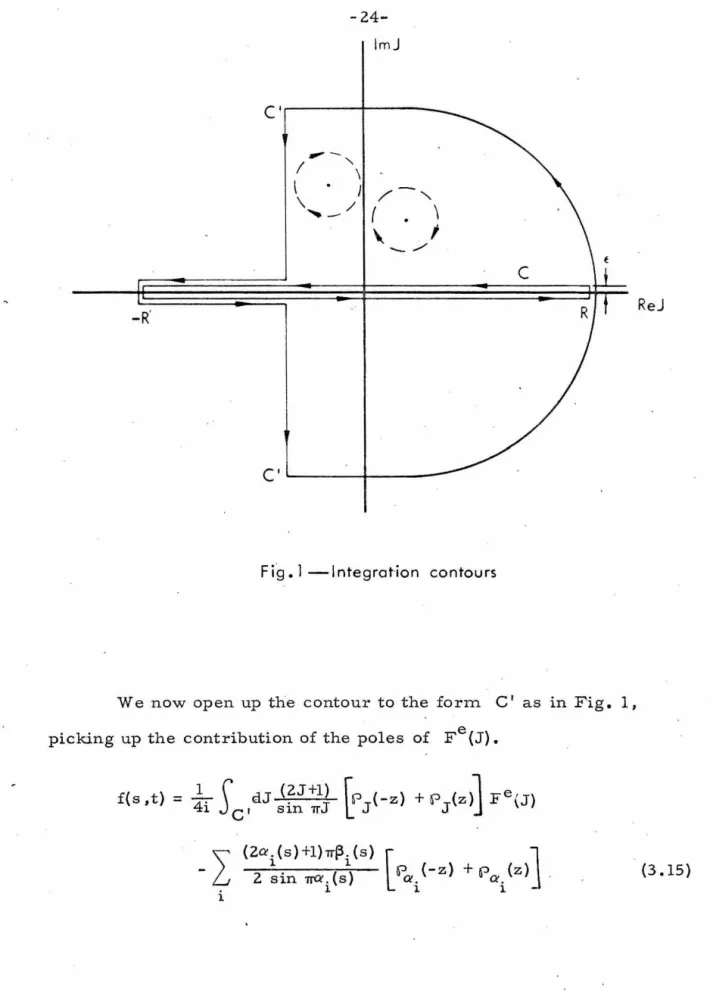
The biggest part of the Reggeizing trick is to find a unique function F(J) of the continuous variable J that will be equal to the partial wave function FJ· for positive integers. Since rP a{z) goes asymptotically for large z than for, iri these limits the contribution of the Regge pole with the maximum value Re J dominates all others and the integral over the contour C'. In the case of N + N - N + N, the contribution of the lowest order term was omitted because it gave a contribution lower than the first order in the coupling constant.
Decomposing the amplitude into two such terms is arbitrary; only their sum, zero, has meaning. The other six processes agree in their asymptotic form with the predictions of {3. 24), but for them the identification of the corresponding coefficients would be purely formal. This formula is valid in the range from the lowest threshold of the intermediate conditions to the first inelastic threshold.
Applying this to the process N + N - N + N, we consider intermediate states of the NN and yy systems. Since {3. 40) must hold in every order of the coupling constant, let's look at the fourth order terms, and then look at the high z limit.
CALCULATION OF THE TRAJECTORY
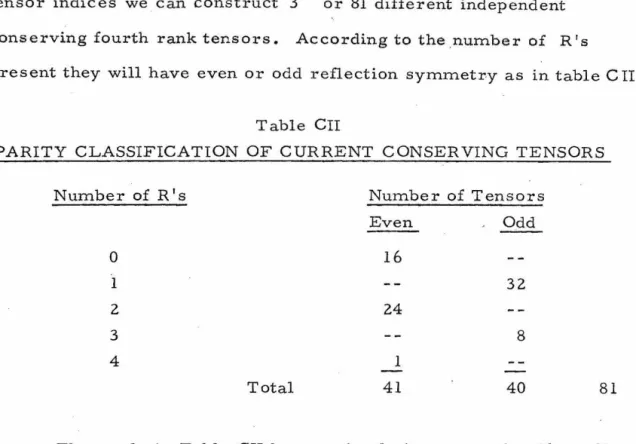
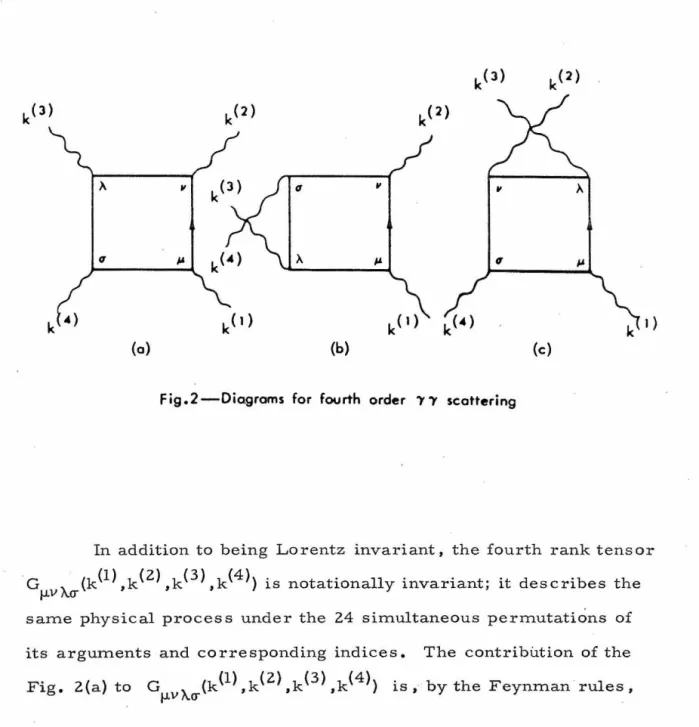
We can obtain the contribution of the three diagrams to G from T by proper permutations alone. Concepts with an even number of them can already be expressed as combinations of the tensors. 4. 7), then shift the origin of the p-integration to eliminate the terms in the denominator linearly in p.
To look only at the right cut, we take in the first integral (4. 3 2) and part of the third. Having solved the problem of extracting the contribution of the right hand cut, we examine its asymptotic form. We have shown that the right-cut portion of the third diagram also contributes terms of this order and not greater.
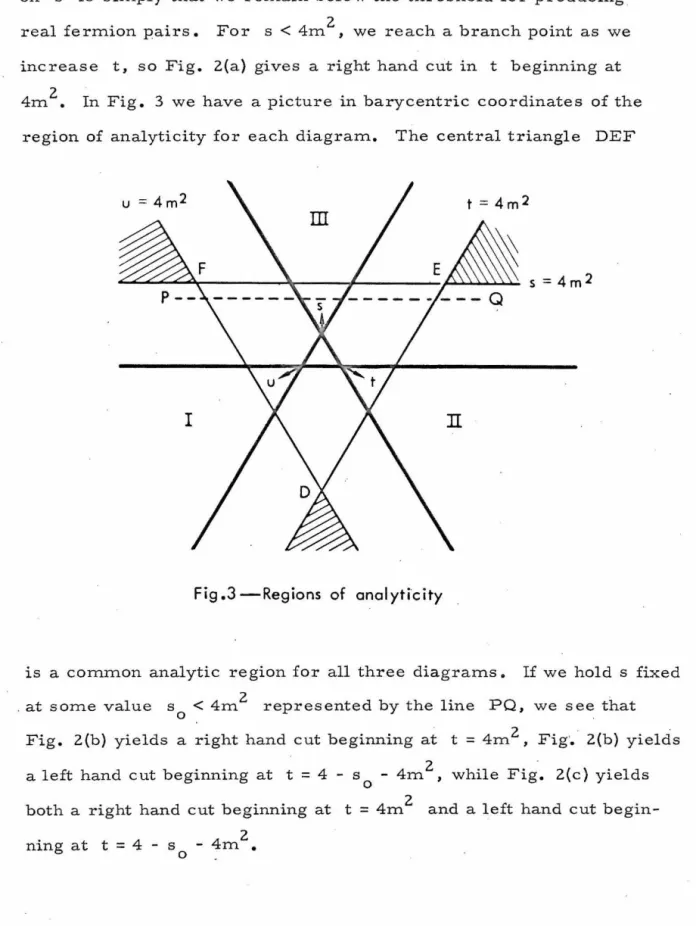
Mandelstam's representation provides the most convenient basis for a discussion of the analytical properties of M. Sl., splitting the contribution of the third double spectral function into right and left hand slices in t. If we could calculate At, absorbing part of the scattering in the t-channel, its .
Integrating this expression over the entire range of cutting by machine calculation we get. A fatal disadvantage of the trajectory calculated with the third diagram is the size of its imaginary part. This is related to the general interpretation that singularities of the scattering amplitude of the non-physical.
So for some big s, the sign of the imaginary part changes sign and becomes negative. The original full-amplitude form derived by Karplus and Neuman had this property. To correct this, we might consider adding to what we have the contribution of the third diagram to the right single spectral functions in t.
In the case of arbitrary amounts of subtractions in u and t, the amount we need to subtract from the contribution of the third diagram to the right t-intercept still holds. We arrived at this program by taking into account the properties of the members attributed to the trajectory of the vacuum.
CONCLUDING REMARKS
A separate calculation of the imaginary part of the forward scattering amplitude in the cross channel. The same prescription should be applied to the recent calculation of Sullivan(ZS) of the vector meson scalar nucleon case to cure the same ailments. Or should it be considered an essential part of the same mechanism that produces what we have chosen to idealize as the "pure" trajectory.
In the latter case, it would fulfill a role, such as allowing for the crossing symmetry of the trajectory, which has yet to be discovered. In the decomposition of the A (x) in plane. waves, for each momentum there are only three independent solutions to the field equation; we take it to be marked by them. However, it is still true that the current is conserved in the presence of the 'I field.
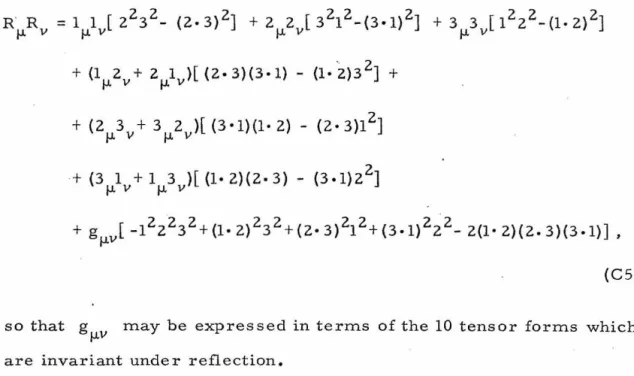
C5), so that gµv can be expressed in terms of the 10 tensor forms which are invariant under reflection. Thus, two of the tensor forms appearing in (4.8) can be eliminated to give a decomposition with uniquely determined coefficients. The effect of the simultaneous permutation of the arguments and indices of G \. 1234) is to create equality between the heads below.
It is simple to prove that the coefficient of each tensor form in (4. 9) must vanish separately so that the third rank tensor obtained by any of the contractions (4. 6) can vanish identically. Here we have followed Karplus and Neuman, making occasional use of the permutation symmetries for convenience. The expression below is presented as a table - - for each of the 81 A's the corresponding tensor coefficient is placed next to it.
This is a description of the calculation of the absorption part of the scattering amplitude 'Y'Y in the t-channel for s = 0. Of course, we have to make similar cuts in the diagram Figure 2{c} and two other diagrams that have the direction of the fermion line reversed. Choosing the appropriate values of moments and helices when transitioning into a crossed channel is somewhat difficult.
We were able to demonstrate this explicitly, using the original Karplus and Neuman shape of the amplitude. As with a random walk, the size of the coefficients in the full answer (4.41) suggests the square root of the number of steps taken; however, here we have two such walks that end in the same place.