14
Theories for Creating Effective Message Strategies
Chapter Contents
r Mendelsohn’s Three Assumptions for Success
r How People Respond to Messages (McGuire’s Hierarchy of Effects or “Domino” Model of Persuasion)
r Just How Difficult Is It?
r Problems With a Source-Oriented Perspective
r Limitations of the Domino Model—Acknowledging People Are Not Always Logical
r Why People Respond to Messages—Finding the Right Motivating Strategy r Other Theories That Explain Special Situations
r Final Thoughts
In the 1950s and early 1960s, communication experts noticed that mass communication campaigns were having little effect, and many believed the situation to be hopeless. One scholar caused an uproar with an arti- cle calling mass media campaigns essentially impotent, and another pub- lished an influential book asserting that information campaigns tended to reinforce existing opinions but rarely changed anybody’s minds. These followed on the heels of two other scholars who blamed the receivers of messages for failing to be persuaded by them. This pessimistic view still prevailed a decade later, when a man named Mendelsohn shot back with a more realistic diagnosis and a more optimistic prognosis. His ideas have had an enormous impact on the communication field.
297
MENDELSOHN’S THREE ASSUMPTIONS FOR SUCCESS
Mendelsohn (1973) believed campaigns often failed because campaign de- signers overpromised, assumed the public would automatically receive and enthusiastically accept their messages, and blanketed the public with messages not properly targeted and likely to be ignored or misinterpreted.
As McGuire (1989) wrote later, successful communication campaigns de- pend on a good understanding of two types of theories: those that explain how someone will process and respond to a message and those that explain why someone will or will not respond to a message in desirable ways.
After more than three decades, Mendelsohn’s diagnosis still applies.
Surveys and interviews with communication professionals have shown consistently that one of the major reasons clients and superiors lose faith in public relations agencies and professionals is because the agencies over- promised (Bourland, 1993; Harris & Impulse Research, 2004). In 2003, the failure to keep promises was the biggest reason cited by clients for declin- ing confidence in public relations agencies (Harris & Impulse Research, 2004). Overpromising often occurs when program planners do not have a good understanding of their publics and of the situation in which program messages will be received. People from varied backgrounds and with var- ied interests are likely to interpret messages differently. Moreover, a good understanding of the problem, the publics, and the constraints affecting the likelihood of change (remember social marketing’s “price”) helps the program planner set goals and objectives that can be achieved using the strategies available in the time allotted. Mendelsohn (1973) offered a trio of campaign assumptions:
1. Target your messages.
2. Assume your target public is uninterested in your messages.
3. Set reasonable, midrange goals and objectives.
On the one hand, Mendelsohn’s admonition that message receivers will not be interested in a campaign and that campaigns setting ambitious goals are doomed to failure can cultivate pessimism. On the other hand, Mendel- sohn’s point is that campaign designers who make his three assumptions can make adjustments in strategy that will facilitate success both in the short term and in the long run. The implication of Mendelsohn’s tripartite is that research is necessary to define and to understand the target publics and that an understanding of theory is necessary in order to develop strate- gies that acknowledge the publics’ likely lack of interest and that point to strategies that will compensate for it. Mendelsohn illustrated his point with an example from his own experience, which, depending on your perspec- tive, could be viewed either as a major success or a dismal failure.
Mendelsohn’s campaign tried to increase traffic safety by addressing the fact that at least 80% of drivers considered themselves to be good or excellent drivers, yet unsafe driving practices killed people every day. Long holiday weekends were especially gruesome. Meanwhile, most drivers ignored the 300,000 persuasive traffic safety messages disseminated each year in the print media.
Mendelsohn’s team, in cooperation with the National Safety Council and CBS, developed “The CBS National Driver’s Test,” which aired im- mediately before the 1965 Memorial Day weekend. A publicity campaign distributed 50 million official test answer forms via newspapers, maga- zines, and petroleum products dealers before the show aired. The show, viewed by approximately 30 million Americans, was among the highest rated public affairs broadcasts of all time to that point and resulted in mail responses from nearly a million and a half viewers. Preliminary research showed that almost 40% of the licensed drivers who had participated in the broadcast had failed the test. Finally, 35,000 drivers enrolled in driver- improvement programs across the country following the broadcast. The producer of the program called the response “enormous, beyond all ex- pectations.” Yet no evidence was provided that accident rates decreased because of the broadcast, and the number of people enrolled in driver improvement programs reflected only about .07% of those who had been exposed to the test forms. How was this an enormous success?
Mendelsohn realized that bad drivers would be difficult to reach because of their lack of awareness or active denial of their skill deficiencies, and he realized that to set a campaign goal of eliminating or greatly reducing traffic deaths as the result of a single campaign would be impossible. As a result, Mendelsohn’s team chose more realistic goals in recognition of the fact that a single campaign could not be expected to completely solve any problem. The goals of the campaign included the following:
1. To overcome public indifference to traffic hazards that may be caused by bad driving (increasing awareness).
2. To make bad drivers cognizant of their deficiencies (comprehension).
3. To direct viewers who become aware of their driving deficiencies into a social mechanism already set up in the community to correct such deficiencies (skill development).
HOW PEOPLE RESPOND TO MESSAGES (MCGUIRE’S HIERARCHY OF EFFECTS OR “DOMINO” MODEL
OF PERSUASION)
Evaluating Mendelsohn’s success illustrates both the pitfalls of depen- dence on the traditional linear model of the communication process and the
The Hierarchy of Effects
FIG. 14.1. McGuire’s domino model. According to McGuire’s (1989) model, message receivers go through a number of response steps that mediate persuasion decision making. Managers setting
program goals at the top of the hierarchy may be unrealistic.
advantages of adopting a more receiver-oriented view, commonly known as thedominomodel orhierarchy of effectstheory of persuasion (Fig. 14.1).
The domino model acknowledges that campaign messages have to achieve several intermediate steps that intervene between message dissemination and desired behavior changes. According to McGuire, the originator of the domino model, effective campaigns need to acknowledge the following steps, which have been modified here to reflect recent research findings and the symmetrical public relations perspective. Each step is a repository for dozens, if not hundreds, of studies that have shown the importance of the step in people’s decision making, along with the factors that enhance or compromise the success of campaign messages at each step.
1. Exposure. This, unfortunately, is where most communication pro- grams begin and end, with getting the message out. Obviously, no one can be persuaded by a message they have had no opportunity to receive. Sim- ply placing a message in the environment, however, is not enough to ensure its receipt or acceptance. Recall that some 300,000 safe driving messages had been ignored consistently by the target public before Mendelsohn’s campaign.
2. Attention. Even a paid advertisement broadcast during the Super Bowl will fail if the target publics have chosen that moment to head to the refrigerator for a snack, never to see or hear the spot ostensibly broad- cast to millions. A message must attract at least a modicum of attention to succeed, and campaign designers must not forget the obvious: complex messages require more attention than simple messages. Production values such as color can make a difference: Color can attract attention, communi- cate emotion and enhance memory (“Breaking Through,” 1999; “The Cul- tural,” 1998). Production values, however, do not guarantee success even if they do attract attention. Color must be used carefully, for example, because the meaning of color may vary with the context and cultural environment.
Although orange may signify humor, Halloween, and autumn, it also can mean quarantine (United States) or death (Arab countries). Red can mean danger or sin (United States), passionate love (Austria and Germany), joy and happiness (China and Japan), and death (Africa). Quite a range! As a result, the International Red Cross, sensitive to this issue, uses green in Africa instead of red (“The Cultural,” 1998). According to the Y & R Brand Futures Group (“Survey Finds,” 1998), blue has become a popular color to signify the future because people across cultures associate it with the sky and water, signifying limitlessness and peace.
Message designers need to know that some aspects of attention are controlled by the viewer, and some are involuntary responses to visual and audio cues. A sudden noise, for example, will draw attention as a result of what scientists call an orienting response, a survival mechanism developed to ensure quick responses to danger. A fun activity, on the other hand, will draw attention because the viewer enjoys seeing it. Many communication strategists find it tempting to force viewers to pay attention by invoking their involuntary responses, such as through quick cuts and edits (e.g., the style often used in music videos). The problem with this tactic is that people have a limited pool of resources to use at any one time for message processing tasks. If viewers must devote most or all of their cognitive en- ergy to attention, they will have little left over for putting information into memory. In other words, they may pay lots of attention to your message but remember little or nothing about it.
3. Involvement (liking or interest). Although research has shown people will orient themselves to sudden changes in sounds or visual effects, other research has shown that they stop paying attention if a message seems ir- relevant, uninteresting, or distasteful. Messages that seem relevant sustain people’s interest, making people more likely to learn from the message.
Social marketing theory acknowledges the importance of this step in its placement of the audience, or public, in the center of the planning pro- file. Everything about the campaign goal—its benefits, costs, and unique qualities—must be considered from the target public’s point of view. They care much more about how a proposal will affect them than how it will
affect your company. The City of Tacoma, Washington, for example, wanted to extend the life of its landfill and promote recycling. A 1995 survey of customers found that customers would recycle more if they did not have to sort and separate items. As a result, the city responded by offering a new comingle recycling program that enabled customers to throw all recy- clables into the same bin. Recycling increased 300% to 400%, far exceeding the research-based objective of 200% to 300% and earning the city a Silver Anvil Award from PRSA.
An unusual characteristic to an otherwise familiar story often can attract people’s interest. The relatively unknown issue of pulmonary hy- pertension achieved its goal of improving awareness by obtaining the co- operation of the U.S. Secretary of State and, as a result, a great deal of publicity. A fund-raising concert became an especially significant event when it took place at the Kennedy Center in Washington, D.C. and fea- tured Condoleezza Rice, an accomplished pianist as well as the Secretary of State, as one of the performers. According to Representative Tom Lantos of California, who had mentioned to the Secretary that his granddaughter suffered from the disease, Rice told him, “We have to do something about this and enhance public consciousness. Let’s have a concert and I’ll accom- pany her at the piano” (Schweld, 2005). According to Orkideh Malkoc, the organization’s associate director for advocacy and awareness, more than 450 people attended the event and the organization received coverage in more than 250 publications, including some outside of the United States (personal communication, June 20, 2005).
4. Comprehension (learning what). Sustained attention increases but does not guarantee the likelihood of comprehension. Messages can be misin- terpreted. For example, a cereal company promotion suggested more than a dozen whimsical ideas for getting a cookie prize, named Wendell and shaped like a person, to come out of the cereal box. Having a cookie for breakfast appealed to children, as did the silly ideas, such as telling him he had to come out because he was under arrest. Unfortunately, one of the ideas—call the fire department to rescue a guy from your cereal box—backfired when some children actually called 911, which confused, alarmed, and irritated the rescue teams. The boxes had to be pulled from the shelves in at least one region of the country.
5. Skill acquisition (learning how). Well-intentioned people may be unable to follow through on an idea if they lack the skills to do so. Potential vot- ers without transportation to the polls will not vote; intended nonsmokers will not quit smoking without social support; interested restaurant patrons will not come if they cannot afford it; parents interested in a civic better- ment program will not attend a meeting if they do not have child care.
An effective campaign anticipates the target public’s needs to provide the help they require. The National Fire Protection Association (NFPA), for example, found, through a Burke Marketing survey, that many people had
a passive attitude about fire, many believed they had much more time to escape than they really do, and only 16% had developed and practiced a home fire escape plan. As a result, NFPA’s 1998 Fire Safety Week promo- tion focused on teaching students about fire escape planning and practice, with incentives to encourage them to participate in a documented prac- tice drill with their families. Although the Silver Anvil Award–winning campaign generated an enormous amount of publicity, the most dramatic result was that at least 25 lives were saved as a direct result of the families’
participation in the promotion.
6. Persuasion (attitude change). Although McGuire listed this step follow- ing skills acquisition, attitude change often precedes skill development.
People who lack the skills to follow through on an idea may tune out the details, figuring it is not relevant for them. Attitude change is another of the necessary but often insufficient steps in the persuasion process. Some- times, however, attitude change is all that is necessary, particularly if the goal of a campaign is to increase a public’s satisfaction with an organiza- tion in order to avoid negative consequences such as lawsuits, strikes, or boycotts. Usually, however, a campaign has an outcome behavior in mind.
In that case, remember that people often have attitudes inconsistent with their behaviors. Many smokers believe smoking is a bad thing but still smoke. Many nonvoters say voting is important and they intend to vote, but they still fail to show up on election day.
7. Memory storage. This step is important because people receive multi- ple messages from multiple sources all day, every day. For them to act on your message, they need to remember it when the appropriate time comes to buy a ticket, make a telephone call, fill out a form, or attend an event.
They need to be able to store the important information about your mes- sage in their memory, which may not be easy if other messages received simultaneously demand their attention. Key elements of messages, there- fore, need to be communicated in ways that make them stand out for easy memorization.
8. Information retrieval. Simply storing information does not ensure that it will be retrieved at the appropriate time. People might remember your special event on the correct day but forget the location. Reminders or mem- ory devices such as slogans, jingles, and refrigerator magnets can help.
9. Motivation (decision). This is an important step that many campaign designers forget in their own enthusiasm for their campaign goals. Remem- ber Mendelsohn’s (1973) admonition that people may not be interested in the campaign? They need reasons to follow through. The benefits need to outweigh the costs. In addition, the benefits must seem realistic and should be easily obtained. The more effort required on the part of the mes- sage recipients the less likely it is that they will make that effort. If the message recipients believe a proposed behavior is easy, will have major personal benefits, or is critically important, they are more likely to act. The
challenge for the program planner is to discover what will motivate the target audience successfully, an issue addressed later in this chapter. Elgin DDB of Seattle, when asked to help reduce Puget Sound curbside disposal of grass clippings by 5%, realized motivation would be an important fo- cus. Focus groups and phone surveys indicated that the target group, male homeowners aged 25 to 65, had an interest in grasscycling but needed the proper tools to make it easy and practical. As a result, they arranged to re- cycle consumers’ old polluting gas mowers for free at a special event and sell Torro and Ryobi mulch mowers at below the normal retail price, with an additional rebate. With a goal of selling 3,000 mowers, they sold 5,000.
They hoped to remove 1,500 gas mowers from the market and ended up recycling approximately 2,600. And, as for their original goal of reducing curbside disposal of grass clippings by 5%? They more than tripled the tar- get amount, reducing grass clippings by 17%, winning a 1999 Silver Anvil Award.
10. Behavior. Success often is measured in terms of behaviors such as sales or attendance figures. Marketing experts, however, know that getting someone’s business once does not guarantee long-term success. One study (“Building Customer,” 1996) found that keeping customers loyal can boost profits up to 80%. As a result, the program planner needs to do everything possible to ensure that behavior attempts meet with success. Victoria’s Secret, for example, wound up with hundreds of thousands of frustrated web browsers when it promoted an online fashion show following the 1999 Super Bowl only to have the technology crash. Anticipating demand and handling unsuccessful attempts in a positive way can help cement relationships for the long term.
11. Reinforcement of behavior, attitude, or both. Most people are familiar with the phrase buyer’s remorse, which is what people feel if they have second thoughts about a decision they made. Sometimes buyer’s remorse results from a bad experience with an organization, such as an unrespon- sive telephone operator, which is quite unrelated to the product or idea that was the focus of a campaign. Program planners need to anticipate possible reasons for buyer’s remorse in a campaign and make follow-up communication part of the campaign to ensure targeted publics continue to feel good about the organization’s products or ideas.
12. Postbehavior consolidation. This is the final step in a message receiver’s decision-making process. At this point, the receiver considers the campaign messages, the attitudes and behaviors involved, and the successes or fail- ures encountered in implementing the targeted attitudes or behaviors, to incorporate this new information into a preexisting world view. By at- tending a special event promoting both a company and a cause, such as feeding the homeless, a message recipient may develop a long-term con- nection with both the company and the cause. In this spirit, medical centers such as the University of Kansas Medical Center hold memorial services
to honor the families of individuals who donate their bodies to the univer- sity. According to Jim Fredrickson, one of the attendees, the event helped family members feel more comfortable about the choice their loved one had made (Nowalcyk, 2003). Affecting the targeted public’s worldview is the most challenging result for a communication campaign, but for pro- grams focused on building long-term, mutually beneficial relationships, this result also is the most coveted.
JUST HOW DIFFICULT IS IT?
McGuire (1989) suggested a success rate of 50% at each stage in a typical mass media campaign would be improbably optimistic. Given that level of attrition, a campaign exposed to 1 million people would gain the atten- tion of 500,000, would hold the interest of 250,000, would be understood as intended by 125,000, would address the necessary skills and needs of 62,500, would be persuasive to 31,250, would be remembered at the time of the communication by 15,625, would be recalled later by 7,813, would be sufficiently motivating to 3,907, would achieve behavior change among 1,954, would achieve repeat behavior among 977, and would gain long- term “consolidation” among 489. No wonder campaign designers in the 1950s and 1960s thought campaigns were doomed to failure. The good news, however, is that this pessimistic view assumes each step has an equal chance of success, each step is equally important to the campaign, and the steps must proceed in the order delineated by McGuire’s matrix.
Fortunately, these assumptions do not always apply.
If we think back to Mendelsohn’s (1973) campaign, in which 50 million people were exposed to promotions regarding the CBS National Driver’s Test, 30 million viewed the program to become aware of the hazards of unsafe driving, nearly 40% of licensed drivers failed the test, and approx- imately 35,000 drivers enrolled in driver improvement programs, should we consider Mendelsohn’s campaign a success or a failure? The cam- paign only achieved close to 0.1% success throughout the hierarchy of effects.
Given Mendelsohn’s points about assuming that the target is unin- terested, the need for targeting the audience, and the need to set rea- sonable goals, we must consider the situation before assigning credit or blame.
Uninterested target.Bad drivers are not likely to be interested in being told their driving is deficient; indeed, they are likely to be defensive.
Everyone thinks everyone else is the bad driver. In fact, Mendelsohn found that 80% of drivers thought they were good drivers, yet almost half of licensed drivers failed the National Driver’s Test. That means
that one of every two bad drivers either did not know or would not acknowledge their deficiencies. This means that Mendelsohn was correct, even understated, on the first point.
Targeting the audience.The CBS National Driver’s Test did not broadcast exclusively to bad drivers. It needed to find them among all other viewers of the program, some of whom were not licensed drivers, were not old enough to drive, or were safe drivers. As a result, the campaign could not reasonably expect, nor did it desire, all 50 million people exposed to the campaign to enroll in driver improvement pro- grams. Indeed, if that many people signed up for class, there would not have been enough teachers to serve them all.
Reasonable goals.If 40% of the drivers who watched the program took the test and failed it in the privacy of their own homes, many of them probably changed their attitudes about their own driving and perhaps took some extra precautions the next time they drove, re- gardless of whether they enrolled in a formal driver improvement program. The 35,000 drivers who did sign up for formal programs represented a 300% increase, in a 3-month period, over the previous annual enrollment in the programs.
Any public relations agency promising 50 million exposures and 50 million behaviors would be dismissed as naive and absurd. Any public relations agency promising a 300% increase in targeted behaviors, par- ticularly for a challenging behavior to change, probably also would be dismissed as arrogant and unrealistic. In this context, Mendelsohn’s cam- paign looks terrific. So from Mendelsohn we can learn that the defini- tion of success depends on the viewer’s perspective. Defining success in terms of desired receiver-oriented outcomes is more appropriate than defining success in terms of source-oriented outputs such as reach or impressions.
PROBLEMS WITH A SOURCE-ORIENTED PERSPECTIVE
The common strategy of promising clients huge exposure can tempt clients to expect more impressive behavioral outcomes than would be realistic.
With such dangers in mind, McGuire (1989) explained various fallacies that can doom a campaign, along with principles for counteracting challenges along the way.
Common Problems in Application of the Domino Model
McGuire (1989) noted three fallacies that dog campaign designers with an insufficient grasp of persuasion theory.
1. The attenuated effects fallacy. Clients and agencies alike want to assume that exposure will produce success in terms of reputation, sales, or other desirable outcomes. The likelihood of continued success along each suc- cessive decision-making step, however, is probably less than 50% in a mass market campaign, making the final outcome likely to be less than 0.1% of the original number exposed to the campaign.
2. The distant measure fallacy. Sometimes program planners report results for attitude change as if it represents behavior change, or they may report changes in awareness as a representation of attitude change. If a program hopes to achieve behavior change, it must measure behavior, not attitudes, as an outcome. Using so-called clip counts as an indicator of awareness by collecting the amount of publicity accumulated misrepresents campaign effects.
The experience of the pop bands Backstreet Boys and ‘N Sync, who released albums the same year, provides a dramatic example of this. The bands had quite different levels of success depending on how observers measured it. The Backstreet Boys garnered aPublicity Watchscore of 1,372 during the 2 months including and following the release of their album, Black & Blue. This number represents a special method for media tracking exposure in print, broadcast, and consumer and trade publications from Delahaye Medialink. ‘N Sync, meanwhile, managed only a score of 951 for the months including and following the release for their album,No Strings Attached. On the measure of exposure, therefore, the Backstreet Boys demolished ‘N Sync. ‘N Sync, however, sold 2.4 million copies of their album in its first week, compared with 1.6 million albums for the Backstreet Boys’ album. Although both albums sold well, ‘N Sync clearly did better on the behavior measure at the cash register (Stateman & Weiner, 2001). To say, based on publicity, that the Backstreet Boys had the more successful release would misrepresent what actually happened.
3. The neglected mediator fallacy. Well-meaning program planners can make unwitting mistakes if they assume elements that enhance success at one step will continue to enhance success at every step. For example, using Nancy Reagan as a spokesperson for the “Just Say No” antidrug programs of the 1980s helped the campaigns achieve tremendous expo- sure nationwide. But Nancy Reagan’s credibility among the targeted au- dience of at-risk adolescents was not high. Likewise, having police officers deliver messages to school children in the “DARE to Say No to Drugs”
campaigns might capture the children’s attention, but it would do little to provide them with the skills needed to face possible ostracization from their peers. A spokesperson more relevant to their own needs and interests is important to such a campaign.
McGuire also offered several recommendations designed to help maxi- mize success at each step. Even if a campaign cannot achieve 300% increases
in behavior, as Mendelsohn’s campaign did, it probably can do better than 0.1% of those initially exposed to a program message if the designer suc- cessfully implements the following principles.
1. The compensatory principle. The good news is that sometimes things can balance out such that something working against your campaign at one step may work in favor of it at another step. If a simple, graphics-heavy mes- sage on television captures people’s attention but communicates little infor- mation about a complex issue, a companion message, perhaps in a medium such as print or web-based technologies more amenable to careful consid- eration, can provide the necessary details. Not everyone will pursue the details, but if the initial message piques the public’s interest, more people probably will pay deeper attention to the companion message than would have done so otherwise. If a political figure helps a campaign achieve expo- sure but is irrelevant to the ultimate target public, a campaign can include more appropriate message sources for different targeted publics.
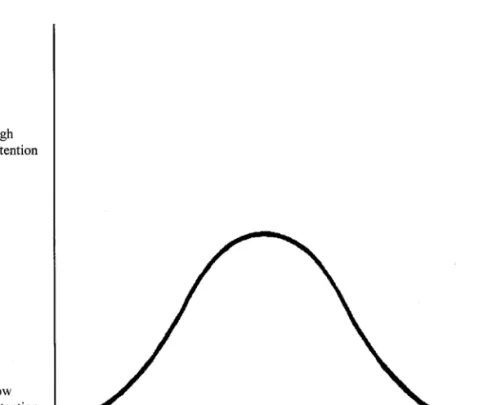
2. The golden mean principle. Usually, a moderate amount of something, rather than extreme levels, has the maximum effect (Fig. 14.2).
FIG. 14.2. The golden mean principle. According to the golden mean principle, moderate levels of production- or content-related strategies tend to have more effectiveness than extreme levels.
The program designer’s challenge is to determine more precisely what level is optimal for each target public and situation.
This principle seems like common sense but can be difficult to apply because it can be challenging to determine what levels of humor or fear, for example, seem extreme to the target public. Similarly, the campaign designer needs to know what level of complexity makes a message incom- prehensible, versus what level of simplicity makes the message boring.
The golden mean principle, therefore, illustrates why pretesting is vital to message development.
3. The situation weighting principle. According to McGuire (1989), achiev- ing the hierarchy of effects is not as difficult as it may seem at first glance because some steps will probably be easier to achieve than others. For ex- ample, publicity campaigns continue to hold such popularity because they often reach enough people who already have the interest and motivation to follow through on a message about a new product or service opportunity.
Most people will not be interested, but if enough interested people read a well-placed piece on a new restaurant, they will need little additional impetus to get them to the restaurant, as long as the location is easy to re- member. They already may possess the skills (transportation and money), the attitude (liking to eat out at that type of restaurant), and the motivation (perhaps an anniversary or birthday dinner is coming up). Likewise, people who want to do something they never thought possible may jump at the op- portunity if a campaign addresses their needs (the skill development step).
The result, according to the domino model and Mendelsohn’s (1973) assumptions, is that a well-researched, carefully targeted campaign will make more dominos fall without going awry.
LIMITATIONS OF THE DOMINO MODEL—
ACKNOWLEDGING THAT PEOPLE ARE NOT ALWAYS LOGICAL
Because the domino model provides such a useful campaign planning tool, it is the most popular theory of persuasion among communication program planners. In fact, Ketchum Public Relations fashioned a public relationseffectiveness yardstick. The yardstick approximates the hierarchy of effects for easy application, by combining the steps of the domino model into three levels of effect (Fig. 14.3).
The first level, called the basic level, measures outputs, or exposure in McGuire’s (1989) terminology, such as total placements and number of impressions. The second level, called theintermediate level, measuresout- growths, such as whether target audiences have received messages directed at them, whether they have paid attention to them, whether they have un- derstood them, and whether they have retained them. This corresponds to the steps of attention, comprehension, interest, and memory storage in McGuire’ model. The third level, called theadvanced level, measures com- municationoutcomes, such as opinion, attitude, or behavior change.
FIG. 14.3. The Ketchum Effectiveness Yardstick is a strategic planning tool that was developed by the Ketchum Research and Measurement Department. Used with permission
from Ketchum Public Relations.
The domino theory, however, has one important limitation: It incorpo- rates an assumption that the recipients of campaign messages will process them in a logical way, carefully considering the veracity of campaign mes- sages to evaluate whether they wish to perform the proposed behavior. The truth is people are not always logical, and we do some things not because they seem right but because they feel good. As a result, it is important to consider another theoretical perspective on persuasion that explicitly acknowledges our logical lapses.
The most popular alternative to the hierarchy of effects theory is called theelaboration likelihood model(ELM). Developed by Petty and Cacioppo (1986) using tightly controlled experiments with limited samples of col- lege students, this theory has its detractors and needs to be applied with respect for its limitations (Chen & Chaiken, 1999). Its basic principles, how- ever, echoed by other theorists pursuing so-called heuristic and systematic routes to decision making, provide a useful framework for communication program application, regardless of how the scholars sort out the details.
According to the ELM, people process messages differently depending on their level of involvement with the issue. In this way, the ELM dovetails
with Grunig and Repper’s (1992) situational theory of publics. People un- interested or uninvolved in a topic will not process messages deeply, but those more interested will be more likely to elaborate, to think more care- fully about, the message.
The result is that the campaign designer can think broadly of two routes to persuasion. The first route is called thecentral approachand emphasizes logic and careful consideration. This is known more broadly assystematic processing. The second route is called theperipheral approachand forgoes logical arguments in favor of more emotionally or heuristic-based strate- gies. These strategies include elements such as likable, attractive, powerful, and credible sources. According to the ELM, decisions achieved using the central approach are more likely to last, whereas decisions achieved us- ing the peripheral approach are more likely to fade or decay. The periph- eral approach, however, can achieve changes more quickly because less thoughtful consideration is necessary from the message recipients. The central approach requires a larger investment of energy from the message recipient, making it more likely to succeed if recipients are highly involved or interested in the topic. If it succeeds it has longer lasting effects because people feel more invested in a decision that took more effort to make and that is based on facts instead of on surface cues. The peripheral approach is more appropriate for low-involvement issues or among target publics who do not care much about the issue. Again, it requires research to determine the extent to which target publics feel involved and ready to participate in thoughtful decision making.
McGuire (1989) called the ELM an alternative route to persuasion be- cause it acknowledges that the central approach follows all the steps in the domino model, whereas the peripheral approach bypasses several steps, concentrating on elements such as attention, liking, and motivation to the exclusion of elements such as attitude change and skill development. Both the central approach and the peripheral approach require that the program planner understand what will attract and hold message recipients’ atten- tion, along with what will motivate them to follow through the hierarchy of effects necessary to achieve behavior change.
WHY PEOPLE RESPOND TO MESSAGES—
FINDING THE RIGHT MOTIVATING STRATEGY
To help campaign designers sort through the possible strategies for moti- vating target publics, McGuire created a matrix that summarizes hundreds of scientific studies on attitudes and persuasion into 16 categories. A mod- ified version of McGuire’s matrix is presented in Figure 14.4 to help the communication professional. Managers may notice that the top half of the chart, labeledcognitive theories, roughly corresponds to the central approach of the ELM theory, or so-called systematic processing strategies, whereas
FIG. 14.4. McGuire’s dynamic theories chart. The chart illustrates different types of motivations that affect the ways people respond to persuasive messages. Adapted with permission
fromPublic Communication Campaigns(2nd ed., Table 2.2, p. 54), R. E. Rice
& C. K. Atkin (Eds.). Copyright c1989 by Sage Publications, Inc.
the bottom half of the chart, labeledaffective theories, roughly corresponds to the peripheral approach, or so-called heuristic processing strategies. Al- though heuristics such as credibility can be quite logically based, they often rely on the tug of emotion. As a result, the bottom half of the matrix also tends to emphasize emotionally based appeals. The top half relies more on logic and evidence, whereas the bottom half makes more use of raw fear, anger, love, and desire.
The top and bottom halves of the chart are divided again, to acknowl- edge that sometimes people are motivated by the need for stability because utter chaos would make life too unpredictable and uncomfortable, and sometimes people are motivated by the desire to grow, such as by the de- sire to become smarter, or more successful, or more independent, or more happy.
The most effective campaign probably will combine various strategies from the matrix to address the needs and interests possessed by different target publics or to address the challenges presented at different steps in the persuasion process. For example, a campaign might use an affective strategy (i.e., a heuristic drawn from the bottom half of the matrix) to pique the public’s interest in an issue and follow that with a more logically based message (from the top half of the matrix) to deepen the public’s under- standing of the issue. Remember that virtually no effective campaign will forgo emotional appeals as part of its strategic mix. A dry recitation of information attracts little attention, interest, or motivation except from the most dedicated target publics. As a result, even logically based strategies tend to incorporate affective elements. This is why it is better to think of the top half of the matrix as systematic approaches (not emotion-free ap- proaches) and the bottom half as heuristic (primarily but not exclusively
emotion based). Again, research and pretesting are required to determine which among the following strategies is most appropriate for a given communication program or campaign.
Logical Strategies
The first half of McGuire’s (1989) dynamic theories matrix focuses on pri- marily logic-based appeals. On the whole, logical appeals serve as useful strategies for publics who have an interest in a topic and some motiva- tion to ponder it. For issues about which they care less or feel defensive, rational arguments may not work. Even logic-based arguments include some affective elements to make target publics think better of themselves or to encourage them to avoid thinking less of themselves. As a result, they include a range of positive and negative strategies, as follows:
1. Consistency. People desire to have consistency in their lives. If the campaign demonstrates they have two conflicting beliefs, they will feel cognitive dissonance, meaning discomfort from the contradictions in their belief system, which they will want to resolve (Fig. 14.5). The consistency- based message is one of the most popular campaign strategies because it offers a straightforward way to communicate that the public is mistaken for disagreeing with the client’s point of view. The Family Violence Pro- tection Fund, for example, challenged its target public that “if the noise coming from next door were loud music, you’d do something about it,”
implying that if the noise is coming from something much more serious such as spousal abuse, there is no excuse for domestic violence and no excuse for failing to report it. The idea that the reader would intervene for something trivial but bothersome yet not for something serious aims to create dissonance by making the reader feel selfish.
2. Categorization. A popular strategy among political campaigners in particular, the categorization approach responds to people’s desire to or- ganize their world into sensible categories such as good and bad, real and unreal (Fig. 14.6). If the campaign designer can change the way people view a situation, it may change the way they evaluate issues relevant to the situation. For example, a moderate Republican challenging a Demo- crat for office may apply the labelliberal, ortax and spendto the Democrat to evoke a reliable response from targeted segments of the electorate, but the same Republican can fall victim to a more conservative Republican challenger who may relabel the moderate Republican astoo liberalor as tax and spendto associate him or her more with the Democrats than with the Republicans. Such strategies, however, can stretch the truth or ethical bondaries and must be used with care. One candidate in a Pennsylvania Senate race, Rick Santorum, went so far as to relabel the firearms issue prob- lem for Pennsylvania gun-favoring voters as his opponent, Harris Wofford.
the inconsistencies that exist between parents’ inherent desire to parent well and their behavior when they do things like asking their children to get a beer for them. Courtesy of the Division of Alcohol and Substance Abuse, Department of Social and Health Services, Washington State.
314
from readers by pointing out someone labeled aloserbecause they seem to have poor athletic skills may be suffering from hunger instead. Courtesy of the Ad Council.
315
Santorum’s direct mail piece suggested Wofford should be targeted to rid Pennsylvania of the gun control problem. The piece, with Wofford’s name imprinted in the center of a target, not only looked as if it was meant for real target shooting but also was offered for sale as such.
3. Noetic or attribution. Sometimes the campaigner prefers to take a more positive approach to people’s desire for consistency. The noetic approach relies on highlighting an association that gives the target public and the organization some common ground on which to share their perspectives, to encourage the target public to view the organization or its proposed behaviors in a more favorable light. One use for attribution theory is to point out a simple association between two things the public may not have connected previously, such as CARE, a social assistance organiza- tion, and Starbucks coffee. Working Assets long-distance service has used the strategy to appeal to consumers who favor nonprofit causes such as Greenpeace, Human Rights Watch, and Planned Parenthood. Each year they accept nominations and survey their customers to choose the benefi- ciaries for the following year.
Of course, communication managers must use such strategies carefully.
Appealing to consumers who favor Greenpeace and Planned Parenthood can alienate others who despise those organizations. Another use is to at- tribute the cause of a problem to a desired issue instead of an undesired issue. For example, some businesses might prefer to attribute the reason for a problem, such as diminished salmon runs, to dammed-up rivers instead of to a complex variety of environmental factors. In this way an organiza- tion can deflect blame from its own environmental practices to one cause.
In another creative application of this strategy, the Learning to Give project of the Council of Michigan Foundations encourages schools to teach children to make philanthropy a priority by associating it with the regular curriculum. In one case, a Jewish day school in Palo Alto, California, has tried to instill a philanthropic mind-set in its students by creating an associ- ation between charitable giving and celebrations upon which the children commonlyreceivegifts. The students research potential recipient organiza- tions, contribute money into a common fund instead of giving each other gifts, make presentations to each other about the prospective charities, and then make decisions about how to allocate the money (Alexander, 2004).
4. Inductional. This approach can be called thecouponapproach because it endeavors to arrange a situation to induce the desired behavior with- out changing an attitude first. Instead, the campaign follows the behavior change with an appeal to change corresponding attitudes. For example, people might attend a rock concert benefiting the homeless out of a desire to hear the music and see the stars. Once at the concert, they might receive a pitch to support the targeted charity.
One technique that became popular in the late 1990s and early 2000s incorporated customized address labels into direct-mail solicitations. For
this tactic to succeed from a public relations standpoint, designers must remember to include the organization’s easily identifiable name, slogan, or symbol on the labels. Even if the prospective donor does not contribute, they can help to spread the organization’s message simply by using the labels. They also receive a personal reminder of the (albeit tiny) invest- ment the organization has made in them every time they use the labels.
Some direct-mail strategists question whether the technique’s popularity has diluted its effectiveness (Schachter, 2004), but campaign evaluators must remember that the labels may increase awareness and involvement and therefore the potential for a delayed return on investment.
5. Autonomy. This strategy appeals to people’s desire for independence.
Particularly in the United States, individualist-minded publics do not want to be bossed around. Appealing to their desire to be self-sovereign some- times can help an organization develop a convincing message. Organiza- tions that believe their own sovereignty is under attack often resort to this strategy, hoping targeted publics will share their outrage. For example, Voters for Choice told readers of theNew York Timesthat “you have the right to remain silent,” displaying a tombstone with the name of Dr. David Gunn, who had been killed for practicing abortion, “but your silence can and will be used against you by anti-choice terrorists.” Sometimes the strat- egy can work with an ironic twist, in an attempt to convince people that giving up some freedom, such as by following the rules in a wilderness park, actually will gain them more freedom by ensuring they can enjoy the peace and quiet themselves.
6. Problem solver. Another favorite campaign strategy, the problem- solver approach, simply shows a problem and demonstrates the favored way to solve the problem. Not enough people can afford to go to college;
give to the United Negro College Fund (Fig. 14.7). Not enough children have safe homes; be a foster parent. Use of this strategy assumes the tar- get public will care enough about the problem to respond, which is a big assumption to make. Recall Mendelsohn’s (1973) advice to assume the op- posite, that the audience is uninterested. Campaigns that neglect to confirm this assumption through research risk failure.
When the assumption holds, however, the results can be impressive.
It worked for Beaufort County, South Carolina, which had to persuade voters to approve a 1% sales tax increase to pay for improving a dangerous 13-mile stretch of road and bridges when the measure had failed by a 2-to-1 margin twice before. The carefully coordinated Silver Anvil Award–
winning, campaign overwhelmed the vocal opposition in a 58% to 42%
victory when White retirees, young workers, employers, and older African- Americans became familiar with the problem, that “The Wait Is Killing Us,”
and mobilized in support of the measure.
7. Stimulation. Sometimes the right thing to do seems boring, and some excitement can make it seem more appealing. A positive type of appeal,
the way to avoid separating friends is to give money to the United Negro College Fund.
Courtesy of the Ad Council.
318
stimulation strategies appeal to people’s curiosity or their desire to help create or preserve something with an exciting payoff, such as a wilderness area that can offer outdoor adventures. A group of police officers in Wash- ington State, for example, although visiting middle schools with a serious antidrug message, transformed themselves into rap stars to deliver their message with rhythm instead of force. As they chanted about things stu- dents should not do or “you’re busted!” the students gyrated and yelled the punch line back to the officers. The message got through.
8. Teleological. Just as noetic theories (creating a positive association) offer the opposite strategy from consistency approaches (creating an ap- parent contradiction that requires resolution), teleological approaches offer the positive alternative to problem-solver approaches. Teleological means heavenlike, and the approach relies on showing what the world would look like if a problem already had been solved (Fig. 14.8). This is a useful strategy for incumbent candidates for political office who wish to show their service has made a positive difference for their constituents. In other cases, the target public is shown the ideal result of implementing a desired behavior, along with a script advising how to make the ideal result be- come reality. A fund-raising promotion for the National Wall of Tolerance not only provided a sketch of the proposed monument but also provided a mock-up of the wall with the solicited donor’s name already inscribed on it.
Affective/Heuristic Strategies
The second half of McGuire’s (1989) dynamic theories matrix focuses on heuristic-based, often more emotionally charged, appeals. On the whole, emotional appeals serve as useful nudges for undecided or uninterested target publics. For issues that require complex consideration, however, or for which a target public has a deeply held view that counters the sponsor- ing organization’s view, emotional appeals can accomplish little or, even worse, can backfire. They, too, include a range of positive and negative approaches:
9. Tension-reduction (fear appeals). This strategy attempts to produce ten- sion or fear in the message recipient, which makes the target public un- comfortable and in need of a solution that will reduce the tension. It is the emotional parallel to the consistency–cognitive dissonance approach, which aims to create or highlight a contradiction in the target public’s be- liefs and behaviors they will want to resolve. The tension-reduction strat- egy is particularly popular among health campaigners, who try to scare the public into more healthy habits.
The problem with fear appeals, however, is that they can backfire badly if not applied with precision. One weakness in fear appeals is a failure
solution, this ad attempts to encourage involvement by demonstrating the positive results that can come from giving someone high expectations for themselves. Courtesy of the Ad Council.
320
to resolve the tension in the message. Threatening a target public with a dire outcome (usually death) linked to a behavior, such as drug use or eating habits, without showing how the problem can be fixed and how the situation might look with the problem resolved can make the target public resent the message and the messenger. Another problem is the use of extreme or unrealistic levels of fear, such as the Partnership for a Drug- Free America’s admonition that equated the use of marijuana with Russian roulette. Because the production of fear appeals is filled with so many pitfalls and the effects of fear appeals are so difficult to predict, they are best avoided. Although appropriate in some situations, such appeals must be well researched. Clients who cannot be dissuaded from using a fear appeal simply must build a large pretesting budget into the project.
10. Ego defensive. The ego-defensive approach sets up a situation in which the target public will associate smartness and success with the de- sired attitude or behavior, whereas failure is associated with the refusal to adopt the message. This approach can be used in both a positive and a negative application. For example, the Business Alliance for a New New York produced messages promising that “you don’t have to be a genius to understand the benefits of doing business in New York. (But if you are, you’ll have plenty of company.)” Meanwhile, the Illinois Department of Public Health and Golin/Harris International focused on making safe- sex decisions “cool” in awkward situations. Research designed to ensure that the appeal would not backfire included mall intercepts of 200 teens, a 33-member teen advisory panel, feedback from high-risk adolescents via state-funded organizations, and message testing using quantitative and qualitative methods.
On the other hand, the Partnership for a Drug-Free America produced messages offering “ten ugly facts for beautiful young women,” in an at- tempt to make use of cocaine seem ego threatening. The connection be- tween the ugly facts and the strong desire for physical appeal unfortu- nately was not made clearly enough. Again, the danger of ego-defensive appeals is that they need to seem realistic to the target public and, therefore, require considerable pretesting. A more effective application of this strat- egy was employed by the Washington State Department of Health in its
“Tobacco Smokes You” campaign, in which they showed a young woman trying to impress her peers and gain acceptance by smoking. Instead of looking cool, however, the ad showed her face morphing into a severely tobacco-damaged visage, which grossed out her peers and led them to re- ject her. Among 10- to 13-year-olds, 73% considered the ad convincing, 71%
said it grabbed their attention, and 88% said it gave them good reasons not to smoke (Washington State Department of Health, 2004). The ad had a slightly lower impact on 14- to 17-year-olds.
11. Expressive. Just as noetic strategies take the opposite tack of consis- tency strategies and teleological approaches reflect the mirror image of
problem-solver approaches, the expressive approach takes a positive twist on the tension-reduction approach. The expressive appeal acknowledges that a target public may find the organization’s undesired behavior de- sirable. For example, many drug users perceive real benefits to the use of drugs, such as escape from reality or peer acceptance. From a social mar- keting point of view, these benefits simply must be acknowledged, along with the real perceived costs of physical and mental discomfort associated with “saying no” to drugs. These costs can include the loss of social status and even physical danger. In perhaps the most well-known campaign in- corporating the expressive approach, communities across the country hold all-night graduation celebrations for high school students that require stu- dents to stay locked in the party for the entire night to make themselves eligible for extremely desirable prizes donated by community members and businesses. The goal: Keep the celebrants from endangering them- selves and others with alcohol and other drugs. The reason it works: The party and its incentives fulfill the students’ need for a major celebration and their desire to keep it going all night long.
Expressive strategies probably have the greatest potential for making difficult behavior-change campaigns effective, but they are rarely used because they do not reflect the campaign sponsor’s perspective. Various theories, however, ranging from co-orientation theory to excellence theory to social marketing theory, discussed in chapter 13, all lend strong support to the value of the expressive approach. Unfortunately, clients often run campaigns using strategies more persuasive to themselves than to their target publics.
12. Repetition. If you simply say the same thing over and over enough times, sometimes it gets through. According to McGuire (1989), three to five repeats can help a message get through, especially if the message is presented in a pleasant way. Many campaign designers interpret the three- to-five rule as a magic bullet guaranteeing a message will be successfully propelled into waiting target publics. Repetition, however, constitutes a useful supplemental strategy for an otherwise well-designed campaign and cannot be considered a sufficient strategy in itself.
13. Assertion. The emotional parallel to autonomy appeals, the asser- tion strategy focuses on people’s desire to gain power and status. A pop- ular appeal for low-involvement issues or products, the assertion appeal promises increased control over others or a situation in return for adopt- ing the proposed attitude or behavior. The U.S. Army is trying to convince young people that they could win at war by creating a video game called
“America’s Army” (www.americasarmy.com), which is realistic and fun and which had attracted more than 5 million users by mid-2005, far ex- ceeding the Army’s expectations. The purpose was to pique players’ in- terest, after which they could be encouraged to request more information from their local recruiter. The strategy seemed to work until the casualty
count in the Iraq war began to diminish young people’s desire to serve their country by fighting terrorism. The game, however, remained hugely popular and may have helped to prevent a further reduction in recruits.
14. Identification. People aspire to feel better about themselves and fre- quently aspire to be like someone else. Often, they look to other role models who embody positive characteristics (Fig. 14.9). Campaigns commonly use this to create positive associations between a proposed idea or product and a desirable personality such as Lance Armstrong. Negative associations also can be made, but as with most negative appeals, they require careful pretesting to ensure relevance and credibility with the target public.
15. Empathy. Empathy strategies appeal to people’s desire to be loved.
Although most applications of the empathic strategy focus on how target publics can achieve personal acceptance from others, this approach can ap- peal to people’s altruism and desire to feel good for helping others they care about (see Fig. 14.9). A simple but eloquent American Red Cross appeal, for example, noted that “when you give blood, you give another birth- day, another anniversary, another day at the beach, another night under the stars, another talk with a friend, another laugh, another hug, another chance.” In a campaign evoking similar emotions, Spokane, Washington–
area animal welfare agencies and local businesses paid for a four-page insert in the local newspaper of classified ads featuring photographs of pets needing homes. Adoptions at the four local shelters shot up to record levels. One shelter director said, “We placed every single animal we had”
(Harris, 2002).
16. Bandwagon. Making an idea seem contagious can make the idea seem even better. If 2,000 community leaders and neighborhood residents have signed a petition favoring the construction of a new city park, shouldn’t you favor it, too? Mothers Against Drunk Driving has made use of this strategy by encouraging people to tie red ribbons on their car antennas during the winter holidays to publicly state their support for sober driving.
The strategy does not do much to change strongly held opinions, but it can sway the undecided and serve as a useful reminder and motivator for those in agreement with a campaign message. According to the domino model of persuasion, increased awareness can (even if it does not always) lead to increased knowledge, skill development, persuasion, and behavior change.
In a remarkable example of the bandwagon effect, the Lance Armstrong Foundation created a craze when it began selling yellow, plastic LIVE- STRONG wristbands to honor the famous bicyclist and raise money for cancer research. The goal of the campaign, cosponsored by Nike, was to raise $5 million by selling the wristbands for $1 each. A year later they had sold 47.5 million wristbands (raising $47.5 million) and had inspired a myrid of spinoff campaigns featuring bracelets to promote everything from breast cancer to political statements. Quite the bandwagon effect.
with the grandfather and feel empathy both for him and his grandson. By giving to the fund, they can feel fulfilled through someone else’s achievement the way the grandfather has.
Courtesy of the Ad Council.
324
The bandwagon strategy also can be used to demonstrate that a behav- ior must be “normal,” because so many people like you do it, think it, or look like it. The Oregon Dairy Council, for example, developed a poster- based educational campaign with the slogan, “What’s normal supposed to look like, anyway?” showing teenage boys and girls spanning the range of healthy sizes and shapes according to the body mass index (Fig. 14.10).
The purpose was to counter stereotyped media images that distort what everyone looks like or should look like. Strategists need to apply a norms campaign with caution, however, because—as with identification—the tar- get public must believe in the personal relevance of the norm presented.
FIG. 14.10. Example of a contagion/norms appeal. This poster encourages teenagers to realize that more than one body shape and size is normal and acceptable. Reproduced with permission
from Nutrition Education Services/Oregon Dairy Council.
OTHER THEORIES THAT EXPLAIN SPECIAL SITUATIONS Diffusion of Innovations
Another popular variation on the domino model provides useful guidance for campaign designers hoping to promote the adoption of an innovation.
Innovations can be products such as a new computing tool or ideas such as recycling or changing eating habits. According to diffusion of innovations theory (Rogers, 1983), people considering whether to adopt an innova- tion progress through five steps that parallel the hierarchy of effects in the domino model. The innovation-decision process follows the way an indi- vidual or decision-making unit passes from a lack of awareness to use of the new product or idea. The likelihood of someone making progress through the steps depends on prior conditions such as previous experiences, per- ceived needs, the norms of the society in which the target public lives, and the individual’s level of innovativeness. The steps include knowledge, persuasion, decision, implementation, and confirmation. Innovations are evaluated on the basis of their relative advantages, which Rogers called compatibility, complexity, trialability, and observability. Simply put, an in- novation is more likely to be adopted if it seems to have clear benefits that are not difficult to harvest, particularly if giving it a try is not particularly risky. Diffusion of innovations theory teaches that most innovations occur according to a fairly predictableS-curve cycle. First, a few brave souls give the new idea a try, and then the innovation picks up speed and becomes more broadly accepted. More specifically, people begin to imitate opinion leaders who have tried the innovation, and gradually a bandwagon effect gets started. Finally, most people likely to adopt the innovation do so, and the rate of change slows down again. Campaigns advocating relatively in- novative ideas or products benefit from tailoring their messages according to where the innovation is on theS-curve.
Campaigns advocating adoption of an innovation must consider that people who are more innovative will have different needs and interests from people who are less innovative. According to diffusion of innova- tions theory, campaigners can think of five broad target publics: innova- tors, who are the first 2.5% to adopt a new product or idea; early adopters, who are the next 13.5%; the early majority, who represent 34% of the total potential market; the late majority, who represent another 34%, and lag- gards, who are the final 16%. People who fit in each of these categories have characteristics in common with each other. According to diffusion of innovations theory, people associate mainly with people who share key characteristics with themselves (calledhomogeneous), but they learn new things from people who are slightly different (calledheterogeneous). People who are completely different will probably not be able to relate well with the target public and will have less persuasive potential.
Inoculation
Inoculation theory looks like the mirror image of diffusion of innovations theory. The idea behind inoculation (Pfau, 1995) is to address potential trouble before it starts so that potential problems never gain enough mo- mentum to create a crisis. Just as a flu shot can prevent a full-blown attack of the flu bug, a small dose of bad news early can prevent an issue from turning into a full-blown crisis. For example, political candidates expecting bad news to hit the media can present the news themselves, from their own perspective. Taking away the element of surprise or confrontation makes the news less sensational and, therefore, less damaging.
FINAL THOUGHTS
Theories explaining how and why message recipients make decisions in various circumstances demonstrate that purely informational messages and messages that appeal mainly to the client instead of the message re- cipient can doom a communication program. Remember that if the target public already shared the organization’s point of view perfectly, a com- munication program probably would not be necessary. Because the goal of a public relations program is to increase the degree to which a tar- get public and an organization share common perspectives and priorities, the organization controlling the message needs to make overtures invit- ing collaboration with the target public, instead of expecting the target public to invite the organization’s perspective into their lives. Making a change is not the target public’s priority. Understanding how and why message receivers think the ways they do can greatly enhance the com- munication professional’s ability to build constructive relationships with them by pinpointing the strategies target publics find relevant, credible, and compelling.