
The effectiveness of Think-Pair-Share technique to improve students' writing skill at MAN 2 Ponorogo. The purpose of this research was to investigate whether there was a significant difference between students' writing skills taught by TPS technique and those who were not taught by TPS technique at MAN 2 Ponorogo. From the results it can therefore be concluded that there is a significant difference between students' writing skills who were taught by TPS and those who were not taught by TPS at MAN 2 Ponorogo.
- Background of the Study
- Identification of the Problems
- Limitation of the Study
- Statement of the Problems
- Objective of Study
- Significances of the Study
- Organization of the Thesis
Therefore, through the effect of the technique in the form of Think Pair Share which improves the students' ability to write. Also, the Think Pair Share technique can make them share their thoughts so that they will produce good writing. The focus of this research is on the effect of Think Pair Share in increasing students' writing skills, especially in writing explanatory text.
- Theoretical Background
- Writing
- Teaching Technique
- Think Pair Share Technique
- Previous Research Findings
- Theoretical framework
- Hypothesis
The researcher used the Think Pair Share technique as a solution to the problem raised by the researcher, namely students' writing skills. 43 Dino Sugiarto and Puji Sumarsono, "Implementing the Think-Pair-Share model to improve students." The three main stages used in the learning process are the main characteristics of the Think Pair Share type of collaborative learning technique.
Depending on the results, the Think Pair Share teaching technique can be designed as a way to improve student learning. 52 Dino Sugiarto and Puji Sumarsono, “The Implementation of the Think-Pair-Share Model to Improve Students.” The concept of the Think-Pair-Share technique is that students are presented with different problem topics.
The Think-Pair-Share exercise can be used in various phases of the teaching sequence, depending on the nature of the work. Additionally, the implementation of Think-Pair-Share can be used up to the college level. In addition, Think Pair Share can help teachers improve information about the learning process or provide feedback.
Think-Pair-Share: A Technique to Enhance Students' Writing Skills” took SMAN 1 Bojonegoro as research location. Researcher's goal is that the implementation of Think-Pair-Share technique can improve students' writing skills in narrative text of the tenth grade of SMAN 1 Bojonegoro. There is no significant effect of using Think Pair Share technique on students' writing skill.
- Research Design
- Research Setting
- Population and Sample of Research
- Operational Definition of Research Variables
- Technique and Instrument of Data Collection
- Validity and Reliability
- Data Analysis
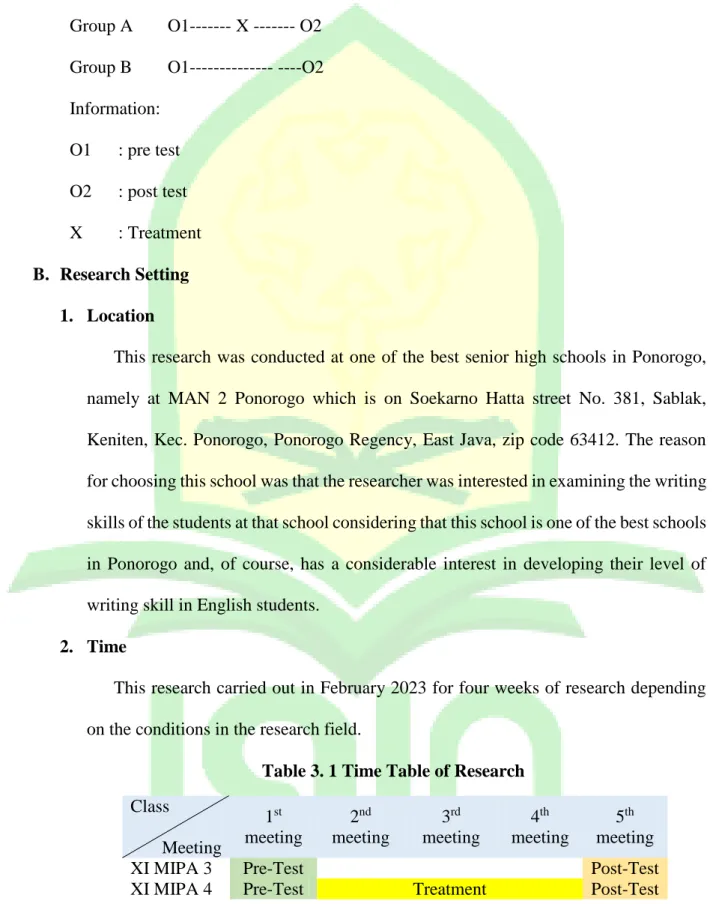
Based on the above table, before the pre-test conducted in the control class and in the experimental class, to test the validity the researcher used class XI MIPA 2. 65 Rasha Mohammed, Khalifa, "The Effectiveness Of Using Think- Pair - Share Strategy for the development of writing skills of eleventh grade in government schools in Rafah" Thesis Thesis, Al-Azhar University - Gaza, 41. 67 Asri Tiara Farhati, "Effectiveness of English songs as media to increase students' ability to pronounce consonants with voice in English [b] , d, G].” (Universitas Negeri Semarang, 2011), http://lib.unnes.ac.id pdf.
A pre-test is an initial test conducted by the researcher before the researcher applies the treatment level in the experimental class. In addition, the instrument for this pretest is in the form of sheets of paper that the researcher arranged according to the structure of the explanatory text. A post-test is a final test administered by the researcher after the researcher has used the treatment level in the experimental class.
At this post-test stage, the concept of the post-test conducted was not much different from the pre-test. 70 Muhammad, Hikmawandani and Nia, Kurniawati, "The use of numbered heads together technique in teaching simple past tense (a quasi-experimental study in the tenth grade students of SMA Negeri 1 Cibeber)". The data above is the result of the pre-test conducted by the researcher before the researcher tested the pre-test in the control and experimental classes.
Based on these results, it was shown that the results of the pre-test conducted by the validity class were 80 to 80.9.
Statistic Description
- Data Description of Control Class
- Data Description of Experimental Class
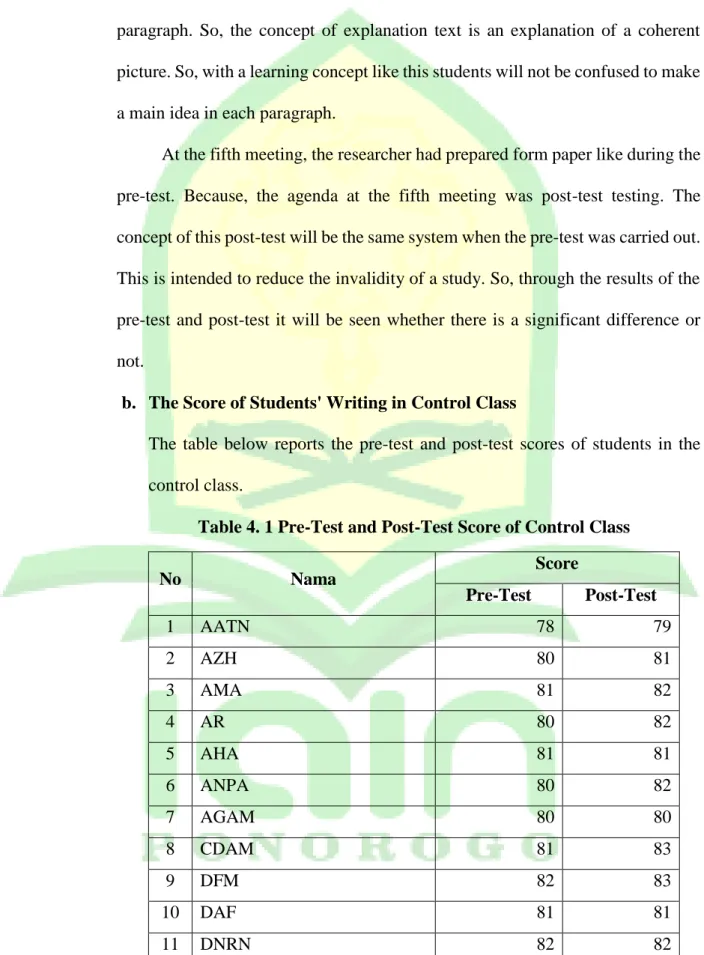
This section presents the teaching and learning procedure and the pre- and post-test scores of students in the control class. The concept of this posttest will be the same system as when the pretest was conducted. The table below shows the pre- and post-test scores of students in the control class.
Based on the chart above, it can be concluded that the pre-test in the control class mean is 80.76, the median is 81, and the mode is 80. It can be seen that there is a difference between the mean, median , and mode in the pre-test and post-test in the control class . The above table shows that the results achieved by the students in the pre-examination were different.
This section presents the teaching and learning procedure and the pre-test and post-test scores of students in the control class. The concept of this post-test will be the same system when the pre-test was conducted. Based on the graph above, it can be concluded that the pre-test in the experimental class, the mean is 81.10, the median is 81, and the mode is 80.
It can be seen that there is a significant difference between the mean, median and mode in the pre-test and post-test in the experimental class.
Statistic Inferential
- Assumption Test
- Hypothesis Test and Interpretation
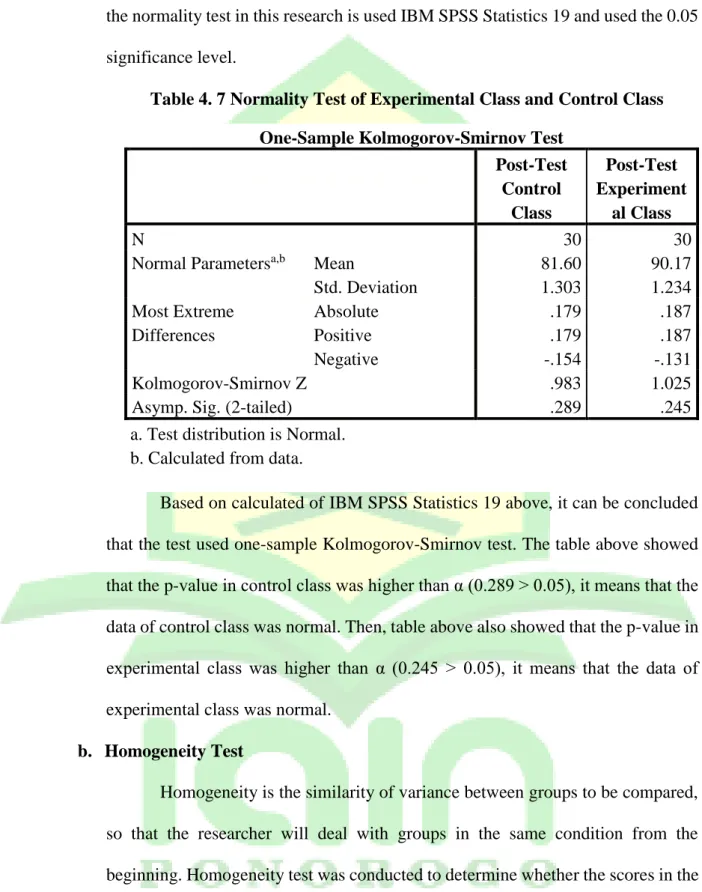
The data on significance Kolmogorov-Smirnov were examined to determine normality for N = 30 (control class) and N = 30 (experimental class). Based on calculated from IBM SPSS Statistics 19 above, it can be concluded that the test used one-sample Kolmogorov-Smirnov test. The table above showed that the p-value in control class was higher than α (0.289 > 0.05), it means that the data of control class was normal.
Then the table above also showed that the p-value in the experimental class was higher than α (0.245 > 0.05). This means that the data of the experimental class was normal. Homogeneity is the similarity in variance between groups to be compared, so that the researcher will deal with groups in the same condition from the start. Based on calculations from IBM SPSS Statistics 19 above, it can be concluded that the scores of both the experimental class and the control class were based on the mean.
In this research, the researcher used T-test to analyze the data by comparing the results between the control class and the experimental class before and after the test. 2-tailed) <0.05, then there is a significant difference between the post-test results in the control and experimental classes. 2-tailed) > 0.05, then there is no significant difference between the post-test scores in the control and experimental classes.
It can be concluded that there was a significant difference in the students' writing skill between those who were taught with Think Pair Share technique and those who were not taught with Think Pair Share technique.
Discussion
Lyman stated that the Think Pair Share technique changed the classroom atmosphere or learning pattern in the classroom. With the Think Pair Share technique used in classroom learning, students' involvement in the learning atmosphere was more active. In addition, it allowed students to supplement their insights on the given topic, and students' self-confidence increased by sharing ideas using the Think Pair Share technique.
This technique is evidenced by the increase in average from cycle 1 to cycle 2 of his research. Moreover, through Think Pair Share, Astheri also discovered that she can improve and change the classroom learning atmosphere to be more effective. Furthermore, based on the research conducted by the researcher, the researcher found that the theory presented by Kagan and Lyman about the Think Pair Share technique was that the Think Pair Share technique could improve their learning achievement.
Based on theory from research conducted by Astheri et al., using Think Pair Share in classroom learning and teaching improved students' writing skills. Moreover, teaching using the Think Pair Share technique made the classroom situation more conductive. Moreover, from the above data, the researcher can conclude that the alternative hypothesis was accepted and the null hypothesis was rejected.
Thus, using the Think Pair Share technique can improve the writing skills of class XI students at MAN 2 Ponorogo.
- Conclusion
- Recommendations
- 1 Chart of Theoretical Framework
- 1 Statistic of Validity Class
- 1 Chart of Mean, Median and Modus Score of Control Class
- 2 Histogram of Pre-Test in Control Class
- 3 Histogram of Post-Test in Control Class
- 4 Chart of Mean, Median and Modus Score of Experimental Class
- 5 Histogram of Pre-Test in Experimental Class
- 6 Histogram of Post-Test in Experimental Class
Furthermore, based on the results calculated from the IBM SPSS Statistics 19 statistics program, it can be concluded that the Think Pair share is effective in improving students' writing skills at MAN 2 Ponorogo. They can study related topics and consider doing further research on improving writing skills through Think Pair Share. Technology-Based Think-Pair Sharing in an Efl Writing Classroom.” World Journal of Education 7, no.
“Pengaruh Model Pembelajaran Think Pair Share (TPS) terhadap Keterampilan Berpikir Kritis di Sekolah Dasar.” Jurnal Basicedu 5, No. Mundriyah dan Aseptiana Parmawati, “Penggunaan Think-Pair-Share (Tps) untuk Meningkatkan Kreativitas Menulis Mahasiswa (Penelitian Tindakan Kelas Semester II Mahasiswa Stkip Siliwangi Bandung), P2M Jurnal Ilmiah STKIP Siliwangi 3, No. Nadeem, Mohammad Asif dan Nadeem, Tahir, “Evaluasi Pengaruh Teknik Think Pair Share terhadap Keterampilan Menulis Deskriptif Siswa Sekolah Menengah,” Jurnal Penelitian Pendidikan 22, no.
Ningtyas Orilina, Argawati and Lilis, Suryani, “Teaching Writing Using Think-Pair-Share Viewed from the Risk Level of Students,” English Review: Journal of English Education 6, No. The Effects of the Type Learning Model Numbered Head Together and Think Pair Share ” International Journal of Trends in Mathematics Education Research 1, No. Rasha Mohammed, Khalifa, “The Effectiveness of Using Think-Pair-Share Strategy for Developing the Writing Skills of Eleventh Graders in Government Schools in Rafah” Thesis Skripsi , Al-Azhar University – Gaza, 3.
The implementation of think-pair-share model to improve students' ability to read narrative texts.” International Journal of English and Education www.ijee.org.