
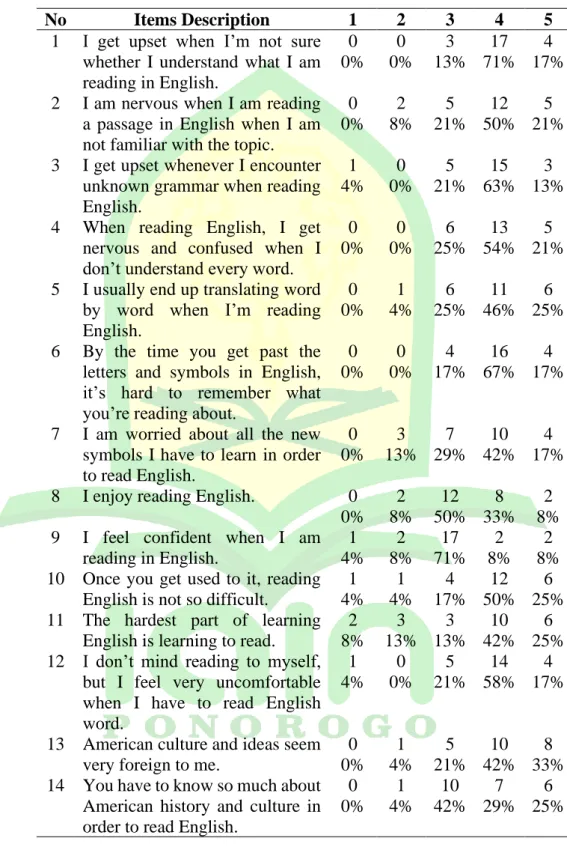
Therefore, it is essential to analyze students' reading anxiety in learning English as their foreign language. The purpose of the study was to analyze the level of students' reading anxiety, describe the factors that cause reading anxiety in students and evaluate how students in SMAN 1 Jetis Ponorogo overcome their reading anxiety. Second, the factors that cause students' reading anxiety showed that in terms of text features, unfamiliar culture occupies the highest place of student responses that agree with these points (31%), followed by unfamiliar topic (29 %) and in the last. was unknown vocabulary (10%).
INTRODUCTION
- Background of the Study
- Research Focus
- Statement of the Problems
- Objectives of the Study
- Significances of the Study
- Organization of the Study
Considering the previous effects, it is essential to analyze students' reading anxiety in learning English as a foreign language. This study focuses on analyzing the level of students' reading anxiety, its causes and how students overcome their reading anxiety. This research is expected to be able to contribute to the increase of knowledge about the level of students' reading anxiety, the factors that cause it and how the eleventh grade students of SMAN 1 Jetis Ponorogo in overcoming their reading anxiety .
THEORETICAL FRAMEWORK AND PREVIOUS RESEARCH
Theoretical Framework
- Reading
- Anxiety
- Reading Anxiety
- Strategies to Overcome Reading Anxiety
39 Sheikh Ahmad et al., "The Potential Sources of Foreign Language Reading Anxiety in a Jordanian EFL Context," 92. 43 Sheikh Ahmad et al., "The Potential Sources of Foreign Language Reading Anxiety in a Jordanian EFL Context," 92. 50 Sheikh Ahmad et al., "Die potensiële bronne van vreemde taalleesangs in 'n Jordaanse EFL-konteks," 92.
Previous Research Findings
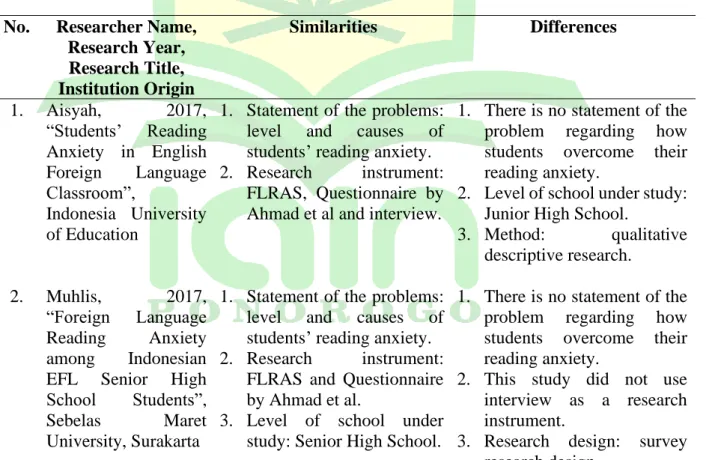
Second, previous research by Muhlis titled "Foreign Language Reading Anxiety among Indonesian EFL Senior High School Students" in 2017 from Sebelas Maret University, Surakarta. The second finding discovered that text features and personal factors were two main potential causes of foreign language reading anxiety. The level of foreign language reading anxiety among students of Chinese as a foreign language (n = 76) in the United States was investigated in this study.
Fifth, previous research by Bensalem titled "Foreign Language Readings in the Saudi Tertiary EFL Context" in 2020 from Northern Border University, Arar, Saudi Arabia. The aims of this study are to investigate the levels, sources and underlying factors of FL reading anxiety among tertiary EFL students. Using Foreign Language Reading Anxiety Scale (FLRAS) by Saito et al and a background information questionnaire.
Foreign language reading anxiety among Indonesian EFL high school students”, Sebelas Maret University, Surakarta. Reading Anxiety of Secondary School Students in a Second Language”, United Arab Emirates University, Al-Ain, United Arab Emirates. Zhou, 2017, "Foreign language reading anxiety in a Chinese as a foreign language context", Hawai'i in the United States Northwest Normal University of Manoa, China.
Foreign Language Reading Anxiety in a Tertiary EFL Context in Saudi Arabia', Northern Border University, Arar, Saudi Arabia.
RESEARCH METHOD
- Research Approach and Design
- Researcher’s Role
- Research Setting
- Data and Data Source
- Data Collection Technique
- Data Analysis Technique
- Checking Validity of Findings
- Research Procedures
From the results of the interviews, it can be concluded that the majority of students have anxiety when reading English texts aloud. From the results of the interviews, it can be said that most students never avoided when asked to read English texts. The results of the observations also showed that the students always looked down when the teacher started to designate students to read the English text.
163 Sheikh Ahmad et al., "The Potential Sources of Foreign Language Reading Anxiety in a Jordanian EFL Context", 100. 166 Sheikh Ahmad et al., "The Potential Sources of Foreign Language Reading Anxiety in a Jordanian EFL Context", 101. 169 Sheikh Ahmad et al., “Possible sources of foreign language reading anxiety in a Jordanian EFL context”, 102.
175 Sheikh Ahmad et al., "The Potential Sources of Foreign Language Reading Anxiety in a Jordanian EFL Context," 91. 179 Sheikh Ahmad et al., "The Potential Sources of Foreign Language Reading Anxiety in a Jordanian EFL Context," 105. 180 Sheikh Ahmad et al., "Die potensiële bronne van vreemde taalleesangs in 'n Jordaanse EFL-konteks," 105.
The results of the interviews showed that the majority of students were nervous when the teacher asked them to read the English text aloud.
FINDINGS AND DISCUSSION
Research Background
- History of School Establishment
- Geographical Position
- Vision and Mission
- Goals of the Institution
In the background of the research, the researcher includes some points related to the profile of the school which includes the history of the establishment of the school, the vision and mission, the goals of the institution and the organizational structure. In the following year (2005), after the realization of the state land and the construction of SMAN 1 Jetis, which is located in the village of Kutuwetan, occupies an area of 6000 m2. To produce devout graduates, with noble character, cultured, knowledgeable, independent, caring for the environment and with a global perspective.
The objectives of SMAN 1 Jetis in general are to improve imtaq, personality, noble character, intelligence, knowledge and skills for independent living and participation in further education.
Findings
- The Level of Students’ Reading Anxiety
- The Factors Causing Students’ Reading Anxiety
- Students’ Strategies to Overcome Their Reading Anxiety
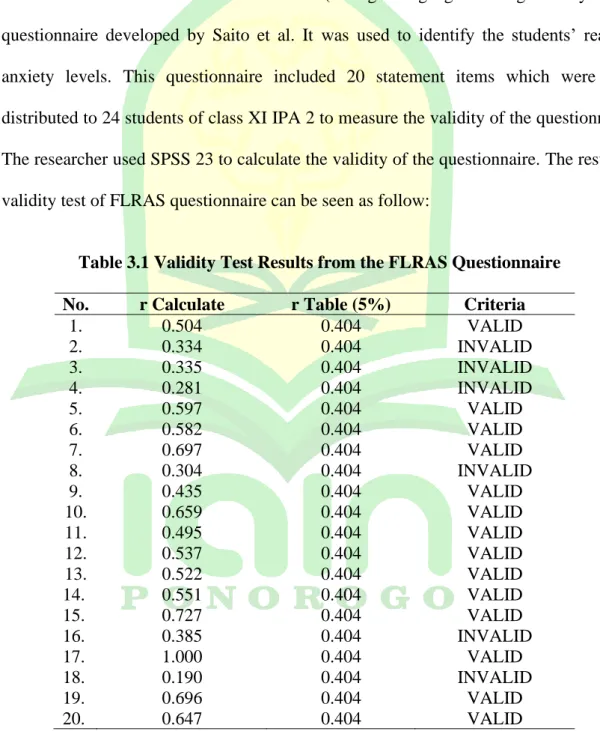
The results of the interviews also showed that the students were anxious when the teacher asked them to read the English text in front of other students. From the results of the interview, it can be concluded that although most students felt nervous when asked to read English texts, some students did not feel nervous. From the results of the questionnaire in Table 4.10, it can be concluded that most students agree that they were afraid of making mistakes when they were assigned to read in front of their peers.
But on the other hand, there were also other students who did not feel anxious when they had to read English texts aloud. From the interviews it can be concluded that some students always thought positively when they wanted to read English reading texts. She said: "I usually ask friends if there is a word from the text that I don't understand".131 Similarly, respondent 9 also always looked for colleagues when she found it difficult to read English texts.
She said, “I usually asked a friend if there was a word I couldn't read.”133. According to an interview with respondent 14, he immediately started reading when the teacher was appointed to read the English text. In addition, respondent 18 also said that he would immediately start reading if the teacher asked him to read the English text.
She said: "When the teacher asks me to read the text, I usually remain silent because I am very nervous".142. From the results of the interview, it can be concluded that when the teacher asks the teacher to read the text in English, the students would read it better. From the results of these interviews, it can be concluded that most students avoided eye contact with the teacher in order not to be asked to read.
Discussion
Several studies investigate students' reading anxiety and the results are almost similar to this study. 187 Hanafi, "Students' Reading Anxiety in Reading Aloud at the Second Year of MA Pondok Pesantren Sultan Hasanuddin," 53. 189 Hanafi, "Students' Reading Anxiety in Reading Aloud at the Second Year of MA Pondok Pesantren Sultan Hasanuddin," 54.
191 Hanafi, "Students' Reading Anxiety When Reading Aloud During the Second Year of MA Pondok Pesantren Sultan Hasanuddin," 54. 194 Hanafi, "Students' Reading Anxiety When Reading Aloud During the Second Year of MA Pondok Pesantren Sultan Hasanuddin," 54. The reading anxiety of the students in this study was caused by two factors; text features and personal factors.
It can also be used to further study the teacher's strategy to overcome students' reading anxiety. Students' reading anxiety during reading aloud in the second year of MA Pondok Pesantren Sultan Hasanuddin.” PhD Thesis, Universitas Islam Negeri Alauddin Makassar, 2019. Anxiety in Reading Foreign Languages Among Indonesian EFL Senior High School Students.” English Franca: Academic Journal of English Language and Education 1, no.
Possible sources of foreign language reading anxiety in a Jordanian EFL context: A theoretical framework. Teaching English 6, no.
CLOSING
Conclusion
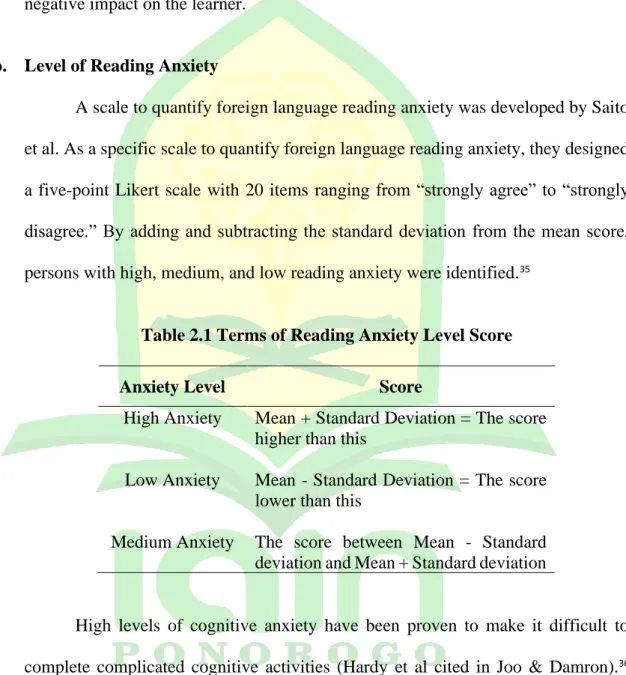
Based on the data findings and discussion in the previous chapter, the researcher can conclude that the level of students' reading anxiety in class XI IPA 1 at SMAN 1 Jetis Ponorogo is included in the category of medium level of anxiety. This could be proven by the results of the FLRAS questionnaire data by Saito et al which showed that 18 of the 24 students belonged to the medium level of reading anxiety with a percentage of 75%. The factor most agreed by students on the aspect of text features was unfamiliar culture (31%), followed by unfamiliar topic (29%), and finally unfamiliar vocabulary (10%).
Meanwhile, in terms of personal factors, students are more in agreement about fear of making mistakes (35%), followed by concerns about reading effects (25%). From these two aspects, the fear of making mistakes was the factor that students most often indicated as the cause of their reading anxiety. The strategy for overcoming reading anxiety most commonly used by students was peer-seeking, with 18 out of 24 students always looking for friends when they were having trouble reading.
It was followed by 14 students who used relaxation and positive thinking strategies in their efforts to overcome anxiety before starting to read the text.
Recommendations
On the other hand, they should apply strategies to overcome reading anxiety that can increase their confidence when they read English texts in front of the teacher or their friends. Investigating the relationship between foreign language reading anxiety and reading proficiency: A case study of preparatory year students at the University of Jeddah. Revista Tempos E Espaços Em Educação 13, no. A portrait of students' reading anxiety at the second grade of MTs Darul Qur'an Kampar Regency." PhD thesis, Universitas Islam Negeri Sultan Syarif Kasim Riau, 2022.
Students' reading anxiety at State Senior High School 1 Bungaraya.” PhD Thesis, Universitas Islam Negeri Sultan Syarif Kasim Riau, 2021. Investigating Reading Anxiety and Achievement on Reading Skill: A Case of Iranian EFL Learners. International Journal of Language and Applied Linguistics. Foreign language reading anxiety: Korean as a foreign language in the United States. Journal of the National Council for Less Commonly Taught Languages 17, no.
An Analysis of Patient Satisfaction with Health Service Quality at Nala Husada Dental Hospital (RSGM), Hang Tuah University, Surabaya.” Asro Magazine 12, no. A Curriculum Design Plan for Acceptable Listening and Reading Skills.” International Journal of English Language, Literature and Translation Studies 2, no. Exploring Anxiety Symptoms and Reactions in EFL Learners' Oral Narratives: The Case of Secondary School Students.” Journal of Language Teaching and Research 7, no.
Kecemasan Membaca pada Mahasiswa di Kelas Membaca EFL Universitas Muhammadiyah Malang.” Tesis PhD, Universitas Muhammadiyah Malang, 2020.