
This book is about thinking with typography - in the end, the accent falls with. Type is with you wherever you go - the street, the mall, the web, your apartment.
While the lean humanist writings appeared in expensively produced books, the cursive form thrived in the cheaper writing shops, where it could be typed more quickly than the carefully shaped lettera antica. In the sixteenth century, printers began to integrate roman and italic forms into type families with matching weights and x-heights (the height of the body of the lowercase letter).
Many typefaces we use today, including Garamond, Bembo, Palatino, and Jenson, are named after printers who worked in the fifteenth and sixteenth centuries. Similar typefaces were designed in the same period by François-Ambroise Didot (1784) in France and Justus Erich Walbaum (1800) in Germany.
Both pages are reproduced from William Dana Orcutt, In Quest of the Perfect Book (New York: Little, Brown and Company, 1926); margins are not accurate. Plan for Improving the Art of Paper War Satirical Essay by Francis Hopkinson, The American Museum, Volume 1 (1787).
Font size and style were chosen for each line to maximize the range of letters in the space provided. The hand-drawn characters used here for the letterhead of the Union of Revolutionary Socialists vary in width, allowing them to fill the entire rectangle.
In 1967, Dutch designer Wim Crouwel responded to the rise of electronic communication by announcing plans for a "new alphabet" made up of straight lines. In the mid-1980s, personal computers and low-resolution printers put the tools of typography into the hands of the general public.
In the early 1990s, when digital design tools began to support the seamless reproduction and integration of media, many designers became dissatisfied with clean, uncontaminated surfaces, and instead sought to immerse the letter in the harsh and corrosive world of physical processes. After Template Gothic was commercially released by Emigre Fonts, its use spread worldwide, making it an emblem of digital typography for the 1990s.
Barry Deck's typeface Template Gothic, designed in 1990, is based on letters drawn with a plastic stencil. Scott Makela's typeface Dead History, also designed in 1990, is a pastiche of two existing typefaces: the traditional serif typeface Centennial and the pop classic VAG Rounded.
Template Gothic: flawed technology
Deck designed Template Gothic while a student of Ed Fella, whose experimental posters inspired a generation of digital typographers.
Dead History: feeding on the past
Gotham: Blue-Collar Curves
The specified width is the body of the letter plus a piece of space that protects it from other letters. The width of a letter is intrinsic to the size and visual impression of the letter.
You can change the set width of the font by playing with its horizontal or vertical scale. This, in turn, distorts the weight of the letters, making heavy elements thin and thin elements fat.
Wide load tight wad
Most software applications allow the designer to select a preferred unit of measure; picas and points are defaults. Instead of torturing a typeface, choose a typeface that has the proportions you're looking for, such as shortened, compressed, wide, or elongated.
Wide load
When two letters are set at the same point size, one often appears larger than the other. The x-height of a typeface affects its apparent size, its spatial efficiency and overall visual impact.
18-Pt adobe garamond Premiere Pro medium subhead, designed by Robert Slimbach, 2005 18-Pt adobe garamond, designed by Robert Slimbach, 1989. In the era of metal type, type designers created a different punch for each type size and adjusted its weight, spacing and other features .
This poster series for the United Nations Office on Drugs and Crime uses typographic scale to compare drug treatment programs, HIV incidence, and other data around the world. The posters specifically target the Russian police, whose country has a poor record in dealing with drugs.
Fonts are essential tools for the graphic designer, just as glass, stone, steel and other materials are used by the architect. Fonts are essential tools for the graphic designer, just as glass, stone, steel and other materials are used by the architect.
CAPITAL investment
CAPITAL punishment
CAPITAL crime
PHILOSOPHIE PASSE PAR
LE GAMEPLAY » KEITA TAKAHASHI
JE FINIRAI
PAR METTRE LE BAZAR UN PEU
SARA FORESTIER
BARAQUE DANS LES SIMS 3
This crooked, fat face has been used intermittently in New York Magazine since the publication was first designed by Milton Glaser in the 1970s. Its accessible geometric shapes are based on Frank Lloyd Wright's lettering for the facade of the Guggenheim.
In InDesign or Illustrator, use the Glyphs palette to find hatch marks when you need them.
The designer repeated a simple ornament from the typeface Whirligigs, designed by Zuzana Licko in 1994, to create an ethereal veil of ink.
Letters are the basis of many digital fonts, but nothing is quite as potent as the real thing.
Custom typography letters are designed to break down into elements that can be mirrored, layered, flipped and animated for a variety of applications including signage, posters, printed matter and online communications. This elaborate identity program for a Mexican bank uses a custom font whose cube shapes are inspired by Mayan glyphs.
Anti-aliasing creates the appearance of smooth curves on the screen by changing the brightness of pixels or subpixels along the edges of each letter.
Elementar is a family of bitmap types consisting of dozens of weights and styles made by manipulating common parameters such as height, width, and the degree of contrast between horizontal and vertical elements.
HALF-BAKED?)]}
Roman or roman?
TEXT }
The proofreader's skill ensures the fidelity of the printed text to the author's handwritten original. Printing helped define the image of the author as the owner of a text, and copyright laws were written in the early eighteenth century to protect copyright for this property.
A philosophical study of writing as a material technology, this book uses typography to emphasize the rhetorical argument of the text. Spaces were introduced after the invention of the Greek alphabet to make words understandable as separate units.
Punctuation, which was used differently by writers in the manuscript era, became part of the standardized, rule-bound apparatus of the printed page. Typography manipulates the silent dimensions of the alphabet through the use of habits and techniques such as spacing and punctuation that are seen but not heard.
On database aesthetics, see Lev Manovich, The Language of New Media (Cambridge: MIT Press, 2002). Barthes's image of the text as a game to be played still holds true as the user responds to signals from the system.
Digital reader impatience arises from culture, not from the intrinsic character of display technologies. The beauty and wonder of "white space" is another modernist myth undergoing revision in the age of the user.
LOVE LETTERS
The optical core used here in InDesign has created tighter spacing for large text and looser spacing for small text.
Designers most often apply tracking to headlines and logos (where offset adjustments are also often required). As the text gets larger, the space between the letters expands, and some designers use tracking to decrease the overall spacing of large text.
The generous capitalization in these logos gives them a sympathetic, antiquarian flavor and lends an overall lightness to the designs.
The distance from the baseline from one line of type to another is called line spacing.
Here, pages of text are set with loose line spacing and printed on thin paper. This classic work of postmodern design uses ultra-tight line spacing to create dramatic density on the page.
In flowing left/grated right text, the left edge is hard and the right edge is soft. Many punctuation marks (at the ends of lines) will attack, threaten and generally weaken the flowing right edge.
Writing moves words from the world of sound to a world of visual space, but print locks words into position in this space. Write move words from the. world of sound to a world of visual space, but print locks words into position in this space.
Stacks of lowercase letters are especially awkward because the ascenders and descenders make the vertical spacing look uneven, and the varying widths of the characters make the stacks look uncertain. Many Asian writing systems, including Chinese, are traditionally written vertically; the square shape of the characters supports this orientation.
Lowercase the first words of a block of text helps smooth the transition between the beginning and the text. The space around the capital is rectangular, which can be visually difficult, as seen here with the slanted silhouette of the letter A.
This can be analyzed as an anxious sequestration, as an obsessional symbolism: the obsession of the cottage owner and petty capitalist not only to possess, but to underline what he possesses two or three times over. This could be analyzed as an anxious sequestration, as an obsessive symbolism: the obsession of the cottage owner and petty capitalist not only to own, but to underline what he owns two or three times over.
Each level of the hierarchy should be signaled by one or more cues, applied consistently throughout the text. For example, paragraphs are traditionally marked with a line break and a dash, a redundancy that has proven quite practical as each signal provides support for the other.
Typophobia The irrational aversion to letterforms, often characterized by a preference for icons, dingbats and - in fatal cases - bullets and daggers. As some of the content is translated into different media, the styles should continue to refer to the parts of the document rather than to specific visual attributes.
Crime Blotter
8H7?DI>EFF?D=
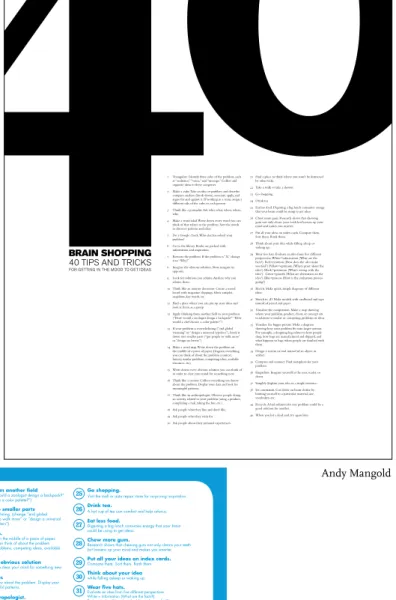
If your problem is big ("end global 13 . warming" or "design a universal font"), break it down into smaller parts ("get people to walk more." Observe people doing an activity related to your problem (using a product , completing a task, riding the bus, etc.) Ask people.
GRID }
This book contains an elegant, unbroken block of text in one of the earliest Roman typefaces.
GRID
Polyglot (multilingual) books display a text in multiple languages simultaneously, which requires complex divisions. Such formats allow multiple streams of text to coexist while defending the sovereignty of the page-as-frame.
Adapted from William Dana Orcutt, In Quest of the Perfect Book (New York: Little, Brown and Co., 1926). In this unusual book structure, the notes appear in the center of the page rather than along the bottom or edges.
Jan Tschichold's book The New Typography, published in Germany in 1928, took ideas from Futurism, Constructivism and De Stijl and passed them on as practical advice to commercial printers and designers. By describing the expansion of space in all directions, the modern grid has slipped past the classic frame of the sheet.
Pictures were cut to fit the modules of the grid, producing shapes of unusual proportion. Acknowledging the originality of the layout, the author credits Bill as "the creator of the typographic structure of the book."
In the early twentieth century, avant-garde designers exposed the grid to dramatize the mechanical conditions of printing. The Web was invented in the early 1990s (in Switzerland) to allow scientists and researchers to share documents created with different software applications.
On the invention of the Web, see Tim Berners-Lee, Weaving the Web (New York: HarperCollins, 1999). The grid is a navigational device that twists and changes as the user moves through it.
The ubiquitous language of the gui (graphical user interface) creates a grid space in which windows overlay windows. The ubiquitous language of the gui (graphical user interface) creates a grid space in which windows overlay windows.
Avant-garde designers in the 1910s and 1920s unveiled the mechanical grid of the book press, bringing it about. Avant-garde designers of the 1910s and 1920s discovered the mechanical grid of the book press and brought it to life.
Grids belong to the technological framework of typography, from the concrete modularity of the book press to the ubiquitous rulers, guides and coordinate systems of graphics. Grids belong to the technological framework of typography, from the concrete modularity of the book press to the ubiquitous rulers, guides and coordinates. The typographic grid is a proportional regulator for composition, tables, images, etc.
Determine the number of horizontal units in relation to the number of lines in the baseline grid. Determines the number of horizontal page units relative to the number of lines in the baseline grid.
Adjust the top or bottom edge of the page to absorb all the space left in the baseline grid. View the baseline grid when you want to check the position of elements; turn off when you are distracted.