CHAPTER 10
Training Human Resources
After you have read this chapter, you should be able to:
●
Define training and identify two types of training.
●
Discuss at least four learning principles that relate to training.
●
Describe four characteristics of an effective orientation system.
●
Discuss the three major phases of a training system.
●
Identify three ways to determine training needs.
●
List and discuss at least four training approaches.
●
Give an example for each level of training evaluation.
HR TRANSITIONS
Web-Based Training
The explosive growth in use of the Internet is changing how training is being done in organizations. As more and more employees use computers and have access to Internet portals, their employers are seeing the World Wide Web as a means for distributing training to employees who are located in widely diverse locations and jobs. A number of examples illustrate the power of web-based training.
Days Inn, the worldwide lodging chain, has 18,000 employees in almost 2,000 locations. With a staff of only 11 trainers, it would be impossi- ble for sufficient training to be done in classroom settings at company loca- tions. Consequently, Days Inn is mak- ing extensive use of interactive web-based training. Customer-service skills are being taught through on-line courses whereby employees at individ- ual hotels can log on and work through an interactive training program. Days Inn is not the only lodging chain to use web-based training either. In conjunc- tion with other firms in the hospitality industry, the American Hotel and Motel Association has established an Educa- tion Institute to provide self-paced, web-based training courses to Days Inn and other firms in the industry.
It is no surprise that technology- oriented firms use web-based training.
At Sun Microsystems, employees access the web and the company intranet to learn to use standard com- puter software packages. Bay Net- works conducts web-based pre-sales training for its sales representatives nationwide. In this training, audio and graphics presentation slides are used to provide technical information to the firm’s sales representatives. A Bay Networks training professional esti- mates that web-based training saves at least $350 per day per person just in travel and lodging costs. A side
benefit is that the company’s sales representatives get to stay home for the training, instead of spending time away from their families and offices.
Rather than limiting web-based training to individual, self-paced instruction, Union Pacific, the large nationwide railroad, uses the com- pany’s intranet to conduct training for employees in classrooms. Throughout the UP operating areas, employees in ten specially equipped classrooms use computer equipment to take learning retention tests. The results of these tests are used to establish additional training for employees.
The importance of web-based train- ing has been recognized by govern-
mental entities as well. The American Learning Exchange (ALX) has been established by the U.S. Department of Labor, a number of states, and the Public Broadcasting Corporation.
Beginning operation in 1998, ALX was started to provide employers and oth- ers a web-based source for training resources. Both on-line and other types of training courses and materials are catalogued. There is no fee to those who list training program details or access ALX for information. Once specific information is located, HR professionals can link to other sites for more details on specific training resources (see ALX at www.alx.org).
With all of the web-based resources and options, it is important that man- agers address some key questions before embarking on extensive use of
web-based training. First, top manage- ment support is crucial, because the initial costs for equipment and devel- opment of training materials may be substantial. Also, employees’ com- puter literacy and access to informa- tion technology are critical. Because web-based training requires diffusing training from a central location, man- agers and HR professionals used to training being controlled must be
“retrained” to accept the idea that training is being decentralized and individualized.
It also should be recognized that web-based training may not be appro- priate for certain types of training. For instance, leadership skill training or
other behaviorally-focused training and development may be done better face-to-face using increased trainee interactions.
Despite these and other issues that firms are experiencing as web-based training spreads, it is likely that this type of training will grow rapidly in the next few years. Once the initial invest- ment in equipment and content devel- opment are made, web-based training becomes a more cost-effective means to training worldwide. Also, training can be simultaneously updated and com- municated more easily to employees.
In summary, training using the web is likely to continue replacing class- room instruction in much of the train- ing done by employers. Thus, more training may become distance learning and available on demand.1
With all of the web-based resources and options,
it is important that managers address some key
questions before embarking on extensive use of
web-based training.
316 Section 3 Training and Developing Human Resources
“
Training is something we hope to integrate into every manager’s mind set.”
CHRIS LANDAUERThe strategies that organizations follow have an impact on most HR activities, in- cluding training. Increasingly, employers are recognizing that training their hu- man resources is vital. Currently, U.S. employers are spending at least $50 billion annually on training. For many employers, training expenditures average at least 1.5—2% of payroll expenses.
Traditionally, about two-thirds of the training expenses have been devoted to developing professional managers and one-third to first-line workers. But that proportion is changing. Organizations are realizing that they need to develop the capabilities of their first-line workers just as much as the capabilities of their man- agers. Something else is changing as well. An old axiom in HR management was,
“When times get tough, training is the first expenditure cut.” Accordingly, often training expenditures are reduced significantly. But a growing number of em- ployers have recognized that training is not just a cost; it is an investment in the human capital of the organization that benefits the entire organization.
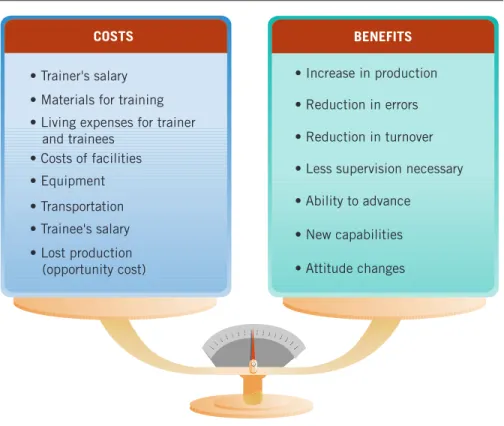
Figure 10-1 shows some costs and benefits that may result from training. While some benefits (such as attitude changes) are hard to quantify, comparison of costs and benefits associated with training remains the best way to determine if train- ing is cost effective. For example, one firm evaluated a traditional safety training
• Trainer's salary
• Materials for training
• Living expenses for trainer and trainees
• Costs of facilities
• Equipment
• Transportation
• Trainee's salary
• Lost production (opportunity cost)
COSTS
• Increase in production
• Reduction in errors
• Reduction in turnover
• Less supervision necessary
• Ability to advance
• New capabilities
• Attitude changes BENEFITS
||| ||
|| | | || | ||
||
||| ||
|| | | || | |||
|
FIGURE 10—1 Balancing Costs and Benefits of Training
program and found that the program did not lead to a reduction in accidents.
Therefore, the training was redesigned so that better safety practices resulted.
What is interesting is that as organizations restructure and implement strate- gic changes, training becomes more important. Employees who must adapt to the changes need training to update their capabilities. Also, managers must have training and development to enhance their leadership skills and abilities. In a number of situations, effective training often produces productivity gains that more than offset the cost of the training. The HR Perspective describes a study in- tended to document the economic value of training.
The Context of Training
Trainingis a process whereby people acquire capabilities to aid in the achieve- ment of organizational goals. Because this process is tied to a variety of organiza- tional purposes, training can be viewed either narrowly or broadly. In a limited sense, training provides employees with specific, identifiable knowledge and skills for use on their present jobs. Sometimes a distinction is drawn between trainingand development,with development being broader in scope and focusing on individuals gaining newcapabilities useful for both present and future jobs.
Training Responsibilities
A typical division of training responsibilities is shown in Figure 10—2. The HR unit serves as a source of expert training assistance and coordination. The unit often
Training
A process whereby people acquire capabilities to aid in the achievement of organizational goals.
H R P E R S P E C T I V E
Research on Identifying the Economic Value of Training
In many organizations, large expen- ditures are made on training. But whether those expenditures produce value and an economic impact for the organizations that make the expenditures has not been identified clearly. To provide some additional insights on the economic utility of organization-wide training, Morrow, Jarrett, and Rupinski did a study, the results of which were reported in Personnel Psychology.
The study was conducted in a large pharmaceutical firm and focused on identifying the economic impact of managerial and
sales/technical training efforts. The CEO of the firm had requested that the dollar value of training be identi-
fied and its value to the firm be con- firmed. The study examined 18 training programs, focusing on the effects of job skills training on employees’ behavioral performance on the job. The behavioral perfor- mance of those who had received the training was noted by their supervisors, peers, or subordinates, depending upon the skills being evaluated.
Using a variety of statistical analyses, the researchers found that sales/technical training had a greater effect than did managerial training. A return on investment (ROI) on each type of training was determined, with the ROI for the sales/technical training calculated
to be 156% and for managerial training to be 84%. Consistent with previous research, the effects of more specific training, such as that in sales/technical skills, apparently have greater immediate payoff. It is possible that the managerial training has a larger payoff over time, but this study focused on first-year returns.
In spite of these issues, the study appears to show that training does produce a return to the organi- zation on its training expenditures.
As organizations face strategic changes and more training expendi- tures are made, it is crucial for the impact of training to be evaluated and documented.2
318 Section 3 Training and Developing Human Resources
has a more long-range view of employee careers and the development of the en- tire organization than do individual operating managers. The difference is espe- cially true at lower levels in the organization.
However, managers are likely to be the best source of technical information used in skills training. They also are in a better position to decide when employees need training or retraining. Because of the close and continual inter- action they have with their employees, it is appropriate that managers determine and discuss employee career potentials and plans with individual employees.
It has been increasingly evident that operating managers and HR profession- als must work together effectively if training is to be done well. Therefore, a
“training partnership” between the HR staff members and operating managers must develop. In this partnership HR serves more as a consultant and training planner with managers, rather than as an entity controlling training.3
Types of Training
Training in organizations is offered in many different areas, and Figure 10—3 shows typical types of training done in organizations. Notice that some of this training is conducted primarily in-house, whereas other types of training make greater use of external training resources.
INTERNAL TRAINING Training in on-the-job locations tends to be viewed as being very applicable to the job, it saves the cost of sending employees away for train- ing, and it often avoids the cost of outside trainers. However, trainees who are learning while working can incur costs in the form of lost customers and broken equipment, and they may get frustrated if matters do not go well.
Often, technical training is conducted inside organizations. Technical train- ing is usually skills based, for example, training to run precision computer-con- trolled machinery. Due to rapid changes in technology, the building and updating of technical skills have become crucial training needs. Basic technical skills training is also being mandated by federal regulations in areas where the Occupational Safety and Health Administration (OSHA), the Environmental Pro- tection Agency (EPA), and other agencies have regulations. As noted in the open- ing discussion, web-based training and intranets also are growing as internal means of training.
FIGURE 10—2 Typical Training Responsibilities
HR Unit Managers
● Prepares skill-training materials
● Coordinates training efforts
● Conducts or arranges for off-the-job training
● Coordinates career plans and employee development efforts
● Provides input and expertise for organizational development
● Provide technical information
● Monitor training needs
● Conduct on-the-job training
● Continually discuss employees’
growth and future potential
● Participate in organizational change efforts
One internal source of training that has grown is informal training, which occurs internally through interactions and feedback among employees.
One study found that 70% of what employees know about their jobs they learned informally from other employees, not from formal training programs.4 Several factors account for the amount of informal learning. First, as employees work in teams and on projects with others, they ask questions, receive explana- tion, and share information with coworkers. Second, rather than relying on the employer to train them and keep their capabilities current, employees request assistance from other employees more knowledgeable or skilled. Third, informal learning occurs among employees striving to meet organizational goals and deadlines. However, problems with informal training include the fact that some training done by fellow employees may not be accurate and may miss certain important details.
At one company in the southeastern United States, managers initially be- came concerned about the amount of time that employees spent talking with each other in the lunchroom. However, an HR professional who spent time in the lunchroom found that many of the conversations were problem- solving discussions about company projects. Consequently, white boards and flip charts were placed in the lunchroom for employees to use if they wish to do so.5
Informal training Training that occurs internally through interactions and feedback among employees.
% Providing Training 92
78
19 9
50 75
24 10
42 75
17 13
45 75
40
11 24
71
32
12 27
71
20 22
29 71
36
4 31
81 79
58
10
1 4
17
% Providing Training In-house
% Providing Training Outside only % Providing Training In-house and Outside New
employee orientation
Conducting performance
appraisal
Personal computer
Team- building
Leadership Sexual harassment
Hiring/
selection process
Train-the- trainer
New equipment
operation 0
20 40 60 80 100
FIGURE 10—3 Types of Training
SOURCE: Based on information inTraining, October 1997 (Lakewood Publications, Minneapolis, MN).
EXTERNAL TRAINING External training occurs for several reasons:
● It may be less expensive for an employer to have an outside trainer conduct training in areas where internal training resources are limited.
● There may not be sufficient time to develop internal training materials.
● The HR staff may not have the level of expertise needed for the subject matter where training is needed.
● There are advantages to having employees interact with managers and peers in other companies in training programs held externally.
One growing trend is the outsourcingof training. Vendors are being used to train employees. For example, many software providers have users’ conferences where employees from a number of employers receive detailed training on using the software and new features being added. Also, vendors can do training inside the organization if sufficient numbers of employees are to be trained.6
Several computer software vendors offer employees technical certifications on their software. For example, being a Master Certified Novell Engineer or Microsoft Certified Product Specialist gives employees credentials that show their level of technical expertise. The certifications also provide employees items to put on their resumes should they decide to change jobs. These certifications also benefit employers, who can use the certifications as job specifications for hiring and pro- motion purposes. If an employer pays for employees to become certified, employees may view the employer more positively and be less prone to leave.7
Legal Aspects of Training
Training is an area targeted by EEO laws and regulations. One area of concern in- volves the practices used to select individuals for inclusion in training programs.
The criteria used must be job related and must not unfairly restrict the participa- tion of protected-class members. Another concern is differences in pay based on training to which protected-class members have not had equal access. A third is the use of training as a criterion for selecting individuals for promotions. In sum- mary, equal employment laws and regulations definitely apply to training, and employers must be aware of them.
Training is a cost, and some employers have gone to court in an attempt to re- quire individuals who leave their firms after training to repay the cost. For in- stance, one firm sued a worker in a skilled technical job, who had signed a promissory note to repay the firm $9,000 if he left the firm voluntarily or was fired for cause within 24 months of starting a special training program. The employee contested the suit by saying that he did not learn anything he had not already known and thus had received no benefits from the training. In this case the employer prevailed because of the signed note by the employee.
Learning Principles: The Psychology of Learning
Working in organizations is a continual learning process, and learning is at the heart of all training activities. Different learning approaches are possible, and learning is a complex psychological process that is not fully understood by prac- titioners or research psychologists.
320 Section 3 Training and Developing Human Resources
LOGGING ON . . .
American Society for Training & Development This website is a complete guide to training and devel- opment. Information on articles, research, educa- tional seminars, and con- ferences can be found here.
http://www.astd.org/
Often, trainers or supervisors present information and assume that merely by presenting it they have ensured that it will be learned. But learning takes place only when information is received, understood, and internalized in such a way that some change or conscious effort has been made to use the information.
Managers can use the research on learning to make their training efforts more effective. Some major learning principles that guide training efforts are pre- sented next.
Intention to Learn
People learn at different rates and are able to apply what they learn differently.
Abilityto learn must be accompanied by motivation, or intention,to learn. Moti- vation to learn is determined by answers to questions like these: “How important is my job to me?” “How important is it that I learn that information?” “Will learning this help me in any way?” and “What’s in it for me?”
Additionally, people vary in their beliefs about their abilities to learn through training. These perceptions may have nothing to do with their actual ability to learn, but rather reflect the way they see themselves. People with low self-efficacy (low level of belief that they can accomplish something) benefit from one-on-one training. People with high self-efficacy seem to do better with conventional train- ing. Because self-efficacy involves a motivational component, it affects a person’s intention to learn.8
Whole Learning
It is usually better to give trainees an overall view of what they will be doing than to deal immediately with the specifics. This concept is referred to as whole learn- ing or Gestalt learning. As applied to job training, this means that instructions should be divided into small elements afteremployees have had the opportunity to see how all the elements fit together.
Another concept is attentional advice, which refers to providing trainees information about the processes and strategies that can lead to train- ing success. By focusing the trainees’ attention on what they will encounter during training and how it is linked to their jobs, trainers can improve trainees’ participation in the training process. For instance, if customer serv- ice representatives are being trained to handle varying types of difficult cus- tomer calls, the training should give an overview of the types of calls, the verbal cues indicating the different types of calls, and the desired outcomes for each type of call.9
Reinforcement
The concept of reinforcementis based on the law of effect,which states that people tend to repeat responses that give them some type of positive reward and avoid actions associated with negative consequences. The reinforcers that an in- dividual receives can be either external or internal, and many training situations provide both kinds. A new salesclerk who answers a supervisor’s question cor- rectly and is complimented for doing so may receive both an external reward (the compliment) and an internal reward (a feeling of pride). A person who is posi- tively reinforced for learning is more likely to continue to learn.
Attentional advice Providing trainees information about the processes and strategies that can lead to training success.
Reinforcement
A concept that people tend to repeat responses that give them some type of positive reward and avoid actions associated with negative consequences.
Behavior Modification
A comprehensive approach to training has been developed based on the concept of reinforcement. This popular approach, behavior modification,uses the theories of psychologist B.F. Skinner, who stated that “learning is not doing; it is chang- ing what we do.” Behavior modification makes use of four means of changing behavior, labeled intervention strategies.The four strategies are positive reinforce- ment, negative reinforcement, punishment, and extinction. Each is reviewed next.
A person who receives a desired reward receives positive reinforcement.If an employee is on time every day during the week and, as a result, receives extra pay equivalent to one hour of normal work, the employee has received positive reinforcement of his or her good attendance by receiving a desired award.
Negative reinforcementoccurs when an individual works to avoid an un- desirable consequence. An employee who arrives at work on time every day may do so to avoid a supervisor’s criticism. Thus, the potential for criticism leads to the employee’s taking the desired action.
Action taken to repel a person from undesirable action is punishment.A gro- cery manager may punish a stock clerk for leaving the stockroom dirty by forcing her to stay after work and clean it up.
Behavior can also be modified through a technique known as extinction, which is the absence of an expected response to a situation. The hope is that un- reinforced behavior will not be repeated.
All four strategies can work to change behavior, and combinations may be called for in certain situations. But research suggests that for most training situa- tions, positive reinforcement of the desired behavior is most effective.
Immediate Confirmation
Another learning concept is immediate confirmation:people learn best if re- inforcement is given as soon as possible after training. Feedback on whether a learner’s response was right or wrong should be given as soon as possible after the response. To illustrate, suppose a corporate purchasing department has developed a new system for reporting inventory information. The purchasing manager who trains inventory processors may not have the trainees fill out the entire new in- ventory form when teaching them the new procedure. Instead the manager may explain the total process and then break it into smaller segments, having each trainee complete the form a section at a time. By checking each individual’s form for errors immediately after each section is complete, the purchasing manager can give immediate feedback, or confirmation, before the trainees fill out the next section. This immediate confirmation corrects errors that, if made through- out the whole form, might establish a pattern that would need to be unlearned.
Learning Practice and Patterns
Learning new skills requires practice and application of what is learned. Both re- search and experience show that when designing training, behavioral modeling, practice, and learning curves are all important considerations.
BEHAVIOR MODELING The most elementary way in which people learn—and one of the best—is behavior modeling, or copying someone else’s behavior. A 322 Section 3 Training and Developing Human Resources
Positive reinforcement A person receives a desired reward.
Negative reinforcement An individual works to avoid an undesirable consequence.
Punishment
Action taken to repel a person from an undesired action.
Extinction The absence of an expected response to a situation.
Immediate confirmation The concept that people learn best if reinforcement is given as soon as possible after training.
Behavior modeling Copying someone else’s behavior.
variation of modeling occurs when people avoid making mistakes they see oth- ers make. The use of behavior modeling is particularly appropriate for skill train- ing in which the trainees must use both knowledge and practice.
ACTIVE PRACTICE Active practice occurs when trainees perform job-related tasks and duties during training. It is more effective than simply reading or pas- sively listening. Research has found that active practice was the factor most closely associated with improved performance following training.10Once some basic instructions have been given, active practice should be built into every learning situation. It is one of the advantages of good on-the-job training. As- sume a person is being trained as a customer service representative. After being given some basic selling instructions and product details, the trainee should be al- lowed to call a customer to use the knowledge received.
SPACED VS. MASSED PRACTICE Active practice can be structured in two ways.
The first, spaced practice,occurs when several practice sessions are spaced over a period of hours or days. The other, massed practice,occurs when a person does all of the practice at once. Spaced practice works better for some kinds of learning, whereas massed practice is better for others. For example, training cashiers to operate a new machine could be alternated with having the individu- als do tasks they already know how to do. Thus, the training is distributed instead of being concentrated into one period.
For other kinds of tasks, such as memorizing tasks, massed practice is usually more effective. Can you imagine trying to memorize the list of model options for a dishwasher one model per day for 20 days as an appliance distribution sales- person? By the time you learned the last option, you would have forgotten the first one.
LEARNING CURVES People in different training situations learn in different pat- terns, called learning curves.The kind of learning curve typical of a given task has implications for the way the training program is designed. In some situations, the amount of learning and/or the skill level increases rapidly at first, then the rate of improvement slows. For example, when an employee first learns to operate a stamping machine, the rate of production increases rapidly at first and then slows as the normal rate is approached. Learning to perform most routine jobs follows such a curve.
Another common pattern occurs when a person tries to learn an unfamiliar, difficult task that also requires insight into the basics of the job. In this pattern, learning occurs slowly at first, then increases rapidly for a while, and then flattens out. Learning to debug computer systems is one example, especially if the learner has little previous contact with computers.
Transfer of Training
For effective transfer of training from the classroom to the job, two conditions must be met. First, the trainees must be able to take the material learned in train- ing and apply it to the job context in which they work. Second, use of the learned material must be maintained over time on the job.
One way to aid transfer of training to job situations is to ensure that the train- ing is as much like the jobs as possible. In the training situation, trainees should be able to experience the types of situations they can expect on the job. For
Active practice The performance of job- related tasks and duties by trainees during training.
Spaced practice Several practice sessions spaced over a period of hours or days.
Massed practice The performance of all of the practice at once.
example, training managers to be better interviewers should include role playing with “applicants” who respond in the same way that real applicants would.
Orientation: Training for New Employees
Orientation is the planned introduction of new employees to their jobs, coworkers, and the organization. However, orientation should not be a mechan- ical, one-way process. Because all employees are different, orientation must in- corporate a sensitive awareness of the anxieties, uncertainties, and needs of the individual. Orientation in one form or another is offered by most employers.
Orientation Responsibilities
Orientation requires cooperation between individuals in the HR unit and other managers and supervisors. In a small organization without an HR department, such as a machine shop, the new employee’s supervisor or manager has the total responsibility for orientation. In large organizations, managers and supervisors, as well as the HR department, should work as a team in employee orientation.
Figure 10—4 illustrates a common division of orientation responsibilities in which managers work with HR specialists to orient a new employee. Together they must develop an orientation process that will communicate what the employee needs to learn. Supervisors may not know all the details about health insurance or benefit options, for example, but they usually can best present in- formation on safety rules; the HR department then can explain benefits.
Purposes of Orientation for Employers
The overall goal of orientation is to help new employees learn about the organi- zation as soon as possible, so that they can begin contributing. From the per- spective of employers, the orientation process has several specific purposes, which are described next.
PRODUCTIVITY ENHANCEMENT Both employers and new employees want indi- viduals starting jobs to become as productive as possible relatively quickly. Texas Instruments found that orientation helps new employees reach full productivity 324 Section 3 Training and Developing Human Resources
FIGURE 10—4 Typical Orientation Responsibilities
HR Unit Managers
● Places employees on payroll
● Designs formal orientation program
● Explains benefits and company organization
● Develops orientation checklist
● Evaluates orientation activities
● Prepare coworkers for new employee
● Introduce new employee to coworkers
● Provide overview of job setting and work rules
Orientation
The planned introduction of new employees to their jobs, coworkers, and the organization.
levels at least two months sooner than those without effective orientation expe- riences. Some employers, including a large accounting firm, give new employees computer and intranet access upon acceptance of a job offer. That way new employees can become more familiar with the organization and its operations even before they go through a formal orientation program.11This example illus- trates that orientation to the organization really begins during the recruiting and selection processes, because the way individuals are treated and what they learn about the organization during the first contacts may shape how they approach new jobs.
Another facet of orientation that affects productivity is training new employees on the proper ways to perform their jobs. One construction company has found that emphasizing safety and instructing new employees in safe work practices has significantly reduced the number of lost-time injuries experienced by new employees.12
TURNOVER REDUCTION Some employers have experienced significant turnover of newly hired employees, and it is common for over half of all new hires in hourly jobs to leave within their first year of employment. But employers with effective orientation programs have found that new employees stay longer. Corning Glass identified that 70% of the employees rating orientation highly were likely to stay at least three years. Another firm was able to reduce annual turnover rates by 40%, and much of the decline was attributed to more effective orientation of new employees.13As pointed out in Chapter 3, turnover is costly, and if orientation helps reduce turnover, then it contributes to organizational success.14
ORGANIZATIONAL OVERVIEW Another purpose of orientation is to inform new employees about the nature of the organization. A general organizational overview might include a brief review of the organization; the history, structure, key executives, purpose, products, and services of the organization; how the employee’s job fits into the big picture; and other general information. If the em- ployer prepares an annual report, a copy may be given to a new employee. Also, some organizations give new employees a list of terms that are used in the in- dustry to help them learn regularly used vocabulary. The HR Perspective shows the passport used at ACI Worldwide. It describes an orientation approach that in- volves executives from throughout the firm, not just HR staff members.
Purpose of Orientation for New Employees
New employees generally are excited about the “new beginning” and also have anxieties about what they face. Therefore, orientation should help create a fa- vorable impression and enhance interpersonal acceptance of new employees.
FAVORABLE EMPLOYEE IMPRESSION Although the first two purposes of orienta- tion are employer-centered, another goal of orientation is to benefit the new employees. Certainly a good orientation program creates a favorable impression of the organization and its work. This impression begins even before the new employees report to work.15Providing sufficient information about when and where to report the first day, handling all relevant paperwork efficiently, and hav- ing personable, efficient people assist the new employee all contribute to creating a favorable impression of the organization.
LOGGING ON . . .
Orientation
At this website, you will find a varied listing of ideas and subjects to incorporate into a new employee orientation program.
http://www.publiccom.com/
web/change/newemp.html
326
H R P E R S P E C T I V E
Passport for New Employee Success
Transaction Systems Architects, Inc., develops, markets, and sup- ports software products for the global electronic funds transfer mar- ket. TSA’s products are used to process transactions involving credit cards, debit cards, smart cards, home banking services, checks, wire transfers, and automated clearing and settlement. TSA’s software solu- tions are used by more than 2,000 customers in 70 countries on six continents. Of the top 500 banks worldwide (in terms of assets), over 100 use at least one of Transaction Systems’ product solutions. More than 2,300 people are employed by TSA in offices in 18 countries. At ACI Worldwide, TSA’s support and distribution division, the new employee orientation process picks up the global theme of TSA by using a new employee passport (see photo).
As part of its employee orienta- tion program, ACI in Omaha, Nebraska, gives new employees their own New Employee Passports.
The objective of the passport is to provide the employee with an intro- duction to ACI’s senior members—
individuals most employees might otherwise never meet. This process also allows senior managers to share their views of the organization and its future prospects.
Modeled after the official U.S.
passport, the New Employee Pass- port is specially prepared for each holder. Inside the passport, in the sections normally reserved for visa stamps, are the names and titles of
the senior managers of the com- pany, including the chief executive officer. In these sections, the man- agement hierarchy specific to the new employee is identified and marked.
Using the passport as an entree, the new employee sets up appoint- ments to meet individually with appropriate senior managers. In these one-on-one meetings, each senior manager describes his/her job and division responsibilities, the strategic directions being pursued, and how the new employee’s job fits into the company plans and changes. At the end of these meet-
ings, each senior manager signs the
“New Employee Passport,” much as a customs official in a foreign coun- try would do. Interestingly, the senior managers uniformly give pri- ority in their schedules for the new employees, thereby emphasizing the importance of the new employee to ACI.
ACI uses its New Employee Pass- port to communicate the company’s informal, open culture. The passport offers a unique introductory process for new employees to learn from senior managers about the strategies and operations of the company.16
ENHANCE INTERPERSONAL ACCEPTANCE Another purpose of orientation is to ease the employee’s entry into the work group. New employees often are con- cerned about meeting the people in their work units. Further, the expectations of the work group do not always parallel those presented at management’s formal orientation. Also, if a well-planned formal orientation is lacking, the new employee may be oriented solely by the group, possibly in ways not beneficial to the organization. For example, at a software company the work group in the sec- tion where new employees were assigned delighted in telling the new employees
“the way it really works here.” Some of their views were not entirely accurate.
Therefore, orientation was essential for management to make certain that new employees knew what their supervisors wanted.
Establishing an Effective Orientation System
A systematic approach to orientation requires attention to attitudes, behaviors, and information that new employees need. Unfortunately, too often orientation is conducted rather haphazardly. The general ideas that follow highlight the ma- jor components of an effective orientation system: preparing for new employees, providing them with needed information, presenting orientation information ef- fectively, and conducting evaluation and follow-up on the initial orientation.
PREPARING FOR NEW EMPLOYEES New employees must feel that they belong and are important to the organization. Both the supervisor and the HR unit should be prepared to give each new employee this perception. Further, coworkers as well as the supervisor should be prepared for a new employee’s arrival. This prepara- tion is especially important if the new employee will be assuming duties that might be interpreted as threatening a current employee’s job status or security.
The manager or supervisor should discuss the purpose of hiring the new worker with all current employees before the arrival of the new worker.17
Some organizations use coworkers or peers to conduct part of the new employees’ orientation. It is particularly useful to involve more experienced and higher-performing individuals who can serve as role models for new employees.
PROVIDING NEW EMPLOYEES WITH NEEDED INFORMATION The guiding question in the establishment of an orientation system is, “What does the new employee need to know now?”Often new employees receive a large amount of information they do not immediately need, and they fail to get the information they really need the first day of a new job.
Some organizations systematize this process by developing an orientation checklist. Figure 10—5 on the next page indicates items to be covered by the HR department representative, the new employee’s supervisor, or both. A checklist can ensure that all necessary items have been covered at some point, perhaps dur- ing the first week. Many employers have employees sign the checklist to verify that they have been told of pertinent rules and procedures.
Often, employees are asked to sign a form indicating that they have received the handbook and have read it. This requirement gives legal protection to em- ployers who may have to enforce policies and rules later. Employees who have signed forms cannot deny later that they were informed about policies and rules.
To help them understand the organization fully, new employees also should be oriented to the culture of the organization. Giving informal information on
BNA
Orientation Pointers 495.30
Review some pointers for supervisors on conducting new employee orientation and compare these point- ers to the manner in which you were oriented to a new job.
328 Section 3 Training and Developing Human Resources
FIGURE 10—5 Orientation Checklist
Employee Name____________________________ Employee Number_________________________________
Starting Date_______________________________ Job Title__________________________________________
Department________________________________ Supervisor________________________________________
FIRST DAY SECOND DAY
OVERVIEW PERSONNEL POLICIES
____ Company history ____ Equal employment
____ Organization chart ____ Alcohol and drug prohibition ____ Company business sectors ____ Sexual and other harassment
WORKING HOURS ____ Complaints and concerns
____ Recording work hours INSURANCE BENEFITS ____ Start and stop times ____ Group health plan ____ Lunch and breaks ____ Disability insurance ____ Overtime policies ____ Life insurance
PAY POLICIES ____ Worker compensation
____ Employee classifications LEAVE BENEFITS
____ Pay periods ____ Sick leave
____ Automatic deposits ____ Holiday and vacations ____ Personal leave
DISTRIBUTE EMPLOYEE HANDBOOK ____ Family and medical leave ____ Civic duty leave
____ Bereavement leave Employee Signature_____________________ RETIREMENT PLANS Date__________________________________ ____ Pension plan
____ 401(k) plan
Employee Name____________________________ Employee Number_________________________________
Starting Date_______________________________ Job Title__________________________________________
Department________________________________ Supervisor________________________________________
FIRST DAY
OVERVIEW JOB ORIENTATION
____ Introduction to coworkers ____ Job overview
____ Tour of department ____ Job description review
____ Tour of company ____ Job equipment
WORK LOCATION ____ Safety equipment
____ Parking ____ Safety policies
____ Accident reporting ____ Dress code
EMERGENCIES ____ Employee lockers
____ Medical ____ Restrooms
____ Power failure ____ Telephone (personal usage)
____ Fire
____ Weather closings Employee Signature______________________
Date___________________________________
Orientation Conducted by (supervisor) _______________________________________
HR D E P A R T M
E N T
S U P E R V I S O R
At the end of the employee’s first two weeks, the supervisor will ask if the employee has any questions concerning any items. After all questions have been discussed, both the employee and the supervisor will sign and date this form and return it to the HR Department.
such factors as typical dress habits, lunch practices, and what executives are called will help new employees to adjust.
Another important type of initial information to give employees is informa- tion on the policies, work rules, and benefits of the company. Policies about sick leave, tardiness, absenteeism, vacations, benefits, hospitalization, parking, and safety rules must be made known to every new employee immediately. Also, the employee’s supervisor or manager should describe the routine of a normal work- day for the employee the first morning.
PRESENTING ORIENTATION INFORMATION EFFECTIVELY Managers and HR repre- sentatives should determine the most appropriate ways to present orientation in- formation. One common failing of many orientation programs is information overload.New workers presented with too many facts may ignore important de- tails or inaccurately recall much of the information.18For example, rather than telling an employee about company sick leave and vacation policies, an employee handbook that includes this information might be presented on the first day. The manager or HR representative then can review this information a few days later to answer any of the employee’s questions, and the employee can review it as needed. Some employers have invested considerable time and effort to make their orientation efforts interesting and useful.
Self-paced orientation, whereby employees review orientation information available electronically or on videotape, is growing in usage also. There are sev- eral advantages to this approach. Most of the general company information is on- line for employees to access from home or in offices throughout the world. It also saves several hours of HR staff time, and new employees can return to the infor- mation at any time. If they have specific questions, new employees can contact the HR staff either by phone or e-mail.
Indeed, employees will retain more of the orientation information if it is pre- sented in a manner that encourages them to learn. In addition to the videotapes and computers already mentioned, some organizations have successfully used movies, slides, and charts. However, the emphasis should be on presenting in- formation, not on entertaining the new employee. Materials such as handbooks and information leaflets should be reviewed periodically for updates and correc- tions.
EVALUATION AND FOLLOW-UP A systematic orientation program should have an evaluation and/or reorientation phase at some point after the initial orientation.
An HR representative or manager can evaluate the effectiveness of the orientation by conducting follow-up interviews with new employees a few weeks or months after the orientation. Employee questionnaires also can be used. Some organiza- tions even give new employees a written test on the company handbook two weeks after orientation. Unfortunately, it appears that most employers do limited or no evaluation of the effectiveness of orientation, according to one survey of employers.19
Too often, typical orientation efforts assume that once oriented, employees are familiar with everything they need to know about the organization forever. In- stead, orientation should be viewed as a never-ending process of introducing both old and new employees to the current state of the organization. To be assets to their organizations, employees must know current organizational policies and procedures, and these may be altered from time to time.
Systems Approach to Training
The success of orientation or any other type of training can be gauged by the amount of learning that occurs and is transferred to the job. Too often, un- planned, uncoordinated, and haphazard training efforts significantly reduce the learning that could have occurred. Training and learning will take place, espe- cially through informal work groups, whether an organization has a coordinated effort or not—because employees learn from other employees. But without a well- designed, systematic approach to training, what is learned may not be what is best for the organization. Figure 10—6 shows the relevant components of the three major phases in a training system: (1) the assessment phase, (2) the imple- mentation phase, and (3) the evaluation phase.20
Assessment Phase
In the assessmentphase, planners determine the need for training and specify the objectives of the training effort. Looking at the performance of clerks in a billing department, a manager might find that their data-entry and keyboard abilities are weak and that they would profit by having instruction in these areas. An ob- jective of increasing the clerks’ keyboard entry speed to 60 words per minute without errors might be established. The number of words per minute without errors is the criterion against which training success can be measured, and it rep- resents the way in which the objective is made specific. To make the bridge be- tween assessment and implementation, the clerks would be given a keyboard data-entry test.
330 Section 3 Training and Developing Human Resources
Determine Training
Needs Assessment
Identify Training Objectives
Develop Criteria
Select Training Methods Implementation
Arrange for Training
Conduct Training
Monitor Training Pretest
Trainees
Compare Training Outcome
against Criteria Evaluation FIGURE 10—6 Model of a Training System
Implementation Phase
Using the results of the assessment, implementation can begin. For instance, a billing supervisor and an HR training specialist could work together to determine how to train the clerks to increase their speeds. Arrangements for instructors, classrooms, materials, and so on would be made at this point. A programmed in- struction manual might be used in conjunction with a special data-entry class set up at the company. Implementation occurs when training is actually conducted.
Evaluation Phase
The evaluationphase is crucial. It focuses on measuring how well the training ac- complished what its originators expected. Monitoring the training serves as a bridge between the implementation and evaluation phases and provides feed- back for setting future training objectives.
Training Needs Assessment
Training is designed to help the organization accomplish its objectives. Determin- ing organizational training needs is the diagnostic phase of setting training objec- tives. Just as a patient must be examined before a physician can prescribe medication to deal with an ailment, an organization or an individual employee must be studied before a course of action can be planned to make the “patient”
function better. Managers can identify training needs by considering three sources.21 Figure 10—7 depicts some of the methods used, for each of the three sources.
Organization-wide Sources
Grievances Accidents
Waste/Scrap Equipment Use Observations
Complaints
Exit Interviews Training Observations
Task Analyses Sources
Job Requirements = Employee KSAs Job Description Requirements = Job Specifications
Individual Employee Sources
Tests Questionnaires
Assessment Centers Attitude Surveys Records
Performance Appraisals FIGURE 10—7 Levels of Training Needs Assessment
Organizational Analyses
The first way to diagnose training needs is through organizational analysis, which considers the organization as a system. An important part of the com- pany’s strategic human resource planning is the identification of the knowledge, skills, and abilities (KSAs) that will be needed by employers in the future as both jobs and the organization change.
Both internal and external forces that will influence training must be consid- ered when doing organizational analyses. The problems posed by the technical obsolescence of current employees and an insufficiently educated labor pool from which to draw new workers should be confronted before those training needs become critical. To illustrate, consider a medium-sized telecommunica- tions firm that is facing increasing competition and changes in its industry. Dur- ing its strategic planning, the firm recognized that greater computerization of its operations was needed. The firm identified that establishing an intranet in the company was going to mean that increased internal and external communica- tions were to occur electronically. Many employees needed to be trained to use computer software and given laptops to use both at work and away from the office.
One important source for organizational analyses comes from various opera- tional measures of organizational performance. On a continuing basis, detailed analyses of HR data can show training weaknesses. Departments or areas with high turnover, high absenteeism, low performance, or other deficiencies can be pinpointed. After such problems are analyzed, training objectives can be devel- oped. Specific sources of information and operational measures for an organiza- tional-level needs analysis may include the following:
● Grievances ● Complaints from customers
● Accident records ● Equipment utilization figures
● Observations ● Training committee observations
● Exit interviews ● Waste/scrap/quality control data
Task Analyses
The second way to diagnose training needs is through analyses of the tasks per- formed in the organization. To do these analyses, it is necessary to know the job requirements of the organization. Job descriptions and job specifications provide information on the performances expected and skills necessary for employees to accomplish the required work. By comparing the requirements of jobs with the knowledge, skills, and abilities of employees, training needs can be identified.
To continue an example, assume that at a telecommunications firm, analyses were done to identify the tasks to be performed by engineers who were to serve as technical instructors for other employees. By listing the tasks required of a technical instructor, management established a program to teach specific in- struction skills needed so the engineers could become successful instructors.
Individual Analyses
The third means of diagnosing training needs focuses on individuals and how they perform their jobs. Figure 10—8 shows how analyses of the job and the per- son mesh to identify training needs. The use of performance appraisal data in making these individual analyses is the most common approach. In some 332 Section 3 Training and Developing Human Resources
instances, a good HR information system can be used to help identify individu- als who require training in specific areas.
To assess training needs through the performance appraisal process, an employee’s performance inadequacies first must be determined in a formal re- view. Then some type of training can be designed to help the employee overcome the weaknesses. Another way of assessing individual training needs is to ask both managerial and nonmanagerial employees about what training they need. The results can inform managers about what employees believe their problems are and what actions they recommend.
A training needs survey can take the form of questionnaires or interviews with supervisors and employees on an individual or group basis. The purpose is to
The Job Analysis
Job Analysis and Job Description
Performance
Appraisal
Training
Performance Standards
Comparison and Performance
Appraisal
Pick Training Methods/Programs Specifically Aimed at Weak Areas
Consider Measurement Methods, Cost, Time Frame
Conduct Training Activities Identify
Areas of Weakness
The Person
Ability and Motivation
Job Performance Level FIGURE 10—8 Using Job Performance to Analyze Training Needs
gather information on problems perceived by the individuals involved. The fol- lowing sources are useful for individual analyses:
● Questionnaires ● Records of critical incidents
● Job knowledge tools ● Data from assessment centers
● Skill tests ● Role-playing results
● Attitude surveys
Establishing Training Objectives and Priorities
Once training needs have been identified using the various analyses, then train- ing objectives and priorities must be established. All of the gathered data is used to compile a gap analysis,which identifies the distance between where an orga- nization is with its employee capabilities and where it needs to be. Training ob- jectives and priorities are set to close the gap.22
The success of training should be measured in terms of the objectives set. Use- ful objectives are measurable. For example, an objective for a new salesclerk might be to “demonstrate the ability to explain the function of each product in the department within two weeks.” This objective serves as a check on internal- ization, or whether the person really learned.
Objectives for training can be set in any area by using one of the following four dimensions:
● Quantity of workresulting from training (for example, number of words per minute typed or number of applications processed per day)
● Quality of workafter training (for example, dollar cost of rework, scrap loss, or errors)
● Timeliness of workafter training (for example, schedules met or budget reports turned in on time)
● Cost savingsas a result of training (for example, deviation from budget, sales expense, or cost of downtime)
Because training seldom is an unlimited budget item and there are multiple training needs in an organization, it is necessary to prioritize needs. Ideally, train- ing needs are ranked in importance on the basis of organizational objectives. The training most needed to improve the health of the organization is done first in order to produce visible results more quickly.
Training Approaches
Once objectives have been determined, the actual training can begin. Regardless of whether the training is job specific or broader in nature, the appropriate train- ing approach must be chosen. The following overview of common training ap- proaches and techniques classifies them into several major groups. Other methods that are used more frequently for management development are discussed in the next chapter, although there can be overlap in the use of some of the methods.
On-the-Job Training (OJT)
The most common type of training at all levels in an organization is on-the-job training(OJT). Whether or not the training is planned, people do learn from their 334 Section 3 Training and Developing Human Resources
LOGGING ON . . .
Training Supersite This site provides access to Training magazine, job openings, products, serv- ices, and research articles for training and develop- ment professionals.
http://www.trainingsupersite.
com/dirset.htm
job experiences, particularly if these experiences change over time. On-the-job training usually is done by the manager, other employees, or both. A manager or supervisor who trains an employee must be able to teach, as well as to show, the employee what to do.
JOB INSTRUCTION TRAINING (JIT) A special, guided form of on-the-job training is known as job instruction training(JIT). Developed during World War II, JIT was used to prepare civilians with little experience for jobs in the industrial sector producing military equipment. Because of its success, JIT is still used. In fact, its logical progression of steps is an excellent way to teach trainers to train. Figure 10—9 shows the steps in the JIT process.
PROBLEMS WITH OJT On-the-job training is by far the most commonly used form of training because it is flexible and relevant to what the employee is doing. How- ever, OJT has some problems as well. A common problem is that OJT often is hap- hazardly done. Trainers may have no experience in training, no time to do it, and no desire to participate. Under such conditions, learners essentially are on their own, and training likely will not be effective. Another problem is that OJT can disrupt regular work. Unfortunately, OJT can amount to no training at all in some circumstances, especially if the trainee simply is abandoned by an ineffective trainer to learn the job alone. However, well-planned and well-executed OJT can be very effective.
Simulation
Simulation is a training approach that uses a training site set up to be identical to the work site. In this setting, trainees can learn under realistic conditions but be away from the pressures of the production schedule. For example, having an employee practice on a PBX console in a simulated setting before taking over as a telephone receptionist allows the person to learn the job more easily and with- out stress. Consequently, there may be fewer mistakes in handling actual incom- ing calls.
One type of simulation is called vestibule training,which occurs in special facilities that replicate the equipment and work demands of jobs. Examples of vestibule training include airlines that use simulators to train pilots and cabin at- tendants, astronauts who train in mock-up space capsules, and nuclear power plant operators who use model operations control rooms and consoles.
Behavioral simulations and computer-generated virtual reality have grown as computer technology and use of the Internet for training have grown. Virtual
Prepare the Learners Present the Information
• Put them at ease
• Find out what they know
• Get them interested
• Tell, show, question
• Present one point at a time
• Check, question, repeat
• Make sure they know
Trainees Practice
• Have them do the job
• Ask questions
• Observe and correct
• Make sure they know it
Do Follow-up
• Put them on their own
• Check frequently
• Reduce close follow-up as performance improves FIGURE 10—9 Job Instruction Training (JIT) Process
BNA: 2030.20.70
Training and Compensable Time To learn about the require- ments for counting time spent in training and work time for overtime determi- nation, review the details in this section.
Vestibule training A type of training which occurs in special facilities that replicate the
equipment and work demands of jobs.
reality uses three-dimensional environments to replicate a job. Computers, audio equipment, and video equipment all may be a part of a virtual reality training ap- proach. It is very useful where danger to the learner or to expensive equipment is involved, such as teaching pilots to fly a 757 aircraft or teaching police officers when to use their weapons and when to hold their fire in situations where their lives may be in danger.
Cooperative Training
Two widely used cooperative training methods are internships and apprentice- ships. Both mix classroom training and on-the-job experiences.
INTERNSHIPS An internship is a form of on-the-job training that usually com- bines job training with classroom instruction in trade schools, high schools, col- leges, or universities. Internships are advantageous to both employers and interns. Interns get “real-world” exposure, a line on the vita (resume), and a chance to examine a possible employer closely. Employers who hire from cam- puses get a cost-effective selection tool that includes a chance to see an intern at work before a final hiring decision is made.
APPRENTICESHIPS Another form of cooperative training that is used by employ- ers, trade unions, and government agencies is apprentice training. An appren- ticeship program provides an employee with on-the-job experience under the guidance of a skilled and certified worker. Certain requirements for training, equipment, time length, and proficiency levels may be monitored by a unit of the U.S. Department of Labor. Apprentice training is used most often to train peo- ple for jobs in skilled crafts, such as carpentry, plumbing, photoengraving, type- setting, and welding. Apprenticeships usually last two to five years, depending on the occupation. During this time the apprentice receives lower wages than the certified individual.
Workforce Investment Partnership Act (1998)
The U.S. government and most state governments have programs providing training support to employers who hire new workers, particularly those who are long-term unemployed or have been receiving welfare benefits. Prior to 1998, most federal training was done under the provisions of the Job Training Partner- ship Act (JTPA). However, in 1998, the JTPA was replaced by the Workforce In- vestment Partnership Act (WIPA). Through WIPA over 60 federal training support programs were consolidated into three block grant programs. These programs tar- get adult education, disadvantaged youth, and family literacy. Employers hiring and training individuals who meet the WIPA criteria receive tax credits and other assistance for six months or more, depending upon the program regulations.23
Behaviorally Experienced Training
Some training efforts focus on emotional and behavioral learning. Behaviorally experienced trainingfocuses less on physical skills than on attitudes, percep- tions, and interpersonal issues. As Figure 10—10 shows, there are several different types of behaviorally experienced training. Employees can learn about behavior by role playing,in which individuals assume identities in a certain situation and 336 Section 3 Training and Developing Human Resources
Behaviorally experienced training
Training methods that deal less with physical skills than with attitudes, perceptions, and interpersonal issues.
act them out. Business games, case studies,other cases called incidents,and short work assignments called in-basketsare other behaviorally experienced learning methods. Sensitivity training,or laboratory training,is an example of a method used for emotional learning. Diversity trainingseeks to shape attitudes about a work en- vironment with differing kinds of employees. Figure 10—10 compares some of the commonly used forms of behaviorally experienced training.
The critical issue is to emphasize the purpose of the exercise. For instance, employees may perceive role playing as fun or annoying, but they should under- stand clearly that the exercise is attempting to teach something. Also, the trainees must be able to transfer the learning back to their jobs.
Classroom and Conference Training
Training seminars, courses, and presentations can be used in both skills-related and developmental training. Lectures and discussions are a major part of this training. The numerous management development courses offered by trade as- sociations and educational institutions are examples of conference training.
Company-conducted short courses, lectures, and meetings usually consist of classroom training, whereas company sales meetings are a common type of con- ference training. Both classroom and conference training frequently make use of training techniques such as case discussions, films, and tapes to enhance the learning experience. Particularly important in classroom training is to recognize FIGURE 10—10 Common Forms of Behaviorally Experienced Training
Type of Training Nature of Training Problems with Training
Role Playing Participants acting out roles in Trainees may see it as a “game,” not work-related situations can improve transferable to the job.
interpersonal skills.
Business Games Computer simulations where the Training is expensive and time-consuming.
trainee makes management decisions and gets feedback on success. Trains people to make business decisions without actually affecting the business.
Sensitivity Training Unstructured attempt to show how Trainees may be personally “threatened”;
others see individual. Can provide also may not be seen as job relevant.
insight into interpersonal skills.
Diversity Training Classroom lecture approach to easing Training can create “backlash” or racial and gender tensions at work. oversensitivity, inhibiting workplace
interactions.
In-Basket Exercises A series of memos or letters that must Training is time-consuming and must be dealt with, usually in a rapid fashion. be tailored to jobs under focus.
Can be made relevant to real job decisions.
Case Studies/ Descriptions of real companies or Care must be taken to ensure that cases Incidents situations that require dealing with are relevant and problems are realistic.
many facts and making decisions.
Can provide a great deal of exposure to many different companies and problems.
that adults in classroom training have different expectations and learning styles than do younger students.24
A number of large firms have established their own “universities” to offer classroom and other training as part of curricula for employees. Among the bet- ter-known corporate universities are Motorola University, Equifax University, and Northern States Power’s Quality Academy.25
Training Media
Several aids are available to trainers presenting in