ZOOTAXA
ISSN 1175-5326 (print edition)
ISSN1175-5334(online edition) Copyright © 2011 · Magnolia Press
Zootaxa 3001: 1–32 (2011)
www.mapress.com/zootaxa/
Article
New species and records of springsnails (Caenogastropoda: Cochliopidae: Tryo- nia) from the Chihuahuan Desert (Mexico and United States), an imperiled biodi- versity hotspot
ROBERT HERSHLER1, HSIU-PING LIU2 & J. JERRY LANDYE3
1Department of Invertebrate Zoology, Smithsonian Institution, P. O. Box 37012, NHB W-305, MRC 163, Washington, DC 20013-7012, USA. Email: [email protected]
2Department of Biology, Metropolitan State College of Denver, Denver, CO 80217, USA. Email: [email protected]
3P.O. Box 696, Mesilla Park, NM 88047, USA
Abstract
We describe 13 new, narrowly localized species of the aquatic gastropod genus Tryonia from springs in the Chihuahuan Desert (Chihuahua and Texas): T. allendae n. sp., T. angosturae n. sp., T. chuviscarae n. sp., T. contrerasi n. sp., T. julimesensis n. sp., T. metcalfi n. sp., T. minckleyi n. sp., T. molinae n. sp., T. oasiensis n. sp., T. ovata n. sp., T. peregrina n. sp., T. taylori n. sp.
and T. zaragozae n. sp.. These novelties are distinguished by shell and other morphologic characters and are well differentiated genetically from each other and from other congeners (mtCOI sequence divergence >1.9%). We also provide two new records for T. seemani (Frauenfeld, 1863), which is distributed near the southern limit of the Chihuahuan Desert (Durango State) and previously had been thought to be possibly extinct. Bayesian analysis of a mtCOI dataset resolved two clades composed of nov- elties described herein: one (containing four species) is distributed in several drainages in Chihuahua, the other (containing three species) is a local species flock in the Río Conchos basin (also in Chihuahua) that lives in the warmest waters yet recorded for Tryonia (41–44°C). (The phylogenetic relationships of the other new species were not well supported.) Both of these clades contain sympatric species pairs; co-occurrence of Tryonia congeners previously had been reported only in Ash Meadows (southern Nevada). Some of the species described herein are from previously unsurveyed localities and may help delineate new areas of endemism within the Chihuahuan Desert. One of the new species (T. julimesensis) became extinct between 1991 and 2001 and another (T. oasiensis) disappeared from its single known locality shortly after it was first discovered in 2009 and also may be extinct. The other species treated herein are at risk of extirpation owing to the declining extent and condition of their unprotected habitats.
Key words: springs, Mexico, Texas, gastropods, mitochondrial DNA, endemism, taxonomy, conservation
Introduction
The Chihuahuan Desert (Mexico and United States) is considered a globally significant freshwater biodiversity hotspot based on its large endemic biota, which includes a flagship assemblage in the Cuatro Cienegas basin and numerous species that are scattered among other insular habitat patches within this large region (Olson et al. 1998, Dinerstein et al. 2001, Olson & Dinerstein 2002). Freshwater habitats are rapidly disappearing from the Chihua- huan Desert owing to groundwater withdrawal, urbanization and other anthropogenic activities, resulting in the decline or extinction of many endemic species (e.g., Williams et al. 1985, Contreras-Balderas et al. 2003, Howells 2003). Viewed within this context, the still incomplete process of discovery and taxonomic description of regional aquatic biota (as a necessary prelude to implementation of conservation initiatives) may be likened to a race against time. Here we contribute to the inventory of this remarkable biota by describing new species and records of nar- rowly localized springsnails from the region.
The genus Tryonia (Caenogastropoda: Cochliopidae) is composed of tiny, narrow-shelled snails which brood their young in the female genital duct; have glandular, papillae-like lobes on the edges of the penis; and typically live in springs. This genus was recently revised by Hershler (2001), who recognized 16 species in western North America, one species in Florida, and one species in Guatemala. One additional (western North American) species,
Hydrobia seemani Frauenfeld, 1863, was subsequently transferred to the genus by Hershler et al. (2002a). Tryonia is diagnosed by an unique character state (shared within the Cochliopidae), the insertion of the visceral vas defer- ens into the postero-dorsal edge of the prostate gland, and is further distinguished from a suite of closely similar genera (Chorrobius, Mexipyrgus, Minckleyella, Pseudotryonia) by a unique combination of female genitalic char- acter-states (Hershler 2001, Hershler et al. 2011). Tryonia has also been delineated as a clade (sister to Mexipyrgus) based on mtCOI data (e.g., Hershler et al. 1999a), although the results of one recent analysis suggest that it may be paraphyletic relative to the recently described monotypic Mexican genus Minckleyella (Hershler et al. 2011). Tryo- nia species differ principally in size, shell shape and sculpture, and number and arrangement of penial papillae (Taylor 1987, Hershler 2001). They are also well differentiated genetically, with pairwise sequence divergences for mtCOI ranging from 1.8% to 7.2% (Hershler et al. 1999a; data from 16 of 19 currently recognized congeners).
In western North America, Tryonia ranges south to the Chihuahuan Desert where four congeners are distrib- uted near the northern and southern limits of this large region. In the early 1970’s one of us (J.J.L.) collected unde- scribed Tryonia-like snails from a series of springs in the (Mexican) Chihuahuan Desert during the course of aquatic biotic surveys led by Wendell L. Minckley (Arizona State University).The first author and J.J.L. made fur- ther collections of these snails and discovered additional such novelties during several excursions to the Chihua- huan Desert beginning in 1990. Previously, we described five of these species which proved to be members of other, anatomically distinctive cochliopid lineages (Hershler et al. 2002b, 2011). Here we describe, based on mor- phologic and molecular (mtCOI) evidence, 13 new species of Tryonia from these collections (11 from Chihuahua, two from Texas) and provide two new records for a previously described regional congener, T. seemani, which had not been collected for more than 100 years and was thought to be possibly extinct (Thompson 2008). (Descriptions of 4–5 additional new congeners from Chihuahua for which we do not have molecular data will be published in a subsequent paper.) We briefly discuss our findings as they relate to the diversification of Tryonia in western North America. We also discuss the conservation status of the species treated herein.
Material and methods
The geographic locations of the species treated herein and other congeners that are distributed in the Chihuahuan Desert are shown in Figure 1. Mexican place names were obtained from 1:50,000 topographic sheets published by the Instituto Nacional de Estadistica Geografia e Informatica (INEGI). Morphological study was based on speci- mens that were relaxed with menthol crystals and fixed in dilute formalin prior to preservation in 70% ethanol.
Snails used for mtDNA sequencing were preserved in 90% ethanol in the field. Types and other voucher material from this study were deposited in the National Museum of Natural History (USNM) collection. Relevant material from the Bell Museum of Natural History (BellMNH); Natural History Museum, London (NHMUK); and Univer- sity of Texas at El Paso Centennial Museum (UTEP) was also examined during the course of this study. Unless oth- erwise specified, paratype lots of the new species contain large (>100 specimens) numbers of dry shells and alcohol preserved specimens.
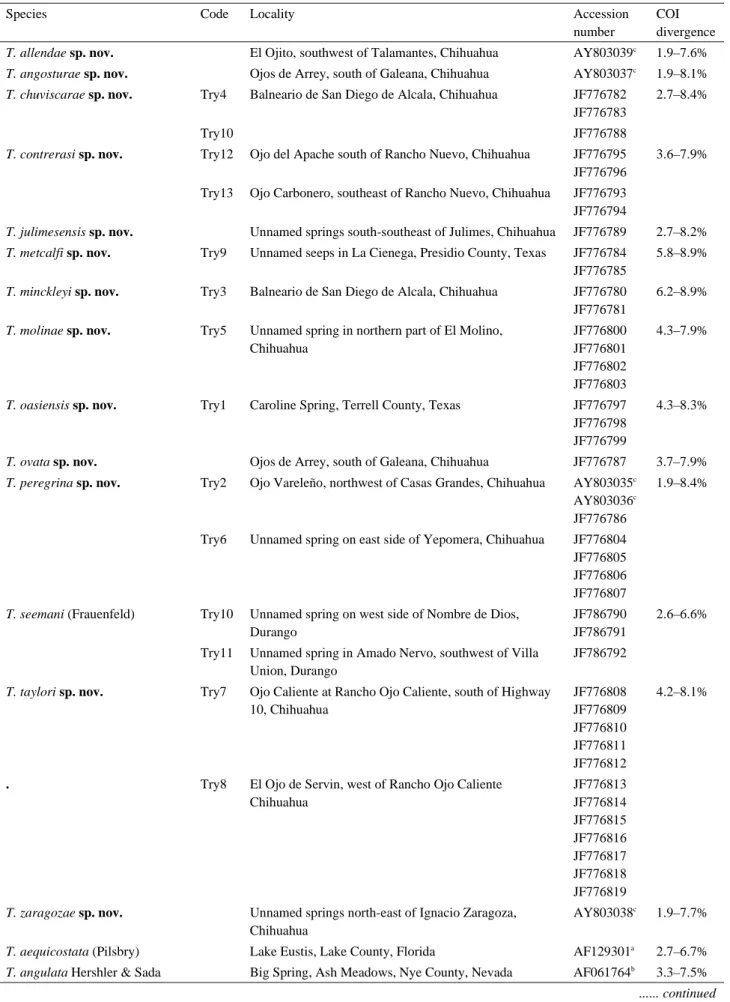
Genomic DNA was extracted from entire snails using a CTAB protocol (Bucklin 1992). A 658-bp segment of cytochrome c oxidase subunit I (COI) was amplified and sequenced with primers LCO1490 and HCOI2198 (Fol- mer et al. 1994) following the protocols of Liu et al. (2003). Sequences were determined for both strands and then edited and aligned using Sequencher™ version 4.10. We sequenced one to seven specimens from each sample of the species treated herein. In preliminary molecular phylogenetic analyses that included a large number of coch- liopid taxa the new sequences were consistently nested within a Tryonia + Minckleyella clade that in turn was sister to Mexipyrgus. The final analysis thus included only the species reported herein, all other species of Tryonia for which mtCOI sequences were available (16 of 19 species), and Minckleyella balnearis Hershler et al., 2011. Note that we recognize anatomically divergent Minckleyella as distinct from Tryonia because it was positioned outside of the Tryonia clade in a subset of recently published molecular phylogenetic analyses (Hershler et al. 2011). A tax- onomic resolution of Tryonia is beyond the scope of this paper. Mexipyrgus carranzae Taylor, 1966 was used as the outgroup. Sample information, GenBank accession numbers, and ranges of pairwise COI sequence divergence for Tryonia species are in Table 1.
FIGURE 1. Map showing the distribution of Tryonia species in the Chihuahuan Desert. 1. Tryonia hertleini, Las Palomas. 2. Tryonia peregrina sp. nov., Ojo Vareleño, northwest of Casas Grandes. 3. Tryonia peregrina sp. nov., Yepomera. 4. Tryonia zaragozae sp.
nov., northeast of Ignacio Zaragoza. 5. Tryonia angostura sp. nov., T. ovata sp. nov., south of Galeana. 6. Tryonia molinae sp. nov., El Molino. 7. Tryonia taylori sp. nov., vicinity of Rancho Ojo Caliente. 8. Tryonia contrerasi sp. nov., vicinity of Rancho Nuevo. 9. Tryo- nia chuviscarae sp. nov., T. minckleyi sp. nov., Balneario de San Diego de Alcala. 10. Tryonia julimesensis sp. nov., south of Julimes.
11. Tryonia allendae sp. nov., southwest of Talamantes. 12. Tryonia metcalfi sp. nov., La Cienega, south of Candelaria. 13. Tryonia oasiensis sp. nov., Caroline Spring, Oasis Ranch. 14. Tryonia cheatumi, Phantom Lake Spring. 15. Tryonia circumstriata, Diamond Y Draw. 16. Tryonia seemani, Ojo de Agua del Obispo, Durango City. 17. Tryonia seemani, Nombre de Dios. 18. Tryonia seemani, Amado Nervo.
TABLE 1. Specimen codes, localities, and GenBank accession numbers. aHershler et al. 1999a; bHershler et al. 1999b; cHershler et al.
2005; dHershler et al. 2011. COI divergence: pairwise sequence divergence among Tryonia species.
Species Code Locality Accession
number
COI divergence T. allendae sp. nov. El Ojito, southwest of Talamantes, Chihuahua AY803039c 1.9–7.6%
T. angosturae sp. nov. Ojos de Arrey, south of Galeana, Chihuahua AY803037c 1.9–8.1%
T. chuviscarae sp. nov. Try4 Balneario de San Diego de Alcala, Chihuahua JF776782 JF776783
2.7–8.4%
Try10 JF776788
T. contrerasi sp. nov. Try12 Ojo del Apache south of Rancho Nuevo, Chihuahua JF776795 JF776796
3.6–7.9%
Try13 Ojo Carbonero, southeast of Rancho Nuevo, Chihuahua JF776793 JF776794
T. julimesensis sp. nov. Unnamed springs south-southeast of Julimes, Chihuahua JF776789 2.7–8.2%
T. metcalfi sp. nov. Try9 Unnamed seeps in La Cienega, Presidio County, Texas JF776784 JF776785
5.8–8.9%
T. minckleyi sp. nov. Try3 Balneario de San Diego de Alcala, Chihuahua JF776780 JF776781
6.2–8.9%
T. molinae sp. nov. Try5 Unnamed spring in northern part of El Molino, Chihuahua
JF776800 JF776801 JF776802 JF776803
4.3–7.9%
T. oasiensis sp. nov. Try1 Caroline Spring, Terrell County, Texas JF776797 JF776798 JF776799
4.3–8.3%
T. ovata sp. nov. Ojos de Arrey, south of Galeana, Chihuahua JF776787 3.7–7.9%
T. peregrina sp. nov. Try2 Ojo Vareleño, northwest of Casas Grandes, Chihuahua AY803035c AY803036c JF776786
1.9–8.4%
Try6 Unnamed spring on east side of Yepomera, Chihuahua JF776804 JF776805 JF776806 JF776807 T. seemani (Frauenfeld) Try10 Unnamed spring on west side of Nombre de Dios,
Durango
JF786790 JF786791
2.6–6.6%
Try11 Unnamed spring in Amado Nervo, southwest of Villa Union, Durango
JF786792
T. taylori sp. nov. Try7 Ojo Caliente at Rancho Ojo Caliente, south of Highway 10, Chihuahua
JF776808 JF776809 JF776810 JF776811 JF776812
4.2–8.1%
. Try8 El Ojo de Servin, west of Rancho Ojo Caliente
Chihuahua
JF776813 JF776814 JF776815 JF776816 JF776817 JF776818 JF776819 T. zaragozae sp. nov. Unnamed springs north-east of Ignacio Zaragoza,
Chihuahua
AY803038c 1.9–7.7%
T. aequicostata (Pilsbry) Lake Eustis, Lake County, Florida AF129301a 2.7–6.7%
T. angulata Hershler & Sada Big Spring, Ash Meadows, Nye County, Nevada AF061764b 3.3–7.5%
... continued
Sequence divergences (uncorrected p distance) within and between species were calculated using MEGA4 (Tamura et al. 2007), with standard errors estimated by 1000 bootstrap replications with pairwise deletion of miss- ing data. Base compositional differences were first evaluated using the X2 test. MrModeltest 2.3 (Nylander 2004) was used to obtain an appropriate substitution model (using the Akaike Information Criterion) and parameter val- ues for the analyses. Phylogenetic relationships were inferred by Bayesian analysis using MrBayes 3.1.2 (Huelsen- beck & Ronquist 2001). Three short runs were first conducted using the default random tree option to determine when the log-likelihood sum reached a stable value (by plotting the log-likelihood scores of sample points against generation time). Metropolis-coupled Markov chain Monte Carlo simulations were then run with four chains using the model selected through MrModeltest for 1,000,000 generations, and Markov chains were sampled at intervals of 10 generations to obtain 100,000 sample points. At the end of the analysis, the average standard deviation of split frequencies was around 0.01, indicating that the runs had reached convergence. The sampled trees with branch lengths were used to generate a 50% majority rule consensus tree with the first 5000 trees, equal to 50,000 genera- tions, removed to ensure that the chain sampled on a stationary portion.
Series of large, adult females were used for shell measurements and illustrations, unless indicated otherwise.
Whorl counts refer to the entire shell. Sexual dimorphism in shells, which is commonly observed in Tryonia spe- cies (Taylor 1987), could not be quantified owing to the generally small sample sizes. Variation in the number of cusps on the radular teeth (n = 5 for each sample) was assessed using the method of Hershler et al. (2007). Other methods of morphological study and descriptive terminology are those of Taylor (1987), Hershler (2001) and Her- shler et al. (2002a). Shell data were analyzed using Systat for Windows 11.00.01 (SSI 2004). Bivariate (scatter) plots of pertinent shell ratios were also generated to help assess differentiation among congeners.
We used an evolutionary lineage concept in describing new species for those snails that are morphologically diagnosable as well as phylogenetically independent and substantially divergent genetically (Hershler et al. 2007).
Inasmuch as the principal goal of our paper is to delimit species, we have only provided brief taxonomic descrip- TABLE 1 (continued)
Species Code Locality Accession
number
COI divergence T. cheatumi (Pilsbry) Phantom Lake Spring outflow, Jeff Davis County, Texas AF129305a 4.4–7.4%
T. circumstriata (Leonard & Ho) Diamond Y Spring, Pecos County, Texas AF129306a 2.7–7.1%
T. clathrata Stimpson Warm Springs, Moapa Valley, Clark County, Nevada AF061767b 4.0–7.4%
T. elata Hershler & Sada Spring, Point of Rocks, Ash Meadows, Nye County, Nevada
AF061766b 2.3–7.9%
T. ericae Hershler & Sada North Scruggs Spring, Ash Meadows, Nye County, Nevada
AF061768b 2.3–7.3%
T. gilae Taylor Tom Niece Spring, Graham County, Arizona AF129309a 4.2–8.4%
T. imitator (Pilsbry) Moro Cojo Slough, Moss Landing, Monterey County, California
AF061770b 1.8–7.1%
T. margae Hershler Grapevine Springs, Death Valley, Inyo County, California
AF061771b 1.9–7.8%
T. monitorae Hershler Unnamed spring, Potts Ranch, Monitor Valley, Nye County, Nevada
AF129326a 1.9–7.8%
T. porrecta (Mighels) “Oasis Spring,” Salton Trough, Riverside County, California
AF061772b 4.9–7.7%
T. quitobaquitae Hershler Quitobaquito Spring, Pima County, Arizona AF129315a 3.7–7.9%
T. rowlandsi Hershler Grapevine Springs, Death Valley, Inyo County, California
AF061775b 3.8–6.5%
T. salina Hershler Unnamed spring, Cottonball Marsh, Death Valley, Inyo County, California
AF061776b 1.8–7.0%
T. variegata Hershler Devils Hole, Ash Meadows, Nye County, Nevada AF061778b 2.9–8.2%
Mexipyrgus carranzae Taylor Mojarral West Laguna, Cuatro Cienegas basin, Coahuila AF129325a Minckleyella balnearis Hershler
et al.
1 Ojo de Dolores, southwest of Jimenez, Chihuahua HM149773d
2 HM149774d
tions which focus on those aspects of morphology that have proven most useful in previous such studies of Tryonia (Taylor 1987, Hershler 2001). Internal anatomy was studied only to determine whether the species treated herein conform to Tryonia as currently diagnosed (Hershler 2001).
Results
Molecular analysis
Forty specimens were sequenced. New sequences were deposited in GenBank under accession numbers JF776780–JF776819 (Table 1). A total of 658 bp of COI was analyzed, of which 201 sites (35%) were variable and 156 (23.7%) were parsimony-informative. Average base frequencies were 24.8% A, 39.4% T, 17.3% C, 18.5% G.
There was no significant base frequency bias among species (X2 = 28.2, df = 189, P = 1.00).
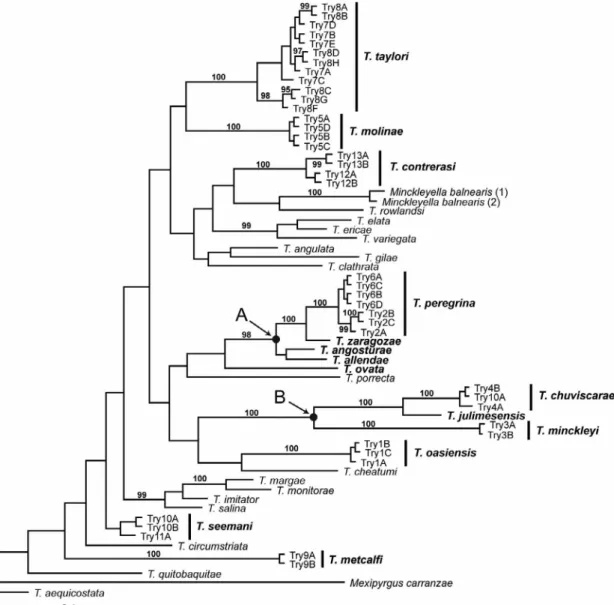
MrModeltest selected the GTR + I + G model as the best fit for the dataset using the Akaike Information Crite- rion. The optimized parameters were A=0.2762, C=0.1474, G=0.1570, T=0.4194; Rmat = {0.3012 23.5625 0.1124 3.0489 15.2104}; shape of gamma distribution = 1.2379; and proportion of invariable sites = 0.6132. The new sequences reported herein formed 14 genetically differentiated (COI divergence > 1.9%) and morphologically diagnosable lineages in the Bayesian tree (Fig. 2), only one of which can be referred to a previously described spe-
FIGURE 2. Bayesian tree based on the COI dataset. Posterior probabilities are provided when >95%. The names of the species treated herein are in bold face. Terminals and specimen codes are labeled as in Table 1. The two well supported clades composed of new spe- cies described herein are labeled A–B.
cies (T. seemani). The other 13 lineages are described below as new species. Two lineages containing novelties described herein were strongly supported in the Bayesian tree: one contains four species that are distributed in sev- eral drainages in Chihuahua (Fig. 2, clade A), the other (clade B) contains three species from the Río Conchos basin (also in Chihuahua). The relationships of the other six new species (and T. seemani) were not well resolved.
Systematics
Family Cochliopidae Tryon, 1866 Genus Tryonia Stimpson, 1865
Type Species: Tryonia clathrata Stimpson, 1865 (by original designation).
Diagnosis: (From Hershler 2001: 3)
The new species described below are referred to Tryonia on the basis of the insertion of the posterior vas deferens into the postero-dorsal edge of the prostate gland and details of female reproductive anatomy (young brooded in thin-walled albumen gland, bursa copulatrix and seminal receptacle present, sperm duct coiled and opening to bur- sal duct behind pallial wall; e.g., T. peregrina, described below, Fig. 3). They also closely conform to the genus in all other respects.
Tryonia peregrina sp. nov.
(Figs 3, 4A–D, H–I, M–O, 5A)
Tryonia sp.—Williams et al. 1985: 50 (reference to Yepomera populations).
Tryonia n. sp. 1.—Hershler et al. 2005: 1757 (COI sequences).
Types. Holotype, USNM 874032, Ojo Vareleño, 2.4 km northwest of Casas Grandes, Chihuahua, 30º24'1.95" N, 107º59'7.8" W, leg. J.J.L. and P. Hines, 16/ix/1990. Paratypes (from same lot), USNM 1153677.
Etymology. The species name is derived from the Latin adjective peregrinus, meaning wandering, and refers to the distribution of this species in the Río Casas Grandes (interior) and Río Papigochic (Pacific) drainages.
Referred material. CHIHUAHUA. USNM 892114, topotypes, leg. R.H and J.J.L., 6/xii/1998. USNM 873288, USNM 873299, spring on east side of Yepomera, 29º3'19.55" N, 107º50'33.82" W, leg. J.J.L., 15/iv/1973.
USNM 1138233, ibid., leg. J.J.L., 11/iii/2010. USNM 873197, spring on west side of creek in northwest part of Yepomera, 29º3'55" N, 107º51'29" W (estimated), leg. J.J.L., 10/xi/1980. USNM 873269, spring run at Rancho El Ojito, 29º3'58" N, 107º51'13" W (estimated), leg. J.J.L., 16/iv/1973.
Diagnosis. Shell medium-sized, conic; penis having two distal papillae on the inner edge and a basal papilla both on the inner and outer edges. Differs from T. zaragozae (described next), which is the only other congener that is distributed in the Río Casas Grandes or Río Papigochic drainages, in its more convex and weaker sculptured tele- oconch whorls, more rounded adapical end of the shell aperture, umbilicate shell, and smooth inner side of opercu- lum. Differs from T. hertleini (Drake, 1956), an apparently extinct species (Hershler 2001) which was distributed near the terminus of the Río Casas Grandes drainage (Fig. 1, locality 1), in its larger size (4.08 vs. 3.08 mm mean shell height, t-test, t=-5.916, df = 8.3, P<0.01; n=5 for T. hertleini), larger size and number of cusps on the inner marginal radular teeth, smaller basal papilla on the inner edge of the penis, and in having a papilla on the outer edge of the penis.
Description. Shell (Fig. 4A–D) up to 5.9 mm tall, large females having 4.75–7.5 whorls, spire height 150–200% width of shell, male shells smaller than those of females. Teleoconch whorls medium to highly convex, evenly rounded with impressed sutures. Aperture usually rounded, sometimes weakly angled adapically. Parietal lip complete, adnate or slightly disjunct, umbilicus narrow. Outer lip usually orthocline, sometimes weakly opist- hocline, sometimes weakly sinuate. Sculpture of strong growth lines and weak spiral threads. Periostracum dark brown.
Shell measurements (mean in parentheses): height 3.45–4.80 mm (4.08), width 1.56–1.90 mm (1.71), body whorl height 1.83–2.29 mm (2.06), body whorl width 1.46–1.82 mm (1.64), aperture height 1.06–1.29 mm (1.18), aperture width 0.86–1.06 mm (0.94), total number of whorls 5.75–6.50 (6.12) (USNM 1153677, n = 13).
FIGURE 3. Tryonia peregrina sp. nov. A. Prostate gland (viewed from left side), USNM 1153677. B–C. Female brood pouch and associated structures (B, viewed from left side, embryos not shown; C, close-up of sperm pouches and associated ducts), USNM 1153677. Scale bars A = 250 µm, B–C = 500 µm. Ag = albumen gland, Avd = anterior section of vas deferens, Bp = brood pouch, Bu
= bursa copulatrix, Cov = coiled oviduct, Pvd = posterior section of vas deferens, Pw = posterior wall of pallial cavity; Sdu, sperm duct; Sr, seminal receptacle; St, sperm tube.
Measurements of holotype: height 3.94 mm, width 1.57 mm, body whorl height 1.96 mm, body whorl width1.51 mm, aperture height 0.92 mm, aperture width 0.40 mm, 6.25 whorls.
Inner and outer sides of operculum smooth (Fig. 4H-I). Radula (Fig. 4M-O): dorsal edge of central teeth con- cave, basal tongue rounded or V-shaped, median cusps elongate, distally pointed, parallel-sided proximally, lateral cusps four–six, basal cusps one–three, usually two (innermost larger; Fig. 4N). Lateral teeth having two–three cusps on inner and four–five cusps on outer side, length of outer wing about 200% width of cutting edge, central cusp pointed or hoe-shaped (Fig. 4O). Inner marginal teeth with 21–33 cusps, outer marginal teeth with 29–42 cusps. Radula data are from USNM 873288, USNM 1153677.
Animal darkly pigmented. Penis (Fig. 5A) having two distal and one basal papillae on inner edge and a slightly enlarged basal papilla on outer edge (40 of 46 specimens from two samples); one specimen differed in having a sin- gle distal papilla on inner edge, one specimen had three distal papillae along the inner edge, and three specimens lacked a papilla on the outer edge. Basal papilla along inner edge often small. Distal bulb of penis expanded later- ally on inner side, black; stylet small. Penial duct undulating along most of length. Penial data are from USNM 873299, USNM 1153677.
Distribution and habitat. Tryonia peregrina is distributed in a single locality in both the Río Casas Grandes and Río Papigochic drainages (Fig. 1, localities 2–3). The type locality, Ojo Vareleño, consists of numerous small springs that form a large cienega (Fig. 6A). Some of these springs have been developed for domestic water usage while others have been diverted into an earthen canal that courses southwest towards Casas Grandes. Tryonia pere- grina was found in intermediate elevation springs within the cienega (in detritus) and in the canal; snails were espe- cially abundant in the latter at a small ranch, Chulavista, about 1.0 km downflow from the spring sources. A Tryonia-like species, Eremopyrgus elegans Hershler et al., 2002b is distributed in the upper portion of this cienega (Hershler et al. 2002b). The water temperature of these habitats is about 27°C. Tryonia peregrina is also distributed in a large spring on the east side of Yepomera (Fig. 6B) that is referred to locally as El Ojo de Yepomera (Miller et al. 2005). In 1973 this snail was found in both the walled headspring (on rocks) and in the outflow (on rocks and on the bases of aquatic vegetation). The site was re-visited in 1998, when the headspring was being developed into a new domestic water system, and T. peregrina was not found. However, in 2010 it was abundant (in sand and aquatic vegetation) in the (19°C) outflow; the status of the population in the headspring, which has been trans- formed into a large pond, is uncertain. In 1973 T. peregrina was also found in a small (17°C) spring brook at Ran-
cho El Ojito on the north side of Yepomera, and in an oxbow cienega on the northwest side of the village. Snails were not found at these sites during several subsequent visits to the area; the spring at Rancho El Ojito was dry or capped when visited in 1998.
Remarks. Tryonia peregrina was delineated in the Bayesian analysis as a well supported lineage (Fig. 2). The two populations of this species are closely similar in all morphological details; their haplotypes differed by 0.17–0.5%.
Tryonia zaragozae sp. nov.
(Figs 4E–G, J–L, P–R, 5B)
Tryonia n. sp. 2.—Hershler et al. 2005: 1757 (COI sequence).
Types. Holotype, USNM 873286, springs ca. 4.8 km north-east of Ignacio Zaragoza along the south side of High- way 5, Chihuahua, 29º39'47.9" N, 107º44'25.8" W, leg. J.J.L. et al., 25/viii/1971. Paratypes (from same lot), USNM 873260, USNM 873289, USNM 874120, USNM 1153679.
Etymology. The species name is a geographic epithet referring to the nearby town of Ignacio Zaragoza.
Referred material. CHIHUAHUA. USNM 854942, topotypes, leg. R.H. and J.J.L., 8/xii/1998.
Diagnosis. Shell medium-sized, conic or turriform, apex usually eroded; penis having two distal papillae on inner edge and a basal papilla both on the inner and outer edges. Contrasted with T. peregrina above.
Description. Shell (Fig. 4E–G) up to 6.7 mm tall, whorls 6.5–8.75, spire height 150–200% width of shell, sex- ual dimorphism of shells not obvious. Teleoconch whorls weakly convex to almost flat, evenly rounded or, less fre- quently, narrowly shouldered, with adpressed sutures. Aperture sharply angled adapically, parietal lip usually incomplete, usually adnate when complete, rarely slightly disjunct, umbilicus absent. Outer lip thin, orthocline or weakly prosocline. Sculpture of strong growth lines and well developed spiral threads (Fig. 4L). Periostracum tan.
Shell measurements (mean in parentheses): height 3.85–4.65 mm (4.20), width 1.60–1.78 mm (1.69), body whorl height 2.10–2.41 mm (2.21), body whorl width 1.53–1.67 mm (1.60), aperture height 1.23–1.41 mm (1.31), aperture width 0.91–1.08 mm (0.99), total number of whorls 6.50–7.25 (6.78) (USNM 1153679, n = 15).
Measurements of holotype: height 4.39 mm, width 1.68 mm, body whorl height 2.30 mm, body whorl width 1.60 mm, aperture height 1.35 mm, aperture width 1.01 mm, 7.25 whorls.
Edges of last operculum whorl strongly frilled on outer side (Fig. 4J); muscle attachment scar margins some- what thickened on inner side of operculum (Fig. 4K). Radula (Fig. 4P-R): dorsal edge of central radular teeth con- cave, basal tongue rounded or V-shaped, median cusps elongate, distally pointed, parallel-sided proximally, lateral cusps five–six, basal cusps two–three (innermost larger) (Fig. 4Q). Lateral teeth having two–three cusps on inner and four–six cusps on outer side, length of outer wing 175–200% width of cutting edge, central cusp pointed (Fig.
4R). Inner marginal teeth with 24–35 cusps, outer marginal teeth with 30–40 cusps. Radula data are from USNM 1153679.
Animal darkly pigmented. Penis (Fig. 5B) having two distal papillae on inner edge and a basal papilla both on the inner and outer edges (30 of 30 specimens). Papilla on outer edge sometimes very small. Distal bulb of penis expanded laterally on inner side, lightly pigmented; stylet small. Penial duct undulating for most of length. Penial data are from USNM 1153679.
Distribution and habitat. Tryonia zaragozae is known only from its type locality, a large (ca. 0.01 km2) cien- ega and spring system (Fig. 6C) in the upper Río Casas Grandes drainage (Fig. 1, locality 4). Snails were collected (on gravel and on soft substrates) from several springs and bogs (29–30°C) within this cienega. This habit has been severely degraded by overgrazing in recent years, although one of the larger head springs is now fenced (first noted in 1998).
Tryonia ovata sp. nov.
(Figs 5C, 7A–B, F–G, J–L)
Types. Holotype, USNM 873264, Ojos de Arrey, western-most head spring, south of Galeana, Chihuahua, 30º3'28.3" N, 107º35'26.3" W, leg. J.J.L. et al., 25/viii/1971. Paratypes (from same lot), USNM 1153676.
FIGURE 4. Tryonia peregrina sp. nov. and Tryonia zaragozae sp. nov. A. Holotype, T. peregrina, USNM 874032. B–D. Shells, T.
peregrina, USNM 873288 (C and D are males). E. Holotype, T. zaragozae, USNM 873286. F–G. Male shells, T. zaragozae, USNM 874120. H–I. Operculum (outer, inner sides), T. peregrina, USNM 1153677. J–K. Operculum (outer, inner sides), T. zaragozae, USNM 1153679. L. Apical view of shell showing spiral sculpture on teleoconch, T. zaragozae, USNM 1153679. M. Portion of radular ribbon, T. peregrina, USNM 1153677. N. Central radular teeth, T. peregrina, USNM 1153677. O. Lateral tooth, T. peregrina, USNM 1153677. P. Portion of radular ribbon, T. zaragozae, USNM 1153679. Q. Central radular teeth, T. zaragozae, USNM 1153679. R. Lat- eral tooth, T. zaragozae, USNM 1153679. Scale bars A–G = 1.0 mm, H–L = 250 µm, M, P = 25 µm, N–O, Q–R = 10 µm.
FIGURE 5. Penes. A. T. peregrina sp. nov., USNM 1153677. B. T. zaragozae sp. nov., USNM 1153679. C. T. ovata sp. nov., USNM 1153676. D. T. angosturae sp. nov., USNM 874174. E. T. molinae sp. nov., USNM 1153674. F. T. contrerasi sp. nov., USNM 1153670. G. T. taylori sp. nov., USNM 874047. H. T. taylori sp. nov., USNM 873252. I. T. metcalfi sp. nov., USNM 1153672. J. T.
chuviscarae sp. nov., USNM 1001756. K. T. minckleyi sp. nov., USNM 1153673. L. T. julimesensis sp. nov., USNM 1153671. M. T.
allendae sp. nov., USNM 1153667. N. T. oasiensis sp. nov., USNM 1153675. O. T. seemani, USNM 874125. P. T. seemani, USNM 874123. Scale bars = 250 µm. Db = distal bulb, Pa = papilla, Pd = penial duct, St = stylet.
FIGURE 6. Photographs of habitats of species treated in this paper. A. Ojo Vareleño, Chihuahua, type locality of T. peregrina sp. nov.
(photograph taken on 16/ix/1990). B. Main spring in Yepomera, Chihuahua, T. peregrina habitat (18/ix/1990). C. Springs northeast of Ignacio Zaragoza, Chihuaua, type locality of T. zaragozae sp. nov. (8/xii/1998). D. Western-most head spring, Ojos de Arrey, Chihua- hua, type locality of T. angosturae sp. nov. and T. ovata sp. nov. (7/xii/1998). E. Spring in northern part of El Molino, Chihuahua, type locality of T. molinae sp. nov. (26/iv/2010). F. Ojo del Apache, Chihuahua, type locality of T. contrerasi sp. nov. (14/xii/1998). G. Ojo Carbonero, Chihuahua, T. contrerasi habitat (2/iv/1991). H. Outflow of Ojo Caliente, Chihuahua, type locality of T. taylori sp. nov. (7/
xii/1998). I–J. El Ojo de Servin, Chihuahua, T.taylori habitat (27-viii-1971, 7/xii/1998, respectively). K. Seeps in La Cienega, Texas, type locality of T. metcalfi sp. nov. (6/xii/2001). L–M. Balneario de San Diego de Alcala, Chihuahua, type locality of T. chuviscarae sp. nov. and T. minckleyi sp. nov. (4/xii/2001). N. Springs southeast of Julimes, Chihuahua, type locality of T. julimesensis sp. nov. (5/
iv/1991). O. El Ojito (outflow), southwest of Talamantes, Chihuahua, type locality of T. allendae sp. nov. (10/xii/1998). P. Caroline Spring, Oasis Ranch, Texas, type locality of T. oasiensis sp. nov. (30/iii/2009). Q. Spring in Nombre de Dios, Durango, T. seemani habitat (2/ix/1971). R. Spring in Amado Nervo, Durango, T. seemani habitat (7/iv/1991).
Referred material. CHIHUAHUA. USNM 854944, topotypes, leg. R.H. and J.J.L., 7/xii/1998. UTEP 977, Ojos de Arrey, ca. 6.4 km south of Galeana, opposite road to Ejido Horcon, leg. A. Metcalf and D.W. Taylor, 3/ix/
1969.
Etymology. The species name is an adjective referring to the broad shell of this snail.
Diagnosis. Shell medium-sized, ovate-conic, apex usually eroded; penis having two distal and one basal papil- lae on the inner edge. Distinguished from sympatric T. angosturae by its more convex teleoconch whorls, presence of a basal papilla on the inner edge of the penis and absence of a basal papilla on the outer edge of the penis.
Description. Shell (Fig. 7A–B) up to 3.9 mm tall, whorls 4.0–5.0, spire height 85–110% width of shell, sexual dimorphism of shells not obvious. Teleoconch whorls medium to highly convex, evenly rounded or narrowly shouldered, sutures deeply impressed. Aperture sometimes weakly angled adapically, parietal lip complete, usually adnate, rarely slightly disjunct, umbilicus narrow. Outer lip thin, orthocline or weakly prosocline. Sculpture of strong growth lines. Periostracum tan.
Shell measurements (mean in parentheses): height 2.71–3.06 mm (2.87), width 1.64–1.94 mm (1.74), body whorl height 1.83–2.11 mm (1.92), body whorl width 1.55–1.70 mm (1.61), aperture height 1.04–1.15 mm (1.10), aperture width 0.90–1.08 mm (0.96), total number of whorls 4.00–5.00 (4.45) (USNM 1153676, n = 5).
Measurements of holotype: height 2.89 mm, width 1.68 mm, body whorl height 1.92 mm, body whorl width 1.57 mm, aperture height 1.11 mm, aperture width 0.95 mm, 5.0 whorls.
Inner and outer sides of operculum smooth (Fig. 7F–G). Radula (Fig. 7J–L): dorsal edge of central radular teeth concave, basal tongue V-shaped, median cusps elongate, distally pointed, parallel-sided proximally, lateral cusps four–six, basal cusps two–three (innermost larger) (Fig. 7K). Lateral teeth having two–three cusps on inner and three–five cusps on outer side, length of outer wing about 200% width of cutting edge, central cusp pointed (Fig. 7L). Inner marginal teeth with 14–26 cusps, outer marginal teeth with 29–42 cusps. Radula data are from USNM 1153676.
Animal darkly pigmented. Penis (Fig. 5C) having two distal and one basal papillae on inner edge (29/30 speci- mens); one specimen differed in having a single distal papilla. Distal bulb of penis only slightly expanded laterally on inner side, lightly pigmented; stylet small. Penial duct near straight or undulating basally. Penial data are from USNM 1153676.
Distribution and habitat. Tryonia ovata is endemic to Ojos de Arrey, a large spring complex in the Río Santa Maria basin (interior drainage) (Fig. 1, locality 5) that is situated along the northern edge of a hill (Cerro Angos- tura). These springs have also been referred to as La Angostura and Ojo de los Reyes. Tryonia ovata and T. angos- turae (described next) snail were collected in the (southwestern) portion of the spring complex that has been developed for recreational purposes; there are several additional springs to the northeast that have not been sam- pled. Both species are found below the main headspring (Fig. 6D; also see Miller et al. 2005: plate 68) on Chara and Potamogeton and in soft sediments under submerged vegetation (26–27°C water temperature).
Tryonia angosturae sp. nov.
(Figs 5D, 7C–E, H–I, M–O)
Tryonia n. sp. 3.—Hershler et al. 2005: 1757 (COI sequence).
Types. Holotype, USNM 873259, Ojos de Arrey, western-most head spring, south of Galeana, Chihuahua, 30º3'28.3" N, 107º35'26.3" W, leg. J.J.L. et al., 25/viii/1971. Paratypes (from same lot), USNM 873261, USNM 873285, USNM 905267, USNM 1153668.
Etymology. The species name is a geographic epithet referring to a nearby village, La Angostura.
Referred material. CHIHUAHUA. USNM 873268, topotypes, leg. J.J.L., 14/iv/1973. USNM 874250, USNM 874174, ibid., leg. J.J.L. and P. Hines, 16/ix/1990. USNM 854943, ibid., leg. R.H. and J.J.L., 7/xii/1998.
USNM 873293, canal outflow from Ojos de Arrey at Hwy 10, 30º4'11" N, 107º36'15" W, leg. J.J.L., 25/viii/1971.
BellMNH 21128, Oja del Rey (sic), leg. D.W. Taylor, 3/ix/1969. BellMNH 21175, east Ojo del Rey (sic), northwest end of Cerro Angostura, leg. D.W. Taylor and A. Metcalf, 3/ix/1969. BellMNH 21174, Ojo del Torreon, northwest end of Cerro Angostura, leg. D.W. Taylor and A. Metcalf, 3/ix/1969.
FIGURE 7. Tryonia ovata sp. nov. and Tryonia angosturae sp. nov. A. Holotype, T. ovata, USNM 873264. B. Male shell, T. ovata, UTEP 977. C. Holotype, T. angosturae, USNM 873259. D–E. Shells, T. ovata, USNM 1153668 (E is a male). F–G. Operculum (outer, inner sides), T. ovata, USNM 1153676. H–I. Operculum (outer, inner sides), T. angosturae, USNM 1153688. J. Portion of radular rib- bon, T. ovata, USNM 1153676. K. Central radular teeth, T. ovata, USNM 1153676. L. Lateral and inner marginal teeth, T. ovata, USNM 1153676. M. Portion of radular ribbon, T. angosturae, USNM 1153688. N. Central radular teeth, T. angosturae, USNM 1153688. O. Lateral and inner marginal teeth, T. angosturae, USNM 115368. Scale bars A–E = 1.0 mm, F–I = 250 µm, J, M = 25 µm, K–L, M–O = 10 µm.
Diagnosis. Shell medium-sized, conic; penis having two distal papillae on the inner edge and a basal papilla on the outer edge. Contrasted with T. ovata above. Differentiated from other Río Santa Maria basin congeners by hav- ing a basal papilla on the outer edge of the penis.
Description. Shell (Fig. 7C–E) up to 4.9 mm tall, large females having 5.0–8.0 whorls, spire height 85–110%
width of shell, male shells smaller than those of females. Teleoconch whorls weak to medium convex, evenly rounded, sutures impressed. Aperture weakly angled adapically, parietal lip usually complete, usually adnate, rarely very slightly disjunct, umbilicus absent. Outer lip thin, weakly prosocline. Sculpture of strong growth lines.
Periostracum brown or tan.
Shell measurements (mean in parentheses): height 2.69–3.36 mm (3.01), width 1.16–1.38 mm (1.25), body whorl height 1.41–1.68 mm (1.55), body whorl width 1.13–1.45 mm (1.26), aperture height 0.76–0.89 mm (0.82), aperture width 0.65–0.82 mm (0.72), total number of whorls 5.25–6.75 (5.92) (USNM 1153668, n = 15).
Measurements of holotype: height 2.76 mm, width 1.25 mm, body whorl height 1.49 mm, body whorl width 1.19 mm, aperture height 0.82 mm, aperture width 0.68 mm, 5.75 whorls.
Edges of last 0.5 operculum whorl sometimes weakly frilled on outer side (Fig. 7H); inner side of operculum smooth (Fig. 7I). Radula (Fig. 7M–O): dorsal edge of central radular teeth weakly convex, basal tongue rounded V- shaped, median cusps distally pointed, parallel-sided proximally, lateral cusps four–six, basal cusps one–three (innermost larger) (Fig. 7N). Lateral teeth having two–three cusps on inner and three–four cusps on outer sides, length of outer wing about 180% width of cutting edge, central cusp pointed (Fig. 7O). Inner marginal teeth having 14–19 cusps, outer marginal teeth having 27–38 cusps. Radula data are from USNM 1153668.
Animal darkly pigmented. Penis (Fig. 5D) having two distal papillae on the inner edge and a basal papilla on the outer edge (all 36 specimens from three samples). Distal bulb of penis expanded laterally on inner side, dark brown; stylet small. Penial duct undulating along most of length. Penial data are from USNM 873293, USNM 874174, USNM 905267.
Distribution and habitat. Tryonia angostura is endemic to the type locality area in the Río Santa Maria basin (Fig. 1, locality 5). Habitat as for T. ovata (described above). Tryonia angostura has also been collected in the main spring canal (from Ojos de Arrey) at the Highway 10 crossing.
Tryonia molinae sp. nov.
(Figs 5E, 8A–C, G–H, K–M)
Types. Holotype, USNM 1139278, unnamed spring in northern part of El Molino, ca. 125 m east of Chihuahua Highway 15, Chihuahua, 29º12'11" N, 107º24'24" W, leg. J.J.L., 26/iv/2010. Paratypes (from same lot), USNM 1153674.
Etymology. A geographical epithet referring to El Molino.
Diagnosis. Shell medium-sized, elongate-conic; penis having two distal and one basal papillae on the inner edge. Differentiated from closely similar T. taylori (described below) by having a single basal papilla on the inner edge of the penis.
Description. Shell (Fig. 8A–C) up to 3.9 mm tall, large females having 4.75–6.25 whorls, spire height 133–167% width of shell, male shells smaller than those of females. Teleoconch whorls weak to medium convex, evenly rounded, with impressed sutures. Aperture weakly angled and sometimes slightly thickened adapically, parietal lip complete, sometimes thickened, adnate, umbilicus narrow. Outer lip orthocoline or weakly prosocline.
Sculpture of strong growth lines and weak spiral threads. Periostracum tan.
Shell measurements (mean in parentheses): height 2.84–3.92 mm (3.35), width 1.35–1.77 mm (1.54), body whorl height 1.70–2.04 mm (1.85), body whorl width 1.25–1.63 mm (1.44), aperture height 0.96–1.19 mm (1.06), aperture width 0.79–0.96 mm (0.87), total number of whorls 4.75–6.25 (5.73) (USNM 1153674, n = 10).
Measurements of holotype: height 3.26 mm, width 1.55 mm, body whorl height 1.90 mm, body whorl width 1.48 mm, aperture height 1.05 mm, aperture width 0.90 mm, 5.75 whorls.
Inner and outer sides of operculum smooth (Fig. 8G–H). Radula (Fig. 8K-M): dorsal edge of central radular teeth concave, basal tongue V-shaped, median cusps elongate, distally pointed or jagged-edged, parallel-sided proximally, lateral cusps four–seven, basal cusps two–three (innermost larger) (Fig. 8L). Lateral teeth having two–six cusps on inner and three–six cusps on outer side, length of outer wing 167–200% width of cutting edge,
central cusp pointed or jagged-edged (Fig. 8M). Inner marginal teeth with 19–31 cusps, outer marginal teeth with 27–35 cusps. Radula data are from USNM 1153674.
Animal darkly pigmented. Penis (Fig. 5E) having two distal and one basal papillae on the inner edge (30 of 30 specimens examined). Basal papilla often small, sometimes positioned ventrally near inner edge. Distal bulb of penis expanded laterally on inner side, lightly pigmented; stylet small. Penial duct nearly straight. Penial data are from USNM 1153674.
Distribution and habitat. Tryonia molinae is endemic to a single locality in the Río Santa Maria basin (Fig. 1, locality 6) that is locally known as “El Ojo.” The outflow of this thermal (28°C) spring is ponded by a small reten- tion dam and used for recreation (Fig. 6E). Snails were abundant on all substrates (including rocks, rootlets and algae) in the headspring and upper portion of the pool.
Remarks. Tryonia molinae was delineated as a well supported lineage in the Bayesian analysis (Fig. 2).
Tryonia contrerasi new species (Figs. 5F, 8D–F, I–J, N–P)
Types. Holotype, USNM 874121, Ojo del Apache, south of Rancho Nuevo, Chihuahua, 30º34'27" N, 106º54'27"
W, leg. J.J.L. and D. Wong, 2/iv/1991. Paratypes (from same lot), USNM 1153670.
Etymology. A patronym honoring Salvador Contreras-Balderas (Professor Emeritus, Department of Biology, Universidad Autonoma de Nuevo Leon, Monterrey, Mexico) for his dedicated efforts over many years to promote the conservation of Chihuahuan Desert aquatic biota.
Referred material. CHIHUAHUA. USNM 854951, topotypes, R.H. and J.J.L., 14/xii/1998. UTEP 881, ca. 4 km southwest of Hacienda Santo Domingo, leg. W. Strain, no date. USNM 854124, USNM 874124, USNM 874128, Ojo Carbonero, southeast of Rancho Nuevo, Chihuahua, 30º34'47.5" N, 106º52'26" W, leg. J.J.L. and D.
Wong, 2/iv/1991. USNM 854952, ibid., leg. R.H. and J.J.L., 14/xii/1998.
Diagnosis. Shell medium-to large-sized, conic, rather strongly sculptured; penis having two distal and one basal papillae on the inner edge. Distinguished from other regional congeners by its more strongly sculptured shell.
Further differentiated from conchologically similar T. molinae by its larger size (t-test for shell height, t = 8.892, df
= 8.892, P<0.01) and evenly rounded distal bulb of the penis; and from T. ovata, which has closely similar penial morphology, by its less convex teleoconch whorls, typically incomplete parietal lip and smaller umbilicus.
Description. Shell (Fig. 8D–F) up to 6.2 mm tall, large females having 5.75–8.75 whorls, spire height 140–200% width of shell, male shells smaller than those of females. Teleoconch whorls weak to medium convex, evenly rounded with impressed sutures. Sculpture of widely spaced collabral riblets or cords and more numerous spiral threads or cords, sometimes resulting in a cancellate appearance. Aperture strongly angled adapically, pari- etal lip usually incomplete or a thin glaze across the parietal wall, rarely complete and adnate or slightly disjunct, umbilicus narrow or absent. Outer lip slightly orthocline or prosocline. Periostracum brown or tan.
Shell measurements (mean in parentheses): height 4.39–6.13 mm (4.92), width 1.85–2.25 mm (2.02), body whorl height 2.39–2.97 mm (2.62), body whorl width 1.71–2.09 mm (1.89), aperture height 1.42–1.71 mm (1.56), aperture width 1.08–1.26 mm (1.15), total number of whorls 5.75–7.75 (6.54) (USNM 1153670, n = 13).
Measurements of holotype: height 5.22 mm, width 2.21 mm, body whorl height 2.90 mm, body whorl width 2.03 mm, aperture height 1.69 mm, aperture width 1.27 mm, 6.5 whorls.
Edges of last 0.5 operculum whorl sometimes frilled on outer side (Fig. 8I), inner side of operculum smooth (Fig. 8J). Radula (Fig. 8N-P): dorsal edge of central radular teeth concave, basal tongue rounded, median cusps elongate, distally pointed, parallel-sided proximally, lateral cusps four–seven, basal cusps one–three (innermost larger) (Fig. 8O). Lateral teeth having two–four cusps on inner and three–five cusps on outer side, length of outer wing about 180% width of cutting edge, central cusp hoe-shaped (Fig. 8P). Inner marginal teeth with 16–25 cusps, outer marginal teeth with 30–40 cusps. Radula data are from USNM 874128, USNM 1153670.
Animal darkly pigmented. Penis (Fig. 5F) having two distal papillae and one basal papilla on inner edge (56 of 57 specimens from two samples); one specimen differed in lacking a basal papilla. Distal bulb of penis evenly rounded; stylet small. Penial duct weakly undulating along most of length. Penial data are from USNM 874128, USNM 1153670.
FIGURE 8. Tryonia molinae sp. nov. and Tryonia contrerasi sp. nov. A. Holotype, T. molinae, USNM 1139278. B–C. Shells, T. moli- nae, USNM 1153674 (C is a male). D. Holotype, T. contrerasi, USNM 874121. E–F. Shells, T. contrerasi, USNM 874128 (F is a male). G–H. Operculum (outer, inner sides), T. molinae, USNM 1153674. I–J. Operculum (outer, inner sides), T. contrerasi, USNM 1153670. K. Portion of radular ribbon, T. molinae, USNM 1153674. L. Central radular teeth, T. molinae, USNM 1153670. M. Lateral and inner marginal teeth, T. molinae, USNM 1153670. N. Portion of radular ribbon, T. contrerasi, USNM 1153670. Q. Central radular teeth, T. contrerasi, USNM 1153670. R. Lateral tooth, T. contrerasi, USNM 1153670. Scale bars A–F = 1.0 mm; G–J = 250 µm; K, N
= 25 µm, L–M, O–P = 10 µm.
Distribution and habitat. Tryonia contrerasi is distributed in two closely proximal (ca. 3 km) springs in the (endorheic) Bolson de los Muertos (Fig. 1, locality 8). These springs are part of a complex to the west of Villa Ahu- mada near Rancho Nuevo. All of these springs with the exception of Ojo Carbonero (referred to as Ojo Carbonera by Miller et al. 2005) have been highly modified. The type locality, Ojo del Apache, is a thermal spring (27°C) that has been severely degraded (trampled) by horses (Fig. 6F). Snails were found in this spring on aquatic vegetation.
Ojo Carbonero contains at least eight discrete sources that coalesce into a spring run for about 100 m (Fig. 6G) before flowing into a canal. Snails were common in this thermal (26–27°C) spring both in detritus and on sand.
UTEP 881, which consists of old, worn shells, may have been collected from a playa lake (Laguna Colorada) along the highway southwest of Hacienda Santo Domingo.
Remarks. Tryonia contrerasi was delineated in the Bayesian analysis as a well supported lineage (Fig. 2).
Snails from Ojo Carbonero (Fig. 8E–F) are slightly smaller and have more highly sculptured shells than those from the type locality (Fig. 8D); these two populations differed by 0.6% COI divergence.
Tryonia taylori sp. nov.
(Figs 5G–H, 9A–D, G–I, L–N)
Types: Holotype, USNM 873254, ouflow of Ojo Caliente at Rancho Ojo Caliente, south of Highway 10, Chihua- hua, 29º54'10.2" N, 107º15'27.1" W, leg. J.J.L. et al., 27/viii/1971. Paratypes (from same lot), USNM 1153678.
Etymology. A patronym honoring the late Dwight W. Taylor for his pioneering taxonomic studies of Tryonia (Taylor 1987).
Referred material. CHIHUAHUA. USNM 873251, topotypes, leg. J.J.L. et al., 27/viii/1971. USNM 874047, topotypes, leg. J.J.L. and P. Hines, 18/ix/1990. USNM 1135493, topotypes, R.H. and J.J.L., 7/xii/1998. USNM 873283, El Ojo de Servin, 5.6 km west of Rancho Ojo Caliente, 0.2 km north of Highway 10, 29º54'17.2" N, 107º18'27.2" W, leg. J.J.L., 14/iv/1973. USNM 873252, USNM 873297, ibid, leg. J.J.L. et al., 27/viii/1971. USNM 874050, ibid., leg. J.J.L., 18/ix/1990. USNM 892118, ibid., leg. R.H. and J.J.L., 7/xii/1998. UTEP 978, ibid., leg.
A. Metcalf and D.W. Taylor, 4/ix/1969. BellMNH 21172, BellMNH 21173, ibid., leg. D.W. Taylor and A. Metcalf, 4/ix/1969.
Diagnosis. Shell medium- to large-sized, conic or elongate-conic; penis having two distal papillae on inner edge and sometimes two–four basal papillae on inner edge and/or dorsal surface. Differentiated from closely simi- lar T. molinae above.
Description. Shell (Fig. 9A–D) up to 6.7 mm tall, whorls ca. 5.50–8.75, spire height 135–220% width of shell, male shells smaller than those of females. Teleoconch whorls usually weak to medium convex, rarely high convex, evenly rounded or weakly shouldered with impressed or adpressed sutures. Aperture weakly or sharply angled adapically, parietal lip usually complete, usually adnate, rarely slightly disjunct, umbilicus narrow or absent. Outer lip sometimes slightly thickened adapically, orthocline or weakly prosocline. Sculpture of strong growth lines and weak spiral threads. Periostracum tan.
Shell measurements (mean in parentheses): height 3.42–4.25 mm (3.74), width 1.54–1.84 mm (1.67), body whorl height 1.93–2.22 mm (2.09), body whorl width 1.46–1.73 mm (1.59), aperture height 1.03–1.33 mm (1.22), aperture width 0.89–1.09 mm (1.00), total number of whorls 5.50–6.50 (6.00) (USNM 1153678, n = 15).
Measurements of holotype: height 3.74 mm, width 1.59 mm, body whorl height 2.16 mm, body whorl width 1.55 mm, aperture height 1.24 mm, aperture width 1.01 mm, 6.0 whorls.
Outer side of operculum smooth (Fig. 9G) or with edges of last 0.5 whorl frilled; inner side of operculum nearly smooth (Fig 10H) or with edges of muscle attachment scar thickened (Fig. 9I). Radula (Fig. 9L-N): dorsal edge of central radular teeth concave, basal tongue rounded, median cusps elongate, distally pointed, lateral cusps four–seven, basal cusps one–three (innermost larger) (Fig. 9M). Lateral teeth having two–five cusps on inner and three–seven cusps on outer side, length of outer wing 160–200% width of cutting edge, central cusp pointed (Fig.
9N) or jagged-edged. Inner marginal teeth with 19–32 cusps, outer marginal teeth with 25–49 cusps. Radula data are from USNM 873283, USNM 1153678.
Animal darkly pigmented. Penis (Fig. 5G–H) usually having two distal papillae on inner edge (46 of 56 speci- mens from two samples), eight specimens differed in having three distal papillae and two differed in having a sin- gle distal papilla. Ojo Caliente specimens usually lacking basal penial papillae (25 of 27 specimens), one specimen
differed in having a basal papilla both on the inner and outer edges, one specimen differed in having two dorsally positioned basal papillae. Ojo de Servin specimens usually having two–three dorsally positioned basal penial papil- lae (27 of 29 specimens) and sometimes also having a basal papilla on the inner edge (12 of 29 specimens); one specimen had four dorsally positioned papillae and one specimen lacked basal papillae. Distal bulb of penis evenly rounded or expanded laterally on inner side, black; stylet small. Penial duct nearly straight to strongly undulating along most of length. Penial data are from USNM 873251, USNM 873252.
Distribution and habitat. Narrowly endemic in the Río Santa Maria drainage (Fig. 1, locality 7). The type locality (Ojo Caliente) is a thermal spring (36–39°C) that is enclosed in a bath house (Fig. 6H). Tryonia taylori was found on mud, rocks and aquatic vegetation in the outflow 5–6 meters below the bath house. We did not discern a marked change in this spring from 1971–1998. The second locality, El Ojo de Servin, is a warm spring complex (23–26°C) about 5 km west of Ojo Caliente. Tryonia taylori is extremely abundant on algae and Chara in the head- spring area and somewhat less common in shallow portions of the spring runs on mud. This formerly lush cienega (as observed in 1971, Fig. 6I) is now severely overgrazed (Fig. 6J).
Remarks. The two populations of T. taylori formed a strongly supported clade in the Bayesian tree (Fig. 2).
These populations differ in shell size (3.7 vs. 5.8 mm mean shell height, t-test, t = -13.811, df = 18.6, P<0.01, n=13 for the El Ojo de Servin sample), teleoconch whorl convexity, number of cusps on the outer marginal teeth, and the number and arrangement of basal papillae on the penis. However, they do not form reciprocally monophyletic clades in the Bayesian tree and their sequence divergence ranged from 0.3 to 1.7% (Table 2). We treat these mor- phologically distinctive populations as conspecific based on the evolutionary lineage concept used herein.
TABLE 2. Divergence of haplotypes detected in the Ojo Caliente (Try7) and Ojo de Servin (Try8) populations of T. taylori.
Tryonia metcalfi sp. nov.
(Figs 5I, 9E–F, J–K, O–Q)
Types. Holotype, USNM 1001931, unnamed seeps in La Cienega, ca. 0.8 km east of cemetery, Presidio County, Texas, 30º6'38.9" N, 104º40'21.1" W, leg. R.H. and J.J.L., 6/xii/2001. Paratypes (from same lot), USNM 1153672.
Etymology. A patronym honoring Art Metcalf (University of Texas at El Paso, now retired) for his many years of study of regional mollusks and for the unfailing encouragement and support that he provided to other such researchers.
Referred material. TEXAS. Presidio County. USNM 1151243, topotypes, J.J.L., 15/ii/2011.
Diagnosis. Shell medium-sized, ovate-conic; penis having two distal and two basal papillae on the inner edge.
Distinguished from Chihuahuan Desert congeners by the greatly enlarged size of the penial papillae relative to the penis. Further differentiated from lower Río Conchos basin congeners by having a basal papilla on the inner edge of the penis, and from Pecos River basin congeners by its larger penial stylet.
Try7A Try7B Try7C Try7D Try7E Try8A Try8B Try8C Try8D Try8F Try8G
Try7A
Try7B 0.000
Try7C 0.003 0.003
Try7D 0.000 0.000 0.003
Try7E 0.000 0.000 0.003 0.000
Try8A 0.003 0.003 0.006 0.003 0.003
Try8B 0.003 0.003 0.006 0.003 0.003 0.000
Try8C 0.017 0.017 0.017 0.017 0.017 0.020 0.020
Try8D 0.002 0.002 0.005 0.002 0.002 0.005 0.005 0.018
Try8F 0.014 0.014 0.014 0.014 0.014 0.017 0.017 0.003 0.015
Try8G 0.002 0.002 0.005 0.005 0.002 0.005 0.005 0.018 0.000 0.015
Try8H 0.015 0.015 0.015 0.015 0.015 0.018 0.018 0.002 0.017 0.002 0.017
FIGURE 9. Tryonia taylori sp. nov and T. metcalfi sp. nov. A. Holotype, T. taylori, USNM 873254. B. Male shell, T. taylori, USNM 1153678. C–D. Shells, T. taylori, USNM 873283 (D is a male). E. Holotype, T. metcalfi, USNM 1001931. F. Shell, T. metcalfi, USNM 1153672. G–I. Operculum (outer, inner, inner sides), T. taylori, USNM 1153678. J–K. Operculum (outer, inner sides), T. metcalfi, USNM 1153672. L. Portion of radular ribbon, T. taylori, USNM 1153678. M. Central radular teeth, T. taylori, USNM 1153678. N.
Lateral tooth, T. taylori, USNM 1153678. O. Portion of radular ribbon, T. metcalfi, USNM 1153672. P. Central radular teeth, T. met- calfi, USNM 1153672. Q. Lateral teeth, T. metcalfi, USNM 1153672. Scale bars A–F = 1.0 mm; G–K = 250 µm; L, O = 25 µm, M–N, P–Q = 10 µm.
Description. Shell (Fig. 9E–F) up to 2.6 mm tall, large females having 4.5–5.0 whorls, spire height 100–130%
width of shell, sexual dimorphism of shells not obvious. Teleoconch whorls medium convex, shouldered, sutures impressed. Aperture ovate, inner lip complete, slightly thickened, adnate or disjunct, umbilicus narrow or absent.
Outer lip thin, orthocline. Sculpture of strong growth lines. Periostracum tan, usually absent owing to erosion of shell surface.
Shell measurements (mean in parentheses): height 1.99–2.62 mm (2.24), width 1.08–1.34 mm (1.19), body whorl height 1.34–1.66 mm (1.51), body whorl width 0.99–1.27 mm (1.12), aperture height 0.77–0.97 mm (0.87), aperture width 0.67–0.80 mm (0.73), total number of whorls 4.50–5.00 (4.78) (USNM 1153672, n = 10).
Measurements of holotype: height 2.27 mm, width 1.17 mm, body whorl height 1.52 mm, body whorl width 1.12 mm, aperture height 0.89 mm, aperture width 0.73 mm, 4.75 whorls.
Inner and outer sides of operculum smooth (Fig. 9J–K). Radula (Fig. 9O–Q): dorsal edge of central radular teeth strongly concave, basal tongue V-shaped, median cusps distally pointed, parallel-sided proximally, lateral cusps five–seven, basal cusps one–two (innermost larger) (Fig. 9P). Lateral teeth having four–six cusps both on the inner and outer sides, length of outer wing about 160% width of cutting edge, central cusp pointed (Fig. 9Q). Inner marginal teeth having 24–28 cusps, outer marginal teeth having 26–32 cusps. Radula data are from USNM 1153672.
Animal darkly pigmented. Penis (Fig. 5I) having two distal and two basal papillae on the inner edge (30/30 specimens), the basal-most papilla is sometimes positioned partly on the dorsal surface. Distal bulb of penis expanded laterally on inner side, black; stylet large. Penial duct weakly undulating in medial section. Penial data are from USNM 1151243.
Distribution and habitat. Endemic to a single locality along the east side of the Rio Grande above the mouth of the Río Conchos (Figure 1, locality 12). This locality is a complex of small seeps that discharges into a broad arroyo (Fig 6K). Tryonia metcalfi was found on mud, decaying vegetation and on the undersides of rocks in 19°C water. This habitat has been heavily degraded by livestock.
Remarks. Tryonia metcalfi was delineated as a well supported lineage in the Bayesian tree (Fig. 2). This spe- cies was discovered coincidentally while searching for additional localities for Pyrgulopsis metcalfi (Taylor, 1987), which is distributed a little to the south of La Cienega (Taylor 1987).
Tryonia chuviscarae sp. nov.
(Figs 5J, 10A–C, F–G, J–L)
Types. Holotype, USNM 873270, Balneario de San Diego de Alcala, Chihuahua, 28º35'17.6" N, 105º32'50.8" W, leg. J.J.L. et al., 29/viii/1971. Paratypes (from same lot), USNM 873294, USNM 905265, 1153669.
Etymology. Epithet refers to the Río Chuviscar, which is close to the type locality of this species.
Referred material. CHIHUAHUA. USNM 854941, topotypes, leg. R.H. and J.J.L., 9/xii/1998. USNM 1001750, USNM 1001756, ibid., leg. R.H. and J.J.L., 4/xii/2001.
Diagnosis. Shell small, broadly- or ovate-conic; penis having two distal papillae on the inner edge and one–two basal papillae on the outer edge. Differentiated from sympatric T. minckleyi (described next) in its smaller shells (t-test for shell height, t = -10.699, df = 24.7, P<0.01), thickened inner lip of shell, larger umbilicus, more convex dorsal edge of central radular teeth, V-shaped basal tongue of central radular teeth, narrower central radular teeth, and square-shaped face of lateral teeth; and from conchologically similar and closely related T. julimesensis (described below) in its larger shells (t-test for shell height, t = -6.666, df = 23.8, P<0.01), in having basal papillae on the penis, and in having a larger number of cusps on the outer marginal radular teeth.
Description. Shell (Fig. 10A–C) up to 2.5 mm tall, large females having 3.75–5.00 whorls, spire height 75–95% width of shell, male shells smaller than those of females. Teleoconch whorls high convex, frequently shouldered, sutures impressed, last 0.5 whorl sometimes loosened. Aperture usually rounded adapically, rarely weakly angled, inner lip complete, usually thickened, adnate or disjunct, umbilicus narrow or open. Outer lip thin, orthocline or prosocline, weakly sinuate. Sculpture of strong growth lines, weak spiral threads also sometimes pres- ent. Periostracum light tan or absent.
Shell measurements (mean in parentheses): height 1.80–2.17 mm (1.98), width 1.21–1.43 mm (1.31), body whorl height 1.36–1.61 mm (1.48), body whorl width 1.06–1.24 mm (1.15), aperture height 0.79–0.99 mm (0.88), aperture width 0.71–0.85 mm (0.77), total number of whorls 3.75–4.25 (4.13) (USNM 1001750, n = 12).
FIGURE 10. Tryonia chuviscarae sp. nov. and Tryonia minckleyi sp. nov. A. Holotype, T. chuviscarae, USNM 873270. B. Male shell, T. chuviscarae, USNM 1153669. C. Male shell, T. chuviscarae, USNM 1001750. D. Holotype, T. minckleyi, USNM 1001751. E.
Male shell, T. minckleyi, USNM 1153673. F–G. Operculum (outer, inner sides), T. chuviscarae, USNM 1001750. H–I. Operculum (outer, inner sides), T. minckleyi, USNM 1153673. J. Portion of radular ribbon, T. chuviscarae, USNM 001750. K. Central radular teeth, T. chuviscarae, USNM 1001750. L. Lateral and inner marginal teeth, T. chuviscarae, USNM 1001750. M. Portion of radular rib- bon, T. minckleyi, USNM 1153673. N. Central radular teeth, T. minckleyi, USNM 1153673. O. Lateral tooth, T. minckleyi, USNM 1153673. Scale bars A–E = 1.0 mm, F–I = 100 µm, J–O = 10 µm.