C H A P T E R 2
Types of Web Sites
In this chapter you will learn about:
The roles and responsibilities behind the development of
a Web site
The different types of sites that make up the Web, how
each differs from the other, and how marketers can take
advantage of each type of site
Within the interconnected tangle of links that makes up the Web, millions of sites vary from each other not just in how they are designed, but in their purpose. As you develop, program, and market Web sites, it is important to understand all of the diff erent types of sites, the audiences they hope to reach, and how marketers can use diff erent sites to build their brands.
The People Behind a Web Site
Before examining the diff erent types of sites on the Web, let’s take a quick look at the people behind a Web site. Th e cast of characters that come together to make a site come alive varies considerably depend- ing on the site. In the following sections, we will discuss the roles and responsibilities of the people often involved in the development of a Web site.
Owners
Th ese are the people who get the ball rolling. Th ey have the initial idea. Th ey own the company, and they organize the team of people who will come together to make the site happen. A successful site owner will wear many diff erent hats. Th ey are visionaries who have a clear idea of the type of site they want to build and the audience they want to reach. Th ey are strong negotiators who can arrange the best deal with venture capitalists and secure the necessary funding to get the site up and running. Th ey are good communicators, who can express their ideas clearly to the people who will put it all together.
Finally, successful Web site owners are strong motivators and manag- ers; they are able to assemble the best possible team and rally that team to do the best possible job developing the site.
Venture Capitalists
Most established businesses, like restaurants, retailers, and manufac- turers, use their marketing budget to develop their Web sites, which are used to support and supplement their core business. Web-based companies that do not have an offl ine component often do not have the necessary funds to hire the staff to program the site, purchase necessary inventory, or eff ectively market the site. Venture capitalists provide the monetary resources necessary for getting some of these sites going. Many people have exciting ideas for new sites, and there is strong competition for a fi nite amount of money. Venture capital- ists want to see a solid business plan for a site and will usually hold a series of investigative meetings with the company’s owners before they will make an investment.
36
Creative Directors
Th e creative director works with the site owner to understand the purpose of the site and identify any specifi c features required. Cre- ative directors then develop the vision for the site—the concept, look and feel, layout, mood, and message—before conveying that vision to other team members who will then execute it. Creative directors will usually develop a site schematic (see Figure 2-1), which is a diagram that establishes the navigational elements and organization of the site.
HOSTING SERVICES CASE STUDIES WHY
CHOOSE US SOLUTIONS
SERVICES ABOUT
CAREERS
Training RT Monitoring
Proactive Maint.
Help Desk Back-up Sys & Proc Sec. & Firewall Mgmt Disaster Rec. & Plan IT Asmt & Plannning
Network Design Network Admin Network Consulting Structured Cabling Network Installation Net Support Contract Network Fax Servers VOIP
Off-Site Back-up Network Relocation Network Security
Web Hosting E-mail Hosting
DSL Lines T1 Circuits-Lines T3 Circuits
NEWS SUPPORT CONTACT
BASIC SUPPORT
PRIVATE CLUBS NON-PROFIT
ORGS MEDICAL
OFFICES PROFESSIONAL
SERVICES
WHAT WE STAND FOR
IT Assessment and Planning
Network Solutions
Telephony Solutions
Video &
Surveillance Solutions
Disaster Recovery Solutions
Video Conferencing HOW TO
SELECT AN IT PROVIDER
MSF MFG/DIST
INTERNET &
CONNECT.
SERVICES HARDWARE &
SOFTWARE CONSULTATION NETWORK
SERVICE MANAGED
SERVICES
HELP DESK SUPPORT UNLIMITED
SUPPORT AFFILIATES &
PARTNERS HOME
Figure 2-1 A sample schematic. The schematic provides the blueprint for how the pages of a site will link to one another and how content will be distributed.
Account and Project Managers
Th e development of any Web site involves a lot of moving parts that need to work together. Account managers act as the central point of
37
contact for the entire team and manage the development process so that the fi nal site meets the required specifi cations and is completed on time. Account managers ensure that deadlines and benchmarks are met, individual site elements pass quality control standards, and progress reports, approvals, and opinions are communicated among the team members. If the site is particularly large, a broader team may be required. In that case, project managers will be assigned to specifi c projects within the development umbrella and will report their prog- ress back to the account manager.
Programmers
Programmers make the site happen. Th ey confer with the creative director to determine which creative visions are feasible, based on fi nancial and time constraints. Once the site needs have been estab- lished, the team of programmers determines the best programming languages to use (or how best to use the languages they know) to make the site come to life. Programmers also work closely with the account managers, who often do not understand the complexities of programming or the length of time needed to complete projects, in order to set appropriate deadlines. Programmers test the site for accuracy and functionality, warn of any potential problems with site development, and provide regular progress reports. It also falls to the programmers to determine how to adjust and alter the work they have already done when the site owner comes up with a new idea (as often happens with visionaries) and wants to make a radical, last minute change.
Graphic Designers
Graphic designers take the creative director’s vision and interpret it artistically. Using programs like Photoshop and Illustrator, they make sure that all elements of the site properly represent the com- pany for which the site is being developed (through careful use of colors, font treatments, and image styles). Graphic designers also produce the necessary graphics in the format requested by the site’s programmers. Most commonly these formats are either .GIF or .JPG, depending upon the need for transparency, color accuracy, photography or illustration, fi le size, and other factors. If the site is to include Flash elements, then a designer trained in Flash develop- ment will provide graphics, animations, and interactive features in the appropriate Flash format. Usually, graphic designers will have to work closely with the programmers to understand how the site will be developed (for instance, the cell dimensions within a table), so that 38
the designers can properly slice large graphics into the appropriate smaller segments.
Copywriters
Quality content is what makes a site interesting and informative.
Sometimes the most time-consuming and daunting task in develop- ing a new site is the creation of the content. Copywriters are assigned the responsibility of writing new and compelling content that will capture the audience’s interest and deliver an appropriate message.
Usually, copywriters work with either the site owner or the creative director to determine the content needs of the site. In addition, copy- writers partner with the graphic designers to balance the amount of copy to be written with the available space for copy. Th is partner- ship is important in order to avoid a potentially frustrating catch-22:
graphic designers are unable to design without knowing how much copy will be included, and copywriters are unsure how much copy to write without knowing how much space the graphic designer will allot for text.
Marketers
A site’s marketers are responsible for promoting the site and driving traffi c to it. How they go about this will largely be a function of the site’s target market, and available marketing budget. Th e strategies and tools available to marketers in their eff orts to drive Web site traf- fi c are reviewed in greater detail in Chapter 11.
Th e size, complexity, and budget of a site will help determine the team required for its development. Not all sites will require all of the people listed above. For smaller sites, the site owner may also act as the account manager, and the creative director may fulfi ll the respon- sibilities of the graphic designer. No matter how large the site and the team of people assembled to create it, the needs that all of these roles fulfi ll will have to be met.
Types of Web Sites
Different types of sites serve different purposes; each provides a unique opportunity to marketers. The type of Web site you build depends on the purpose of the site, the market you want to reach, and whether the site will be used to support an existing business or function as a business unto itself. In the following
39
sections, we will cover the primary types of site that currently exist on the Web.
Web Portals
A Web portal is a site that helps users locate information that is dis- persed throughout the Web; a portal presents and organizes informa- tion regarding other sites. Typically, this is done through a search engine, which is a program that allows users to fi nd documents based on keywords that they enter into a text fi eld. Th e portal will scour the Web for pages that include the desired keywords and, almost instan- taneously, present a list of relevant pages. Most portals do not divulge the specifi c weighting system used for compiling their search results or how sites are ranked. However, the indices are usually created using a variety of criteria, including information contained in the HTML code, such as the <title> and <meta> tags, copy found within the body of a site, the popularity (based on site traffi c) of a given site, and links to and from a site. A search can return thousands of pages of results containing millions of individual Web pages that include matches to the requested keywords. Because of this, a niche segment within the marketing industry has arisen that provides services to help compa- nies get their URL’s listed in the coveted “Top 10”—the fi rst ten results sent back by search engines (usually page one of the results).
In order to be categorized as a true Web portal, a site needs to pro- vide easy access to other sites—not just information about its own site. Google, for example, is the largest and most visited portal1, and each search for information results in the listing of sites from all corners of the Web. Online superstore Amazon would not count as a portal. Even though it has a powerful keyword-based search engine that visitors use to search for information, the results provided are links only to products that Amazon sells on its own site.
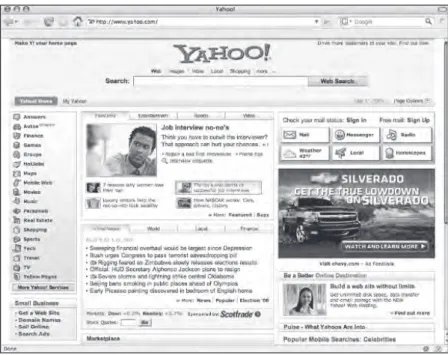
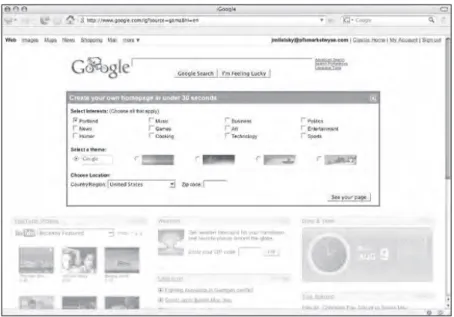
As the starting point for many Web users, portals have become more than just a means of fi nding information through search engines. Portals also serve as a one-stop resource for tools, informa- tion, and links. Some portals, such as Google, allow users to select the type of tools and information (if any) they would like to appear on the Home page of the site each time they return. Other portals, like Yahoo! and AOL, have a set off ering of tools and information like e-mail, headline news, stock tickers, product sales, popular videos, and more already built into their framework. Figure 2-2 shows how Google off ers the user numerous options for tools to include on a customized Home page, and Figure 2-3 shows the Yahoo Home page, which has a pre-set Home page with less user customization available.
40
Figure 2-3 The Yahoo Home page comes with pre-set information.
Figure 2-2 Google allows users to select the information they want to appear on their personalized Home page.
41
A standard Web portal collects and presents connections to other sites based on keyword matching or other links within its pages.
A distributed Web portal collects information from Web sites and other portals based on a central theme. SimplyHired.com (see Figure 2-4), for example, gives visitors the opportunity to search for jobs posted by companies and organizations across the Web through a keyword-based search engine. A search on the Simply- Hired site returns links to job postings on individual company sites and other online job search sites.
Figure 2-4 Simply Hired is a distributed Web portal that collects job listings from individual Web sites and other job search portals.
Niche portals are similar to distributed Web portals in that they focus on a specifi c topic. However, niche portals largely provide their own content and allow users to search both on and off the site for relevant information. Th ere are niche portals online for practi- cally any interest that is shared by enough people to support a site.
Figure 2-5 features ESPN.com, a niche portal for people interested in sports information.
Competition in the Web portal business has been fi erce from the early commercialization of the Web. A large percentage of the online population visits a portal on a regular basis. According to Alexa.com, a rating site for the Web, three of the top four most popular Web sites based on traffi c rates are portals as defi ned in this section.2 Th e revenue generated on portal sites can be immense (Yahoo reported 42
revenues of $6.4 billion in 2006), and acts as a strong lure for new entrants in the fi eld.3
B2B (Business to Business)
One of the most common types of Web sites is a B2B (business to business) site. B2B involves one business marketing and selling prod- ucts and services to other businesses. Many businesses generate their revenue solely by serving other businesses. Advertising agencies, for example, are not interested in reaching out to individual consumers.
To make their money, they need to catch the attention of business owners and marketing directors. Payroll administration companies, insurance providers, trucking companies, IT management fi rms, original equipment manufacturers, employee recognition providers, event managers—the list of businesses that sell goods and services to other businesses is lengthy.
B2B companies typically have a very limited audience that they need to reach, which can pose a signifi cant challenge. A company that provides payroll services, for example, might be able to serve a com- pany with tens of thousands of employees. However, only a few of those employees represent the target market—the handful that work Figure 2-5 ESPN.com is a niche portal specifi cally for sports-related topics such as major league and college level team information, scores, highlights, and commentary.
43
in the Human Resources department, in particular, the department director.
Because B2B sales are more relationship-based, and the sales cycle can be fairly long, B2B sites typically do not have e-commerce functionality. B2B companies tend to focus their Web resources on achieving the following goals:
• Reinforcing their brand name
• Establishing that they understand their clients’ “pain points”—the critical issues faced by potential clients in their particular industry and those faced by the decision-making individuals within those companies
• Proving that they can deliver the products and services necessary to ease the aforementioned pain
• Showing themselves to be leaders in their industry
• Moving potential visiting clients to take action by contacting a sales representative
In order to reach these goals, B2B companies focus on creating sites that will capture their audience, present information that makes the company seem established and capable, and encourage users to take further action by contacting a company representative. In developing their sites, B2B companies take many specifi c and deliberate eff orts, including:
• Utilizing copy and information more frequently than graphics and animation
• Using case studies and client testimonials to illustrate how their services can be benefi cial to potential clients
• Scheduling educational video Webcasts
• Authoring white papers (authoritative reports) on key industry topics and offering free downloads of those papers via their Web site
• Providing informational brochures in PDF format for easy downloading
• Developing a cyber newsroom that shows how the company has been improving, growing, and evolving (cyber newsrooms are discussed in greater detail in Chapter 11)
• Including an About Us section that details the biographies of key management to evoke trust in the experience and knowledge of the company’s leaders
44
• Off ering a password-protected area where clients can log in to review invoices, company fi les, time sheets, and other account information
• Presenting company contact information, including e-mail links and phone numbers, on an easily accessible contacts page Unfortunately, many B2B companies do not understand that while their clients are other companies, their target audience is made up of individual people in decision-making positions. In addition, many smaller B2B companies do not have the fi nancial resources to hire the right designers and programmers; therefore, B2B sites have tended to lag behind other sites in terms of aesthetics and development innovation.
CASE STUDY: ERC Dataplus
ERC Dataplus is a B2B company that understands how to build an eff ective B2B Web site. Located in Norwalk, CT, ERC was founded in 1993 by current CEO, Paul Rathblott, and Vice President of Marketing, Joel Pelzner. Since then, they have been providing technology to help companies manage their application and hiring process for both hourly and managerial employees—a process that can be time-consuming and frustrating for job seekers and employers alike.
ERC’s client base is made up of mid-to-large-sized companies that would benefi t from services that expedite the interviewing and hiring process. ERC targets the decision makers within the human resources department of prospective organizations in order to sell their services.
To reach this highly specifi c audience, ERC integrates online and offl ine strategies, including pay-per-click online ad placement, print and online banner advertising in key industry publication magazines and Web sites, and inclusion in vendor directories. Ultimately, ERC’s goal is to land an account through a personal interaction between a salesperson and a potential client. However, ERC’s frontline market- ing strategy is to drive human resources professionals to the ERC Web site for more information. “Th ere are over 100 competitors in our industry,” Pelzner explains, “By and large, most of the larger organizations that we would want as clients already have a technol- ogy solution such as ours in place, although not all of them are very happy with them. So there is change taking place. Once a company is committed to changing resources, the fi rst action they’ll take is to do research on who’s out there, who’s delivering the best price, per- formance, functionality, and so forth. And each time, that research begins on the Internet.”
45
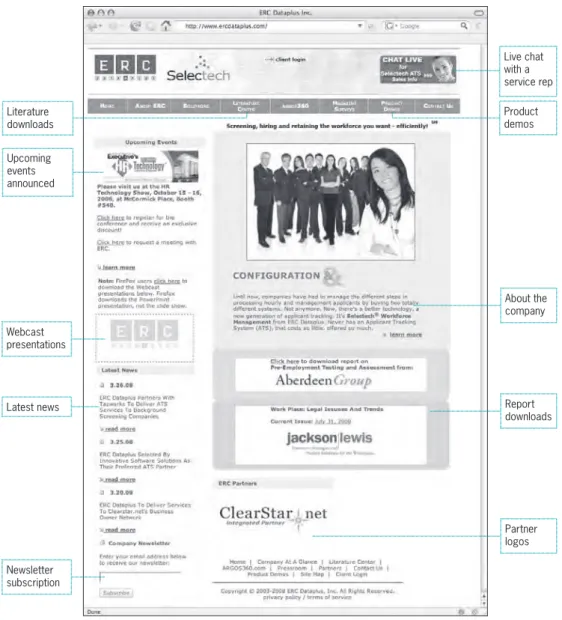
With that in mind, ERC has been careful to create a Web site that builds their brand and caters to a potential client’s need for informa- tion (as shown in Figure 2-6). ERC does not anticipate that potential clients will be heavy repeat visitors, so the company does its best to capture the audience and deliver key messages as eff ectively as pos- sible during each visit. To accomplish that, ERC included a variety of tools on the company’s Web site, including: live online chat with a sales representative, online product demos, regularly updated corporate news releases, announcements of upcoming events, an online literature
Figure 2-6 The ERC Home page, with important B2B features pointed out.
Literature downloads
Upcoming events announced
Webcast presentations
Newsletter subscription Latest news
Product demos Live chat with a service rep
About the company
Report downloads
Partner logos
46
library for brochure and white paper downloads, and an option to subscribe to a company newsletter. Each of these tactics is meant to promote ERC as a thought leader within their industry, establish the brand as experienced and capable, and encourage a prospective client to take the next step in retaining ERC’s services.
Because the Web site plays such a key role in ERC’s marketing strategy and sales cycle, they are careful to keep it updated regularly, not only for the benefi t of potential clients, but also for existing clients who visit the site to access account-related fi les through ERC’s client admin area.
As Pelzner explains, “We need to always make sure that the Web site stays fresh. Years ago, making content changes meant having to write everything in raw HTML, which is a rather laborious process. Now, with content management systems, the way the site’s been set up and organized, and with a number of the programming tools that we use, it becomes a lot easier to make those content changes. We don’t need extensive technology backgrounds, although we do have Web designers on staff who are in the process of redoing the entire site. I believe that it’s important to change the site every year and a half to two years, to keep up with the times, keep the site fresh, and refl ect some of the new content that’s been developed.”
As for many marketers, eff ectively communicating with the program- ming staff to create the ideal site has been an important and some- times challenging task for Pelzner. According to Pelzner, “the designers and I have to come up with a common language. Th ey can’t talk to me in code, and I can’t necessarily talk to them in non-technical terms.
We use a lot of graphics and sketches to explain to the programmers what we’re trying to achieve. We’ll lay out what we’d like the Web page to look like, fi ll in some headlines to indicate what the content for each page may be, and thereby illustrate what we’d like. We then ask the programmer for feedback about what they think will work. Th ere’s a lot of give and take, but the programmers have gotten a lot more famil- iar with marketing, which has proven to be a big help in terms of site development.”
B2C (Business to Consumer)
E-commerce, which is the nickname for “electronic commerce,” is the buying and selling of goods and services over electronic systems, most notably via the Web. While bank transfers of electronic funds and other types of exchanges technically fall under the e-commerce umbrella, e-commerce is commonly used to refer to purchases made via a Web site, and this is how the term will be used through- out this book.
47
While some B2B sites do have e-commerce capabilities on their site (companies that sell ink and print toner to other companies, for exam- ple, might utilize e-commerce functionality, as might distributors with a large catalog of products that they sell to retailers), e-commerce is most often used by companies who sell directly to the consumer. B2C (business to consumer) involves a business marketing and selling prod- ucts and services to a consumer.
In 2003, Amazon paved the way for a surge in e-commerce activity by posting their fi rst ever yearly profi t.4 One of the few survivors of the dot-com collapse, Amazon’s ability to get out of the red, even for just a year, proved that money could, in fact, be generated through e-commerce.
E-commerce has grown signifi cantly year after year, both in terms of total dollars generated and as a percentage of overall retail sales.
Shopping online has become so popular that one of the most popular shopping days of the year, Black Friday (the Friday following Th anks- giving), is now followed almost immediately by what is commonly called Cyber Monday (the Monday after Th anksgiving), when shop- pers fl ock to their computers to buy their Christmas gifts from their favorite Web stores. Very often, however, consumer brands fi nd that their e-commerce sites help boost revenue offl ine as well as online.
According to a 2006 study by ComScore, a leading Internet marketing research company, 63% of people who searched for and researched a specifi c product on the Web completed their purchase offl ine;
only 37% made their purchases online.5 A similar study by Forrester Research in April 2006, found that 22% of all offl ine sales are infl u- enced by the Web.6 As the line between cyber shopping and in-store shopping continues to blur, e-commerce has expanded beyond the confi nes of the Internet and has integrated itself with traditional offl ine retail channels.
B2C companies count on consumers executing relatively quick online transactions (the length of time it takes a buyer to make a decision is typically proportional to the price of the item being purchased. For example, it will take buyers longer to decide which car to purchase than to decide which bar of soap to buy.) Th erefore, B2C companies concentrate on the following goals when developing online sales and marketing strategies:
• Reinforcing their brand name
• Gaining a consumer’s trust
• Building consumer loyalty to the brand
• Showing that their product or service fi lls a consumer’s needs
• Diff erentiating their products or services from competing brands 48
• Making the decision-making process quick and easy
• Maximizing consumer dollars spent per purchase through add-ons
• Creating a pleasant overall shopping experience
• Providing quality customer service throughout the decision- making and purchasing process (this is usually a short-term interaction that ends upon completion of a given transaction, as opposed to the ongoing relationship necessary on the B2B side) Th at is a fairly extensive list, and a lot for one Web site to accomplish—
especially when targeting a consumer market that has many other options on the Web to choose from. To capture and keep their audi- ence, B2C companies need to present themselves in an engaging way, motivate users to move through the site in a particular direction, and ultimately compel them to buy. To reach these goals, B2C e-com- merce sites tend to do the following:
• Utilize images and product shots more frequently than long sec- tions of copy.
• Personalize the site as much as possible, so that when shoppers return, the site off ers them products they will be more likely to buy.
• Feature more popular products on the Home page where they are more likely catch the attention of a site visitor. (Many brick-and- mortar retailers, on the other hand, put the most sought-after products as far from the entrance as possible. In large super- markets, for example, milk and eggs, which are staple household products, are almost always stocked as far from the entrance as possible, ensuring that customers walk past as many other prod- ucts as possible on their way to get them. Because it is so easy for users to surf away from a site and shop at another, e-commerce sites do not have the luxury of making the more popular products harder to fi nd.)
• Off er a wide selection of products to choose from, easily searchable based on price, popularity, availability, and other related criteria.
• Build in functionality that allows customers to read and write product reviews.
• Off er links to related products based on the products a shopper is reviewing (suggesting light bulbs after a shopper has added a lamp to his or her shopping cart, for example).
• Provide shopping cart and check-out capabilities that make shop- ping and paying as easy as possible.
• Provide easy to understand and easy to implement product return policies.
49
As e-commerce continues to improve and grow, so do the features e-commerce sites off er their shoppers. Chapter 9 of this book will analyze the various features of a typical e-commerce site and how they add to and improve the shopping experience.
C2C (Consumer to Consumer)
Drive through a typical suburban neighborhood on a sunny weekend day and you are bound to pass a garage sale or two, where homeown- ers have put used items that they no longer want in their yard and driveway so that other people can purchase them. Th e people run- ning the garage sale aren’t doing so as a profi t-generating business.
Th ey are not turning their yard into a retail center in order to sell new products that they have bought at wholesale and marked up for profi t.
Th ey are consumers who have bought products and are now selling them to other consumers. Th e sellers benefi t from making a few bucks on products they no longer want, and the buyers benefi t from paying lower prices, rather than retail prices which include a mark-up.
Garage sales are examples of C2C (consumer to consumer) market- ing. C2C involves a consumer marketing and selling products and services directly to other consumers. Th e Web has its share of C2C- specifi c sites, and they are growing in popularity due to their poten- tial for cost-savings and the near limitless selection of products and services available.
eBay.com is one of the most well known C2C sites. eBay users auction everything including used socks, houses, CDs, and corn fl akes shaped like certain U.S. states. eBay takes a small commission for each sale and charges fees to make auctions more obvious, but beyond that there is little mark-up attached to products and services. Items are sold at the going rate. Because eBay is an auction site, products and services are sold to the highest bidder.
Another popular example is Cragslist.com (shown in Figure 2-7), which provides Web-based classifi ed ads. Users visiting Craigslist can open a section specifi cally targeted to their geographic area and search through posts generated by other users for products to buy, rooms to rent, small services off ered, and any one of a number of dif- ferent classifi ed categories. For the most part, posting ads is free (in some cities, Craigslist charges companies a nominal fee to post job off erings), so that consumers can easily connect with other users.
Th e drawback of C2C Web sites is that they rely in large part on the trust factor. Th ere is no brand or reputation to count on and no customer ser- vice number to call. If you buy something from someone on Craigslist, for example, there is no guarantee you are going to get what you paid for, and there is very little retribution if the transaction goes awry.
50
CASE STUDY: Turning a Red Paperclip into a House
Of the many classifi ed ad categories on Craigslist, one of the most pop- ular is the section called “Barter”—an area where people post items they would like to trade for something else.
To prove the power of C2C marketing, on July 12, 2005, Kyle McDonald launched a Web site called One Red Paperclip and posted a picture of a red paperclip in the Barter section of Craigslist, with the follow- ing copy:
Th is red paperclip is currently sitting on my desk next to my com- puter. I want to trade this paperclip with you for something bigger or better, maybe a pen, a spoon, or perhaps a boot.
If you promise to make the trade I will come and visit you, wherever you are, to trade.
So, if you have something bigger or better than a red paperclip to trade, email me.
Hope to trade with you soon!
Kyle
Figure 2-7 Craigslist is a popular C2C site that provides mostly free classifi ed ad postings, allowing consumers to sell to and interact with each other.
51
PS: I’m going to make a continuous chain of ‘up trades’ until I get a house. Or an island. Or a house on an island. You get the idea.
Kyle got a response, and ended up trading his red paperclip for a pen in the shape of a fi sh. From there, his string of trades (14 total), would take some astonishing turns, earning him a house and a place in the Guinness Book of Worlds Records for the biggest online trade:
• He traded the fi sh pen for a handmade, ceramic cabinet doorknob in the shape of E.T.
• He traded the doorknob to a guy who needed a knob for his stove top espresso maker in exchange for a Coleman stove.
• Th e Coleman stove was traded for a red generator, to a sergeant in the Marines who was driving across country and wanted to use the stove to cook along the way.
• Th e red generator was traded to a man in Queens, New York for an
“instant party” - a beer keg, a neon Budweiser sign, and an I.O.U.
for a keg’s worth of beer.
• Th e instant party was traded for a snowmobile. Th e snowmobile was owned by Michel Barrette, a radio talk show host in Quebec, Canada, who had heard of Kyle’s red paperclip project and announced the trade on his radio show. Suddenly, news outlets, including CNN, were covering the story.
• One of the news shows that covered the story was Th e Hour, a national TV program in Canada. Th e host asked Kyle if there was any place he wouldn’t go to make a trade. Kyle replied “I’ll go any- where, except Yahk, British Columbia.” Th e next day, a magazine located just outside of Yahk called and made an off er for the snow- mobile: roundtrip airfare for two from anywhere in North America to Cranbrook, British Columbia, a day of skiing, meals, and a snow- mobile trip to Yahk.
• Th e trip to Yahk was traded to a man who worked for the Cintas uniform company. In return for the trip, he gave Kyle a 1995 Ford Cintas Cube Van with over 200,000 miles on it.
• Th e van was traded for a recording contract that included 30 hours of recording time and transportation to and from Toronto, Canada from anywhere in the world, accommodations in Toronto, and the chance to have the fi nal recording pitched to executives at Sony- BMG and XM radio.
• Th e recording contract was bartered to aspiring musician Jody Gnant, for a year’s free rent in half of a furnished duplex in down- town Phoenix, Arizona, with roundtrip airfare for two from any- where in North America.
52
• Th e woman who lived in the other half of the Phoenix duplex got interested in the trade. She was an employee for Alice Cooper’s (the rock star) restaurant, and she arranged with her boss to trade an afternoon spent hanging out with Alice Cooper for the free rent for a year.
• Th e afternoon with Alice Cooper was traded for a motorized KISS snow globe.
• One of the biggest snow globe collections in the world is held by actor Corbin Bernsen, who got the snow globe in return for a paid, credited speaking role in an upcoming fi lm, room and board during fi lming, and roundtrip airfare to and from anywhere in the world.
• Finally, Kyle traded the movie role to the town of Kipling, Saskatch- ewan, which, among other things, gave him a key to the town, built the largest red paperclip on Earth, and, yes, gave him a house.
Th e power of C2C marketing!7
B2E (Business to Employee)
B2E (business to employee) marketing involves a business carry- ing out online initiatives to communicate with its employees. Many medium to large companies have B2E sites, which help facilitate internal communications and provide information to employees.
B2E sites can be used to provide a variety of resources and important information to employees, including:
• Important corporate announcements
• Access to employee information, such as benefi ts statement, 401(k) management, insurance information, etc.
• Special employee off ers (trips, products, etc.)
• Campaign information (companies often run internal campaigns to incentivize their employees to reach certain goals)
• Employee requests for supplies
• Online training
Social Networking
Social networking is the interaction of people from a variety of demographic groups and geographic locations via the Internet. At its heart, through blogging, Web site feedback, reviews, message boards, RSS, and other tools, the Internet has become one large,
53
ongoing conversation, with side topics being started and continued all the time. Th ink of it as a large party. Th e party itself is made up of a large group of people in attendance, all talking and engaging in conversation, meeting each other, exchanging ideas, debating, and so on. Th roughout the night, small groups of people band together to engage in a variety of side conversations, usually open to anyone who passes by. Each of these side conversations evolves as diff erent people enter and leave, moving from one group to another, perhaps taking the thoughts and opinions from a group on one side of the room and expressing them to a group on the other side of the room.
All of the tools that enable social networking fall under the umbrella term “social media,” and can be found throughout the Web. Product reviews left by customers on a shopping site, for example, constitute social networking through social media, as does a stand-alone blog, and reader comments on a news article.
Social media involves all of the tools that facilitate the online con- versation; however, the defi nition of a “social media site” is a site built specifi cally to facilitate a user’s personal expression and interac- tion with others—such as MySpace, Facebook, and My Yearbook.
Although diff erent business models exist for each social media site, advertising, rather than e-commerce, is the primary source of rev- enue. Social networking sites are based on the ability of users to communicate freely with friends, family and strangers. Th ese sites typically include blogging capabilities, photo, and video sharing options, message boards, chat rooms, and more. For marketers, the ability to reach users through social media networks creates a unique opportunity, both in increased awareness and perceived brand accep- tance on behalf of the target market.
Chapter 3 details the power of social media and social network- ing sites, how they work, and the ways in which marketers can take advantage of these tools and sites.
INTERVIEW WITH...
Anthony Lamme and Chad Hahn of Famzam.com Famzam.com is a rapidly growing social networking site that focuses on keeping family and friends connected (see Figure 2-8). Registered users spend their time on the site trading photographs, postings blog entries, sharing recipes, and more, allowing them to maintain rela- tionships in ways they never could before.
I have had the pleasure of being involved with the development and marketing of Famzam from its early stages, when CEO Anthony Lamme fi rst sat with me over sushi and talked to me about his idea.
54
In the true spirit of an entrepreneur, Anthony risked everything he had, selling his home to keep expenses down while pursuing his dream of launching his own company.
Famzam is now a major Web destination for friends and families, and Anthony and his partners have proven that marketing, ingenuity, and a little bit of risk can reap big rewards. I recently sat down with Anthony and his partner, Chad Hahn to discuss Famzam’s start-up, marketing strategies, and future goals.
Jason: Tell me what Famzam is and how you came up with the idea for the site.
Anthony: Famzam is a social connection site. We like to use the term “social connection” rather than the more mainstream “social networking” title that’s used for sites like Facebook and MySpace.
Th e diff erence is we’re really not about networking. Famzam is about connecting with your family members and your closest friends. Users aren’t going to Famzam to meet new friends—
they’re going to the site to connect with people closest to them.
Because we felt that this was an unfulfi lled need on the Internet, my two partners and I created what we feel is the best platform to meet that demand.
I came up with the idea for the site in 2006. Originally, Famzam was going to be a memorial site, where people could go to honor the memory of a deceased family member by creating a Web page for Figure 2-8 The Famzam Home page.
55
them, lighting a cyber memorial candle, and telling stories about their lives.
My two partners introduced me to the social network phenomenon, and the Famzam concept moved in that direction.
Jason: So the site has gone through a major evolution since the ini- tial concept. Walk me through the timeline and some of the other evolutions you went through prior to launch.
Anthony: We started building the site in June of 2006, and it took us about nine months to get a fi rst beta version up. Th e beta version was private and available only to our friends, family, and certain investing parties. It was a core prototype with just the connecting mechanism in place. Shortly after that, we included the ability to share photos and to blog. At this point, it was family connectivity only - no friend connec- tivity yet. People could “sneak” friends into their network, of course, by calling them a cousin or a brother, but at the time, maintaining a network of friends wasn’t really why the site was built.
After the beta version of the site was up, I went to an entrepreneur training program (which I strongly suggest any entrepreneur do).
With knowledge and resources I received at the program, along with the successful launch of Famzam as a beta test, I was able to secure funding. Th at funding allowed us to build out the site, including the ability to invite friends, as well as family, so that users have a cus- tomizable friend network and a customizable family network that are completely independent from one another. We also created a cal- endar to store family events and dates with an automatic reminder feature, a recipe-sharing section, in-network private messaging capa- bilities, and other features that would interest the target market.
Jason: And who is the target market?
Anthony: Our primary target market is young women who are Internet savvy and are using the Web every day to share photos and communicate with friends and family. Th ese women will be the catalyst for inviting those close to them to sign up with Famzam and spreading the word about our site virally.
Jason: What is the Famzam business model? What are your revenue streams?
Anthony: Every revenue stream is derived from something family- related. Th ere is advertising, of course, which we have strategically placed to maximize ad revenue, without getting in the way of a user’s enjoyment of the site.
In addition, we have a proprietary gift store where users can custom- ize products like mugs and blankets with their own photographs.
We also have Famzam Flowers, a proprietary fl ower store, and 56
connections with major retailers like Best Buy, Zales, and others for online purchases. But from a marketing perspective, having these stores isn’t enough. We have to compel the user to make a purchase.
Th at’s where the connectivity comes in. Let’s say that a registered user invites his or her mother to the site. Th e mom accepts the invitation and joins. Her birthday now appears on the calendar of the person who invites her, and it will show up on the calendar of everyone she adds into her network. So when her birthday is approaching, Famzam will alert her network and prompt them to send her a gift from one of the Famzam stores. We leverage the users’ information and relation- ships to create more personalized—and more eff ective—marketing.
Jason: In terms of programming, what languages went into building the site?
Chad: We used the Microsoft .NET platform—C#.NET, SQL Server 2005 database, IIS 6.0, Windows Server 2003. We also used the ASP.NET AJAX Control Toolkit for some of the rich UI features.
Jason: Can you describe a particularly diffi cult programming hurdle you encountered in the programming of the site, and explain how you overcame it?
Chad: Th e biggest programming challenge had to do with establish- ing the connection between family members and how the inverse relationship gets automatically established. For example, if you have a sister and you both invite your father, he is your “father.” But in the eyes of your father, the inverse relationship is tricky. In one case, you are his “son,” but in the other case, your sister is your father’s “daugh- ter.” Th e inverse relationship is gender dependent, and the software logic to correctly identify this was diffi cult to build. We got through it by pure sweat and perseverance. With programming, a lot of solu- tions are found through trial and error.
Jason: When you developed the site, how diffi cult was it for you to communicate with one another? Was there a marketer/programmer language barrier? If so, how did you overcome it?
Anthony: Th at’s a great question. It was actually pretty seamless.
Our other partner, Mark Murphy, is the graphic designer who cre- ated the look of Famzam, and he put me in touch with Chad origi- nally. Chad understood the importance of marketing as well as how to program a site—otherwise I don’t think it would have worked.
Th ere were fi ve stages of development that we used throughout the process:
• Th e fi rst phase is analysis. Th e three of us would talk about what we wanted to add, the diff erent features to be included, and we would map out schematics.
57
• Th e second phase was creating it. Mark would create the mock ups and the overall look and feel of the service.
• Th e third phase would be its analysis and development. Chad would develop the framework and outsource to India for the coding to be done.
• Th e fourth phase was to test the new service on a test server, get all the kinks out, and fi x the bugs. Th is was a joint eff ort among the three of us, and our community of about 200 sample testers who represented our potential audience.
• Th e fi nal phase was deployment; we launched that service to our existing clientele.
Jason: How do you drive traffi c to this site?
Anthony: We have a marketing agency that is helping us with our marketing and PR plan. Getting the name out through public rela- tions both online and offl ine has really helped raise the brand profi le and drive traffi c.
As far as marketing the site, we have a very multi-tiered approach.
As a social site, the viral nature of Famzam is the most eff ective mar- keting tool. We use other social networking tools like Facebook and MySpace to get the word out, and we stay active in the blogosphere.
We also use a pretty active Google AdWord strategy [a popular method of running pay-per-click ads on Google search pages and third party sites that feature Google ads.]
Most importantly, though, we continue to market to our strongest audience—the people who’ve already registered. Th ese people have already bought in and like the site, so we send them regular remind- ers through e-mail blasts to expand their network, invite more people, and visit the site often. Sometimes we use promotional tac- tics, like sending a Starbucks giftcard to users who sign on three new members. Too often, marketers assume that once you’ve captured an audience you no longer need to market to them, because they’ve already bought in. But it’s exactly the opposite—these are the people you need to market to the most, as they’ll be the best advocates for your brand.
Jason: What advice would you give to graduating students interest- ing in pursuing a career in Web development? What skills should they know in particular?
Chad: It’s most important to learn the software development life- cycle. Also, they need to be a generalist in terms of programming technologies but specialize in one thing—either back-end program- ming or Web programming, etc.
58
Jason: What’s the end goal for Famzam? What does the future hold?
Anthony: Simple. To be the largest family-based Internet portal in the world. And I believe that in three to fi ve years, we will be that.
Informational
Much like any other site category, the purpose of an informational site is to relate content to the users. Th e diff erence, however, is that informational sites do so as the primary reason for being, unlike a B2B site, which exists in order to generate new contacts and eventu- ally increase sales, or B2C sites, which primarily exist to generate Web-based sales.
Informational Web sites include a variety of sites, reaching any number of different markets. Maybe your school offers online classes, or an area for campus clubs to post upcoming meeting or event dates. These types of sites fall within the informational category, as do concert calendars posted by radio stations, online gossip magazines, movie review sites or general media sites.
Figures 2-9 through 2-11 provide screen shots of three different informational sites.
Figure 2-9 The New York Post Web site provides information on daily news events.
59
Some informational sites may be created by hobbyists, or launched simply to support a certain audience. A Web site established to announce campus club events, for instance, is set up by the college to support organized student activities—it is unlikely that this type of site is meant to generate revenue.
Figure 2-10 Rotten Tomatoes is a Web site that provides information about and reviews for current and upcoming movies.
Figure 2-11 WebMD provides users with on-demand medical information.
60
For larger, more commercial informational sites, the main revenue stream is advertising. Th e key to generating higher advertising reve- nue is to show as many ads as possible, which means that traffi c rates have to be high. In order to generate high traffi c rates, informational sites need to ensure that the information they provide is:
• Interesting to the market they are trying to reach—not just in terms of content, but also in the way the content is presented.
Copy writers must work hard to ensure that they produce copy in a voice that is specifi c to their readers.
• Updated on a regular basis. If long periods of time elapse between content updates, readers will be less likely to return. RSS feeds, discussed in Chapter 6, help alert the user when new content has been added to a site, so that they are more likely to return.
• Highlighted in a marketing campaign. In order to gain maximum exposure, developers of information-based sites need to do their own marketing to let their target audience know that their content exists.
Other revenue models for informational and educational sites include off ering paid subscriptions for more in-depth information and arti- cles. Th is is not a popular model, however, as it has proven diffi cult for subscription-based sites to fi nd an audience with so many free resources available on the Web.
Entertainment
Entertainment-specifi c sites have grown in popularity—a simple glance at the most-visited sites on the Web proves that. Users continue to fl ock to YouTube, while new and established sites race to cash in on the streaming-video craze. Traditional forms of entertainment such as TV and board games have steadily lost their audience, while online video and gaming sites have seen steady and impressive increases. Flash, a program developed by Adobe, has played a large role in the popularity of both online gaming and video sharing, as more developers turn to Flash for its vector-based, interactive capabilities for complex game creation, and its cross-platform near lossless technology for video compression.
Perhaps more than any other type of site, entertainment sites enjoy a particularly valuable quality: user retention per visit. In 2006, each YouTube visitor, for example, averaged nearly fi fteen 1/2 minutes per visit, according to the Pew Internet and American Life Project.8 Because videos and online games provide a potentially longer user experience (once started, users tend to watch a video or play a game to completion), entertainment sites are able to keep visitors locked in, feeding them more advertising and off ers to purchase products.
(Using fi fteen 1/2 minutes as an average retention time, a Web site that rotates a new display ad once every 30 seconds would feed 31
61
Keeping content fresh is one of the highest priorities for entertainment sites, as most videos and games lose their ability to entertain after the fi rst few times they have been watched or played. While user retention per visit might be higher than it is for many other types of sites, keeping users coming back to entertainment sites is more of a challenge. Much like an e-commerce site, which pitches its best products on its Home page, enter- tainment sites constantly need to seek out better ways to entertain and must frequently refresh their sites with new and exciting products.
Th e high user retention rates and increasing volume of traffi c to entertainment sites make them a potentially explosive platform on which marketers can gain visibility among a large audience of potential customers. While standard display and video commercial advertising on these sites has perhaps been the most popular means of leveraging entertainment sites, some marketers take more creative approaches. On video sharing sites like YouTube, for example, some brands have posted their own videos, in the hopes of capturing atten- tion (see Figure 2-12 and Figure 2-13).
Figure 2-12 Hewlett Packard posts instructional videos on YouTube that demonstrate the power of their product.
Gaming sites are increasingly off ering games that are either sponsored by a particular brand or created by them, with the product playing the central role. Figure 2-14 shows an example of how one national restau- rant chain has marketed itself by creating a game around their name and menu items. By such means, a company can create brand aware- ness subtly, but eff ectively, while entertaining users.
62
Figure 2-13 Another printer takes an entirely different approach. Pazazz Printing posted on YouTube this very funny and very popular video on how passionate they are about printing.
Figure 2-14 This game, which has been distributed through gaming sites for free online play, is centered on the menu of Denny’s, a national restaurant chain. Notice the accompanying banner ad for Denny’s at the top of the site.
63
INTERVIEW WITH...
John Vechey Online gaming has become a popular pastime for Internet users of all ages, as faster connections and more sophisti- cated programs allow for programmers to develop better games. It is a highly competitive industry, where game providers struggle to cap- ture the largest share of the game-playing audience—an audience that is notorious for getting bored easily and demanding new and better games.
Since 2000, one online game provider has executed a successful strat- egy, maintaining a strong position as one of the most highly visited gaming sites on the Web. PopCap Games, the brainchild of entrepre- neur John Vechey, continues to be one of the most popular game pro- viders (see Figure 2-15). Chances are that you’ve played at least one of PopCap’s games, which include such perennial titles as Bejeweled and Zuma. PopCap remains popular by using a surprising business model—while most game sites allow free online play, PopCap Games earns its revenue by selling games. I spoke with John to discover the how and why behind PopCap’s success.
Figure 2-15 The PopCap Games Home page.
Jason: What gave you the idea to start this site?
John: We started PopCap Games in 2000. At the time, the big thing in online gaming was multiplayer games, where people com- peted against other online players, but there were no real single 64
player games. So basically [my two partners and I] wanted to change that. Our original model was to create games and license them out, and because the games were going to be awesome, we were going to make a lot of money from the licensing fees. It didn’t really work out like that. What we eventually discovered was that we could draw an audience by creating an online version of a game that’s free to play and make a downloadable version with better art, better graphics, music and all that stuff , and then sell that. So we had this symbiotic relationship between a little Web game and a downloadable, deeper gaming experience.
Jason: A number of gaming sites off er games from a variety of devel- opers. Does PopCap do this as well?
John: We were distributing games made by other developers a while back, but eventually we decided to remove those games from the site because we realized that our audience really want PopCap games—
they want that PopCap experience. Every other gaming site off ers everyone else’s games—including ours. Th e fact that we only off er our own games is one of the main ways that we diff erentiate ourselves for our customers.
Jason: Tell me about your background—is it more in marketing or more in programming?
John: It’s more in starting companies. In college, I met a friend, Brian Fiete, and we were studying computer science, so I suggested we make a game. We created a downloadable Internet action game, and we put it out there in 1997. We got people to come and play it by talking it up in chat rooms and stuff like that—our early eff orts at marketing! Eventually the game got picked up by a company called the Toy Computer Network, which became ToGo. Th at’s where we met Jason Kapalka, who became our third partner in PopCap, which we started after holding down other jobs and learn- ing the trade. So my background includes a little of everything—
development, sales, marketing—but my main focus has always been on building the momentum of products or a company, which falls on the sales and marketing side.
Jason: What is the basic marketing strategy now? How do you drive traffi c to the site?
John: Well, the trick isn’t so much to drive traffi c to the site as it is to distribute games through as many places on the Internet as possible.
PopCap.com is just one place users can purchase and download our games. Our strategy has been to partner up with other companies and resources, like MSN, Yahoo, AOL—we work with everybody. It’s these partners that market our products for us, so we actually spend almost no money on marketing.
65
Jason: Demographically, who is the target audience that you are trying to reach?
John: We’re about 65% female on most of our channels. Th ey’re mostly a little bit older, over 35, and college educated.
Jason: And what’s the primary revenue stream?
John: Advertising on PopCap.com is a healthy revenue stream;
although, for us the majority is the downloadable sale of games.
Jason: How do you compete with sites like Bubblebox.com and AddictingGames.com that provide online play for free?
John: Having a better game experience. We’re careful to always have the best product on the market. Why is the iPod more suc- cessful than the countless other mp3 players, which have similar and sometimes more features than the iPod? It comes from the fact that iPod is better - it feels like a better product, you want to feel it, you want to touch it, and it’s gratifying. From a game standpoint, if you say that all games are commodities, then your question makes perfect sense, and users would play the games that are totally free and browser-based. But we off er a better experience, a richer, deeper experience that’s a lot more gratifying in the long run. For some people, the quality they get on a free site is good enough, but PopCap attracts customers who want a richer experience.
Jason: One of the things I’ve noticed on your site is a lack of popular social networking tools, like giving users the ability to review games.
Most other online games sites that I’ve seen have included these capa- bilities. It there any reason why you’ve stayed away from that?
John: As a company, our philosophy is to not add things unless we have a great idea for them, or there’s a real need. People come to PopCap.com to play games, right? So why add something to get in the way of that? Just to do it, because it’s kind of a neat thing? Th at’s not what we’re about. We want to give users what they came for, which is to play games. If a new feature won’t add to that experience, in a very direct way, it’s really not worth putting on.
Jason: As someone who has been highly successful with an Internet business for the better part of a decade, what do you think are some of the more important skill sets that graduating students need to know, if they want to build their career on the Web?
John: Simple: Getting things done. I’ve seen a lot of people that try to start companies, and they just wallow in this world of trying to make it work. Th ey have this big vision, but they don’t have the dis- cipline to get there. To be successful on the Web, or in any business, just get one thing done and move forward. And then get one more thing done and move forward. Th at’s what builds momentum.
66
Don’t try to be all things to all people, but try to be one thing for one seg- ment and do it really, really well. So many people fail because they are trying to create some giant thing like the next YouTube, or the next MyS- pace, and that prevents them from doing something simple. If you want to build something, keep it simple, get it out there, and then expand on it.
Chapter Summary
• Web sites don’t just appear out of thin air. A team of people, each with a diff erent skill set, comes together and puts the pieces in place to develop a new site. A wide range of talents is required to develop a successful site. Ideally, a Web development team will represent a mix of fi nancial, creative, programming, organiza- tional, and communication-based skill sets. Each site will require a diff erent blend of people and responsibilities, with larger and more complex sites naturally demanding greater resources of talent.
• Often, one of the most diffi cult hurdles to overcome in site develop- ment is the communication among team members who don’t neces- sarily understand the unique challenges specifi c to each role.
• Web sites fall into a variety of categories, including portals, B2B, B2C, e-commerce, social networking, informational, and enter- tainment sites. What each type of site does, how it is built, and the way it is presented to the user are largely dependent on the combi- nation of the human and fi nancial resources available, the general purpose of the site, and the target audience.
• Each type of site brings with it its own challenges and opportu- nities for building an audience and making inroads into a target market. Business to business sites, for example, may concentrate more on gaining the user’s trust and encouraging a potential client to make a phone call, download white papers and call for more information. E-commerce sites are more likely to try to encourage visitors to make an immediate purchase. Th e types of challenges a site might face will help determine how the site gets built and the team of people that are needed to build it.
Key Terms
B2B—Business to business. One business marketing and selling products and services to other businesses.
B2C—Business to consumer. A business marketing and selling product and services to general consumers, or end-users.
67
B2E—Business to employee. A business carrying out online initia- tives to send messages to their employees.
C2C—Consumer to consumer. A consumer marketing and selling products and services directly to other consumers.
distributed Web portal—A portal that collects information from Web sites and other portals based on a central theme.
e-commerce—Th e buying and selling of products and services via electronic systems, mostly often via the Web.
niche portal—A Web portal that focuses on a specifi c topic. Niche portals largely provide their own content and allow users to search both on and off the site for relevant information.
search engine—A program that allows users to fi nd documents based on keywords that they enter into a text fi eld.
site schematic—A diagram that establishes the navigational elements and organization of the site.
Web portal—A site that helps users locate information that is dis- persed throughout the Web and presents and organizes information regarding other sites.
Review Questions
1. For a large, Web-based company, who is most likely to provide the funding for the site’s development and marketing?
Creative director a.
Venture capitalist b.
Site employees c.
Account managers d.
2. Which of the following would a graphic designer be primarily responsible for?
Deciding which programming languages should be used a.
to build a site
Graphically interpreting the creative director’s vision b.
Developing the overall concept of the site c.
Organizing all of the information regarding the site devel- d.
opment and communicating it to the team 68
3. Which of the following would be mostly likely to require an account manager and project managers?
An e-commerce site for a large retail chain that sells shoes a.
and shoe accessories
A site for a local B2B company that off ers fi nancial plan- b.
ning services to small companies
A travel blog written by a world adventurer c.
A site that shows the best places to fi nd wildfl owers in d.
Massachusetts
4. Which of the following statements is false?
B2B companies typically have longer sales cycles than a.
B2C companies.
B2B Web sites tend to favor graphics over content.
b.
B2B sites often feature downloadable PDFs of brochures c.
and catalogs.
B2B sites often have online biographies of key management.
d.
5. Which of the following is not part of the ERC Dataplus site, as of the time of this writing?
Online product demos a.
Downloadable PDFs of brochures b.
Live chat with a sales rep c.
E-commerce functionality d.
6. According to 2006 data, what percentage of shoppers who searched for a product online actually fi nished their purchase offl ine?
24%
a.
78%
b.
63%
c.
11%
d.
7. A site that is used as the starting point to fi nd other sites is called a(n):
B2B site a.
E-commerce site b.
69