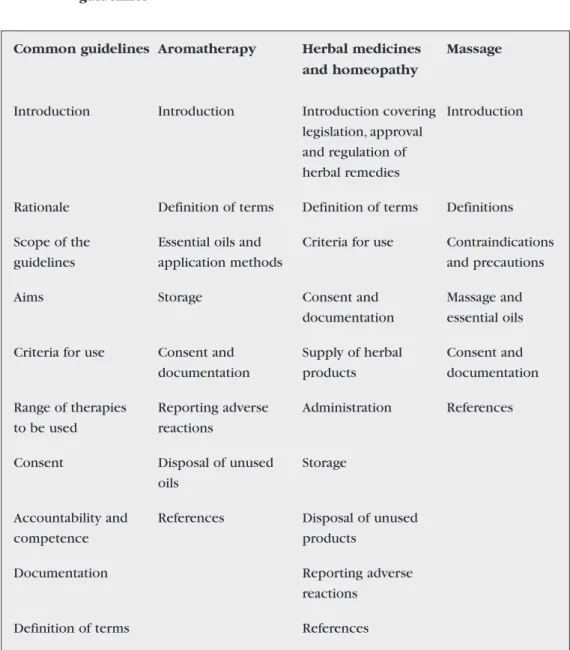
The Nurses Board of Victoria: Guidelines for the use of complementary therapies in nursing practice. Appendix 3. Nurses Board of Victoria (1999): Guidelines for the use of complementary therapies in nursing practice. Melbourne. Nurses Board of Victoria (1999): Guidelines for the use of complementary therapies in nursing practice. Melbourne: Australia, NBV.
STATUTORY REGULATION
As a result, individual practitioners and other health care professionals involved in the implementation and delivery of complementary therapies find themselves working with much less professional certainty than that enjoyed by those operating strictly within the realm of conventional health care. As a result, the regulatory vacuum is slowly starting to work. addressed as the benefits of complementary care as a valuable health care strategy are increasingly recognized by mainstream health care authorities such as the Therapeutic Goods Administration, the Departments of Health in the various states, the Nurses Registration Boards and the Royal College of Nursing, Australia. South Wales one must have completed a course of training and hold a recognized diploma, certificate or other award indicating successful completion of that course at a recognized institution in New South Wales provided by law for the. Under section 43, the Council is empowered to establish professional codes of conduct which set out the rules of conduct to be observed by accredited nurses in carrying out the practice of nursing.
Formal complaints against registered nurses are covered by the provisions of section 44 and section 45 sets out the procedures to be followed by the Board in relation to complaints. To be eligible for registration in New South Wales, chiropractors and osteopaths must be: over 18 years of age, of good character, have completed a prescribed course of training and hold a diploma, certificate or other academic award or have passed an examination regulated by the Board (sections 9, 10 and 11 Chiropractors and Osteopaths Act (NSW) (1991) Under section 27, the Board is empowered to establish codes of professional conduct containing rules of conduct to be observed by chiropractors and registered osteopaths.
Formal complaints against registered chiropractors and osteopaths fall within the provisions of section 28, while section 32 sets out the conditions under which a practitioner may be suspended from practice.
COMMON LAW REGULATION
Contractual liability is more likely to arise in the health care context as a claim under consumer protection law. The most common category of claim is likely to be that of misleading or deceptive conduct in representations made to a patient by a health professional. Under section 52 of the Trade Practices Act 1974 (Cth) (TPA) it is an offense for a corporation to engage in conduct that is misleading or deceptive or likely to deceive or deceive. It can arise from actions that result in harm to a person, or failure to act where harm results. This translates into doing what a reasonable nurse would not do in the same or similar circumstances, or failing to act in a way that would be reasonably expected. Person. Three elements must be proven, on the balance of probabilities, for a negligence action to succeed. These elements are a duty of care, a breach of that duty, and physical and/or financial harm resulting from the breach.
In the health care context, a duty of care arises whenever a therapeutic relationship is established. A therapeutic relationship is a relationship that exists between a health care professional and a person seeking advice or treatment within that relationship. The therapeutic relationship is the same regardless. whether the practitioner practices conventional or complementary therapies or a combination of the two. The determining principle of the duty of care is known as the "neighbourly principle" and was laid down in the landmark case of Donoghue v Stevenson (1932) AC 562,. While considering the issue of informed consent in Rogers v Whitaker, the High Court of Australia criticized the Bolam test for its tendency to focus on what a reasonable professional opinion would expect from a reasonable doctor in the circumstances, rather than considering what a reasonable patient would expect from a reasonable doctor . Rogers v. Whitaker changed the perspective from which the standard of care is established, away from a focus on professional opinion about how much information should be provided to a patient, in favor of a focus on the patient's right to be informed of material risks.
A material risk is one that a reasonable person in the patient's position is likely to consider significant, or one that the physician must be aware of in order for a particular patient to consider it significant. For providers of complementary therapies and nurses who provide complementary care, this means that they will have to meet the same standard of care criteria as the healthcare professionals involved in providing.

PUBLIC COMPLAINTS MECHANISMS Complaints commissions
The Ombudsman in each state has the power to investigate complaints made about decisions made by public officials in public institutions. Complaints arising from the provision of private health services or health professionals operating in a private capacity are outside the jurisdiction of the Ombudsman. Unlike the broad authority given to the State Complaints Offices and Commissions to provide appropriate legal remedies, the powers of the Ombudsman are limited to making recommendations and reporting the case to Parliament when the recommendations are not followed.
Because of their limited scope for obtaining practical legal remedies, ombudsmen are not used as often for health care complaints as other complaint mechanisms. All health care providers should remember that the best way to prevent apparent problems from escalating into major complaints is to promptly address early expressions of patient dissatisfaction by openly discussing the issue while the problem is in its early stages. Failure to resolve problems as they arise usually leads to the involvement of public grievance mechanisms.
SELF-REGULATING ASSOCIATIONS
It is important to ensure that patients are given full details of the planned treatment regimen and the expected outcome. Quantitative and qualitative research were described as research approaches and methods and applications were made to complementary therapies. The chapter. It is often more difficult to implement these therapies in acute care settings due to the lack of recognition of the benefits of complementary therapies within the orthodox medical field.
Having said that, the growing recognition of the benefits of complementary therapies will certainly increase the level of their use in the acute area in the future. Nutrition plays an important role in the health of mother and baby. DNA integrity can be determined nutritionally before conception, so it's good. She served on the International Advisory Board of the UK Journal of Complementary Therapies in Nursing and Midwifery from 1995 to 1998.
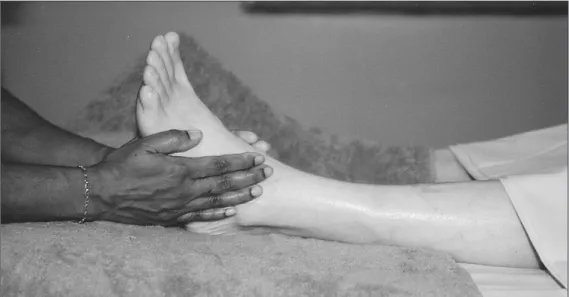
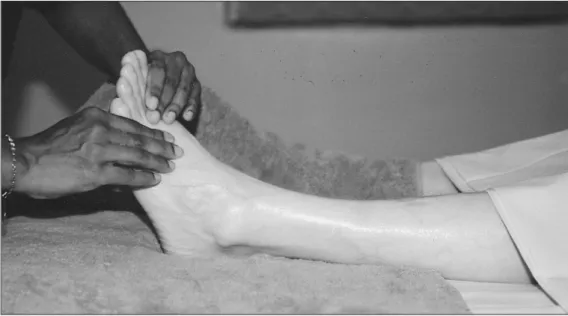
Massage is one of the most effective ways to apply essential oils to the body. Bathing improves hydration of the skin, making it more permeable to essential oils and increases circulation in the dermis, facilitating the absorption of essential oils. About six drops of essential oil are added to water in a vaporizer. The water must be changed every four hours and fresh essential oils added due to the evaporation of the aromatic molecules.
Nurses who use massage are challenged to describe their use of massage within the defined framework of professional codes. Legal and ethical aspects of the use of complementary therapies in nursing and midwifery are discussed in Chapter 5.
GUIDED IMAGERY
Nurses using guided imagery should be aware of two possible outcomes: .. i) The effectiveness of relaxation may be limited by a person's fear. If negative thoughts or emotions are experienced during relaxation, it is important to allow them to occur and preferably for the patient to face them openly. Once we are willing to look fully and deeply at the source of fear, it loses its power (Gawain. For example, patients may find it easier to deal with the reactions or symptoms of stress than to investigate the more difficult and complex reasons for the stress. ii) Physical relaxation can sometimes lead to the release of psychological tension.
Therefore, when encouraging patients to use relaxation techniques, nurses should be aware of the possibility of an emotional release. Emotional responses to physical relaxation can be a frightening experience for the patient, especially if they are unexpected. Nurses should recognize an emotional response to relaxation and make necessary referrals for counseling.
Now see yourself in bed and pay attention to how good you are. The room is dark and quiet, the bedding is fresh and you have your favorite pillow. Gently bring your awareness to the sensation of the heat and weight of your body against the mattress and sheets.
MEDITATION
Dolores Krieger began teaching TT in the mid-1970s as part of the master's and doctoral programs in nursing at New York University. Rebalancing or re-patterning the energy system increases the inherent healing ability of the person. She describes TT as 'a conscious act based on a person's knowledge of the therapeutic functions of the human vital energy field'.
Clues are recognized when the practitioner's hands are moved about two to six inches away from the body to scan the etheric or first level of the energy field. An evaluation might reveal that the energy around the rest of the body is still depleted, so the practitioner could direct the energy to the adrenal gland and solar plexus area (Hall, 1998). This is based on verbal feedback and reassessment of the energy field and includes a period of rest to maximize benefits.
Centering remains the core of the practice. The HT evaluation process complements the TT process and includes an evaluation of the energy flow through the energy centers and the remaining emotional, mental, and spiritual levels of the energy field. The main focus of touch modalities is the therapeutic use of the self as part of a healing dyad.