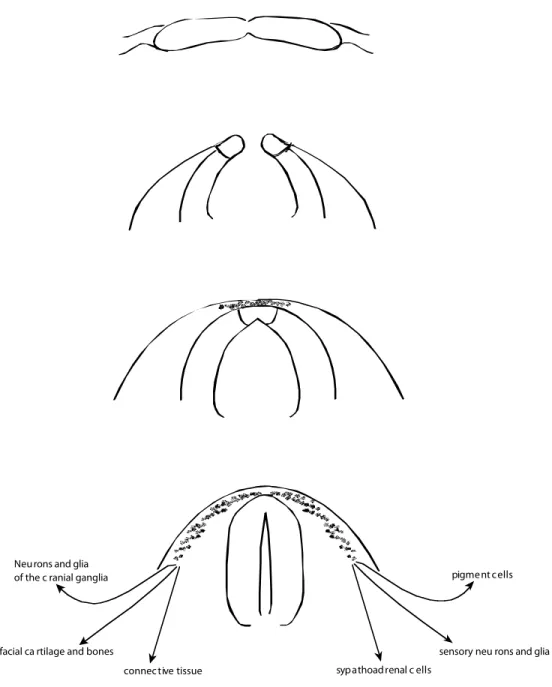
The neural crest (NC) is a pluripotent cell population that arises at the junction between the neural tube and the dorsal ectoderm (Figure 1). The skeletogenic potential of the cranial neural crest has been widely explored and documented throughout.
Historical aspects
More interspecific grafts were used in an attempt to understand the nature of the induction of neural crest cells. Furthermore, the neural crest cells were shown to originate from both cultured tissues (Selleck and Bronner-Fraser 1995; Mancilla and Mayor 1996).
The EMT process in NCC with distinct involved factors
Another type II cadherin, Cad11, has also been described in migrating neural crest cells in Xenopus (Hadeball, Borchers et al. 1998) and mouse (Hoffmann and Balling 1995; Kimura, Matsunami et al. 1995). Level signaling is also necessary for the formation of the cranial neural crest (Endo, Osumi et al.
Neural crest stem cell plasticity and pluriopotency
Furthermore, when individual neural crest cells were injected into host embryos, they were shown to be able to give rise to numerous daughter cells of different neural crest cell lineages (Bronner-Fraser, Sieber-Blum et al. 1980). In quail, in vitro analysis of neural crest cells cultured on fibroblast feeder cells with endothelin 3-.
Neural crest cells and neuroendocrine tumors
These pheochromocytomas are usually noradrenergic and therefore phenylethanolamine N-methyltransferase negative (Tischler 2008; Eisenhofer, Huynh et al. 2004). Interestingly, some mutations of mouse Nf1 have occurred in most tumor types seen in neurofibromatosis (Joseph, Mosher et al. 2008).
Known human craniofacial defects
Mutations in FGFR1 have also been found in familial Pfeiffer syndrome (Muenke, Schell et al. 1994). Therefore, a conditional mouse mutant showing typical craniofacial defects was generated (Chen, Akinwunmi et al. 2007).
Goal of this thesis
34;Bimodal functions of Notch-mediated signaling are involved in neural crest formation during avian ectoderm development.". 34;Neural crest potential for tooth development in the amphibian urodele: developmental and evolutionary significance." Dev Biol. 34; Normal fate and altered function of the cardiac neural crest cell lineage in embryos with a retinoic acid receptor mutation.".
34; Transcription factor c-Myb is involved in the regulation of the epithelial-mesenchymal transition in the avian neural crest." Cell Mol Life Sci. 34; Neural crest cell-cell adhesion controlled by sequential and subpopulation-specific expression of novel cadherins.". 34; Morphology and behavior of quail neural crest cells in artificial three-dimensional extracellular matrices." Dev Biol.
34; A radioautographic analysis of the migration and localization of stem neural crest cells in the chick." Dev Biol 6: 279-310.
Discovery of transcription factors and other candidate regulators of neural crest
Abstract
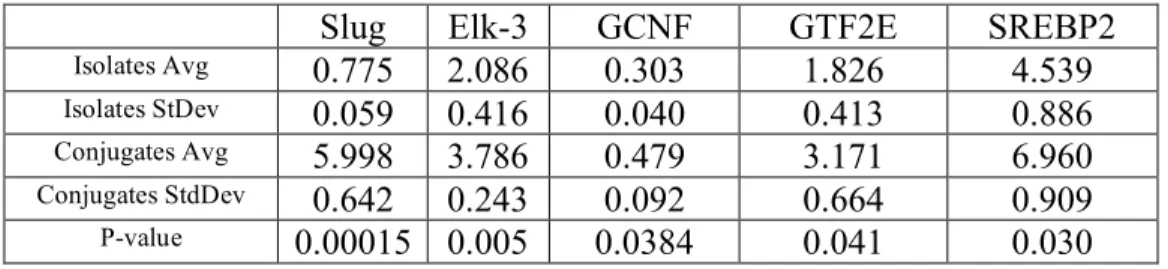
Despite previous efforts to identify genes upregulated in neural crest populations, transcription factors have proven elusive due to relatively low expression levels and often transient expression. We screened newly induced neural crest cells for early target genes with the aim of identifying transcriptional regulators and other developmentally important genes. Quantitative real-time PCR confirmed upregulation of several transcription factors in newly induced neural crest populations in vitro.
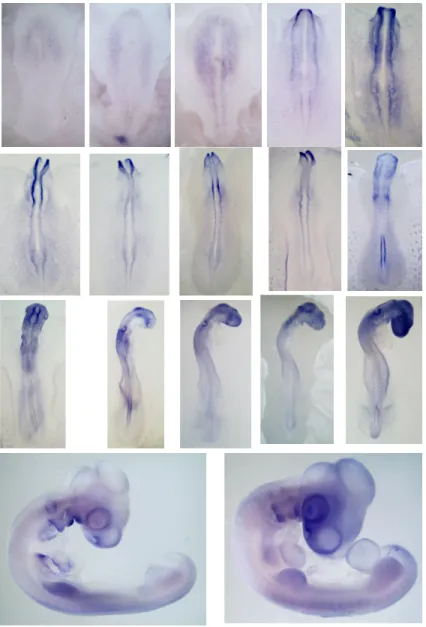
In a secondary screen by in situ hybridization, we verified the expression of >100 genes in the neural crest. We note that several of the transcription factors and other genes from the screen are expressed in other migrating cells.
Introduction
However, it seems unlikely that these complex processes are controlled by the relatively few transcription factors identified to date in newly formed neural crest cells. However, this yielded only two transcription factors not previously associated with the neural crest. This allowed the identification of more than 200 genes, many of which had not previously been linked to neural crest development.
As a secondary screen, we performed in situ hybridization to verify expression of 101 genes in premigratory and/or migrating neural crest cells. Quantitative PCR (QPCR) was used to confirm the level of upregulation of various transcription factors in newly induced neural crest cells.
Materials and methods
The results reveal many previously unknown transcriptional regulators in the neural crest and suggest interesting commonalities between neural crest cells, various metastatic cancers and other migratory cell types. The results for different samples were then interpolated on a line created by running standard curves for each primer set and then normalized against the results for a housekeeping gene, which is assumed to be a measure of the amount of cDNA used in each reaction. Selected embryos were then grossly sectioned using a scalpel or finely sectioned using a cryostat (Bright) and mounted or immunostained.
They were then placed in PBS (phosphate-buffered saline) + 0.1% Tween 20 + 5% goat serum block for hours at room temperature before a 4°C overnight incubation with anti-HNK antibody -1 1:20 (hybridoma of the American culture collection type ). Slides were then washed again in PTW several times, rinsed twice in dH20, and then coverslipped using PermaFluor (Immunotech).
Results and discussion
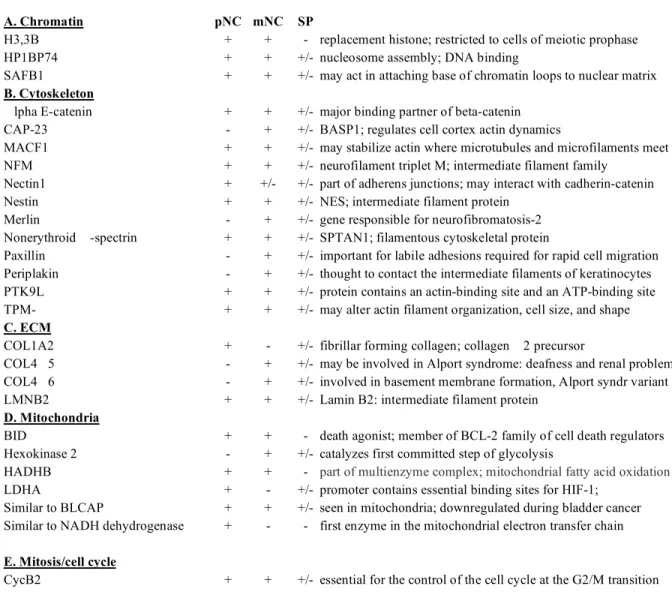
NF2 has previously been shown to be expressed during development in the neural tube as well as in migrating neural crest cells and their derivatives (Akhmametyeva, Mihaylova et al. 2006). Col1a2 is a major collagen subunit that plays a role in neural crest cell migration and can regulate cell differentiation (He, Feng et al. 2005). It has previously been shown to be expressed in the developing mouse spinal cord and brain, as well as neural crest derivatives such as dorsal root ganglia (Leung, Sun et al. 1999).
Furthermore, depletion of alpha-spectrin in Drosophila results in the loss of cell-cell contact (Lee, Coyne et al. 1993). Finally, FMIP (FMS Interacting Protein) has been shown to control the differentiation of granulocytes and macrophages (Tamura, Mancini et al. 1999).
Acknowledgements
These data provide new players to include in existing gene transduction networks and advance our understanding of neural crest cell development. Neural crest expression of and QPCR results for Snail 2. A-D) Snail2 expression is seen specifically in premigratory (dorsal neural tube) and migrating neural crest. Neural crest expression of and QPCR results for GTF2E. A-D) GTF2E expression is seen specifically in premigratory (dorsal neural tube) and migrating neural crest.
Critical role of Brg1 member of the SWI/SNF chromatin remodeling complex during neurogenesis and neural crest induction in zebrafish. Sox10 is required for the early development of the potential neural crest in Xenopus embryos.
Functional perturbations of candidate regulators of neural crest development
Abstract
Here we present the results of our studies of two different candidates that are the result of our screening for genes important for neural crest cell development. The levels of Ccar1 in neural crest cells induced in vitro were analyzed by quantitative PCR.
Introduction
Ccar1 has traditionally been considered a strictly apoptotic molecule in malignant cell types such as breast or prostate cancer as well as leukemia (Zhang, Levi et al. 2007). Reduced levels of Ccar1 in this type of malignant cells lead to a decrease in apoptosis signaling by CD437 ([3-(1-adamantyl)-4-hydroxyphenyl]-2-naphthalenecarboxylic acid), the chemotherapeutic (anthracycline toxin) adriamycin, etoposide, and EGFR inhibitor(s) (Rishi, Zhang et al. 2006). For this reason, Adh5 is also known as FALDH or FDH (NAD+/glutathione-dependent formaldehyde dehydrogenase) (Uotila and Koivusalo 1974; Iborra, Renau-Piqueras et al. 1992).
This enzyme functions as a homodimer and has a zinc at the active site which is essential (Wagner, Pares et al. 1984). This suggests that a class III Adh gene was the evolutionary precursor of the ADH family (Kaiser, Fernandez et al. 1993).
Materials and methods
This suggests that a class III Adh gene was the evolutionary precursor of the ADH family (Kaiser, Fernandez et al. Gene specific primers were designed using the Primer Express program (Applied Biosystems) and synthesized by IDT. During the exponential phase of the QPCR reaction a threshold and baseline were set according to the protocols of Applied Biosystems as described in Chapter 2.
LCQKIRVTQGKGLMPDGTIRFTCKGKQIYHFMGTSTFSEYTVVVADISVAKIDPAA PFDKVCLLGCGVSTGYGAAVNTAKVEPGSTCAVFGLGGVGLATVMGCKAAGA SRIIGIDINKNTYAKKEFGAAECISPIGGAVDFEKVDF CHKGWGVSVIVGVAAAGQEISTRPFQLVTGRTWKGTAFGGWKS VDSVPKLVNDYMAKKIKVDEFVTHTLPFDKINEAFDLHLKGKSIRTVLKF Ccar1 is identified as XM_42157. 3 and the gene sequence is. They were then cultured in a 37°C incubator for 12 to 36 hours in dishes on a thin layer of minimal albumin.
Results
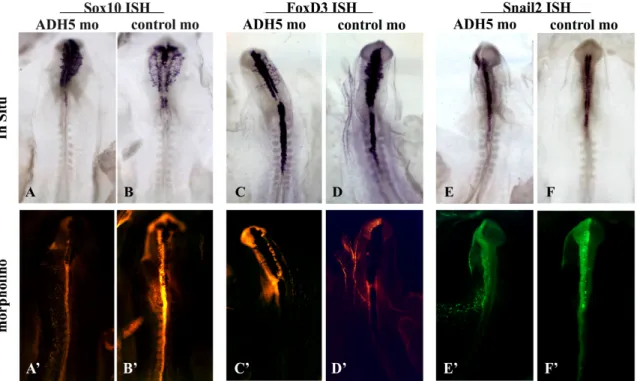
In contrast, control morpholino-electroporated embryos under identical conditions simultaneously showed no deficits on the injected side (20/22 embryos) or very mild deficits (2/22 embryos). Sox10 in situ hybridization performed on Adh5 morpholino injected embryos showed a significant reduction of Sox10 mRNA on the injected side. When Snail2 was examined by in situ hybridization on Adh5 morpholino injected embryos, there was a significant reduction of Snail2 mRNA on the injected side.
Of the 13 electroporated embryos, 5 showed no difference, 5 showed a minor deficiency, and 3 showed a severe deficiency of Snail2 mRNA on the injected side of the embryo (Figure 5: E and E'). Of the 12 electroporated embryos, 5 showed no difference, 4 showed a minor deficiency, and 3 showed a severe deficiency of FoxD3 mRNA on the injected side of the embryo (Figure 5: C and C').
Discussion
34; Analysis of DBC1 and its homologues suggests a potential mechanism for regulation of sirtuin domain deacetylases by NAD metabolites." Cell Cycle. 34; Ascidian and amphioxus Adh genes correlate functional and molecular features of ADH family expansion during vertebrate evolution." J Mol Evol. 34;Immunocytochemical and biochemical demonstration of formalhyde dehydrogenase (class III alcohol dehydrogenase) in the nucleus." J Histochem Cytochem.
34;Origin of the human alcohol dehydrogenase system: implications of the structure and properties of the octopus protein." 34;Transactivator of transcription-marked cell cycle and apoptosis regulatory protein-1 peptides suppress the growth of human breast cancer cells in vitro and in vivo. " Mole Cancer Ther.
Summary and future directions
34; [Nuclear tritiated thymidine labeling of neural crest derivatives in the amphibian Urodele Pleurodeles waltlii Michah]." J Embryol Exp Morphol. 34; Tcof1/Treacle is required for neural crest cell formation and proliferative defects causing craniofacial abnormalities.". 34; Isolation and Directed Differentiation of Neural Crest Stem Cells Derived from Human Embryonic Stem Cells." Nat Biotechnol.
34; Neural crest formation in the mouse embryo head as observed using a new histological technique. "J Embryol Exp Morphol. 34; Regulation of the initiation of neural crest migration by coordinated activity of BMP4 and Noggin in the dorsal neural tube." .