None of the samples should have an MPN coliform index above 10. Untreated water: In 90% of the samples tested throughout the year, the MPN index of coliform organisms should not be lower than 10.
Introduction
In an attempt to bring order out of chaos, the American Public Health Association appointed a committee to study the various analytical methods available and published the committee's recommendation as "Standard Methods of Water Analysis" in 1905. The purpose of the experiments are to determine the following types of solids in the given sample(s): b) Total (inorganic) solids (c) Total volatile (organic) solids (d) Total dissolved solids. e) Dissolved solid (inorganic) solids (f) Dissolved volatile (organic) solids (g) Total suspended solids. h) Suspended solid (inorganic) solids (i) Suspended volatile (organic) solids (j) Settling solids.
DETERMINATION OF SOLIDS
W6= Weight of empty evaporating dish + Solid solids remaining after ignition at 550°C. g) Volatile Dissolved Solids = Total Dissolved Solids – Solid Dissolved Solids. H). Suspended Solids = Total Solids - Solid Dissolved Solids. i) Suspended Volatiles = Total Volatile Solids – Volatile Dissolved Solids.
TURBIDITY
Weigh accurately 5 g of 'Anal–R' grade hydrazine sulfate (NH2)2H2SO4 into a 500 ml volumetric flask and add distilled water to make up to the mark. Dilute the sample with one or more volumes of turbidity-free distilled water until the turbidity drops below 100 NTU.
DETERMINATION OF ALKALINITY
To determine the amount of the following types of alkalinity in the given samples: Originally, the hardness of water was understood as a measure of the capacity of water to precipitate soap.
DETERMINATION OF HARDNESS
When the hardness is numerically greater than the sum of the carbonate alkalinity and the bicarbonate alkalinity, the amount of hardness, which is equal to the total alkalinity, is called carbonate hardness; the amount of hardness that exceeds it is called non-carbonate hardness. Compare the color with that of the color printed on the wrapper of the pH paper book.
DETERMINATION OF CHLORIDE
DETERMINATION OF IRON Aim
The phenanthroline method is the preferred standard procedure for measuring iron in water, except when phosphate or heavy metal interferences are present. The color obeys Beer's law and can be easily measured by visual or photometric comparison.
DETERMINATION OF IRON AND MANGANESE
DETERMINATION OF MANGANESE Aim
Both methods depend on the oxidation of manganese from its lowest oxidation state to VII where it forms the multi-colored permanganate ion. The color produced is directly proportional to the concentration of manganese present over a considerable concentration range in accordance with Beer's law. If the spectrophotometer is used, a distilled water blank must be prepared along with the color standards.
Prepare the calibration chart by taking the meter reading along the y-axis and the manganese concentration (in µg) in color standards on the x-axis.
DETERMINATION OF SULPHATE Aim
- Gravimetric Method with Ignition of Residue Principle
DETERMINATION OF SULPHATE AND SULPHIDE
Gravimetric Method with Drying of Residue
Turbidimetric Method Principle
If no organic matter is present in the sample, the first method can be performed without igniting and instead drying and weighing the residue. After stirring, some of the solution is poured into the absorption cell of the photometer and the turbidity is measured at 30 second intervals for four minutes. The standards are prepared in 5 mg/L intervals in the 0-40 mg/L sulfate range and their turbidity or absorbance read.
By determining the absorbance for a given sample, the sulfate concentration in the solution is determined using a calibration curve.
DETERMINATION OF SULPHIDE Aim
What is the purpose of the digestion of the sample in the gravimetric analysis for sulfates. To determine the optimum coagulant dosage for clarification of the given sample of water using alum as coagulant and conduct the jar test experiment. Samples will be taken in jars or beakers, and varying doses of coagulant will be added simultaneously to all the jars.
The vanes will be rotated at 100 rpm for 1 minute and at 40 rpm for 20 to 30 minutes, corresponding to the flash mixing and slow mixing in the treatment plant flocculator.
JAR TEST FOR DETERMINING OPTIMUM COAGULANT DOSAGE
The +ve species combine with the negatively charged colloids to neutralize some of the charge on the colloidal particle. The purpose of the experiment is to determine the amount of dissolved oxygen present in the given sample(s) using the modified Winkler method (azide modification). Dissolved oxygen (D.O.) levels in natural and wastewater depend on the physical, chemical and biochemical activities prevailing in the water body.
The test is based on the addition of a solution of divalent manganese, followed by strong alkali, to a sample of water in a glass-stoppered bottle.
DETERMINATION OF DISSOLVED OXYGEN
At the end of 5 days, the dissolved oxygen content (D2) in the set of incubated bottles is determined. Determine the initial dissolved oxygen content in the next set of bottles and record the results. Determine the dissolved oxygen content of the incubated bottles at the end of 5 days and record the results.
Note: The procedure for determining the dissolved oxygen content is the same as described in the experiment under "Determination of dissolved oxygen".
DETERMINATION OF AVAILABLE CHLORINE IN BLEACHING POWDER
OTA METHOD Aim
To determine the amount of free residual chlorine, combined residual chlorine and total residual chlorine present in the given samples of chlorinated water. Orthotolidine (OT) is an aromatic compound that is oxidized in acid solution by chlorine, chloramines and other oxidizing agents to produce a yellow colored compound, holoquinone at pH less than 1.8, the intensity of color is proportional to the amount present. A second test is made in which a reducing agent (sodium arsenite) is added within 5 seconds of adding 'OT'.
The arsenite which is a much stronger reducing agent than 'OT' immediately reduces the chloramines and stops further action with OT.
TEST FOR RESIDUAL CHLORINE
STARCH IODIDE METHOD Aim
To determine the amount of total residual chlorine present in the given samples of chlorinated water by starch iodide method. Escherichia coli (E.coli) for the purpose of sanitary examination of water, is defined as a gram-negative, non-spore-forming rod capable of fermenting lactose with the production of acid and gas at 35°C in less than 48 hours, which produces indole peptone water containing tryptophan, which is unable to use sodium citrate as its sole source of carbon, which is unable to produce acetylmethyl carbinol, and which gives a positive methyl red test. The results are expressed in terms of MPN (Most Probable Number), which is based on certain probability formulas.
Water safety is generally assessed based on knowledge of sanitary conditions and is reported by the number of samples with positive or negative results.
TEST FOR COLIFORMS IN WATER
Inoculate a series of fermentation tubes with the appropriate graduated amounts (multiple and sub-multiples of 10) of the water to be tested. The concentration of nutrient components in the medium mixture must be in accordance with the specifications. The portions of the water sample used to inoculate fermentation tubes of lactose or lauryl tryptose broth will vary in size and number with the character of the water under examination.
The formation of gas in any amount in the inverted flask of the fermentation tube of green lactose bile juice at any time within 48±3 hours constitutes a confirmed positive test.
AMMONIA NITROGEN
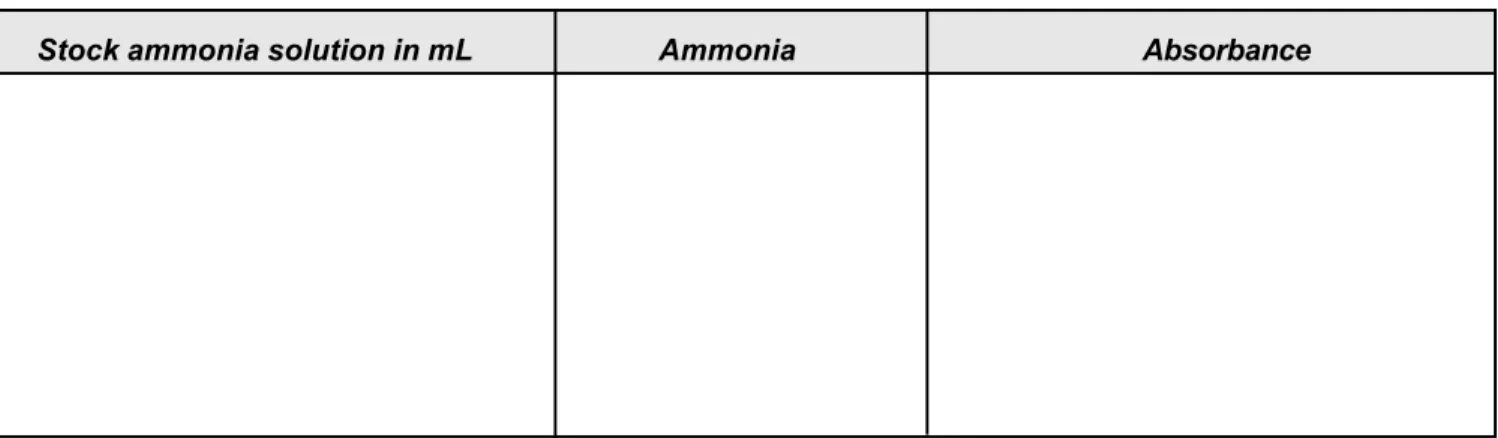
The colorimetric method, using Nessler reagent, is sensitive to 20 mg/L ammonia N and can be used up to 5 mg/L ammonia N. In samples that have been properly clarified by a pretreatment method using zinc sulfate and sodium hydroxide, it is possible to obtain a measure of the amount of ammonia N by treatment with Nessler's reagent, which is a strongly alkaline solution of potassium mercuric iodide (K2HgI4). The typical yellow or reddish brown color of ammonia N can be measured in a spectrophotometer at wavelengths of 400-500 nm with a light path of 1 cm.
To this is added 2 mL of Nessler's reagent (proportional amount to be added (if the sample volume is smaller).
NITRATE NITROGEN
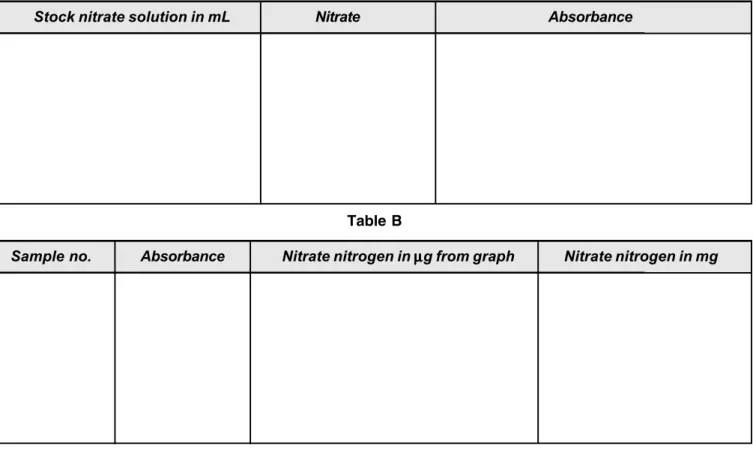
The reaction with nitrate and brucine produces a yellow color that can be used for the colorimetric estimation of nitrate. Place the rack in a cool water bath and add 2 mL of NaCl solution and mix well. Prepare a standard curve of absorbance value of standards (minus the blank) against the concentration of NO3-N.
By recording the absorbance of an unknown sample, the nitrate concentration can be determined.
NITRITE NITROGEN
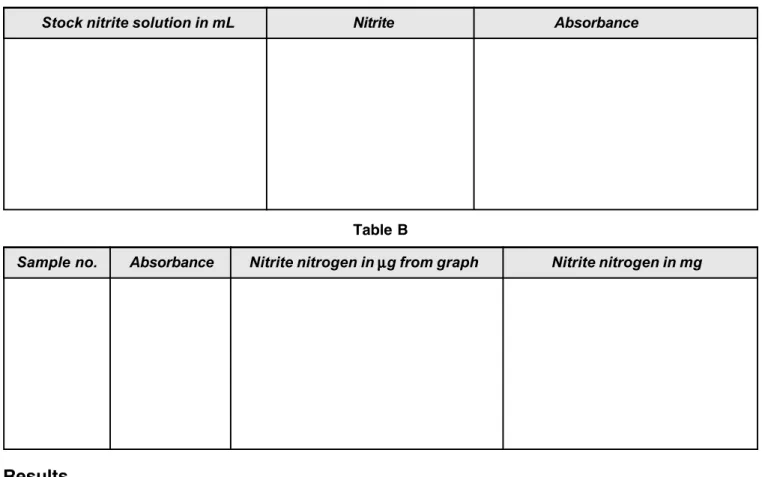
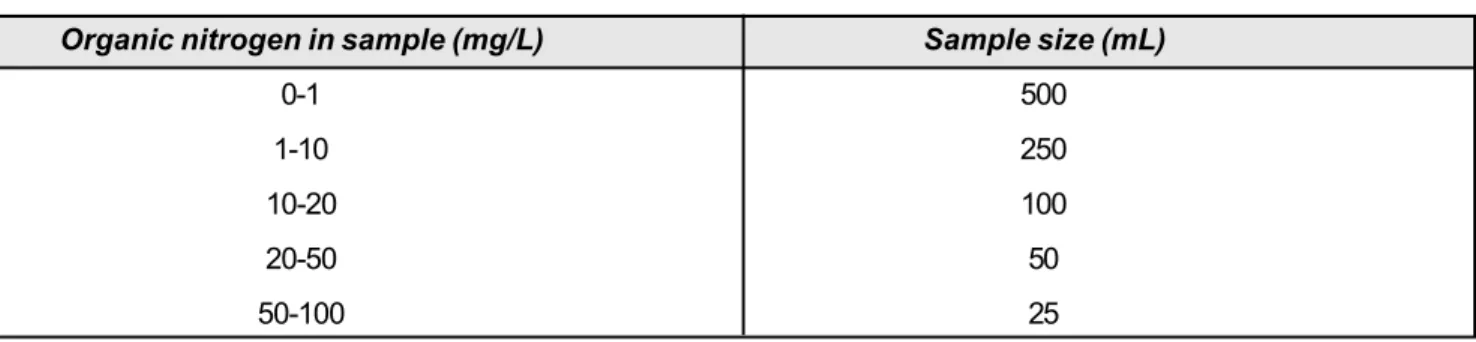
The nitrite concentration is determined by the formation of a red-purple azo dye produced at pH 2.0–2.5 by coupling diazotized sulphanilic acid with N-(1-naphthyl)-ethylenediamine dihydrochloride. In the presence of sulfuric acid, potassium sulfate and mercury sulfate as a catalyst, the amino nitrogen of many organic materials is converted into ammonium sulfate. After the mercury-ammonium complex is broken down from the digestible by sodium thiosulfate, the ammonia is distilled from an alkaline medium and absorbed into boric acid.
KJELDAHL NITROGEN
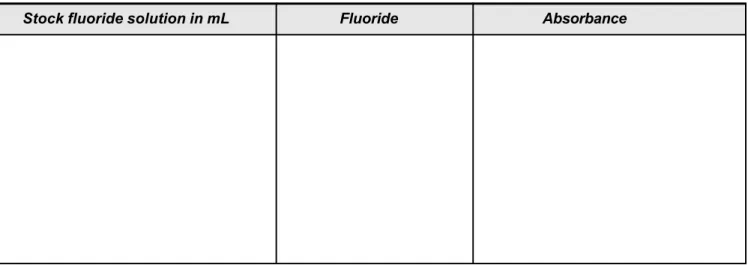
Add enough hydroxide-thiosulfate reagent to form an alkaline layer at the bottom of the flask. The color performed is the result of the action between zirconium ion and alizarin dye. Fluoride ion combines with zirconium ion to form a stable complex ion ZrF6––, and the color lacquer intensity decreases accordingly.
The bleaching effect is a function of the concentration of fluoride ions and is directly proportional to it.
DETERMINATION OF FLUORIDE IN WATER
Since the color change of phenolphthalein indicator is close to pH 8.3, this value is accepted as a standard endpoint for titration of total acidity. For more complex mixtures or buffered solutions, a fixed endpoint of pH 3.7 and pH 8.3 is used. For example, for standard determination of the acidity of waste water and natural water, methyl orange acidity (pH 3.7) and phenolphthaleic acidity (pH 8.3) are used.
When determining the acidity of the sample, the volumes of standard alkali required to bring about a color change at pH 8.3 and pH 3.7 are therefore determined.
DETERMINATION OF ACIDITY OF WATER
In the sample, which contains only carbon dioxide-bicarbonate-carbonate, the titration at pH 8.3 at 25°C corresponds to the stoichiometric neutralization of carbonic acid to carbonate. Empty in the same way a blank consisting of distilled water of equal volume to that of the sample. To determine the amount of oil and grease present in the given water sample by the gravimetric method of separation.
In the Partition-Gravimetric method, dissolved or emulsified oil and grease are extracted from water by intimate contact with trichlorotrifluoroethane; petroleum ether (40/60) or hexane.
DETERMINATION OF OIL AND GREASE
Knowing the quality of the oil and grease present is helpful in the proper design and operation of the wastewater treatment system. The three methods used to evaluate oil and fats are (i) distributive gravimetric method (ii) distributive infrared method and (iii) solvent extraction method. In method (ii), the appropriate instruments allow measurements of only 0.2 mg of oil and fat.
The amount of oil and grease in the sample can be calculated as, Oil and Grease (mg/L) = (A – B) 1000/volume of sample where, A = mass of evacuated flask and residue (g).
DETERMINATION OF ODOUR
The standard unit of color is the color produced by dissolving 1mg of platinum cobalt in 1 liter of distilled water. Take the sample and the comparison solutions in the Nessler tubes and compare the color. Record the dilution of the comparator solution with the same color as the sample.
If corresponding colors are not developed, the sample can be diluted to obtain the corresponding color.
DETERMINATION OF COLOUR
Methyl orange indicator: Dissolve 500 mg methyl orange powder in distilled water and dilute it to 1 litre. Keep the solution in dark or in an amber coloured bottle
Standard EDTA titrant 0.01 M: Weigh 3.723 g of analytical reagent grade EDTA disodium salt (Na2H2C10H12O8N2) and dissolve in distilled water and dilute to 1 liter.
APPENDICES
- Hydrochloric acid: Concentrated HCl
- Barium chloride: Barium chloride crystals
- Hydrochloric acid: Prepare a 6 N solution
- Sulphuric acid concentrated: 1mL is equivalent to about 3 mL alkali-iodide-azide reagent
- Dissolve 1.35 g orthotolidine dihydrochloride in 500 mL distilled water: Add this solution with constant stirring to a mixture of 350 mL distilled water and 150 mL concentrated hydrochloric acid
- Lactose broth: Beef extract 3 g, peptone 5 g, lactose 5 g and reagent grade distilled water 1 litre
- Methyl orange indicator: Dissolve 500 mg methyl orange powder in distilled water and dilute it to 1 litre
- Phenolphthalein indicator: Dissolve 5 g phenolphthalein disodium salt in distilled water and dilute to 1 litre
- EDTA reagent (stabiliser): Dissolve 50 g EDTA disodium salt in 60 mL of water containing 10 g NaOH
- Sodium chloride solution: Dissolve 300 g NaCl and dilute to 1litre with distilled water
- Hydrochloric acid: HCl (1+3)
- Borate buffer solution: Add 88 mL 0.1N NaOH solution to 500 mL 0.025 M sodium tetraborate (Na 2 B 4 O 7 ) solution (5 g Na 2 B 4 O 7 in 1 litre) and dilute to 1 litre
- Sodium hydroxide 6 N: Dissolve 240 g NaOH in 1 litre ammonia free distilled water
Standard iron solution: Pipette 50 mL of standard solution into a 1 liter volumetric flask and dilute to the mark with distilled water. Standard sodium thiosulfate 0.025 N: Dissolve 6.205 g of sodium thiosulfate (Na2S2O3.5H2O) in freshly boiled and cooled distilled water and dilute to 1 liter. Standard sodium thiosulfate 0.025 N: Dissolve 6.205 g of sodium thiosulfate (Na2S2O3.5H2O) in freshly boiled and cooled distilled water and dilute to 1 liter.
Sodium hydroxide-sodium thiosulfate reagent: Dissolve 500 g of NaOH and 2 g of Na2S2O3.5H2O in ammonia-free distilled water and dilute to 1 liter.