United States National Museum Bulletin 252
Contributions from
The Museum of History and Technology:
Paper 72
Anthracite in the Lehigh Region OF Pennsylvania, 1820-45
John N. Hoffman
INTRODUCTION
92 DISCOVERY OFCOAL
INTHE LEHIGH REGION
92LEHIGH NAVIGATION
94LEHIGH COMPANY COAL
PROPERTIES 103incorporation
of additionalcompanies no
DELAWARE
DIVISIONOF THE PENNSYLVANIA CANAL
114 capitalrequirements
115SUMMARY
117supplemental BIBLIOGRAPHY
121APPENDIXES
122Smithsonian Institution Press Washington, D.C.
1968
John N. Hoffman
ANTHRACITE
In the Lehigh Valley
of Pennsylvania 1820-45
This monograph
presents the historicaland
technological de-velopments
of the anthracite industry in theLehigh
region ofPennsylvania from
1820 to 1845.The
first constructive effort todevelop
this regionbegan
in 1818 with theenactment
ofalaiv^by
the Legislature ofPennsylvania
granting -'unlimitedpowers"
to three itidividuals toimprove
the navigation oftheLehigh
River.Regular shipments
of anthracitefrom
theLehigh
regionbegan
in1820.
The development
of the industryduring
this periodwas
achievedthrough
thecombined
efforts of theLehigh Coal and Navigation Company and
itsformer companies, who
operated the only navigation facilityfrom
the regionand engaged
inmining
operations.
During
the first 25years ofthe industry, 17 additionalcompanies were
chartered by thePennsylvania
Legislatureto takeadvantage
of the navigationalimprovements
constructedon
theLehigh
River.These companies were
authorized toengage m
mining and
railroad operations, butnone was
given"unlimited
powers."Large amounts
of capitalwere
required to develop the coal- bearing propertiesand
to bring the coal to market, withmost
oj themoney
being invested in the construction of transportationfacilities.
Approximately
$12.2 millionwas
invested by the variouscompanies
todevelop
thisindustryduring
the period 1820to 1845.The Author: fohn N. Hoffman
is associate curator, division ofmanufactures and heavy
industries, in theSmithsonian
Insti- tution'sMuseum
of Historyand Technology.
PAPER
72:ANTHRACITE
INTHE LEHIGH VALLEY
91
Introduction
THE ANTHRACITE
DEPOSITS of Northern Pennsyl-vania are found in the counties of: Carbon, Co- kimbia,
Dauphin, Lackawanna, Lebanon,
Luzerne,Northumberland,
Schuylkill, Sullivan, Susquehanna,and Wayne. The
coal-bearing formations cover asur- face area of approximately484
square milesand
are divided into fourfields: northern (176 square miles) ;easternmiddle (33 squaremiles) ; westernmiddle (94 square miles) ;
and
southern (181 square miles).In anthracite trade circles, the four fields are regardedasthreeproducingareas:
The
Schuylkill (the western middle fieldand
the southern field west ofTamaqua)
;The Lehigh
(the eastern middle fieldand
the southern field east ofTamaqua)
;and The Wyo- ming
(thenorthernfield).
The
topography of the area in the pioneer days of theCommonwealth
excludedthe use of turnpikesand
the constructionofnew
roadsforthe transportation of bulky commoditiesfrom
the hinterland to the highly populated east-coast areas.The
entire anthracite areawas
drained by three large streams, butnone was
navigable with safety inits naturalstate.The Lehigh
Riverwas
early recognized as being a natural route for the transportation of materials to market.The
PennsylvaniaLegislaturepassed a Lehigh Riverimprovement
act in 1771,and
other programs followed in 1791, 1794, 1798, 1810, 1814,and
1816.^Several of the acts included the
appointment
ofcom-
missioners to supervise the riverimprovements and
moderate appropriations to help finance the work. In every case themoney was
undoubtedly spent, but the construction efforts,if any,did not materiallyimprove
the navigation of theriver.Discovery
ofCoal
in theLehigh Region The
discoveiy ofcoal in theLehigh
areais credited to PhilipGinder-who, m
1791, found coalonMauch
'Erskine Hazard, "History of the Introduction of An- thracite Coalinto Philadelphia" {HistoricalSociety ofPenn- sylvaniaMemoirs,vol. 2, pt. 1; Philadelphia: Carey, Lea,and Carey, 1827),p. 157.
Thomas
C.James, "A BriefAccountof theDiscoveryof AnthraciteCoalontheLehigh" {HistoricalSocietyofPennsyl- vania Memoirs, vol. 1, pt. 2; Philadelphia: Carey, Lea, and Carey, 1826), p. 318. Dr. Tames used the family name as Ginler, butthemonument
e-ccted at Summit Hill, Pa., com- memorating the 150th anniversary (1941) of the discovery ofanthracitewasinscribed"Ginder."Chunk
(Sharp)Mountain where
thetown
ofSummit
Hill is
now
located,about nine miles westofthetown
of
Mauch
Chunk.''Ginder
gavesome
specimensof his find to Col. Jacob Weiss at Fort Allen (Weissport).The
Colonel sent thespecimens toPhiladelphiafor ex- amination.Sometime
later Colonel Weisswas
in-fonned
that the specimens were found to be "Stone Coal."On
February 13, 1792, Colonel Weissand
several friends from Philadelphiaformed
the unincorporated Lehigh CoalMine Company.^
This organization ob- tained from Colonel \\'eiss the landupon
which the discoverywas made
(Weisshad
obtained thelandpre- viously from Ginder) and, therefore, obtained addi- tional wanants.The
total land holdings in this area subsequently totaled approximately 8,000 acres.The
organizationcommenced
miningoperationsand
producedseveral tons,having littledifficultv in diggingtlie coal from the a;round. Tliey were then confronted with the problemof
what
todo
withthe coal.Mining
operations\\eresuspendedforthetime beingand
theireffortswere concentrated
on
provinganthracite'svalue byarousing publicinterest in theirproduct.The
public, however,was
reluctant to accept thisnew
fuel.An-
other problem faced the owners; that of transporting theirmined
coal out of the primitive forests to the landings along theLehigh
River. Sixwooden
arks were constructedon
the river aboveMauch Chunk,
loaded with coal,and made
ready for high water (freshets) tofloatthem down
to Philadelphia, via the Lehighand Delaware
Rivers.Each
ark held approxi- mately ten tons of coaland had
a crew of six men.After a perilous trip
down
the rivers in the spring of 1803, two ofthe six arks finally reached Philadelphia.No
readybuyer could befound but, aftermuch
effort bythe owners, the coalwas
sold tothecityforuse asa fuel for a steam engine at the city's waterworks. This experimentwas
a failure as the fireman was not suc- cessful in getting the coal to burn.''The
organization's hopeofprosperitywas
lost.In
December
1807, the owners granted a lease toRowland and
Butland toremove
coalfrom
one of the\einsexposed on theminingproperty.
The
]3artnership was disbandedand
the lease forfeited during the next'
Mauch Chunk
and EastMauch
Chunk became Jim Thorpebyreferendumin 1954.'James,op. cit.,p. 319.
=Ibid.
92 BiLLETIN
252:CONTRIBUTIONS FROM THE MUSEUM OF HISTORY AND TECHNOLOGY
^^.
yi.i//-ft^-(!
^a^a^^^^^-^
Figure2.
—
Lejl:JosiahWhite.Right:ErskineHazard. Bothlithographswere by A.
Newsam,
ca. 1840. (M. S. Henry.History ojtheLehtgh Valley, 1860.)yearastheyfailed to
mine
anycoalfromthe property."In
December
1813, the owners, still desirous ofdeveloping their holdings,granted a lease for 10 years toCharles Miner, JacobCist,
and John
VV.Robinson.' As an additional incenti\c, the owners gave thisnew
groupthe right to cut timberon
theirpropertyand
use the timber for constructing riverboats formoving
the coaldown
the river. In leturn forthe lease, the lesseesagreed to marketa
minimum
of 10,000 bushelsof coal annually.Revenues from
the sale of the coalwent
to thenew
organization.The
owners received nothing from the lease, buthoped
that by the time the lease expired,and
with a publicmore
accustomed to burning anthracite, the mineswould
bea valuableasset.'History of the Lehigh Coal and Navigation
Company
(Philadelphia:
W.
S.Young, 1840), p. 3. Hereafter referred to asLehighHistory.'Hazard,op.cit.,p. 158.
This
new
group in the spring of 1814,managed
to loadand
send five arks of coal from the landing atMauch Chunk. Two
arksfinallyreached Philadelphia, but three arks were wrecked in passagedown
the Le- high River.Most
of the coal that survived the tripwas
purchased by JosiahWhite and
ErskineHazard
for$21 a tonforuseintheirwiremanufacturingplant locatedattheFallsoftheSchuylkill.'Thispricedid not compensate the
new
partnership for the mining costs, the transportation costs frommine
to the river,and
the losses incurred in transporting the coal
down
the river. Cost ofthe operation asgiven by CharlesMiner
in his testimony before the Packer Commission'sstudy of the coal trade in 1834,
showed
that $330.77was expended
for each ark containing 24 tons of anthracite.'-'"LehighHistory, op.cit.,p.4.
"
S. J. Packer, "Senate Committee Report on the Coal Trade" {Senate Journal, vol. 2, 1833-34: Harrisburg: H.
Welsh, 1834),p. 540. Hereaftei referredtoasPacker Report.
PAPER
72:ANTHRACITE
INTHE LEHIGH VALLEY 93
Mining
coal@
$1 per ton $24.00Transportation 9 miles
@
$4 per ton 96.00Loading
ark 5.00Ark
construction 130.00Crew's wages 28.27
Pilot wages
47.50
Total $330. 77
This expenditure
was
required whether or not the ark arrived safely in Philadelphia.As
a result of thisone venture,this group,like itspredecessors,
was com-
pelled to
abandon
theoperationand
forfeitthe lease.During November
1817, JosiahWhite and
Erskine Hazard, being in need of coal for their wire plant, turned their attentions to the coal lands located along the Lehigh River. JosiahWhite
\vas one of thecom-
missionersnamed
in the act of incorporation of the Schuylkill NavigationCompany
in 1815.At
the elec- tion ofmanagers
by the stockholders.White was
not electeddue
to hisownershipofthe\viremanufacturing plant at the Falls of the Schuylkilland
his possible conflict of interest." White's unpleasant associations with themanagers
of the Schuylkill NavigationCom- pany
alsocontributed to hissearchingforanew
source offuel.Mr.
White and George
F.Hauto
visited themining
operations onMauch Chunk
(Sharp)Mountain and
the Lehigh River soutlnvard fromMauch Chunk
duringDecember
1817." Josiah White's report on his trip to the regionwas
quite fa\orable as he \sas con-\inced that coal could be obtained cheaper
from
this area. His in\estigation also revealed that the lease of the coal lands by the third partnershiphad
been for- feitedand
the most recent lawwhich had
been]3assed by the legislature to improve the navigation of the Lehigh Riverhad
not been carriedout to completion.Messrs. White, Hauto.
and
Hazard,upon
applica- tion to the original ONvners, were granted a 20-year leaseon themine
holdings. Theirleaseallowed 3years for preparationof the propertyand
required that they deliver atleast40,000 bushelsofcoalannuallytoPhila-delphia.
Annual
rent for the propertywas
one ear of corn payableondemand.
^-Lehigh Navigation
After White, Hauto,
and Hazard had
obtained the leaseforthecoal lands,theyturnedtothe Pennsylvania Legislature for an act to authorizethem
to improve the navigation of the Lehigh River. Their planswere presented to the legislatureand
strong oppositionwas
encountered: thenavigationplanfortheLehigh
Riverwas
considered impractical because of the failure of previous plans to accomplish thesame
purpose.On March
20, 1818, the legislature gave thisnew
group, as individuals, "the privilege of ruining themselves"l.-\ppendi-x I).''
Major
provisions of the act were:(1 I thedi\ision of the Lehigh Riverinto twosections;
(2) the locks to be at least 18 feet wide
and
80 feet long; (3)downward
navigation tobeaccomplished at least once e\ery 3 days (except during the winter) ;and
(4) the retention bythe legislature of the right to purchase the navigationand
allimprovements
atany- time afterthe expirationof36years."The
Lehigh NavigationCompany came
into exist-ence
on
August 10, 1818,when
themoney
subscribed by stockholdershad
been obtained. Subscriptionsamounted
to $50,000 with 25 percent of the profitsfrom
theoperations reservedfor the stockholders.The
balancewas
to go to the three original founders who, inaddition,had
the exclusive control ofthecompany.
Work commenced
immediatelyon
the project.Another
organization, the Lehigh CoalCompany, was
beingformed
by the owners of the NavigationCompany
tomine
the coal, to build a roadfrom
the mines to the river,and
to bring the coal to market by the river navigation.On
October 21. 1818, this orga- nization was completed with a subscription of$55,000.^^ Subscription
was
similar to the NavigationCompany
with the percentage of profits retained for the stockholdersbeing 20percent insteadof25 percent.The mine wagon
roadwas
laid out in 1818,and
completed in 1819. Itwas
a descending road designed" LehighHistory, op.cit.,p.5.
"Charles
V. Hagner, Early History of the Falls of the "See Appendix I; Pennsylvania Legislative Acts, 1818 Schuylkill (Philadelphia: Ch.xlon, Remsen, andHaffelfinger, (Harrisburg: C. Gleim, 1818),p. 205.1869),p.45. "Pennsylvania claimed ownership of the Lehigh River on
"Richard
Richardson, M-moir ofJosiah White (Phila- July 19, 1965.delphia: J. B. LippincottandCu,^:pany, 1873),p.40. '"'LehighHistory, op.cit.,p.9.
M BLLLETIN
252:CONTRIBUTIONS FROM THE MUSEUM
OFHISTORY AND TECHNOLOGY
CRIBB/^Cs:MASO/V/^
y
CHAMBER
llijB!iKii;.!aiiib!';:ji;ijiftii:aa} .[.anii-'ji \n iMiiiiaJ
I ]
Cff/BB//VC
Figure 3.
—
Plan of the Bear
Trap
Locks. Tofill the locks: close wickets at B; open wickets at .-1; Avater passesthirough sluicesE
and.-1intowaterchamber, then throughsluiceC
underneathgates;gates elevated;watercollectsbackof gates andformspoolupstream. Toemptythe locks:closewicketsatA;openwicketsatB; waterpassesfrom waterchamber and under gates through sluicesB
and D; gates lowered; water passesover lowered gates carrying the boat downstream.Chutelength-gate todownstream end: 68feet. Chutelength-gate toupstreamend: 38feet. Chute width: 17feet. Gates length: 27 feet. Water chamber length: 33 feet. Water chamberwidth: 10feet.(Richard Richardson, Msmo/Vo/Jo.f(a/i
White, 1873. pp. 128-129.)
to
accommodate
a railroad; the rails could be placedwhen
businesswould
warrant this additional expense.This
wagon
roadwas
the first in theCommonwealth
ever laid out using surveying instruments
and em-
ployed the principle of spreading out the difference in elevationfrom
the beginning to the end over the entire distance as evenly as the topographywould
permit.A
drou,ghtoccurredlate in 1818and
the waterlevel of the Lehigh River fell 12 inches below what,up
to that time,had
been considered the lowestwater level.This required the storage of
make-up
water by con- structing additionaldams
nearMauch Chunk.
JosiahWhite
introduced a lockand dam
withsluice gates to provide an adequate water levelfor thepassageof the canalboats as required.The workmen
on the naviga-tion called the locks the "Bear Trap," toeludethe curi- osity ofpersons
who
were inquiringaboutthe purpose of theirconstructionefforts.Twelve
of these locks anddams
were installed during 1818and
all proved to be workable. JosiahWhite
obtained a patent for the de- signofthe lockson October 19, 1819.^" Thisnew
con- struction delayed the opening of thewaterway
as ad- ditional capitalproved difficultto obtain.On March
7, 1820,Hazard and White
bought out G. Hauto's interests aftersome
disagreementamong them
as totheconductof theoperations.The
claimsofHauto
against thecompany
werenotsettled until 1830.The
Lehigh Navigationand
CoalCompany
was'"Richardson, op. cit., p. 58. Richardsoncites December,
but the U.S. Patent Office records indicateOctober.
PAPER
72:ANTHRACITE
INTHE LEHIGH VALLEY 95
formed
on April 21, 1820,bythemerger
oftheLehigh
CoalCompany and
the Lehigh NavigationCompany (Appendix
II).White and Hazard
subscribed to ap- proximately three-fifths of the additionalamount
of capital required to effectthis reorganization.With
this additionalcapital the navigationwas
placedinopera- tion afterrepairingsome dams
thathad
beendestroyed during the winter of 1819.Three hundred and
si.xty- five tonsofcoal weresent to Philadelphiain 1820,and
so began the first regular shipment of coal
from
the Lehighregion viathe navigation.'"The
organizationwas
completely reorganized by the directors onMay
1, 1821, with anaccompanying
in- crease in stock.The name
of thenew amalgamation was "The
Lehigh Coaland
NavigationCompany."
All theoperationsbecame more
closelyalignedand
JosiahWhite and
ErskineHazard
ga\eup
their special rightsand became
ordinary stockholders.The management became
the responsibility of five managers, withtwo
(Whiteand
Hazard) located inMauch Chunk and
three in Philadelphia.'-Financial problemsstill confronted this
new
organi- zation \v'ith investors beingreluctant topurchasemore
stock
and
thestockholdersbeingconcerned about their personal liability asthe organizationwas
not incorpo- rated.To overcome
these difficulties, an applicationwas
submitted to the legislature, which,on
February13, 1822, approved an act of incorporation. This act also enabled the
company
to increase its capital stock withnew
subscriptionsamounting
to $83,950.'^ Laterin the
same
year, the descending route of the Lehigh Navigationwas
inspected by commissioners appointed by theGovernor
forthis purpose.The
commissioners' reportwas
favorableand
on Januai-y 17, 1823, theGovernor
granted thecompany
a license to take tolls,but
no
tollwas
chargeduntil 1827.-"The
boats, or arks,on the navigation were designed asflatbottomed
shallow boxes,from
16to 18feetwideand from
20 to 25 feet long.Two
of these boatswere connected by "hinges" to allowthem
flexibilitywhen
passingthrough thedams.
As
theboatmen became
ex- perienced inhandling the arks in pairs,thenumber
of sections in one arkwas
increased until overall lengths of 180feetwere obtained.Thesearksweresteeredwith longoars, similar tothoseusedon rafts.The
arkswereSD GENERAL NEWS.
it-^r," Lehigh History, op.cit.,p.11.
"Ibid.,p. 12.
"Ibid., p. 13.
=°Ibid.,p. 15.
SWI.\(;LEtow.—Tworenlsa poiiiulvmH!.<pi.id lur good cleanSwingl'TowalMauchChunk. J.WlillK,A.HI.
fj^HE bo.alRI) ofivrss.\(7Eutrof^rL.;i^;Tnrf7.r,r7,ii'i M. NavigationCompanyiiaveresolvedllml lorthe vcarIt-oO, the TollonS^LATEbe1jcents per Ionsix tectliftortall.
OhCoal1jcentsper ton persix feelorI'lilt(t;c(iialto104rents- atonfromMauch ChunktotheDelaware,beinga lockage of^tjO feet,)
TftrToll onill tithcTarliclfs thexamrfigtaulyear Vii:
Threefourthsof acomper ton tor evit^- sixfei1 liftor ^11, on ttmestone,(iypsiim,.Manure,Clay,Iro;iOre,Stone,Firewood, Sand,Earth,andHvdraiiiicI^ime.
Ijcents per tonloreverysix feetliftorfallon Bricks,Lime Marble, liark, Vegetables, liuy. Straw Salt,and Lumberm
BoaLi.
li of a cent per tonforeverysixfeetliftorHill,on Cminand Seedsofallsons, Flour, Cider, Fruit,Oy.sters,Beer, Portermid Pig-iron.
^ cents per Ionforeverysixfeetlitlorfall,on Beef, Pork, Fisli, Lard,ButterandWhiskey.
OnLumberin rafus,andaMarticlesnot cnitmcratcd, Eg cents per ton foreverysix feetfallorlili.
On Boaisandvesselsmadeand usedforthe transportation of passengcis
—
10centsforeverysix feelliflorf;ii!.Onboatsorvesselspassing:up, except boatslorpassengers,
—
G
centsforeverysix feetliftorfall
List of quantitieswhicharctohedeemed and csttmaled as a tonin collerfingthelolls,viz:
FLOUR.—ICi barteks: Whiskcy-8barrel-,or2hocsheads:
Wheat, Kye,Indianf-orn,and Flaxseed
—
40 bushels: Oats—
Sflbushels: Barley,50buslie's- Stone,four fifthsofoneperch:
—
SaltFish, -^barrels,or14 halfbarrels: I-uniber, IOl.t'fe»tboard measure,20UO 3feelshingles,300O-2feet do-SOfHJ1lootCinch do. 1000banelstaves and heading,700hugsheaddo. lliO railsor posts, 10110 lIoop-[Kiics;Cordwood,halfacord: Bricks,500:
Sidl,Liverpoolfine,46bushels;allother description?,3i;liushels:
far,7 barrels: Kosiii,8barrels;Oysters,400O:Lime,28 bush- els: \V!iidovvGlass,2;<00feel.
TheOflices ofcollectionareat Mauch Chunk, Lehigh Gap, Alientowri,Bethlehem, andSouth-eastcu.atv\liicliplacesonare- ceiptof thetoll,[icrmits willbegrantc<l("dha reduction of Ci per cent)lothe placcofdesliiiatioii. Thetollisa'.uayslobe paidhc- forcthe boator craftpasses theLOCK.
ThepriceofCOAL,alMnuchChunkyby the cxitfiotodescend thecanal subjecttoIheabovetoll,twodollarsand26cents|ierton.
Theprices of coalalother placeson the Lehijjh Iheiame as
lastyear JO.SI.\H WHriE,
Mauchrftiiiil-,1st,mo,26,1 630, t f. AcJuifrManai'cr.
'l\fUTlCE.
—
llieaiihscriber hereby givesnotice, that he wdlFigure 4.
—
Lehigh Navicationratesoftoll,January28, 1830. (Mauch Chunk Courier.)
builtby
hand and
fivemen
couldfabricateonesection in 45 minutes.-'These
arksmade
onlyonedownward
trip,
and upon
reaching Philadelphia were brokenup and
the lumber sold.The hardware was
returned by theboatmen
toMauch Chunk and
reused in the con- struction ofnew
arks. This type ofboat was in use on the navigation until 1833,when
theDelaware
Division of the PennsylvaniaCanal was opened
and ]3ermittedup-and-down
river passage.The wooden
arks were constructed mainly of pine lumber obtainedfrom
nearbyforests.The
boardswere placedincrosscoursesand
fastened together with nails.To
ensure tight fitting joints, a joiner's planewas drawn
along the edge (lengthwise) of the board to produce a continuous even surface. In the boatyards at LaurelRun
(18 miles aboveMauch Chunk),
the planewasdrixenbywaterpower and
atMauch Chunk
Ibid..
96 BULLETIN
252:CONTRIBUTIONS FROM THE MUSEUM OF HISTORY AND TECHNOLOGY
Figure6.
—
The
ca:. : systemofthe Lehigh Coal and NavigationCompany,
ca. 1867. (L.C.N.C.jby crank
and manpower.
Caulkingwas
done with white pine strips, half an inch square, placed into groovesmade
for this purpose in the plank. Rushes were alsoused attimes for caulkingoperations.--The
consumption oflarge quantities of lumber in the con- struction ofthesetemporaryboatssoonbecame
appar- entand
additional timber resources were of utmost importance. In 1823, navigationwas
extendedup
the Lehigh River approximately 16 milesto procure addi- tional suppliesoflumber.-^Public acceptance of anthracite
seemed
to emerge duringthe 1824-25season. Intheprevious3 years, the supply exceeded thedemand and
a quantity of coal remained onhand
attheend
ofeachwinter.However,
the entire stock of anthracite in 1825was
sold by the 31st ofDecember.-* Shipments ofanthracitedown
the Lehigh River tripled between 1824and
1825.During
1825, thecompany
circulated apamphlet
containingfacts illustrative ofthecharacterofLehigh coal(Appendix
III). Signed statementsfrom
black- smiths, foundries, rolling mills, distilleries,and home and
industrial users were included to indicate the variousand
efficient uses ofLehigh
coal.-''The
variety of industriespresented is an indication of the extensive efforts by thecompany
to prove the valueof theirproduct.Gratesand
furnacesforburning anthracitewere alsobeingmanufactured
by this time.JacobF. Walter, a gratemanufacturerinPhiladelphia,
was
instrumental in this promotional effort.-'' Walter received apatenton
hisgrate designon June
8, 1827.By
1826, thewagon
roadfrom
theminesto the river landingatMauch Chunk was
inneedofimprovementsto handle the increased
demand
for coal. As this road"-Hazard's Register of Pennsylvania (vol. 6, no. 18, Octo- ber30, 1830; Philadelphia:
W.
F. Geddes, 1830),p. 275.''LehighHistory, op.cit.,p. 14.
-'Anthraciteshipmentsfromthe Schuylkillfieldbeganwith thecompletion ofthe SchuylkillNavigationin 1825.
~'
Lyman
and Ralston, FactsIllustrative of theCharacter of theAnthracite (Boston: T. R. Marvin, 1825), p. 9."We
have used the Lehigh coal several years past toheatbariron forourrolling mill atBridgetown, Cumberland county.New
Jersey;priortotheintroductionofthis,weusedtheRichmond
coal for thesamepurpose,and fromexperience thusobtained, wearesatisfiedthat forthispurpose,onebusheloftheformer
is worth at least two of the latter." "Philadelphia,
May
19,1824,Benjaminand DavidReeves."
™Richardson, op. cit., p. 66. Throughout the literature, this surname is given both as "Walter" and "Walters"; the former predominates.
had
alwayspresentedaconstantmaintenance problem, themanagers
decided toconstruct the railroad.The
railroad fromMauch Chunk
to the mines atSummit
Hillwas
started in January 1827,and was
in operation by May.-" Total lengthwas
9 miles with gravity descentfrom
themines to theriver. This rail-road
was
the first in the country constructed for themovement
ofcoal.-'Some
characteristicsoftheMauch Chimk
railroad were:
1.
The
cross ties were laid 4 feet apart on a stone foundation.The
rails,from
England, were rolled iron bars,three eighthsofan
inchthick,oneand
one- half inches wideand mounted
onwooden
timbers.2.
The
carscarriedoneand
one-half tonsof coaland
descended the road usually in groups of fourteen.Each
groupwas
attended by twomen who
regu- lated the rate of descent.The empty
cars weighed 1,600 pounds.3.
The
descending trip took 30 minutesand
the ascending trip took 3 hours.4. Cost of the road
amounted
to $38,726 or about$3,050 permile.=='
During
1827. themanagers had
theLehigh Naviga- tion surveyed byCanvas
\Vhite^" to estimate the cost of enlargementand
the conversion of the present sys-tem to canal
and
slackwater navigation betweenMauch Chunk and
Easton.As
a result,the dimensions of the navigation were fixed at 60 feet wide on the surfaceand
5 feet deep; the locks were to be 100 feet longand
22 feet wide adapted to handle boats with acapacityof120tons.The
Pennsylvania Canal Commissionersmet
in thefall of 1827 for the purpose of proceeding with the construction of the Delaware Division ofthe Pennsyl- vania Canal.
The managers
of theLehigh Navigation tried to convince the commissioners to follow the Lehigh'sdesign, but thecommissioners were convinced"The
Lehigh Coal and Navigation Company, Atuiual Report for 1827 (Philadelphia: S. W. Conrad. 1828), p. 4.Hereafter referred to as L.C.N. C.
-"
One
earlier road, 3 miles in length, was in use by theQuincy Railroad in Massachusetts for hauling granite from their quarry to loading docks on the Neponset River. David Stevenson,Sketchof the CivilEngineeringofNorth America (London: JohnWeale, 1838),p.238.
™L.C.N.C., Annual Report for 1827 ^Philadelphia: S. W.
Conrad,1828),p. 7.
".\ prominent engineer prcviouslv employed in the con- struction of the Erie Canal.
PAPER
72:ANTHRACITE
INTHE LEHIGH VALLEY 99
Figure 7.
—
Lehigh Navigation above
Mauch Chunk
andthe railroad fromWhiteHaven
totheSusquehanna River, 1840.{History oftheLehigh CoalandNavigation Company. 1840.)
100 BULLETIN
252:CONTRIBUTIONS FROM THE MUSEUM OF HISTORY AND TECHNOLOGY
that
European
experience, in using 25-ton boats,was more
applicableand
decided tomake
the locks half the width but thesame
length as those of the Lehigh Navigation.^'The
Lehigh slackwater navigation betweenMauch Chunk and
Eastonwas opened
foruse inJune
1829.^-The Delaware
Division improvements, started 4months
after the Lehigh, were not completed until 1832.To
ensure the Delaware's completion, JosiahWhite was
impressed as a consultant to designand
construct a useful navigational system.^'The
delay in the construction of theDelaware
Division caused the Lehighmanagers
to pass eight semiannual dividend payments.The company
wasrequiredtousetemporary arkswhich
were the only kind of boats that could be used in thedownward
na\igation on the Delaware.The
LehighCompany expended
allofitsauthorized capitalwhileengaged
inimprovingand
enlargingtheir facilitiesand, in 1828, appliedto the legislature foran increaseofcapital.''^The
attitude ofthe publictowardthisventure
changed
asthemanagers had
proventhat the Lehighwas
navigable, butnow
there %\eremany
objectionstotheconcessionsgrantedundertheoriginal charter.
The
increase in capital was denied as the Lehighmanagers
refused to relincjuish their valuable concessions.With
the denial by the legislature for an increase in capital, the company's first private loanwas
negotiatedduring 1828 (detailsremainunknown)
.
During
the next 6 years, the coal traffic continued togrow
despite the necessity of continual improve- ments tokeep the navigation operational.The
capaci-ties of the boats were gradually increased
and
theMauch Chunk
Courierannounced, neartheendofthe 1833 season, the use of a 100-ton boat on the naviga- tion.^^ Shipments of coal decreased in 1834, as the result of slack business conditions throughout the country, but an increase in the coal tradewas
noted in the following year.In 1835, with public attention being directed to the Beaver
Meadows
coal regionand
the deadline ap- proachingfor the completionof the navigationon the"^Lehigh History,op. cit., p. 20.
"^L.C.N.C,Anjiual Report for 1829 (Philadelphia: T. .\.
Conrad, 1830),p. 12.
"Josiah White resigned his office of Acting Manager at
Mauch Chunk
during 1831 and moved to Philadelphia.Hazard's Register of Pennsylvania, op. cit. (vol. 8 no. 8,
August 20, 1831), p. 128.
"LehighHistory, op.cit.,p.22.
"
Mauch
ChunkCourier,November9,1833.uppersection, theLehigh
managers
decided to extend the navigationup
to Stoddartsville. Thiswork
wasbegun
in 1835and
completed on September26, 1837.^''The
prejudices against thecompany had
subsided by thenand
onMarch
13, 1837, the legislature au- thorized thecompany
tobuildtheLehighand
Susque-hanna
Railroad, 19 mileslong,toconnectthenorthern anthracite field with the Lehigh Navigation (Wilkes- Barre toWhite Haven)
.^'Under
thesame
authority, thecompany was
permitted to increase its capital to$1.6 millionfromthe previouslimit of.$1 million.
The
Governor's commission inspected the Stod- dartsville section ofthe navigationand recommended
the issuance of a warrant to collect tolls beginning
November
2, 1837 (Appendix IV).^**The
managers reported to the Governor that the railroad wascom-
pleted onMarch
19, 1838,and
onJune
19, 1838, received a warrant to charge tolls on that property.^"With
the completion ofthe railroad, a shorterline ofcommunication
was obtained to the west by use of the Pennsylvania canal system which was completedin 1835. Total construction costs of the Lehigh and
Susquehanna
Railroadamounted
to $1,326,700.As early as 1834, the
company
offered to any iron manufacturerwho
successfullyused Lehigh anthracite in his furnace special privileges—
coal at a reducedrate, grants of waterpower,
and
reduced canal rates for shipments to market.^"No
offers were received until July 1839,when
the owners of the LehighCrane
IronCompany
accepted thecompany's longstandingoffer.*'The Company,
in- corporated onMay
20. 1839, for the manufacture of ironfrom cokeor mineralfuel,was formed
throughthe efforts of three of the managers of the Lehigh Coaland
NavigationCompany.
''"As superintendent of their operations.
David Thomas,
an ironmaster from Wales, was employed.Thomas
was an associate of George Crane,who
had""L.C.N.C, Annual Report for 1838 (Philadelphia: James Kay,1839),p.37.
""Pennsylvania Legislative Acts, 1836-37 (Harrisburg:
T. Fenn, 1837), pp. 52-57.
"L.C.N.C., Annual Reportfor 1838 (Philadelphia: James Kay, 1839), p. 45.
"°
Ibid., p. 53.
'"RiCH,\RDsoN,op.cit.,p. 100.
"L.C.N.C,Annual Report for 1839 (Philadelphia: W. S.
Young, 1840),p. 27.
*^Josiah White, Erskine Hazard, and ThomasEarp.
PAPER
72:ANTHRACITE
INTHE LEHIGH VALLEY 101
'{f''i.-"i^'
(J'^^'^l^'^'J r^-^
Figure 8.
—
David Thomas. Lithograph by A.
Newsam.
(M. S. Henry. Hislory oftheLehigh Valley, 1860.) invented
and
patented a process of ironmaking
using anthracite inWales
in 1837." In 1838,Crane
pur- chased theAmerican
rights fora similarprocessfrom
the executors of Dr. F.
W.
Geissenhainer,who had
received a patent onDecember
19, 1833, after suc- cessfully using anthracite at Valley Furnace (Potts- ville).Crane was
later granted anAmerican
patent for smelting iron with anthracite."A
blast furnacewas
built at Craneville (Catasau- cjua)and
onJuly4, 1840, thefirst.successfulblastusing I-.ehighcoalwas
made.'*''Anthracite furnaces were built throughout the East asa result of this (and later) experiments conducted by
Thomas.
"
Walter
R.Johnson, Notes on the UseofAnthracite in theManufacture ofIron (Boston: C.C. Little andJ. Brown, 1841). p. 12." Richardson,op. cit.,p. 102.
''Maiich Chunk Courier, July 25, 1840. Previously, an experimental water-powered furnace built in
Mauch
Chunk used Lehigh coal during 18"8-39. Mechanical problems forcedthefurnaceto closedown.Stack height
Bosh
diameterNumber
oftuyeresWater
wheel diameterTemperature
Hearth
areaLehigh Crane Iron Furnace
Furnace Design 40feet 12 feet 3 12 feet 600° F.
3^2feetsquare Capacity {week) 104 tons of iron ore
69^3 tons of anthracite 52 tons oflimestone
50 tons ofpig metal
produced
Business conditionsweresatisfactoryforseveralyears until a flood occurred
on
January 10, 1841.'"'As
a result, coal could not be sent to market,and
all the resourcesofthecompany had
tobecalledup
torestore thedamage
to the canal.A mortgage was
negotiatedon
the coal lands in the vicinity ofMauch Chunk
to obtain the funds required for reconstruction.The
navigation
was
againopened
to trafficon
July 10,1841."
The managers
acted with great speed during this reconstruction periodand made
a request to the legis- lature for an increase in capital funds.The managers
presented their caseon
thepremise that a fewyearsof prosperitywould
bring thecompany
out of debt.An amending
actwhich was
passdon March
13, 1841, stated"thatitshallbelawful fortheLehigh Coaland
NavigationCompany
to increase their capital stock bythesale ofsharesor otherwise toanamount which
shall not exceed the actual cost of the navigation
and
railroad . . . provided the capital stock . . . shall notexceedsixmilliondollars." ^^The
period from the reconstruction of the flooddamage,
1842 to 1845, againshowed
an increase in coal traffic.The
navigationwas
adequate in size, con- sistent with thedemand, and
thecompany
possessed amonopoly
onthetradefrom
theregion.The
coaltraffic increased bothfrom
the company's minesand trom
"L.C.N.C, Annual Report for 1840 (Philadelphia: W. S.
Young, 1841),p. 17.
" 'L.CN.C, Annual Reportfor1841 (Philadelphia: Brown, BickingandGuilbert,1842),p. 7.
'^Pennsylvania Legislative Acts, 1841 (Harrisburg: Pea- cockandM'Kinley, 1841),pp.36-37.
102 BULLETIN
252:CONTRIBUTIONS FROM THE MUSEUM OF HISTORY AND TECHNOLOGY
>'• H'- •l-«^--'^l*/•*':*sS&iSiv'^lE^at-•
iiiji]i<iw.|jii^i"ri>min^.iu'"]i'][r'j^L)' .Z'^
(
.'Figure9.
—
Early
anthracite iron-furnace at Catasauqua. {Pop.Sci. Monthly, 1891,vol. 38, no. 4, p. 451,)othermines under development, by Beaver
Meadows,
Hazleton,SugarLoaf,and Buck Mountain
CoalCom-
panies. (See description of companies, pp. 110-114.)
The
coal tradewas
themain
source ofrevenuefor thecompany.
Competitionfrom therailroaddidnotbegin until 1855."Also showing an increase in this period were two classesoftraffic;
lumber and
materials involved in the manufacture of iron. Iron oreand
limestonewas
car- riedup
the canal to theblast furnacesand
latercame
backdown
in theform
ofpigiron.Lumber
shipments continued togrow
until 1850and
then began to decrease.The
general trade classification, including flour, whiskey, grain, bricks, etc., neverbecame
amajor
source of revenue.When
railroad connectionsbecame
available, this traffic disappeared
more
rapidly from the navigation than did the heavier class of traffic."TheDelaware,Lehigh,Schuylkill and SusquehannaRail- road (changed to the Lehigh Valley Railroad in January
1853) wasincorporatedon.April23, 1846.
PAPER
72:ANTHRACITE
INTHE LEHIGH VALLEY
Lehigh Company Coal
PropertiesThe
coal lands belonging to thecompany
totaled approximately 8,000 acresand
comprised the entire eastern end of the southern anthracite field. These lands begin ontheeast,on
the topofBroadMountain (Mount
Pisgah) a half mile from the Lehigh Ri\er nearMauch Chunk, and
extend 14milestoTamaqua
on the Little Schuylkill River.
On
the northern side ofthiscoal basin, nine coal beds rangingfrom 5 to 28feet in thicknessare found,
and
insome
places extendup
to 111 feet.On
thesouthern sideofthe basin fourmajor
seamsofcoalarefound measuring9, 15,20,and
50 feet, for a total thickness of94 feet.=°At
the greatmine
atMauch Chunk
(Sharp)Moun-
tain the seams were located near the surface,
and
mining operations were greatly simplified during the early days.The
working force primarily consisted ofhand
laborers,and
open-pit quarry-type operations'LehighHistory, op.cit.,p. 23.
103
Figure 10.
—
Coal
mineat Summit Hill. 1821. (Richard Richardson, MemoirofJosiah White. 1873, p. 48.)were used.-'^
The
overburdenwas
relatively lightand
variedfrom
3 to 15 feet.The
exposed areawas
entered inmany
locations by roads cutaround and
throughthe coalseams.The
e.xposed coalwas remo\ed
by usinghand
picks in the natural jointsand
by drivingwedges
in the seams running parallel with the host strata.A few
blows by these tools were usually required to free the coal. Foreaseinhandling,sledgeswere sometimes usedto break the larger pieces before loading into wagons.
In
some
cases,when
the coalwas
interrupted byslate and rock, it
was
necessaiy to drill holes byhand and
separate the strata by blasting. Large pieces of material resulting from the blast were reduced in .sizeby sledging. Refuse material
from
the quarrywas
hauledaway
anddumped
overan adjacent hillwhere
it
would
not interfere withmining operations."Laborerswere furnished with dailyrations ofwhiskey, at areduced pay scale,ifsodesired. Hazard's RegisterofPenn- sylvania (vol. 1,no. 20; Phii.itielphia: W. F. Geddes, 1828), p.312.
The company,
with high hopesof discovering addi- tional coal deposits nearer the navigation, began onMarch
1, 1824, to excavate a tunnel about two and one-half miles west ofMauch Chunk.
This "Hackle- bernie" tunnel wasthe firstlargemining tunnel driven in the United States. Itmeasured
16 feet wideand
8 feet highand was
extendedsome
790 feet before theoperations weretemporarily suspendedon June
9, 1827.Coal was found in the tunnel but, at the time the
company
suspendedoperations,itwas
decided thatthe continuanceofthe operationwas
notessential for cur- rent production recjuircments.The company
antici- pated the need in lateryears for a drainage tunnel inminingthe coalbeds above,
and
this tunnel could then becontinuedto sei-vethatpurpose. -During
the 3 years of tunnel operations, thecom- pany expended
$26,812toremove
approximately 3,745"'Work on the tunnel was resumed in 1846 and driven for atotallengthof2,200feet.
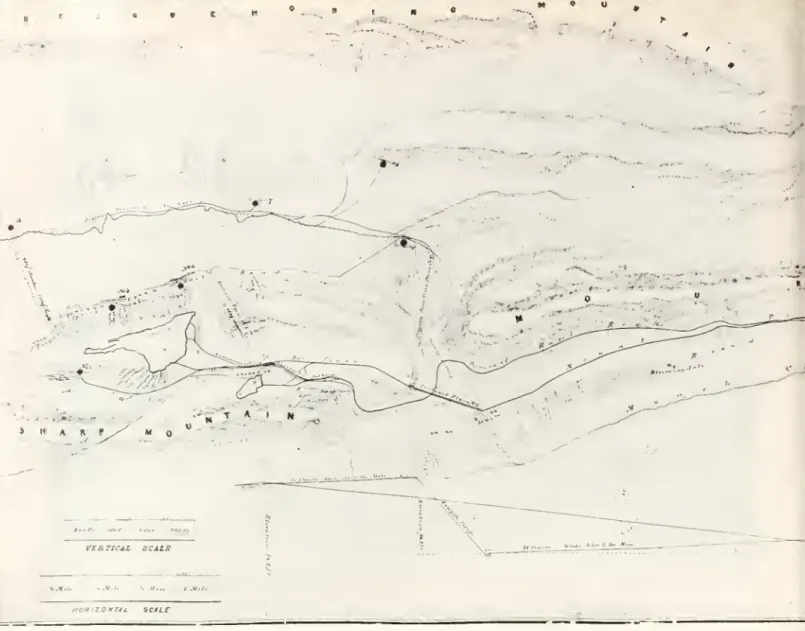
104 tULLETIN
252:CONTRIBUTIONS FROM THE MUSEUM OF HISTORY AND TECHNOLOGY
M A
IPin t'lio
MAirCIT cm N K COAL RKGIOX.
_ii_'' =.
--,--^^„,
,,''''•'>W»'»<VV'<H,»«*i..jiiKfV*'l^|.--ii,,«^^
Summit of Mauch ch.. i.k >inunta.n *V'<-. ...'.^SjiiAiE!^-,.ii»i^
c .. .. dc J- ' r.. . u.. .. D.p A"f [ *- " -
I "
I,--n^f :;.'•-Jvttvdi^•"•J•'ll>^-"'••"'"''•!'
i..A.'«wDv,V.'^ w'^ul1(4 Siiuii^utn^ DtpJ^ /'.eaiftJ^fi^tlhLl^iatlJipi''
f- ^^ ' ^i
'/ gytywtOuilltr^fiiunta*It '
II yi:i"*/jrih I/I r tlf . taryf ri>cb^./t \
f />t.i.* furtli*ttrk^n renljj./(.. I /' ddrkriritifront N-ta^nu) 3.1.
j ^ ff**mrfrn will Hi.
jf4^ttn/ni (frioJJ,yrf:/ion',o//A^ifwttt/a/ttftl.^/leirrMlOoa/' Uinr
Figure 11.
—
The Mauch Chunk
coalregion.The
"Hacklebeinie"tunnelisshownintheupperright. (Benjamin SilHman, TheAmerican Journalnf ScienceandArts. 1831. vol. 19, no. 1, pi. 1.)cubic yards of hard conglomerate at a unit cost of
$7.16per cubic yard.
The
followingcostswere charged totheoperation:-^
Labor—
23,1 293/i days$18,697.09
Tools
and
materials 3.785. 86Powder—
521 kegs 1.831.00Candles
and
oilforlights 812. 71Lumber,
including pipes for air 508.54One
horseblowingwind
for268 days__ 196.80Superintendence 980.00
Total $26, 812.00
^I. Daniel Rupp,HistoryofNorthampton,Lehigh,Mon-
roe, Carbon, and Schuylkill Counties (Harrisburg: Hickock andCantine, 1845),pp.202-203.
The
working dayatthe minesbegan at sunriseand
endedat4:30 p.m.Accordingtoa newsitemthatwas
given \vide circulation by the press, the a\-eragenum-
ber of tons of coal quarried each woking day totaled 268. This quantity of coal was loaded at the mines, transported onthe railroad,unloadedfromthe
wagons
at the chute,
and
loaded into boats.The news
item ended"we
not only load the vessels, but create the freight,and
also build the vessels tocany
it allon thesame
day"!^^
During
1830, a depositofcoalwasdiscoveredon
the northside ofMount
Pisgah nearRhumc (Room) Run,
(Nesquehoning) only 4 miles from the Lehigh River.°'Hazard's Register of Pennsylvania (vol. 5, no. 24, June
12, 1830),p.384.
PAPER
72:ANTHRACITE
INTHE LEHIGH VALLEY 105
Afmn-h (/lunl.:3 month.12,1831.
PROPOSAlvS.
"IT/'ILL be received ai the office of the Lehigh
" ' Coaland Navigation (^otnpany,(at thisplace) onor before the 25lhinst. forperformingthe follow- ingwork,viz.
Fofquarryina-coalat Iheorcat mine.
Do
havlivrrdotosummit.Do
Iniildin^boxboats.Do
rifrffincrdo do complete.Do
inakinn'scoops,oarpins, cabivs,i^-c.Do
haxdivrroil!rafts oflumber a.i dpiVins-Do
supplyingrailroadviaffonsforcoal.Do
do do do 'for dirt.Do
transporting coalfro7n AiaxichChunk
to South EustoncfC.inthe Cvmpanifsbu.rboats.i None need apply but tliose
who
can satisfy the i.VrtingManagerthattheyareableandwilling to ful-jfiltheircontracts themselves,andnotbysub-contrac-
lors.
All partirular.= will be
made
Jinownrelating tothe works,by applying to the(Jiimp;iny's Aneni at the mines, ortothe Actij,gManageriitMauch
Chunlc.JOS',AH WHITE,
Actinn-Manag-er.March15, l?;.^!. it.
N. B. Printed blanks for proposals will be furn- ishedat t>.pCompany'soffic-
Figure 12.
—
.Advertisement requesting bids,
March
28, 1831. (Mauch ChunkCourier.)Figure 13.
—
Descending coal and mule wagons.
The
artisthas added two mules to the usual complementof four per wagon. (T. L.
Mumford,
The Switzerland of .America. 1883, p. 15.)Benjamin
Silliman, reportingon the qualityand
quan-tityofthe coalatthis
new
deposit, statedthat "the coal appearstobeofthefinestquality,and some
ofit,inthe highlustreand
perfection ofits fracture, exceeds any- thing Ihaveelsewhereseen."He
estimated that"when
all thebeds are perforated therecan be no doubt that theentirethicknesswillexceed two
hundred
feet,which
is about three times that of the great
mine
atMauch Chunk."
^=The managers
immediately started plans to locatea railroadfromthisnew
deposittothelandingatMauch Chunk. The
road, completed in 1833, included three inclined planesand
the entireroadfrom
themine
\vas descending.'"The
designof the self-acting planeswas
such that the descending loadedwagons
returned theempty
onestothetopofthe plane.During
1831, thecompany began
to negotiate con- tracts for the miningand
transporting of coal to the^Benjamin
Sillim.w, "Notes on a Journey fromNew
Haven,Connecticutto
Mauch
Chunk,Pennsylvania" {Ameri- can JournalofScience and .irts,vol. 19, no. 1:New
Haven:H.Howe, 1830),p. 18.
"L.C.N.C, AnnualRepori .r 1833 (Philadelphia: James Kay, 1834),p.9.
landing at
Mauch Chunk.
Advertisements appeared requesting that proposals be submitted tothecompany
to perform other needed services, such as sorting the coal before loading, loadinginto wagons,
and
loading theboatsatMauch Chunk.
'^'The
location of coal deposits near the surface per- mitted themine
operators to holddown
labor costs.Quarry
operations permitted the use ofcommon
laborers at a
wage
rate lower than that paid to theunderground
miners required in the Schuylkill field.The wage
differential during this period rangedfrom
a low of approximately 18 cents per day in 1831. to a high of 33 cents per day in 1845. Calculations using this labor differential on a per ton basis revealed that a reduction offrom
10 to 25 cents per ton could be effected by employingcommon
labor..\n inventory, conducted by the acting manager, of
equipment
at thecompany
mines in 1831 contained thefollowing i